
In vivo evaluation of synthetic cannabinoid JWH-018 derivatives as potential new psychoactive substances
Abstract
Supplementary Information:
The online version contains supplementary material available at 10.1038/s41598-026-51639-z.
Article type: Research Article
Keywords: Drug discovery, Medical research, Neuroscience
Affiliations: https://ror.org/04fxknd68grid.253755.30000 0000 9370 7312College of Pharmacy, Daegu Catholic University, Gyeongsan, Gyeongbuk 38430 Republic of Korea
License: © The Author(s) 2026 CC BY 4.0 Open Access This article is licensed under a Creative Commons Attribution 4.0 International License, which permits use, sharing, adaptation, distribution and reproduction in any medium or format, as long as you give appropriate credit to the original author(s) and the source, provide a link to the Creative Commons licence, and indicate if changes were made. The images or other third party material in this article are included in the article’s Creative Commons licence, unless indicated otherwise in a credit line to the material. If material is not included in the article’s Creative Commons licence and your intended use is not permitted by statutory regulation or exceeds the permitted use, you will need to obtain permission directly from the copyright holder. To view a copy of this licence, visit http://creativecommons.org/licenses/by/4.0/.
Article links: DOI: 10.1038/s41598-026-51639-z | PubMed: 42115297 | PMC: PMC13350963
Relevance: Moderate: mentioned 3+ times in text
Full text: PDF (1.5 MB)
Introduction
New psychoactive substances (NPS) represent a major and continuously evolving public health challenge worldwide1. Their rapid structural diversification, ease of dissemination, and frequent circumvention of existing legal controls have resulted in significant societal harm, including outbreaks of acute intoxication, unpredictable toxicological effects, and an increasing burden on emergency medical and forensic systems2,3. Among NPS, synthetic cannabinoid receptor agonists (SCRAs)—often marketed as “synthetic marijuana” under brand names such as K2 or Spice—have emerged as one of the most problematic classes, owing to their exceptionally high potency, inconsistent chemical composition, and limited detectability in routine drug screening4–6. Notably, the overall risk posed by NPS continues to escalate as newly designed analogues and formulations are introduced, enabling persistent evasion of regulatory frameworks and further complicating surveillance and enforcement efforts2,7,8.
Within this broader context, the emergence of JWH-018 (1) and related naphthoylindole-based derivatives represents an early and influential example of how SCRAs rapidly disrupted both public health and regulatory systems. These compounds were widely incorporated into commercial “K2/Spice” products, driving extensive recreational use while simultaneously generating substantial uncertainty regarding their legal status and toxicological risk profiles4,6,9. Collectively, these outcomes indicate that JWH-018-type SCRAs were not merely early members of the class, but catalysts for a persistent pattern of harm across subsequent generations of synthetic cannabinoids2,4,6.
Notably, this phenomenon has not been limited to Western countries. In South Korea, recent forensic and analytical evidence indicates a sustained increase in the detection of new NPS, including synthetic cannabinoids and their structural analogues. National forensic data show that both the number and structural diversity of newly identified psychoactive substances have risen steadily in recent years, with synthetic cannabinoids accounting for a substantial proportion of compounds detected in seized materials and biological specimens10. These findings further indicate that many of the detected substances are newly designed analogues intended to evade existing scheduling controls, reflecting a regulatory “cat-and-mouse” dynamic similar to that observed internationally. As a result, despite historically low levels of illicit drug use, the rapid emergence and diversification of NPS now represent a growing challenge for public health, law enforcement, and forensic systems in South Korea.
Taken together, these observations show that, although first-generation synthetic cannabinoids such as JWH-018 (1) may decline after legal control, the broader threat persists through continued structural modification and market adaptation11,12. To help address this ongoing public-health concern, the present study focuses on the synthesis and in vivo evaluation of JWH-018 (1) derivatives with the potential to function as new psychoactive substances, providing pharmacological and toxicological insight relevant to early risk assessment and regulatory consideration12,13.
For JWH-018 (1), hydroxylation on the aromatic indole ring has been identified as a major metabolic pathway, and several of these hydroxylated metabolites have been reported to retain significant pharmacological activity. In particular, metabolites bearing a hydroxyl group at the 5- or 6-position of the indole moiety have been shown to exhibit substantial cannabinoid receptor activity, highlighting their potential relevance to the in vivo effects of JWH-018 (1) (Fig. 1)13,14. Motivated by these observations, we focused on these metabolically relevant positions and synthesized compounds 4 and 5, bearing methoxy substituents at the 6- and 5-positions, respectively.
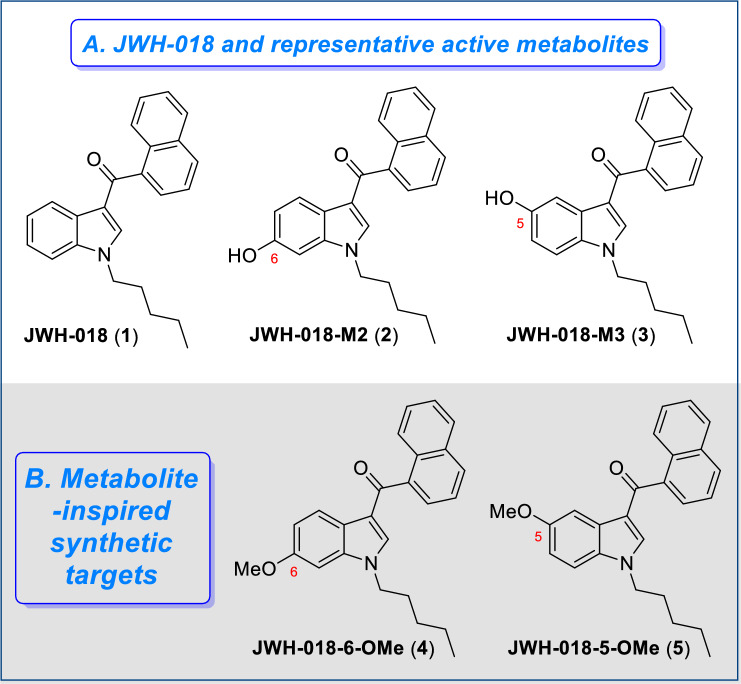
Given the structural relevance of these positions, it is essential to determine how such modifications influence the overall pharmacological impact in vivo. To this end, we evaluated the pharmacological profiles of these metabolite-inspired derivatives using the cannabinoid tetrad assay. This well-established behavioral model that assesses four key parameters- catalepsy, hypothermia, antinociception, and suppressed locomotor activity- and is widely used to characterize the behavioral effects of CB1 receptor agonists in rodents15–17. By assessing these four distinct parameters, we aimed to provide a comprehensive physiological and behavioral evaluation, enabling a systematic comparison between these novel analogues and established cannabinoids like JWH-018 (1). This approach is instrumental for the preliminary risk assessment of emerging SCRAs, as it correlates specific structural modifications with their subsequent biological outcomes. Through this comparative analysis, we aimed to determine whether metabolite-inspired modifications of the indole ring give rise to compounds with potent in vivo activity, thereby providing critical insights into the risk profiles of potential NPS.
Results
Synthesis of JWH-018–6-OMe (4) and JWH-018–5-OMe (5)
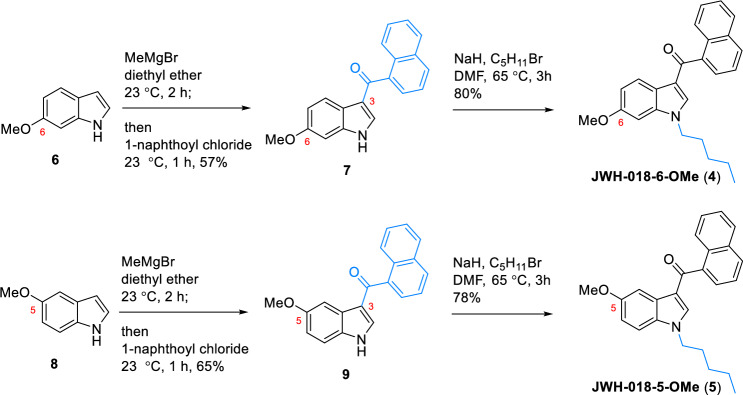
The synthetic routes to JWH-018–6-OMe (4) and JWH-018–5-OMe (5) are outlined in Fig. 2. Acylation of the corresponding methoxy-substituted indoles 6 and 8 with 1-naphthoyl chloride afforded the ketone intermediates 7 and 9 in 57% and 65% yield, respectively. To gain insight into the mechanistic features of the C-3 acylation of indoles, a widely accepted mechanism suggests abstraction of N–H proton by highly basic Grignard reagent to generate the corresponding indolyl Grignard intermediate. This Grignard intermediate subsequently enhances the nucleophilicity of the already nucleophilic C-3 carbon, which in turn reacts with the 1-naphthoyl chloride to yield the corresponding 3-acylated indole derivative18,19. Subsequent N-alkylation of intermediates 7 and 9 was achieved using NaH and 1-bromopentane in DMF, providing the target compounds JWH-018–6-OMe (4) and JWH-018–5-OMe (5) in 80% and 78% yield, respectively18. This straightforward two-step sequence enabled efficient access to both methoxy-substituted JWH-018 (1) derivatives for further biological evaluation.
In vivo evaluation of JWH-018–5-OMe (5)
The pharmacological profile of JWH-018–5-OMe (5) was evaluated using the cannabinoid tetrad assay—comprising catalepsy, hypothermia, analgesia, and locomotor activity—to determine its potential psychoactive effects relative to the established synthetic cannabinoid JWH-018 (1, Fig. 3A–D). The assessment time points (15, 30, 45, and 60 min post-injection) were specifically timed to coincide with the peak brain concentrations (Cmax) and maximal behavioral effects typically observed within one hour for indole-derived cannabinoids20.
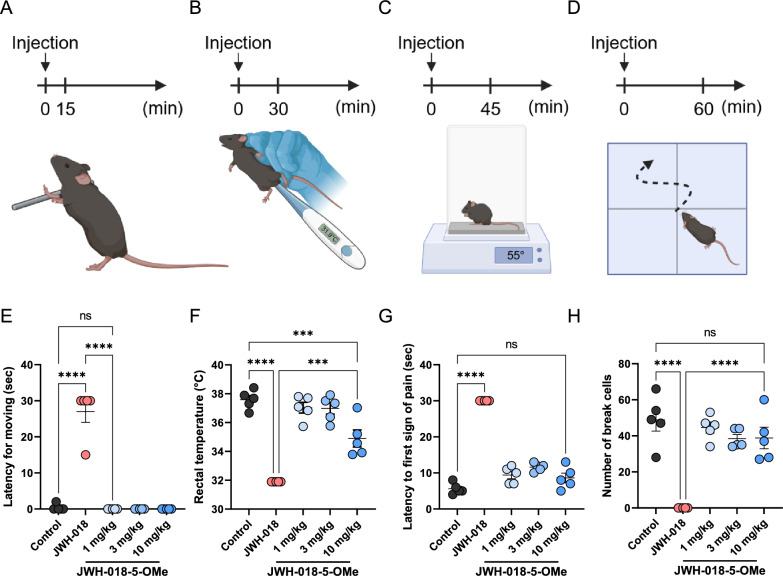
In the bar test for catalepsy and the hot plate test for antinociceptive activity, the positive control JWH-018 (1) exhibited profound cataleptic and analgesic responses compared to the vehicle control group (Fig. 3E,G). In contrast, JWH-018–5-OMe (5) did not show any significant cataleptic or analgesic responses across all tested doses (Fig. 3E,G). Similarly, JWH-018–5-OMe (5) did not significantly alter spontaneous locomotor activity, with the number of grid crossings remaining comparable to the control group (Fig. 3H). However, it is particularly interesting to note that despite the absence of these classical behavioral markers, JWH-018–5-OMe (5) induced a significant and selective reduction in rectal temperature, especially at the 10 mg/kg dose (p < 0.001) (Fig. 3F). This distinct divergence from the typical cannabinoid tetrad profile suggests a unique pharmacological interaction of the 5-methoxy derivative.
In vivo evaluation of JWH-018–6-OMe (4)
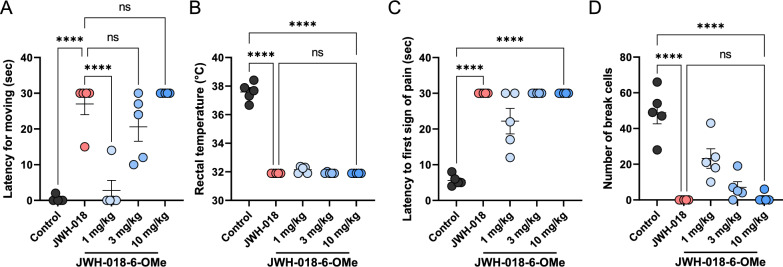
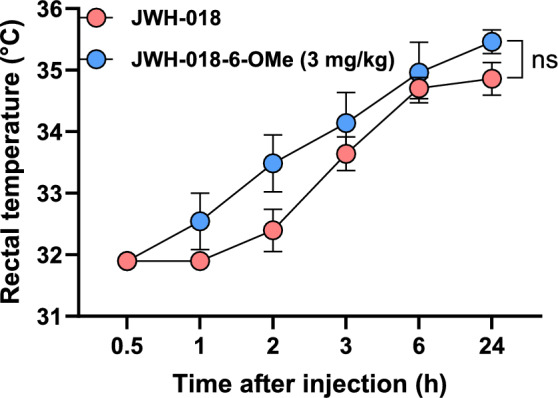
In striking contrast to the 5-methoxy derivative, JWH-018–6-OMe (4) exhibited a potent pharmacological profile that was almost identical to that of the positive control, JWH-018 (1). Administration of JWH-018–6-OMe (4) resulted in a robust, dose-dependent increase in the latency for moving during the bar test, with the 10 mg/kg dose inducing cataleptic effects that were statistically indistinguishable from those of JWH-018 (1, Fig. 4A). Furthermore, all tested doses of JWH-018–6-OMe (4) triggered a rapid and profound drop in rectal temperature, reaching approximately 32 °C, which mirrors the severe hypothermia observed in the JWH-018 (1) group (Fig. 4B). The compound also demonstrated significant antinociceptive activity; mice treated with 3 and 10 mg/kg doses reached the maximum cut-off time (30 s) in the hot plate test, reflecting a complete suppression of thermal pain response identical to the effects of the scheduled drug (Fig. 4C). Additionally, spontaneous locomotor activity was markedly reduced in a dose-dependent manner, confirming the potent immobilizing and sedative properties of this derivative (Fig. 4D). Notably, time-course analysis revealed that the recovery trajectory of rectal temperature for JWH-018–6-OMe (4, 3 mg/kg) closely followed that of JWH-018 (1), with a gradual return toward baseline over a 24-h period, further highlighting their pharmacological equivalence (Fig. 5). Taken together, these results provide definitive evidence that JWH-018–6-OMe (4) possesses a cannabinoid-like behavioral similarity comparable to that of JWH-018 (1), fulfilling all the classical behavioral hallmarks of potent cannabinoid agonists.
Discussion
The results of this study provide critical insights into the structure–activity relationship (SAR) of JWH-018 (1) derivatives, demonstrating that the specific position of methoxy substitution on the indole scaffold is a primary determinant of their in vivo pharmacological potency. Notably, JWH-018–6-OMe (4) exhibited a comprehensive “tetrad” profile that closely mirrors the effects of the parent compound, JWH-018 (1), whereas JWH-018–5-OMe (5) failed to elicit a tetrad response substantially comparable to that of JWH-018 (1).
In the catalepsy assessment, the robust immobility induced by JWH-018–6-OMe (4) suggests potent central nervous system (CNS) depression mediated by the activation of CB₁ receptors within the basal ganglia21. This effect is consistent with established pharmacological models where CB₁ agonists modulate dopaminergic and GABAergic neurotransmission in the striatum to inhibit motor execution21–24. Interestingly, while JWH-018–5-OMe (5) failed to induce significant catalepsy, it did maintain a significant hypothermic effect. This selective reduction in rectal temperature indicates that both derivatives preserve the typical synthetic cannabinoid profile regarding thermoregulation, likely through CB₁ receptor-mediated actions in the preoptic area of the hypothalamus25–29. The fact that the 5-OMe derivative retains its hypothermic action despite losing other tetrad effects suggests that thermoregulatory circuits may be more sensitive to structural variations or represent a distinct signaling efficiency compared to other behavioral endpoints30.
The antinociceptive potential of these compounds, evaluated through the hot plate test, further reinforces the position-dependent activity of the methoxy group. JWH-018–6-OMe (4) produced a significant increase in pain latency, indicating that CB₁ receptor activation in the periaqueductal gray (PAG) and spinal cord—key regions for modulating supraspinal and spinal pain pathways—remains highly effective31–34. This potent analgesia, coupled with the marked hypolocomotion observed in the open-field test, confirms that the 6-OMe substitution preserves the high-potency psychotropic profile characteristic of synthetic cannabinoids17. The observed decrease in spontaneous locomotor activity is a hallmark of CB₁-mediated CNS inhibition, a phenomenon that has been shown to be entirely absent in CB₁-knockout models17,35.
In this study, female mice were exclusively used to evaluate the pharmacological potential of JWH-018 derivatives, as females have been reported to exhibit higher sensitivity to the behavioral effects of cannabinoids, often attributed to higher levels of active metabolites compared to males. While we did not monitor the estrous cycle in this study, prior research suggests that the acute and robust pharmacological responses in the cannabinoid tetrad assay are primarily driven by dosage and the route of administration, rather than subtle hormonal fluctuations associated with the estrous cycle36. Nevertheless, future studies incorporating both sexes and considering hormonal status will be beneficial to further elucidate the sex-dependent pharmacokinetics of these novel analogues.
In conclusion, JWH-018–6-OMe (4) exhibits a psychoactive profile closely resembling that of JWH-018 (1), suggesting that it may be classified as a potential NPS. Given its comparable in vivo behavioral effects, this compound warrants early surveillance and proactive regulatory consideration, demonstrating that structural variations on the indole scaffold can produce measurable psychoactive effects.
Materials and methods
Chemical synthesis
General information
All reactions were performed in oven-dried round-bottom flasks fitted with rubber septa and were conducted under positive nitrogen pressure, unless noted otherwise. Gas-tight syringes with stainless steel needles were used to transfer all liquids. Flash column chromatography was performed as described by Still et al.37 using granular silica gel 60 (Merck 0.040–0.063 mm). Analytical thin layer chromatography (TLC) was performed using glass plates pre-coated with 0.25 mm 230–400 mesh silica gel impregnated with a fluorescent indicator (254 nm). TLC plates were visualized by exposure to short wave ultraviolet light (254 nm) and irreversibly stained by treatment with an aqueous solution of ceric ammonium molybdate (CAM) (~ 1 min) on a hot plate. Organic solutions were concentrated at 40 °C on rotary evaporators capable of achieving a minimum pressure of ~ 10 Torr.
Materials
Commercial reagents and solvents were used as received with the following exceptions: diethyl ether and N,N-dimethylformamide were purchased from Samchun chemicals and TCI South Korea respectively and were stored over pre-activated 4 Å molecular sieves and were used under positive nitrogen pressure. Deuterated solvents used for nuclear magnetic resonance (NMR) spectroscopy were purchased from Cambridge Isotope Laboratories, Inc. and were used as received. 5-methoxy indole was purchased from Fluka, 1-bromopentane and 1-naphthoyl chloride were purchased from Alfa Aesar, whereas 6-methoxy indole and NaH (60% in mineral oil) were purchased from TCI chemicals South Korea.
Instrumentation
Proton nuclear magnetic resonance (1H NMR) spectra were recorded with a Bruker AVANCE NEO 600 spectrometer. Spectra were processed with Bruker Topspin 4.5.0 using the automatic phasing and baseline correction for data up to 6D. Chemical shifts are recorded in parts per million on the δ scale and are referenced from the residual protium in the NMR solvent (CHCl3: δ 7.26). Data are reported as follows: chemical shift [multiplicity (s = singlet, d = doublet, t = triplet, q = quartet, m = multiplet, br = broad), coupling constant(s) in Hertz, integration, assignment]. Apparent multiplets that correspond to two distinct signals in proximity are annotated as “app”. Carbon-13 nuclear magnetic resonance (13C NMR) spectra were recorded with a Bruker AVANCE NEO 600 spectrometer and are recorded in parts per million on the δ scale and are referenced from the carbon resonances of the solvent (CDCl3: δ 77.16). Data are reported as follows: chemical shift (assignment). High-resolution mass spectra (HRMS) were recorded on a JEOL JMS-700 mass spectrometer equipped with a magnetic sector analyzer, using electron ionization (EI) mode. The purity of all synthesized compounds was confirmed to be ≥ 95% using a Waters 2695 HPLC system (Waters Corporation, Milford, MA, USA) equipped with a Waters 2487 Dual λ Absorbance detector. For chromatographic separation, an Agilent Eclipse Plus C18 column (250 × 4.6 mm) was utilized at a column temperature of 30 ℃. The mobile phases consisted of water containing 0.1% TFA (v/v) (phase A) and acetonitrile (phase B), with a flow rate set at 1.0 mL/min. The gradient elution program was as follows: 0 min A: 30%, B: 70%; 30 min A: 10%, B: 90%; 36 min A: 10%, B: 90%; 37 min A: 30%, B: 70%; 45 min A: 30%, B: 70%.
Compounds 1, 4, 5, 7 and 9 were synthesized according to literature procedure described by Makriyannis et al.38.
Compound 1
Compound 1 was synthesized according to a literature procedure38.
Rf = 0.7 (30% EtOAc in hexanes); 1H NMR (600 MHz, CDCl3) δ (ppm) 8.49–8.48 (m, 1H, ArH), 8.19 (d, J = 8.39 Hz, 1H, ArH), 7.97 (d, J = 8.25 Hz, 1H, ArH), 7.91 (d, J = 8.07 Hz, 1H, ArH), 7.66 (dd, J = 6.90, 0.86 Hz, 1H, ArH), 7.54–7.50 (m, 2H, ArH), 7.48–7.46 (m, 1H, ArH), 7.41–7.35 (m, 4H, ArH), 4.07 (t, J = 7.44 Hz, 2H, -NCH2-), 1.81 (quint, J = 7.51 Hz, 2H, -NCH2CH2CH2-), 1.34–1.23 (m, 4H, -CH2CH2CH3), 0.85 (t, J = 6.93 Hz, 3H, -CH2CH3) ppm; 13C NMR (150.9 MHz, CDCl3, 25 °C): δ 192.03 (-C = O), 139.16 (Ar), 138.02 (Ar), 137.09 (Ar), 133.79 (Ar), 130.85 (Ar), 130.00 (Ar), 128.23 (Ar), 127.06 (Ar), 126.78 (Ar), 126.32 (Ar), 126.03 (Ar), 125.88 (Ar), 124.62 (Ar), 123.64 (Ar), 122.94 (Ar), 122.87 (Ar), 117.54 (Ar), 110.09 (Ar), 47.16 (-NCH2-), 29.50 (-NCH2CH2-), 28.91 (-CH2CH2CH2-), 22.20 (-CH2CH3), 13.92 (-CH2CH3) ppm. HRMS (EI) calcd for C24H23NO [M]⁺· 341.178, found 341.1779. HPLC purity: 99.52%; retention time: 13.8 min.
Compound 7
To a stirred solution of 6-methoxy indole 6 (200 mg, 1.36 mmol) in dry diethyl ether 15 mL was added MeMgBr dropwise (3 M in diethyl ether, 0.5 mL, 1.5 mmol, 1.1 equiv) at 0 °C. Then the reaction was stirred at 23 °C for 2 h followed by dropwise addition of 1-naphthoyl chloride (0.2 mL, 1.36 mmol, 1.0 equiv) dissolved in dry diethyl ether (5 mL) at 0 °C. The resulting solution was then stirred at 23 °C for additional 1 h. The reaction was then quenched with sat. NH4Cl (15 mL) and stirred for 10 min followed by addition of 20 mL H2O and extraction with EtOAc (3 × 25 mL). Combined organics were dried over MgSO4, solvent evaporated under vacuo and chromatographed to give compound 7 (233 mg, 57%) as an off white solid.
Rf = 0.5 (30% EtOAc in hexanes); 1H NMR (600 MHz, CDCl3, 25 °C) δ 8.56 (br. s, 1H, NH), 8.37 (d, J = 8.77 Hz, 1H, ArH), 8.17 (d, J = 8.31 Hz, 1H, ArH), 7.95 (d, J = 8.23 Hz, 1H, ArH), 7.89 (d, J = 7.98 Hz, 1H, ArH), 7.64 (dd, J = 6.92, 0.83 Hz, 1H, ArH), 7.50 (t, J = 7.07 Hz, 2H, ArH), 7.46 (td, J = 8.49, 1.35 Hz, 1H, ArH), 7.30 (d, J = 2.98 Hz, 1H, ArH), 7.01 (dd, J = 8.71, 2.25 Hz, 1H, ArH), 6.90 (d, J = 2.96 Hz, 1H, ArH), 3.89 (s, 3H, -OCH3) ppm; 13C NMR (150.9 MHz, CDCl3, 25 °C): δ 193.00 (-C = O), 156.79 (Ar), 138.92 (Ar), 135.42 (Ar), 133.84 (Ar), 131.43 (Ar), 130.84 (Ar), 130.17 (Ar), 128.32 (Ar), 126.94 (Ar), 126.45 (Ar), 125.97 (Ar), 124.64 (Ar), 119.00 (Ar), 114.80 (Ar), 112.45 (Ar), 103.77 (Ar), 55.94 (-OCH3) ppm. HRMS (EI) calcd for C20H15NO2 [M]⁺· 301.1103, found 301.1100.
Compound 9
To a stirred solution of 5-methoxy indole 8 (200 mg, 1.36 mmol) in dry diethyl ether 15 mL was added MeMgBr dropwise (3 M in diethyl ether, 0.5 mL, 1.5 mmol, 1.1 equiv) at 0 °C. Then the reaction was stirred at 23 °C for 2 h followed by dropwise addition of 1-naphthoyl chloride (0.2 mL, 1.36 mmol, 1.0 equiv) dissolved in dry diethyl ether (5 mL) at 0 °C. The resulting solution was then stirred at 23 °C for additional 1 h. The reaction was then quenched with sat. NH4Cl (15 mL) and stirred for 10 min followed by addition of 20 mL H2O and extraction with EtOAc (3 × 25 mL). Combined organics were dried over MgSO4, solvent evaporated under vacuo and chromatographed to give compound 9 (225 mg, 65%) as an off pale-yellow solid.
Rf = 0.6 (30% EtOAc in hexanes); 1H NMR (600 MHz, CDCl3) δ 8.66 (br. s, 1H, NH), 8.17 (d, J = 8.40 Hz, 1H, ArH), 8.02 (s, 1H, ArH), 7.95 (d, J = 8.24 Hz, 1H, ArH), 7.89 (d, J = 8.14 Hz, 1H, ArH), 7.64 (d, J = 6.86 Hz, 1H, ArH), 7.50 (t, J = 8.14 Hz, 2H, ArH), 7.46 (t, J = 7.33 Hz, 1H, ArH), 7.34 (d, J = 2.92 Hz, 1H, ArH), 7.31 (d, J = 8.77 Hz, 1H, ArH), 6.98 (dd, J = 8.81, 2.15 Hz, 1H, ArH), 3.92 (s, 3H, -OCH3) ppm; 13C NMR (150.9 MHz, CDCl3, 25 °C): δ 192.76 (-C = O), 157.78 (Ar), 138.85 (Ar), 137.60 (Ar), 134.24 (Ar), 133.85 (Ar), 130.89 (Ar), 130.23 (Ar), 128.31 (Ar), 126.95 (Ar), 126.43 (Ar), 126.07 (Ar), 126.02 (Ar), 124.60 (Ar), 123.45 (Ar), 120.20 (Ar), 119.38 (Ar), 112.50 (Ar), 95.17 (Ar), 55.82 (-OCH3) ppm. HRMS (EI) calcd for C20H15NO2 [M]⁺· 301.1103, found 301.1101.
Compound 4
To a solution of NaH (52 mg, 1.30 mmol, 3.0 equiv, 60% in mineral oil) in dry DMF 5 mL, was added compound 7 (130 mg, 0.432 mmol) and the resulting solution was stirred at rt for 30 min. Then, 1-bromopentane (80 µL, 0.65 mmol, 1.5 equiv) was added and the resulting solution was stirred at 65 °C for 3 h. The reaction was then quenched with sat. NH4Cl (10 mL) and stirred for 20 min and extracted with EtOAc (3 × 20 mL). Combined organics were dried over MgSO4, solvent evaporated under vacuo and chromatographed to give compound 4 (128 mg, 80%) as a colourless waxy solid.
Rf = 0.4 (20% EtOAc in hexanes); 1H NMR (600 MHz, CDCl3) δ (ppm) 8.37 (d, J = 8.78 Hz, 1H, ArH), 8.19 (d, J = 8.42 Hz, 1H, ArH), 7.96 (d, J = 8.27 Hz, 1H, ArH), 7.91 (d, J = 8.1 Hz, 1H, ArH), 7.65 (d, J = 6.54 Hz, 1H, ArH), 7.53 (d, J = 7.13 Hz, 1H, ArH), 7.51 (d, J = 6.26 Hz, 1H, ArH), 7.47 (t, J = 6.98 Hz, 1H, ArH), 7.24 (s, 1H, ArH), 7.01 (dd, J = 8.71, 2.17 Hz, 1H, ArH), 6.83 (d, J = 2.09 Hz, 1H, ArH), 4.00 (t, J = 7.23 Hz, 2H, -NCH2-), 3.91 (s, 3H, -OCH3), 1.79 (quint, J = 7.26 Hz, 2H, -CH2CH2CH2-), 1.33–1.23 (m, 4H, -CH2CH2CH3), 0.86 (t, J = 6.89 Hz, 3H, -CH2CH3) ppm; 13C NMR (150.9 MHz, CDCl3, 25 °C): δ 192.02 (-C = O), 157.47 (Ar), 139.17 (Ar), 138.08 (Ar), 137.43 (Ar), 133.83 (Ar), 130.93 (Ar), 130.01 (Ar), 128.24 (Ar), 126.81 (Ar), 126.36 (Ar), 126.12 (Ar), 125.92 (Ar), 124.62 (Ar), 123.71 (Ar), 121.21 (Ar), 117.70 (Ar), 111.82 (Ar), 94.17 (Ar), 55.89 (-OCH3), 47.16 (-NCH2-), 29.39 (-NCH2CH2-), 28.98 (-CH2CH2CH2-), 22.27 (-CH2CH3), 13.97 (-CH2CH3) ppm. HRMS (EI) calcd for C25H25NO2 [M]⁺· 371.1885, found 371.1885. HPLC purity: 96.88%; retention time: 12.8 min.
Compound 5
To a solution of NaH (50 mg, 1.25 mmol, 60% in mineral oil) in dry DMF 4 mL, was added compound 9 (125 mg, 0.415 mmol) and the resulting solution was stirred at rt for 30 min. Then, 1-bromopentane (78 µL, 0.63 mmol, 1.5 equiv) was added and the resulting solution was stirred at 65 °C for 3 h. The reaction was then quenched with sat. NH4Cl (10 mL) and stirred for 20 min and extracted with EtOAc (3 × 20 mL). Combined organics were dried over MgSO4, solvent evaporated under vacuo and chromatographed to give compound 5 (123 mg, 78%) as a colourless waxy solid.
Rf = 0.35 (20% EtOAc in hexanes); 1H NMR (600 MHz, CDCl3) δ (ppm) 8.19 (d, J = 8.48 Hz, 1H, ArH), 8.02 (d, J = 2.46 Hz, 1H, ArH), 7.97 (d, J = 8.24 Hz, 1H, ArH), 7.91 (d, J = 8.02 Hz, 1H, ArH), 7.65 (dd, J = 6.93, 1.07 Hz, 1H, ArH), 7.54–7.50 (m, 2H, ArH), 7.48–7.46 (m, 1H, ArH), 7.27 (d, J = 8.08 Hz, 1H, ArH), 6.99 (dd, J = 8.82, 2.48 Hz, 1H, ArH), 4.02 (t, J = 7.33 Hz, 2H, -NCH2-), 3.93 (s, 3H, -OCH3), 1.79 (quint, J = 7.42 Hz, 2H, -CH2CH2CH2-), 1.32–1.21 (m, 4H, -CH2CH2CH3), 0.8 (t, J = 7.07 Hz, 3H, -CH2CH3) ppm; 13C NMR (150.9 MHz, CDCl3, 25 °C): δ 192.08 (C = O), 156.76 (Ar), 139.26 (Ar), 138.00 (Ar), 133.81 (Ar), 132.00 (Ar), 130.88 (Ar), 129.94 (Ar), 128.24 (Ar), 127.91 (Ar), 126.78 (Ar), 126.35 (Ar), 126.09 (Ar), 125.83 (Ar), 124.65 (Ar), 117.23 (Ar), 114.23 (Ar), 110.95 (Ar), 104.04 (Ar), 55.91 (-OCH3), 47.41 (-NCH2-), 29.58 (-NCH2CH2-), 28.94 (-CH2CH2CH2-), 22.22 (-CH2CH3), 13.94 (-CH2CH3) ppm. HRMS (EI) calcd for C25H25NO2 [M]⁺· 371.1885, found 371.1884. HPLC purity: 99.69%; retention time: 13.1 min.
Animals
Four-week-old female C57BL/6 mice were purchased from Hyochang Science, Korea. All mice were housed under controlled environmental conditions with a 12-h light/dark cycle, a temperature of 22 ± 2 °C, and a humidity of 50 ± 10%. The animals were provided with ad libitum access to a standard laboratory diet and sterilized water. All animal experiments and procedures were performed in accordance with the Guide for the Care and Use of Laboratory Animals (8th edition, National Research Council, 2011). The study protocol was approved by the Institutional Animal Care and Use Committee (IACUC) of Daegu Catholic University (approval number: CUD-2025-043).
Drug preparation and administration
JWH-018 (1) and its methoxy derivatives (4 and 5) were dissolved in a vehicle composed of 5% ethanol, 5% Tween 80, and 90% phosphate-buffered saline (PBS). Stock solutions were initially prepared at a concentration of 10 mg/kg based on the average body weight of the mice. Subsequent doses of 1 mg/kg and 3 mg/kg were obtained by serial dilution with the same vehicle. The dose range (1–10 mg/kg) was determined based on literature precedent, as JWH-018 (1) has been reported to induce significant, dose-dependent cannabinoid-like effects in the mouse tetrad assay starting at 3 mg/kg (i.p.). Preliminary pilot studies in our laboratory further confirmed that 3 mg/kg of JWH-018 (1) serves as a reliable benchmark for inducing measurable behavioral responses across all tetrad parameters. All compounds and the vehicle control were administered via intraperitoneal (i.p.) injection in a fixed volume of 200 µL per mouse.
Catalepsy assessment
Catalepsy was assessed 15 min after injection using the bar test. The mouse’s forepaws were placed on a horizontal bar positioned at a height of 4 cm from the floor. The duration for which the mouse maintained this imposed posture was recorded. The test ended when the mouse removed its paws from the bar or after a maximum cut-off time of 30 s.
Hypothermia assessment
Rectal temperature was measured 30 min post-injection to assess hypothermia. A calibrated digital rectal thermometer was gently inserted into the rectum to a depth of approximately 2 cm. The stable temperature reading was recorded.
Analgesia assessment
Antinociceptive activity (analgesia) was evaluated 45 min after injection using the hot plate test. The mouse was placed on a hot plate maintained at a constant temperature of 55 °C. The latency to exhibit nociceptive responses, such as hind paw licking, shaking, or jumping, was measured. A cut-off time of 30 s was applied to prevent tissue damage.
Immobility (locomotor activity) assessment
Spontaneous locomotor activity was assessed 60 min post-injection using an open field arena (40 × 40 × 40 cm). The floor of the arena was divided into equal square quadrants (cells). Each mouse was placed in the center of the arena, and its activity was monitored for 5 min. Locomotor activity was quantified by counting the number of cells crossed (grid crossings), defined as the mouse moving all four paws into a new cell. Additionally, the total duration of immobility (defined as the complete absence of voluntary movement except for respiration) was recorded during the test period. The arena was thoroughly cleaned with 70% ethanol between each trial to eliminate olfactory cues.
Statistical analysis
Statistical analyses were performed using GraphPad Prism 10.0. All data are presented as mean ± standard error of the mean (SEM). To determine the significance of differences between multiple experimental groups, a one-way analysis of variance (ANOVA) was conducted. Following the ANOVA, Tukey’s multiple comparison test was applied to identify specific differences between pairs of groups. For all experiments involving animal subjects, a sample size of N = 5 mice per group was utilized to ensure statistical power. A p-value of less than 0.05 (p < 0.05) was considered statistically significant.
Supplementary Materials
References
- I-M Marandiuc. New psychoactive substances: A multidisciplinary review of challenges and their diverse character. DARU J. Pharm. Sci., 2025. [DOI]
- A Peacock. New psychoactive substances: Challenges for drug surveillance, control, and public health responses. Lancet, 2019. [DOI | PubMed]
- AL Mohr. Reports of adverse events associated with use of novel psychoactive substances, 2017–2020: A review. J. Anal. Toxicol., 2022. [DOI | PubMed]
- L Fattore, W Fratta. Beyond THC: The new generation of cannabinoid designer drugs. Front. Behav. Neurosci., 2011. [DOI | PubMed]
- R Law. Notes from the field: Increase in reported adverse health effects related to synthetic cannabinoid use—United States, January–May 2015. MMWR. Morb. Mortal. Wkly. Rep., 2015. [PubMed]
- R Marshell. In vivo effects of synthetic cannabinoids JWH-018 and JWH-073 and phytocannabinoid Δ9-THC in mice: Inhalation versus intraperitoneal injection. Pharmacol. Biochem. Behav., 2014. [DOI | PubMed]
- J Neicun, A Roman-Urrestarazu, K Czabanowska. Legal responses to novel psychoactive substances implemented by ten European countries: An analysis from legal epidemiology. Emerg. Trends Drugs Addict. Health., 2022. [DOI]
- OA Lin, P-J Chuang, YJ Tseng. Comparison of controlled drugs and new psychoactive substances (NPS) regulations in East and Southeast Asia. Regul. Toxicol. Pharmacol., 2023. [DOI | PubMed]
- R Lindigkeit. Spice: A never ending story?. Forensic Sci. Int., 2009. [DOI | PubMed]
- 10.National Forensic Service. Drug Analysis White Paper 2024. (National Forensic Service, 2024).
- R Roque-Bravo. Synthetic cannabinoids: A pharmacological and toxicological overview. Annu. Rev. Pharmacol. Toxicol., 2023. [DOI | PubMed]
- A Potts, C Cano, S Thomas, S Hill. Synthetic cannabinoid receptor agonists: Classification and nomenclature. Clin. Toxicol., 2020. [DOI]
- LK Brents. Phase I hydroxylated metabolites of the K2 synthetic cannabinoid Jwh-018 retain in vitro and in vivo Cannabinoid 1 Receptor affinity and activity. PLoS One, 2011. [DOI | PubMed]
- KC Chimalakonda. Cytochrome P450-mediated oxidative metabolism of abused synthetic cannabinoids found in K2/Spice: Identification of novel cannabinoid receptor ligands. Drug Metab. Dispos., 2012. [DOI | PubMed]
- M Metna‐Laurent, M Mondésir, A Grel, M Vallée, PV Piazza. Cannabinoid‐induced tetrad in mice. Curr. Protoc. Neurosci., 2017. [DOI]
- AT El-Alfy, L Wilson, MA Elsohly, EA Abourashed. Towards a better understanding of the psychopharmacology of nutmeg: Activities in the mouse tetrad assay. J. Ethnopharmacol., 2009. [DOI | PubMed]
- XF Wang. Different receptor mechanisms underlying phytocannabinoid‐versus synthetic cannabinoid‐induced tetrad effects: Opposite roles of Cb1/Cb2 versus Gpr55 receptors. Br. J. Pharmacol., 2020. [DOI | PubMed]
- S Beuck. Structure characterisation of urinary metabolites of the cannabimimetic Jwh-018 using chemically synthesised reference material for the support of Lc-Ms/Ms-based drug testing. Anal. Bioanal. Chem., 2011. [DOI | PubMed]
- DA Rodriguez-Soacha. Development of an indole-amide-based photoswitchable cannabinoid receptor subtype 1 (Cb1r) “cis-on” agonist. ACS Chem. Neurosci., 2022. [DOI | PubMed]
- L Uttl. Behavioral and pharmacokinetic profile of indole-derived synthetic cannabinoids Jwh-073 and Jwh-210 as compared to the phytocannabinoid Δ9-Thc in rats. Front. Neurosci., 2018. [DOI | PubMed]
- T Morera-Herreras, C Miguelez, A Aristieta, JÁ Ruiz-Ortega, L Ugedo. Endocannabinoid modulation of dopaminergic motor circuits. Front. Pharmacol., 2012. [DOI | PubMed]
- C García, C Palomo-Garo, Y Gómez-Gálvez, J Fernández-Ruiz. Cannabinoid-dopamine interactions in the physiology and physiopathology of the basal ganglia. Br. J. Pharmacol., 2016. [DOI | PubMed]
- Z Sidló, PH Reggio, ME Rice. Inhibition of striatal dopamine release by CB1 receptor activation requires nonsynaptic communication involving GABA, H2O2, and KATP channels. Neurochem. Int., 2008. [DOI | PubMed]
- BK Atwood, J Huffman, A Straiker, K Mackie. JWH018, a common constituent of ‘Spice’herbal blends, is a potent and efficacious cannabinoid CB1 receptor agonist. Br. J. Pharmacol., 2010. [DOI | PubMed]
- SM Rawls, J Cabassa, EB Geller, MW Adler. CB1 receptors in the preoptic anterior hypothalamus regulate WIN 55212-2 [(4, 5-Dihydro-2-Methyl-4 (4-Morpholinylmethyl)-1-(1-Naphthalenyl-Carbonyl)-6 H-Pyrrolo [3, 2, 1ij] Quinolin-6-One]-induced hypothermia. J. Pharmacol. Exp. Ther., 2002. [DOI | PubMed]
- GC Ripamonte. Functional role for preoptic CB1 receptors in breathing and thermal control. Neurosci. Lett., 2020. [DOI | PubMed]
- S Tai. Repeated administration of phytocannabinoid Δ9-THC or synthetic cannabinoids JWH-018 and JWH-073 induces tolerance to hypothermia but not locomotor suppression in mice, and reduces CB1 receptor expression and function in a brain region-specific manner. Pharmacol. Res., 2015. [DOI | PubMed]
- PK Bonfils, J Reith, H Hasseldam, FF Johansen. Estimation of the hypothermic component in neuroprotection provided by cannabinoids following cerebral ischemia. Neurochem. Int., 2006. [DOI | PubMed]
- N Suzuki. Contribution of hypothermia and CB1 receptor activation to protective effects of TAK-937, a cannabinoid receptor agonist, in rat transient MCAO model. PLoS. One, 2012. [DOI | PubMed]
- WE Fantegrossi, JH Moran, A Radominska-Pandya, PL Prather. Distinct pharmacology and metabolism of K2 synthetic cannabinoids compared to Δ9-THC: Mechanism underlying greater toxicity?. Life Sci., 2014. [DOI | PubMed]
- A Wilson-Poe, M Morgan, S Aicher, D Hegarty. Distribution of CB1 cannabinoid receptors and their relationship with Mu-opioid receptors in the rat periaqueductal gray. Neuroscience, 2012. [DOI | PubMed]
- AR Wilson, L Maher, MM Morgan. Repeated cannabinoid injections into the rat periaqueductal gray enhance subsequent morphine antinociception. Neuropharmacology, 2008. [DOI | PubMed]
- GX Santos. The influence of the cannabinoid receptor Cb1 on the periaqueductal gray in mice treated with photobiomodulation after chronic constriction injury of the sciatic nerve: A placebo-controlled trial. Braz. J. Pain., 2020
- AG Hohmann. Spinal and peripheral mechanisms of cannabinoid antinociception: Behavioral, neurophysiological and neuroanatomical perspectives. Chem. Phys. Lipids, 2002. [DOI | PubMed]
- A Zimmer, AM Zimmer, AG Hohmann, M Herkenham, TI Bonner. Increased mortality, hypoactivity, and hypoalgesia in cannabinoid Cb1 receptor knockout mice. Proc. Natl. Acad. Sci. U. S. A., 1999. [DOI | PubMed]
- CF Moore, EM Weerts. Cannabinoid tetrad effects of oral Δ9-Tetrahydrocannabinol (Thc) and cannabidiol (Cbd) in male and female rats: Sex, dose-effects and time course evaluations. Psychopharmacology, 2022. [DOI | PubMed]
- WC Still, M Kahn, A Mitra. Rapid chromatographic technique for preparative separations with moderate resolution. J. Org. Chem., 1978. [DOI]
- 38.Makriyannis, A. Cannabimimetic Indole Derivatives. (2005).