This study aims to bring about a novel approach to the analysis of Sustainable Development Goals (SDGs) based solely on the appearance of news. Our purpose is to provide a monitoring tool that enables world news to be detected in an SDG-oriented manner, by considering multilingual as well as wide geographic coverage. The association of the goals with news basis the World Bank Group Topical Taxonomy, from which the selection of search words approximates the 17 development goals. News is extracted from The GDELT Project (Global Database of Events, Language and Tone) which gathers both printed as well as online news from around the world. 60 851 572 relevant news stories were identified in 2019. The intertwining of world news with SDGs as well as connections between countries are interpreted and highlight that even in the most SDG-sensitive countries, only 2.5% of the news can be attributed to the goals. Most of the news about sustainability appears in Africa as well as East and Southeast Asia, moreover typically the most negative tone of news can be observed in Africa. In the case of climate change (SDG 13), the United States plays a key role in both the share of news and the negative tone. Using the tools of network science, it can be verified that SDGs can be characterized on the basis of world news.
This news-centred network analysis of SDGs identifies global partnerships as well as national stages of implementation towards a sustainable socio-environmental ecosystem. In the field of sustainability, it is vital to form the attitudes and environmental awareness of people, which strategic plans cannot address but can be measured well through the news.
Affiliations: MTA-PE “Lendület” Complex Systems Monitoring Research Group, University of Pannonia, Egyetem str. 10, H-8200 Veszprém, Hungary; Institute of Advanced Studies Köszeg, Chernel str. 14, H-9730 Köszeg, Hungary; Sustainability Solutions Research Lab, University of Pannonia, Egyetem str. 10, H-8200 Veszprém, Hungary
News plays a significant role in conveying objectives and major focus areas of both governmental as well as public interests. Furthermore, news can be considered to be creative source of information (ref. Moutidis and Williams, 2019). The level of public awareness and prioritisation regarding sustainability issues can be determined across countries and regions (ref. Barkemeyer et al., 2013). The analysis of news can define areas that gain attention, moreover, governmental strategies and action plans to be identified as sustainable development and environment-related news coverage depend mostly on political institutions and experts as sources of news (ref. Maniou et al., 2017).
News analysis can also play an active role in terms of defining the status of the road map for localizing the SDGs. Generic patterns in sustainability-related media agendas can contribute to support addressing challenges (ref. Barkemeyer et al., 2013). The localization of the SDGs is critical as local spaces are key factors of the successful implementation and preservation of the goals (ref. Taskforce, 2016).
It is our aim to bring about a comprehensive overview of articles concerning sustainable development goals by the different approaches of media analysis. In Section 2. 113 articles are classified according to their relevance with regard to describing the 17 SDGs. The overview of articles revealed a gap in terms of defining SDG areas through news and media appearance and highlighted that there is a need for a systematic tool for country-specific and thematically targeted news-based monitoring of sustainable development.
In this research, the GDELT database (ref. GDELT) is used to explore news about sustainable development goals as well as measure trends and similarities between countries around the world. The proposed methodology can be used to determine which sustainability issues are becoming more critical in a given country or region, or what trends can be observed in the field of sustainability communication.
In connection to world news, the following analytical questions can be formulated:
What terms directly related to sustainable development goals can be identified in the taxonomic system of news?
What is the tone of the news regarding each of the sustainability issues?
What are the differences between countries in terms of SDG news? How similar are the focal points?
Which countries cooperate in terms of various sustainability issues?
To answer these questions a labelled multilayer network is created to identify the profiles of nations/regions based on the news categorized according to the 17 sustainable development goals and the related targets and indicators.
The novelty of the research is hidden in the broadened exploration of news that overcomes boundaries – it links the multi-level analysis of SDGs with evidence-based events, governmental strategies as well as public interests. The news centred approach can model interconnections between nations regarding sustainable development actions and strategies as well as supports decision-making mechanisms. Furthermore it is possible to measure public awareness, which is closely related to social acceptance and support for the national sustainable development strategies. The appearance of the sustainable development goals in the news has not been directly measurable previously. The main advantage of the developed tool is that the analysis of the occurrence of goals in the published news can be performed in an automated way for any time period.
Systematic overview of articles describing sustainable development-related topics based on news analysis
This section refers to a systematic overview of articles that used news analysis in order to proximate the sustainable development goals and reveal the extent of their spread, coverage or effect on forming public awareness.
Specific search words were used to identify articles relevant for the overview. In Appendix A, Table A.1 indicates these key search words used to proximate each SDG. The time horizon considered was between 2015 and 2020.
The article explores how the pattern of media references Millennium DevelopmentGoals (MDGs) compares to the emerging early pattern of media references toSustainableDevelopment Goal (SDG).
Full text search in LexisNexis, removeduplication, categorization of articles,count of articles per category
The article explores the role of the media in implementing the SDGs as well as themedia coverage of events organised by international development partners inBangladesh.
The article explores the differences between sustainability-relatedmedia across countries and regions with greater focuson the relationship of global South and North.
The article explores the media coverage on inequality-related topics on a daily basis and matches it withsurvey responses that varied daily with respect to theconcerns about the economic situation as well asthe perceived fairness within the society.
Content analysis
Media Tenor International,Tagesschau, Tagesthemen,ZDF heute, ZDF Heute Journal, Bild,Focus, Der Spiegel
The article explores the major debate topics and therelated issues on the subject of nutrition and food,as well as the main characteristics of the correspondingmedia coverage.
The article examines crisis communication strategiesused by four leading Chinese milk companies at variousstages of crisis to cope with the largest food safety crisis inChina.
The article presents an overview of current and emerging sensingand monitoring technologies suitable for precision health, withparticular attention given to technologies in high demand such asmobile and portable devices, wearables and implantable sensors.
Mixed-methods analysis: systematicreview of academic literature, patentdatabases, news sources
The article analyses statements in the news made by highlyvisible political and public figures regarding the subject of rapein the context of themes emerging from ethnography and semi-structured interviews with middle class people in Delhi.
The article explores the national television news coverage ofpre K 12 (early childhood through high school) education in theUnited States over the past 35 years.
The article explores how was #metoo coveredand framed in Danish and Swedish newspapersand how the similarities and differences betweenthese frames in relation to the politicaland cultural contexts can be understood.
Combination of a quantitative contentanalysis and qualitative frame analysis
Aftonbladet, Dagens Nyheter, Svenska Dagbladet andExpressen in Sweden, and Politiken, Berlingske Tidende,Ekstrabladet and B.T. in Denmark
The article examines different usages andmeanings ascribed to the term gender neutral innews reports over time to elucidate how thismultifaceted ideal challenges the gender binaryand the omni-relevance of gender faced ineveryday life.
The article focuses on the close relationshipbetween social inequalities, orientationsof news organizations and news content
Content analysis
Le Parisien, Bild, The Sun, Leggo, Blick, NY Daily,France 2, ARD, BBC, RAI, SRF Swiss Info, NPR,TF1, N-TV, Sky GB, Sky IT, CNN, Le Figaro, Die Welt,Daily Mail, Repubblica, Tagesanzeiger, Washington Post,Ouest France, Der Westen, The Times,Corriere della sera,Südostschweiz, LA Times, Le Monde, Frankfurter AllgZeitung, The Guardian, Il fatto quotidiano, NZZ-, NY Times,Libération, Sueddeutsche, The Telegraph, Unita, Landbote,Tampabay Times, Rue89, Spiegel Online, Open Democracy,Linkiesta, News.ch, Huffington Pos
–
280/country
United States,United Kingdom,Germany,Switzerland,France and Italy
Table 6: Sustainable development goals describing articles based on news analysis – SDG 7: Affordable and clean energy, and SDG 8: Decent work and economic growth.
SDG 7: Affordable and clean energy
Description
Method
Analysed news published in
Language
No. of articles
Horizontal coverage of data
Temporal coverage of data
Ref.
The article explore how does media portrayal of smartgrid (SG) compare in the U.S. and Canada.
Comparative media analysis
The Wall Street Journal, USA Today, and The New YorkTimes, Globe and Mail, the National Post and LaPresse
The article examines the nexus of three trends inelectricity systems transformations underwayworldwide the scale-up of renewable energy,regionalization, and liberalization.
The article analyses how online public diplomacyin two Western Balkans states, Croatia and Serbia,framed the issue of unemployment through officialgovernment websites.
Content analysis
Online news releases in English published on Croatianand Serbian Government websites
The article investigates whether news coverage aboutunemployment affects people s perceptions of the stateof the economy.
Quantitative analysis
DIGAS, Nexis, and Genios, Bild, Frankfurter AllgemeineZeitung, Frankfurter Rundschau, Handelsblatt, SüddeutscheZeitung, TAZ, and Welt and regional new papers
Table 7: Sustainable development goals describing articles based on news analysis – SDG 9: Industry, innovation and infrastructure, and SDG 10: Reduced inequalities.
SDG 9: Industry, innovation and infrastructure
Description
Method
Analysed news published in
Language
No. of articles
Horizontal coverage of data
Temporal coverage of data
Ref.
The article argues that local news requires a differentmethod and infrastructure support for effectivegeoreferencing.
The article explores, proposes and tests a system analyticsframework based on social sensing and text mining todetect topic evolution associated with the performanceof infrastructure systems in disasters.
The article examines the extent to which entrepreneurialinnovation is covered in Nigerian nationalnewspapers and how this can lead to sustainabledevelopment in Nigeria.
The article explores newspapers, representations of differentactors in infrastructure projects, and analyses the powerrelations between them through a case study in Hong Kong.
The article explores media coverage of inequality-relatedtopicson a daily basis and matches them with daily varying surveyresponses with respect to concerns about the economicsituation as well as the perceived fairness within the society.
Content analysis
Media Tenor International, Tagesschau,Tagesthemen, ZDF heute, ZDF heute Journal, Bild,Focus, Der Spiegel
The article explores the textual and visual representationsof climate change-induced migration within online newsmedia in the UK.
Critical discourse analysis(CDA)
Media Watch on Climate Change Tool(http://www.ecoresearch.net/climate/) – The Sun, DailyMail (Daily Mail Online), The Daily Mirror (Mirror.co.uk),the Telegraph, The Guardian, and the Independent
Table 8: Sustainable development goals describing articles based on news analysis – SDG 11: Sustainable cities and communities, and SDG 12: Responsible consumption and production.
SDG 11: Sustainable cities and communities
Description
Method
Analysed news published in
Language
No. of articles
Horizontal coverage of data
Temporal coverage of data
Ref.
The article explores trends of topics and issues aboutsmart factories within the online news articles.
The article examines the nexus of three trends intransformation of electricity systems underwayworldwide, e.g. the scale-up of renewable energy,regionalization, and liberalization.
Table 9: Sustainable development goals describing articles based on news analysis – SDG 13: Climate action.
SDG 13: Climate action
Description
Method
Analysed news published in
Language
No. of articles
Horizontal coverage of data
Temporal coverage of data
Ref.
The article explores the textual and visualrepresentations of climate change-induced migrationwithin online news media in the UK.
Critical discourse analysis (CDA)
Media Watch Change Tool(http://www.ecoresearch.net/climate/) -Sun, The Daily Mail (Daily Mail Online),The Daily Mirror (Mirror.co.uk), theTelegraph, The Guardian, The Independent
The article explores how carbon capture and storageas well as biomass can be beneficial with regard to themitigation of climate change by news media.
SPEED Framework
LexisNexis – The Boston Globe, The StarTribune, The Billings Gazette, HoustonChronicle, The Republican, St. PaulPioneer Press, Missoulian, Austin American-Statesman, Cape Cod Times, Duluth NewsTribune, Bozeman Daily Chronicle, andMidland Reporter-Telegram
The article analyses digital and broadcast news mediacoverage of the Fourth National Climate Assessmentin order to get a sense of ethos constructions in climate-change communication.
Comparative rhetorical analysis
The Washington Post, USA Today, CBS News,Fox News, CNN, The New York Times,BuzzFeed News, Los Angeles Times, Reuters(via Yahoo News), The Guardian (US Edition),Huff Post, San Francisco Chronicle,National Geographic
The article examines the coverage of aquaculture inregional and national newspapers
Content coding
The Advocate (Louisiana), The Portland Press Herald(Maine), The Boston Globe (Massachusetts) The New YorkTimes, The Washington Post, The Wall Street Journal,USA Today
The article explores newspapers, framing of urban forests,focusing on if and how the framing changed as a resultof a major storm that highlighted urban forest disservices.
Table 11: Sustainable development goals describing articles based on news analysis – SDG 16: Peace, justice and strong institutions and SDG 17: Partnerships for the goals.
SDG 16: Peace, justice and strong institutions
Description
Method
Analysed news published in
Language
No. of articles
Horizontal coverage of data
Temporal coverage of data
Ref.
The article examines conflict intensity in Arab countries.
Remote sensing
GDELT, Flicker
–
–
Arab countries
Arab Spring:January 2007, November 2010,December 2010-2018
The article introduces a protest news framing cycle andpresents the results of a longitudinal analysis of newsattention and framing of protest movements.
The article presents findings from a media analysis ofmainstream newspaper coverage of the Trans-PacificPartnership Agreement (TPP)
Content analysis
Factiva- algaryHerald, The Edmonton Journal,The Globe and Mail, NationalPost, Ottawa Citizen, The Province, The StarPhoenix, Times Colonist, Toronto Star,Vancouver Sun, Windsor Star, and WinnipegFree Press.
The article analyses the international economic news aboutChinese outward foreign direct investment in Latin Americancountries from corresponding Latin American newspapers
Content analysis
Factiva database: La Nación, La Voz, O Globo,Folha de S. Paulo, El Mercurio, La Tercera,Portafolio, El Espectador, El Universal, La fomada,El Comercio, El Nacional, El Universal, La Estrella
The article explores the role of the media in implementing theSDGs as well as the media coverage of events organised byinternational development partners in Bangladesh.
Each table outlines a comprehensive overview of the articles including: a straightforward description of the examined article, methodology used to analyse news, newspapers or search engine used as the basis of the source, the language of news/search, the number of articles examined in the sample, horizontal coverage of data to comprehend its relevance at local, national or international levels, as well as the temporal coverage of data and references.
The exploration of the articles outlined the limitations of SDG-related news analysis, which can be seen in Table 1. In most of the cases, news and media in local/national newspapers/sources disregarding broader geographic coverage, which led up to a narrowing focus with regard to language requirements. Only 28 articles analysed the involvement of at least two countries and 48 explored news in at least two languages (this includes 36 articles where the language of news was not specified).
Table 1: Attributes and limitations of the reviewed articles exploring SDG-related news.
Furthermore, the time period of the analysis considered was typically far earlier than the day of publication, which on the one hand, is an essential way to gain overall knowledge of a closed period, on the other hand to advance news analysis to the next level to serve as an effective monitoring tool, temporal coverage must be as recent as possible. This enables present issues to be detected and assumptions as well as actions taken to meet the sustainable development goals.
This finding led to the provision of a tool that enables sustainable development-specific world news to be monitored in several languages and considered the latest data available, for which the GDELT Project served as an effective source.
Development of the methodology of the news-related analysis of sustainable development goals
In this section, the methodological steps are discussed from data acquisition and categorization up until the formation of multi-layered networks. The proposed methodological workflow is suitable to build multi-layered networks to reveal the focal points between news and specific contents and taxonomies. The key assumption is that connecting topic-specific news and their spatial connection can reveal the sensitivity of country to a given topic as well as detect interconnections between keywords. Regarding the analysis sustainable development goals the spatial coverage is considered at the country level, while the temporal horizon is considered in the year of 2019. This chapter presents the connection between the specific content of sustainable development goals and the taxonomy of the World Bank as well as the segments of the My World 2015 survey, followed by a presentation of the development of analytical Structured Query Language (SQL) queries. The reader is then guided through the description of the network formulation from the extracted information to determine the news and SDG.
The workflow of SDG-related acquisition of news gained from the GDELT Project
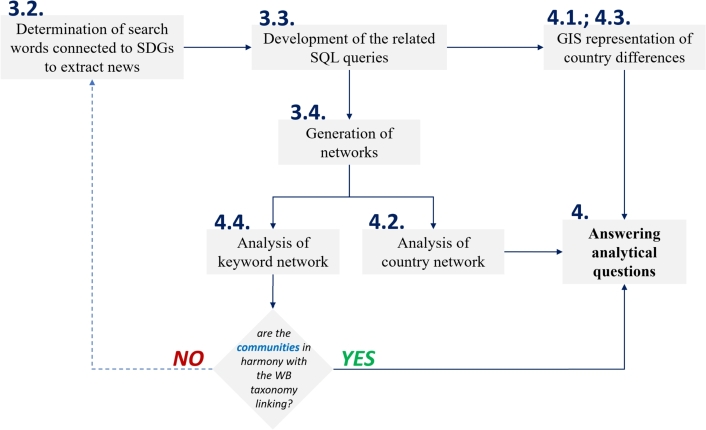
The steps of the analysis are summarized in Fig. 1, where the dark blue numbers refer to the related subsections in the paper.
Figure 1: The proposed workflow of the news-based analysis of sustainability issues.
World news on sustainable development goals is a good illustration of the mentality of countries’ concerning the 2030 Agenda. The published news stories are labelled along with the ontologies in the GDELT Project, which allows for their thematic analysis if the ontologies related to the given issue are selected, in our case, the SDGs based on the taxonomy of the World Bank.
The taxonomy of the World Bank has been reviewed and the categories related to SDGs selected.
The data were extracted from the GDELT’s Global Knowledge Graph (GKG). GDELT has already been used to estimate the future level of violence in Afghanistan (ref. Yonamine, 2013), explore disasters and their determinants (ref. Kwak and An, 2014), determine the risk of upcoming social unrest events and predict indicators related to the instabilities of country (ref. Qiao and Chen, 2016) or to analyze peace and conflict data (ref. Keertipati et al., 2014).
Two methods were used for the extraction, namely the “standard” way, which involves Google Big-Query engine, and a self-developed Python-based engine. For short queries, and validation, Big-Query was used, for more analytical and long time frame analysis, the offline Python-based engine was used.
The results of the queries can also be analyzed using Geographic Information System (GIS) techniques, thus revealing how the countries are sensitive to SDG issues and how much news is reported about SDGs. Multidimensional networks comprised of queries aim to shed light on the relationships between countries and topics. The ontological assignments with regard to the SDGs can be checked based on the identified keyword communities, however, it is important to emphasize that due to the interconnectedness of SDGs the validation requires expert knowledge.
Determination of search words connected to SDGs to extract news
WBG Topical Taxonomy refers to the World Bank Group’s topical knowledge domains and areas of expertise, whilst the segments determined by the My World 2015 survey contributed to the formation of Agenda 2030. These data was used as a basis to approximate these categories within the 17 goals – involved targets and its indicators.
The selection from topics with regard to WBG Topical Taxonomy and association with the development goals happened through expert sampling. These associated search words are shown in Appendix B.
The segments of the My World 2015 survey are the following: A good education, Better healthcare, Better job opportunities, An honest and responsive government, Affordable and nutritious food, Protection against crime and violence, Access to clean water and sanitation, Support for people who can’t work, Better transport and roads, Equality between men and women, Reliable energy at home, Political freedoms, Freedom from discrimination and persecution, Protecting forests, rivers and oceans, Phone and Internet access, and Action taken on climate change.
The formulation of sustainable development goals is concise and ambitious, therefore, the World Bank categories are preferably linked on the basis of the keywords in the more detailed description of the indicators. For example, the following keywords can be extracted from the indicators of SDG 15: ‘ecosystem’, ‘forest’, ‘land’, ‘protected’, ‘biodiversity’, ‘red list’, ‘mountain’, ‘wildlife’ and ‘species’. Links are based on expert knowledge, however, the methodology allows them to be validated.
For SDG 13, “Take urgent action to combat climate change and its impacts”, 5 targets and 7 indicators were declared. To measure this goal, the number of countries with disaster risk reduction strategies, number of affected persons by disaster, mobilized financial support and other policy strategic measures are used. Table 12 shows that topics were selected that are very closely related to the concept of SDG 13 and its indicators. The following keywords extracted from the SDG 13 targets and indicators that linked with the World Bank categories: ‘disaster’, ‘natural disaster’, ‘policies, strategies and planning’, ‘education’, ‘climate change mitigation and adaptation’, ‘impact reduction’, ‘early warning’. The experience of studies discussing the interconnectedness of SDGs was taken into consideration in the application of the search words (ref. Sebestyén et al., 2019) (ref. Dörgő et al., 2018). One of the main advantages of the proposed methodological development is that it can be applied flexibly in any subject area, such as the representation of the circular economy or industry 4.0 topics in world news. In the table, the column WB_SHORT refers to the ontology number of the World Bank, that empowers the traceability, the column WB_NAME describes the description connected to WB_SHORT.
Table 12: Search words applied to proximate SDG 13: Climate action and SDG based on the World Bank Group Topical Taxonomy.
SDG 13: Climate action
My World 2015
UNGP_CLIMATE_CHANGE_ACTION (Action taken on climate change)
WB_SHORT
WB_NAME
WB_SHORT
WB_NAME
WB_587_
Poverty and Climate Change
WB_1844_
Market-Based Climate Change Mitigation
WB_821_
Disaster Risk Reduction
WB_1787_
Natural Habitats
WB_823_
Post Disaster Recovery and Reconstruction
WB_3138_
Natural Disaster
WB_3358_
Man-Made Disasters
WB_1705_
Disaster Preparedness
WB_1770_
Climate Change and Vulnerable Groups
WB_580_
Low Carbon Development
WB_142_
Energy and Water
WB_705_
Economic Shocks and Climate Change
WB_156_
Groundwater Management
WB_1838_
Climate Risk Screening
WB_1798_
Water Pollution
WB_1750_
Climate Change Adaptation Impacts
WB_1998_
Water Economics
WB_1752_
Climate Change Adaptation in Coastal and Marine Areas
WB_1831_
Environmental Crime and Law Enforcement
WB_1753_
Gas-to-Power
WB_849_
Environmental Laws and Regulations
WB_1758_
Transport and Climate Change
WB_158_
Water Resources and Climate Adaptation
WB_1772_
Private Sector and Climate Change
WB_140_
Agricultural Water Management
WB_1773_
Climate Change Impacts
WB_537_
Urban Energy Efficiency
WB_1774_
Climate Forecasting
WB_538_
Energy Efficiency in Industry
WB_1777_
Forests
WB_1756_
Energy and Climate Change
WB_1791_
Air Pollution
WB_520_
PPP in Energy and Power
WB_1795_
Ozone Depleting Substances (ODS)
WB_2673_
Jobs and Climate Change
WB_1837_
Climate Change and Disaster Risk
WB_1075_
Industry Policy
WB_1839_
Ozone Layer Depletion and Climate Change
WB_1979_
Natural Resource Management
WB_1849_
Public Climate Finance
WB_963_
Natural Resources Law
WB_1850_
Private Climate Finance
WB_2639_
Climate Efficient Industries
WB_1878_
Carbon Capture and Storage
WB_582_
Greenhouse Gas Accounting
WB_570_
Early Warning Systems
WB_810_
Climate Change Adaptation in Urban Areas
WB_573_
Climate Risk Management
WB_1841_
Short-lived Climate Pollutants (SLCPs)
Sustainable development goals are not evenly covered by indicators, and in the case of indicators, there is a significant lack of data, which makes it challenging to monitor their fulfilment. This is especially true of SDG 13, where hardly any measurable indicators are present. This is why it is essential to find additional data sources for which one of the promising tools is the news analysis presented in this research. It is generally true that the SDG indicators do not characterize the awareness and participation of the society, however, the proposed methodological development allows these factors to be taken into account.
Development of the related SQL queries
GDELT uses some of the world’s most sophisticated natural-language and data-mining algorithms, including the world’s most powerful deep-learning algorithms, to extract and monitor world news. GDELT consists of the Event Database, which captures worldwide activities (events), as well as the Global Knowledge Graph (GKG), which records and entwines people, organizations, locations, themes, taxonomies, sources, tone and events of news into a network. The important attributes of GKG can be seen in Table 13.
Table 13: Important attributes of an article for the network creation.
Name
Notation
Description
GDELT attribute
Id
id
Identifies an article. This is a unique attribute of all articles
GKGRECORDID
Date
ti
Identifies the publication date of the article
V2.1DATE
Location
Li
List identifying the locations mentioned by the article
V1LOCATIONS
Themes
Di
List identifying the topics
V2ENHANCEDTHEMES
Sentiment
si
Shows the average tone of the article. This ranges between -100 (extremely negative) and +100 (extremely positive)
V1.5TONE
GKG enables the co-occurrence of people, locations or organizations that empower analysis concerning the relationships between parties to be determined.
GDELT Global Knowledge Graph, which offers scalable, cost-effective, cloud-based opportunities to analyse huge amounts of data, is available as a queryable dataset in the Google BigQuery (GBQ).
GBQ is comprised of a Structured Query Language (SQL)-like syntax, with lots of additional data processing tools, e.g. unnesting (separating columns into multiple rows) and regular expression capturing. This domain-specific language is often used in programming and data management. The queries are based on a schematic SELECT query which captures the main details of the GKG database, namely location, date, topics and tone.
Generation of networks
Network analysis provides a graphical representation of complex patterns of relationships between variables (ref. Hevey, 2018). Therefore, beyond the relationships of countries with regards to sustainability news, the relationships between countries and topics can be described. Furthermore, this method can serve as validation of the selection and categorization of keywords which occurred as a result of expert sampling, as if the keywords are clustering significantly (creating a community), a strong interrelationship can be observed between them and the classification can be confirmed as suitable.
Network analysis carries great potential to:
explore and visualize relationships;
identify central nodes – countries/keywords – by defining the number of connections (degrees) to the node or analysing the frequency pathway between other nodes (betweenness);
detect clustering nodes (communities), e.g. countries systematically involved in a certain topic.
GDELT Global Knowledge Graph allows the co-occurrence exploration of locations (e.g. countries), people as well as themes that appear in news, which can serve as a basis for the network formation.
The analysis is based on the multidimensional network representation of the available information. A multidimensional network can be defined as, nodes (V), edges (E) and dimensions (D):
((1))
An edge is expressed as a connection between two nodes u and v, in a dimension d. In our case, the nodes are countries and the dimensions are sustainable goals as well as their subcategories. The network is generated using the GDELT geolocation, topic recognition and sentiment analysis. The sentiment analysis part will be discussed later, for now, the creation of the simplest network will be concentrated on. GDELT geolocates each article to countries and cities according to the locations mentioned in the article. If an article contains or mentions, two different countries, this is an edge in the network between the two countries. Upon the identification of an edge, the dimension must be accounted for. The network will be multidimensional, therefore, the categories of the article will define which layer the previously mentioned edge appears in.
An article is regarded as a quadruplet of the article’s id (i), its publication date (), the identified set of locations mentioned within it (), the dimensions and tags of the article () and its sentiment (). Table 13 summarizes the connections between the GDELT database and our notations.
((2))
Based on GDELT, two types of network building are followed. One approach is when the nodes of the network are the topics (integrated SDGs), where the edges are the news, the dimension of the edges is the countries or groups of countries, while the weight of the edges is the number of pieces and/or tone.
The other option is when the nodes of the network are countries and edges are the news of a particular topic, where the weight of the edges can be determined from the number of articles. Networks can be generated directly with developed SQL queries, but can also be generated based on the downloaded database.
The presented tool analyzes the occurrence of sustainable development goals in the news and characterizes the emphasis of the goals based on the assigned World Bank Group Topical Taxonomy categories. A limiting factor of the approach is that the very general categories that are related to a lot of news can mislead the analyst, so it is not enough to interpret aggregated results at the SDG level, but also to control them at the taxonomy level. The tool can be further developed if different taxonomies are not given equal importance to the goals, but the labels that best describe the goals are represented with higher weights.
Results
The results section shows how world news are related to sustainable development goals. This is the only piece of research that uses a broad-spectrum, systematic, multilingual monitoring tool to describe the sustainability information flow objectively. This methodological development allows to be continuously monitored throughout the world through online queries, thus measuring the social acceptance of SDGs and encouraging participation in terms of their implementation, as well as helping countries around the world to share experiences concerning their problems and successes, which is essential for the implementation of the Agenda. Based on the news, the significance and tone of SDGs in different countries can be modelled on its own. Based on the network analysis, the joint occurrences of the topics can be explored from which the presented approach can be validated. In the news, the spatial allocation of sustainability issues can be measured based on common countries, and countries with similar problems or achievements can be grouped. The analysis can be performed both holistically and in a goal-oriented fashion.
The analysis presented for 2019 can be carried out for any time period. The developed tools and the extracted data are publicly available on the authors’ website: abonyilab.com.
In the following, the representation of the proposed method is described through the global overview of the Sustainable Development Goals, after which climate change goal (SDG13) is presented in detail and finally, the SDG interlinkages are illuminated by the interpretation of the generated networks.
The Sustainable Development Goals in the world news
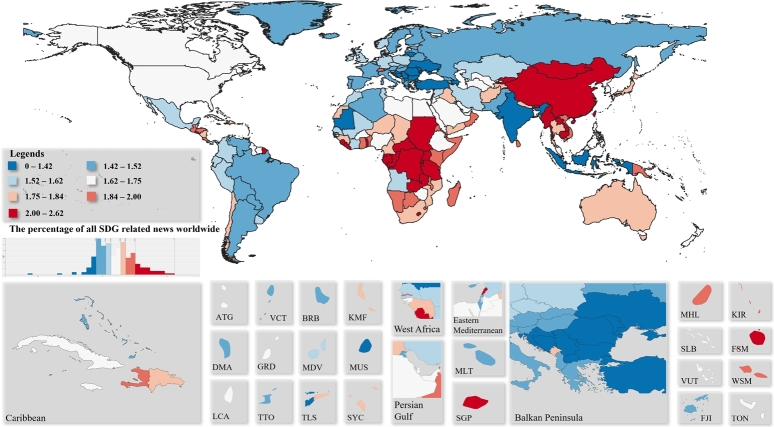
Based on our method it can be determined, that how often the SDGs occur in the news in different countries worldwide. The percentages of world SDG news are summarized in Fig. 2. Cold colours represent lower percentages, while warm colours represent higher percentages. Map cutouts were selected based on the Global Burden of Disease Study (ref. Fullman et al., 2017). For the quantization of the data equal-frequency binning has been applied, in which we divided the dataset into bins that all have an equal number of frequencies.
Figure 2: Percentage of SDG-related world’s news.
Fig. 2 shows that the share of sustainability news, even in the most sensitive countries, is only around 2.6%. Sierra Leone leads the flow of information on SDG news with 2.62%, followed by Rwanda with 2.47% and Liberia with 2.44%. There are only 2 countries where the share of SDG-related news is less than 1%, Saint Pierre and Miquelon and Bouvet Island. The distribution shown in Fig. 2 shows that Africa as well as East and Southeast Asia are the general hot spots of SDG news.
In Eastern Europe, the appearance of SDGs in the news lags slightly behind that in Western countries. Considering that the maximum value is around 2.6%, it follows that the scale moves in a relatively narrow range. In Europe, sustainability related news is most common in Switzerland, at 1.94%. For Small Island Developing States (SIDS), the relative frequency varies. There are countries where more SDGs news appear, such as Singapore (2.04%) and Federated States of Micronesia (2.29%) and some where less than Mauritius (1.4%) or Dominica (1.52%).
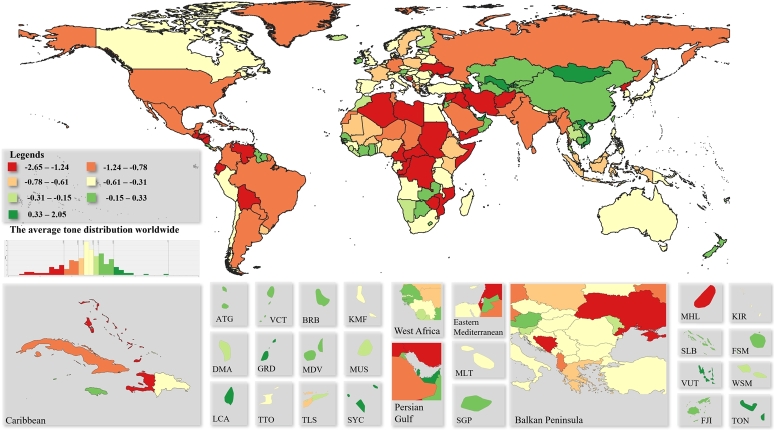
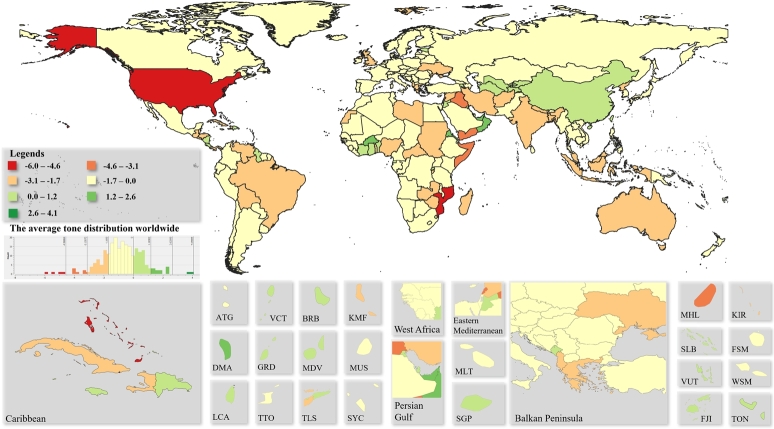
The tone of the SDG-related news is illustrated in Fig. 3. For the quantization of the data equal-frequency binning has been applied, in which we divided the dataset into bins that all have an equal number of frequencies. Due to the relatively high number of topic areas, no particular extremes can be observed in Fig. 3. Even the unweighted average tone is represented the aggregate indicator is suitable for presenting the general opinion of the countries concerning the SDGs.
Figure 3: Average tone of SDG related world’s news.
Based on Fig. 3, the most positive (+2.05) is found in Saint Kitts and Nevis, followed by Macau with 1.42. All other positive tones are below +1.00. Other positive countries are Saint Lucia scoring 0.92, Seychelles with 0.82, and then the United Arab Emirates with 0.73. The most pessimistic country is Christmas Island with a tone of -2.65, followed by Libya with -2.44 and Iran with -2.43. A very interesting correlation is observed between Figs. 2 and 3. The most SDG-related news sees the light of day in Africa, but the news is also the most negative here, therefore, a joint analysis of quantity and tone is recommended.
For Small Island Developing States, perceptions of SDG are generally positive (except in Marshall Islands, where -1.25), but overall, the news are more negative in the world as a global picture. One reason for this may be that awareness raising works more effectively if the emphasis is on the negative consequences. In any case, the regional patterns are well understood in the average tone of the news, however, they may be of further interest for analysis of tones at the different SDGs, which is beyond the scope of the present research. Nevertheless, the proposed tool we have developed is directly suitable for conducting such researches. In this case, the average tones can also be interpreted on a wider scale.
The impact of climate change is perhaps the most obvious in the world’s news, so the application of the methodology to address this issue will be described separately.
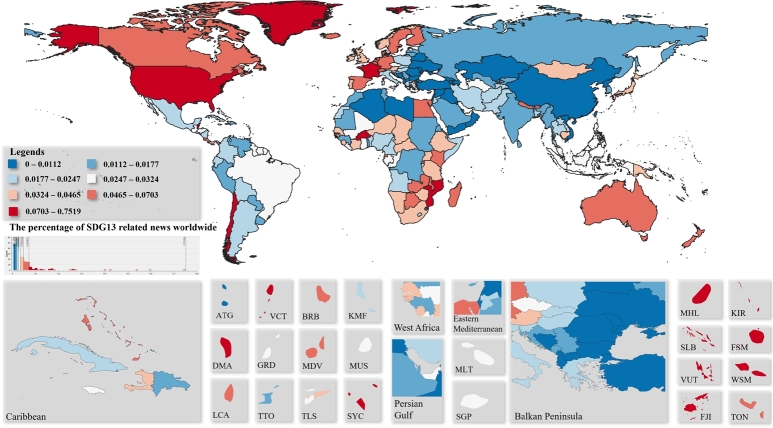
Fig. 4 shows the percentage of world news related to action against climate change in 2019. In the figure, red colours indicate higher frequencies, while colder blue colours indicate lower frequencies. Map cutouts were selected based on the Global Burden of Disease Study (ref. Fullman et al., 2017). For the quantization of the data equal-frequency binning has been applied, in which we divided the dataset into bins that all have an equal number of frequencies.
Figure 4: Percentage of climate change action related to world news.
As a proportion of all the news in the countries of the world, Tuvalu publishes the most news related to climate change, 0.75% to be exact. The second most common is the U.S., where 0.6% of the news is about climate change. The third place is located in the Arctic Ocean, namely the Svalbard archipelago, with 0.54%. The least amount of news concerning climate change appears in Anguilla, 0.003%. In general, the analysis shows that news about climate change is more relevant in small island states. Climate induced risks for small islands includes sea level rise, tropical and extratopical cyclones, changes in rainfall patters and the increase of air and sea surface temperatures (ref. Nurse et al., 2014). This fact has so far not been sufficiently taken into account with regard to the implementation of the 2030 Agenda, as the indicators set for the Climate Action (SDG 13) goal in themselves fail to take into account such groupings of countries.
In general, climate change is more prominent in countries that, due to their geographical location, have a more significant relationship with the seas or oceans. In Europe, France has the most news on climate action, with 0.12%, an order of magnitude higher than the European average.
News media play a significant role in informing and engaging citizens in sustainability issues (ref. Östman, 2014), therefore, the tone of news indicates their general opinion. The average tone of the countries can be seen in Fig. 5. Pessimistic countries are denoted in red, while those with a positive attitude are labelled in green and nations that are neutral in yellow. For the quantization of the data equal-frequency binning has been applied, in which we divided the dataset into bins that all have an equal number of frequencies.
Figure 5: Average tone of climate change action related to world news.
According to the news, Cape Verde is the most negative country with regard to climate change, where the average tone is -6. In second place is the United States with a value of -5.5 and in third is The Bahamas with -4.9. The most optimistic country is Aruba, with an average tone of 4.1, followed by Monaco with a value of 3.7 and then Macau with a score of 2.4. It can be seen that the average tone is usually neutral in the world. Further interesting research could be a separate analysis of very negative and very positive news, which can be done directly with the methodology developed in the present research.
The intertwining of the SDGs and world and news
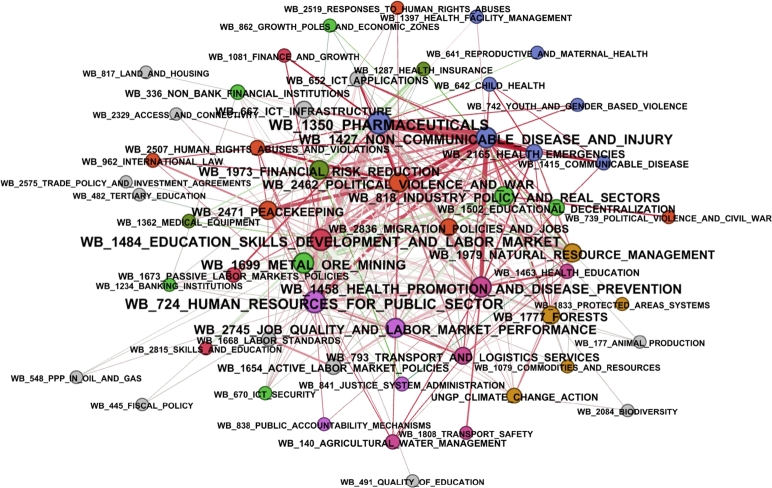
Sustainable development goals are closely interlinked, a fact that is also true for news categories and the typical published news profiles of the countries around the world. In the following, networks are used to illustrate the complex interrelationships of the intertwining of SDGs and news. The network of ontologies characterizing sustainable development goals is illustrated in Fig. 6. In the network, the size of the title of the topics is proportional to its degree of centrality, while the thickness of the links between the issues is proportional to the number of news and the colour shows the average tone.
Figure 6: The intertwining of world news and SDGs.
As is shown in Fig. 6, the identified modules in the network are related to the same topics, which are highlighted by the colours of the nodes, therefore, the connections between the ontologies of the World Bank and the sustainable development goals considered can be validated. The highest degrees of centrality with regard to the nodes in the network are the ‘human resources for public sector’, ‘pharmaceuticals’, ‘metal ore mining’, ‘education skills development and labor market’ and ‘health promotion and disease prevention’. The edges of the network are predominantly red, which means that sustainability news tends to be negative. If the developed queries are used, the development of the network of topic areas over time, the interest in sustainable development, the flow of information, and the speed of responding to environmental problems can all be measured. This research aims to present query-based monitoring as a new option in the field of sustainability assessment. Analyzing changes in the news over time is a promising future research direction.
This research has presented a methodological development based on the combination of news with SDGs that can contribute to the effective delivery of the 2030 Agenda. There are differences between countries around the world in both the proportion and tone of SDG-related news. The proposed methodology is also suitable for holistic and goal-oriented analyses, which were presented across all objectives and on the example of SDG 13. The overall hot spots of sustainability news are mainly in Africa as well as East and Southeast Asia, moreover the most negative tone recorded in Africa. In contrast, in the case of climate change, the United States and small island states are more in focus. These facts outline the foundations for exploring future focal points of SDG 10: Reduced inequalities, nevertheless, they can also help fill in information gaps to identify potential areas for collaboration (SDG 17). Tracking news can also help to better understand the state of technical goals worldwide, such as SDG 6 “Clean water and sanitation,” where SDG indicators focus mainly on infrastructure, while social aspects are highly underrepresented. Analyzing the news provides support for strategists in precisely this objectively difficult area to also measure modern wastewater treatment processes such as heat recovery, enzymatic wastewater treatment or membrane technology which can be measured mainly through news, across the SDG indicators it is not possible.
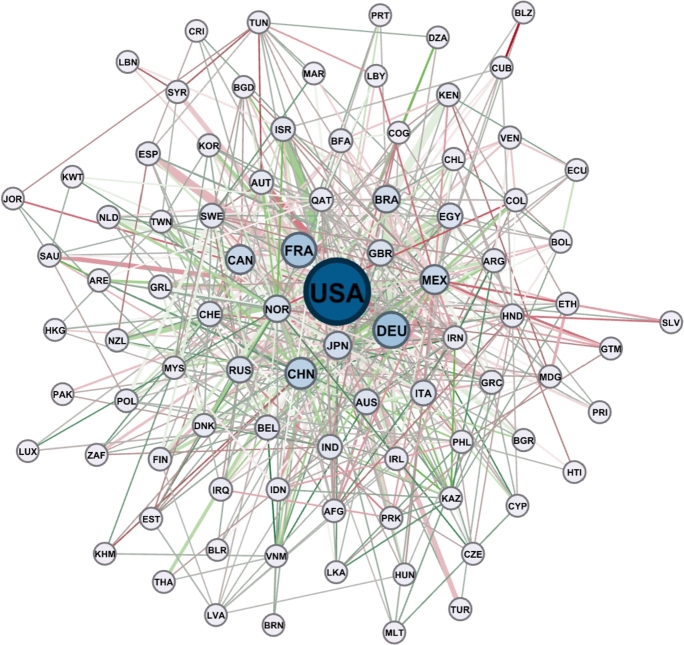
In Fig. 7 the occurrences of countries in the climate action-related (SDG 13) news are represented in a network. The network identifies the intertwining of countries based on countries mentioned together in news with regard to the 13th goal.
Figure 7: The intertwining of countries worldwide with regard to climate change (SDG 13).
The sizes of the nodes are proportional to their occurrence, and the edges represent those mentioned to be in collaboration, where the weight is the number of the news. The colours of the nodes were chosen according to the classes of modularity detected.
Fig. 7 shows that the United States is most often mentioned in the world news about climate change. The U.S. can be grouped with 132 other countries, has a betweenness centrality of 0.525 and is by far the most significant hub in the network. The most weighted edges in the network are France-USA with 3343 news, France-Germany with 3243 news, Canada-USA 3209, UK-US 2368, Russia-USA 2091, Egypt-USA 2052 and China-USA 2015. In terms of nodes, the second most central hub is France, the third is Germany, the fourth is Mexico and the fifth is India.
The provision of information encourages people to participate in environmental protection and, by involving people, makes it possible to maintain the continuity and implementation of sustainability policy in the most cost-effective way. (ref. Iizuka, 2016)
Analyses showed that there was very little difference in the level of environmental quality concerns between developed and developing countries (ref. Iizuka, 2016).
If the environmental preferences of agents are sensitive to environmental pollution and human capital, the economy is able to follow a balanced growth trajectory, with damped oscillations that can be addressed by environmental policy (ref. Constant and Davin, 2019).
The fact that countries play a largely neutral role in the climate change news network is a good indication that we need to make serious efforts to achieve the objectives of the SDGs and the Paris Climate Agreement.
In summary, sustainable development goals can be monitored through news appearing determined by carefully selected keywords. The network of ontologies characterizing sustainable development goals determines their centrality, links and tone. The distribution of the percentage of sustainability news reveals that general hot spots are located in Africa as well as East and Southeast Asia. The average tone of the SDG-related news presenting the general opinion of countries in regard with the issues, for example, considering the average of SDG news, the most positive country is Saint Kitts and Nevis (+2.5), while the most pessimistic is Christmas Island (-2.65). Furthermore, the cooperation of countries in regard with sustainability issues can be determined by the thoughtful analysis of countries co-occurrence in the selected news.
Conclusion
The major objective of this paper was to determine country profiles as well as interconnections according to the presence of sustainability – assessed through a news-centred network analysis. This method enables the stages of implementation to be determined and serves as a supportive decision-making tool to contribute towards the conscious formation of a sustainable socio-economic ecosystem.
Based on the developed methodology, any SDG can be analyzed in the world news. A comprehensive analysis of 2019 shows that world news are not significantly focus on SDGs, as with all related topics accounting for only roughly 2.5% of the news are covered by SDG-related topics, even in the most sensitive countries. Sustainability news is most prevalent in Africa as well as East and Southeast Asia, with the former having the most negative tone in the region. The proposed methodology will provide essential information for future strategic planning with regard to several goals, in particular in the area of SDG 10, where addressing inequalities is a key challenge.
Through the news, not only holistic but also goal-oriented analyses can be performed. It can be seen that the role of the United States is prominent in SDG 13 and that greater emphasis should be placed on small island states in the future, because the news about climate change is mostly negative in these countries. The analysis shows that more emphasis should be placed in all countries on the appearance of SDGs in the news.
Since countries are also grouped together in terms of different SDG-related ontologies, the relationship between countries can also be analyzed. It has been shown that the United States is one of the most important hubs in the network. The results will contribute to an objective SDG-based analysis of the news, thus helping to track implementation of the 2030 Agenda.
The average tone of SDGs is negative, especially for African countries, while Small Island Developing States have a positive viewpoint on the 2030 Agenda. The most positive countries are Saint Kitts and Nevis +2.05, followed by Macau with 1.42. The most negative news are occurred in Christmas Island with a tone of -2.65, followed by Libya with -2.44 and Iran with -2.43.
We recommend that countries exposed to climate change (especially the SIDS) work together, while tackling the negative appearance of the United States in the news about climate change is an urgent task. The negative perception of African countries about SDGs shows that countries around the world need to put more emphasis on Reduced Inequalities within and among countries (SDG10) goal.
Social acceptance is a key element in the strategic planning of the implementation of 2030 Agenda, so we recommend that national governments inform the public about the tasks, achievements and challenges related to SDGs. A more frequent appearance in the news can be one of the positive drivers for a better understanding of sustainability issues and solutions. The presented monitoring tool can provide useful feedback to decision makers about the awareness of residents and help them learn about their attitudes.
Declarations
Author contribution statement
V. Sebestyén: Performed the experiments; Analyzed and interpreted the data; Contributed reagents, materials, analysis tools or data; Wrote the paper.
T. Czvetkó: Analyzed and interpreted the data; Contributed reagents, materials, analysis tools or data; Wrote the paper.
G. Honti: Performed the experiments; Analyzed and interpreted the data; Contributed reagents, materials, analysis tools or data.
J. Abonyi: Conceived and designed the experiments; Performed the experiments; Analyzed and interpreted the data; Contributed reagents, materials, analysis tools or data.
Funding statement
This work was supported by Széchenyi 2020 (GINOP-2.3.2-15-2016-00016) and NKFIH-872.
The article explores how carbon capture and storage
as well as biomass can be beneficial with regard to the
mitigation of climate change by news media.
LexisNexis – The Boston Globe, The Star
Tribune, The Billings Gazette, Houston
Chronicle, The Republican, St. Paul
Pioneer Press, Missoulian, Austin American-
Statesman, Cape Cod Times, Duluth News
Tribune, Bozeman Daily Chronicle, and
Midland Reporter-Telegram
US (Massachusetts,
Minnesota, Montana
and Texas)
January 1, 1990 –
June 15, 2009
The article examines climate-change news coverage
between 1997 and 2010 in Canada.
Analyse longitudinal trends in
articles, analyse peak periods
8960;
603
1997-2010;
2007-2008
The article explores the comparision between social
media and mainstream news on climate change
Mixture of annotation conducted by the
authors and crowdsourced workers
through the CrowdFlower platform
561644,
482615
September 1, 2013 –
September 31, 2014
The article explores the importance of the role played by
media analysis in how political representations
in international negotiations will develop.
Business Day, The Mercury; Dagens
Naeringsliv, Bergens Tidende
South Africa,
Norway
During the Seventeenth
Conference of the Parties
(COP17) -2011
The article explores climate change communication
both as a news product and cultural phenomenon.
August 2, 2012 –
August 22, 2012
The article explores the dissonance between global and
a specific local environmental imaginary through a case
study of community newspaper coverage.
Boksburg, Gauteng,
South Africa.
January 2014 –
July 2015
The article explores the structure of the public discourse
concerning the Gateway project.
LexisNexis and Canadian Newsstand
database – Postmedia Network, Toronto Star,
Globe and Mail, Glacier Media
December 2011;
January 2012;
May-June 2012
The article shows whether or not an assumed analogue
of climate change energy storage is as politicized in the
traditional media
Automated and handcoded content
analysis
The article explores the media’s role in bridging the
information gap concerning environmentally sustainable
development.
Sunday Mail, The Patriot, The Herald,
Newsdaym Financial Gazette
January 2012 –
April 2016
The article analyses digital and broadcast news media
coverage of the Fourth National Climate Assessment
in order to get a sense of ethos constructions in climate
-change communication.
The Washington Post, USA Today, CBS News,
Fox News, CNN, The New York Times,
BuzzFeed News, Los Angeles Times, Reuters
(via Yahoo News), The Guardian (US Edition),
Huff Post, San Francisco Chronicle,
National Geographic
The article explores the role of mass media in the
diffusion of marine conservation information.
Google Search, La Tercera, Canal 13, MEGA,
CHV, TVN
The article examines the coverage of aquaculture in
regional and national newspapers
The Advocate (Louisiana), The Portland Press Herald
(Maine), The Boston Globe (Massachusetts) The New York
Times, The Washington Post, The Wall Street Journal,
USA Today
The article explores the presence of marine issues in
the news.
October 2002 –
December 2010
The article examines the construction of the China-Pakistan
Economic Corridor issue in Indian media through
the discourse analysis of news.
Telegraph India, Deccan Herald, The Tribune,
Hindustan Times, The Hindu, The Times of India
April 20, 2015 –
June 30, 2015
The article explores the media coverage of online news to
analyze existing media representation of forest
management
January 13, 2016 –
January 12, 2017
The article analyzes how the news media influences the
construction of the social perception of forests and
forestry.
Summative content analysis –
combination of both quantitative
and qualitative data analysis
The article explores newspapers, framing of urban forests,
focusing on if and how the framing changed as a result
of a major storm that highlighted urban forest disservices.
Toronto Star, Mississauga News, Brampton
Guardian
January 1, 2013 –
December 31, 2014
The article explores oil and gas drilling proposals in the
Arctic National Wildlife Refuge (ANWR).
LexisNexis: Wall Street Journal, The New York Times,
USA Today, Alaskan local newspapers
The article explores wildlife-related news coverage by
the Indian print news agencies and quantifies its patterns.
Content analysis – General linear
models
The article explores how the conflict between wildlife and
humans was framed by the news media.
Designed Market Area sampling
method
Selected by DMA sampling method – 3 newspapers/
DMA
The article explores the environmental coverage by the
Nigerian press and examines the factors that affect
coverage.
Sequential mixed methods for
content analysis and in-depth
interviews
The Guardian, Business Day, Daily Trust,
ThisvDay
January 2013 –
December 2014
Arab Spring:
January 2007, November 2010,
December 2010-2018
The article introduces a protest news framing cycle and
presents the results of a longitudinal analysis of news
attention and framing of protest movements.
The article examines the framing of visual images of
conflicts and violence in television-news programming.
Al Jazeera, Al Jazeera English, Al Arabiya,
Alhurra, BBC Arabic
The article explores how the media portrays and represents
conflicts and the restoration of peace as well as women in
conflict situations.
Nagaland Post, The Morung Express, Poknapham,
The Sangai Express, The Assam Tribune, Asomiya
Pratidin
The article examines the influence on of IBSA Dialogue Forum
(India, Brazil, South Africa) membership
South Africa.
The article explores media coverage of major conflicts
as well as the war/peace frame of news production/
presentation.
The Globe and Mail, National Post, Toronto
Star, Toronto Sun, Jerusalem Post, The New York
Times, New York Post
Afghanistan and
Israeli-Hezbollah wars
The article examines how the same event the Syrian conflict
– has been covered by US and Chinese media.
The article presents findings from a media analysis of
mainstream newspaper coverage of the Trans-Pacific
Partnership Agreement (TPP)
Factiva- algaryHerald, The Edmonton Journal,
The Globe and Mail, National
Post, Ottawa Citizen, The Province, The Star
Phoenix, Times Colonist, Toronto Star,
Vancouver Sun, Windsor Star, and Winnipeg
Free Press.
The article explores how German and Russian media
represents the relationship between EU – Ukraine.
Süddeutsche Zeitung, Frankfurter Allgemeine
Zeitung, Kommersant and Rossiyskaya Gazeta
Germany, Russia,
Ukraine, EU
4 periods:
April 30 – May 10, 2009;
September 22 – October 3, 2011;
November 21 – December 2, 2013,
May 14-25, 2015
The article explores the territorial and temporal patterns of
the media coverage of EU cohesion policy.
Natural language processing
techniques, Sentiment analysis
The Telegraph, The Guardian, El País, El
Mundo, The Scotsman La Voz de Galicia, Financial
Times, Politico, EURACTIV
EU – focus on Spain
and UK
The article analyses the international economic news about
Chinese outward foreign direct investment in Latin American
countries from corresponding Latin American newspapers
Factiva database: La Nación, La Voz, O Globo,
Folha de S. Paulo, El Mercurio, La Tercera,
Portafolio, El Espectador, El Universal, La fomada,
El Comercio, El Nacional, El Universal, La Estrella
The article explores the role of the media in implementing the
SDGs as well as the media coverage of events organised by
international development partners in Bangladesh.
References
Amodu, L., Ekanem, T., Yartey, D., Afolabi, O., Oresanya, T., 2016. Media coverage of entrepreneurial innovation as a determinant of sustainable development in Nigeria, pp. 342–345.
L. Andersson. Where technology goes to die: representations of electronic waste in global television news. Environ. Commun., 2017
O. Ashmoore, D. Evensen, C. Clarke, J. Krakower, J. Simon. Regional newspaper coverage of shale gas development across Ohio, New York, and Pennsylvania: similarities, differences, and lessons. Energy Res. Soc. Sci., 2016
T. Askanius, J.M. Hartley. Framing gender justice: a comparative analysis of the media coverage of# metoo in Denmark and Sweden. Nordicom Rev., 2019
R. Aslam, D. Gibbons, P. Ghezzi. Online information on antioxidants: information quality indicators, commercial interests, and ranking by Google. Front. Public Health, 2017. [PubMed]
D. Atanasova. Moving society to a sustainable future: the framing of sustainability in a constructive media outlet. Environ. Commun., 2019
N.A. Azhar, G. Pan, P.S. Seow, A. Koh, W.Y. Tay. Text analytics approach to examining corporate social responsibility. Asian J. Account. Govern., 2019
A. Balashankar, A. Dugar, L. Subramanian, S. Fraiberger. Proceedings of the 2nd ACM SIGCAS Conference on Computing and Sustainable Societies, 2019
M. Balcilar, E. Cakan, R. Gupta. Does us news impact Asian emerging markets? evidence from nonparametric causality-in-quantiles test. N. Am. J. Econ. Finance, 2017
R. Barkemeyer, F. Figge, D. Holt. Sustainability-related media coverage and socioeconomic development: a regional and north–south perspective. Environ. Plann., C. Gov. Policy, 2013
R. Barkemeyer, P. Givry, F. Figge. Trends and patterns in sustainability-related media coverage: a classification of issue-level attention. Environ. Plann., C. Polit. Space, 2018
C. Benesch, S. Loretz, D. Stadelmann, T. Thomas. Media coverage and immigration worries: econometric evidence. J. Econ. Behav. Organ., 2019
M. Bertl. News analysis for the detection of cyber security issues in digital healthcare. Young Inform. Scientist, 2019
D. Bhattacharya, T. Khan, M. Sabbih. 2020
A.H. Bierbaum. News media’s democratic functions in public education: an analysis of newspaper framings of public school closures. Urban Educ., 2018
B. Blair, D. Zimny-Schmitt, M.A. Rudd. US news media coverage of pharmaceutical pollution in the aquatic environment: a content analysis of the problems and solutions presented by actors. Environ. Manag., 2017
M. Bourk, J. Rock, L.S. Davis. Mediating the science: symbolic and structural influences on communicating climate change through New Zealand’s television news. Environ. Commun., 2017
M.D. Bruce, L. Conlin. Images of conflict and explicit violence on Arab TV: a visual content analysis of five pan-Arab news networks. Athens J. Mass Media Commun., 2016
T. Caeiro, A. Gonçalves. Homelessness–press, policies and public opinion in Portugal. Eur. J. Homelessness, 2015
G. Cai, Y. Tian. Proceedings of the 10th Workshop on Geographic Information Retrieval, 2016
K. Coe, P.J. Kuttner. Education coverage in television news: a typology and analysis of 35 years of topics. AERA Open, 2018
Cokeley, K., 2017. Framing homelessness as crisis: a comparative content analysis of local media reports on Portland’s tent cities, pp. 1–165.
K. Constant, M. Davin. Environmental policy and growth when environmental awareness is endogenous. Macroecon. Dyn., 2019
T.M. Conway, M.A. Jalali. Representation of local urban forestry issues in Canadian newspapers: impacts of a major ice storm. Can. Geogr., 2017
Dakota Rohlin, M., et al., 2019. Ethos in climate change communication: analyzing digital and broadcast news coverage of the fourth national climate assessment, pp. 1–115.
S. Dauda, N.N.N. Hasan. Framing the sustainable development goals in Malaysian online news. Search J. Southeast Asia Res. Centr. Commun. Human., 2018
R. Dewenter, U. Heimeshoff, T. Thomas. 2016
M. Diermeier, H. Goecke, J. Niehues, T. Thomas. 2017
K. Diprose, R. Fern, R.M. Vanderbeck, L. Chen, G. Valentine, C. Liu, K. McQuaid. Corporations, consumerism and culpability: sustainability in the British press. Environ. Commun., 2018
G. Dörgő, V. Sebestyén, J. Abonyi. Evaluating the interconnectedness of the sustainable development goals based on the causality analysis of sustainability indicators. Sustainability, 2018
R. Dornelas, S. Giannini, L.P. Ferreira. CoDAS, 2015
E. Edmunds, A. Gupta. Headline violence and silenced pleasure: contested framings of consensual sex, power and rape in Delhi, India 2011-2014. Reproduc. Health Matters, 2016
E.P. Estrada, K. Ebert, M.H. Lore. Sociological Forum, 2016
M. Ette. Where are the women? Evaluating visibility of Nigerian female politicians in news media space. Gend. Place Cult., 2017
M. Fabra Crespo, E. Rojas Briales. Analysis of mass media news on forest issues: a case study of Spain. Forest Syst., 2015
C. Fan, A. Mostafavi, A. Gupta, C. Zhang. Workshop of the European Group for Intelligent Computing in Engineering, 2018
A.M. Feldpausch-Parker, M. Burnham, M. Melnik, M.L. Callaghan, T. Selfa. News media analysis of carbon capture and storage and biomass: perceptions and possibilities. Energies, 2015
N. Fullman, R.M. Barber, A.A. Abajobir, K.H. Abate, C. Abbafati, K.M. Abbas, F. Abd-Allah, R.S. Abdulkader, A.M. Abdulle, S.F. Abera. Measuring progress and projecting attainment on the basis of past trends of the health-related sustainable development goals in 188 countries: an analysis from the global burden of disease study 2016. Lancet, 2017. [PubMed]
M. Garz. Effects of unemployment news on economic perceptions–evidence from German Federal States. Reg. Sci. Urban Econ., 2018
GDELT. The GDELT project – global database of events, language and tone
J. Gottlieb. Protest news framing cycle: how the new york times covered occupy wall street. Int. J. Commun., 2015
Q. Guan, H. An, H. Li, X. Hao. The rapid bi-level exploration on the evolution of regional solar energy development. Physica A Statist. Mech. Appl., 2017
R.A. Hackett, B. Schroeder. Peace Journalism in Times of War, 2017
A. Hamzah, A.F. Hidayatullah. MATEC Web of Conferences, EDP Sciences, 2018
D. Hevey. Network analysis: a brief overview and tutorial. Health Psychol. Behav. Med., 2018
E. Humprecht, F. Esser. A glass ceiling in the online age? Explaining the underrepresentation of women in online political news. Eur. J. Commun., 2017
Iizuka, M., 2016. Role of environmental awareness in achieving sustainable development, pp. 1–37.
I. Irwansyah. E3S Web of Conferences, EDP Sciences, 2018
Issac, T.F., 2017. A content analysis of the portrayal of refugees in us news media, pp. 1–43.
S. Jia, T. Lansdall-Welfare, N. Cristianini. Proceedings of the 24th International Conference on World Wide Web, 2015
J. Johannessen. Worldview struggles under a new climate regime: South African and Norwegian media coverage of COP17. Nordicom Rev., 2015
Y.S. Jung, T. Chang. Text mining based online news analysis about smart factory. ICIC Express Lett. Part B, Appl. Inter. J. Res. Surv., 2018
K. Kabi, A.K. Nayak. Media, gender and peace initiatives in northeast India: an analysis. Media Watch, 2019
O. Kakade. News coverage of sanitation in Kannada newspapers–a content analysis. Paradigm, 2015
S. Keertipati, B.T.R. Savarimuthu, M. Purvis, M. Purvis. Proceedings of the MLSDA 2014 2nd Workshop on Machine Learning for Sensory Data Analysis, 2014
T.R. Keller, V. Hase, J. Thaker, D. Mahl, M.S. Schäfer. News media coverage of climate change in India 1997–2016: using automated content analysis to assess themes and topics. Environ. Commun., 2020
I. Khan, S. Farooq, S. Gul. China-Pakistan economic corridor: news discourse analysis of Indian print media. J. Polit. Stud., 2016
M. Kibet. 2015
K. Kleinschnitger, M. Knodt, N. Safonova. Frames and images facing Ukraine: comparing Germany’s and Russia’s media perceptions of the EU relations with Ukraine. Cogn. Commun. Disc., 2018
L. Kogen. Not up for debate: US news coverage of hunger in Africa. Int. Commun. Gaz., 2015
Kokkonen, O., 2017. A faceless threat or vulnerable individuals?: the representations of refugees in British newspapers during the European refugee crisis.
R.E.G. Kroner. Media coverage of the arctic national wildlife refuge drilling controversy. J. Mas. Grad. Res., 2016
H. Kwak, J. An. International Conference on Social Informatics, 2014
M. Lawhon, J. Pierce, R. Bouwer. Scale and the construction of environmental imaginaries in local news. South African Geogr. J., 2018
A.H. Lee, E.A. Silva. Newspaper representation and power relations in infrastructure projects: a case study of Hong Kong’s express rail link. Int. Plan. Stud., 2017
S.Y. Lee, D. Riffe. Who sets the corporate social responsibility agenda in the news media? Unveiling the agenda-building process of corporations and a monitoring group. Public Relat. Rev., 2017
M.M. Legge, L. Tarasoff, C. Flanders, R. Taha, M. Robinson. A critical examination of online news media representations of bisexual women who use cannabis. J. Bisexual., 2018
N. Levin, S. Ali, D. Crandall. Utilizing remote sensing and big data to quantify conflict intensity: the Arab Spring as a case study. Appl. Geogr., 2018
J. Loke, I. Bachmann, D. Harp. Co-opting feminism: media discourses on political women and the definition of a (new) feminist identity. Med. Cult. Soc., 2017
K. Lucyk. They are not my problem: a content and framing analysis of references to the social determinants of health within Canadian news media, 1993-2014. Canad. J. Commun., 2016
D. Lusa, H. Jakopovic. Websites as a government tool of public diplomacy: framing the issue of unemployment. Teor. Praksa, 2017
S. Lyngdoh, D. Dixit, B.C. Sinha. Print mass media coverage of wildlife in the developing world. Curr. Sci., 2017
J. Lyytimäki. Renewable energy in the news: environmental, economic, policy and technology discussion of biogas. Sustain. Product. Consump., 2018
A. Mallett, J.C. Stephens, E.J. Wilson, R. Langheim, R. Reiber, T.R. Peterson. Electric (dis) connections: comparative review of smart grid news coverage in the united states and Canada. Renew. Sustain. Energy Rev., 2018
C.A. Mandeno. 2015
T. Maniou, I. Photiou, N. Eteokleous, I. Seitanidis. The utilization of journalistic sources in the national press: communicating the transition from economic crisis to sustainable growth. Centr. Eur. J. Commun., 2017
J.W. McArthur, C. Zhang. Measuring the diffusion of the millennium development goals across major print media and academic outlets. Glob. Policy, 2018
E.E. McGinty, H. Samples, S.N. Bandara, B. Saloner, M.A. Bachhuber, C.L. Barry. The emerging public discourse on state legalization of marijuana for recreational use in the US: analysis of news media coverage, 2010–2014. Prev. Med., 2016. [PubMed]
I. Medovikov. When does the stock market listen to economic news? New evidence from copulas and news wires. J. Bank. Finance, 2016
C. Mendez, F. Mendez, V. Triga, J.M. Carrascosa. EU cohesion policy in the media spotlight: exploring territorial and temporal patterns in news coverage and tone. J. Common Mark. Stud., 2020
S. Moore. 2015
I. Moutidis, H.T. Williams. International Conference on Complex Networks and Their Applications, 2019
N. Murukutla, N.S. Negi, P. Puri, S. Mullin, L. Onyon. Online media coverage of air pollution risks and current policies in India: a content analysis. WHO South-East Asia J. Publ. Heal., 2017
F. Neresini, S. Crabu, E. Di Buccio. Tracking biomedicalization in the media: public discourses on health and medicine in the UK and Italy, 1984–2017. Soc. Sci. Med., 2019
M.K. Niemi, V. Pitkänen. Gendered use of experts in the media: analysis of the gender gap in Finnish news journalism. Publ. Understand. Sci., 2017
Nixon, L., Gardin, K., Seklir, L., Gottlieb, M., Dorfman, J.L., 2016. Examining the public debate on school food nutrition guidelines, pp. 1–19.
Nurse, L.A., McLean, R.F., Agard, J., Briguglio, L., Duvat-Magnan, V., Pelesikoti, N., Tompkins, E., Webb, A., 2014. Small islands.
E. Ogadimma. 2018
A. Olteanu, C. Castillo, N. Diakopoulos, K. Aberer. Ninth International AAAI Conference on Web and Social Media, 2015
J. Östman. The influence of media use on environmental engagement: a political socialization approach. Environ. Commun., 2014
B. Pinto, J. Costa, H. Cabral. What news from the sea? Assessing the presence of marine issues in the Portuguese quality press. Ocean Coast. Manag., 2020
C. Piotrowski, C.J. Fenner. Facebook research: implications for investigators in the field of media psychology. North Am. J. Psychol., 2017
F. Qiao, K. Chen. 2016 International Conference on Identification, Information and Knowledge in the Internet of Things (IIKI), 2016
L. Ranacher, A. Ludvig, P. Schwarzbauer. Depicting the peril and not the potential of forests for a biobased economy? A qualitative content analysis on online news media coverage in German language articles. Forest Pol. Econ., 2019
K. Raso, R.J. Neubauer. Managing dissent: energy pipelines and “new right” politics in Canada. Canad. J. Commun., 2016
L.N. Rickard, A.M. Feldpausch-Parker. Of sea lice and superfood: a comparison of regional and national news media coverage of aquaculture. Front. Commun., 2016
S. Rodat. Debate topics and patterns of media coverage of nutrition in Germany. Ann. Univ. Craiova Journal. Commun. Manag., 2018
T.C. Rosas-Moreno. A South African news framing analysis reveals modern-day slavery flourishes domestically despite an international human rights relationship. Afric. Journal. Stud., 2018
A.C. Saguy, J.A. Williams. Reimagining gender: gender neutrality in the news. Signs J. Women Cult. Soc., 2019
M. Sakellari. Climate change and migration in the UK news media: how the story is told. Int. Commun. Gaz., 2019
N.G. Saraisky. Analyzing public discourse: using media content analysis to understand the policy process. Cur. Iss. Comp. Educ., 2016
A. Schram, A. Rückert, R. Labonté, B. Miller. Media and neoliberal hegemony: Canadian newspaper coverage of the trans-pacific partnership agreement. Stud. Polit. Econ., 2016
V. Sebestyén, M. Bulla, Á. Rédey, J. Abonyi. Network model-based analysis of the goals, targets and indicators of sustainable development for strategic environmental assessment. J. Environ. Manag., 2019
Shapiro, M.A., 2018. The connection between battery storage and climate change: testing for the politicization of energy storage research in the media, pp. 1–17.
N.A. Shea. Examining the nexus of science communication and science education: a content analysis of genetics news articles. J. Res. Sci. Teach., 2015
N. Showkat. Coverage of sanitation issues in India. Sage Open, 2016
M. Shumow, R.E. Gutsche. Urban policy, press, and place: city-making in Florida’s Miami-Dade County. J. Urban Aff., 2016
D. Silvera-Tawil, M.S. Hussain, J. Li. Emerging technologies for precision health: an insight into sensing technologies for health and wellbeing. Smart Heal., 2019
N.T. Stafford, R.F. Welden, B.L. Bruyere. Media reporting of conflict between wildlife and people spending time in nature. Wildl. Soc. Bull., 2018
M.C. Stoddart, R. Haluza-DeLay, D.B. Tindall. Canadian news media coverage of climate change: historical trajectories, dominant frames, and international comparisons. Soc. Nat. Res., 2016
G. Taskforce. Global Taskforce of Local and Regional Governments, 2016
M.W. Thanaphokhai. 2015
G. Thompson-Saud, S. Gelcich, J. Barraza. Marine environmental issues in the mass media: insights from television, newspaper and internet searches in Chile. Ocean Coast. Manag., 2018
S. Vedachalam, B.V. Lewenstein, K.A. DeStefano, S.D. Polan, S.J. Riha. Media discourse on ageing water infrastructure. Urban Water J., 2016
C. Walker, A. Alexander, M.B. Doucette, D. Lewis, H.T. Neufeld, D. Martin, J. Masuda, R. Stefanelli, H. Castleden. Are the pens working for justice? News media coverage of renewable energy involving indigenous peoples in Canada. Energy Res. Soc. Sci., 2019
Yonamine, J.E., 2013. Predicting future levels of violence in Afghanistan districts using GDELT. Unpublished manuscript.
M.S. Yuliarti, I.D.A. Nurhaeni, R.A. Nugroho. 2016 International Conference on Public Management, 2016
L. Zeng, L. Zhou, P.L. Pan, G. Fowler. Coping with the milk scandal: a staged approach to crisis communication strategies during china’s largest food safety crisis. J. Commun. Manag., 2018
S. Zhou, N. Landa, I.N. Zhou. Analysis of media role in bridging the information gap for environmentally sustainable development in Zimbabwe. East. Afr. Soc. Sci. Res. Rev., 2017
Y. Zhu, L. Wang. Newspaper portrayal of Chinese outward foreign direct investment in Latin American newspapers: a content analysis. Int. Commun. Gaz., 2018