
Integrative network analysis reveals organizational principles of the endocannabinoid system
Abstract
Background:
The endocannabinoid system (ECS) is a complex signaling network that regulates diverse physiological processes, including pain, mood, metabolism, and immune response, through coordinated interactions among receptors, enzymes, and lipid-derived ligands. Although individual ECS components have been extensively studied, the integrated systems-level organization and structural dependencies of the ECS remain insufficiently characterized in a unified network context. Here, we present a computational, network-based systems analysis of the ECS that integrates protein–protein and protein–chemical interactions into a unified interaction framework, enabling the identification of components that occupy structurally prominent positions in the network, with potential relevance to the role of ECS in diverse physiological processes and therapeutic contexts.
Methods:
We constructed integrated ECS networks by combining experimentally validated protein–protein and protein–chemical interactions from multiple public databases. Network analyses were performed using centrality metrics, community detection algorithms, and targeted perturbations of highly ranked nodes to assess structural organization, modular architecture, and redistribution of topological influence.
Results:
Centrality analyses systematically identified nodes with high topological prominence across the ECS network. Canonical receptors cannabinoid receptor 1 (CB1) and cannabinoid receptor 2 (CB2) ranked consistently among the most influential nodes, while non-canonical components such as transient receptor potential vanilloid 1 (TRPV1), G-protein coupled receptor 55 (GPR55), peroxisome proliferator-activated receptor alpha (PPARα), cyclooxygenase-2 (COX-2), fatty acid amide hydrolase (FAAH), and diacylglycerol lipase alpha (DAGLα) also emerged as highly ranked nodes across multiple centrality measures. Closeness and eigenvector centrality further highlighted phytocannabinoids including cannabidiol (CBD), tetrahydrocannabivarin (THCV), and cannabidivarin (CBDV) as structurally well-connected components within the network. Community detection revealed a modular organization separating receptor-mediated signaling components from endocannabinoid metabolic processes, with clusters centered on CB1/CB2 signaling machinery and enzymes such as FAAH and diacylglycerol lipase beta (DAGLβ), which are associated with 2-arachidonoylglycerol (2-AG) turnover. Perturbation analyses demonstrated that removal of dominant hubs, particularly CB1, redistributed centrality and altered shortest-path structure, increasing the relative prominence of nodes such as CB2 and GPR55 while decreasing that of others such as DAGLβ and linoleoyl ethanolamide (LEA). These findings identify structurally influential and configuration-dependent nodes whose prominence becomes apparent through network-level analysis.
Conclusion:
By mapping the ECS as an integrated interaction network, this study provides a structural framework for understanding how receptors, enzymes, and ligands collectively shape ECS organization. Our results demonstrate that network analysis can identify structurally influential components within the ECS, highlighting nodes whose importance emerges from the overall network organization. The identification of highly ranked and perturbation-sensitive nodes offers a systematic basis for prioritizing underexplored components for hypothesis-driven experimental investigation and pharmacological study. More broadly, this work establishes a network-based foundation for expanding ECS modeling to incorporate additional molecular entities, interaction directionality, signaling dynamics, and tissue- or context-specific interactions, thereby informing future therapeutic strategies targeting the ECS and its interacting molecular pathways across diverse physiological processes and disease pathways.
Supplementary Information:
The online version contains supplementary material available at 10.1186/s42238-026-00447-3.
Article type: Research Article
Keywords: Endocannabinoid system, Biological network, Cannabinoid receptors, Cannabinoids, CB, CB, GPR55
Affiliations: Office of the Vice Chancellor of Research, Cannabis Research Institute, 2201 W Campbell Park Drive, Room 115, Chicago, IL 60612 USA
License: © The Author(s) 2026 CC BY 4.0 Open Access This article is licensed under a Creative Commons Attribution 4.0 International License, which permits use, sharing, adaptation, distribution and reproduction in any medium or format, as long as you give appropriate credit to the original author(s) and the source, provide a link to the Creative Commons licence, and indicate if changes were made. The images or other third party material in this article are included in the article’s Creative Commons licence, unless indicated otherwise in a credit line to the material. If material is not included in the article’s Creative Commons licence and your intended use is not permitted by statutory regulation or exceeds the permitted use, you will need to obtain permission directly from the copyright holder. To view a copy of this licence, visit http://creativecommons.org/licenses/by/4.0/.
Article links: DOI: 10.1186/s42238-026-00447-3 | PubMed: 42129940 | PMC: PMC13344038
Relevance: Relevant: mentioned in keywords or abstract
Full text: PDF (3.7 MB)
Background
The endocannabinoid system (ECS) is a multifaceted regulatory network that maintains physiological homeostasis across diverse organ systems (Lu and Mackie ref. 2021; Kunos et al. ref. 2008; Sikyta et al. ref. 2024). It is composed of endogenous ligands known as endocannabinoids, their cognate receptors, and the enzymes that mediate their synthesis and degradation (Lu and Mackie ref. 2021; Schurman et al. ref. 2019). Endocannabinoids are cannabinoids produced within the human body, in contrast to phytocannabinoids, which are derived from a number of plants, of which the best known is Cannabis sativa (Gülck and Møller ref. 2020; Ribeiro et al. ref. 2024; Chavez and D’Auria ref. 2023), and synthetic cannabinoids, which are laboratory-engineered compounds designed to mimic or modulate the effects of natural cannabinoids for research and therapeutic applications (Lu and Mackie ref. 2021; Schurman et al. ref. 2019). Through the coordinated activity of these molecular components, the ECS influences a broad spectrum of biological processes, including pain perception, inflammation, memory, and mood regulation (Barrie and Manolios ref. 2019; Campolongo and Trezza ref. 2012; Simankowicz and Stępniewska ref. 2025).
Two primary receptors define much of the functional landscape of the ECS. Cannabinoid receptor 1 (CB1, also called CNR1) is predominantly expressed in the brain and central nervous system, where it regulates mood, appetite, pain perception, and cognitive processes (Lu and Mackie ref. 2021; Barrie and Manolios ref. 2019; Campolongo and Trezza ref. 2012; Simankowicz and Stępniewska ref. 2025). Cannabinoid receptor 2 (CB2, also called CNR2) is primarily located in immune cells and peripheral tissues, where it regulates inflammatory and immune responses (Lu and Mackie ref. 2021; Barrie and Manolios ref. 2019; ref. 2012; Campolongo and Trezza ref. 2025). The ECS also interfaces with intracellular kinase signaling pathways that control cell survival, synaptic plasticity, and metabolic regulation. This extensive interconnectedness underscores how the ECS integrates with broader cellular signaling networks (Lu and Mackie ref. 2021; Kunos et al. ref. 2008; Sikyta et al. ref. 2024; Schurman et al. ref. 2019; Barrie and Manolios ref. 2019; Campolongo and Trezza ref. 2012; Simankowicz and Stępniewska ref. 2025; Dörnyei et al. ref. 2023; Haspula and Clark ref. 2020). When the processes governing endocannabinoid synthesis and degradation become dysregulated, the resulting imbalance in “endocannabinoid tone” has been associated with a range of pathological conditions, including chronic pain, neurodegenerative disorders, metabolic syndromes, and cancer (Dörnyei et al. ref. 2023; Haspula and Clark ref. 2020; Russo ref. 2016, ref. 2001; Ross ref. 2001).
The growing acknowledgment of the ECS’s role in human physiology has made it a key target for both basic and clinical research, particularly in understanding how endogenous and exogenous compounds can modulate its signaling (Howlett et al. ref. 2002; Di Marzo et al. ref. 2008; Pacher et al. ref. 2006; Tudorancea et al. ref. 2022). The active compounds delta-9-tetrahydrocannabinol (Δ9-THC) and cannabidiol (CBD), derived from medical cannabis, interact with and modulate the activity of cannabinoid receptors, specifically CB1 and CB2, influencing endocannabinoid signaling and therapeutic outcomes (Blebea et al. ref. 2024; Mick and Douek ref. 2024; Hoch et al. ref. 2025). Specifically, CBD-rich formulations with minimal THC content are increasingly studied and prescribed for conditions such as epilepsy, anxiety, and inflammation (Blebea et al. ref. 2024; Mick and Douek ref. 2024; Hoch et al. ref. 2025). Despite this rising interest, the ECS remains insufficiently characterized as a networked system, particularly in terms of how its molecular components interact and respond to changes (Lu and Mackie ref. 2021). A systems-level understanding of these interactions is critical for identifying novel therapeutic targets and developing strategies that more precisely modulate ECS function (Bernabò et al. ref. 2013).
In this study, we employed a computational systems biology framework to characterize the ECS as an integrated molecular interaction network. We constructed curated networks encompassing protein–protein and protein–chemical relationships within the system. Through network analysis, we identified structurally prominent nodes using multiple centrality measures and performed clustering analyses to delineate modular groupings of molecules with shared biological roles. To further examine network structure, we introduced targeted perturbations to assess topological robustness and to evaluate how the removal of highly connected nodes redistributes connectivity within the ECS interaction map. Collectively, this framework provides a systems-level structural representation of the ECS, offering insight into its organization, connectivity patterns, and potential applications in hypothesis-driven experimental and therapeutic exploration.
Methods
Data collection and network construction
To construct a comprehensive and well-supported representation of the ECS, we built upon a previously curated ECS interaction framework described by Bernabò et al. (ref. 2013), which assembled core ECS proteins and ligands through extensive curation of peer-reviewed experimental studies. In that study, molecular entities were selected based on reproducible experimental evidence from multiple independent reports, establishing a validated foundation of canonical ECS components. We used Bernabò et al. (ref. 2013) as a foundational reference because of its rigorous methodology and well-curated ECS components, allowing us to focus on the primary scope of this study, which is analyzing the network organization and topology of the ECS.
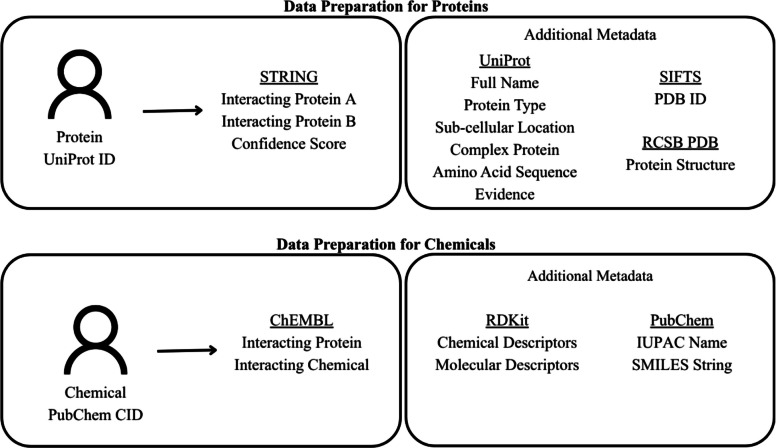
Using this curated set as a foundation, we compiled proteins, chemicals, protein–protein interactions (PPIs), and protein–chemical interactions (PCIs) from multiple public databases to generate an integrated interaction network (Fig. 1). In the resulting networks, nodes represent predefined ECS proteins or chemicals, and edges reflect experimentally supported interactions. All entities were annotated with structural and functional metadata to facilitate reproducibility and public access.
Proteins
A curated set of forty ECS-associated proteins was derived from the curated ECS framework described by Bernabò et al. (ref. 2013) and subsequently supplemented using UniProt and STRING database queries (Szklarczyk et al. ref. 2023; Ahmad et al. ref. 2025). This set includes canonical receptors CB1 and CB2, enzymes fatty acid amide hydrolase (FAAH), monoacylglycerol lipase (MAGL), and N-acyl-phosphatidylethanolamine phospholipase D (NAPE-PLD), and signaling partners. Core attributes, including amino acid sequence, sub-cellular localization, and complex membership, were retrieved from UniProt (ref. 2025). Structural mappings to the Protein Data Bank were obtained via SIFTS, and protein structures were extracted from RCSB PDB (Dana et al. ref. 2019; Berman ref. 2000). Protein–protein interactions were collected from STRING using a confidence threshold of 0.7 to reduce false positives (Szklarczyk et al. ref. 2023). STRING confidence scores integrate multiple evidence types to estimate the likelihood of a true interaction, with values approaching one indicating higher confidence. All protein entries and protein–protein interactions were derived from human (Homo sapiens) data.
Chemicals
Forty ECS-relevant chemicals were similarly derived from prior literature (Bernabò et al. ref. 2013) and included endocannabinoids anandamide (AEA) and 2-arachidonoylglycerol (2-AG), phytocannabinoids Δ9-THC and CBD, and selected eicosanoids. Chemical metadata, including IUPAC names and SMILES strings, were retrieved from the PubChem database (Kim et al. ref. 2025). Molecular descriptors, including molecular weight, partial charges, and topological fingerprints, were calculated using RDKit to serve as metadata (Landrum et al. ref. 2025). Protein-chemical interactions were defined as any experimentally supported association between a curated ECS chemical and a predefined ECS protein set. These interactions were retrieved from the ChEMBL database (Zdrazil et al. ref. 2024). No explicit filtering was applied based on quantitative affinity or activity measures (e.g., Ki, Kd, EC50, or IC50), and interactions were not weighted. Due to the heterogeneity of assay types and activity annotations in ChEMBL, all supported interactions were treated as binary edges. Additionally, since interactions reported in ChEMBL may include multiple activity records derived from different assays or studies, each protein-chemical pair was represented as a single unique association in the network.
Network construction and analysis
Three networks were constructed using NetworkX: a protein–protein only network, a protein–chemical only network, and a combined network containing all interactions (Hagberg et al. ref. 2008). We modeled the networks as unweighted, undirected graphs where edges indicate the presence of experimentally supported interactions without encoding interaction strength or causal directionality. Network topology was quantified using centrality metrics, including betweenness, closeness, degree, and eigenvector. These measures identify nodes that are highly connected, influential, or serve as critical bridges within the ECS, providing insight into the system’s organizational hierarchy (Gómez ref. 2019).
All centrality measures were computed using the NetworkX library, following its standard implementations (Hagberg et al. ref. 2008). Degree centrality was calculated as the fraction of nodes in the network to which a given node is directly connected, normalized by the maximum possible degree. Betweenness centrality was computed as the proportion of shortest paths between all node pairs that pass through a given node. Closeness centrality was defined as the reciprocal of the average shortest path length from a node to all other reachable nodes, reflecting relative topological accessibility.
Eigenvector centrality was computed using the NetworkX implementation of the power iteration method, which estimates the dominant eigenvector of the graph’s adjacency matrix. Centrality values were normalized to unit Euclidean norm, consistent with NetworkX’s default behavior. In networks with disconnected components, eigenvector centrality is calculated using the entire graph. In these situations, the dominant eigenvector is mainly influenced by the largest connected component. As a result, nodes in smaller or isolated components often receive disproportionately lower centrality values because of their limited connectivity within the overall adjacency structure (Carreras et al. ref. 2007; Van Mieghem ref. 2016). Raw normalized eigenvector centrality values were used for all analyses, without logarithmic scaling or additional transformations.
Network clustering
Functional modules within the ECS network were identified using the Louvain algorithm, which maximizes modularity by clustering nodes with preferential interactions (Li et al. ref. 2024a). This approach highlights groups of proteins and chemicals that are likely to share biological functions or participate in coordinated processes.
Network perturbations
Network robustness was evaluated by targeting the removal of specific nodes. Specifically, the nodes with the highest betweenness and degree centrality, namely the top one and top three nodes from each metric, were systematically removed to simulate the disruption of crucial, highly connected components. After each removal, the network was reassessed to determine the number of remaining interactions and connections and to evaluate changes in its overall structure. Centrality metrics were recalculated to identify shifts in the relative importance of the remaining nodes and to understand how the network reorganized in response to the loss of these critical elements (Bernabò et al. ref. 2013; Pacher and Kunos ref. 2013; Jaeger and Aloy ref. 2012).
Code and data availability
All data and code used in this study are available in a GitHub repository at https://github.com/aanyashridhar/ECS-Network.
Results
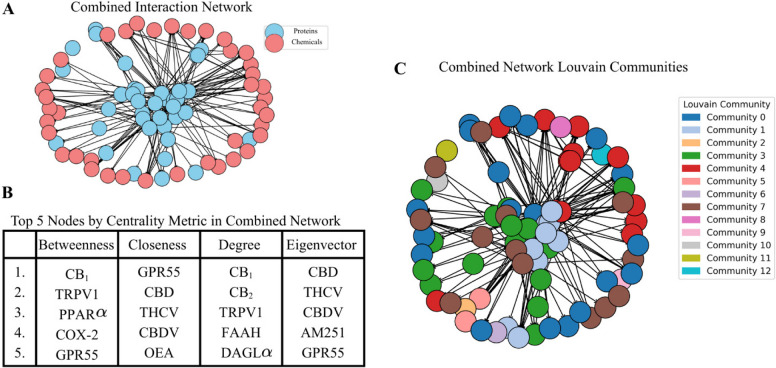
The combined ECS network was constructed from the curated ECS component from Bernabò et al. (ref. 2013) as a foundation and expanded with protein–protein and protein-chemical interactions from STRING and ChEMBL databases. This unified network comprised 80 nodes and 218 edges and served as the primary framework for subsequent analyses (Fig. 2a, Tables S1-S4). Edges were treated as unweighted and non-directional, such that the interactions represent the presence of an association without encoding interaction strength or causal directionality. In this network, proteins occupy the central core, while chemicals are positioned toward the periphery. This structural organization reflects the biological architecture of the ECS, where proteins act as molecular hubs mediating signaling and metabolic processes, and chemicals serve as ligands or substrates that connect through these central protein nodes. The resulting topology suggests that the ECS is organized around a dense protein interaction core that enables diverse chemical inputs to converge on shared molecular pathways.
For comparison, the protein–protein and protein–chemical subnetworks, analyzed separately, contained 40 nodes and 92 edges, and 80 nodes and 126 edges, respectively. These subnetworks are shown in Figures S1–S4 and Tables S1–S4, and provide additional insight into the distinct interaction patterns that contribute to the overall connectivity of the ECS.
Network centrality analysis reveals the hierarchical organization of the ECS and provides insight into connectivity and influence patterns
To understand the structural organization of the ECS network, we quantified key centrality measures that reflect node influence and connectivity (Fig. 2b, Tables S12-S13). The analysis revealed distinct patterns in how proteins and chemicals occupy topological positions within the combined network.
To evaluate the stability of these centrality metrics with respect to network composition, we performed a sensitivity analysis by removing the ten lowest-degree nodes and recalculating the centrality measures for the remaining network. This alteration had a minimal effect on the relative rankings of the highly connected nodes (Table S5), suggesting that the centrality patterns are stable and not influenced by marginal or sparsely connected components.
The five nodes with the highest betweenness centrality (Gómez ref. 2019) in the combined network were CB1, transient receptor potential vanilloid 1 (TRPV1), peroxisome proliferator-activated receptor alpha (PPARα), cyclooxygenase-2 (COX-2), and G-protein coupled receptor 55 (GPR55), in order of rank (Fig. 2b). High betweenness centrality indicates that these nodes occupy positions through which many shortest paths traverse, reflecting their topological role as connectors within the ECS network. As one of the two primary cannabinoid receptors, CB1 connects to numerous cannabinoids and signaling components, serving as a central bridge in the ECS (Howlett et al. ref. 2002; Mackie ref. 2008). The second-highest ranked node, TRPV1, though not a canonical cannabinoid receptor, is a ligand-gated ion channel that mediates pain perception, inflammation, and thermoregulation (Rosenbaum and Simon ref. 2007; Palazzo et al. ref. 2008; Cui et al. ref. 2006). It is strongly activated by cannabinoids, positioning it as a key integrative node within the ECS. The third-ranked PPARα is a nuclear receptor linking cannabinoid signaling to metabolic regulation (Iannotti and Vitale ref. 2021). The fourth-ranked enzyme, COX-2, converts endocannabinoids into prostaglandins, occupies a position connecting inflammatory and pain-related pathways (Fowler ref. 2007). Finally, GPR55, ranked fifth, is a G-protein coupled receptor (GPCR) that functions as a major non-cannabinoid receptor, reflecting its topological prominence in ECS connectivity (Ryberg et al. ref. 2007).
The five nodes with the highest closeness centrality (Gómez ref. 2019) in the combined network were GPR55, CBD, tetrahydrocannabivarin (THCV), cannabidivarin (CBDV), and oleoylethanolamide (OEA), in descending order (Fig. 2b). High closeness centrality indicates that these nodes occupy positions from which they can reach many other nodes in the network through relatively few steps, reflecting their topological centrality within the ECS network. GPR55 connects to multiple cannabinoids and receptors, resulting in short path lengths across the network (Ryberg et al. ref. 2007). CBD, THCV, and CBDV follow closely, consistent with their interactions across diverse ECS targets, including CB1, CB2, TRPV channels, and GPCRs (Blebea et al. ref. 2024). The fifth-ranked OEA, an endocannabinoid-like lipid, shares biosynthetic and signaling pathways with canonical endocannabinoids but does not bind directly to the cannabinoid receptors CB1 or CB2 (Barrie et al. ref. 2022).
Nodes ranked highest by degree centrality (Gómez ref. 2019) in the combined network were CB1, CB2, TRPV1, FAAH, and diacylglycerol lipase alpha (DAGLα), in order (Fig. 2b). High degree centrality indicates that these nodes are highly connected hubs within the network, reflecting their broad engagement across ECS components and their structural importance for maintaining network connectivity. CB1 and CB2, the two canonical cannabinoid receptors, exhibit extensive connectivity across both protein and chemical domains (Howlett et al. ref. 2002; Mackie ref. 2008). TRPV1, again, emerges as a highly connected integrator of cannabinoid and non-cannabinoid signaling (Rosenbaum and Simon ref. 2007; Palazzo ref. 2008; Cui et al. ref. 2006). The fourth-ranked FAAH, a degradation enzyme (Deutsch et al. ref. 2002), and the fifth-ranked DAGLα, a biosynthetic enzyme (Reisenberg et al. ref. 2012), occupy central positions linking metabolic processes with other network components, highlighting their topological prominence and potential importance within the ECS network.
Finally, nodes ranked highest by eigenvector centrality (Gómez ref. 2019; Carreras et al. ref. 2007; Van Mieghem ref. 2016) in the combined network were CBD, THCV, CBDV, AM251, and GPR55, in descending order (Fig. 2b). High eigenvector centrality indicates that these nodes are not only well-connected themselves but also closely linked to other influential nodes, emphasizing their role in shaping highly interactive subnetworks within the ECS. The prominence of CBD, THCV, and CBDV highlights the influence of phytocannabinoids within the network, as they engage several central receptors and enzymes (Blebea et al. ref. 2024). AM251, a synthetic CB1 antagonist, ranks fourth due to its strong association with the CB1 receptor, reflecting its frequent use in receptor-targeting studies (Rodgers et al. ref. 2005). GPR55 was also ranked among the top five, consistent with its high connectivity within the ECS interaction network (Ryberg et al. ref. 2007).
Network clustering analysis uncovers the modular architecture of the ECS and identifies biologically meaningful groupings of receptors, enzymes, and ligands
Clustering analysis identified thirteen distinct communities within the ECS network (Fig. 2c, Tables S6-S7). The largest community consisted of six proteins and fourteen chemicals, while the smallest communities included only a single node (Tables S6-S7). Although these isolated nodes were formally classified as communities by the algorithm, they do not represent meaningful biological groupings. The overall modularity of 42.77% (Table S7) falls within the expected range for biological networks (typically 30–70%) (Sah et al. ref. 2014), indicating a balance between connectivity and modular organization.
Among the identified clusters, two communities were particularly informative. The first and largest, designated community 0 (Table S6), captured the core signaling architecture of the ECS. This cluster included the two primary cannabinoid receptors (CB1 and CB2 (Haspula and Clark ref. 2020; Howlett et al. ref. 2002; Mackie ref. 2008)), PLC enzymes (phospholipase C epsilon 1 (PLCε1) and phospholipase C beta 1 (PLCβ1) (Bunney and Katan ref. 2011)), signaling partners (inhibitory Guanine nucleotide-binding protein G alpha subunits i1–3 (Gαi1-3) (Villaseca et al. ref. 2022)), numerous synthetic cannabinoids (WIN55,212–2 (Price et al. ref. 2009), WIN55,212–3 (Price et al. ref. 2009), JWH-018 (Huffman et al. ref. 1994), JWH-073 (Huffman et al. ref. 1994), JWH-133 (Huffman et al. ref. 1994), CP55,940 (Ortega et al. ref. 2015), SR141716A (Rinaldi-Carmona et al. ref. 1994), SR144528 (Rinaldi-Carmona et al. ref. 1994), and AM251 (Rodgers et al. ref. 2005)), and endocannabinoid AEA (Devane et al. ref. 1992; Lu and Mackie ref. 2016). The Gαi proteins represent intracellular signaling mediators in the ECS, while synthetic cannabinoids and AEA illustrate the diversity of ligand–receptor interactions within the system. This cluster can be viewed as the cannabinoid receptor group, showing the cannabinoid receptors and their immediate effectors clustering strongly together. This organization reinforces the biological validity of the network and demonstrates that its modular structure captures known ECS signaling relationships.
The second notable cluster, community 1 (Table S6), which is the fifth largest community, centered on enzymes and molecules involved in the metabolism of endocannabinoids. This community contained degradation enzymes (FAAH (Deutsch et al. ref. 2002), MAGL (Dinh et al. ref. 2002), α/β-hydrolase domain-containing protein 6 (ABHD6) (Marrs et al. ref. 2010; Savinainen et al. ref. 2012), and α/β-hydrolase domain-containing protein 12 (ABHD12) (Marrs et al. ref. 2010; Savinainen et al. ref. 2012)), synthesis enzymes (NAPE-PLD (Tevosian et al. ref. 2023), DAGLα (Reisenberg et al. ref. 2012), and diacylglycerol lipase beta (DAGLβ) (Reisenberg et al. ref. 2012)), non-canonical receptor GPR55 (Ryberg et al. ref. 2007; Tudurí et al. ref. 2017), transporter (fatty acid-binding protein 7 (FABP7) (Kaczocha et al. ref. 2009)), and endocannabinoid 2-AG (Lu and Mackie ref. 2016). Together, these nodes represent the metabolic group of the ECS, highlighting the tightly coupled nature of endocannabinoid synthesis, degradation, and transport. The inclusion of GPR55 within this community further underscores the functional integration of metabolic and signaling processes that maintain ECS homeostasis.
Beyond these two modules, additional multi-node communities (containing more than two nodes) also reflected distinct functional roles. Community 3 grouped nuclear receptors (PPARα, PPARδ, and PPARγ) (Iannotti and Vitale ref. 2021), lipid-binding proteins (Fatty acid-binding protein 1 (FABP1), FABP3, and FABP5) (Elmes et al. ref. 2019; Glaser et al. ref. 2023), signaling regulators (AKT1 (serine/threonine protein kinase), β-arrestin-1, and G protein-coupled receptor kinase 2 (GRK2)) (Reiter and Lefkowitz ref. 2006; Vroon et al. ref. 2006; Blando et al. ref. 2022), phytocannabinoids (Δ9-THC and Δ8-THC) (Ledvina et al. ref. 2023; Ligresti et al. ref. 2016), and lipid mediators (OEA and prostaglandin D2 (PGD2)) (Bestard-Escalas et al. ref. 2026; Kolousek et al. ref. 2023; Rahman et al. ref. 2021; Wójcik et al. ref. 2020). This organization suggests a transcriptional and signaling-integration module linking lipid-derived molecules and phytocannabinoids to nuclear receptor activation and downstream regulatory pathways (Nguyen et al. ref. 2012; Huang et al. ref. 2018; Schroeder et al. ref. 2016; Iannotti and Vitale ref. 2021; Pistis and Melis ref. 2010). Community 4 consisted of TRP channels (TRPV1–4) (Storozhuk and Zholos ref. 2018; Marzo and Petrocellis ref. 2010; De Petrocellis et al. ref. 2011; Rossi et al. ref. 2011; De Petrocellis et al. ref. 2012), several phytocannabinoids (cannabinol (CBN), cannabichromene (CBC), cannabigerol (CBG), THCV, and CBDV) (Zhang et al. ref. 2023a; Jurga et al. ref. 2024; Rezende et al. ref. 2023), endogenous lipid mediators (N-arachidonoyl dopamine (NADA), N-arachidonoyl glycine (NAGly), and palmitoylethanolamide (PEA)) (Greco et al. ref. 2022; Bradshaw et al. ref. 2009; Deveci et al. ref. 2020; Grabiec et al. ref. 2012), and N-acylethanolamine-hydrolyzing acid amidase (NAAA) (Piomelli et al. ref. 2020; Zhao et al. ref. 2007), reflecting a non-canonical cannabinoid signaling axis centered on TRP-mediated sensory and inflammatory modulation (Barrie and Manolios ref. 2017; Șerban et al. ref. 2025). Lastly, community 7 comprised enzymes involved in arachidonic acid metabolism (COX-2, arachidonic acid lipoxygenase 5 (ALOX5), ALOX12, and ALOX15) (Kolousek et al. ref. 2023; Ivanov et al. ref. 2021; Wu et al. ref. 2018; Tallima ref. 2021; Wang et al. ref. 2021; Zhang et al. ref. 2023b), their substrate arachidonic acid (AA), and downstream lipid mediators (prostaglandin 2 (PGE2), prostaglandin A2 (PGA2), leukotriene B4 (LTB4), 12-hydroxyeicosatetraenoic acid (12-HETE), and 15-HETE) (Wang et al. ref. 2021; Zhang et al. ref. 2023b; Chen et al. ref. 2023; Yamaguchi et al. ref. 2022; Biernacki and Skrzydlewska ref. 2025), representing a module associated with eicosanoid and inflammatory lipid metabolism (Biernacki and Skrzydlewska ref. 2025; Rouzer and Marnett ref. 2011). Together, these communities illustrate that the ECS network organizes into discrete yet interconnected topological modules spanning receptor signaling, lipid metabolism, transcriptional regulation, and inflammatory pathways.
Network perturbation analysis illustrates how removal of key nodes reshapes ECS connectivity, revealing patterns of topological reorganization within the interaction network
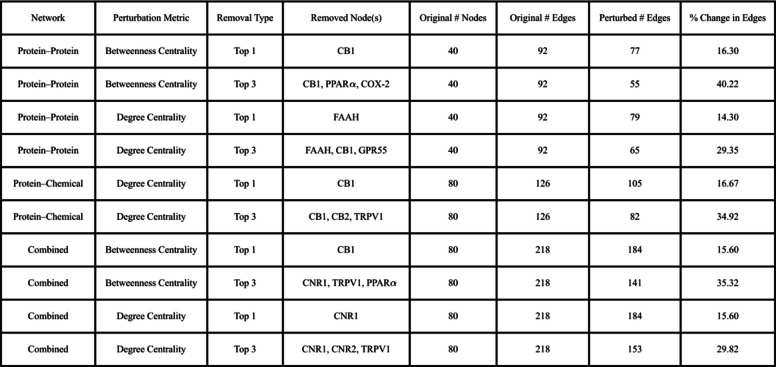
A total of four perturbations were performed for each network, including the removal of the top one node by betweenness centrality, the top three nodes by betweenness centrality, the top one node by degree centrality, and the top three nodes by degree centrality. The protein–chemical only network was limited to two perturbations because betweenness centrality relies on shortest path calculations between nodes, which are of limited interpretability in this bipartite network, where chemicals only connect to proteins, allowing only degree-based removals. Across all networks, this approach produced a total of ten perturbations (Table 1). After each perturbation, the change in the number of edges before and after node removal was calculated as a high-level indicator of network impact. Perturbation by betweenness centrality in the protein–protein only network produced the most pronounced effect, with a 40.22% reduction in edge count. In general, removing the top one node, regardless of metric, decreased edge count by approximately 14–16%, whereas removing the top three nodes caused a larger reduction of roughly 34–40%. Notably, CB1 was removed at least once in all networks, regardless of whether it was identified as a top-ranked node based on betweenness or degree centrality, underscoring its structural importance within the ECS.
Table 1: Network perturbation analysis across protein–protein, protein–chemical, and combined ECS networks. Summary of robustness simulations following targeted removal of highly central nodes (top one or top three rankings in betweenness or degree centrality). For each perturbation, the table shows the number of original nodes and edges, number of edges after perturbation, and percent change in edge count
To evaluate how influential nodes shape network organization, we performed targeted perturbations informed by centrality rankings. Nodes were selected for removal based on their rankings in betweenness and degree centrality, which capture shortest-path mediation and connectivity, respectively. For each perturbation, key centrality measures, including betweenness, closeness, degree, and eigenvector centrality, were recalculated to assess shifts in network structure. The percent change in each metric was standardized relative to the distribution of changes across all nodes. Perturbations involving the removal of the top one or top three nodes by betweenness centrality (Figs. 3 and 4) and degree centrality (Figs. 5 and 6) were used to examine how hub disruption alters network topology.
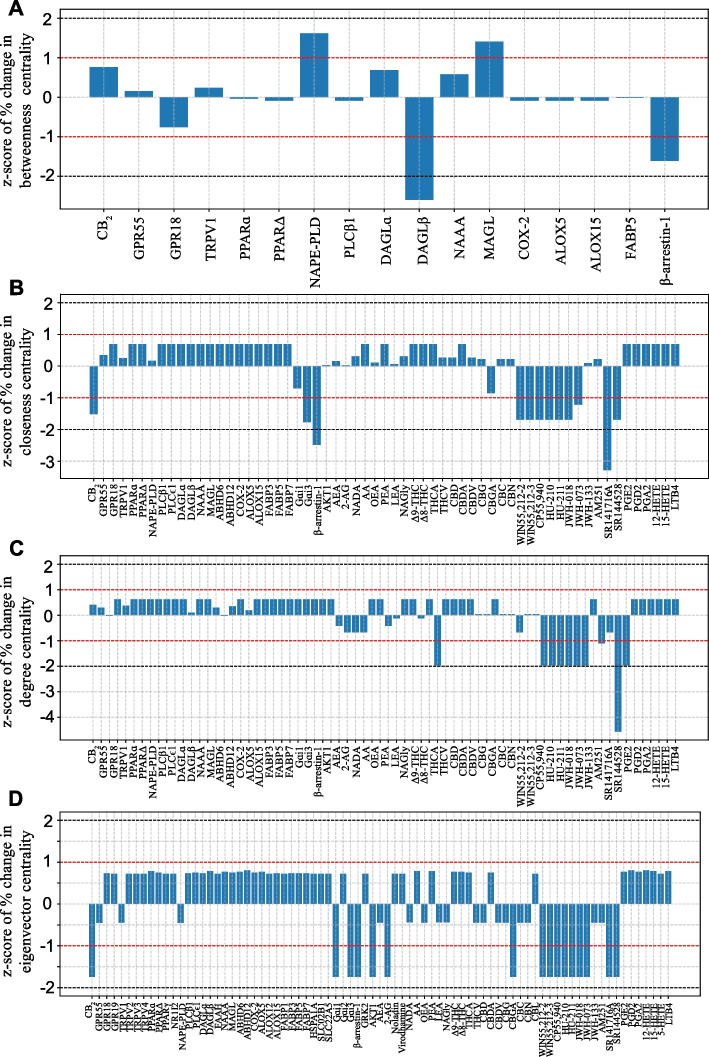
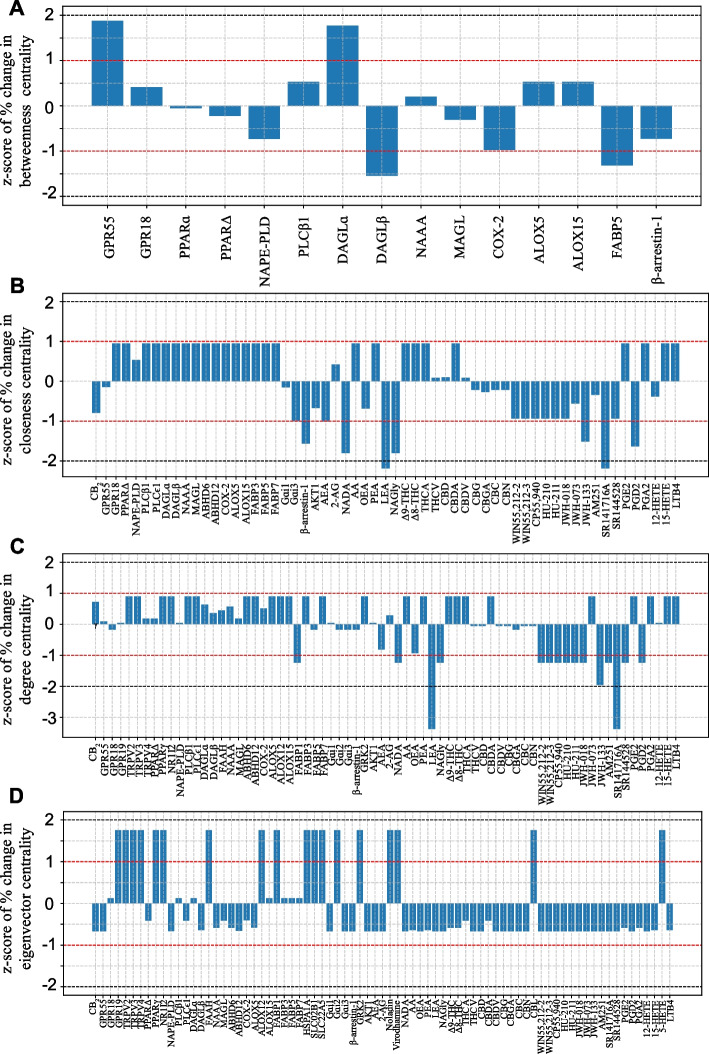
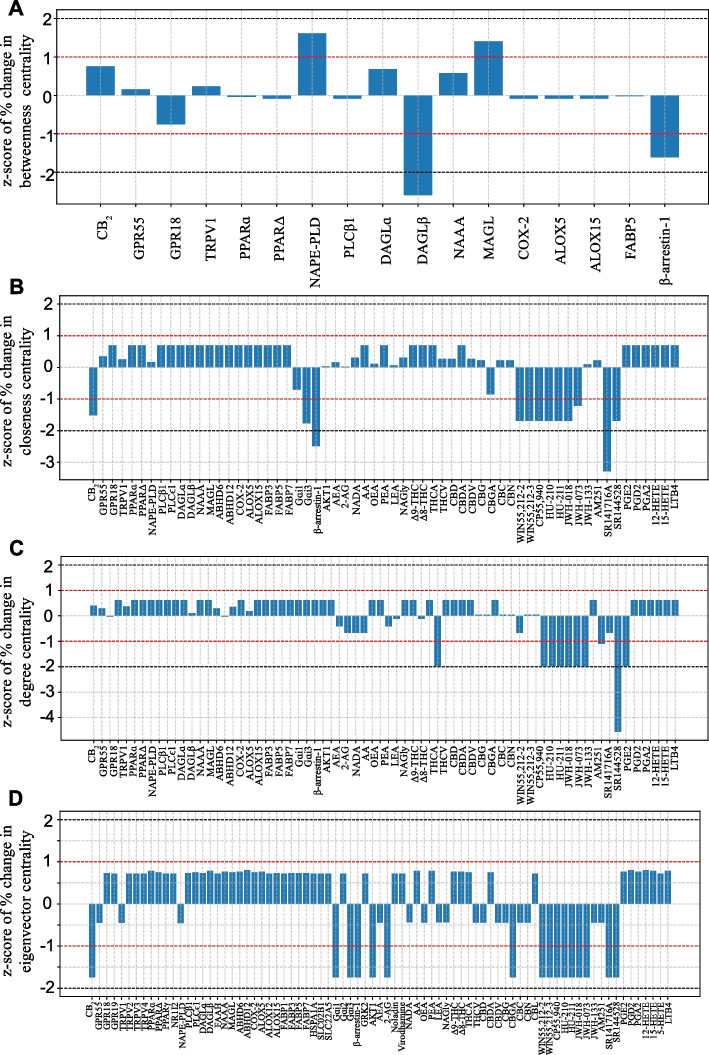
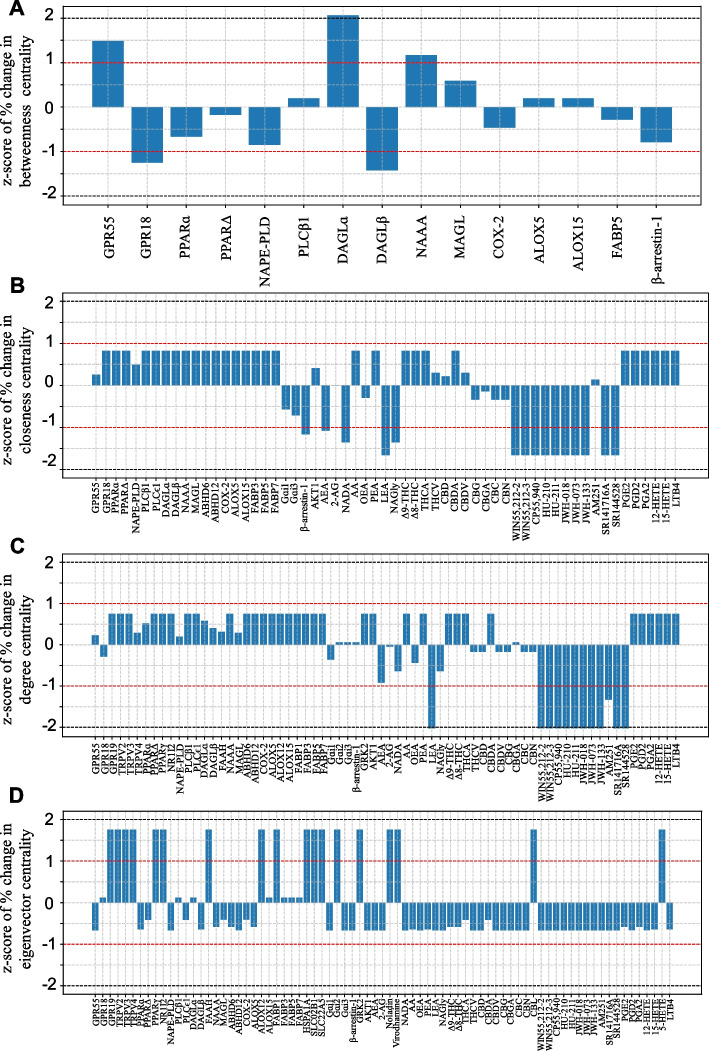
Removal of highly connected or central nodes produced marked redistribution of centrality across the remaining network. For example, in the absence of CB1, receptors CB2 (Mackie ref. 2008) and GPR55 (Ryberg et al. ref. 2007) exhibited increases in centrality (Figs. 3a, 4a, 5a, and 6a), reflecting their increased structural prominence under the altered network configuration. Conversely, degradation enzymes such as DAGLβ (Reisenberg et al. ref. 2012) showed decreases in betweenness centrality by over two standard deviations (Figs. 3a and 5a), indicating reduced positional influence following CB1 removal. Similarly, the endocannabinoid-like lipid LEA (Barrie et al. ref. 2022) exhibited a drop in closeness centrality by nearly two standard deviations following the removal of the top-ranked nodes (Figs. 4b and 6b), reflecting decreased topological accessibility within the perturbed network. These shifts indicate that node centrality is sensitive to hub disruption and highlight components whose structural roles depend on the presence of dominant connectors.
Synthetic cannabinoids, including WIN55,212–2 (Price et al. ref. 2009), WIN55,212–3 (Price et al. ref. 2009), JWH-018 (Huffman et al. ref. 1994), JWH-073 (Huffman et al. ref. 1994), JWH-133 (Huffman et al. ref. 1994), HU-210 (Ottani and Giuliani ref. 2001), HU-211 (Ottani and Ortega Giuliani ref. 2001), CP55,940 (Ortega et al. ref. 2015), SR141716A (Rinaldi-Carmona et al. ref. 1994), and SR144528 (Rinaldi-Carmona et al. ref. 1994), exhibited significant decreases in network metrics following node removal (Figs. 3c, 4c, 5c, and 6c). For example, removing the top ranked node based on both betweenness and degree centrality caused the degree centrality values of these compounds to decrease significantly, as shown in Figs. 3c and 5c. Several synthetic cannabinoids dropped in degree centrality by nearly two standard deviations, with SR141716A decreasing by over four standard deviations (Figs. 3c and 5c). These results reflect the strong topological dependence of these ligands on highly connected receptor nodes within the current interaction map.
Finally, a comparison of eigenvector centrality changes following the removal of the top one versus the top three nodes by degree centrality revealed a redistribution of influence (Figs. 3d, 4d, 5d, and 6d). Removal of a single top node led to substantial decreases in centrality across many nodes, consistent with reduced cohesion around a dominant hub. In contrast, removing the top three nodes produced positive shifts in eigenvector centrality, indicating a reallocation of structural prominence within the network. This pattern suggests that, in the absence of dominant hubs, alternative nodes assume higher relative centrality within the perturbed configuration. These results should be interpreted as structural shifts within a static network rather than evidence of functional compensation or biological resilience.
Discussion
The ECS network presented here was constructed from a manually curated component set grounded in the study by Bernabò et al. (ref. 2013) and subsequently expanded using established databases. The network constructed in this study incorporates protein–protein and protein-chemical interactions retrieved from STRING and ChEMBL databases, respectively, building on the curated ECS components from Bernabò et al. (ref. 2013). While this approach provides biological relevance and conceptual consistency, it necessarily reflects the current state of ECS research. As with any literature-informed curation strategy, the resulting network may be influenced by publication bias, uneven experimental characterization, and database coverage (Wodak et al. ref. 2013; Snider et al. ref. 2015; Schaefer et al. ref. 2015; Gillis et al. ref. 2014; Prakash et al. ref. 2007; Schnoes et al. ref. 2013). Proteins and chemicals that are more extensively characterized may exhibit higher connectivity within the network, reflecting both their biological importance and the depth of experimental investigation available in current literature and databases (Wodak et al. ref. 2013; Snider et al. ref. 2015; Schaefer et al. ref. 2015; Gillis et al. ref. 2014; Schnoes et al. ref. 2013). Accordingly, this network should not be considered a complete or exhaustive representation of the ECS, but rather a structured approximation based on currently available data. Nevertheless, the integrated dataset provides a sufficiently robust foundation for examining the organizational and topological properties of the ECS at a systems level.
Protein–protein interactions were identified among the ECS proteins based on the components from Bernabò et al. (ref. 2013) and expanded with STRING interactions filtered by a specified confidence threshold to prioritize higher-confidence associations. STRING aggregates evidence from curated experimental data, database annotations, co-expression analyses, text mining, and computational inference (Szklarczyk et al. ref. 2023). Although applying a confidence cutoff reduces the inclusion of lower-support interactions, the resulting PPI layer may still contain indirect or functionally inferred associations that do not necessarily correspond to direct physical binding events (Wodak et al. ref. 2013; Snider et al. ref. 2015; Gillis et al. ref. 2014). Thus, the PPI component of the network represents high-confidence literature-supported and computationally integrated relationships within the curated ECS protein set, rather than an exclusively structure-resolved interactome (Wodak et al. ref. 2013; Snider et al. ref. 2015; Gillis et al. ref. 2014; Schnoes et al. ref. 2013). Emerging large-scale and structure-informed interaction datasets, including 3D interaction mapping and deep learning–based PPI prediction frameworks (Baranwal et al. ref. 2022; Wu et al. ref. 2023a; Patel et al. ref. 2017; Xiong et al. ref. 2025; Fang et al. ref. 2021), may further refine ECS network resolution in future work by distinguishing direct molecular interfaces and expanding interaction coverage.
Protein–chemical interactions in the present network reflect curated literature-supported associations rather than quantitative pharmacological parameters (Bernabò et al. ref. 2013). Because ChEMBL integrates diverse assay types, including binding and functional studies conducted across varying experimental contexts, individual interactions may differ substantially in affinity, efficacy, and physiological relevance (Zdrazil et al. ref. 2024). For example, ChEMBL captures interactions derived from assays such as ligand binding affinity measurements (e.g., Ki or Kd), functional activity assays (e.g., EC50 or IC50) and cellular response studies conducted under various experimental conditions. By representing these heterogeneous measurements as binary edges, the current framework emphasizes structural connectivity over biochemical precision. While this abstraction enables global topological analysis, it does not distinguish between high-affinity canonical interactions and weaker or context-dependent associations. Incorporating affinity-weighted edges or multilayer representations would allow future studies to more directly model pharmacological strength and signaling specificity (Zheng et al. ref. 2019; Berenstein et al. ref. 2016; Zhang et al. ref. 2016; Jiang et al. ref. 2022; Cheng et al. ref. 2012).
In addition, all interactions were modeled as unweighted and non-directional edges. This abstraction enables global topological analyses but does not capture interaction strength, binding affinity, temporal dynamics, or signaling directionality (Bosque et al. ref. 2014; Martínez et al. ref. 2023; Gursoy et al. ref. 2008; Wuchty ref. 2006). Consequently, measures such as degree or betweenness centrality reflect structural prominence within the curated interaction framework rather than quantitative biochemical influence or causal regulatory flow. This simplification of interactions in the network limits the extent to which signaling dynamics, interaction strength, and directional effects can be inferred, and highlights the importance of integrating additional data sources to develop more detailed and context-specific ECS models. Future extensions incorporating weighted edges, context-specific interaction strengths, or directed signaling relationships could provide a more mechanistic representation of ECS dynamics (Berenstein et al. ref. 2016; Zhang et al. ref. 2016; Jiang et al. ref. 2022; Cheng et al. ref. 2012; Wuchty ref. 2006; Nasser et al. ref. 2011; Rush and Repsilber ref. 2018; Chen et al. ref. 2021; Li et al. ref. 2024b). Despite these limitations, the current network offers a systematic and reproducible framework for interrogating ECS organization at a systems level.
Our network-based analysis demonstrates how centrality measures can systematically identify nodes with high topological prominence within the ECS interaction network. Distinct patterns emerged across various metrics. Betweenness and degree centrality highlighted both canonical and non-canonical proteins, including CB1, TRPV1, PPARα, COX-2, FAAH, and DAGLα, indicating their roles as hubs or connectors within the network. In contrast, closeness and eigenvector centrality highlighted chemicals such as CBD, THCV, and CBDV, demonstrating their extensive network reach and connectivity (see Fig. 2b and Table S13). The consistent top rankings of CB1, CB2, and GPR55 across multiple centrality metrics reflect their central positions in the curated ECS framework rather than pre-assigned biological weighting. Collectively, these findings illustrate that ECS organization arises from a combination of highly connected receptors, metabolic enzymes, and ligands that integrate receptor-mediated, metabolic, and signaling pathways. By highlighting both canonical and non-canonical nodes, these centrality-based insights provide a framework for prioritizing experimental studies to understand network-level relationships, structural dependencies, and potential targets for pharmacological exploration.
Clustering analysis revealed a modular yet interconnected architecture of the ECS network (Fig. 2c, Figures S3–S4, Tables S6–S11). The network’s connectivity alone was sufficient to uncover biologically coherent functional groupings. Rather than being randomly organized, the network is divided into communities that correspond to key areas such as receptor signaling, endocannabinoid synthesis and degradation, transcriptional regulation, non-canonical signaling mediated by TRP channels, and inflammatory pathways derived from arachidonic acid. This organization highlights that the ECS is structured around functional modules, which remain interconnected through shared ligands, enzymes, and signaling intermediates (Lu and Mackie ref. 2021; Sikyta et al. ref. 2024; Barrie and Manolios ref. 2019; Campolongo and Trezza ref. 2012; Dörnyei et al. ref. 2023; Bernabò et al. ref. 2013; Pistis and Melis ref. 2010; Rezende et al. ref. 2023; Șerban et al. ref. 2025). By delineating distinct yet interacting communities, this framework offers a structured basis for hypothesis-driven investigations and can serve as a guide for future studies focused on specific clusters and their constituent nodes when examining receptor regulation, metabolic flux, transcriptional control, or inflammatory crosstalk. Integrating contextual layers into future network models, such as tissue-specific expression patterns or condition-dependent interactions (Zheng et al. ref. 2019; Berenstein et al. ref. 2016; Zhang et al. ref. 2016; Nasser et al. ref. 2011; Rush and Repsilber ref. 2018; Chen et al. ref. 2021; Li et al. ref. 2024b), could further refine these modules and clarify how ECS connectivity may vary across physiological and pathological states.
Our perturbation analysis indicates that removing highly connected nodes alters the topological structure of the ECS interaction network. Consistent with previous research describing the ECS as a scale-free network (Bernabò et al. ref. 2013), a small subset of highly connected nodes exerts a disproportionate influence on overall connectivity. The targeted removal of these nodes redistributes centrality across the remaining network, increasing the relative importance of some components while decreasing that of others. For instance, after the removal of CB1, receptors such as CB2 and GPR55 showed increased centrality, whereas certain enzymes like DAGLβ and endocannabinoid-like lipids like LEA showed reduced positional influence. These changes reflect a reconfiguration of the shortest paths and connectivity patterns within the static interaction map, rather than a functional compensation.
Importantly, such perturbation-driven changes identify nodes whose structural roles are contingent upon the presence of dominant hubs and highlight components that assume greater topological prominence under altered configurations. While these results do not imply biological resilience or adaptive signaling responses, they provide a systematic framework for prioritizing hypothesis-driven investigations. Nodes that increase in centrality following hub removal, such as CB2 and GPR55, may represent underexplored components whose influence is revealed under perturbed conditions. Conversely, nodes that exhibit substantial decreases in centrality, like DAGLβ and LEA, may reflect interaction patterns highly dependent on specific connectors. Together, these observations offer a network-based strategy for selecting candidate proteins or ligands for experimental validation, mechanistic study, or therapeutic exploration within the broader context of ECS-related signaling and cross-talk (Zheng et al. ref. 2019; Nada et al. ref. 2024; Carels et al. ref. 2023; Ruffner et al. ref. 2007; Tiwari and Dwivedi ref. 2019).
GPR55 consistently ranked among the top nodes across multiple centrality measures, indicating strong structural prominence within the ECS interaction network. In the combined network comprising 80 nodes, GPR55 ranked among the top five nodes for betweenness (5th), closeness (1st), degree (5th), and eigenvector centrality (5th), exceeding the rankings of other non-canonical GPCRs such as GPR18 and GPR119, which were placed substantially lower across these measures (Table S14). These patterns were even more pronounced in the protein–protein network (40 nodes), where GPR55 ranked first in both closeness and eigenvector centrality and third in degree centrality (Table S14). Its normalized eigenvector centrality score approached 1.0, reflecting strong connectivity to other highly ranked nodes within the defined ECS network. In this context, high eigenvector centrality indicates that GPR55 is embedded within densely connected regions of the network, emphasizing its topological prominence.
Consistent with these structural observations, perturbation analysis showed that removal of CB1 increased GPR55’s relative centrality ranking, indicating that its positional prominence becomes more pronounced under altered network configurations. These shifts reflect the redistribution of centrality within the static interaction map rather than evidence of biological compensation. Together, these findings identify GPR55 as a structurally central component within the curated ECS framework. Independent experimental studies have implicated GPR55 in cannabinoid-responsive signaling and diverse physiological processes such as synaptic signaling and inflammatory responses (Ryberg et al. ref. 2007; Lauckner et al. ref. 2008; Kargl et al. ref. 2012). While the present analysis does not assign functional significance, the consistent topological prominence of GPR55 across network configurations supports its prioritization for further hypothesis-driven experimental investigation within ECS-related signaling contexts.
Although we constructed a systems-level network of the ECS by integrating experimentally validated interactions between proteins and chemical compounds, this network has inherent limitations that restrict functional interpretation. The network captures structural connectivity and organizational patterns, illustrating how key nodes and interactions shape network topology (Fig. 2a and b), how molecular components cluster into coherent communities (Fig. 2c), and how perturbation of specific nodes redistributes centrality and connectivity (Table 1, Figs. 3, 4, 5, 6). However, it does not incorporate interaction directionality, signaling dynamics, or context-dependent regulation, limiting insights to structural topology rather than functional activity.
Looking forward, this framework lays the groundwork for several avenues of future investigation and addresses key gaps in ECS research. Incorporating interaction directionality, experimentally measured interaction strengths, signaling dynamics, and tissue- or context-specific interactions (Zheng et al. ref. 2019; Berenstein et al. ref. 2016; Zhang et al. ref. 2016; Jiang et al. ref. 2022; Cheng et al. ref. 2012; Wuchty ref. 2006; Nasser et al. ref. 2011; Rush and Repsilber ref. 2018) would enable predictive modeling of ECS responses to endogenous ligands, phytocannabinoids, and synthetic compounds, capabilities that remain largely unexplored in current studies (Bernabò et al. ref. 2013; Bernabò et al. ref. 2014; Liu et al. ref. 2024). Complementary network approaches, such as network proximity analysis, could quantify distances between ECS nodes and disease-associated or drug-target modules, revealing potential cross-talk with other signaling pathways and informing therapeutic strategies (Wu et al. ref. 2023b; Han et al. ref. 2024; Brohée et al. ref. 2008; Cheng et al. ref. 2018). Moreover, perturbation- and centrality-driven analyses can prioritize understudied or structurally sensitive nodes, providing a systematic framework for hypothesis-driven experiments to test their roles in ECS connectivity, signaling, and pharmacological modulation. By combining these approaches, future studies could substantially expand both the conceptual and practical impact of ECS network mapping, uncovering non-obvious regulatory components, identifying candidate targets for experimental validation, and guiding the design of interventions that leverage network topology for translational or therapeutic benefit.
Conclusion
In this study, we characterized the endocannabinoid system (ECS) as an integrated molecular interaction network using computational, topology-driven analyses. Centrality measures revealed structurally prominent canonical and non-canonical receptors, while community detection demonstrated that the ECS is organized into modular yet interconnected clusters corresponding to receptor-mediated signaling and endocannabinoid metabolic processes. Targeted perturbation of highly connected nodes further clarified how topological influence is redistributed within the network, enabling identification of configuration-dependent components that may warrant deeper experimental investigation. Overall, this work establishes a structural foundation for understanding ECS organization and provides a scalable framework for future studies incorporating additional molecular entities, interaction directionality, signaling dynamics, and tissue-specific context to advance mechanistic and translational research.
Supplementary Materials
References
- S Ahmad, J da Costa Gonzales L, EH Bowler-Barnett, DL Rice, M Kim, S Wijerathne. The UniProt website API: facilitating programmatic access to protein knowledge. Nucleic Acids Res, 2025. [DOI | PubMed]
- M Baranwal, A Magner, J Saldinger, ES Turali-Emre, P Elvati, S Kozarekar. Struct2Graph: a graph attention network for structure based predictions of protein–protein interactions. BMC Bioinformatics, 2022. [DOI | PubMed]
- N Barrie, N Manolios. The endocannabinoid system in pain and inflammation: its relevance to rheumatic disease. Eur J Rheumatol, 2019. [DOI]
- N Barrie, N Manolios, J Stuart, T Chew, J Arnold, R Sadsad. Design and function of targeted endocannabinoid nanoparticles. Sci Rep, 2022. [DOI | PubMed]
- N Barrie, N Manolios. The endocannabinoid system in pain and inflammation: its relevance to rheumatic disease. Eur J Rheumatol, 2017. [DOI | PubMed]
- AJ Berenstein, MP Magariños, A Chernomoretz, F Agüero. A multilayer network approach for guiding drug repositioning in neglected diseases. PLoS Negl Trop Dis, 2016. [DOI | PubMed]
- HM Berman. The Protein Data Bank. Nucleic Acids Res, 2000. [DOI | PubMed]
- N Bernabò, B Barboni, M Maccarrone. Systems biology analysis of the endocannabinoid system reveals a scale-free network with distinct roles for Anandamide and 2-Arachidonoylglycerol. OMICS, 2013. [DOI | PubMed]
- N Bernabò, B Barboni, M Maccarrone. The biological networks in studying cell signal transduction complexity: the examples of sperm capacitation and of endocannabinoid system. Comput Struct Biotechnol J, 2014. [DOI | PubMed]
- J Bestard-Escalas, O Sasportes, H Ameraoui, M González-Nicolau, M Alhouayek, GG Muccioli. The endocannabinoid-derived prostaglandin glycerol esters and prostaglandin ethanolamides modulate intestinal epithelial hallmarks of colitis. Biochimica Et Biophysica Acta (BBA) – Molecular and Cell Biology of Lipids, 2026. [DOI | PubMed]
- M Biernacki, E Skrzydlewska. Metabolic pathways of eicosanoids—derivatives of arachidonic acid and their significance in skin. Cell Mol Biol Lett, 2025. [DOI | PubMed]
- S Blando, I Raffaele, L Chiricosta, A Valeri, A Gugliandolo, S Silvestro. Cannabidiol promotes neuronal differentiation using Akt and Erk pathways triggered by Cb1 signaling. Molecules, 2022. [DOI | PubMed]
- NM Blebea, AI Pricopie, RA Vlad, G Hancu. Phytocannabinoids: exploring pharmacological profiles and their impact on therapeutical use. Int J Mol Sci, 2024. [DOI | PubMed]
- G Bosque, A Folch-Fortuny, J Picó, A Ferrer, SF Elena. Topology analysis and visualization of Potyvirus protein-protein interaction network. BMC Syst Biol, 2014. [DOI | PubMed]
- HB Bradshaw, N Rimmerman, S Hu, VM Benton, JM Stuart, K Masuda. The endocannabinoid anandamide is a precursor for the signaling lipid N-arachidonoyl glycine by two distinct pathways. BMC Biochem, 2009. [DOI | PubMed]
- S Brohée, K Faust, G Lima-Mendez, G Vanderstocken, J van Helden. Network analysis tools: from biological networks to clusters and pathways. Nat Protoc, 2008. [DOI | PubMed]
- TD Bunney, M Katan. PLC regulation: emerging pictures for molecular mechanisms. Trends Biochem Sci, 2011. [DOI | PubMed]
- P Campolongo, V Trezza. The endocannabinoid system: a key modulator of emotions and cognition. Front Behav Neurosci., 2012. [DOI | PubMed]
- N Carels, D Sgariglia, MGV Junior, CR Lima, FRG Carneiro, GF da Silva. A strategy utilizing protein–protein interaction hubs for the treatment of cancer diseases. Int J Mol Sci, 2023. [DOI | PubMed]
- Carreras I, Miorandi D, Canright GS, Engø-Monsen K. Eigenvector Centrality in Highly Partitioned Mobile Networks: Principles and Applications. In. 2007. p. 123–45. 10.1007/978-3-540-72693-7_7
- BG Chavez, JC D’Auria. Turning a new leaf on cannabinoids. Nat Plants, 2023. [DOI | PubMed]
- C Chen, L Jiang, B Shen, M Wang, CH Griffin, VM Chinchilli. A computational atlas of tissue-specific regulatory networks. Front Syst Biol, 2021. [DOI]
- HC Chen, WC Chang, JY Chuang, KY Chang, JP Liou, TI Hsu. The complex role of eicosanoids in the brain: implications for brain tumor development and therapeutic opportunities. Biochimica Et Biophysica Acta (BBA) – Reviews on Cancer, 2023. [DOI | PubMed]
- F Cheng, RJ Desai, DE Handy, R Wang, S Schneeweiss, AL Barabási. Network-based approach to prediction and population-based validation of in silico drug repurposing. Nat Commun, 2018. [DOI | PubMed]
- F Cheng, Y Zhou, W Li, G Liu, Y Tang. Prediction of chemical-protein interactions network with weighted network-based inference method. PLoS ONE, 2012. [DOI | PubMed]
- M Cui, P Honore, C Zhong, D Gauvin, J Mikusa, G Hernandez. TRPV1 receptors in the CNS play a key role in broad-spectrum analgesia of TRPV1 antagonists. J Neurosci, 2006. [DOI | PubMed]
- JM Dana, A Gutmanas, N Tyagi, G Qi, C O’Donovan, M Martin. SIFTS: updated Structure Integration with Function, Taxonomy and Sequences resource allows 40-fold increase in coverage of structure-based annotations for proteins. Nucleic Acids Res, 2019. [DOI | PubMed]
- L De Petrocellis, A Ligresti, AS Moriello, M Allarà, T Bisogno, S Petrosino. Effects of cannabinoids and cannabinoid-enriched Cannabis extracts on TRP channels and endocannabinoid metabolic enzymes. Br J Pharmacol, 2011. [DOI | PubMed]
- L De Petrocellis, P Orlando, AS Moriello, G Aviello, C Stott, AA Izzo. Cannabinoid actions at TRPV channels: effects on TRPV3 and TRPV4 and their potential relevance to gastrointestinal inflammation. Acta Physiol, 2012. [DOI]
- DG Deutsch, N Ueda, S Yamamoto. The fatty acid amide hydrolase (FAAH). Prostaglandins, Leukotrienes and Essential Fatty Acids (PLEFA), 2002. [DOI]
- WA Devane, L Hanuš, A Breuer, RG Pertwee, LA Stevenson, G Griffin. Isolation and structure of a brain constituent that binds to the cannabinoid receptor. Science, 1992. [DOI | PubMed]
- A Deveci, J Hasna, A Bouron. Inhibition of store-operated calcium channels by N-arachidonoyl glycine (NAGly): no evidence for the involvement of lipid-sensing G protein coupled receptors. Sci Rep, 2020. [DOI | PubMed]
- V Di Marzo. Targeting the endocannabinoid system: to enhance or reduce?. Nat Rev Drug Discov, 2008. [DOI | PubMed]
- TP Dinh, D Carpenter, FM Leslie, TF Freund, I Katona, SL Sensi. Brain monoglyceride lipase participating in endocannabinoid inactivation. Proc Natl Acad Sci, 2002. [DOI | PubMed]
- G Dörnyei, Z Vass, CB Juhász, GL Nádasy, L Hunyady, M Szekeres. Role of the endocannabinoid system in metabolic control processes and in the pathogenesis of metabolic syndrome: an update. Biomedicines, 2023. [DOI | PubMed]
- MW Elmes, LE Prentis, LL McGoldrick, CJ Giuliano, JM Sweeney, OM Joseph. FABP1 controls hepatic transport and biotransformation of Δ9-THC. Sci Rep, 2019. [DOI | PubMed]
- J Fang, P Zhang, Y Zhou, CW Chiang, J Tan, Y Hou. Endophenotype-based in silico network medicine discovery combined with insurance record data mining identifies sildenafil as a candidate drug for Alzheimer’s disease. Nat Aging, 2021. [DOI | PubMed]
- CJ Fowler. The contribution of cyclooxygenase‐2 to endocannabinoid metabolism and action. Br J Pharmacol, 2007. [DOI | PubMed]
- ST Glaser, K Jayanetti, S Oubraim, A Hillowe, E Frank, J Jong. Fatty acid binding proteins are novel modulators of synaptic epoxyeicosatrienoic acid signaling in the brain. Sci Rep, 2023. [DOI | PubMed]
- J Gillis, S Ballouz, P Pavlidis. Bias tradeoffs in the creation and analysis of protein–protein interaction networks. J Proteomics, 2014. [DOI | PubMed]
- Gómez S. Centrality in Networks: Finding the Most Important Nodes. In: Business and Consumer Analytics: New Ideas. Cham: Springer International Publishing; 2019. p. 401–33. 10.1007/978-3-030-06222-4_8
- U Grabiec, M Koch, S Kallendrusch, R Kraft, K Hill, C Merkwitz. The endocannabinoid N-arachidonoyldopamine (NADA) exerts neuroprotective effects after excitotoxic neuronal damage via cannabinoid receptor 1 (CB1). Neuropharmacology, 2012. [DOI | PubMed]
- R Greco, C Demartini, AM Zanaboni, M Francavilla, R De Icco, L Ahmad. The endocannabinoid system and related lipids as potential targets for the treatment of migraine‐related pain. Headache, 2022. [DOI | PubMed]
- T Gülck, BL Møller. Phytocannabinoids: origins and biosynthesis. Trends Plant Sci, 2020. [DOI | PubMed]
- A Gursoy, O Keskin, R Nussinov. Topological properties of protein interaction networks from a structural perspective. Biochem Soc Trans, 2008. [DOI | PubMed]
- Hagberg AA, Schult DA, Swart PJ. Exploring Network Structure, Dynamics, and Function using NetworkX. In: Varoquaux G, Vaught T, Millman J, editors. Proceedings of the 7th Python in Science Conference. Pasadena, CA USA; 2008. p. 11–5.
- M Han, S Jung, D Lee. Drug repurposing for Parkinson’s disease by biological pathway based edge-weighted network proximity analysis. Sci Rep, 2024. [DOI | PubMed]
- D Haspula, MA Clark. Cannabinoid receptors: an update on cell signaling, pathophysiological roles and therapeutic opportunities in neurological, cardiovascular, and inflammatory diseases. Int J Mol Sci, 2020. [DOI | PubMed]
- E Hoch, ND Volkow, CM Friemel, V Lorenzetti, TP Freeman, W Hall. Cannabis, cannabinoids and health: a review of evidence on risks and medical benefits. Eur Arch Psychiatry Clin Neurosci, 2025. [DOI | PubMed]
- AC Howlett, F Barth, TI Bonner, G Cabral, P Casellas, WA Devane. International union of pharmacology. XXVII. Classification of cannabinoid receptors. Pharmacol Rev, 2002. [DOI | PubMed]
- H Huang, AL McIntosh, GG Martin, LJ Dangott, AB Kier, F Schroeder. Structural and functional interaction of Δ 9 -Tetrahydrocannabinol with Liver Fatty Acid Binding Protein (FABP1). Biochemistry, 2018. [DOI | PubMed]
- JW Huffman, D Dai, BR Martin, DR Compton. Design, synthesis and pharmacology of cannabimimetic indoles. Bioorg Med Chem Lett, 1994. [DOI]
- FA Iannotti, RM Vitale. The endocannabinoid system and PPARs: focus on their signalling crosstalk, action and transcriptional regulation. Cells, 2021. [DOI | PubMed]
- I Ivanov, KR Kakularam, EV Shmendel, M Rothe, P Aparoy, D Heydeck. Oxygenation of endocannabinoids by mammalian lipoxygenase isoforms. Biochimica Et Biophysica Acta (BBA) – Molecular and Cell Biology of Lipids, 2021. [DOI | PubMed]
- S Jaeger, P Aloy. From protein interaction networks to novel therapeutic strategies. IUBMB Life, 2012. [DOI | PubMed]
- M Jiang, S Wang, S Zhang, W Zhou, Y Zhang, Z Li. Sequence-based drug-target affinity prediction using weighted graph neural networks. BMC Genomics, 2022. [DOI | PubMed]
- M Jurga, A Jurga, K Jurga, B Kaźmierczak, K Kuśmierczyk, M Chabowski. Cannabis-based phytocannabinoids: overview, mechanism of action, therapeutic application, production, and affecting environmental factors. Int J Mol Sci, 2024. [DOI | PubMed]
- M Kaczocha, ST Glaser, DG Deutsch. Identification of intracellular carriers for the endocannabinoid anandamide. Proc Natl Acad Sci, 2009. [DOI | PubMed]
- J Kargl, N Balenga, GP Parzmair, AJ Brown, A Heinemann, M Waldhoer. The cannabinoid receptor CB1 modulates the signaling properties of the Lysophosphatidylinositol Receptor GPR55. J Biol Chem, 2012. [DOI | PubMed]
- S Kim, J Chen, T Cheng, A Gindulyte, J He, S He. PubChem 2025 update. Nucleic Acids Res, 2025. [DOI | PubMed]
- A Kolousek, E Pak-Harvey, O Liu-Lam, M White, P Smith, F Henning. The effects of endogenous cannabinoids on the Mammalian Respiratory System: a scoping review of Cyclooxygenase-dependent pathways. Cannabis Cannabinoid Res, 2023. [DOI | PubMed]
- G Kunos, D Osei-Hyiaman, J Liu, G Godlewski, S Bátkai. Endocannabinoids and the control of energy homeostasis. J Biol Chem, 2008. [DOI | PubMed]
- Landrum G, Tosco P, Kelley B, Rodriguez R, Cosgrove D, Vianello R, et al. rdkit/rdkit: 2025_09_1 (Q3 2025) Release. Zenodo; 2025. Available from: 10.5281/zenodo.17232453.
- JE Lauckner, JB Jensen, HY Chen, HC Lu, B Hille, K Mackie. GPR55 is a cannabinoid receptor that increases intracellular calcium and inhibits M current. Proc Natl Acad Sci U S A, 2008. [DOI | PubMed]
- KR Ledvina, E Suelzer, AT El-Alfy. Delta-8-tetrahydrocannabinol: a phytocannabinoid on the rise. RPS Pharm Pharmacol Rep, 2023. [DOI]
- Li J, Lai S, Shuai Z, Tan Y, Jia Y, Yu M, et al. A comprehensive review of community detection in graphs. 2024a. Available from: https://arxiv.org/abs/2309.11798.
- Z Li, G Liu, X Yang, M Shu, W Jin, Y Tong. An atlas of cell-type-specific interactome networks across 44 Human tumor types. Genome Med, 2024. [DOI | PubMed]
- A Ligresti, L De Petrocellis, V Di Marzo. From phytocannabinoids to Cannabinoid Receptors and endocannabinoids: pleiotropic physiological and pathological roles through complex pharmacology. Physiol Rev, 2016. [DOI | PubMed]
- Y Liu, H Xing, Y Zhang, Y Song. The endocannabinoid system in Alzheimer’s disease: a network meta‐analysis. J Neurosci, 2024. [DOI]
- HC Lu, K Mackie. Review of the endocannabinoid system. Biol Psychiatry Cogn Neurosci Neuroimaging, 2021. [DOI | PubMed]
- HC Lu, K Mackie. An introduction to the endogenous cannabinoid system. Biol Psychiatry, 2016. [DOI | PubMed]
- K Mackie. Cannabinoid receptors: where they are and what they do. J Neuroendocrinol, 2008. [DOI | PubMed]
- WR Marrs, JL Blankman, EA Horne, A Thomazeau, YH Lin, J Coy. The serine hydrolase ABHD6 controls the accumulation and efficacy of 2-AG at cannabinoid receptors. Nat Neurosci, 2010. [DOI | PubMed]
- F Martínez, JL Carrasco, C Toft, J Hillung, S Giménez-Santamarina, L Yenush. A binary interaction map between turnip mosaic virus and Arabidopsis thaliana proteomes. Commun Biol, 2023. [DOI | PubMed]
- V Marzo, L Petrocellis. Endocannabinoids as Regulators of Transient Receptor Potential (TRP)channels: a further opportunity to develop new endocannabinoid-based therapeutic drugs. Curr Med Chem, 2010. [DOI | PubMed]
- G Mick, P Douek. Clinical benefits and safety of medical cannabis products: a narrative review on natural extracts. Pain Ther, 2024. [DOI | PubMed]
- H Nada, Y Choi, S Kim, KS Jeong, NA Meanwell, K Lee. New insights into protein–protein interaction modulators in drug discovery and therapeutic advance. Signal Transduct Target Ther, 2024. [DOI | PubMed]
- S Nasser, HE Cunliffe, MA Black, S Kim. Context-specific gene regulatory networks subdivide intrinsic subtypes of breast cancer. BMC Bioinformatics, 2011. [DOI | PubMed]
- PT Nguyen, CL Schmid, KM Raehal, DE Selley, LM Bohn, LJ Sim-Selley. β-Arrestin2 regulates Cannabinoid CB1 Receptor signaling and adaptation in a Central Nervous System region–dependent manner. Biol Psychiatry, 2012. [DOI | PubMed]
- A Ortega, E Rangel-López, A Hidalgo-Miranda, A Morales, E Ruiz-García, A Meneses-García. On the effects of CP 55-940 and other cannabinoid receptor agonists in C6 and U373 cell lines. Toxicol in Vitro, 2015. [DOI | PubMed]
- A Ottani, D Giuliani. HU 210: a potent tool for investigations of the cannabinoid system. CNS Drug Rev, 2001. [DOI | PubMed]
- P Pacher, S Bátkai, G Kunos. The endocannabinoid system as an emerging target of pharmacotherapy. Pharmacol Rev, 2006. [DOI | PubMed]
- P Pacher, G Kunos. Modulating the endocannabinoid system in human health and disease – successes and failures. FEBS J, 2013. [DOI | PubMed]
- E Palazzo, F Rossi, S Maione. Role of TRPV1 receptors in descending modulation of pain. Mol Cell Endocrinol, 2008. [DOI | PubMed]
- S Patel, R Tripathi, V Kumari, P Varadwaj. DeepInteract: deep neural network based protein-protein interaction prediction tool. Curr Bioinform., 2017. [DOI]
- D Piomelli, L Scalvini, Y Fotio, A Lodola, G Spadoni, G Tarzia. N -Acylethanolamine Acid Amidase (NAAA): structure, function, and inhibition. J Med Chem, 2020. [DOI | PubMed]
- M Pistis, M Melis. From Surface to Nuclear Receptors: The Endocannabinoid Family Extends its Assets. Curr Med Chem, 2010. [DOI | PubMed]
- A Prakash, B Piening, J Whiteaker, H Zhang, SA Shaffer, D Martin. Assessing bias in experiment design for large scale mass spectrometry-based quantitative proteomics *. Mol Cell Proteomics, 2007. [DOI | PubMed]
- DA Price, AA Martinez, A Seillier, W Koek, Y Acosta, E Fernandez. WIN55,212‐2, a cannabinoid receptor agonist, protects against nigrostriatal cell loss in the 1‐methyl‐4‐phenyl‐1,2,3,6‐tetrahydropyridine mouse model of Parkinson’s disease. Eur J Neurosci, 2009. [DOI | PubMed]
- SMK Rahman, T Uyama, Z Hussain, N Ueda. Roles of endocannabinoids and endocannabinoid-like molecules in Energy Homeostasis and Metabolic Regulation: a nutritional perspective. Annu Rev Nutr, 2021. [DOI | PubMed]
- M Reisenberg, PK Singh, G Williams, P Doherty. The diacylglycerol lipases: structure, regulation and roles in and beyond endocannabinoid signalling. Philos Trans R Soc Lond B Biol Sci, 2012. [DOI | PubMed]
- E Reiter, RJ Lefkowitz. GRKs and β-arrestins: roles in receptor silencing, trafficking and signaling. Trends Endocrinol Metab, 2006. [DOI | PubMed]
- B Rezende, AKN Alencar, GF de Bem, FL Fontes-Dantas, GC Montes. Endocannabinoid system: chemical characteristics and biological activity. Pharmaceuticals, 2023. [DOI | PubMed]
- R Ribeiro, YC da Silva, R Finotti, GRA Carneiro, GR Cardoso dos Santos, HMG Pereira. Trema micranthum (L.) Blume as a new source of cannabinoids. Sci Rep, 2024. [DOI | PubMed]
- M Rinaldi-Carmona, F Barth, M Héaulme, D Shire, B Calandra, C Congy. SR141716A, a potent and selective antagonist of the brain cannabinoid receptor. FEBS Lett, 1994. [DOI | PubMed]
- RJ Rodgers, PM Evans, A Murphy. Anxiogenic profile of AM-251, a selective cannabinoid CB1 receptor antagonist, in plus-maze-na??ve and plus-maze-experienced mice. Behav Pharmacol, 2005. [DOI | PubMed]
- Rosenbaum T, Simon SA. TRPV1 Receptors and Signal Transduction. Liedtke WB, Heller S, editors. Boca Raton (FL): CRC Press/Taylor & Francis; 2007. Available from: https://www.ncbi.nlm.nih.gov/books/NBK5260/ PubMed PMID: 21204507. Cited 2026 Feb 22.
- EM Ross. Handbook of psychotropic herbs: a scientific analysis of herbal remedies for psychiatric conditions. Nutr Clin Care, 2001. [DOI]
- F Rossi, G Bellini, L Luongo, M Torella, S Mancusi, L De Petrocellis. The endovanilloid/endocannabinoid system: A new potential target for osteoporosis therapy. Bone, 2011. [DOI | PubMed]
- CA Rouzer, LJ Marnett. Endocannabinoid oxygenation by cyclooxygenases, lipoxygenases, and cytochromes P450: cross-talk between the eicosanoid and endocannabinoid signaling pathways. Chem Rev, 2011. [DOI | PubMed]
- H Ruffner, A Bauer, T Bouwmeester. Human protein–protein interaction networks and the value for drug discovery. Drug Discov Today, 2007. [DOI | PubMed]
- STA Rush, D Repsilber. Capturing context-specific regulation in molecular interaction networks. BMC Bioinformatics, 2018. [DOI | PubMed]
- E Russo. Hemp for Headache. J Cannabis Therapeut, 2001. [DOI]
- EB Russo. Clinical endocannabinoid deficiency reconsidered: current research supports the theory in migraine, fibromyalgia, irritable bowel, and other treatment-resistant syndromes. Cannabis Cannabinoid Res, 2016. [DOI | PubMed]
- E Ryberg, N Larsson, S Sjögren, S Hjorth, N Hermansson, J Leonova. The orphan receptor GPR55 is a novel cannabinoid receptor. Br J Pharmacol, 2007. [DOI | PubMed]
- P Sah, LO Singh, A Clauset, S Bansal. Exploring community structure in biological networks with random graphs. BMC Bioinformatics, 2014. [DOI | PubMed]
- JR Savinainen, SM Saario, JT Laitinen. The serine hydrolases MAGL, ABHD6 and ABHD12 as guardians of 2-arachidonoylglycerol signalling through cannabinoid receptors. Acta Physiol, 2012. [DOI]
- MH Schaefer, L Serrano, MA Andrade-Navarro. Correcting for the study bias associated with protein–protein interaction measurements reveals differences between protein degree distributions from different cancer types. Front Genet, 2015. [DOI]
- AM Schnoes, DC Ream, AW Thorman, PC Babbitt, I Friedberg. Biases in the experimental annotations of protein function and their effect on our understanding of protein function space. PLoS Comput Biol, 2013. [DOI | PubMed]
- F Schroeder, AL McIntosh, GG Martin, H Huang, D Landrock, S Chung. Fatty Acid Binding Protein‐1 (FABP1) and the human FABP1 T94A Variant: roles in the Endocannabinoid System and dyslipidemias. Lipids, 2016. [DOI | PubMed]
- LD Schurman, D Lu, DA Kendall, AC Howlett, AH Lichtman. Molecular mechanism and cannabinoid pharmacology. Handb Exp Pharmacol., 2019. [DOI]
- M Șerban, C Toader, RA Covache-Busuioc. The endocannabinoid system in human disease: molecular signaling, receptor pharmacology, and therapeutic innovation. Int J Mol Sci, 2025. [DOI | PubMed]
- Sikyta M, Konin JG, Kutz M. The endocannabinoid system signaling, a precursor to the endocannabinoid system signaling, a precursor to homeostasis: a scoping review homeostasis: a scoping review. Internet Journal of Allied Health Sciences and Practice and Practice. 2024. Report. Available from: https://nsuworks.nova.edu/ijahsp.
- P Simankowicz, J Stępniewska. The role of endocannabinoids in physiological processes and disease pathology: a comprehensive review. J Clin Med, 2025. [DOI | PubMed]
- J Snider, M Kotlyar, P Saraon, Z Yao, I Jurisica, I Stagljar. Fundamentals of protein interaction network mapping. Mol Syst Biol, 2015. [DOI]
- MV Storozhuk, AV Zholos. TRP Channels as novel targets for endogenous ligands: focus on endocannabinoids and nociceptive signalling. Curr Neuropharmacol., 2018. [DOI | PubMed]
- D Szklarczyk, R Kirsch, M Koutrouli, K Nastou, F Mehryary, R Hachilif. The STRING database in 2023: protein–protein association networks and functional enrichment analyses for any sequenced genome of interest. Nucleic Acids Res, 2023. [DOI | PubMed]
- H Tallima. Clarification of arachidonic acid metabolic pathway intricacies. ACS Omega, 2021. [DOI | PubMed]
- M Tevosian, H Todorov, E Lomazzo, L Bindila, N Ueda, D Bassetti. NAPE-PLD deletion in stress-TRAPed neurons results in an anxiogenic phenotype. Transl Psychiatry, 2023. [DOI | PubMed]
- S Tiwari, UN Dwivedi. Discovering innovative drugs targeting both cancer and cardiovascular disease by shared protein–protein interaction network analyses. OMICS, 2019. [DOI | PubMed]
- IM Tudorancea, M Ciorpac, GD Stanciu, C Caratașu, A Săcărescu, B Ignat. The therapeutic potential of the endocannabinoid system in age-related diseases. Biomedicines, 2022. [DOI | PubMed]
- E Tudurí, M Imbernon, RJ Hernández-Bautista, M Tojo, J Fernø, C Diéguez. GPR55: a new promising target for metabolism?. J Mol Endocrinol, 2017. [DOI | PubMed]
- Van Mieghem P. Graph eigenvectors, fundamental weights and centrality metrics for nodes in networks. 2016. Available from: https://arxiv.org/abs/1401.4580.
- S Villaseca, G Romero, MJ Ruiz, C Pérez, JI Leal, LM Tovar. Gαi protein subunit: a step toward understanding its non-canonical mechanisms. Front Cell Dev Biol, 2022. [DOI | PubMed]
- A Vroon, CJ Heijnen, A Kavelaars. GRKs and arrestins: regulators of migration and inflammation. J Leukoc Biol, 2006. [DOI | PubMed]
- B Wang, L Wu, J Chen, L Dong, C Chen, Z Wen. Metabolism pathways of arachidonic acids: mechanisms and potential therapeutic targets. Signal Transduct Target Ther, 2021. [DOI | PubMed]
- SJ Wodak, J Vlasblom, AL Turinsky, S Pu. Protein–protein interaction networks: the puzzling riches. Curr Opin Struct Biol, 2013. [DOI | PubMed]
- P Wójcik, N Žarković, A Gęgotek, E Skrzydlewska. Involvement of metabolic lipid mediators in the regulation of apoptosis. Biomolecules, 2020. [DOI | PubMed]
- B Wu, C Bai, Z Du, H Zou, J Wu, W Xie. The arachidonic acid metabolism protein-protein interaction network and its expression pattern in esophageal diseases. Am J Transl Res, 2018. [PubMed]
- J Wu, B Liu, J Zhang, Z Wang, J Li. DL-PPI: a method on prediction of sequenced protein–protein interaction based on deep learning. BMC Bioinformatics, 2023. [DOI | PubMed]
- Q Wu, S Su, C Cai, L Xu, X Fan, H Ke. Network proximity-based computational pipeline identifies drug candidates for different pathological stages of Alzheimer’s disease. Comput Struct Biotechnol J, 2023. [DOI | PubMed]
- S Wuchty. Topology and weights in a protein domain interaction network – a novel way to predict protein interactions. BMC Genomics, 2006. [DOI | PubMed]
- D Xiong, Y Qiu, J Zhao, Y Zhou, D Lee, S Gupta. A structurally informed human protein-protein interactome reveals proteome-wide perturbations caused by disease mutations. Nat Biotechnol, 2025. [DOI | PubMed]
- A Yamaguchi, E Botta, M Holinstat. Eicosanoids in inflammation in the blood and the vessel. Front Pharmacol, 2022. [DOI | PubMed]
- B Zdrazil, E Felix, F Hunter, EJ Manners, J Blackshaw, S Corbett. The ChEMBL Database in 2023: a drug discovery platform spanning multiple bioactivity data types and time periods. Nucleic Acids Res, 2024. [DOI | PubMed]
- SS Zhang, NN Zhang, TT Guo, LY Sheen, CT Ho, NS Bai. The impact of phyto- and endo-cannabinoids on central nervous system diseases: a review. J Tradit Complement Med, 2023. [DOI | PubMed]
- Y Zhang, Y Liu, J Sun, W Zhang, Z Guo, Q Ma. Arachidonic acid metabolism in health and disease. MedComm (Beijing), 2023. [DOI]
- P Zhang, L Tao, X Zeng, C Qin, S Chen, F Zhu. A protein network descriptor server and its use in studying protein, disease, metabolic and drug targeted networks. Brief Bioinform., 2016. [DOI]
- LY Zhao, K Tsuboi, Y Okamoto, S Nagahata, N Ueda. Proteolytic activation and glycosylation of N-acylethanolamine-hydrolyzing acid amidase, a lysosomal enzyme involved in the endocannabinoid metabolism. Biochimica Et Biophysica Acta (BBA) – Molecular and Cell Biology of Lipids, 2007. [DOI | PubMed]
- W Zheng, D Wang, X Zou. Control of multilayer biological networks and applied to target identification of complex diseases. BMC Bioinformatics, 2019. [DOI | PubMed]