
Real‐world effectiveness of highly purified cannabidiol in epilepsy associated with 15q11.2‐q13.1 duplication and deletion syndromes: A multicenter study
Abstract
Plain Language Summary:
Epilepsy secondary to 15q11.2‐q13.1 duplication or deletion syndromes (15q‐DDS) is often severe, making daily life difficult for patients and their families. In this study, treatment with highly purified cannabidiol (CBD) reduced seizures in many patients with 15q‐DDS. CBD was generally well tolerated, and caregivers also reported improvements in sleep, behavior, and attention in a number of cases. Overall, these findings suggest that CBD may be a helpful treatment option for people with 15q‐DDS.
Article type: Brief Report
Keywords: Angelman syndrome, CBD, developmental and epileptic encephalopathy, dup15q syndrome, intellectual disability, Lennox–Gastaut
Affiliations: Department of Human Neurosciences Sapienza University Rome Italy; Pediatric Neurology and Psychiatric Unit Fondazione Policlinico Universitario Agostino Gemelli IRCCS Rome Italy; Department of Pediatric Neurology University Children’s Hospital and University of Zurich Zurich Switzerland; Department of Health Science and Public Health Università Cattolica del Sacro Cuore Rome Italy; Child Neuropsychiatry Unit, Epilepsy Center for Children Martini Hospital Turin Italy; Pediatric and Neuromuscular Diseases Unit Member of the European Reference Network (ERN) for Rare and Complex Epilepsies (EpiCARE), IRCCS Istituto Giannina Gaslini Genoa Italy; Department of Neurosciences, Rehabilitation, Ophthalmology, Genetics, Maternal and Child Health University of Genoa Genoa Italy; Scientific Institute IRCCS E.Medea, Epilepsy and Clinical Neurophysiology Unit Conegliano Italy; Department of Science of Health, School of Medicine University of Catanzaro Catanzaro Italy; Epilepsy Centre University Hospital Federico II Naples Italy; Pediatric Neurology University Hospital of Pisa, Azienda Ospedaliero Universitaria Pisana Pisa Italy
License: © 2026 The Author(s). Epilepsia Open published by Wiley Periodicals LLC on behalf of International League Against Epilepsy. CC BY 4.0 This is an open access article under the terms of the http://creativecommons.org/licenses/by/4.0/ License, which permits use, distribution and reproduction in any medium, provided the original work is properly cited.
Article links: DOI: 10.1002/epi4.70241 | PubMed: 41992447 | PMC: PMC13238626
Relevance: Relevant: mentioned in keywords or abstract
Full text: PDF (683 KB)
Key points
- Epilepsy associated with Angelman syndrome and dup15q is often severe and highly drug‐resistant.
- Evidence on the use of highly purified cannabidiol (CBD) in these genetic epilepsies has been limited to small case series and anecdotal reports.
- In this real‐world study, add‐on CBD was associated with a sustained reduction in seizure burden and a favorable safety profile.
- These findings provide a rationale for prospective studies evaluating CBD in these patient populations.
INTRODUCTION
Over the past few decades, the treatment landscape for epilepsy has significantly evolved, with an expanding armamentarium of antiseizure medications (ASMs) available and a growing emphasis on personalized therapeutic approaches.ref. epi470241-bib-0001
Among recent advancements, highly purified cannabidiol (CBD) has been approved by the European Medicines Agency (EMA) and the US Food and Drug Administration (FDA) for the treatment of drug‐resistant epilepsy in Dravet syndrome (DS), Lennox–Gastaut syndrome (LGS), and tuberous sclerosis complex (TSC)‐related epilepsy, based on evidence from randomized controlled trials.ref. epi470241-bib-0002, ref. epi470241-bib-0003, ref. epi470241-bib-0004 Beyond these indications, emerging data suggest that CBD may also be effective in other developmental and epileptic encephalopathies (DEEs), especially those with an underlying genetic cause.ref. epi470241-bib-0005, ref. epi470241-bib-0006
Chromosome 15q syndromes are neurodevelopmental disorders caused by deletions or duplications within the unstable 15q11.2‐q13.1 region, which is prone to clinically relevant rearrangements and contains genes subject to genomic imprinting.ref. epi470241-bib-0007 Deletions in this region lead to either Prader–Willi syndrome (PWS) or Angelman syndrome (AS), depending on whether the deleted allele is of paternal or maternal origin. Conversely, maternally inherited duplications result in 15q duplication syndrome (dup15q), a clinically heterogeneous condition characterized by intellectual disability, autism spectrum disorder, hypotonia, and epilepsy in up to 80% of affected individuals, often presenting with a LGS phenotype.ref. epi470241-bib-0008
While epilepsy in PWS typically responds well to monotherapy with conventional ASMs,ref. epi470241-bib-0009 both dup15q syndrome and AS are frequently associated with drug‐resistant epilepsy.ref. epi470241-bib-0007, ref. epi470241-bib-0010, ref. epi470241-bib-0011
A previous open‐label study suggested a possible effectiveness of CBD in patients with highly refractory epilepsy associated with dup15q.ref. epi470241-bib-0012 Additionally, recent preclinical and anecdotal reports have highlighted a potential role for CBD in AS.ref. epi470241-bib-0013, ref. epi470241-bib-0014
With this background, we aimed to evaluate the effectiveness and safety of CBD in a cohort of patients with 15q11.2‐q13.1 duplication/deletion syndromes (15q‐DDS).
METHODS
Data collection and inclusion criteria
This retrospective multicenter study was conducted across nine tertiary centers across Europe, with established expertise in epilepsy and DEEs, following STROBE guidelines. Written informed consent was obtained from the participants’ legal guardians; assent was obtained from participants when appropriate.
The study was conducted in accordance with the Declaration of Helsinki and approved by the ethics committee of Sapienza University of Rome, Italy (protocol No. 7671, 0534/2024), with additional approvals obtained from local ethics committees in accordance with national regulations.
We included patients with drug‐resistant epilepsy prescribed with CBD (Epidyolex®) from January 2020 to February 2024, who had a diagnosis of 15q‐DDS, classified using established clinical and molecular diagnostic criteria.ref. epi470241-bib-0007, ref. epi470241-bib-0015 Patients with <6 months of follow‐up after CBD initiation were excluded.
Data were extracted retrospectively from medical records and included demographic characteristics, genetic findings, clinical history, neurodevelopmental comorbidities, seizure and epilepsy types, ASM history, and baseline seizure frequency, defined as the average monthly seizure count during the 3 months prior to CBD initiation. A shared, standardized data‐collection sheet was used across centers to reduce variability in data extraction. Furthermore, when available, clinicians were asked to qualitatively evaluate the EEG tracings of the patients included in the study to assess whether any changes were observed over time.
Follow‐up data on seizure frequency, according to seizure type, adverse events, and treatment discontinuation were obtained from seizure diaries, caregivers’ reports, and clinical records, with evaluations typically conducted at 3‐month intervals.ref. epi470241-bib-0006
CBD dosage and concomitant ASMs were adjusted by the treating clinicians during the follow‐up as clinically indicated.
Effectiveness outcomes included mean seizure reduction, ≥50% and ≥75% seizure reduction rates, and seizure freedom at the last follow‐up compared to baseline observation period. Safety and tolerability assessments included treatment retention and incidence of adverse events attributed to CBD by treating physicians.
Overall clinical response was also evaluated using the Clinical Global Impression‐improvement (CGI‐I) scale,ref. epi470241-bib-0016 a seven‐point scale that ranges from 1 (“very much improved”) to 7 (“very much worse”), which was applied retrospectively by the treating clinicians to assess perceived changes in efficacy and tolerability relative to baseline, incorporating the clinical status and the subjective report of the caregivers.
Furthermore, potential changes in domains not directly related to seizure outcomes—such as behavior, sleep, alertness, or daily functioning—reported by caregivers or treating clinicians were also collected.
Statistical analysis
Based on data distribution and visual inspection, continuous variables were compared between groups using either an unpaired t‐test (for overall seizure reduction) or the Mann–Whitney U test (for all other continuous variables), while Fisher’s exact test was applied to categorical variables. Spearman’s rank correlation was used to evaluate the association between percentage seizure reduction and CBD dose at the last follow‐up.
CBD retention was assessed using survival analysis. The time of entry into the analysis was the date of CBD prescription, and the time of the endpoint was the date in which CBD was discontinued for ineffectiveness or side effects or the date of the last follow‐up visit (depending on which occurred first). A two‐tailed p value < 0.05 was considered statistically significant.
RESULTS
Clinical and demographic characteristics of patients
Twenty‐two patients (10 females) with 15q‐DDS were included, including 12 patients with dup15q syndrome and 10 patients with AS, with a median age at CBD initiation of 14.5 years (interquartile range [IQR]: 10–22.5).
All patients with dup15q syndrome and 2/10 (20%) with AS presented with an LGS phenotype. The most common seizure type in the overall population prior to CBD initiation was tonic in 13/22 (59.1%), followed by myoclonic in 9/22 (40.9%), atypical absences in 6/22 (27.3%), and spasms in 5/22 (22.7%).
At baseline, the study population was characterized by a high seizure burden and considerable prior treatment exposure. Most patients experienced daily seizures (15/22, 68.2%), while five patients (22.7%) had weekly seizures and only two patients (9.1%) had monthly or yearly seizures. At the time of CBD initiation, patients had been treated with a median of five ASMs (IQR: 4–9.5). In addition, five patients (22.7%) had previous or concomitant treatment with vagus nerve stimulation, and three patients (13.6%) were receiving a ketogenic diet at the time of CBD initiation.
Detailed clinical and demographic characteristics of patients, as well as stratified data by diagnostic subgroup, are presented in Table 1. Detailed clinical and genetic data for individual patients are provided in the Appendix table.
TABLE 1: Clinical characteristics of patients.
| AS (10 patients) | Dup15q (12 patients) | Overall population (22 patients) | |
|---|---|---|---|
| Demographic characteristics | |||
| Female sex, n (%) | 5 (50) | 5 (41.7) | 10 (45.5) |
| Intellectual disability severity | |||
| Mild/moderate, n (%) | 1 (10) | 2 (16.7) | 3 (13.6) |
| Severe, n (%) | 9 (90) | 10 (83.3) | 19 (86.4) |
| Age at CBD initiation, median (IQR) | 15.5 (6.5–27) | 14.5 (10–17) | 14.5 (10–22.5) |
| Follow‐up duration, months, median (IQR) | 16 (12–25.5) | 23 (17–41) | 21 (14–33) |
| Epilepsy characteristics | |||
| Seizure type at CBD initiation | |||
| Tonic seizures, n (%) | 1 (10) | 12 (100) | 13 (59.1) |
| Myoclonic seizures, n (%) | 8 (80) | 1 (8.3) | 9 (40.9) |
| Atypical absences, n (%) | 1 (10) | 5 (41.7) | 6 (27.3) |
| Tonic–clonic seizures, n (%) | 2 (20) | 2 (16.7) | 4 (18.2) |
| Atonic seizures, n (%) | 1 (10) | 1 (8.3) | 2 (9.1) |
| Focal seizures, n (%) | 2 (20) | 2 (16.7) | 2 (9.1) |
| Spasms, n (%) | 1 (10) | 4 (33.3) | 5 (22.7) |
| Focal status epilepticus, n (%) | 1 (10) | 0 | 1 (4.5) |
| Frequency of seizure at baseline | |||
| Daily, n (%) | 7 (70) | 8 (66.7) | 15 (68.2) |
| Weekly, n (%) | 1 (10) | 4 (33.3) | 5 (22.7) |
| Monthly/yearly, n (%) | 2 (20) | 0 | 2 (9.1) |
| Number of ASM ever used at the time of CBD initiation, median (IQR) | 5 (4.5–9.5) | 5.5 (4–11) | 5 (4–9.5) |
| Concomitant use of clobazam, n (%) | 4 (40) | 7 (58.3) | 11 (50) |
Abbreviations: ASM, antiseizure medication; CBD, highly purified cannabidiol; IQR, interquartile range.
Effectiveness of CBD
Median follow‐up duration after CBD initiation was 21 months (IQR 14–33). The median initial maintenance dose of CBD was 10 mg/kg/day (IQR: 10–14), whereas the median dose at the last follow‐up was 14.5 mg/kg/day (IQR: 11–18).
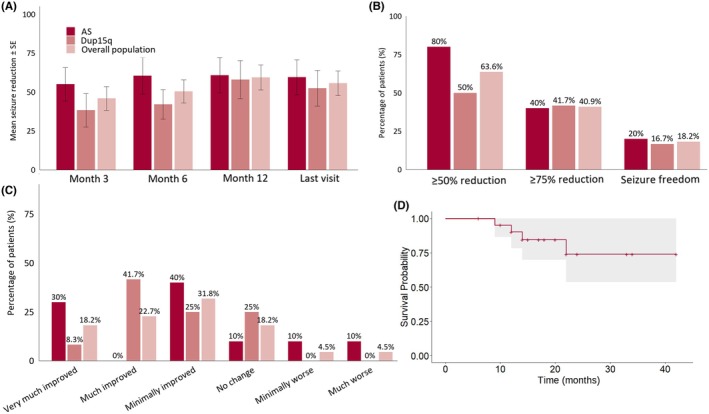
At last follow‐up visit, mean seizure reduction was 55.7% (95% confidence interval [CI]: 38.7–72.7) and 14/22 (63.6%, 95% CI: 43.0–80.3) patients achieved ≥50% seizure reduction, 9/22 (40.9%, 95% CI: 23.3–61.3) achieved ≥75% seizure reduction, and 4/22 (18.2%, 95% CI: 7.3–38.5) achieved seizure freedom.
No significant differences were noted regarding these effectiveness outcomes between AS and dup15q patients at any follow‐up visit (p value >0.2 for all comparisons, Figure 1, panel A, B).
There was no statistically significant correlation between the final CBD dose and percentage seizure reduction at last follow‐up (Spearman’s Rho = −0.26, p = 0.24).
When considering the most common seizure types observed in our cohort, median reduction from baseline after CBD initiation was 60% (IQR: 15–96) for tonic, 70% (IQR: 0–75) for myoclonic, 50% (IQR: 10–82) for atypical absences, and 0% (IQR: 0–25) for spasms.
Regarding concomitant ASM therapy, the regimen remained unchanged in 15 of 22 patients (68.2%). In five patients (22.7%), one ASM was withdrawn after CBD initiation (Patients 1, 4, 5, 15, and 19).
Conversely, in two patients, treatment adjustments involved ASM substitution, with phenytoin switched to cenobamate (Patient 2) and brivaracetam switched to ethosuximide (Patient 18).
The concomitant use of clobazam was not associated with a higher likelihood of achieving ≥50% and ≥ 75% seizure reduction or seizure freedom (p value >0.2 for all comparisons).
In patients with available pre‐ and post‐treatment EEG tracings, a qualitative assessment showed a reduction in interictal epileptiform activity in 7/16 cases (43.7%). Complete disappearance of epileptiform discharges was observed in two patients with dup15q syndrome, one of whom also a showed marked improvement in background activity. In the Appendix figure, two representative examples are shown.
Safety, tolerability, and overall efficacy of CBD
Regarding the CGI‐I scale, applied retrospectively by the treating clinician, improvement was reported in 16/22 cases (72.7%, 95% CI: 51.8–86.8), with a significant association between CGI‐I scores and overall seizure reduction at the last visit (Spearman’s Rho = −0.561, p = 0.007). Specifically, 4/16 (25%) patients were rated as very much improved, 5/16 (31.2%) as much improved, and 7/16 (43.7%) as slightly improved. No change was reported in 4/22 patients (18.2%), while worsening was noted in two (9.1%). Both cases of CGI‐I worsening occurred in individuals with AS, with clinicians reporting behavioral worsening as the primary reason for the negative evaluation; in one case, this was associated with an increased intensity of myoclonic seizures. See panel C of the figure for CGI‐I scores stratified by AS and dup15q.
Concerning nonseizure outcomes, caregivers reported improvements in sleep quality in 9/22 patients (40.9%), behavioral symptoms in 6/22 (27.3%), motor coordination and/or gait stability in 4/22 (18.2%), and overall attention and reactivity in 5/22 (22.7%). No changes across any domains were reported in 6/22 (27.3%), and behavioral worsening was noted in two, as previously described. See the table in the Appendix for individual‐level data on nonseizure outcomes.
At the last visit, CBD retention was observed in 18/22 (81.8%, 95% CI: 61.5–92.7) patients (Figure 1, Panel D), with four patients (3 dup15q and one AS) discontinuing treatment due to lack of effectiveness, with no significant difference between the two groups (p value = 0.47).
Side effects were reported in six patients (27.3%, 95% CI: 13.2–48.2), with only two patients still reporting them at the last visit. The most common side effects were drowsiness/sedation (5/22), followed by gastrointestinal complaints (3/22), elevated liver enzymes (1/22), and dermatological manifestations (1/22).
Among patients experiencing side effects, the median initial maintenance dose of CBD (12.5 mg/kg/day, IQR: 6.3–19.8) and the median dose at last follow‐up (14.5 mg/kg/day, IQR: 6.2–19.5) were comparable to those in patients without side effects (10 mg/kg/day, IQR: 10–11, and 11.4 mg/kg/day, IQR: 14.5–18.3, respectively), with no statistically significant differences between groups (p value >0.2 for both comparisons).
DISCUSSION
This is the largest real‐world cohort study to date evaluating the effectiveness and tolerability of CBD in patients with 15q‐DDS, encompassing both AS and dup15q syndrome. Before this work, evidence was limited to a single case report in AS and a small dup15q subgroup within larger DEE cohorts, providing only preliminary indications of potential benefit from CBD treatment.ref. epi470241-bib-0012, ref. epi470241-bib-0013
In this cohort of 22 individuals with early‐onset, drug‐resistant epilepsy, CBD was associated with a clinically meaningful reduction in seizure burden. Mean seizure reduction reached 55.7% at last follow‐up, with nearly two‐thirds of patients achieving ≥50% reduction and almost 20% attaining seizure freedom. Importantly, the antiseizure effect was sustained over a median follow‐up of nearly 2 years, with comparable outcomes in both AS and dup15q subgroups.
In particular, patients with dup15q syndrome presenting with an LGS phenotype showed a robust antiseizure effect, especially for tonic seizures. However, it is worth noting that a previous open‐label expanded access program involving eight patients with dup15q syndrome, most of whom were treated during childhood, reported a lower responder rate.ref. epi470241-bib-0012 This discrepancy highlights the need for further studies to identify clinical factors associated with response in this population.
Among patients with AS, apart from two individuals who were prescribed CBD due to an LGS phenotype, the majority were treated off‐label given the occurrence of daily myoclonic seizures. A high response rate was reported, supporting the potential utility of CBD for the treatment of this seizure type in AS.
When considering CGI‐I data, a well‐established global measure of overall drug efficacy and tolerability,ref. epi470241-bib-0016 over 70% of patients were reported to experience clinical improvement, further supporting the antiseizure effect of CBD in this population. Beyond seizure reduction, nonseizure benefits such as improved sleep quality, gait stability, attention, and behavioral regulation were also observed in a subset of patients, suggesting potential broader neurobehavioral effects of CBD, consistent with findings in other genetic epilepsies.ref. epi470241-bib-0006
The pathophysiology of epilepsy in 15q‐DDS is complex and not fully understood. The implicated chromosomal region includes more than 20 genes, among which UBE3A—a maternally expressed imprinted gene involved in synaptic development and plasticity—and a cluster of nonimprinted GABA_A receptor subunit genes (GABRB3, GABRA5, GABRG3) are of particular interest. In dup15q, overexpression of UBE3A and these GABAergic genes may disrupt inhibitory tone, while in AS, haploinsufficiency leads to circuit hyperexcitability.ref. epi470241-bib-0017
Although limited by the small sample size of our cohort, it may be speculated that the ability of CBD to modulate GABAergic transmission—either by restoring inhibitory balance in dup15q or compensating for deficits in AS—may underlie its observed efficacy across both syndromes.ref. epi470241-bib-0008, ref. epi470241-bib-0010, ref. epi470241-bib-0016, ref. epi470241-bib-0017 Future studies with pharmacogenomic markers may help clarify whether specific variants within GABA_A subunit genes or UBE3A predict differential CBD response.
Additionally, CBD is known to exert anxiolytic and antiseizure effects in part through activation of 5‐HT1A receptors.ref. epi470241-bib-0018 Recent findings from Drosophila models of dup15q syndrome possibly support a role for serotonergic modulation, showing that 5‐HT1A agonists and 5‐HT2B antagonists can act as potent seizure suppressors in this genetic disorder.ref. epi470241-bib-0019 While these mechanistic hypotheses remain speculative, they provide interesting frameworks for understanding both the antiseizure and broader neurodevelopmental benefits observed in our cohort.
CBD was well tolerated. Retention at last follow‐up was high (81.8%), and adverse effects were mild and consistent with previous studies, with no patient withdrawing treatment due to side effects in our cohort. Interestingly, concomitant clobazam treatment was not associated with a better outcome, in line with previous studies.ref. epi470241-bib-0020
Several limitations must be acknowledged. First, the retrospective and multicenter design of the study, although it allowed the inclusion of a considerable number of patients with such rare conditions, may have reduced homogeneity in data collection and introduced potential confounding. Furthermore, the relatively small sample size might limit the generalizability of our findings. Additionally, the assessment of seizure frequency during follow‐up relied on caregiver reports, seizure diaries, and clinicians’ documentation, which may have introduced reporting bias. Likewise, nonseizure outcomes, CGI‐I scale, and adverse events were derived from retrospective medical and caregiver reports rather than from standardized evaluations, potentially limiting the reliability of these measures. Finally, although improvements in EEG tracings were observed in a subset of patients, the assessment was limited to a qualitative evaluation.
In conclusion, our findings offer the most comprehensive real‐world evidence to date on the effectiveness and tolerability of CBD in 15q‐DDS, including both AS and dup15q. These results highlight the need for prospective studies exploring early treatment initiation, electrophysiological correlates, and mechanistic biomarkers. Given the substantial disease burden and drug resistance typical of epilepsy in 15q‐DDS, CBD may emerge as a promising therapeutic option in these patients.
AUTHOR CONTRIBUTIONS
E.C.I., A.C., and A.O. contributed to the concept and design of the study. ECI contributed to drafting a significant portion of the manuscript and figures. All authors significantly contributed to the acquisition and analysis of the data and critically revised the manuscript for intellectual content.
FUNDING INFORMATION
The authors have nothing to report.
CONFLICT OF INTEREST STATEMENT
E.C.I. has received speaker’s fees from Angelini Pharma and travel support from UCB pharma, Jazz Pharmaceuticals and Angelini Pharma outside the submitted work. A.M. received speaking honoraria and has served on advisory boards for Angelini Pharma, outside the submitted work. G.R. has served on advisory boards or received speaker honoraria paid to her department from Angelini, Bial, Jazz Pharmaceuticals, Neuraxpharm, Neurocrine, and Takeda, outside the submitted work. Her research receives support from the Swiss National Science (SNSF: 208184) and Anna Mueller Grocholski Foundations. P.S. has received speaker fees, consultancy honoraria, and/or research support from Jazz Pharmaceuticals UCB pharma, Angelini Pharma, Proveca, Biomarin, outside the submitted work. C.D.B. reports personal fees from UCB Pharma, Eisai, Jazz Pharmaceuticals, Angelini Pharma, Lusofarmaco, and Ecupharma, outside the submitted work. A.C. received speaker’s fees from Jazz Pharmaceuticals, outside the submitted work. The other authors report no disclosures relevant to this article. We confirm that we have read the Journal’s position on issues involved in ethical publication and affirm that this report is consistent with those guidelines.
Supplementary Materials
References
- Precision medicine for genetic epilepsy on the horizon: recent advances, present challenges, and suggestions for continued progress.. Epilepsia., 2022. [DOI | PubMed]
- Trial of cannabidiol for drug‐resistant seizures in the Dravet syndrome.. N Engl J Med., 2017. [DOI]
- Add‐on cannabidiol treatment for drug‐resistant seizures in tuberous sclerosis complex: a placebo‐controlled randomized clinical trial.. JAMA Neurol., 2021. [DOI | PubMed]
- Cannabidiol in patients with seizures associated with Lennox‐Gastaut syndrome (GWPCARE4): a randomised, double‐blind, placebo‐controlled phase 3 trial.. Lancet Lond Engl., 2018. [DOI]
- Long‐term use of cannabidiol‐enriched medical cannabis in a prospective cohort of children with drug‐resistant developmental and epileptic encephalopathy.. Seizure., 2022. [DOI | PubMed]
- Expanding the therapeutic role of highly purified cannabidiol in monogenic epilepsies: a multicenter real‐world study.. Epilepsia., 2025. [DOI | PubMed]
- Prader‐Willi, Angelman, and 15q11‐q13 duplication syndromes.. Pediatr Clin North Am., 2015. [DOI | PubMed]
- The inv dup (15) or idic (15) syndrome (Tetrasomy 15q).. Orphanet J Rare Dis., 2008. [DOI | PubMed]
- Epilepsy in Prader‐Willi syndrome: clinical, diagnostic and treatment aspects.. World J Pediatr., 2014. [DOI | PubMed]
- Spectrum of epilepsy and electroencephalogram patterns in idic (15) syndrome.. Am J Med Genet A., 2016. [DOI | PubMed]
- Epilepsy in Angelman syndrome: a scoping review.. Brain Dev., 2021. [DOI | PubMed]
- Open‐label use of highly purified CBD (Epidiolex®) in patients with CDKL5 deficiency disorder and Aicardi, Dup15q, and Doose syndromes.. Epilepsy Behav., 2018. [DOI | PubMed]
- Successful use of cannabidiol in nonconvulsive status epilepticus in Angelman syndrome.. Epilepsia Open., 2024. [DOI | PubMed]
- Cannabidiol attenuates seizures and EEG abnormalities in Angelman syndrome model mice.. J Clin Invest., 2019. [DOI | PubMed]
- Technical standards for the interpretation and reporting of constitutional copy number variants: a joint consensus recommendation of the American College of Medical Genetics and Genomics (ACMG) and the Clinical Genome Resource (ClinGen).. Genet Med., 2020. [DOI | PubMed]
- The clinical global impressions scale: applying a research tool in clinical practice.. Psychiatry (Edgmont (Pa: Township))., 2007
- 17 Reiter LT . Chapter 9 – Developmental disabilities, autism, and schizophrenia at a single locus: complex gene regulation and genomic instability of 15q11‐q13 cause a range of neurodevelopmental disorders. In: Rubenstein J , Rakic P , Chen B , Kwan KY , editors. Neurodevelopmental Disorders. San Diego, CA: Academic Press; 2020. p. 201–221. 10.1016/B978-0-12-814409-1.00009-4
- Cannabidiol acts at 5‐HT1A receptors in the human brain: relevance for treating temporal lobe epilepsy.. Front Behav Neurosci., 2020. [DOI | PubMed]
- Glial expression of Drosophila UBE3A causes spontaneous seizures that can be modulated by 5‐HT signaling.. Neurobiol Dis., 2024. [DOI | PubMed]
- Real‐world data on cannabidiol treatment of various epilepsy subtypes: a retrospective, multicenter study.. Epilepsia Open., 2023. [DOI | PubMed]