
Cannabidiol as a possible treatment for endometriosis through suppression of inflammation and angiogenesis
Abstract
Background:
Endometriosis is associated with a wide variety of signs and symptoms and can lead to infertility, embryo death, and even miscarriage. Although the exact pathogenesis and etiology of endometriosis is still unclear, it has been shown that it has a chronic inflammatory nature and angiogenesis is also involved in it.
Objective:
This review aims to explore the role of inflammation and angiogenesis in endometriosis and suggest a potential treatment targeting these pathways.
Findings:
Among the pro‐inflammatory cytokines, studies have shown solid roles for interleukin 1β (IL‐β), IL‐6, and tumor necrosis factor α (TNF‐α) in the pathogenesis of this condition. Other than inflammation, angiogenesis, the formation of new blood vessels from pre‐existing capillaries, is also involved in the pathogenesis of endometriosis. Among angiogenic factors, vascular endothelial growth factor (VEGF), hypoxia‐inducible factor 1α (HIF‐1α), transforming growth factor β1 (TGF‐β1), and matrix metalloproteinases (MMPs) are more essential in the pathogenesis of endometriosis. Interestingly, it has been shown that inflammation and angiogenesis share some similar pathways with each other that could be potentially targeted for treatment of diseases caused by these two processes. Cannabidiol (CBD) is a non‐psychoactive member of cannabinoids which has well‐known and notable anti‐inflammatory and antiangiogenic properties. This agent has been shown to decrease IL‐1β, IL‐6, TNF‐α, VEGF, TGFβ, and MMPs in different animal models of diseases.
Conclusion:
It seems that CBD could be a possible treatment for endometriosis due to its anti‐inflammatory and antiangiogenic activity, however, further studies are needed.
Article type: Review Article
Keywords: angiogenesis, cannabidiol, cannabinoids, endometriosis, inflammation
Affiliations: Department of Obstetrics and Gynecology Hamadan University of Medical Sciences Hamadan Iran; School of Medicine, Hamadan University of Medical Sciences Hamadan Iran; Medical Biology Research Center, Health Technology Institute Kermanshah University of Medical Sciences Kermanshah Iran
License: © 2024 The Author(s). Immunity, Inflammation and Disease published by John Wiley & Sons Ltd. CC BY 4.0 This is an open access article under the terms of the http://creativecommons.org/licenses/by/4.0/ License, which permits use, distribution and reproduction in any medium, provided the original work is properly cited.
Article links: DOI: 10.1002/iid3.1370 | PubMed: 39110084 | PMC: PMC11304901
Relevance: Relevant: mentioned in keywords or abstract
Full text: PDF (1.2 MB)
INTRODUCTION
Reports estimate the endometriosis prevalence to be 10%–15% in the general female population of reproductive age.ref. iid31370-bib-0001 This pathology is associated with dysmenorrhea, dyspareunia, dyschezia, and dysuria.ref. iid31370-bib-0002 Clinically, endometriosis could increase the risk of infertility,ref. iid31370-bib-0003 embryo death, and even miscarriage.ref. iid31370-bib-0004 Considering the mentioned outcomes, this condition strongly affects life quality and socioeconomically condition of those affected.ref. iid31370-bib-0005 Endometriosis is recognized by the existence of functional endometrial glands as well as stroma in exterior side of the uterine cavity in a chronic setting.ref. iid31370-bib-0001 Among the common sites of presence, ovaries, the uterosacral ligaments, the fossa ovarica, and the posterior cul‐de‐sac are more prevalent than the others.ref. iid31370-bib-0001 In some aspects, endometriosis is comparable with malignancies as they both tend to be recurrent, invasive, metastatic, and have estrogen‐dependent growth.ref. iid31370-bib-0006, ref. iid31370-bib-0007 Although the exact etiology and mechanism of endometriosis is still unknown, retrograde menstruation is seriously suspected. However, other causes/etiologies such as immune system abnormalities, genetics and environmental issues, and coelomic metaplasia have been considered as well. It has been suggested that it’s possible for at least two of the mentioned causes to be involved together.ref. iid31370-bib-0002 This article aims to review the role of inflammation and angiogenesis in the endometriosis and suggest a new possible treatment candidate for research: cannabidiol (CBD).
SEARCH STRATEGY
For this study, different databases such as PubMed, Scopus, and ISI Web of Science were searched from the inception to Jun 2023 with keywords including “Endometriosis; Angiogenesis; Inflammation; Cannabinoids; Cannabidiol.” Only English studies were included and different types of studies such as in vitro, ex vivo, in vivo, and clinical trials were used for data extraction.
Endometriosis and inflammation
Endometriosis is considered as a chronic inflammatory condition.ref. iid31370-bib-0004 The pro‐inflammatory cytokines such as interleukin 1β (IL‐β), IL‐6, and tumor necrosis factor α (TNF‐α) not only increase the inflammation but also are involved in the adhesion of endometrial tissue to the peritoneal surface. Also, they could increase production of metalloproteinases (MMPs) which leads to shedding of the endometrial tissue fragments.ref. iid31370-bib-0008
IL‐1β is a pro‐inflammatory cytokine from interleukin‐1 family which gets activated in the inflammasome to exert a wide range of inflammatory action.ref. iid31370-bib-0009 As it has been shown, levels of proIL‐1β and IL‐1β in the peritoneal fluid of women with endometriosis were significantly higher than controls.ref. iid31370-bib-0010, ref. iid31370-bib-0011 As we showed before, the serum levels of IL‐1β were significantly higher in patients with endometrioma compared to healthy controls.ref. iid31370-bib-0012 Also, the levels of this pro‐inflammatory cytokine have been shown to be associated with the dyspareunia in the women with endometriosis.ref. iid31370-bib-0013
Inflammasomes are multi‐protein structures involved in both innate and adaptive immune system responses. They are involved in the production of different ILs such as IL1β. Aside from their IL production roles, inflammasomes are also key role players of endometriosis and, therefore, potent treatment targets.ref. iid31370-bib-0014 According to the investigations, estrogen receptor‐β (ERβ) is greatly increased in the endometriosis compared to normal endometrial tissues. It has been shown that ERβ of endometrial cells interacts with “cell death machinery” to prevent the TNF‐α‐induced apoptosis. Also, it increases IL‐1β production through an inflammasome‐mediated pathway to boost the cellular proliferation. Among the inflammasomes that ERβ interacts with in the endometriotic tissues are NOD‐, LRR, caspase I, and pyrin domain‐containing 3 (NLRP3) which all are involved in IL‐1β production pathway.ref. iid31370-bib-0015
IL‐6, an acute phase reactant, is a very crucial cytokine in inflammation and immune response.ref. iid31370-bib-0016 According to the results of our previous study, IL‐6 levels (serum) were significantly higher in patients with endometrioma compared to healthy controls.ref. iid31370-bib-0012 It has been shown that the expression of this cytokine was increased in the endometriotic tissues compared to the normal endometrial cells. Also, treatment of the mentioned cells with IL‐1β led to a dramatic increase in IL‐6 expression.ref. iid31370-bib-0017 Moreover, it has been shown that the expression of IL‐6 and soluble IL‐6 in plasma and peritoneal fluid was significantly higher in endometriotic patients compared to the controls.ref. iid31370-bib-0018 Also, there are other studies implicating the involvement of IL‐6 in the pathogenesis of endometriosis.ref. iid31370-bib-0019, ref. iid31370-bib-0020
TNF‐α is a potent inflammatory cytokine of the TNF superfamily with a notable role in inflammation.ref. iid31370-bib-0021 This inflammatory cytokine has been shown to be involved in the pathogenesis of endometriosis.ref. iid31370-bib-0004 According to the investigations, TNF‐α is upregulated in the endometrial tissues of patients with endometriosis compared to normal endometrial tissues which supports the role of inflammation in this disorder.ref. iid31370-bib-0002 Also, the level of IL‐16 is found to be increased in the peritoneal fluid of cases diagnosed with endometriosis. This in turn suggests a possible involved pathway in the inflammatory process of this disorder.ref. iid31370-bib-0022 Not only IL‐16, but also IL‐8 and Regulated on Activation, Normal T Cell Expressed and Secreted (RANTES or CCL5) are increased in peritoneal fluid of women with endometriosis.ref. iid31370-bib-0011, ref. iid31370-bib-0023 Moreover, peritoneal fluid analysis in the early stage endometriosis has revealed the increased levels of IL‐12.ref. iid31370-bib-0024
Endometriosis and angiogenesis
Angiogenesis is defined as new blood vessel formation from the pre‐existing capillaries. This process is observed in a few physiological conditions including female reproductive cycleref. iid31370-bib-0025 and wound healing.ref. iid31370-bib-0026 On the other hand, angiogenesis participates in the pathogenesis of solid tumors growth,ref. iid31370-bib-0027 corneal neovascularization,ref. iid31370-bib-0028 hemophilic arthropathy,ref. iid31370-bib-0029 psoriasis,ref. iid31370-bib-0030 and endometriosis.ref. iid31370-bib-0031 Also, endometriosis is associated with a chronic inflammatory responseref. iid31370-bib-0004 that could cause endothelial dysfunction.ref. iid31370-bib-0032 Same as the tumors, angiogenesis and “dense vascularization” has been known as a characteristic condition in endometriosis for which antiangiogenesis therapies have been suggested in different studies.ref. iid31370-bib-0031, ref. iid31370-bib-0033, ref. iid31370-bib-0034
An increased unmet demand for oxygen leading to hypoxia could cause overexpression of hypoxia‐inducible factor 1α (HIF‐1α) which in turn could activate certain downstream pathways. The expression of HIF‐1α has been demonstrated to be significantly increased in ectopic endometriotic lesions compared to the controls.ref. iid31370-bib-0035, ref. iid31370-bib-0036 Also, vascular endothelial growth factor (VEGF) and HIF‐1α are both proven to be overexpressed in the endometrial tissues with ectopic location.ref. iid31370-bib-0036, ref. iid31370-bib-0037 In cases with ovarian endometriosis, an increased expression of HIF‐1α and nitric oxide synthase isoforms has been detected.ref. iid31370-bib-0038 In the ovarian endometriomas, the levels of VEGF and cyclooxygenase 2 (COX‐2) are found to be increased and correlate with each other, implicating the role of angiogenesis in ovarian endometriosis.ref. iid31370-bib-0039 In a systematic review and meta‐analysis on 13 published papers on animal models, anti‐VEGF/VEGF receptor therapy was found successful for treatment of endometriosis via suppression of angiogenesis.ref. iid31370-bib-0040 Also, it has been shown that transforming growth factor β1 (TGF‐β1) was increased in the peritoneum, peritoneal fluid, ectopic endometrium, and sera of women with endometriosis in compression to the controls.ref. iid31370-bib-0041 MMPs are among the important angiogenic factors that degrade basement membrane for facilitating the migration of endothelial cells. As mentioned above, these factors are extremely expressed in the endometriosis and the levels of their inhibitor follow a decreasing pattern.ref. iid31370-bib-0042 As described, MMPs are involved in the pathogenesis of endometriosis secondary to the inflammation. Studies have shown impaired or increased production of MMP‐1, MMP‐2, MMP‐3, and MMP‐9 as well as tissue inhibitors of MMP‐1 (TIMP‐1) and TIMP‐2.ref. iid31370-bib-0042
Inflammation and angiogenesis
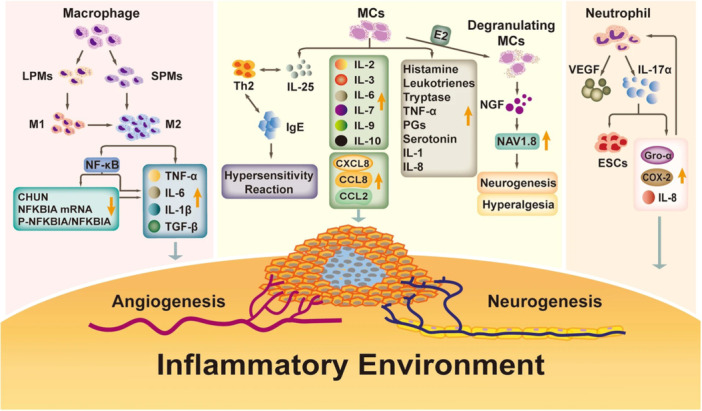
Inflammation and angiogenesis have common pathways with each other. Inflamed tissues experience hypoxia which leads to the activation of HIF‐1α.ref. iid31370-bib-0043 This in turn, triggers the increased expression of VEGF, VEGF receptor (VEGFR), platelet‐derived growth factor (PDGF), stromal cell‐derived factor (SDF‐1), COX‐2, and IL‐1β that are all among the angiogenic factors.ref. iid31370-bib-0043, ref. iid31370-bib-0044, ref. iid31370-bib-0045, ref. iid31370-bib-0046 Interestingly, IL‐1β and COX‐2 are also among the most important players of inflammation.ref. iid31370-bib-0043 During hypoxia, different proangiogenic factors could be upregulated via nuclear factor κB (NF‐κB) activation among which are IL‐6, TNF‐α, macrophage inflammatory protein 2 (MIP‐2), intercellular adhesion molecule (ICAM), and vascular cell adhesion molecule (VCAM).ref. iid31370-bib-0047 Also, inflammation could end in the release of different pro‐inflammatory cytokines among which is TNF‐α, capable of inducing NF‐κB.ref. iid31370-bib-0043 Therefore, angiogenesis and inflammation work so close with each other that inhibition of one could potentially inhibit the other. Figure 1 ref. iid31370-bib-0048 shows the role of inflammation in the pathogenesis of endometriosis and inducing angiogenesis in environment.
HYPOTHESIS
Since inflammation and angiogenesis are quite crucial in the pathogenesis of endometriosis, cannabidiol could be a potent candidate for treatment of this condition due to its antiangiogenic and anti‐inflammatory potential.
Cannabidiol
Cannabinoids are active compounds of plant named Cannabis sativa which has been used in medicine for long.ref. iid31370-bib-0049 Today, these compounds are categorized into three main groups according to their origin: (I) endocannabinoids produced in body, (II) plant‐derived cannabinoids or phytocannabinoids originating from the Cannabis sativa (exocannabinoids), (III) synthetic cannabinoids synthetized in the laboratories (exocannabinoids).ref. iid31370-bib-0030 Although different receptors have been known for cannabinoids and endocannabinoids, they exert many of their main actions through two major groups of cannabinoids receptors of cannabinoid receptor 1 (CB1) and CB2.ref. iid31370-bib-0050 CBD is a natural non‐psychoactive cannabinoid with affinity to both CB1 and CB2 receptors.ref. iid31370-bib-0051 In Jun 2018, CBD became the first cannabinoid which received approval of the Food and Drug Administration (FDA) of United States for two types of seizures under the brand name of Epidiolex®.ref. iid31370-bib-0052
Cannabidiol and inflammation
As mentioned, inflammation is a crucial step in the pathogenesis of endometriosis. Data have revealed that CBD has potent anti‐inflammatory properties. Also, in a carrageenan‐induced inflammation murine model, CBD decreased COX activity as well as PGE2 and nitric oxide levels.ref. iid31370-bib-0053 The macrophages of mouse treated with lipopolysaccharide (LPS) showed to release lower amounts of TNF‐α after treatment with CBD.ref. iid31370-bib-0054 Moreover, similar evidence was observed in a mouse model of endotoxin‐induced uveitis which levels of TNF‐α decreased and infiltration of macrophages was inhibited.ref. iid31370-bib-0055 Also, it has been shown that CBD could decrease the levels of IL‐1α, IL‐6, and TNF‐α in the LPS‐treated microglial cells which seems to be achieved through modulating NF‐κB.ref. iid31370-bib-0056 In the mitogen‐activated human peripheral blood mononuclear cells (PBMC), CBD decreased IL‐1β and TNF‐α.ref. iid31370-bib-0057 Also, in the experimental rat models for asthma, CBD has been shown to alleviate inflammation via lowering the levels of TNF‐α, IL‐4, IL‐5, IL‐6, and IL‐13.ref. iid31370-bib-0058, ref. iid31370-bib-0059
Cannabidiol and angiogenesis
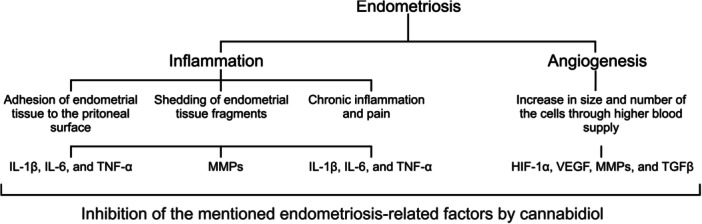
CBD is proven capable of decreasing endothelial cells proliferation and migration (with no toxication and apoptosis induction). These two cell processes are both crucial for angiogenesis. This effect is known to be related to the anti‐tube formation activity of CBD on endothelial cells which is very essential for angiogenesis. These results were followed by inhibition of angiogenesis in vivo in the presence of a strong angiogenic cocktail: VEGF, TNF‐α and heparin. Interestingly, CBD decreases the expression of different proangiogenic factors such as MMP‐2, MMP‐9, TIMP‐1, CXCL16, endothelin 1, IL‐8, and PDGF‐AA.ref. iid31370-bib-0060 Also, cannabidiol hydroxyquinone (HU‐331) is able to inhibit angiogenesis in an ex vivo model of rat aortic ring (VEGF induced). Moreover, in a mouse tumor‐angiogenesis models, HU‐331 showed potential of decreasing vessels total area, density, and size.ref. iid31370-bib-0061 Another study on human endothelial cells demonstrated that CBD decreased high glucose‐induced expression and levels of ICAM‐1 and VCAM‐1 as well as monocytes ability to adhere to the endothelial cells. Moreover, it has been stated that this cannabinoid could decrease the levels of NF‐κB.ref. iid31370-bib-0062 As it is shown in Figure 2, both inflammation and angiogenesis are involved in the pathogenesis of endometriosis through different molecular pathways that could be inhibited by CBD.
CONCLUSION
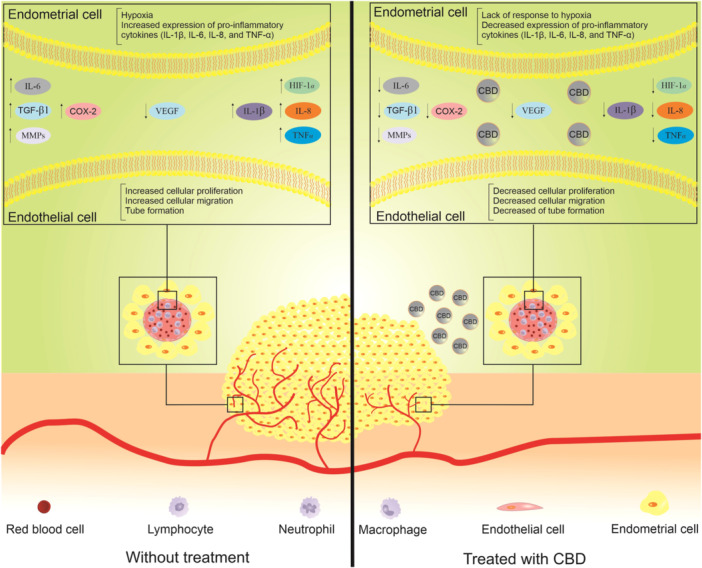
So far, the exact mechanism of endometriosis is not fully understood. However, this phenomenon is known as a chronic inflammatory condition accompanied with angiogenesis. Herein, we reviewed the inflammatory aspects of this disease with an eye on angiogenesis. As we showed, the molecular pathways of angiogenesis and inflammation have a lot in common. Thus, it seems that targeting inflammation could be considered hitting two birds with one stone. Considering the potent anti‐inflammatory and antiangiogenic effects of CBD under various other conditions, authors suggest in vitro and in vivo studies on CBD and endometriosis (Figure 3).
AUTHOR CONTRIBUTIONS
Roghayeh Anvari Aliabad: Conceptualization; data curation; writing—original draft; writing—review and editing. Kamyab Hassanpour: Data curation; writing—original draft; writing—review and editing. Amir Hossein Norooznezhad: Conceptualization; data curation; writing—original draft; writing—review and editing.
CONFLICT OF INTEREST STATEMENT
The authors declare no conflict of interest.
References
- Endometriosis still a challenge.. J Med Life., 2014. [PubMed]
- Endometriosis: pathogenesis and treatment.. Nat Rev Endocrinol., 2014. [PubMed]
- Endometriosis‐associated infertility: aspects of pathophysiological mechanisms and treatment options.. Acta Obstet Gynecol Scand., 2017. [PubMed]
- Inflammation and endometriosis.. Front Biosci., 2016
- Use of immunomodulators to treat endometriosis.. Best Pract Res Clin Obstet Gynaecol., 2019. [PubMed]
- Endometriosis and the development of malignant tumours of the pelvis. A review of literature.. Best Pract Res Clin Obstet Gynaecol., 2004. [PubMed]
- Molecular profiling of experimental endometriosis identified gene expression patterns in common with human disease.. Fertil Steril., 2007. [PubMed]
- Endometriosis.. N Engl J Med., 2009. [PubMed]
- The role of interleukin‐1 in general pathology.. Inflamm Regen., 2019. [PubMed]
- Association of the precursor of interleukin‐1β and peritoneal inflammation‐role in pathogenesis of endometriosis.. J Clin Lab Anal., 2016. [PubMed]
- Functional changes of immune cells: signal of immune tolerance of the ectopic lesions in endometriosis?. Reprod Biomed Online., 2021. [PubMed]
- Investigating the efficacy of ultrasound‐guided ethanol retention technique for endometrioma sclerotherapy and its effect on pro‐inflammatory cytokine levels: a single‐arm clinical trial.. Clinics., 2023. [PubMed]
- Role of interleukin‐1β in nerve growth factor expression, neurogenesis and deep dyspareunia in endometriosis.. Hum Reprod., 2020. [PubMed]
- Inflammasome as a key pathogenic mechanism in endometriosis.. Curr Drug Targets., 2017. [PubMed]
- Evading immunosurveillance in endometriosis.. Nat Rev Immunol., 2015. [PubMed]
- IL‐6 in inflammation, immunity, and disease.. Cold Spring Harbor Perspect Biol., 2014
- Interleukin‐6 secretion in vitro is up‐regulated in ectopic and eutopic endometrial stromal cells from women with endometriosis.. J Clin Endocrinol Metab., 1996. [PubMed]
- Role of Interleukin‐6 and its receptor in endometriosis.. Med Sci Monit., 2017. [PubMed]
- Altered gene expression and secretion of interleukin‐6 in stromal cells derived from endometriotic tissues.. Fertil Steril., 2000. [PubMed]
- Serum interleukin‐6 levels are elevated in women with minimal‐mild endometriosis.. Hum Reprod., 2007. [PubMed]
- TNF? and the TNF receptor superfamily: structure‐function relationship(s).. Microsc Res Tech., 2000. [PubMed]
- Elevated interleukin‐16 levels in the peritoneal fluid of women with endometriosis may be a mechanism for inflammatory reactions associated with endometriosis.. Fertil Steril., 2005. [PubMed]
- PAPP‐A and osteoprotegerin, together with interleukin‐8 and RANTES, are elevated in the peritoneal fluid of women with endometriosis.. Am J Obstet Gynecol., 2006. [PubMed]
- Peritoneal interleukin‐10 increases with decrease in activated CD4+ T lymphocytes in women with endometriosis.. Hum Reprod., 1997. [PubMed]
- Regenerative medicine and angiogenesis; challenges and opportunities.. Adv Pharm Bull., 2020. [PubMed]
- Evaluation of wound healing in diabetic foot ulcer using platelet‐rich plasma gel: a single‐arm clinical trial.. Transfus Apher Sci., 2017. [PubMed]
- Comparative in vitro/theoretical studies on the anti‐angiogenic activity of date pollen hydro‐alcoholic extract: highlighting the important roles of its hot polyphenols.. Bioimpacts., 2018. [PubMed]
- Cannabinoid (JWH‐133) therapy could be effective for treatment of corneal neovascularization.. J Med Hypothese Ideas., 2010
- Curcumin: hopeful treatment of hemophilic arthropathy via inhibition of inflammation and angiogenesis.. Expert Rev Hematol., 2020. [PubMed]
- Cannabinoids: possible agents for treatment of psoriasis via suppression of angiogenesis and inflammation.. Med Hypotheses., 2017. [PubMed]
- The immunopathophysiology of endometriosis.. Trends Mol Med., 2018. [PubMed]
- Increased asymmetric dimethylarginine and enhanced inflammation are associated with impaired vascular reactivity in women with endometriosis.. Atherosclerosis., 2011. [PubMed]
- The heterogeneity of fibrosis and angiogenesis in endometriosis revealed by single‐cell RNA‐sequencing.. Biochim Biophys Acta Molec Basis Dis., 2023. [PubMed]
- Angiogenesis signaling in endometriosis: molecules, diagnosis and treatment (Review).. Mol Med Rep., 2024. [PubMed]
- Hypoxia: the force of endometriosis.. J Obstet Gynaecol Res., 2019. [PubMed]
- Hypoxia‐inducible factor‐1alpha: A promising therapeutic target in endometriosis.. Biochimie., 2016. [PubMed]
- Expression of vascular endothelial growth factor (VEGF), hypoxia inducible factor‐1α (HIF‐1α), and microvessel density in endometrial tissue in women with adenomyosis.. Int J Gynecol Pathol., 2009. [PubMed]
- Proangiogenetic molecules, hypoxia‐inducible factor‐1α and nitric oxide synthase isoforms in ovarian endometriotic cysts.. Virchows Arch., 2010. [PubMed]
- Expression of cyclooxygenase‐2 and vascular endothelial growth factor in ovarian endometriotic cysts and their relationship with angiogenesis.. Fertil Steril., 2008. [PubMed]
- Efficacy of anti‐VEGF/VEGFR agents on animal models of endometriosis: a systematic review and Meta‐Analysis.. PLoS One., 2016. [PubMed]
- The role of TGF‐β in the pathophysiology of peritoneal endometriosis.. Hum Reprod Update., 2017. [PubMed]
- Transcriptional characterizations of differences between eutopic and ectopic endometrium.. Endocrinology., 2006. [PubMed]
- Cellular and molecular mechanisms of inflammation‐induced angiogenesis.. IUBMB Life., 2015. [PubMed]
- Progenitor cell trafficking is regulated by hypoxic gradients through HIF‐1 induction of SDF‐1.. Nature Med., 2004. [PubMed]
- Evidence that hypoxia‐inducible factor‐1 (HIF‐1) mediates transcriptional activation of interleukin‐1β (IL‐1β) in astrocyte cultures.. J Neuroimmunol., 2006. [PubMed]
- Direct transcriptional up‐regulation of cyclooxygenase‐2 by hypoxia‐inducible factor (HIF)‐1 promotes colorectal tumor cell survival and enhances HIF‐1 transcriptional activity during hypoxia.. Cancer Res., 2006. [PubMed]
- Hypoxia. Regulation of NFκB signalling during inflammation: the role of hydroxylases.. Arthritis Res Ther., 2009. [PubMed]
- Autonomic nervous system and inflammation interaction in endometriosis‐associated pain.. J Neuroinflam., 2020
- Cannabinoid (JWH‐133) therapy could be effective for treatment of corneal neovascularization.. Iran J Med Hypotheses Ideas., 2010
- Cannabinoids as treatment for hemophilic arthropathy: hypothesized molecular pathways.. J Rep Pharm Sci., 2016
- Is the cardiovascular system a therapeutic target for cannabidiol?. Br J Clin Pharmacol., 2013. [PubMed]
- Pharmacology and legal status of cannabidiol.. Ann Istit Super Sanita., 2020
- Cannabis sativa L. and nonpsychoactive cannabinoids: their chemistry and role against oxidative stress, inflammation, and cancer.. BioMed Res Int., 2018. [PubMed]
- New cannabidiol derivatives: synthesis, binding to cannabinoid receptor, and evaluation of their antiinflammatory activity.. J Med Chem., 2006. [PubMed]
- Neuroprotective effects of cannabidiol in endotoxin‐induced uveitis: critical role of p38 MAPK activation.. Mol Vision., 2008
- Cannabinoids Δ9‐tetrahydrocannabinol and cannabidiol differentially inhibit the lipopolysaccharide‐activated NF‐κB and Interferon‐β/STAT proinflammatory pathways in BV‐2 microglial cells.. J Biol Chem., 2010. [PubMed]
- Marijuana components stimulate human peripheral blood mononuclear cell secretion of interferon‐gamma and suppress interleukin‐1 alpha in vitro.. Int J Immunopharmacol., 1991. [PubMed]
- Cannabidiol reduces airway inflammation and fibrosis in experimental allergic asthma.. Eur J Pharmacol., 2019. [PubMed]
- Evaluation of serum cytokines levels and the role of cannabidiol treatment in animal model of asthma.. Mediat Inflamm., 2015
- Cannabidiol inhibits angiogenesis by multiple mechanisms.. Br J Pharmacol., 2012. [PubMed]
- A cannabinoid quinone inhibits angiogenesis by targeting vascular endothelial cells.. Mol Pharmacol., 2006. [PubMed]
- Cannabidiol attenuates high glucose‐induced endothelial cell inflammatory response and barrier disruption.. Am J Physiol Heart Circul Physiol., 2007