
Cannabidiol negatively modulates adenosine A2A receptor functioning in living cells
Abstract
Objectives:
Cannabidiol (CBD) is a phytocannabinoid with great potential in clinical applications. The mechanism(s) of action of CBD require further investigation. Previous studies suggested that adenosine A2A receptors (A2ARs) could play a role in CBD-induced effects. Here, we evaluated the ability of CBD to modify the function of A2AR.
Methods:
We used HEK-293T cells transfected with the cDNA encoding the human A2AR and Gαs protein, both modified to perform bioluminescence-based assays. We first assessed the effect of CBD on A2AR ligand binding using an A2AR NanoLuciferase sensor. Next, we evaluated whether CBD modified A2AR coupling to mini-Gαs proteins using the NanoBiT™ assay. Finally, we further assessed CBD effects on A2AR intrinsic activity by recording agonist-induced cAMP accumulation.
Results:
CBD did not bind orthosterically to A2AR but reduced the coupling of A2AR to Gαs protein and the subsequent generation of cAMP.
Conclusion:
CBD negatively modulates A2AR functioning.
Article type: Research Article
Keywords: cannabidiol, adenosine 2A receptor, negative allosteric regulation, competitive binding, cyclic AMP, luminescence-based assays
Affiliations: Pharmacology Unit, Department of Pathology and Experimental Therapeutics, School of Medicine and Health Sciences, Institute of Neurosciences, University of Barcelona, L’Hospitalet de Llobregat, Spain;; Neuropharmacology and Pain Group, Neuroscience Program, Institut d’Investigació Biomèdica de Bellvitge, IDIBELL, L’Hospitalet de Llobregat, Spain;; Immuno-Pharmacology and Interactomics, Department of Infection and Immunity, Luxembourg Institute of Health (LIH), Esch-sur-Alzette, Luxembourg; Molecular Recognition Section, Laboratory of Bioorganic Chemistry, National Institute of Diabetes and Digestive and Kidney Diseases, National Institutes of Health, Bethesda, MD, USA
License: CC BY 4.0 This is an Open Access article, distributed under the terms of the Creative Commons Attribution licence (http://creativecommons.org/licenses/by/4.0/), which permits unrestricted re-use, distribution and reproduction, provided the original article is properly cited.
Article links: DOI: 10.1017/neu.2023.30 | PubMed: 37605951 | PMC: PMC10894643
Relevance: Relevant: mentioned in keywords or abstract
Full text: PDF (593 KB)
Introduction
Cannabidiol (CBD) is a phytocannabinoid isolated from Cannabis sativa without psychoactive properties, but with potential benefits against multiple pathological conditions (ref. ElSohly ). Several preclinical reports demonstrated protective and anti-inflammatory effects of CBD in a wide spectrum of neurodegenerative diseases, neuroinflammatory processes, stroke, colitis, liver, kidney injury, cardiovascular disease, arthritis, sepsis, diabetes, cancer, and epilepsy models (ref. Pacher ). Furthermore, CBD exerted positive effects in experimental models of other neuropsychiatric disorders such as epilepsy, anxiety, schizophrenia, dementia, addiction, and neonatal hypoxic-ischemic encephalopathy (ref. Devinsky ). Although its translation to clinical trials is somewhat limited to date, the successful case of Epidiolex®, an oral solution based on a botanical extract containing purified CBD, is notable. Epidiolex® was approved by the US Food and Drug Administration in 2018 for the treatment of Lennox-Gastaut and Dravet syndromes, two rare and debilitating genetic forms of epilepsy in children. Additionally, CBD is currently under clinical evaluation for other conditions, including different forms of pain, obsessive-compulsive disorders, and behavioural problems associated with intellectual disability or autism, among others (ClinicalTrials.gov database).
Despite growing interest in its potential clinical applications, the mechanism(s) of action of CBD require further exploration. CBD has a very low affinity for the orthosteric site of CB1 and CB2 receptors, the main G protein-coupled receptors (GPCRs) that belong to the endogenous cannabinoid system (ref. McPartland ). Alternatively, CBD can act on multiple targets, including TRPV1 channels and PPARγ, adenosine A2A, 5-HT1A, α3-glycine, α1-adrenal, dopamine D2, GABAA, μ- and δ-opioid receptors (ref. McPartland ). Additionally, CBD can inhibit the activity of GPR55 (ref. Ryberg ), an effect that has been associated with its antiepileptic activity (ref. Sylantyev ). In the present study, we probed the putative direct effects of CBD on adenosine A2A receptors (A2ARs). The relevant role that A2ARs play in several of the neuropsychiatric disorders in which CBD could offer beneficial effects (i.e. dementia, schizophrenia, epilepsy, depression, anxiety) supports this interest (ref. Domenici ). Furthermore, previous preclinical evidence supports the participation of A2AR in CBD-mediated effects. Thus, A2AR antagonists blocked the anti-inflammatory effects of CBD (ref. Liou ; ref. Ribeiro ; ref. Mecha ; ref. Oláh ), or the ability of CBD to blunt Δ9-THC-induced cognitive impairment (ref. Aso ). Similarly, the genetic deletion of A2AR reduced the CBD-induced potentiation of the cataleptic and anxiolytic properties of Δ9-THC (ref. Stollenwerk ). This A2AR-dependent activity of CBD was proposed to depend on the ability of CBD to bind to the equilibrative nucleoside transporter (ENT). Thus, inhibition of adenosine uptake would lead to indirect activation of A2AR (ref. Pandolfo ). However, a direct effect of CBD on A2AR has not been further investigated. Here we aimed to evaluate the capacity of CBD to bind to the orthosteric site of A2AR and/or to modify its intrinsic activity by using state-of-the-art luminescence-based assays.
Materials and methods
Reagents
The ligands used were CGS21680, ZM241385, and CBD (Tocris Bioscience, Bristol, United Kingdom). MRS7396, a fluorescent selective A2AR orthosteric antagonist derived from SCH442416 and containing a BODIPY630/650 fluorophore, was previously described (ref. Duroux ). Other reagents used were Dulbecco’s modified Eagle’s medium (DMEM; Sigma Aldrich, St Louis, MO, USA), geneticin (Santa Cruz Biotechnology, Dallas, TX, USA), adenosine deaminase (ADA; Roche Diagnostics GmbH, Mannheim, Germany), zardaverine (Calbiochem, San Diego, CA, USA), and coelenterazine 400a (NanoLight Technologies, Pinetop, AZ, USA).
Plasmid constructs
To perform bioluminescence resonance energy transfer (BRET) experiments and cAMP accumulation assays, we used the A2AR NanoLuciferase (NanoLuc) sensor (A2ARNL), previously described (ref. Lanznaster ). To perform the NanoBiT™ assay, the cDNA encoding human A2AR was cloned at the BamHI/EcoRV restriction enzyme sites of pIREShyg3-SmBiT (Promega, Madison, WI, USA), as previously described (ref. Sarasola ). The construct (A2ARSmBiT) was verified by DNA sequencing. The plasmid encoding the mini-Gαs (engineered GTPase domain of Gα subunit; LgBiTmini-Gαs) linked to LgBiT was previously described (ref. Wan ; ref. Meyrath ).
Cell culture and transfection
Human embryonic kidney (HEK)-293T cells were grown in DMEM supplemented with 1 mM sodium pyruvate (Biowest, Nuaillé, France), 2 mM L-glutamine (Biowest), 100 U/mL streptomycin (Biowest), 100 mg/mL penicillin (Biowest), and 5% (v/v) foetal bovine serum (Invitrogen Corporation, Camarillo, CA, USA) at 37°C and in an atmosphere of 5% CO2. Cells were transiently transfected with the indicated cDNA construct using polyethylenimine (PEI, 1 mg/mL, Sigma Aldrich), as previously described (ref. Longo ). Finally, HEK-293T cells stably expressing A2ARNL were grown in the presence of geneticin (1 mg/mL).
NanoBRET experiments
The NanoBRET assay was performed as previously described (ref. Lanznaster ). Briefly, HEK-293T cells expressing the A2ARNL construct were resuspended in Hank’s balanced salt solution (HBSS; Thermo Fisher, Waltham, MA, USA) containing ADA (0.5 U/mL) and plated on white 96-well plates coated with poly-ornithine (Corning, Corning, NY, USA) at a density of 20,000 cells/well. After 24 h, cells were challenged with the fluorescent A2AR antagonist (MRS7396) in the absence/presence of ZM241385 or CBD and incubated for 1 h at 37°C. Subsequently, coelenterazine 400a was added at a final concentration of 1 μM, and the readings were performed after 15 min using a CLARIOStar microplate reader (BMG Labtech, Durham, NC, USA). Donor and acceptor emission were measured at 490 ± 10 nm and 650 ± 40 nm, respectively. The raw NanoBRET ratio was calculated by dividing the 650 nm emission by the 490 nm emission and the values fitted by nonlinear regression using GraphPad Prism 9 (GraphPad Software, La Jolla, CA, USA). The results were expressed as a percentage of the maximum signal obtained (mBU; miliBRET units).
NanoBiT assay
The NanoBiT™ assay (Promega) was performed as previously described (ref. Sarasola ). Briefly, transient transfected HEK-293T cells with A2ARSmBiT and LgBiTmini-Gαs were resuspended in HBSS containing ADA (0.5 U/mL) and transferred (90 μl) into white 96-well plates (Corning). Subsequently, coelenterazine 400a was added (1 μM) to each well. After 15-minute incubation, basal luminescence was determined using a CLARIOstar plate reader (BMG Labtech). Immediately after the initial measurement (basal), the ligands were added, and the luminescent signal was measured every 5 min for 30 min. The luminescence signal (RLU) was normalised as follows: (RLUsample – RLUbasal) / RLUbasal.
cAMP assay
cAMP accumulation was measured using the LANCE® Ultra cAMP Kit (PerkinElmer, Waltham, MA, USA) as previously described (ref. Lanznaster ). Briefly, HEK-293T cells stably expressing the A2ARNL construct were first incubated for 1 h at 37°C with stimulation buffer (BSA 0.1%, ADA 0.5 units/mL, zardaverine 2 μM; in serum-free DMEM) and later with CGS21680 (100 nM) and increasing concentrations of ZM241385 or CBD for 30 min at 37°C. Subsequently, cells were transferred (1000 cells/well) into white 384-well plates (Corning), in which reagents were added following the manufacturer’s instructions. After 1 h at room temperature, time-resolved fluorescence resonance energy transfer (TR-FRET) was determined by measuring light emission at 620 nm and 665 nm using a CLARIOstar plate reader (BMG Labtech).
Statistics
Data are represented as mean ± standard error of mean (SEM) with statistical significance set at P < 0.05. The number of samples (n) in each experimental condition is indicated in the legend of the corresponding figure. Outliers were assessed using the ROUT method (ref. Motulsky & Brown, 2006); thus, no sample was excluded assuming a Q value of 1% in GraphPad Prism 9. Comparisons between experimental groups were performed using one-way factor analysis of variance (ANOVA) followed by Dunnett’s multiple comparisons post hoc test using GraphPad Prism 9 as indicated.
Results
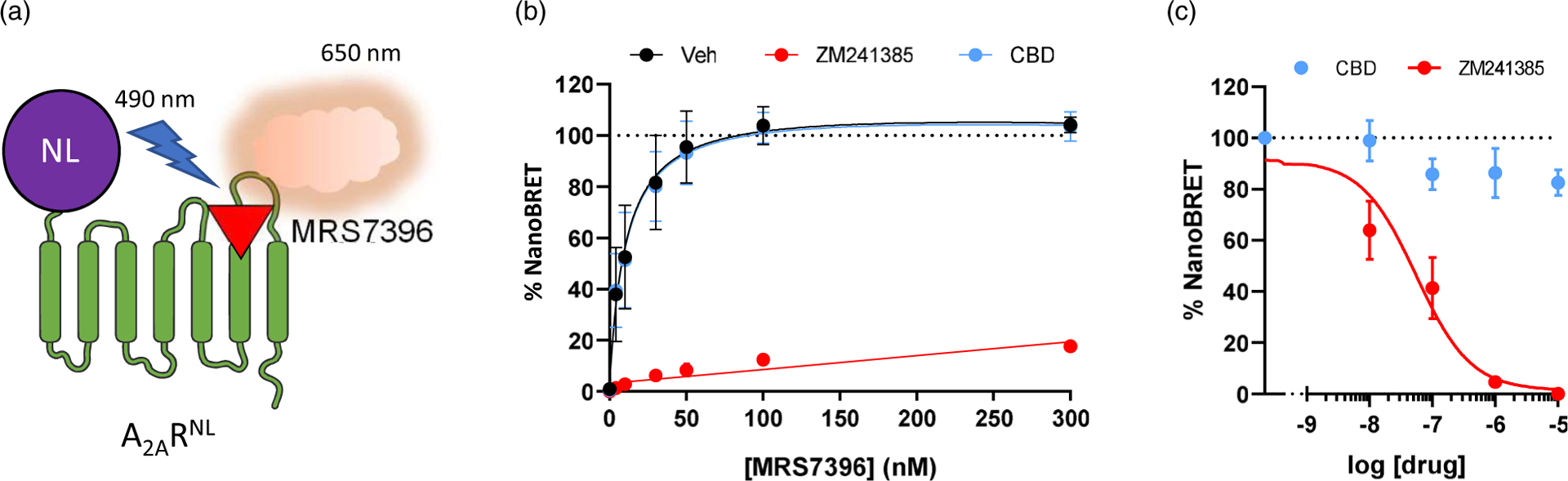
To assess the impact of CBD on A2AR functionality, we initially evaluated whether CBD modified the binding of MRS7396, a fluorescent A2AR antagonist. To this end, we took advantage of a previously reported NanoBRET-based A2AR binding assay (Fig. 1a) (ref. Lanznaster ). HEK-293T cells permanently expressing the A2ARNL construct were challenged with increasing concentrations of MRS7396, which upon binding to the receptor can act as a compatible acceptor in a BRET process (Fig. 1a). As expected, a saturable hyperbolic curve was obtained for the total binding of MRS7396, which was blocked upon incubation with a saturating concentration (1 μM) of the unlabelled A2AR antagonist ZM241385 (nonspecific binding; Fig. 1b). The analysis of the specific binding of MRS7396 revealed a dissociation constant (KD) of 8.5 ± 3.2 nM and a maximum binding capacity (Bmax) of 98.9 ± 8.4 %. Next, upon the same experimental conditions, we examined the ability of CBD to attenuate MRS7396 binding. Differently from ZM241385, CBD (1 μM) was unable to modify the specific binding of MRS7396 to the A2AR (Fig. 1b). Accordingly, no significant differences in affinity (KD) and receptor capacity (Bmax) were found in the presence of CBD (KD = 8.2 ± 2.7 nM; Bmax = 96.9 ± 7.2 %; P = 0.992, F(2, 34) = 0.0079). In addition, we also assessed whether CBD could modulate orthosteric binding of A2AR by performing a competition binding assay with a fixed concentration of MRS7396 (30 nM). Again, while ZM241385 blocked A2AR binding, CBD did not significantly modify the NanoBRET signal (Fig. 1c; P = 0.269, F(4, 10) = 1.518). Collectively, these results indicate that CBD does not bind orthosterically to A2AR.
Subsequently, we aimed to determine whether CBD affected A2AR signalling. To this end, we first evaluated the interaction of A2AR with mini-Gαs protein using the NanoBiT™ complementation assay (ref. Sarasola ). Accordingly, cells were transiently transfected with the A2ARSmBiT and LgBiTmini-Gαs constructs, which once expressed allow the reconstitution of the split nanoluciferase and real-time recordings of receptor-effector coupling induced by agonists (Fig. 2a). Cells were challenged with the selective A2AR agonist CGS21680 (100 nM), which induced a rapid increase in the luminescent signal, reaching a peak at 15 min that remained stable for 30 min. This effect was absent in cells challenged with CBD alone (Fig. 2b). Notably, this agonist-dependent A2AR interaction with mini-Gαs protein was completely blocked when co-incubating cells with ZM241385 (50 nM, Fig. 2b). Next, we assessed CGS21680-induced A2AR coupling to Gαs protein in the presence of increasing concentrations of CBD. Interestingly, CBD dose-dependently blocked A2AR coupling to Gαs protein, both decreasing the maximum peak and the density of the effect (Fig. 2b). Of note, differently from ZM241385, CBD only led to a partial blockade of CGS21680-mediated effects.
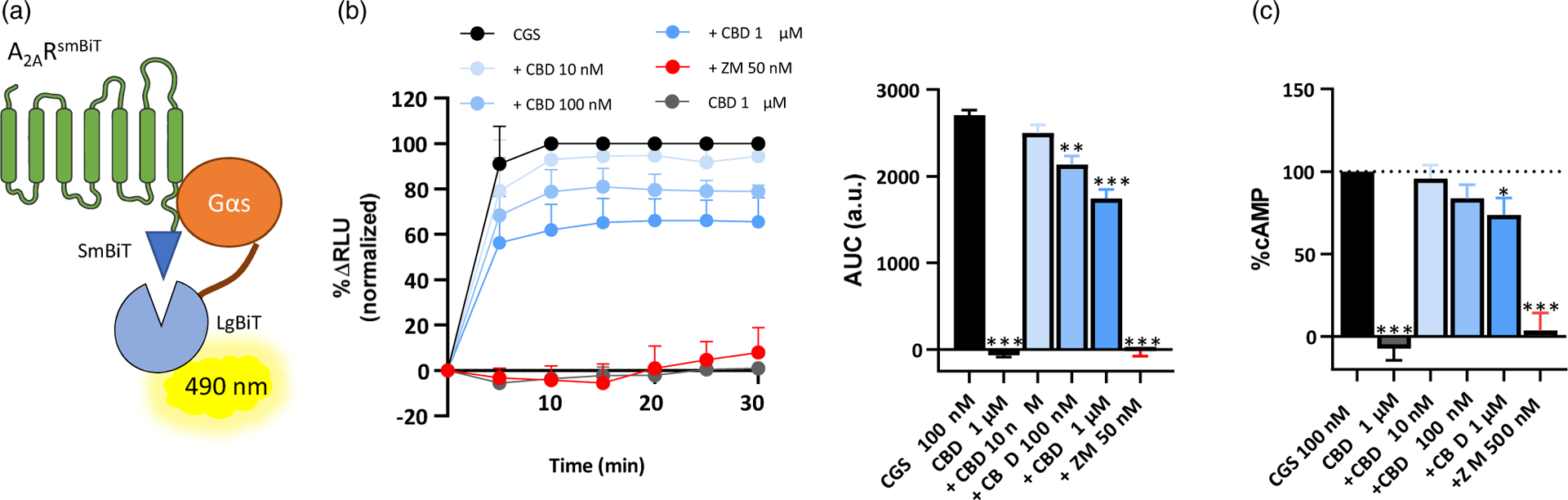
Finally, to further characterise the effects of CBD on the intrinsic activity of A2AR, we evaluated agonist-induced cAMP accumulation in cells permanently expressing the A2ARNL construct and challenged with CGS21680 in the presence/absence of CBD. Interestingly, although CBD itself did not modify cAMP levels, it was able to dose-dependently block CGS21680-induced cAMP levels (Fig. 2c). Again, differently from ZM241385, a full-antagonist, CBD partially blocked A2AR agonist increase of cAMP levels. Overall, these results are compatible with the notion that CBD acts as a weak A2AR negative allosteric modulator.
Discussion
CBD is a promising drug for several pathologies (ref. ElSohly ). Accordingly, unravelling its precise mechanism of action is relevant in the progress towards its clinical development. Here, we reveal that CBD does not affect the binding of an A2AR orthosteric ligand, but it is capable of negatively modulating agonist-induced interaction with the Gαs protein at sub-micromolar concentrations (≥100 nM), thus reducing receptor signalling (i.e. cAMP generation). Therefore, we disclose a new non-competitive interaction of CBD with A2AR.
The effect of CBD on A2AR could operate through a new allosteric site at the receptor. However, further experiments (i.e. using labelled CBD) would be needed to confirm this hypothesis. On the other hand, we cannot rule out other mechanisms of action for CBD different from classical allosteric drugs. In this sense, previous evidence indicates that other lipids, including the endogenous cannabinoid anandamide at micromolar concentrations, might act as allosteric modulators of other GPCRs through a membrane-perturbing effect that is sensitive to receptor conformation (ref. Lanzafame ; ref. Van der Westhuizen ). Further studies are needed to assess this putative CBD-mediated membrane effect on A2AR-Gαs protein coupling. Similarly, CBD could indirectly modify A2AR functioning by interacting with equilibrative nucleoside transporter 1 (ENT1), as was previously demonstrated in striatal synaptosomes (ref. Pandolfo ). However, this hypothetical CBD effect on ENT seems not to play a relevant role in vivo, since a recent study demonstrated that CBD lacks the ability to substantially raise endogenous adenosine levels by using the hypothermia mouse model (ref. Xiao ). These discrepancies between in vitro and in vivo studies could be also explained by the fact that A2AR can form heteromers with other GPCRs, including CB1R (ref. Carriba ; ref. Ferré ; ref. Aso ), in physiological conditions different from that obtained in heterologous expression systems. The assembly of A2AR-containing heteromers leads to changes in the agonist recognition, signalling, and trafficking, which might result in different A2AR activity in the presence of CBD.
Although we evaluated the effects of CBD in cultured cells expressing A2AR, these results could be relevant for many disorders in which A2AR activity increases. For example, in certain inflammatory processes and cardiovascular diseases, but also in pathological conditions that affect the central nervous system, such as Alzheimer’s disease, Parkinson’s disease, attention deficit hyperactivity disorder, fragile X syndrome, depression, or anxiety (ref. Domenici ). A2ARs, which are widely expressed both in neurons and glia, are mainly found in the dorsal and ventral striatum and other nuclei of the basal ganglia, where they play a key role in the control of voluntary movements, as well as in motivational, emotional and cognitive processes (ref. Sebastião and Ribeiro, 2009). In this way, A2ARs are involved in regulating the release of neurotransmitters and contribute to the homeostatic control of synaptic transmission and brain function (ref. Sebastião and Ribeiro, 2009). In general, our results are consistent with the positive effects reported for CBD in various brain disorders that can be associated with an exacerbated A2AR function, where CBD would tone down A2AR hyperactivity.
Overall, the present study provides evidence on the ability of CBD to negatively modulate A2AR signalling. The CBD-mediated negative modulation of A2AR function is restricted to the receptor-effector coupling and does not interfere with the binding of the orthosteric ligand. Accordingly, we provide a new and genuine pharmacological way to modulate the adenosinergic system in pathological conditions in which A2AR function is increased.
References
- E Aso, V Fernández-Dueñas, M López-Cano, J Taura, M Watanabe, I Ferrer, R Luján, F Ciruela. Adenosine A2A-cannabinoid CB1 receptor heteromers in the hippocampus: cannabidiol blunts Δ9-tetrahydrocannabinol-induced cognitive impairment.. Molecular Neurobiology, 2019. [PubMed]
- P Carriba, O Ortiz, K Patkar, Z Justinova, J Stroik, A Themann, C Müller, AS Woods, BT Hope, F Ciruela, V Casadó, EI Canela, C Lluis, SR Goldberg, R Moratalla, R Franco, S Ferré. Striatal adenosine A2A and cannabinoid CB1 receptors form functional heteromeric complexes that mediate the motor effects of cannabinoids.. Neuropsychopharmacology, 2007. [PubMed]
- ClinicalTrials.gov database. The National Library of Medicine. Available at https://clinicaltrials.gov/ (accessed 16 December 2022).
- O Devinsky, MR Cilio, H Cross, J Fernández-Ruiz, J French, C Hill, R Katz, V Di Marzo, D Jutras-Aswad, WG Notcutt, J Martínez-Orgado, PJ Robson, BG Rohrback, E Thiele, B Whalley, D Friedman. Cannabidiol: pharmacology and potential therapeutic role in epilepsy and other neuropsychiatric disorders.. Epilepsia, 2014. [PubMed]
- MR Domenici, A Ferrante, A Martire, V Chiodi, R Pepponi, MT Tebano, P Popoli. Adenosine A2A receptor as potential therapeutic target in neuropsychiatric disorders.. Pharmacological Research, 2019. [PubMed]
- R Duroux, A Ciancetta, P Mannes, J Yu, S Boyapati, E Gizewski, S Yous, F Ciruela, JA Auchampach, ZG Gao, KA Jacobson. Bitopic fluorescent antagonists of the A2A adenosine receptor based on pyrazolo [4,3-: E] [1,2,4]triazolo[1,5- c] pyrimidin-5-amine functionalized congeners.. Medicinal Chemistry Communications, 2017. [PubMed]
- MA ElSohly, MM Radwan, W Gul, S Chandra, A Galal, AD Kinghorn, H Falk, S Gibbons, J Kobayashi). Phytocannabinoids: unraveling the complex chemistry and pharmacology of Cannabis sativa., 2017
- S Ferré, C Lluís, Z Justinova, C Quiroz, M Orru, G Navarro, EI Canela, R Franco, SR Goldberg. Adenosine-cannabinoid receptor interactions. Implications for striatal function.. British Journal Pharmacology, 2010
- A Lanzafame, E Guida, A Christopoulos. Effects of anandamide on the binding and signaling properties of M1 muscarinic acetylcholine receptors.. Biochemical Pharmacology, 2004. [PubMed]
- D Lanznaster, CM Massari, V Marková, T Šimková, R Duroux, KA Jacobson, V Fernández-Dueñas, CI Tasca, F Ciruela. Adenosine A1-A2A receptor-receptor interaction: contribution to guanosine-mediated effects.. Cells, 2019. [PubMed]
- GI Liou, JA Auchampach, CJ Hillard, G Zhu, B Yousufzai, S Mian, S Khan, Y Khalifa. Mediation of cannabidiol anti-inflammation in the retina by equilibrative nucleoside transporter and A2A adenosine receptor.. Investigative Ophthalmology & Visual Science, 2008. [PubMed]
- PA Longo, JM Kavran, MS Kim, DJ Leahy. Transient mammalian cell transfection with polyethylenimine (PEI).. Methods Enzymology, 2013
- JM McPartland, M Duncan, V Di Marzo, RG Pertwee. Are cannabidiol and Δ(9)-tetrahydrocannabivarin negative modulators of the endocannabinoid system? A systematic review.. British Journal Pharmacology, 2015
- M Mecha, A Feliú, PM Iñigo, L Mestre, FJ Carrillo-Salinas, C Guaza. Cannabidiol provides long-lasting protection against the deleterious effects of inflammation in a viral model of multiple sclerosis: a role for A2A receptors.. Neurobiology Disease, 2013
- M Meyrath, CB Palmer, N Reynders, A Vanderplasschen, M Ollert, M Bouvier, M Szpakowska, A Chevigné. Proadrenomedullin N-terminal 20 peptides (PAMPs) are agonists of the chemokine scavenger receptor ACKR3/CXCR7.. ACS Pharmacology Translational Science, 2021. [PubMed]
- HJ Motulsky, RE Brown. Detecting outliers when fitting data with nonlinear regression – a new method based on robust nonlinear regression and the false discovery rate.. BMC Bioinformatics, 2006. [PubMed]
- A Oláh, BI Tóth, I Borbíró, K Sugawara, AG Szöllõsi, G Czifra, B Pál, L Ambrus, J Kloepper, E Camera, M Ludovici, M Picardo, T Voets, CC Zouboulis, R Paus, T Bíró. Cannabidiol exerts sebostatic and antiinflammatory effects on human sebocytes.. Journal Clinical Investigation, 2014
- P Pacher, NM Kogan, R Mechoulam. Beyond THC and endocannabinoids.. Annual Review Pharmacology Toxicology, 2020
- P Pandolfo, V Silveirinha, A dos Santos-Rodrigues, L Venance, C Ledent, RN Takahashi, RA Cunha, A Köfalvi. Cannabinoids inhibit the synaptic uptake of adenosine and dopamine in the rat and mouse striatum.. European Journal Pharmacology, 2011
- A Ribeiro, V Ferraz-de-Paula, ML Pinheiro, LB Vitoretti, DP Mariano-Souza, WM Quinteiro-Filho, AT Akamine, VI Almeida, J Quevedo, F Dal-Pizzol, JE Hallak, AW Zuardi, JA Crippa, J Palermo-Neto. Cannabidiol, a non-psychotropic plant-derived cannabinoid, decreases inflammation in a murine model of acute lung injury: role for the adenosine A2A receptor.. European Journal Pharmacology, 2012
- E Ryberg, N Larsson, S Sjögren, S Hjorth, NO Hermansson, J Leonova, T Elebring, K Nilsson, T Drmota, PJ Greasley. The orphan receptor GPR55 is a novel cannabinoid receptor.. British Journal Pharmacology, 2007
- LI Sarasola, CL Del Torrent, A Pérez-Arévalo, J Argerich, N Casajuana-Martín, A Chevigné, V Fernández-Dueñas, S Ferré, L Pardo, F Ciruela. The ADORA1 mutation linked to early-onset Parkinson’s disease alters adenosine A1-A2A receptor heteromer formation and function.. Biomedicine and Pharmacotherapy, 2022. [PubMed]
- AM Sebastião, JA Ribeiro. Adenosine receptors and the central nervous system.. Handbook Experimental Pharmacology, 2009
- TM Stollenwerk, S Pollock, CJ Hillard. Contribution of the adenosine 2A receptor to behavioral effects of tetrahydrocannabinol, cannabidiol and PECS-101.. Molecules, 2021. [PubMed]
- S Sylantyev, TP Jensen, RA Ross, DA Rusakov. Cannabinoid- and lysophosphatidylinositol-sensitive receptor GPR55 boosts neurotransmitter release at central synapses.. Proceedings of the National Academy of Sciences of the United States of America, 2013. [PubMed]
- ET Van der Westhuizen, C Valant, MC Sexton, A Christopoulos. Endogenous allosteric modulators of G protein-coupled receptors.. Journal Pharmacology Experimental Therapeutics, 2015
- Q Wan, N Okashah, A Inoue, R Nehmé, B Carpenter, CG Tate, NA Lambert. Mini G protein probes for active G protein-coupled receptors (GPCRs) in live cells.. Journal Biological Chemistry, 2018
- C Xiao, O Gavrilova, N Liu, SA Lewicki, ML Reitman, KA Jacobson. In vivo phenotypic validation of adenosine receptor-dependent activity of non-adenosine drugs.. Purinergic Signal (, 2023