
Near-Complete Genome Sequence of GI-17 Lineage Infectious Bronchitis Virus, Circulating in Iowa
Abstract
Avian infectious bronchitis virus (AvIBV) is the causative agent of a highly contagious respiratory disease in chickens which results in significant economic losses in the poultry industry. Here, we report a near-complete genome sequence of the strain, designated IA1162/2020, identified in tracheal swabs from chickens in Iowa in 2020.
Affiliations: Department of Veterinary Diagnostic and Production Animal Medicine, College of Veterinary Medicine, Iowa State University, Ames, Iowa, USA; National Laboratory for Veterinary Quality Control on Poultry Production, Animal Health Research Institute, Agriculture Research Center, Giza, Egypt
License: Copyright © 2021 Hashish et al. CC BY 4.0 This is an open-access article distributed under the terms of the Creative Commons Attribution 4.0 International license.
Article links: DOI: 10.1128/MRA.01406-20 | PubMed: 34016687 | PMC: PMC8188336
Relevance: Moderate: mentioned 3+ times in text
Full text: PDF (799 KB)
ANNOUNCEMENT
Avian infectious bronchitis virus (AvIBV) belongs to the genus Gammacoronavirus, family Coronaviridae, subfamily Coronavirinae, and order Nidovirales (ref. 1). AvIBV is characterized by high genetic diversity and the continuous emergence of new variant strains (ref. 2). In 2011, a nephropathogenic strain of AvIBV, Delmarva/1639 (DMV/1639), from genotype I lineage 17 (GI-17) was reported (ref. 3). Despite the recent wide distribution of this strain in the United States and the availability of multiple S1 gene sequences, whole-genome sequences of this strain are limited. In this study, we report the near-complete genome sequence of a new GI-17 strain, designated IA1162/2020, related to the DMV/1639 strain.
Two pooled tracheal swabs were collected from 10-day-old layer chicks in Iowa with mild respiratory signs and submitted to the Iowa State University Veterinary Diagnostic Laboratory (ISU-VDL) in January 2020. The samples tested positive by reverse transcription-quantitative PCR (qRT-PCR) (ref. 4) with a threshold cycle (CT) value of 18. Total nucleic acid was reextracted from the tracheal swabs using the MagMAX pathogen RNA/DNA kit (Thermo Fisher Scientific, Massachusetts) with a KingFisher 96 instrument (Thermo Fisher Scientific) (ref. 5). Double-stranded cDNA was synthesized using the NextFlex rapid transcriptome sequencing (RNA-seq) kit (Bioo Scientific Corp., Texas). The sequencing library was prepared using the Nextera XT DNA library preparation kit (Illumina, California) with dual indexing. The pooled libraries were sequenced on an Illumina MiSeq platform using the 300-cycle v2 reagent kit (Illumina). The raw reads were analyzed and preprocessed using Trimmomatic v0.36 (ref. 6). The cleaned reads were classified using Kraken v0.10.5-beta (ref. 7) with the standard database. Unclassified reads were classified using Kaiju v1.6.2 (ref. 8), and KronaTools v2.6 (ref. 9) was used to generate the interactive html charts for the hierarchical classification results. Out of a total of 603,724 reads generated for this sample, 8,214 raw reads were identified as IBV. AvIBV reads were extracted from the classification results for de novo assembly using ABySS v1.3.9 (ref. 10). The resulting contigs were manually refined and curated to remove contaminated (nonviral) contigs and to trim chimeric (misassembled) contigs in the SeqMan Pro DNASTAR Lasergene 11 core suite. Finally, a near-complete sequence of AvIBV IA1162/2020 (99.9% genome coverage based on the GA9977/2019 reference genome [GenBank accession number MK878536.1]) was identified with a genome length of 27,486 nucleotides, excluding the poly(A) tail, with a GC content of 38%.
Twelve open reading frames (ORFs) were predicted (Table 1) using the ORFfinder program (https://www.ncbi.nlm.nih.gov/orffinder/), resulting in the following genome organization: 5′-1a-1ab-S-3a-3b-E-M-4b-4c-5a-5b-N-3′. This genome (IA1162/2020) is missing ORF 6b, which was supposed to be between the nucleocapsid gene (N) and the 3′ untranscribed region (UTR). ORF 6b (74 amino acids [aa]) is thought to be an apoptosis inducer (ref. 11) and accelerated the replication of murine coronavirus (CoV) in vitro (ref. 12).
TABLE 1: Open reading frames, proposed function, nucleotide length and amino acid size of the DMV/1639-like IBV strain (IA1162/2020 strain)
| Open reading frame | Proposed function | Nucleotide location | Nucleotide length (bp) | No. of amino acids | |
|---|---|---|---|---|---|
| From | To | ||||
| 1a | Nonstructural polyprotein | 522 | 12383 | 11,862 | 3,953 |
| 1ab | Nonstructural polyprotein | 522ngtab1.1 | 20416 | 19,895 | 6,631 |
| Spike | Structural protein | 20367 | 23867 | 3,501 | 1,166 |
| 3a | Accessory protein | 23867 | 24040 | 174 | 57 |
| 3b | Accessory protein | 24040 | 24234 | 195 | 64 |
| Envelope “3c” | Structural protein | 24215 | 24538 | 324 | 107 |
| Membrane | Structural protein | 24519 | 25187 | 669 | 222 |
| 4b | Accessory protein | 25188 | 25472 | 285 | 94 |
| 4c | Accessory protein | 25393 | 25563 | 171 | 56 |
| 5a | Accessory protein | 25547 | 25744 | 198 | 65 |
| 5b | Accessory protein | 25741 | 25989 | 249 | 82 |
| Nucleocapsid | Structural protein | 25932 | 27161 | 1,230 | 409 |
a A −1 frameshift for polyprotein 1ab occurs at position 12352.
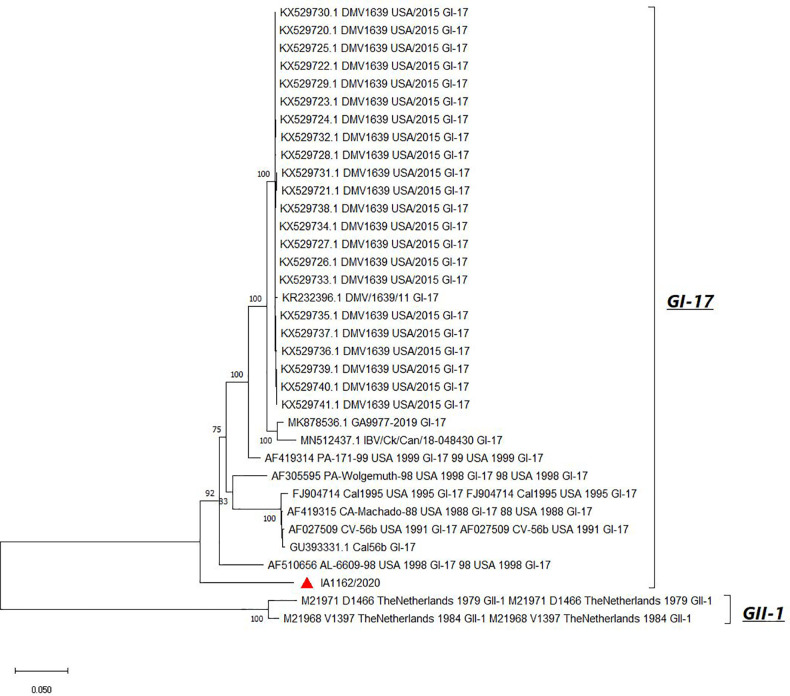
Full-length genome sequence BLAST comparison of IA1162/2020 showed the highest nucleotide similarity (94.78%) to Georgia strain GA9977/2019 (GenBank accession number MK878536.1) belonging to lineage GI-17 (ref. 13). The sequence of the full S1 of IA1162/2020 clustered within GI-17 (ref. 14); however, it formed a separate clade away from other GI-17 strains (Fig. 1).
This near-complete genome will be useful for developing new diagnostic assays and new and alternative vaccination strategies and for better understanding the evolution of AvIBV.
Data availability.
The near-complete genome sequence of the IA1162/2020 AvIBV DMV/1639 strain has been deposited in GenBank under the accession number MW024789. The raw data were deposited under SRA number SRR12575717, BioSample number SAMN15963238, and BioProject number PRJNA660897.
References
- Discovery of seven novel mammalian and avian coronaviruses in the genus deltacoronavirus supports bat coronaviruses as the gene source of alphacoronavirus and betacoronavirus and avian coronaviruses as the gene source of gammacoronavirus and deltacoronavirus.. J Virol, 2012. [DOI | PubMed]
- Genetic analysis of avian coronavirus infectious bronchitis virus in yellow chickens in southern china over the past decade: revealing the changes of genetic diversity, dominant genotypes, and selection pressure.. Viruses, 2019. [DOI]
- Characterization of nephropathogenic infectious bronchitis virus DMV/1639/11 recovered from Delmarva broiler chickens in 2011.. Avian Dis, 2013. [DOI | PubMed]
- Development and evaluation of a real-time Taqman RT-PCR assay for the detection of infectious bronchitis virus from infected chickens.. J Virol Methods, 2006. [DOI | PubMed]
- High-throughput whole genome sequencing of porcine reproductive and respiratory syndrome virus from cell culture materials and clinical specimens using next-generation sequencing technology.. J Vet Diagn Invest, 2017. [DOI | PubMed]
- Trimmomatic: a flexible trimmer for Illumina sequence data.. Bioinformatics, 2014. [DOI | PubMed]
- Kraken: ultrafast metagenomic sequence classification using exact alignments.. Genome Biol, 2014. [DOI | PubMed]
- Fast and sensitive taxonomic classification for metagenomics with Kaiju.. Nat Commun, 2016. [DOI | PubMed]
- Interactive metagenomic visualization in a Web browser.. BMC Bioinformatics, 2011. [DOI | PubMed]
- ABySS: a parallel assembler for short read sequence data.. Genome Res, 2009. [DOI | PubMed]
- Genomic and single nucleotide polymorphism analysis of infectious bronchitis coronavirus.. Infect Genet Evol, 2015. [DOI | PubMed]
- Severe acute respiratory syndrome coronavirus protein 6 accelerates murine coronavirus infections.. J Virol, 2007. [DOI | PubMed]
- First complete genome sequence of currently circulating infectious bronchitis virus strain DMV/1639 of the GI-17 lineage.. Microbiol Resour Announc, 2019. [DOI | PubMed]
- S1 gene-based phylogeny of infectious bronchitis virus: an attempt to harmonize virus classification.. Infect Genet Evol, 2016. [DOI | PubMed]
- A simple method for estimating evolutionary rates of base substitutions through comparative studies of nucleotide sequences.. J Mol Evol, 1980. [DOI | PubMed]
- MEGA X: molecular evolutionary genetics analysis across computing platforms.. Mol Biol Evol, 2018. [DOI | PubMed]