
Health, safety, and socioeconomic impacts of cannabis liberalization laws: An evidence and gap map
Abstract
Background:
Globally, cannabis laws and regulations are rapidly changing. Countries are increasingly permitting access to cannabis under various decriminalization, medicalization, and legalization laws. With strong economic, public health, and social justice incentives driving these domestic cannabis policy reforms, liberalization trends are bound to continue. However, despite a large and growing body of interdisciplinary research addressing the policy‐relevant health, safety, and socioeconomic consequences of cannabis liberalization, there is a lack of robust primary and systematic research that comprehensively investigates the consequences of these reforms.
Objectives:
This evidence and gap map (EGM) summarizes the empirical evidence on cannabis liberalization policies. Primary objectives were to develop a conceptual framework linking cannabis liberalization policies to relevant outcomes, descriptively summarize the empirical evidence, and identify areas of evidence concentration and gaps.
Search Methods:
We comprehensively searched for eligible English‐language empirical studies published across 23 academic databases and 11 gray literature sources through August 2020. Additions to the pool of potentially eligible studies from supplemental sources were made through November 2020.
Selection Criteria:
The conceptual framework for this EGM draws upon a legal epidemiological perspective highlighting the causal effects of law and policy on population‐level outcomes. Eligible interventions include policies that create or expand access to a legal or decriminalized supply of cannabis: comprehensive medical cannabis laws (MCLs), limited medical cannabidiol laws (CBDLs), recreational cannabis laws (RCLs), industrial hemp laws (IHLs), and decriminalization of cultivations laws (DCLs). Eligible outcomes include intermediate responses (i.e., attitudes/behaviors and markets/environments) and longer‐term consequences (health, safety, and socioeconomic outcomes) of these laws.
Data Collection and Analysis:
Both dual screening and dual data extraction were performed with third person deconfliction. Primary studies were appraised using the Maryland Scientific Methods Scale and systematic reviews were assessed using AMSTAR 2.
Main Results:
The EGM includes 447 studies, comprising 438 primary studies and nine systematic reviews. Most research derives from the United States, with little research from other countries. By far, most cannabis liberalization research focuses on the effects of MCLs and RCLs. Studies targeting other laws—including CBDLs, IHLs, and DCLs—are relatively rare. Of the 113 distinct outcomes we documented, cannabis use was the single most frequently investigated. More than half these outcomes were addressed by three or fewer studies, highlighting substantial evidence gaps in the literature. The systematic evidence base is relatively small, comprising just seven completed reviews on cannabis use (3), opioid‐related harms (3), and alcohol‐related outcomes (1). Moreover, we have limited confidence in the reviews, as five were appraised as minimal quality and two as low quality.
Authors’ Conclusions:
More primary and systematic research is needed to better understand the effects of cannabis liberalization laws on longer‐term—and arguably more salient—health, safety, and socioeconomic outcomes. Since most research concerns MCLs and RCLs, there is a critical need for research on the societal impacts of industrial hemp production, medical CBD products, and decriminalized cannabis cultivation. Future research should also prioritize understanding the heterogeneous effects of these laws given differences in specific provisions and implementation across jurisdictions.
Affiliations: Department of Criminal Justice and Criminology Georgia State University Atlanta Georgia USA
License: © 2023 The Authors. Campbell Systematic Reviews published by John Wiley & Sons Ltd on behalf of The Campbell Collaboration. CC BY 4.0 This is an open access article under the terms of the http://creativecommons.org/licenses/by/4.0/ License, which permits use, distribution and reproduction in any medium, provided the original work is properly cited.
Article links: DOI: 10.1002/cl2.1362 | PubMed: 37915420 | PMC: PMC10616541
Relevance: Relevant: mentioned in keywords or abstract
Full text: PDF (8.3 MB)
PLAIN LANGUAGE SUMMARY
The evidence on cannabis liberalization laws is unevenly distributed across policies and outcomes, and the research remains under‐reviewed
An evidence and gap map (EGM) provides a systematic and visual representation of available research on a specific issue or topic. This EGM presents evidence on the effects of cannabis policies. The map reveals areas of both evidence concentration, which can aid systematic review and policy decisions, and evidence gaps, which can inform research and funding priorities.
Studies examining the effects of medical and recreational cannabis laws on cannabis use are relatively common. The evidence base for other laws and outcomes remains underdeveloped.
What is this EGM about?
The map provides descriptive and interactive displays of empirical evidence on the effects of cannabis liberalization laws. Specific interventions include laws that create or expand access to cannabis by removing criminal penalties, allowing medical use, or legalizing use for adults. Main outcomes include health, safety, and socioeconomic factors that are potentially linked to cannabis liberalization.
What studies are included?
The EGM includes 447 studies, comprising 438 primary studies and nine systematic reviews. Eligible studies included works published in English since 1970 that employed quasi‐experimental designs.
What is the aim of this evidence and gap map (EGM)?
The aim of this EGM is to present evidence on the effects of cannabis liberalization laws, including laws that create or expand access to cannabis by removing criminal penalties, allowing medical use, or legalizing use for adults.
What are the main findings of this map?
Most cannabis liberalization research focuses on the effects of medical cannabis laws and recreational cannabis laws. These studies primarily investigate overall effects, but a sizable number also explore the specific effects of cannabis dispensaries.
Studies targeting other relevant laws—including medical cannabidiol laws, industrial hemp laws, and cultivation decriminalization laws—are relatively rare.
The map documented 113 distinct outcomes, with cannabis use outcomes investigated most frequently.
Although no geographic restrictions were applied, most of the evidence is from North America, predominantly the USA.
The systematic evidence base is relatively small, comprising just seven completed reviews on cannabis use, opioid‐related harms, and alcohol‐related outcomes. Five reviews were assessed as minimal quality and two as low quality.
How up to date is this EGM?
The literature search is current through 15 August 2020, with final study additions from other sources occurring on 12 November 2020.
BACKGROUND
The problem, condition, or issue
Globally, cannabis laws and regulations are rapidly changing. Since the late 1980s, countries have increasingly abandoned strict prohibition in favor of alternative approaches legalizing the use and sales of cannabis (Decorte, 2020). In the United States, as of 2022, 38 states have enacted medical cannabis laws authorizing use for qualifying health conditions, and 20 states have passed recreational cannabis laws legalizing home cultivation and/or retail sales for adult use (Klieger, 2017; Klitzner, 2017; Schauer, 2021). Dozens of other countries have also permitted access to cannabis under various decriminalization, medicalization, and legalization regimes (Belackova, 2020; Decorte, 2017; Rehm, 2019). Most notably, Uruguay became the first country to fully legalize recreational cannabis in 2013 (Queirolo, 2020), followed by Canada in 2018 (Fischer, 2018) and Malta in 2021 (Bubola, 2021).
With strong economic, public health, and social justice incentives driving domestic cannabis policy reforms (Newman, 2021; Oldfield, 2021), these trends will only accelerate. However, despite a large and growing body of interdisciplinary research addressing the policy‐relevant health, safety, and socioeconomic outcomes of cannabis liberalization, there remains a paucity of systematic research examining the potential benefits and harms of these reforms. In fact, outside of a handful of narrowly targeted narrative syntheses and meta‐analyses, no systematic reviews have fully scoped this diverse empirical literature. Consequently, this hampers policymakers’ ability to understand the impacts of these policies when adoptions or amendments are considered. This evidence and gap map (EGM) summarizes the empirical evidence on cannabis liberalization policies, highlights current knowledge gaps, and identifies opportunities for future research.
Why was it important to develop this EGM?
This EGM provides the first comprehensive review of the available evidence on cannabis liberalization reforms, capturing important heterogeneity in target populations, research designs, and study quality that is crucial to understanding this literature (Choo, 2017; Hunt, 2015; Pacula, 2017). Accordingly, the EGM offers stakeholders both a timely summary of the evidence and a roadmap for prioritizing future research.
Existing EGMs and/or relevant systematic reviews
Although there are no existing EGMs in this policy space, more than a dozen systematic reviews have been published examining the effects of cannabis liberalization policies on a small subset of relevant outcomes, namely cannabis use, other substance use, cannabis use disorders, roadway safety, and opioid‐related mortality.
Most systematic reviews assessed youth and adult cannabis use as the primary outcome, including one rapid review (O’Grady, 2022), four narrative reviews (Lachance, 2022; Leung, 2018; Pacula, 2022; Smart, 2019), and two meta‐analyses (Melchior, 2019; Sarvet, 2018). Harrell et al. (Harrell, 2022) also examined cannabis use as part of a larger scoping review of factors linked to vaping, and Pacula and colleagues (Pacula, 2022; Smart, 2019) investigated alcohol use both alone and in combination with cannabis, updating an earlier review by Guttmannova et al. (Guttmannova, 2016). While the reviews’ findings are mixed, two broad generalizations hold: increases in cannabis use, when observed, were more likely (i) among young adults than adolescents and (ii) following passage of recreational versus medical cannabis laws.
A smaller number of systematic reviews have investigated specific harms linked to cannabis liberalization. Several reviews examined cannabis use disorders, but none could draw firm conclusions (Leung, 2018; O’Grady, 2022; Smart, 2019). Similarly, a rapid review (Ansari, 2020), narrative review (Vyas, 2018), and meta‐analysis (Chihuri, 2019) found the overall evidence on opioid‐related mortality and associated harms to be inconsistent and inconclusive. A narrative review of roadway safety by Hasan et al. (Hasan, 2022) determined the evidence was insufficient to draw strong conclusions with respect to driving under the influence of drugs. However, a narrative review by Vingilis et al. (Vingilis, 2021) concluded, albeit cautiously, that cannabis commercialization was linked to increases in both traffic accidents and driver cannabis‐positivity rates.
In summary, existing systematic reviews of the effects of cannabis liberalization policies primarily focus on cannabis use, despite primary studies investigating a much broader and arguably more salient set of outcomes (Sznitman, 2015). Recent conceptual mappings across varied national contexts have identified dozens of performance indicators in the public health, community safety, and economic sectors that are relevant for understanding the full scope of cannabis policy impacts (Campeny, 2020; Fischer, 2018; Maslov, 2016).
EGMs: Definition and purpose
EGMs involve systematic searches of policies or interventions to identify gaps in knowledge and future research needs (Miake‐Lye, 2016). Results are typically presented in the form of a detailed graph and/or interactive database. Development of the current EGM adhered to published guidance (O’Leary, 2017; White, 2020).
OBJECTIVES
This EGM had three key objectives:
- Develop a clear conceptual framework linking cannabis liberalization laws to associated health, safety, and socioeconomic outcomes.
- Provide a structured summary of the empirical evidence, research setting and context, and study quality from existing primary empirical studies and systematic reviews for use by policymakers, researchers, and other stakeholders.
- Identify study clusters that can support further systematic review, and document evidence gaps where additional primary research and funding resources are needed.
EGM framework
Scope of the EGM
This EGM focuses on the impacts of laws and policies that expand legal access to cannabis. This encompasses medical, recreational, and industrial cannabis laws, as well as cannabis cultivation decriminalization laws that, while not legalizing production, abolish criminal penalties for small‐scale cultivation. The vertical axis of the map captures this policy dimension. The horizontal axis of the map captures health, safety, and socioeconomic outcomes that are theoretically or practically responsive to cannabis liberalization.
Conceptual framework
Legal epidemiology is an interdisciplinary approach to studying causal effects of laws and policies on population‐level outcomes (Burris, 2013; Burris, 2016). Drawing upon this approach, Figure 1 frames our understanding and interpretation of cause‐and‐effect factors. The framework distinguishes policy from practice. Cannabis laws are statutes and regulations governing the production, availability, and use of cannabis. Legal practices reflect on‐the‐ground implementation of these laws. This distinction is important because the “law on the books” may deviate materially from the “law on the streets.” For example, it has typically taken one to 2 years post‐legalization for recreational cannabis markets to be fully open and operational in US states (Schauer, 2021).
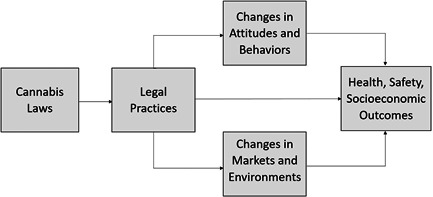
The conceptual framework also highlights how laws and practices affect intermediate changes in attitudes and behaviors (e.g., perceptions of harm, frequency of use) and markets and environments (cannabis potency, availability of cannabis). These intermediate factors are themselves worthy of study, especially since ultimate outcomes (e.g., respiratory disease) take longer to manifest than more proximal factors (e.g., vaping prevalence).
Stakeholder engagement
We solicited feedback on EGM concept and design from selected researchers and stakeholders in the areas of drug and cannabis policy from various organizations, including the International Society for the Study of Drug Policy, Global Cannabis Cultivation Research Consortium, and RAND Drug Policy Research Center. We received comments from multiple domain experts that helped improve the research protocol, including conceptualization and scope of the project, coding guide development, and selection of academic and gray literature database sources.
METHODS
Criteria for including and excluding studies
Types of interventions
Eligible studies included policies that create or expand access to a legal or decriminalized supply of cannabis. As summarized in Table 1, this scope encompasses five distinct types of laws: comprehensive medical cannabis laws (MCLs) (e.g., Rehm, 2019), limited medical cannabidiol laws (CBDLs) (e.g., Alharbi, 2020), recreational cannabis laws (RCLs) (e.g., Klitzner, 2017), industrial hemp laws (IHLs) (e.g., McGregor, 2020), and decriminalization of cultivation laws (DCLs) (e.g., Belackova, 2020).
Table 1: Cannabis liberalization laws.
| Law or Policy | Description |
|---|---|
| Medical cannabis law (MCL) | Grants qualified patients with a physician’s recommendation or prescription the legal right to use and possess cannabis and, in some jurisdictions, cultivate cannabis to treat approved medical conditions. |
| Cannabidiol law (CBDL) | Grants qualified patients with a physician’s recommendation or prescription the legal right to use and possess high‐CBD/low‐THC cannabis products, such as oils and tinctures, to treat approved medical conditions. Tetrahydrocannabinol (THC) is the main psychoactive constituent of cannabis, whereas cannabidiol (CBD) is a key nonpsychoactive compound. |
| Recreational cannabis law (RCL) | Legalizes adult cannabis use and regulates the modes of cannabis production and supply. |
| Industrial hemp law (IHL) | Legalizes the cultivation of low‐THC cannabis (e.g., <0.3% THC), otherwise known as hemp, to produce foods, supplements, and nonconsumable products such as textiles and cosmetics |
| Decriminalization of cultivation law (DCL) | Removes criminal penalties for small‐scale (e.g., <6 plants) home cultivation of cannabis for personal use and social supply |
Studies of policies that do not explicitly increase the supply of cannabis meant for human consumption were considered out‐of‐scope. This delimitation excludes, for instance, studies of decriminalization laws that only remove penalties for cannabis use or possession, industrial hemp laws that legalize cannabis cultivation solely for producing textiles and other nonconsumable products, and other policies that do not establish clear regulatory authority over cannabis supply. Note that the latter exclusion applies to the US Department of Justice’s Ogden Memorandum, which articulated a federal policy of nonenforcement in states with strong and effective medical cannabis regulations, but not to the Dutch “coffeeshop” model which de facto legalized the retail supply of cannabis under uniform and enforceable national regulations (Korf, 2020).
Types of outcomes
Studies were included in the EGM if they measured health, safety, or socioeconomic outcomes. Health outcomes assess physical or mental well‐being and quality of life, safety outcomes measure levels of security and risk of harm, and socioeconomic outcomes capture social and economic conditions. We also included studies focusing on intermediate outcomes reflecting changes in structural conditions and incentives, including attitudes and behaviors (e.g., perceptions of marijuana, prevalence of use, routes of administration) and markets and environments (e.g., cannabis prices and potency, advertising). As our purview was purposely broad, we placed no a priori restrictions on specific outcomes within this framework, nor did we limit the measurement modality (e.g., self‐report, administrative data). Table 2 describes and provides examples of these eligible intermediate and ultimate outcomes.
Table 2: Intermediate and ultimate outcomes.
| Outcomes | Description | Examples |
|---|---|---|
| Intermediate | ||
| Attitudes and behaviors | Perspectives and activities of individuals | Perceptions of harm, prevalence of cannabis use, prevalence of other drug use, routes of administration |
| Markets and environments | Marketplace and contextual characteristics | Availability of cannabis, cannabis prices, and potency, product marketing and advertising |
| Ultimate | ||
| Health | Physical or mental well‐being and quality of life | Substance use disorders, overdose, suicide, mortality, mental and physical health |
| Safety | Levels of security and risk of harm | Crime, drugged driving, traffic accidents, workplace safety |
| Socioeconomic | Social and economic conditions | Housing values, educational attainment, productivity, environmental consequences |
Types of target populations
RCLs target the general adult population, whereas MCLs and CBDLs target people who have been diagnosed with specific medical conditions (e.g., epilepsy, HIV, chronic pain). However, because cannabis liberalization research is often concerned with unintended consequences among groups not directly targeted by these laws (e.g., accidental ingestion by youth), we placed no a priori restrictions on study target or reference populations.
Types of settings
Eligible study settings included any national or subnational jurisdiction that decriminalized, medicalized, or legalized the supply of cannabis since 1970, a starting year that encompasses all modern cannabis policy reforms. Studies not published in English were excluded because the study team had no fluency in other languages.
Types of evidence
We included both completed and ongoing primary studies and systematic reviews in the EGM. We targeted all types of quasi‐experimental and experimental research designs, although we did not anticipate locating true experiments since cannabis policies are not randomly assigned to states. Quasi‐experimental designs use observational data to estimate the average effect of an intervention, where the comparator consists of groups and/or time periods that are not exposed to the policy. Eligible quasi‐experimental designs included but were not limited to difference‐in‐differences, interrupted time series, regression discontinuity, synthetic control method, instrumental variables, propensity score matching, controlled before‐and‐after, cohort design, and regression‐based cross‐sectional analyses that control for confounding variables (Bärnighausen, 2017; Reeves, 2017; Rockers, 2015). We excluded studies if they used only simulated data or forecasting techniques, were primarily descriptive in nature, or employed only qualitative evidence. We included systematic reviews of all types if the reviews reported replicable methods and summaries of impact (MacEntee, 2019).
Search methods for identification of studies
We searched academic databases and gray literature sources and implemented supplemental search strategies to locate relevant citations. All retrieved references were downloaded into EndNote software for bibliographic management.
Academic databases
Between August 13–15, 2020, we searched the following 23 indexed academic databases and systematic review registries (with vendor noted):
- Academic Search Complete (EBSCO)
- APA PsycINFO (EBSCO)
- Applied Social Sciences Index and Abstracts (ProQuest)
- Campbell Library (Campbell Collaboration)
- CINAHL Plus (EBSCO)
- Cochrane Library (Wiley)
- Criminal Justice Abstracts (EBSCO)
- Criminal Justice Database (ProQuest)
- Dissertations & Theses A&I (ProQuest)
- EconLit (EBSCO)
- Embase (Elsevier)
- ERIC (EBSCO)
- Health Management/Administration Database (ProQuest)
- Health Source: Nursing/Academic Edition (EBSCO)
- International Bibliography of the Social Sciences (ProQuest)
- Legal Source (EBSCO)
- Medline (EBSCO)
- National Criminal Justice Reference Service (ProQuest)
- PAIS Index (ProQuest)
- PROSPERO (University of York)
- Research Library (ProQuest)
- ScienceDirect (Elsevier)
- Web of Science: Core Collection (Clarivate Analytics)
We used both natural language and controlled vocabulary terms to search databases using Boolean logic across three domains: (1) cannabis, (2) policy change, (3) and quantitative methods. Natural language terms were used to query title, abstract, and keyword fields. Controlled vocabulary terms were used to query subject fields. If the database search engine allowed, we automatically expanded the search to include related words and equivalent subjects, while delimiting the query by language (English‐only), time (since 1970), and source (e.g., no commentaries). See Supporting Information: Appendix 1 for the complete database search strategy.
Gray literature sources
Between August 13–15, 2020, we also searched the following 11 gray literature sources:
- Don M. Gottfredson Library of Criminal Justice Gray Literature Database (https://njlaw.rutgers.edu/cj/gray/index.php)
- European Monitoring Centre for Drugs and Drug Addiction (https://www.emcdda.europa.eu/publications)
- International Society for the Study of Drug Policy Grey Literature Bibliography (https://www.issdp.org/bibliography-introduction/)
- IZA – Institute of Labor Economics (https://www.iza.org/publications)
- National Bureau of Economic Research Working Papers (https://www.nber.org/papers.html)
- RAND Corporation (https://www.rand.org/search/advanced-search.html)
- National Drug & Alcohol Research Centre (https://ndarc.med.unsw.edu.au/resources)
- Open Society Framework (https://osf.io/preprints/)
- RePEc (https://ideas.repec.org/)
- ScholarWorks (https://scholarworks.gsu.edu/)
- Social Sciences Research Network (https://papers.ssrn.com/sol3/DisplayAbstractSearch.cfm)
The search strategy for gray literature was simplified to accommodate their less sophisticated search engines, which commonly disallowed the use of wildcards, delimiters, or more advanced search logic.
Supplementary search strategies
We augmented our systematic search by including studies from our personal libraries. We also reached out to subject matter experts for new, updated, or unpublished research. Finally, to identify additional potentially relevant studies, we (i) reviewed the references of eligible studies and reviews and (ii) used Google Scholar to forward citation search for eligible studies. The final addition to our pool of potentially eligible studies from any of these supplemental sources was entered on November 12, 2020, although we continued to update the bibliographic information of working papers and prepublication articles as we were alerted to newer versions of record.
Study screening and selection
Before screening, duplicate records were removed using the EndNote deduplication protocol outlined by Bramer et al. (Bramer, 2016). We screened both titles/abstracts and full‐text using the DistillerSR platform (Evidence, 2022). All three authors took part in the study screening and selection process. Initially, the titles and abstracts of retrieved records were independently screened by two reviewers according to the following three criteria:
- Does the study examine a cannabis liberalization law or policy that expands legal access to cannabis supply for personal consumption?
- Does the study examine (i) an intermediate market/environmental or attitudinal/behavioral outcome or (ii) a final health, safety, or socioeconomic outcome?
- Is the study (i) a systematic review or (ii) does it employ a quasi‐experimental study design providing quantitative evidence of impact?
Studies were passed to the full‐text screening stage if all three questions were answered affirmatively. Screening conflicts were resolved by reaching consensus with a third reviewer. To reduce screening workload at the title/abstract stage, we used DistillerSR’s continuous reprioritization feature, which employs artificial intelligence to reorder unscreened studies based on their predicted relevance, coupled with the software’s auditing and simulation tools to help identify potentially incorrectly excluded and incorrectly included studies (Hamel, 2020). Next, two reviewers independently and manually examined the full texts of all potentially eligible studies according to the same three screening questions (i.e., dual full‐text screening), with any conflicts arbitrated by a third reviewer. Any additional reasons why a study was deemed ineligible (e.g., superseded version, non‐English, full‐text unavailable) were also recorded at this stage.
Data collection and analysis
Data extraction, coding, and management
Initial data extraction was performed independently by two coders using DistillerSR to collect study‐level descriptive data. Discrepancies were deconflicted by consensus, with a third reviewer arbitrating when needed. We coded bibliographic information, study setting and data years, publication type, funding information, policies and provisions, outcomes, study design, and study quality. When study‐level information was missing on any of these items, we coded it as “not reported.” If study criteria fell across multiple coding categories, we recorded all statuses. For instance, if a study used multiple research designs (e.g., difference‐in‐differences and instrumental variables) or study data spanned multiple decades (e.g., 1990–1999 and 2000–2009), each condition was coded in the final map. After this step, the original coding scheme was refined and adjusted to produce a final coding scheme for use with EPPI‐Reviewer (Thomas, 2022), the software platform we used to develop the online EGM. The final coding guide is presented in Supporting Information: Appendix 2.
Quality appraisal
All studies were assessed for quality. For primary intervention studies, we used a modified version of the Maryland Scientific Methods Scale (SMS) (Madaleno, 2016; Sherman, 2002), a 5‐point scale ranging from 1 (lowest quality) to 5 (highest quality). SMS robustness is determined by the study’s ability to identify a causal effect according to the following design criteria:
- Level 1: Study lacks either a comparison group or pre‐post observations on the outcome. These studies typically employ comparative cross‐sectional designs or one‐group pretest–posttest designs.
- Level 2: Study uses both a comparison group and pre‐post observations on the outcome. These studies may control for confounders or use propensity score matching, but do not account for unobservable differences between groups. Studies at this level include cohort designs, in which subjects allocate themselves to treatment status, and controlled before‐and‐after designs, in which subjects are nonrandomly allocated to treatment status.
- Level 3: Study employs (i) panel data to compare treated and comparison groups on many pre‐ and postintervention observations (e.g., difference‐in‐differences, synthetic control method, proportional hazard model) or (ii) time series data to compare a treated group across many timepoints both before and after an intervention (e.g., interrupted time series).
- Level 4: Study achieves quasi‐randomization by employing specific design features that mitigate selection bias and other forms of endogeneity (e.g., instrumental variables estimation, regression discontinuity).
- Level 5: Study randomizes subjects into treatment and control conditions (e.g., RCT).
If a study reported multiple designs (e.g., in a supplemental analysis), we coded the highest study quality level. Note that because no RCT studies have been conducted in this policy domain, we used only the first four quality levels. Accordingly, we adopted the following study quality descriptors for this EGM: Level 1 = minimal, Level 2 = low, Level 3 = moderate, and Level 4 = high. Being largely design‐driven and focused on internal validity, the SMS does not explicitly account for implementation quality nor does it assess other relevant dimensions of bias (e.g., confounding, selective effect size reporting). As such, the SMS has serious limitations as a comprehensive quality appraisal tool, but alternative risk of bias instruments are ill‐suited for the types of designs encountered in this review (Waddington, 2017).
For systematic reviews, we assessed risk of bias using AMSTAR 2 (Shea, 2017). We analogously summarized overall confidence in the results of each review according to AMSTAR 2 scoring criteria: Minimal (more than one critical flaw with or without noncritical weaknesses), low (one critical flaw with or without noncritical weaknesses), moderate (more than one noncritical weakness), and high (no more than one noncritical weakness).
Analysis and presentation
The EGM is presented as an interactive policy‐outcome matrix (https://eppi.ioe.ac.uk/cms/Portals/35/Maps/Cannabis_Liberalization_Laws_EGM), which is supplemented by a data visualization tool (https://eppi.ioe.ac.uk/eppi-vis/login/open?webdbid=243) as well as the descriptive analyses reported in this paper. The unit of analysis is a systematic review or primary study, represented as an entry within a cell of the EGM. If a review or study investigated multiple policies and/or outcomes, then it is reported in each relevant cell of the EGM.
We used Stata/MP 17.0 (StataCorp, 2021) or Microsoft Excel to produce the statistics and graphs. The online, interactive EGM was developed using EPPI‐Mapper (Digital, 2022). Cannabis liberalization policies form one axis of the map; health, safety, and socioeconomic outcomes form the other axis. Study entries within each cell of the interactive EGM are stratified and color‐coded by study quality (i.e., minimal to high), with additional selectable study filters including country, data period, publication type, funding information, policy and outcome sources, reference population, and research design.
RESULTS
Results of the search
Figure 2 depicts the PRISMA flow diagram for our literature search. The search strategy yielded 44,676 records, including 43,444 from academic databases, 502 from protocol registers, 102 from gray literature source, and 628 from other sources. After removing 27,949 duplicates, we retained 16,727 records for title and abstract review. Using DistillerSR’s continuous reprioritization feature, we manually reviewed 5498 titles/abstracts (32.9%), stopping when the predicted likelihood of any remaining unscreened records being eligible for inclusion was less than 3%. At this point, we additionally reviewed the studies with the highest predicted likelihood of being either incorrectly included or incorrectly excluded, ultimately determining that no studies were wrongly classified. Overall, we manually excluded 5498 records and automatically excluded 10,546 by machine learning.
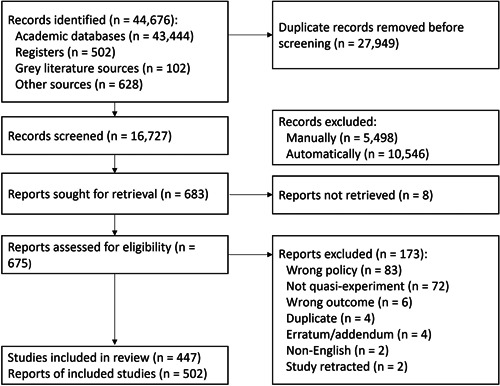
We sought 683 reports for retrieval, but could not locate the full texts for eight potentially eligible studies. Of the remaining 675 full‐text reports assessed for eligibility, we included 447 studies in the EGM, comprising 438 primary studies and nine systematic reviews. Overall, we retrieved 502 reports for the 447 eligible studies. The remaining 173 ineligible studies were excluded for the following reasons: wrong policy (83), wrong outcome (6), not quasi‐experimental (72), duplicate (4), erratum/addendum (4), non‐English (2), and study retracted (2).
Aggregate map
In this section, we discuss the major policy and outcome groupings in the EGM. More granular policy and outcome drill‐downs are presented in subsequent sections. Additional information on all eligible studies can be viewed and filtered in the online map (https://eppi.ioe.ac.uk/cms/Portals/35/Maps/Cannabis_Liberalization_Laws_EGM) and data visualizer (https://eppi.ioe.ac.uk/eppi-vis/login/open?webdbid=243).
Table 3 shows the aggregate number of primary studies (n = 438) and systematic reviews (n = 9) by major policy and outcome categories. On the policy axis, most studies in the EGM, whether primary studies or systematic reviews, focused on MCLs (n = 282) and RCLs (n = 248), with just a handful of studies investigating CBDLs (Aranda, 2020; Phillips, 2017; Prestemon, 2019; Shi, 2019; Shover, 2019), IHLs (Carrieri, 2019; Carrieri, 2020), or DCLs (Cerveny, 2017; Damrongplasit, 2010; Melchior, 2019; Williams, 2004). On the outcome axis, more than half the studies in the EGM investigated attitudes/behaviors (n = 232), about a quarter examined health (n = 123) and safety (n = 119), and roughly a 10th focused on markets/environments (n = 44) and socioeconomics (n = 48).
Table 3: Aggregate map: Number of studies by policy and outcome categories.
| Attitudes and behaviors | Markets and environments | Health | Safety | Socioeconomic | Row total | |
|---|---|---|---|---|---|---|
| Medical cannabis law | 142 | 9 | 151 | 22 | 1 | 23 | 81 | 6 | 87 | 73 | 1 | 74 | 29 | 0 | 29 | 273 | 9 | 282 |
| CBD law | 1 | 0 | 1 | 1 | 0 | 1 | 3 | 0 | 3 | 0 | 0 | 0 | 1 | 0 | 1 | 5 | 0 | 5 |
| Recreational cannabis law | 120 | 7 | 127 | 24 | 1 | 25 | 53 | 5 | 58 | 68 | 1 | 69 | 28 | 0 | 28 | 241 | 7 | 248 |
| Industrial hemp law | 1 | 0 | 1 | 1 | 0 | 1 | 0 | 0 | 0 | 1 | 0 | 1 | 0 | 0 | 0 | 2 | 0 | 2 |
| Decriminalization of cultivation law | 3 | 1 | 4 | 0 | 0 | 0 | 0 | 0 | 0 | 0 | 0 | 0 | 0 | 0 | 0 | 3 | 1 | 4 |
| Column total | 223 | 9 | 232 | 43 | 1 | 44 | 117 | 6 | 123 | 119 | 1 | 120 | 48 | 0 | 48 | 438 | 9 | 447 |
Note: The first figure in each cell refers to the number of primary studies, the second figure to the number of systematic reviews, and the third figure to the total number of studies.
Looking specifically at primary studies, the most populated cells in the map aligned in three tiers across both MCLs and RCLs. MCL research on attitudes/behaviors was predominant (n = 142), followed by studies addressing health (n = 81) and safety (n = 72) outcomes, and, lastly, socioeconomic (n = 29) and market/environment (n = 22) factors. Research on RCLs followed a similar overall pattern. Most RCL studies investigated attitudes/behaviors (n = 120), followed by research on matters of safety (n = 67) and health (n = 53), and trailed by studies on socioeconomics (n = 28) and markets/environments (n = 24). The number of primary studies across cells corresponding to CBDLs, IHLs, and DCLs was relatively sparse, reflecting the nascent policy environment and emergent nature of research on these other cannabis laws.
Comparatively, the seven completed and two ongoing systematic reviews in the EGM focused primarily on attitudes/behaviors and health responses to MCLs and RCLs. Few systematic reviews targeted other policies and outcomes. The exceptions are Melchior et al. (Melchior, 2019), who reported on the effects of DCLs on adolescent and young adult cannabis use, and a preregistered review by Busse et al. (Busse, 2018), who identified safety‐related motor vehicle accidents as a key outcome.
Description of included primary studies
Study setting
Of the 438 primary studies in the EGM, most (n = 427) were conducted in North America, predominately the United States (n = 422) but also Canada (n = 10) and Mexico (n = 1). Five of the North American studies were conducted in the context of both the United States and Canada (Goodman, 2019; Goodman, 2020; Hildebrand, 2020; Lane, 2019; Rup, 2020), and one study examined spillover effects of MCLs in the United States on homicide in Mexico (Gavrilova, 2019). Studies from other countries were represented sparingly in the EGM: Australia (Damrongplasit, 2010; Williams, 2004), Czech Republic (Cerveny, 2017), Italy (Carrieri, 2019; Carrieri, 2020), Netherlands (Wouters, 2009; Wouters, 2012), and Uruguay (Jorge, 2020; Laqueur, 2020; Nazif‐Munoz, 2020).
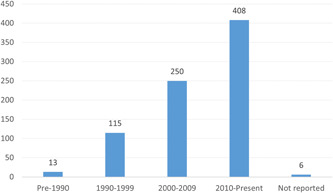
Figure 3 presents the number of primary studies by years of data coverage, aggregated by decade. Few studies (n = 13) presented or analyzed data from pre‐1990. However, the number of studies increases steadily across data years, with most (n = 408) reporting data analytic results, in part or whole, for the decade covering 2010‐Present. Six studies did not report the data period.
Policies and provisions
As described previously, cannabis liberalization laws vary considerably in their overarching policy objectives. Most primary studies in the EGM (n = 358) focused on a single type of law. Among the remaining studies that examined multiple laws, the majority (n = 77) targeted MCLs and RCLs, with one examining MCLs and CBDLs and four investigating MCLs, RCLs, and CBDLs together.
Table 4 presents the number of primary studies by year of publication and policy. During the first eight publication years covered by the EGM (2004–2011) only eight studies were produced, with the very first study by Williams (Williams, 2004) examining the effect of Australian state decriminalization of cannabis consumption and cultivation on cannabis use. The earliest MCL study similarly examined effects on cannabis use in the United States (Gorman, 2007), whereas the initial RCL study compared cannabis buying behavior by “coffeeshop” availability across Netherlands cities (Wouters, 2009). The later publication of seminal studies on CBDLs (Phillips, 2017) and IHLs (Carrieri, 2019) reflects their more recent policy diffusion. As Table 4 shows, the pace of cannabis policy research accelerated in 2014, with the number of MCL studies predominating (77%) before 2019 but shifting primarily to RCLs (72%) since 2019.
Table 4: Number of primary studies by year of publication and policy.
| Year | Medical cannabis law | Cannabidiol law | Recreational cannabis law | Industrial hemp law | Decrim of cultivation law | Total |
|---|---|---|---|---|---|---|
| 2004 | 0 | 0 | 0 | 0 | 1 | 1 |
| 2005 | 0 | 0 | 0 | 0 | 0 | 0 |
| 2006 | 0 | 0 | 0 | 0 | 0 | 0 |
| 2007 | 1 | 0 | 0 | 0 | 0 | 1 |
| 2008 | 0 | 0 | 0 | 0 | 0 | 0 |
| 2009 | 0 | 0 | 1 | 0 | 0 | 1 |
| 2010 | 2 | 0 | 0 | 0 | 1 | 3 |
| 2011 | 2 | 0 | 0 | 0 | 0 | 2 |
| 2012 | 7 | 0 | 1 | 0 | 0 | 8 |
| 2013 | 4 | 0 | 0 | 0 | 0 | 4 |
| 2014 | 18 | 0 | 1 | 0 | 0 | 19 |
| 2015 | 21 | 0 | 8 | 0 | 0 | 25 |
| 2016 | 34 | 0 | 9 | 0 | 0 | 42 |
| 2017 | 34 | 1 | 24 | 0 | 1 | 47 |
| 2018 | 41 | 0 | 35 | 0 | 0 | 66 |
| 2019 | 58 | 3 | 78 | 1 | 0 | 114 |
| 2020 | 38 | 0 | 70 | 1 | 0 | 91 |
| 2021 | 12 | 1 | 13 | 0 | 0 | 21 |
| 2022 | 1 | 0 | 1 | 0 | 0 | 2 |
Policy design and implementation also differs substantially within major law types. Certain MCL jurisdictions, for instance, allow retail dispensaries and home cultivation, whereas others do not. Understanding how such policy heterogeneity affects outcomes is an important, and often overlooked, aspect of cannabis liberalization research (Pacula, 2014). Table 5 shows the number of primary studies by specific MCL and RCL policy provisions. Other cannabis liberalization policies are not presented in the table because no existing studies have investigated their specific policy dimensions.
Table 5: Number of primary studies by policy provisions.
| Policy provisions | Medical cannabis law | Recreational cannabis law |
|---|---|---|
| Total studies | 273 | 241 |
| General law—only studies | 144 | 140 |
| Specific policy provision studies | 129 | 101 |
| Registries | 34 | 0 |
| Qualifying medical conditions | 17 | n/a |
| Employment protections | 1 | 0 |
| Caregiver regulations | 1 | n/a |
| Home cultivation | 37 | 4 |
| Plant/possession limits | 4 | 1 |
| Social clubs/collectives | 4 | 0 |
| Retail outlets | 102 | 99 |
| Product and marketing regulations | 1 | 0 |
| Policy provision index | 10 | 1 |
Most MCL studies (n = 144) examined general law‐only effects, that is, whether the law was generally active and operational in a jurisdiction. Among the remaining MCL studies that explored the effects of one or more specific policy provisions, the majority focused on retail outlets (n = 102) followed by home cultivation (n = 37), registries (n = 34), and qualifying medical conditions (n = 17). Other MCL policy provisions (i.e., social clubs/collectives, plant/possession limits, product/marketing regulations, employment protections, and caregiver regulations) were infrequently investigated. Lastly, rather than focus on specific policy provisions, 10 studies operationalized policy indexes as measures of overall medical program leniency or restrictiveness.
As shown in Table 5, most RCL studies (n = 140) also examined general law‐only effects. Nearly every study that focused on an RCL policy provision identified the effects of retail outlets or dispensaries (n = 99). Other RCL policy provisions, including home cultivation and plant/possession limits, were rarely investigated.
Our analysis of cannabis policies and provisions reveals that the research tends to be unidimensional, largely focusing on MCLs and RCLs. Moreover, despite including a broad range of cannabis policy provisions in our coding guide, outside of a few key dimensions (e.g., retail outlets, home cultivation), many aspects of these laws have rarely, if ever, been studied.
Policy data sources
Comparative policy research requires that statutes and laws be reliably and consistently coded across jurisdictions (Ritter, 2016). Although most study authors either developed their own policy indicators or did not report this information, Figure 4 depicts the number of studies for which specific policy data sources were reported, all of which describe policies across US states.
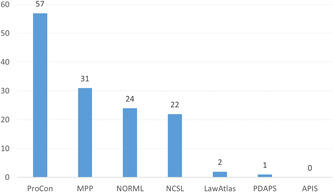
Of the 105 studies that drew upon one or more policy data source, most referenced ProCon (n = 57), an online encyclopedic resource for debatable policy issues. Special interest groups were also frequently sourced for policy data, including the Marijuana Policy Project (MPP; n = 31), National Organization for the Reform of Marijuana Laws (NORML; n = 24), and National Conference of State Legislatures (NCSL; n = 22). By comparison, academic and governmental sources were rarely referenced—including LawAtlas (n = 2), Prescription Drug Abuse Monitoring System (PDAPS; n = 1), and Alcohol Policy Information System (APIS; n = 0)—despite each source producing well‐documented cannabis policy data systems.
Outcomes
For this EGM, we recorded a total of 113 unique outcomes across five domains: attitudes and behaviors (n = 19), markets and environments (n = 11), health (n = 37), safety (n = 24), and socioeconomic outcomes (n = 22). Multiple outcomes, both within and across domains, were commonly investigated within a single study.
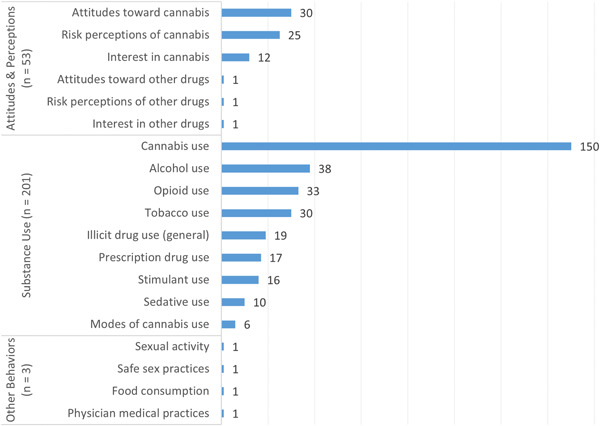
Figure 5 presents the outcome distribution of 223 primary studies that investigated specific attitudes and behaviors. Most studies in this domain (n = 201) targeted substance use outcomes generally, with cannabis use (n = 150) the single most common outcome—investigated by about four times as many studies as alcohol use (n = 38). In the attitudes/perceptions subdomain (n = 53), cannabis‐related outcomes predominated, including attitudes toward cannabis (n = 30), risk perceptions of cannabis (n = 25), and interest in cannabis (n = 12). Lastly, a catch‐all subdomain of other behaviors (e.g., sex and junk food consumption) captured four outcomes across just three studies.
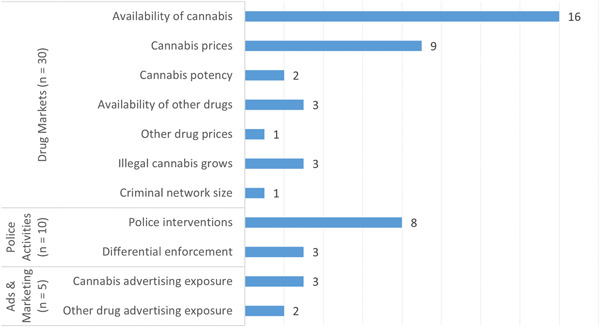
The distribution of market and environment outcomes, reported across 43 primary studies, is presented in Figure 6. Features of drug markets were most common (n = 30), including studies on the availability of cannabis (n = 16) and cannabis prices (n = 9). Police activities were the focus of 10 studies, most of which addressed specific police interventions (n = 8) such as traffic stops and contraband seizures. Lastly, just five studies researched advertising and marketing outcomes, mainly involving cannabis advertising exposure (n = 3).
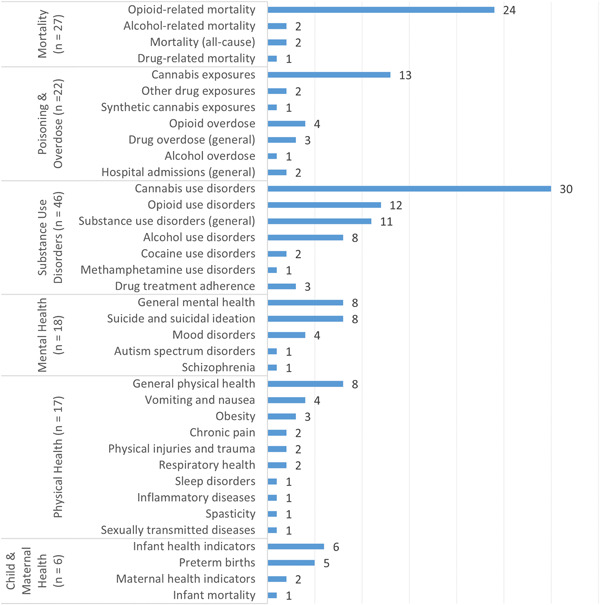
As shown in Figure 7, cannabis policy researchers have investigated more than three dozen specific health outcomes across six subdomains and 117 primary studies: substance use disorders (n = 46), mortality (n = 27), poisoning and overdose (n = 22), physical health (n = 17), mental health (n = 18), and child and maternal health (n = 6). Not surprisingly, across all health outcomes, studies commonly targeted cannabis‐specific consequences, including cannabis use disorders (n = 30) and inadvertent cannabis exposures (n = 13). Given interest in the substitutability of cannabis for opioids in the treatment of certain health conditions, investigators also regularly studied opioid‐specific outcomes, including opioid‐related mortality (n = 24), opioid use disorders (n = 12), and opioid overdose (n = 4). However, most of the specific health outcomes we recorded (23 of 37, or 62%) were backed by just three or fewer studies.
The number of studies investigating safety outcomes, presented in Figure 8, is divided into crime and justice (n = 78), roadway safety (n = 53), and workplace safety (n = 2) subdomains. Most studies on crime and justice issues focused on violent crime (n = 51), property crime (n = 42), and general drug crime (n = 27). Cannabis‐specific crimes, typically measured by cannabis arrests, were targeted less often by researchers. By comparison, other crime and criminal justice outcomes were infrequently investigated. Roadway safety studies mostly examined DUI cannabis (n = 12) and nondrug‐specific metrics of DUI (n = 12), traffic crashes (n = 10), and traffic fatalities (n = 13). Workplace safety issues, including injuries and fatalities occurring on the job, were rarely studied.
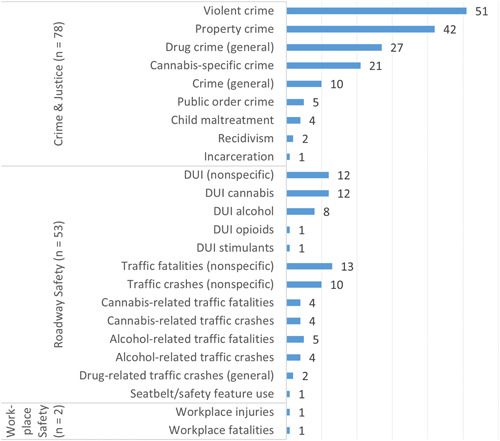
Figure 9 presents the outcome distribution of the 48 studies in the EGM that investigated socioeconomic outcomes, split across the following subdomains: business and economy (n = 22), labor market (n = 14), demographics (n = 9), healthcare and insurance (n = 7), and educational attainment (n = 6). Notably, no studies investigated environmental outcomes. The modal study in the business and economy sector addressed changes in housing values/supply (n = 8), whereas nearly every labor market study (n = 13) examined labor force participation (e.g., unemployment rate). Disability claims (n = 3), GPA/grades (n = 3), and interstate migration (n = 6) were the most common outcomes examined across the remaining three socioeconomic subdomains.
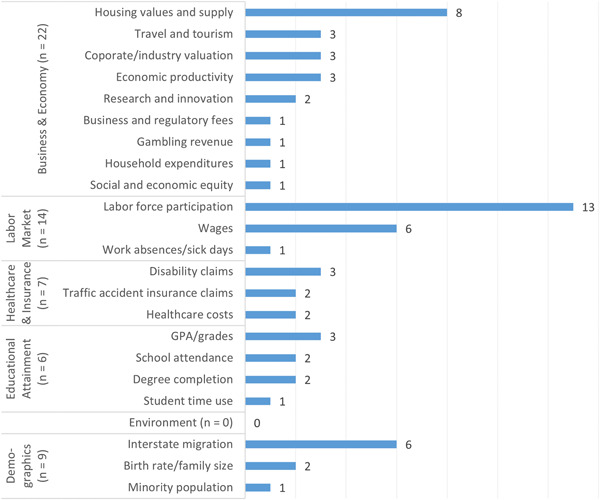
Overall, cannabis use was the most common outcome identified in this EGM, having been investigated in nearlyn two‐thirds (34%) of the included studies. More broadly, across five domains and 21 subdomains, we documented 113 distinct outcomes that have been investigated in the cannabis liberalization literature since 2004. Given that more than half (58%) the outcomes documented in this EGM were investigated by three or fewer studies, the evidence base remains overwhelmingly slim in many areas.
Outcome data sources
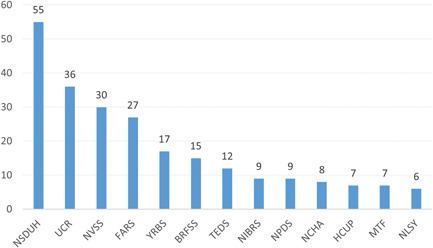
While more than half the studies in this EGM collected primary data, used proprietary data sources, or analyzed other public data, many studies operationalized key outcomes from federally sponsored US serial data collections. As shown in Figure 10, the National Survey on Drug Use and Health (NSDUH) was employed most frequently (n = 55), followed by the Uniform Crime Reports (UCR; n = 36), National Vital Statistics System (NVSS; n = 30), Fatality Analysis Reporting System (FARS; n = 27), Youth Risk Behavior Survey (YRBS; n = 17), and Behavioral Risk Factor Surveillance System (BRFSS; n = 15). The remaining data sources were used by 6–12 studies each: Treatment Episode Data Set (TEDS), National Incident‐Based Reporting System (NIBRS), Healthcare Cost and Utilization Project (HCUP), National College Health Assessment (NCHA), National Poison Data System (NPDS), Monitoring the Future (MTF), and National Longitudinal Survey of Youth (NLSY).
Target population
Figure 11 depicts 37 target populations coded for this EGM. We found the general population to be the most common reference group (n = 91), followed by criminal justice involved individuals (n = 69), high school students (n = 42), auto crash involved persons (n = 31), and decedents (n = 30). Overall, the diversity of target populations is indicative of the broad range of outcomes identified and researcher interest in understanding the indirect effects of cannabis policy (e.g., prenatal exposure among newborns and low birth weight).
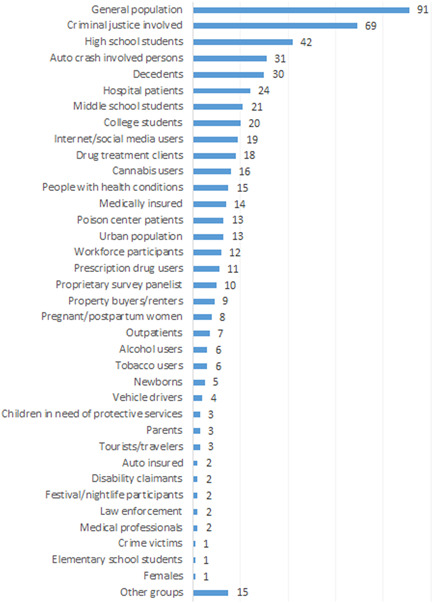
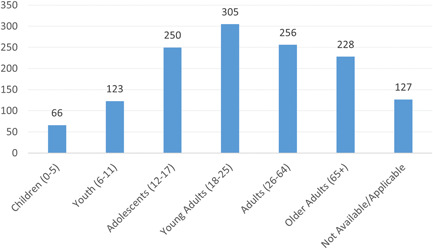
Figure 12 breaks down the target populations by age group. Most studies (n = 305) focused on the young adult (18–25) population, whereas small children (0–5) were studied least often (n = 66). For 127 studies, subject age was either not reported or not applicable.
Publication type
Most primary studies in the EGM are peer‐reviewed journal articles (n = 298), followed by undergraduate or graduate dissertations and theses (n = 85), unpublished working papers (n = 34), and conference proceedings or abstracts (n = 21).
Funding status
Most primary studies did not report funding status (n = 215). However, when this information was reported, more than four studies were funded (n = 183) for every unfunded study (n = 40).
Research design and quality appraisal
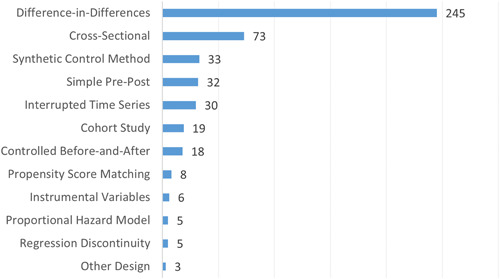
Figure 13 presents the number of primary studies by quasi‐experimental research design. Given its flexibility in estimating effects with staggered policy adoption across jurisdictions, difference‐in‐differences (DID) was the most frequently used design (n = 245) in the EGM. The ubiquity of the DID design meant it was often estimated in concert with supplementary designs. For instance, the synthetic control method was used in 33 studies, but DID was a supplemental method in 21 of these studies. After DID and SCM, the most common designs were cross‐sectional (n = 73) and simple pre‐post (n = 32), which are among the least rigorous from a causal analysis perspective. In contrast, the most methodologically sophisticated designs, including instrumental variables (n = 6) and regression discontinuity (n = 5), were rarely used in this literature.
The distribution of quality appraisals based on the SMS indicates that about one‐quarter of the studies in the EGM (n = 109) received a minimal quality appraisal and 10% (n = 44) attained a low rating. These lower‐rated studies do not support strong causal claims. Most studies in the EGM (n = 281) achieved a moderate quality appraisal, which is often considered the minimally acceptable rating for causal inference. Lastly, just a handful of studies (n = 11) earned a high quality appraisal. Although the SMS does not provide a comprehensive assessment of risk of bias, about two‐thirds (65.3%) of primary studies included in this review used designs that are causally robust.
Description of included systematic reviews
We documented seven completed and two ongoing systematic reviews in the EGM. The ongoing reviews, registered in PROSPERO, will investigate the effects of cannabis liberalization laws on health‐related outcomes (Busse, 2018) and youth attitudes, perceived risks, and cannabis‐related healthcare utilization (Stitchell, 2020). Both ongoing studies appear stalled, however, as the registered protocols have not been updated recently.
The seven completed systematic reviews are summarized in Table 6, including one rapid review (Ansari, 2020), three narrative reviews (Guttmannova, 2016; Leung, 2018; Vyas, 2018), and three reviews with meta‐analyses (Chihuri, 2019; Melchior, 2019; Sarvet, 2018). Five reviews focused on cannabis liberalization laws generally (including one that was part of a broader review of opioid interventions), whereas two targeted just MCLs. Three reviews addressed cannabis use and cannabis use disorders, three targeted opioid‐related harms, and one focused on alcohol‐related outcomes. Five reviews were delimited to the United States, one to both the United States and Canada, and one was not delimited geographically. The number of included studies ranged between 9 and 41.
Table 6: Summary of systematic reviews included in the EGM.
| Review | Review type | Review focus | Setting and window | Included studies and quality appraisala |
|---|---|---|---|---|
| Ansari et al. (2020) | Rapid review | Effects of systems‐level opioid policy interventions on opioid use, overdose, or death. MCLs and RCLs included among target interventions. | United States and Canada, January 1, 2014 through July 19, 2018 | Included 9 relevant studies. AMSTAR 2 appraisal by domain: (1) Yes, (2) No, (3) Yes, (4) No, (5) Yes, (6) Yes, (7) No, (8) Yes, (9) No, (10) No, (11) N/A, (12) N/A, (13) No, (14) No, (15) N/A, (16) Yes. Overall confidence in results: Minimal. |
| Chihuri and Li (2019) | Meta‐analysis | Effects of cannabis liberalization laws on opioid overdose, mortality, and related health outcomes. | United States, through March 15, 2019 | Included 16 studies. AMSTAR 2 appraisal by domain: (1) Yes, (2) No, (3) Yes, (4) Yes, (5) Yes, (6) Yes, (7) No, (8) Yes, (9) Partial Yes, (10) No, (11) Yes, (12), No, (13) No, (14) Yes, (15) Yes, (16) Yes. Overall confidence in results: Minimal. |
| Guttmannova et al. (2016) | Narrative review | Effects of cannabis liberalization laws, including decriminalization, on alcohol‐related outcomes. | United States, through 2015 | Included 15 studies. AMSTAR 2 appraisal by domain: (1) Yes, (2) No, (3) Yes, (4) Partial Yes, (5) No, (6) No, (7) No, (8) No, (9) No, (10) No, (11) N/A, (12) N/A, (13) No, (14) No, (15) N/A, (16) Yes. Overall confidence in results: Minimal. |
| Leung et al. (2018) | Narrative review | Effects of cannabis liberalization laws on cannabis use and cannabis use disorder. | Destrée et al., 2018 | Included 16 studies. AMSTAR 2 appraisal by domain: (1) Yes, (2) No, (3) Yes, (4) No, (5) No, (6) No, (7) No, (8) Partial Yes, (9) No, (10) Yes, (11) N/A, (12) N/A, (13) No, (14) No, (15) N/A, (16) Yes. Overall confidence in results: Minimal. Overall confidence in results: Minimal. |
| Melchior et al. (2019) | Meta‐analysis | Effects of cannabis liberalization laws on adolescent and young adult cannabis use. | Any country, through March 1, 2018 | Included 41 studies. AMSTAR 2 appraisal by domain: (1) Yes, (2) Yes, (3) Yes, (4) Partial Yes, (5) Yes, (6) No, (7) No, (8) Yes, (9) Partial Yes, (10) No, (11) Yes, (12), No, (13) Yes, (14) Yes, (15) Yes, (16) Yes, Overall confidence in results: Low. |
| Sarvet et al. (2018) | Meta‐analysis | Effects of MCLs on adolescent cannabis use. | United States, through 2014 | Included 21 studies (11 in meta‐analysis). AMSTAR 2 appraisal by domain: (1) Yes, (2) No, (3) Yes, (4) Partial Yes, (5) Yes, (6) No, (7) No, (8) Yes, (9) No, (10) No, (11) Yes, (12), No, (13) No, (14) Yes, (15) No, (16) Yes. Overall confidence in results: Low. |
| Vyas et al. (2018) | Narrative review | Effects of MCLs on prescription opioid use and opioid use disorder. | United States, 2010 through July 2017 | Included 10 studies. AMSTAR 2 appraisal by domain: (1) Yes, (2) No, (3) Yes, (4) Partial Yes, (5) No, (6) No, (7) No, (8) Yes, (9) No, (10) No, (11) N/A, (12) N/A, (13) No, (14) No, (15) N/A, (16) No. Overall confidence in results: Minimal. |
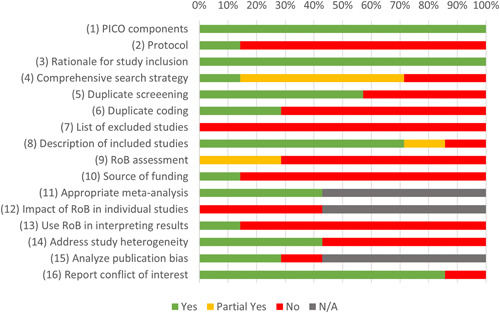
AMSTAR 2 quality appraisal domains: (1) PICO components, (2) Protocol, (3) Rationale for study inclusion, (4) Comprehensive search strategy, (5) Duplicate screening, (6) Duplicate coding, (7) List of excluded studies, (8) Description of included studies, (9) RoB assessment, (10) Source of funding, (11) Appropriate meta‐analysis, (12) Impact of RoB in individual studies, (13) Use RoB in interpreting results, (14) Address study heterogeneity, (15) Analyze publication bias, (16) Report conflict of interest.
We critically appraised the seven completed systematic reviews using AMSTAR 2 (Shea, 2017). Table 6 reports (i) domain‐level scoring for each review and (ii) an overall confidence rating based on seven critical domains per AMSTAR 2 guidance. Five reviews were rated lowest as having minimal, and two were rated marginally better as having low confidence in the results. Notably, no reviews achieved a moderate or high rating. As shown in Figure 14, common review limitations include the lack of a prespecified research protocol, implementation of a limited search strategy (two reviews queried just a single database), single study screening or coding, failure to document the source of funding or list of excluded studies, and inadequate risk of bias or effect heterogeneity assessment. The AMSTAR 2 ratings highlight the shortcomings of existing reviews, which reinforces the need for updated and well‐implemented systematic reviews and meta‐analyses.
DISCUSSION
The objectives of this EGM were to develop a conceptual framework linking cannabis liberalization policies to relevant outcomes, descriptively summarize the empirical evidence, and identify areas of evidence concentration and gaps. This section contextualizes our results by reviewing patterns observed in the literature and presenting a holistic overview of the evidence base.
Areas of evidence concentration and evidence gaps
Virtually all (98.8%) cannabis liberalization research included in this EGM focused on the impacts of MCLs (n = 273) or RCLs (n = 241). The heaviest concentration of primary MCL and RCL studies targeted substance use generally (n = 129 and 103, respectively) and cannabis use specifically (n = 91 and 80, respectively). This clustering is also reflected in the seven completed systematic reviews in the EGM: all assessed substance use outcomes, and three specifically targeted cannabis use.
While primary studies of substance use predominated, a fair degree of evidence saturation emerged across other subdomains. Moderately high concentrations of MCL studies focused on crime and justice (n = 52), substance use disorders (n = 33), attitudes and perceptions (n = 28), and roadway safety (n = 28). Likewise, we documented moderately high concentrations of primary RCL studies in the areas of crime and justice (n = 39), attitudes and perceptions (n = 36), and roadway safety (n = 35). These are areas where ongoing and future systematic review efforts are warranted.
Smaller yet meaningful aggregations of evidence on the effects of MCLs were apparent across a handful of other subdomains, including mortality (n = 20), drug markets (n = 18), mental health (n = 14), and poisoning and overdose (n = 12). Similarly, for RCLs, we observed moderately low concentrations of evidence for substance use disorders (n = 19), drug markets (n = 16), business and economy (n = 15), poisoning and overdose (n = 12), and mortality (n = 11).
In addition to general‐law studies, the EGM investigated the impact of specific cannabis policy provisions. We observed, across both MCLs and RCLs, that most policy provision studies sought to understand the effects of legal sales through retail outlets or dispensaries. Overall, the evidence from 181 dispensary studies clustered predominately in four outcome subdomains: substance use (n = 74), crime and justice (n = 39), substance use disorders (n = 21), and roadway safety (n = 20). Similarly, a smaller aggregation of 61 MCL studies that examined the effects of home cultivation, patient registries, and/or patient qualifying conditions primarily investigated substance use (n = 29) and crime and justice (n = 13) outcomes.
The EGM also highlighted major gaps in the evidence. Notably, just ten primary studies investigated the effects of cannabis laws legalizing hemp production (IHLs), medicalizing CBD products (CBDLs), or decriminalizing cannabis cultivation (DCLs). This research gap can be explained in part by the later adoption, slower diffusion, and narrower scope of these laws. Major evidence gaps were also evident for more heavily researched MCLs and RCLs. Outcome subdomains for which the combined number of primary studies on MCLs and RCLs remained relatively sparse include demographic shifts (n = 9), policing activities (n = 9), healthcare and insurance impacts (n = 7), child and maternal health (n = 6), educational attainment (n = 6), and advertising and marketing exposures (n = 5). Moreover, evidence on MCLs and RCLs was slim to nonexistent across other key subdomains: sexual activity and other behaviors (n = 3), workplace safety (n = 2), and environmental impacts (n = 0). Still, even when there was a modicum of evidence on MCLs and RCLs across certain subdomains, the number of studies addressing specific outcomes was often slim. For instance, 17 MCL/RCL studies assessed physical health concerns overall, but specific physical health maladies were investigated by just one (i.e., sexually transmitted diseases, inflammatory conditions, sleep disorders, and spasticity) or two (i.e., chronic pain, injury/trauma, and respiratory health) primary studies.
Quality of the evidence
Overall, most primary studies (65%) in the EGM were rated moderate to high quality based on the Maryland Scientific Methods Scale (Madaleno, 2016; Sherman, 2002). Studies appraised moderate to high quality are generally considered more robust for making causal claims than studies rated minimal or low quality.
Among the nine systematic reviews included in the EGM, five were rated minimal quality according to AMSTAR 2 (Shea, 2017), two were rated low quality, and two were not rated as they are technically still in progress. Notably, no systematic reviews were rated as being of moderate or high quality, suggesting a critical need for more robust syntheses of existing evidence.
Limitations of the EGM
The EGM involved an extensive search for peer‐reviewed and gray literature, screening nearly 17,000 citations. Despite this, there are several limitations to our search process. First, we included only English language studies in the EGM, which may have limited the inclusion of eligible studies from other countries. Second, we used artificial intelligence screening tools to increase screening efficiency, but it is possible that some eligible studies that we did not manually screen were erroneously excluded. Third, this is a policy area with research being published at a rapid pace, so the EGM will not capture the most recent evidence. After rerunning our original search for the recent period August 10, 2020 to August 10, 2022, we retrieved an additional 4,132 potentially relevant citations to screen. The EGM will therefore need to be updated regularly.
Although we used the SMS to assess the robustness of study designs, we did not fully assess the implementation quality of these designs. For instance, not all difference‐in‐differences studies included in the EGM are equally robust. Future evidence syntheses should enhance quality appraisal. Finally, our coding of study outcomes and target populations was purposely open‐ended to accommodate the interdisciplinary breadth of cannabis liberalization research. Accordingly, our categorization of these outcomes and target populations, although embedded within a clear conceptual framework, was not thoroughly prespecified in our protocol.
AUTHORS’ CONCLUSIONS
Across the globe, the international status quo of strict cannabis prohibition is rapidly ceding to a range of cannabis policy reforms aimed at liberalizing access to cannabis for medical and recreational purposes. This EGM provides a comprehensive summary of existing research examining the public health, community safety, and socioeconomic implications of these reforms. It highlights areas of evidence concentrations and evidence gaps to inform future research needs, including both primary studies and systematic reviews.
Implications for research and policy
The modal primary study in this EGM investigates the effects of MCLs or RCLs on substance use, namely cannabis use. In our conceptual framework, substance use is a key intermediate outcome, but more primary and systematic research is needed to better understand the effects of cannabis liberalization laws on longer‐term—and arguably more salient—health, safety, and socioeconomic outcomes. This EGM, as well as other recent conceptualizations of cannabis policy outcomes (e.g., Campeny, 2020; Daldegan‐Bueno, 2022; Lake, 2019), can assist in prioritizing such a research program. Moreover, future research might productively employ more nuanced cannabis use measures (e.g., frequency and modes of use) as mediators in research on causal mechanisms influencing ultimate outcomes.
This EGM has also highlighted the heterogeneous nature of cannabis liberalization laws. We observed a critical need for research addressing industrial hemp production, medical CBD products, and decriminalized cannabis cultivation. Most research in this policy space focused on MCL and RCL general‐law effects. To the extent that specific policy provisions were investigated, studies predominantly assessed the effects of cannabis dispensaries. Future research should prioritize understanding how other key policy provisions impact relevant outcomes. Reliance on standardized policy databases such as the Prescription Drug Abuse Monitoring System (PDAPS) and Alcohol Policy Information System (APIS) can facilitate this effort.
The existing body of research on cannabis liberalization policy is derived primarily from the United States. More research is desperately needed from other countries to diversify our understanding of these laws, as current evidence may not be generalizable to other settings.
Methodologically, cannabis policy research would greatly benefit from improvements in measurement and design aimed at enhancing causal validity and inference (Hunt, 2015). Many studies of crime and driving consequences, for instance, rely on administrative databases, such as the Uniform Crime Reports (UCR) and Fatality Analysis Reporting System (FARS), which do a poor job of measuring cannabis‐specific outcomes. As a result, researchers commonly default to operationalizing general arrest and crash outcomes instead. However, researchers are overcoming these deficiencies by using novel data systems and more advanced methods. For example, Firth et al. (Firth, 2019) used the National Incident‐Based Reporting System (NIBRS), which has certain advantages over UCR, to investigate post‐legalization changes in racial disparities in cannabis arrests in Washington state (also see Doonan, 2020). As another example, Sevigny (Sevigny, 2018) accounted for missing data in FARS by using multiple imputation to more reliably measure cannabis positivity among drivers involved in fatal crashes.
From a design perspective, we noted that most research in this area employs a difference‐in‐differences (DID) design, estimated primarily by way of two‐way fixed‐effects (TWFE). Recent advances in the econometrics of DID, however, call into serious question the validity of TWFE when policy adoption is staggered and effects are heterogeneous (Goodman‐Bacon, 2021; Roth, 2022). Since these features are common in cannabis policy research, there is a critical need for replication using alternative DID estimators that counter the potential bias inherent in the canonical TWFE implementation (e.g., Callaway, 2021; Sant’Anna, 2020; Sun, 2021). The implications of these new methods are far‐reaching, and serious scholars in the field should take note of these and related methodological innovations (e.g., Ben‐Michael, 2022; de Chaisemartin, 2020) in designing future research studies.
Despite the global proliferation of cannabis liberalization policies and the associated accumulation of empirical research, especially over the last decade, clear implications of this massive social policy experiment remain elusive. Accordingly, this EGM highlights a critical need for more robust primary studies and systematic reviews on a broader range of salient outcomes.
CONTRIBUTIONS OF AUTHORS
Eric L. Sevigny: Conceptualization; methodology; software; validation; formal analysis; investigation; resources; data curation; writing—original draft; visualization; supervision; project administration; funding acquisition. Danye N. Medhin: Software; validation; investigation; data curation; writing—review and editing. Jared Greathouse: Software; validation; formal analysis; investigation; data curation; writing—review and editing; visualization.
DECLARATIONS OF INTEREST
The authors have no vested interest in the outcomes of this EGM, nor any incentive to represent findings in a biased manner. Sevigny has published primary research in this policy area, including two studies included in this EGM. He was not involved in the coding of these studies.
PLANS FOR UPDATING THE EGM
Once published, we plan to update the EGM on a regular basis, contingent upon the availability of external funding. At present, we have rerun our systematic literature search for the period August 10, 2020 to August 10, 2022 and retrieved an additional 4132 unduplicated references for further screening and coding. The lead author will be responsible for updating the EGM.
DIFFERENCES BETWEEN PROTOCOL AND REVIEW
The protocol for this EGM was previously published (Sevigny et al., 2021). No deviations were made to study eligibility criteria or the literature search strategy. We amended the conceptual framework depicted in Figure 1 to better highlight the direct effect of legal practices on final outcomes while de‐emphasizing potential feedback between intermediate factors, which was ultimately of secondary interest for this review. In the final review, we also revised our coding guide in planned and unplanned ways. Given that our purview was explicitly open‐ended with respect to coding outcomes and target populations, we revised our coding scheme to reflect the specific categories and groups encountered in the review. However, we amended our coding of interventions. In the protocol, we listed contingent provisions under various categories (e.g., user authorization provisions, commercial supply provisions) without being explicitly nested under each parent law. In the final review, we coded specific provisions nested by policy type. Since available studies of CBDLs, IHLs, and DCLs reported only general‐law effects, we simply coded the high‐level policies. For MCLs and RCLs, we coded provisions that were relevant to each specific law. In adopting this strategy, we aggregated, dropped, or added certain provisions to simplify the coding. For instance, we merged “advertising regulations” and “product display regulations” described in the protocol into a single “product and marketing regulations” category in the final review. Similarly, we dropped provisions for “taxes” and “banking regulations” as these were never investigated in the literature and rarely, if ever, included in statutory language. And, we added codes for unanticipated policy operationalizations, namely “policy indexes” that combine multiple policy provisions into a single measure. Lastly, we did not anticipate the use of AI during study screening in the protocol because we were unaware of these tools during protocol development. However, after DistillerSR launched these tools on its platform, we decided to learn about them and use them to screen studies when conducting the final review.
SOURCES OF SUPPORT
Internal sources
- No sources of support provided
External sources
- National Institute on Drug Abuse, USA
- NIH Award No.: R03DA046806
Supplementary Materials
References
- Aalen, P. (2013). The impact of medical marijuana legalization on violent crime [Master’s thesis, University of Oslo]. http://urn.nb.no/URN:NBN:no-40676
- Examining the relationship between medical cannabis laws and cardiovascular deaths in the US.. International Journal of Drug Policy,, 2018. [DOI | PubMed]
- Utilization of prescription opioids and benzodiazepines among Arkansans with medical cannabis identification cards: A matched control study.. Value in Health,, 2020. [DOI]
- Seatbelt use as a police avoidance strategy: A test using the legality of medical marijuana.. Safety,, 2017. [DOI]
- Albino Dominic, K. (2017). The marijuana policy impact on labor productivity. Department of Economics, University of Connecticut. 10.13140/RG.2.2.13913.01125
- Albuquerque, G. T. (2016). Legalize it? The effects of California’s medical marijuana law on violent crime [Master’s thesis, Pontifícia Universidade Católica do Rio de Janeiro]. https://www.dbd.puc-rio.br/pergamum/tesesabertas/1412604_2016_completo.pdf
- Exploring the effect of Colorado’s recreational marijuana policy on opioid overdose rates.. Public Health,, 2020. [DOI | PubMed]
- Alford, C. (2014). How medical marijuana laws affect crime rates. University of Virginia.
- Alghamdi, H. (2020). Potential impact of medical marijuana laws on Hispanic high‐school students’ self‐reported use of marijuana [Doctoral dissertation, University of the Sciences in Philadelphia] [ProQuest: 27958992].
- Tobacco 21 policies in California and Hawaii and sales of cigarette packs: A difference‐in‐differences analysis.. Tobacco Control,, 2019. [DOI | PubMed]
- Trends in college students’ alcohol, nicotine, prescription opioid and other drug use after recreational marijuana legalization: 2008–2018.. Addictive Behaviors,, 2020. [DOI | PubMed]
- Trends in self‐reported and urine toxicology (UTOX)‐detected maternal marijuana use before and after legalization.. American Journal of Obstetrics and Gynecology,, 2016. [DOI]
- Three‐year retention in methadone opioid agonist treatment: A survival analysis of clients by dose, area deprivation, and availability of alcohol and cannabis outlets.. Drug & Alcohol Dependence,, 2018. [DOI | PubMed]
- Spatial access to opioid treatment program and alcohol and cannabis outlets: Analysis of missed doses of methadone during the first, second, and third 90 days of treatment.. The American Journal of Drug and Alcohol Abuse,, 2020. [DOI | PubMed]
- Cannabis effect on inpatient disease outcomes in inflammatory bowel disease among two states with marijuana legalization.. Gastroenterology,, 2020. [DOI]
- Anders, J. P. (2019). Chapter 2: Medicaid, marijuana and opioids: Identifying shocks to opioid mortality. In A. J. Paul (Ed.), The long run effects of transformational federal policies: Redlining, the affordable care act and head start (Doctoral dissertation). Texas A&M University. pp. 77–143.
- *Anders, J. P. (2019). Medicaid, marijuana and opioids: Is prescription access to blame? SSRN. 10.2139/ssrn.3247989
- Medical marijuana laws, traffic fatalities, and alcohol consumption.. Journal of Law and Economics,, 2013. [DOI]
- Anderson, D. M. , Rees Daniel, I. , & Sabia Joseph, J. (2012). High on life? Medical marijuana laws and suicide. SSRN. 10.2139/ssrn.1994343
- Medical marijuana laws and suicides by gender and age.. American Journal of Public Health,, 2014. [DOI | PubMed]
- Medical marijuana laws and teen marijuana use.. American Law & Economics Review,, 2015. [DOI]
- Medical marijuana laws and workplace fatalities in the United States.. International Journal of Drug Policy,, 2018. [DOI | PubMed]
- Association of marijuana laws with teen marijuana use: New estimates from the Youth Risk Behavior Surveys.. JAMA Pediatrics,, 2019. [DOI | PubMed]
- Challenging the association of marijuana laws with teen marijuana use‐reply.. Journal of the American Medical Association, Pediatrics,, 2019. [DOI]
- The impact of medical marijuana laws and dispensaries on self‐reported health.. Forum for Health Economics & Policy,, 2019. [DOI]
- A rapid review of the impact of systems‐level policies and interventions on population‐level outcomes related to the opioid epidemic, United States and Canada, 2014‐2018.. Public Health Reports,, 2020. [DOI | PubMed]
- Distinct but not apart? Stigma reduction and cross‐industry evaluative spillovers: The case of medical marijuana legalization.. Academy of Management Journal,, 2021. [DOI]
- Medical marijuana laws and their effect on opioid related mortality.. Economics Bulletin,, 2019
- Crash fatality rates after recreational marijuana legalization in Washington and Colorado.. American Journal of Public Health,, 2017. [DOI | PubMed]
- Fatal crashes in the 5 years after recreational marijuana legalization in Colorado and Washington.. Accident Analysis & Prevention,, 2019. [DOI | PubMed]
- Medical cannabis laws and opioid analgesic overdose mortality in the United States, 1999‐2010.. JAMA Internal Medicine,, 2014. [DOI | PubMed]
- Marijuana use trends among college students in states with and without legalization of recreational use: Initial and longer‐term changes from 2008 to 2018.. Addiction,, 2020. [DOI | PubMed]
- Is access to medical marijuana a disamenity?. Economics Bulletin,, 2017
- Recreational marijuana laws and junk food consumption.. Economics & Human Biology,, 2020. [DOI]
- Marijuana and alcohol: Evidence using border analysis and retail sales data.. Canadian Journal of Economics,, 2020. [DOI]
- Baggio, M. , Chong, A. , & Simon, D. (2018). Sex, drugs, and baby booms: Can behavior overcome biology?. NBER. 10.3386/w25208
- Sex, marijuana and baby booms.. Journal of Health Economics,, 2020. [DOI | PubMed]
- Marijuana legalization and youth marijuana, alcohol, and cigarette use and norms.. American Journal of Preventive Medicine,, 2020. [DOI | PubMed]
- Effects of recreational marijuana legalization on college students: A longitudinal study of attitudes, intentions, and use behaviors.. Journal of Adolescent Health,, 2021. [DOI]
- Medical marijuana laws and suicide.. Archives of Suicide Research,, 2019. [DOI]
- Marijuana medicalization and motor vehicle fatalities: A synthetic control group approach.. Journal of Experimental Criminology,, 2020. [DOI]
- Impact of legislation legalizing recreational marijuana sales on cannabis exposure calls to poison centers 2008‐2017.. Clinical Toxicology,, 2018. [DOI]
- The effect of marijuana commercialization on adolescent polysubstance use and treatment.. Drug & Alcohol Dependence,, 2015. [DOI]
- Marijuana use and driving under the influence among young adults: A socioecological perspective on risk factors.. Substance Use & Misuse,, 2018. [DOI | PubMed]
- Bharadwaj Radhika, N. (2019). The impact of legalization of marijuana on opioid overdose deaths [Master’s thesis, City University of New York]. https://academicworks.cuny.edu/hc_sas_etds/398
- Bhave, A. , & Murthi, B. P. S. (2021). A study of the effects of legalization of recreational marijuana on sales of cigarettes. SSRN. 10.2139/ssrn.3508422
- Biemiller Nathan, R. (2019). Chapter 3: The effect of opening recreational marijuana markets on domestic violence. In N. R. Biemiller (Ed.), Essays in behavioral economics (Doctoral dissertation, University of Oregon). pp. 42–95. ProQuest: https://www.proquest.com/docview/2307163519
- Relationships between state medical marijuana laws and college students’ use of marijuana/other drugs.. Journal of Student Affairs Research and Practice,, 2019. [DOI]
- The implications of cannabis policy changes in Washington on adolescent perception of risk, norms, attitudes, and substance use.. Substance Abuse: Research & Treatment,, 2018. [DOI]
- Bleyer, A. , & Barnes, B. (2019). Contribution of marijuana legalization to the US opioid mortality epidemic: Individual and combined experience of 27 states and District of Columbia. medRxiv. 10.1101/19007393
- Do medical marijuana centers behave like locally undesirable land uses? Implications for the geography of health and environmental justice.. Urban Geography,, 2014. [DOI]
- Smoking, vaping, eating: Is legalization impacting the way people use cannabis?. International Journal of Drug Policy,, 2016. [DOI | PubMed]
- Legal cannabis laws, home cultivation, and use of edible cannabis products: A growing relationship?. International Journal of Drug Policy,, 2017. [DOI | PubMed]
- U.S. cannabis legalization and use of vaping and edible products among youth.. Drug & Alcohol Dependence,, 2017. [DOI | PubMed]
- Borodovsky Jacob, T. (2018). Leveraging social media to rapidly assess the effects of cannabis legalization [Doctoral dissertation, Dartmouth University]. ProQuest: https://www.proquest.com/docview/2075847516/E8C9F79CAF6F467APQ
- Boxerman, R. D. (2020). The effect upon state crime rates of the legalization of recreational marijuana in California [Master’s thesis, University of Missouri‐St. Louis. https://www.researchgate.net/publication/342424627
- Medical marijuana laws reduce prescription medication use in Medicare Part D.. Health Affairs,, 2016. [DOI | PubMed]
- Medical marijuana laws may be associated with a decline in the number of prescriptions for Medicaid enrollees.. Health Affairs,, 2017. [DOI | PubMed]
- The impact of medical cannabis legalization on prescription medication use and costs under Medicare part D.. Journal of Law and Economics,, 2018. [DOI]
- Association between US state medical cannabis laws and opioid prescribing in the Medicare Part D population.. JAMA Internal Medicine,, 2018. [DOI | PubMed]
- Branson, C. M. (2019). The impact of city bans on medical marijuana dispensaries on marijuana use among high school students in Los Angeles County, California [Doctoral dissertation, UCLA]. https://escholarship.org/uc/item/2jm249z3
- Not in my backyard? Not so fast. The effect of marijuana legalization on neighborhood crime.. Regional Science and Urban Economics,, 2019. [DOI]
- Adolescent marijuana use, marijuana‐related perceptions, and use of other substances before and after initiation of retail marijuana sales in Colorado (2013–2015).. Prevention Science,, 2018. [DOI]
- Bruner, D. , Callahan, S. , & Giguere Christopher, S. (2019). Correcting for measurement error in the Uniform Crime Report with an application estimating the effects of legalizing medical marijuana on crime rates. Agricultural & Applied Economics Association Annual Meeting. https://ageconsearch.umn.edu/record/290927/files/290927.pdf
- Unintended costs of a dual regulatory environment: Evidence from state‐level cannabis legalization and bank audit fees.. Journal of Accounting and Public Policy,, 2020. [DOI]
- Multi‐center analysis of marijuana use in sexual assault patients stratified by state marijuana legalization status.. Clinical Toxicology,, 2018. [DOI]
- The effect of marijuana dispensary openings on housing prices.. Contemporary Economic Policy,, 2019. [DOI]
- The short‐run effects of marijuana dispensary openings on local crime.. Annals of Regional Science,, 2019. [DOI]
- Busse, J. , Agarwal, A. , Halladay, J. , Couban, R. , MacKillop, J. , Shergill, Y. , Emary, P. , Noor Salmi, T. , Bhatt, M. , Ng Jeremy, Y. , Giangregorio, A. , Perera, S. , & Cancelliere, C. (2018). The impact of legalizing or decriminalizing cannabis: A systematic review. PROSPERO registration. http://www.crd.york.ac.uk/PROSPERO/display_record.asp?ID=CRD42018110845
- Changes in healthcare encounter rates possibly related to cannabis or alcohol following legalization of recreational marijuana in a safety‐net hospital: An interrupted time series analysis.. Journal of Addiction Medicine,, 2019. [DOI | PubMed]
- The impact of the legalization of recreational marijuana on a safety‐net health system.. Journal of General Internal Medicine,, 2018
- An examination of relationships between cannabis legalization and fatal motor vehicle and pedestrian‐involved crashes.. Traffic Injury Prevention,, 2020. [DOI | PubMed]
- Light cannabis and organized crime: Evidence from (unintended) liberalization in Italy.. European Economic Review,, 2019. [DOI]
- Do‐It‐Yourself medicine? The impact of light cannabis liberalization on prescription drugs.. Journal of Health Economics,, 2020. [DOI | PubMed]
- Medical marijuana laws in 50 states: Investigating the relationship between state legalization of medical marijuana and marijuana use, abuse and dependence.. Drug & Alcohol Dependence,, 2012. [DOI | PubMed]
- Association of state recreational marijuana laws with adolescent marijuana use.. JAMA Pediatrics,, 2017. [DOI | PubMed]
- Medical marijuana laws and adolescent use of marijuana and other substances: Alcohol, cigarettes, prescription drugs, and other illicit drugs.. Drug & Alcohol Dependence,, 2018. [DOI | PubMed]
- Association between recreational marijuana legalization in the United States and changes in marijuana use and cannabis use disorder from 2008 to 2016.. JAMA Psychiatry,, 2020. [DOI | PubMed]
- Cannabis decriminalization and the age of onset of cannabis use.. International Journal of Drug Policy,, 2017. [DOI | PubMed]
- The effects of recreational cannabis access on the labor market: Evidence from Colorado.. IZA Journal of Labor Economics,, 2021. [DOI]
- The effects of recreational marijuana legalization and dispensing on opioid mortality.. Economic Inquiry,, 2020. [DOI]
- Going to pot? The impact of dispensary closures on crime.. Journal of Urban Economics,, 2017. [DOI | PubMed]
- Medical marijuana laws and marijuana use among U.S. adolescents: Evidence from Michigan youth risk behavior surveillance data.. Journal of Drug Education,, 2018. [DOI]
- The effect of legalizing retail marijuana on housing values: Evidence from Colorado.. Economic Inquiry,, 2018. [DOI]
- State marijuana laws and opioid overdose mortality.. Injury Epidemiology,, 2019. [DOI | PubMed]
- *Choi, A. (2015). Chapter 1: The effects of medical marijuana laws on marijuana use and other risky health behaviors. In A. Choi (Ed.), Three essays in health economics (Doctoral dissertation). Cornell University. pp. 1–48. https://conservancy.umn.edu/handle/11299/175547
- Choi, A. (2014). The impact of medical marijuana laws on marijuana use and other risky health behaviors. 5th Biennial Conference of the American Society of Health Economics. https://ashecon.confex.com/ashecon/2014/webprogram/Paper2784.html]
- Smoke gets in your eyes: Medical marijuana laws and tobacco cigarette use.. American Journal of Health Economics,, 2019. [DOI]
- Marijuana use/nonuse among those aged 50+: Comparisons of use‐to‐nonuse, initiation/reinitiation, and continued use over 24 months.. Aging & Mental Health,, 2021. [DOI | PubMed]
- The impact of state medical marijuana legislation on adolescent marijuana use.. Journal of Adolescent Health,, 2014. [DOI]
- The impact of state medical marijuana legislation on adolescent marijuana use.. Drug & Alcohol Dependence,, 2015. [DOI]
- Chu, Y.‐W. L. (2013). Chapter 1: The effects of medical marijuana laws on illegal marijuana use. In Y.‐W. L. Chu (Ed.), Essays in empirical microeconomics (Doctoral dissertation). Michigan State University (pp. 1–65).
- Chu, Y.‐W. L. (2014). Medical marijuana laws and illegal marijuana use (Doctoral dissertation). SSRN. 10.2139/ssrn.2164778
- The effects of medical marijuana laws on illegal marijuana use.. Journal of Health Economics,, 2014. [DOI | PubMed]
- Chu, Y.‐W. L. (2013). Chapter 2: Do medical marijuana laws increase hard‐drug use? In Y.‐W. L. Chu (Ed.), Essays in empirical microeconomics (Doctoral dissertation). Michigan State University. pp. 66–116.
- Do medical marijuana laws increase hard‐drug use?. Journal of Law and Economics,, 2015. [DOI]
- High times: The effect of medical marijuana laws on student time use.. Economics of Education Review,, 2018. [DOI]
- Joint culpability: The effects of medical marijuana laws on crime.. Journal of Economic Behavior & Organization,, 2019. [DOI]
- The impact of recreational marijuana commercialization on traumatic injury.. Injury Epidemiology,, 2019. [DOI | PubMed]
- The impact of recreational marijuana legislation in Washington, DC on marijuana use cognitions.. Substance Use & Misuse,, 2018. [DOI | PubMed]
- Close, N. S. (2019). Chapter 3: Interrupted time‐series analysis of marijuana exposures, 1999‐2016, Washington State. In N. S. Close (Ed.), Adverse health effects of marijuana legalization (Doctoral dissertation). University of Washington. pp. 51–65. https://digital.lib.washington.edu/researchworks/handle/1773/44809
- Close, N. S. Chapter 2: Association of marijuana policy changes with risk of marijuana‐related hospital discharges, 1994‐2016, Washington State. In N. S. Close (Ed.), Adverse health effects of marijuana legalization (Doctoral dissertation). University of Washington. pp. 31–50. https://digital.lib.washington.edu/researchworks/handle/1773/44809
- Cole, D. (2018). Recreational marijuana and traffic fatalities: Sensationalism or new safety concern [Master’s thesis, University of Montana]. https://scholarworks.umt.edu/etd/11218
- A quasi‐experimental evaluation of marijuana policies and youth marijuana use.. American Journal of Drug & Alcohol Abuse,, 2019. [DOI | PubMed]
- Contact high: The external effects of retail marijuana establishments on house prices.. Real Estate Economics,, 2017. [DOI]
- The criminogenic effect of marijuana dispensaries in Denver, Colorado: A microsynthetic control quasi‐experiment and cost‐benefit analysis.. Justice Evaluation Journal,, 2020. [DOI]
- A block‐level analysis of medical marijuana dispensaries and crime in the city of Los Angeles.. Justice Quarterly,, 2017. [DOI]
- A lottery test of the effect of dispensaries on emergency room visits in Arizona.. Health Economics,, 2020. [DOI | PubMed]
- Marijuana decriminalization, medical marijuana laws, and fatal traffic crashes in US cities, 2010–2017.. American Journal of Public Health,, 2020. [DOI | PubMed]
- The prevalence of marijuana in suspected impaired driving cases in Washington state.. Journal of Analytical Toxicology,, 2014. [DOI | PubMed]
- Czastkiewicz, M. (2020). Attitudes before and after the legalization of recreational marijuana among undergraduate students in Nevada [Master’s thesis, University of Nevada].
- Mining social media data on marijuana use for Post Traumatic Stress Disorder.. Computers in Human Behavior,, 2017. [DOI]
- Damrongplasit, K. (2007). Chapter 1: Decriminalization and marijuana smoking prevalence: Evidence from Australia. In D. Kannika (Ed.), Essays on the econometrics of program evaluation (Doctoral dissertation). University of Southern California. pp. 1–60.
- Decriminalization and marijuana smoking prevalence: Evidence from Australia.. Journal of Business and Economic Statistics,, 2010. [DOI]
- “Time for dabs”: Analyzing Twitter data on butane hash oil use.. Drug and Alcohol Dependence,, 2015. [DOI]
- “Time for dabs”: Analyzing Twitter data on marijuana concentrates across the U.S.. Drug & Alcohol Dependence,, 2015. [DOI | PubMed]
- Characterizing marijuana concentrate users: A web‐based survey.. Drug & Alcohol Dependence,, 2017. [DOI | PubMed]
- “Retweet to pass the blunt”: Analyzing geographic and content features of cannabis‐related tweeting across the United States.. Journal of Studies on Alcohol and Drugs,, 2017. [DOI | PubMed]
- DeAngelo, G. , & Redford, A. (2016). Is medical marijuana a gateway drug?: The effect of medical marijuana legalization on heroin use rates. Southern Agricultural Economics Association Annual Meeting, pp. 1–33. 10.22004/ag.econ.229981
- Does cannabis legalisation change healthcare utilisation? A population‐based study using the healthcare cost and utilisation project in Colorado, USA,. BMJ Open, 2019. [DOI]
- Association of geography and access to health care providers with long‐term prescription opioid use in Medicare patients with severe osteoarthritis: A cohort study.. Arthritis and Rheumatology,, 2019. [DOI | PubMed]
- de Silva, N. , & Torgler, B. (2011). Smoke signals and mixed messages: Medical marijuana drug policy signalling effects (CREMA Working Paper No. 2011‐18). http://hdl.handle.net/10419/214501
- Exploring the association of legalisation status of cannabis with problematic cannabis use and impulsivity in the USA.. Drugs in Context,, 2018. [DOI]
- Dickerson, S. (2018). The effects of recreational marijuana legislation on the opioid epidemic in Washington state [Undergraduate thesis, Claremont McKenna College]. http://scholarship.claremont.edu/cmc_theses/1757
- Prevalence of cannabis use in youths after legalization in Washington state.. JAMA Pediatrics,, 2019. [DOI | PubMed]
- Dills, A. K. , Goffard, S. , & Miron, J. (2017). The effects of marijuana liberalizations: Evidence from monitoring the future. NBER. 10.3386/w23779
- *Dong, X. (2020). Chapter 1: “The effect of recreational marijuana sales legalization on workplace injuries: Evidence from Oregon”. In X. Dong (Ed.), The economic impact of government regulations on marijuana and immigration (Doctoral dissertation). Syracuse University [ProQuest: 27836018]. pp. 1–61.
- Dong, X. (2019). The effect of recreational marijuana sales legalization on workplace injuries: Evidence from Oregon. Syracuse University. https://ntanet.org/wp-content/uploads/2020/02/Xiuming-Dong-Poster-Session1564_Paper3404_Presentation_1.pdf]
- Dong, X. , & Tyndall, J. (2020). Chapter 2: The impact of recreational marijuana dispensary openings on crime: Evidence from a natural experiment. In X. Dong (Ed.), The economic impact of government regulations on marijuana and immigration (Doctoral dissertation). Syracuse University [ProQuest: 27836018].
- *Dong, X. , & Tyndall, J. (2021). The impact of recreational marijuana dispensaries on crime: Evidence from a lottery experiment (University of Hawaii Economic Research Organization Working Paper No. 2021‐1). pp. 62–97. https://uhero.hawaii.edu/wp-content/uploads/2021/05/UHEROwp2101.pdf
- Donovan, I. (2020). Does access to recreational cannabis reduce opioid related deaths? [Undergraduate thesis, California Polytechnic State University]. https://www.cob.calpoly.edu/economics/wp-content/uploads/sites/27/2020/07/Donovan.pdf
- Using recreational cannabis to treat insomnia: Evidence from over‐the‐counter sleep aid sales in Colorado.. Complementary Therapies in Medicine,, 2019. [DOI]
- Crime and the legalization of recreational marijuana.. Journal of Economic Behavior and Organization,, 2019. [DOI]
- Dragone, D. , Prarolo, G. , Vanin, P. , & Zanella, G. (2016). Recreational cannabis reduces rapes and thefts: Evidence from a quasi‐experiment. SSRN. 10.2139/ssrn.2841267
- Dubov, B. (2015). Marijuana laws and overdose deaths from heroin and opioid‐based painkillers [Undergraduate thesis, The College of New Jersey].
- How does medical marijuana legalization affect the number of marijuana users? An inclusion and examination of different age groups.. The Developing Economist,, 2016
- Impact of e‐cigarette minimum legal sale age laws on current cigarette smoking.. Journal of Adolescent Health,, 2018. [DOI]
- Medical cannabis legalization and state‐level prevalence of serious mental illness in the National Survey on Drug Use and Health (NSDUH) 2008–2015.. International Review of Psychiatry,, 2018. [DOI | PubMed]
- Ehrens, B. (2012). An empirical exploration of the effects of medical marijuana laws [Undergraduate thesis, University of Puget Sound]. https://soundideas.pugetsound.edu/economics_theses/94/
- Marijuana use and driving in Washington State: Risk perceptions and behaviors before and after implementation of retail sales.. Traffic Injury Prevention,, 2019. [DOI | PubMed]
- Elboeva, O. R. (2016). Chapter 3: Medical marijuana laws and heterogeneity in youth marijuana smoking intensity. In O. R. Elboeva (Ed.), Essays in applied economics: Applications of transformed ordinal quantile regression (Doctoral dissertation). University of Tennessee, Knoxville. https://trace.tennessee.edu/utk_graddiss/3909
- Ellis, C. M. , Grace Martin, F. , Smith Rhet, A. , & Zhang, J. (2019). Marijuana de‐regulation and automobile accidents: Evidence from auto insurance. https://aei.culverhouse.ua.edu/wp-content/uploads/sites/26/2019/03/Medical_Marijuana_and_Auto_Insurance_RTS_Final.pdf
- Evaluating the effect of retail marijuana legalization on parent marijuana use frequency and norms in U.S. States with retail marijuana legalization.. Addictive Behaviors,, 2020. [DOI | PubMed]
- The impact of marijuana legalization on adolescent use, consequences, and perceived risk.. Substance Use & Misuse,, 2016. [DOI | PubMed]
- Post‐legalization opening of retail cannabis stores and adult cannabis use in Washington state, 2009–2016.. American Journal of Public Health,, 2019. [DOI | PubMed]
- Feng, B. (2017). Marijuana legalization and interest in marijuana: Evidence from Google Trends. SSRN. 10.2139/ssrn.3053263
- Fetick, J. E. (2018). Does a legal “high” lead to higher rents? An estimation of the effects of cultivation laws on Colorado industrial property values (Master’s thesis, Miami University]. http://rave.ohiolink.edu/etdc/view?acc_num=miami1532786903670889
- Exposure to marijuana marketing after legalization of retail sales: Oregonians’ experiences, 2015–2016.. American Journal of Public Health,, 2018. [DOI | PubMed]
- Medical marijuana laws and driving under the influence of marijuana and alcohol.. Addiction,, 2020. [DOI | PubMed]
- Did marijuana legalization in Washington State reduce racial disparities in adult marijuana arrests?. Substance Use & Misuse,, 2019. [DOI | PubMed]
- Implications of cannabis legalization on juvenile justice outcomes and racial disparities.. American Journal of Preventive Medicine,, 2020. [DOI | PubMed]
- Fisher, C. (2016). The effects of medical marijuana on crime rates and substance abuse in California [Undergraduate thesis, University of California, Santa Barbara]. https://escholarship.org/uc/item/4rg0g3vw
- The effect of cannabis laws on opioid use.. International Journal of Drug Policy,, 2019. [DOI | PubMed]
- Fortin, D. (2015). Cannabis cannibalization [Master’s thesis, Copenhagen Business School]. https://research.cbs.dk/en/studentProjects/bebe3ac6-dcf2-4f13-9514-b88fd756ceb1
- Examining the relationship between the physical availability of medical marijuana and marijuana use across fifty California cities.. Drug & Alcohol Dependence,, 2014. [DOI | PubMed]
- Examining the relationship between marijuana use, medical marijuana dispensaries, and abusive and neglectful parenting.. Child Abuse & Neglect,, 2015. [DOI | PubMed]
- A micro‐temporal geospatial analysis of medical marijuana dispensaries and crime in Long Beach, California.. Addiction,, 2016. [DOI | PubMed]
- Freisthler, B. , Ponicki William, R. , Gaidus, A. , & Gruenewald Paul, J. (2015). Assessing the longitudinal relationship between crime and medical marijuana dispensaries. Society for Prevention Research.
- From medical to recreational marijuana sales: Marijuana outlets and crime in an era of changing marijuana legislation.. Journal of Primary Prevention,, 2017. [DOI | PubMed]
- Opioid misuse and the availability of medical marijuana through dispensaries.. Journal of Studies on Alcohol and Drugs,, 2020. [DOI | PubMed]
- Medical marijuana dispensaries and referrals for child maltreatment investigations.. Journal of Interpersonal Violence,, 2022. [DOI | PubMed]
- Legalization of medical marijuana and marijuana use among youths.. Drugs: Education, Prevention & Policy,, 2013. [DOI | PubMed]
- Fu, W. (2015). Investigating the impact of marijuana legalization on income, education, and depression [Undergraduate thesis, Union College]. https://digitalworks.union.edu/theses/307/
- Furton, G. (2018). High crimes? The effect of marijuana legalization on crime in Colorado. SSRN. 10.2139/ssrn.3271993
- Retail availability of marijuana in Oregon counties and co‐use of alcohol and marijuana and related beliefs among adolescents.. Alcoholism: Clinical and Experimental Research,, 2019. [DOI]
- Garin, J. , Pohl, R. V. , & Smith, R. (2018). The effect of medical cannabis dispensaries on opioid and heroin overdose mortality. MPRA. https://mpra.ub.uni-muenchen.de/89613/
- Garrison, K. (2017). The effect of medical marijuana on crime rates [Undergraduate thesis, Haverford College]. http://hdl.handle.net/10066/19270
- Is legal pot crippling Mexican drug trafficking organizations? The effect of medical marijuana laws on US crime.. The Economic Journal,, 2019. [DOI]
- Medical marijuana and workers’ compensation claiming.. Health Economics,, 2020. [DOI | PubMed]
- Glowacki, K. J. (2016). Can the herb really heal the nation: The effect of medical marijuana legalization on the opioid epidemic [Undergraduate thesis, The College of Wooster]. https://openworks.wooster.edu/independentstudy/7308/
- Impact of legalization on prevalence of maternal marijuana use and obstetrical outcomes.. American Journal of Obstetrics and Gynecology,, 2019. [DOI]
- Impact of marijuana legalization on prevalence of maternal marijuana use and perinatal outcomes.. American Journal of Perinatology,, 2020. [DOI | PubMed]
- Good, A. (2015). The effect of marijuana availability on alcohol use: Evidence from marijuana legalization [Undergraduate thesis, University of Notre Dame]. https://economics.nd.edu/assets/165128/alex_good_research_paper1.pdf
- Goodman, E. M. (2017). Epidemiology of prescription opioid abuse using the RADARS® system poison‐center program data: Variation by geography, drug class, and medical marijuana legislation [Doctoral dissertation, University of Colorado]. [ProQuest: 10279006].
- The impact of plain packaging and health warnings on consumer appeal of cannabis products.. Drug & Alcohol Dependence,, 2019. [DOI]
- Prevalence and forms of cannabis use in legal vs. illegal recreational cannabis markets.. International Journal of Drug Policy,, 2020. [DOI]
- Do medical cannabis laws encourage cannabis use?. International Journal of Drug Policy,, 2007. [DOI | PubMed]
- Use of marijuana and other substances among pregnant and parenting women with substance use disorders: Changes in Washington state after marijuana legalization.. Journal of Studies on Alcohol and Drugs,, 2018. [DOI | PubMed]
- Employment and marijuana use among Washington state adolescents before and after legalization of retail marijuana.. Journal of Adolescent Health,, 2019. [DOI]
- Marijuana use and outcomes in adult and pediatric trauma patients after legalization in California.. The American Journal of Surgery,, 2019. [DOI | PubMed]
- A reexamination of medical marijuana policies in relation to suicide risk.. Drug & Alcohol Dependence,, 2015. [DOI | PubMed]
- Guo, X. , Huang, W. , & Peng, L. (2021). Medical marijuana laws and labor market outcomes: Estimates using a border discontinuity design. SSRN. 10.2139/ssrn.3580861
- Impacts of changing marijuana policies on alcohol use in the United States: Clinical and experimental research clinical and experimental research.. Alcoholism: Clinical and Experimental Research,, 2016. [DOI | PubMed]
- Hake, M. L. (2019). Marijuana legalization and traffic fatalities involving cannabinoids [Doctoral dissertation, Walden University].
- State‐level comparison of traffic fatality data in consideration of marijuana laws.. Transportation Research Record,, 2017. [DOI]
- Trends in and correlates of medical marijuana use among adults in the United States.. Drug & Alcohol Dependence,, 2018. [DOI | PubMed]
- Hansen, B. (2019). Are marijuana and alcohol substitutes? Evidence from neighboring jurisdictions. Center for Growth and Opportunity at Utah State University. https://www.thecgo.org/research/are-marijuana-and-alcohol-substitutes/
- Hansen, B. , Miller, K. , & Weber, C. (2020). Drug trafficking under partial prohibition: Evidence from recreational marijuana. NBER. 10.3386/w23762
- Federalism, partial prohibition, and cross‐border sales: Evidence from recreational marijuana.. Journal of Public Economics,, 2020. [DOI]
- Early evidence on recreational marijuana legalization and traffic fatalities.. Economic Inquiry,, 2020. [DOI]
- The cross‐border spillover effects of recreational marijuana legalization.. Economic Inquiry,, 2020. [DOI]
- Hao, Z. (2018). Chapter 3: The cross‐border spillover effects of recreational marijuana legalization. In Z. Hao (Ed.), Three essays on health economics (Doctoral dissertation). Washington State University. pp. 61–120.
- Do medical marijuana laws increase marijuana use? Replication study and extension.. Annals of Epidemiology,, 2012. [DOI | PubMed]
- Adolescent marijuana use and perceived ease of access before and after recreational marijuana implementation in Colorado.. Substance Use & Misuse,, 2018. [DOI | PubMed]
- Medical marijuana laws and adolescent marijuana use in the USA from 1991 to 2014: Results from annual, repeated cross‐sectional surveys.. The Lancet Psychiatry,, 2015. [DOI | PubMed]
- US adult illicit cannabis use, cannabis use disorder, and medical marijuana laws: 1991‐1992 to 2012‐2013.. JAMA Psychiatry,, 2017. [DOI | PubMed]
- Driving under the influence of alcohol or cannabis in the U.S., 1991‐1992 to 2012‐2013: Relationship to state medical marijuana laws.. Alcoholism: Clinical and Experimental Research,, 2017. [DOI]
- A comparison of U.S. marijuana exposures calls to poison centers in states with and without medical marijuana laws.. Drug & Alcohol Dependence,, 2014. [DOI]
- Helgesson, A. (2019). Does medical marijuana availability reduce prescription of anxiety medication and improve mental health? [Master’s thesis, Lund Universty]. https://lup.lub.lu.se/student-papers/search/publication/8980819
- Hernandez, N. A. (2015). An evaluation of the medical marijuana legislation’s (MML) impact on the crime rate of Colorado [Master’s thesis, Texas State University]. https://digital.library.txstate.edu/handle/10877/5522
- Heyman, M. (2020). Finding a way out of the weeds: The effect legalization of recreational marijuana has on unemployment and arrests—Are there any racial disparities? [Undergraduate thesis, Uppsala University]. http://uu.diva-portal.org/smash/record.jsf?pid=diva2%3A1388816&dswid=8543
- Recreational marijuana and collision claim frequencies.. HLDI Bulletin,, 2017
- Cannabis use for symptom relief in multiple sclerosis: A cross‐sectional survey of webinar attendees in the US and Canada.. Multiple Sclerosis and Related Disorders,, 2020. [DOI]
- Hohl, N. M. (2018). Medical marijuana and stigma: A causal comparative quantitative study [Doctoral dissertation, University of the Rockies] [ProQuest: 10840234].
- Hollingsworth, A. , Wing, C. , & Bradford, A. (2020). Comparative effects of recreational and medical marijuana laws on drug use among adults and adolescents. SSRN. 10.2139/ssrn.3400519
- The effect of marijuana policy on crime.. Comparative Advantage,, 2014
- Cannabis use in individuals with severe alcohol use disorders in Colorado after cannabis decriminalization.. Alcohol,, 2018. [DOI]
- The relationship of cannabis decriminalization in Colorado and cannabis use in individuals with alcohol use disorders.. Journal of Cannabis Research,, 2020. [DOI]
- Cannabis control and crime: Medicinal use, depenalization and the war on drugs. B.E.. Journal of Economic Analysis and Policy,, 2016. [DOI]
- Marijuana dispensaries and neighborhood crime and disorder in Denver, Colorado.. Justice Quarterly,, 2020. [DOI]
- The effect of cannabis legalization on the frequency of hospitalizations for cannabis hyperemesis syndrome,. Gastroenterology, 2020. [DOI]
- Early impacts of marijuana legalization: An evaluation of prices in Colorado and Washington.. Journal of Primary Prevention,, 2017. [DOI | PubMed]
- Hunt, P. , Pacula Rosalie, L. , & Weinberger, G. (2018). High on crime? Exploring the effects of marijuana dispensary laws on crime in California counties. SSRN. 10.2139/ssrn.3193321
- Isa, N. A. (2017). Legalization of recreational marijuana and its impact on economic activities [Master’s thesis, Georgetown University]. https://www.proquest.com/docview/1892809543
- The dark web and cannabis use in the United States: Evidence from a big data research design.. International Journal of Drug Policy,, 2020. [DOI]
- Jemtå, R. , & Harder, A. (2016). Medical marijuana laws and crime [Undergraduate thesis, Uppsala University. https://uu.diva-portal.org/smash/record.jsf?pid=diva2%3A1082606&dswid=3310
- Has self‐reported marijuana use changed in patients undergoing total joint arthroplasty after the legalization of marijuana?. Clinical Orthopaedics and Related Research,, 2019. [DOI | PubMed]
- The effect of marijuana on labour market outcomes: Evidence from medical marijuana laws.. Applied Economics,, 2021. [DOI]
- The design of medical marijuana laws and adolescent use and heavy use of marijuana: Analysis of 45 states from 1991 to 2011.. Drug & Alcohol Dependence,, 2017. [DOI | PubMed]
- Johnson Julie, K. (2015). Do state liberalized marijuana policies affect adolescent marijuana and alcohol use? A state‐level analysis [Doctoral dissertation, Brandeis University].
- Heterogeneity of state medical marijuana laws and adolescent recent use of alcohol and marijuana: Analysis of 45 states, 1991‐2011.. Substance Abuse,, 2018. [DOI | PubMed]
- Johnson, C. (2020). Chapter 3: Can legalization “weed” out risky behaviors? Determining whether marijuana acts as a substitute or complement. In C. Johnson (Ed.), Essays on employment growth, wage discrimination, and marijuana legalization (Doctoral dissertation). West Virginia University. pp. 62–83. https://researchrepository.wvu.edu/etd/7563
- Johnston, C. (2019). The impact of marijuana’s legalization on consumption and sale of alcohol and cigarettes: Evidence from the United States [Master’s thesis, University of Ottawa]. http://hdl.handle.net/10393/39193
- The impact of the legalization of recreational marijuana on college students.. Addictive Behaviors,, 2018. [DOI | PubMed]
- Jones, J. T. (2018). The association between medical marijuana laws and maternal marijuana use [Doctoral dissertation, Walden University]. https://www.proquest.com/docview/1886456153/DF299D26501B4071PQ/1
- Marijuana and alcohol use among injured drivers evaluated at level I trauma centers in Arizona, 2008‐2014.. Drug & Alcohol Dependence,, 2019. [DOI | PubMed]
- Short term effects of cannabis legalization in Uruguay on crime: An analysis using synthetic control.. DIEM: Dubrovnik International Economic Meeting,, 2020
- Kalbfuss, J. , Odermatt, R. , & Stutzer, A. (2018). Medical marijuana laws and mental health in the United States (CEP Discussion Papers (CEPDP1546)). https://eprints.lse.ac.uk/88697/
- Change in traffic fatality rates in the first 4 states to legalize recreational marijuana.. JAMA Internal Medicine,, 2020. [DOI | PubMed]
- Kan Emily, E. (2019). What’s law got to do with it? Comparing rates of recreational marijuana use among justice‐involved young adults after state‐wide legalization [Doctoral dissertation, UC Irvine]. https://escholarship.org/uc/item/9gr9f8vw]
- Marijuana use among justice‐involved youths after California statewide legalization, 2015–2018.. American Journal of Public Health,, 2020. [DOI | PubMed]
- Provider knowledge, attitudes, and practice regarding cannabis: Results from a national veterans health administration survey.. Pain Medicine,, 2019. [DOI]
- Kazakova, N. (2019). Marijuana legalization and suicidal ideation in Oregon mental health [Doctoral dissertation, Pacific University]. https://commons.pacificu.edu/work/sc/53863ecc-0a6a-4026-a0c0-839118d0dec1
- Exploring the ecological association between crime and medical marijuana dispensaries.. Journal of Studies on Alcohol and Drugs,, 2012. [DOI | PubMed]
- Profiles of patients who use marijuana for inflammatory bowel disease.. Digestive Diseases & Sciences,, 2018. [DOI | PubMed]
- Changes in undergraduates’ marijuana, heavy alcohol and cigarette use following legalization of recreational marijuana use in Oregon.. Addiction,, 2017. [DOI | PubMed]
- Oregon recreational marijuana legalization: Changes in undergraduates’ marijuana use rates from 2008 to 2016.. Psychology of Addictive Behaviors,, 2018. [DOI | PubMed]
- Trends and age, period and cohort effects for marijuana use prevalence in the 1984–2015 US National Alcohol Surveys.. Addiction,, 2018. [DOI | PubMed]
- Enhancing gender and ethnic representativeness of NCHA‐II data with survey weights: The examples of substance use prevalence and state marijuana legalization.. Journal of American College Health,, 2021. [DOI | PubMed]
- How does state marijuana policy affect US youth? Medical marijuana laws, marijuana use and perceived harmfulness: 1991‐2014.. Addiction,, 2016. [DOI | PubMed]
- Race/ethnicity and marijuana use in the United States: Diminishing differences in the prevalence of use, 2006‐2015.. Drug & Alcohol Dependence,, 2017. [DOI | PubMed]
- Utilizing Google Trends to measure public interest in marijuana before and after recreational legalization in California.. American Journal on Addictions,, 2019. [DOI]
- Cyclic vomiting presentations following marijuana liberalization in Colorado.. Academic Emergency Medicine,, 2015. [DOI | PubMed]
- Medical marijuana laws and annual opioid analgesic sales in the United States.. Drug and Alcohol Dependence,, 2015. [DOI]
- State medical marijuana laws and the prevalence of opioids detected among fatally injured drivers.. American Journal of Public Health,, 2016. [DOI | PubMed]
- Kim, Y. C. (2016). Chapter 3: Examining the joint use of marijuana and tobacco: The effect of medical marijuana laws and cigarette smoking among U.S. adults. In Y. C. Kim (Ed.), Harm reduction and substance use: Examining the politics and policy impacts (Doctoral dissertation). University of North Carolina at Chapel Hill. pp. 63–89. 10.17615/epwt-6d60
- Kim, Y. C. (2016). Chapter 2: Medical marijuana laws, arrest rates, and crime. In Y. C. Kim (Ed.), Harm reduction and substance use: Examining the politics and policy impacts (Doctoral dissertation). University of North Carolina at Chapel Hill. pp. 7–62. 10.17615/epwt-6d60
- Kim, J. H. (2017). Chapter 2: Medical marijuana laws and opioid overdose: A case‐control study. In J. H. Kim (Ed.), In cases of opioid overdose, do medical marijuana laws matter? A case‐control study among National Health Interview Survey participants, 1986‐2011 (Doctoral dissertation). Columbia University. pp. 28–47. https://www.proquest.com/docview/1989113172/A36507846B3347C4PQ/1
- Nonmedical use of prescription opioids and medical marijuana laws in the U.S. from 2004–2013.. Drug & Alcohol Dependence,, 2017. [DOI]
- Kim, D. , O’Connor, S. , & Norwood, B. (2020). Retail marijuana deregulation and housing prices. SSRN. 10.2139/ssrn.3537860
- Kintz, M. (2012). Smoke and mirrors? Examining the relationship between medical cannabis dispensaries and crime [Undergraduate thesis, University of California]. https://escholarship.org/uc/item/5hz9n172
- Kirsch, J. A. (2019). Chapter 3: The impact of legal cannabis on traffic fatalities: Evidence from Colorado licensing data. In J. A. Kirsch (Ed.), Evaluation of the legal cannabis industry in the United States (Doctoral dissertation). University of Colorado. pp. 63–104. https://www.proquest.com/docview/2234479145/95C52558F8DB4133PQ/1
- The effects of recreational cannabis legalization on forest management and conservation efforts in U.S. national forests in the Pacific Northwest.. Ecological Economics,, 2019. [DOI]
- Perceived prevalence of peer marijuana use: Changes among college students before and after Oregon recreational marijuana legalization.. American Journal of Drug & Alcohol Abuse,, 2019. [DOI | PubMed]
- A latent class analysis of poly‐marijuana use among young adults.. Addictive Behaviors,, 2017. [DOI | PubMed]
- Lamb John, C. (2010). Examining the impact of California’s medical marijuana program on public health [Undergraduate thesis, Claremont Mckenna College]. http://scholarship.claremont.edu/cmc_theses/40
- “Those edibles hit hard”: Exploration of Twitter data on cannabis edibles in the U.S.. Drug & Alcohol Dependence,, 2016. [DOI | PubMed]
- “You got to love rosin: solventless dabs, pure, clean, natural Medicine.” Exploring twitter data on emerging trends in Rosin Tech marijuana concentrates.. Drug & Alcohol Dependence,, 2018. [DOI | PubMed]
- Traffic fatalities within US states that have legalized recreational cannabis sales and their neighbours.. Addiction,, 2019. [DOI | PubMed]
- Density of medical marijuana dispensaries and current marijuana use among young adult marijuana users in Los Angeles.. Substance Use & Misuse,, 2019. [DOI | PubMed]
- The impact of cannabis legalization in Uruguay on adolescent cannabis use.. International Journal of Drug Policy,, 2020. [DOI | PubMed]
- Larson, R. A. , Rusko Corey, J. , & Secor Alan, E. (2015). A blunt analysis: Marijuana policy liberalization and market prices in Colorado and Washington. SSRN. 10.2139/ssrn.3776067
- The effect of medical marijuana legalization on pharmaceutical marketing to physicians.. Health Economics,, 2021. [DOI | PubMed]
- Lee, J. (2015). Chapter 3: Medical marijuana laws and crimes. In J. Lee (Ed.), Three essays in program evaluation (Doctoral dissertation). University of New York. pp. 90–133.
- Investigation of associations between marijuana law changes and marijuana‐involved fatal traffic crashes: A state‐level analysis.. Journal of Transport & Health,, 2018. [DOI]
- Is medical marijuana legalization associated with prescription drug misuse, illicit drug use, or combination of both among adults in the United States?. Journal of Drug Issues,, 2020. [DOI]
- The impact of state legalization on rates of marijuana use in pregnancy in a universal drug screening population.. Journal of Maternal‐Fetal and Neonatal Medicine,, 2022. [DOI | PubMed]
- Has the legalization of medical and recreational cannabis use in the USA affected the prevalence of cannabis use and cannabis use disorders?. Current Addiction Reports,, 2018. [DOI]
- Leung, G. (2019). The impact of medical marijuana laws on college students’ mental health, drugs substitutability, and academic outcomes. University of Kansas. https://www.semanticscholar.org/paper/The-Impact-of-Medical-Marijuana-Laws-on-College-and-Leung/68bad4d92b2c2196bbb42cd71c72a90b46103062
- Prevalence of marijuana use among adolescent trauma patients before and after legalization of medical Marijuana.. Academic Emergency Medicine,, 2019. [DOI]
- Prevalence of marijuana use among trauma patients before and after legalization of medical marijuana: The Arizona experience.. Substance Abuse,, 2021. [DOI | PubMed]
- Prevalence of marijuana use among trauma patients before and after medical marijuana became legal.. Journal of Medical Toxicology,, 2019. [DOI]
- Medical cannabis legalization and opioid prescriptions: Evidence on US Medicaid enrollees during 1993–2014.. Addiction,, 2018. [DOI | PubMed]
- The associations of neighborhood availability of marijuana dispensaries and data‐2000 waivered providers with hospital stays related to opioids.. Substance Use & Misuse,, 2019. [DOI | PubMed]
- The association between pain clinic laws and prescription opioid exposures: New evidence from multi‐state comparisons.. Drug & Alcohol Dependence,, 2020. [DOI | PubMed]
- Lin, T.‐C. , & Lin, R. (2019). Domestic violence and marijuana: Evidence from retail marijuana law. SSRN. 10.2139/ssrn.3509989
- Availability of tobacco products associated with use of marijuana cigars (blunts).. Drug & Alcohol Dependence,, 2014. [DOI | PubMed]
- Liu, A. (2019). Examining the effect of retail marijuana outlets on crime in their localities and their neighboring areas [Master’s thesis, University of Maryland]. https://www.proquest.com/docview/2303896500/37D987AD7D3C4810PQ/1
- Recreational cannabis legalization and opioid‐related deaths in Colorado, 2000‐2015.. American Journal of Public Health,, 2017. [DOI | PubMed]
- THC use and marijuana legalization do not influence chronic opioid therapy compliance.. American Journal of Clinical Pathology,, 2015. [DOI]
- Cannabis legalization does not influence patient compliance with opioid therapy.. The American Journal of Medicine,, 2019. [DOI | PubMed]
- The association between the legalization of recreational marijuana and both small for gestational age births and NICU admissions in Colorado.. Journal of Perinatology,, 2019. [DOI | PubMed]
- Prescription opioid distribution after the legalization of recreational marijuana in Colorado.. International Journal of Environmental Research and Public Health,, 2020. [DOI]
- State medical cannabis laws associated with reduction in opioid prescriptions by orthopaedic surgeons in Medicare Part D cohort.. Journal of the American Academy of Orthopaedic Surgeons,, 2021. [DOI | PubMed]
- The cannabis effect on crime: Time‐series analysis of crime in Colorado and Washington state.. Justice Quarterly,, 2019. [DOI]
- Marijuana laws: Relationships between state policy and drug and alcohol violations in on‐campus housing.. Journal of College & University Student Housing,, 2018
- Effects of state medical marijuana laws on adolescent marijuana use.. American Journal of Public Health,, 2013. [DOI | PubMed]
- *Maclean, J. C. , Ghimire Keshar, M. , & Nicholas Lauren, H. (2019). Medical marijuana laws and disability applications, receipts, and terminations. NBER https://www.nber.org/papers/w23862
- Maclean, J. C. , Ghimire Keshar, M. , & Nicholas Lauren, H. (2017). The impact of state medical marijuana laws on social security disability insurance and workers’ compensation benefit claiming. NBER. https://www.nber.org/system/files/working_papers/w23862/revisions/w23862.rev0.pdf
- Marijuana legalization and disability claiming.. Health Economics,, 2020. [DOI | PubMed]
- The impacts of marijuana dispensary density and neighborhood ecology on marijuana abuse and dependence.. Drug & Alcohol Dependence,, 2015. [DOI | PubMed]
- Marijuana legalization and crime clearance rates: Testing proponent assertions in Colorado and Washington state.. Police Quarterly,, 2019. [DOI]
- The impact of recreational marijuana sales on calls for service: An analysis of neighbouring cities.. Policing and Society,, 2021. [DOI]
- Stohr Mary, K. , Willits Dale, W. , Makin David, A. , Hemmens, C. , Lovrich Nicholas, P. , Stanton Sr Duane, L. , & Meize, M. (2020). Effects of marijuana legalization on law enforcement and crime. National Institute of Justice. https://www.ojp.gov/pdffiles1/nij/grants/255060.pdf
- Marini, N. , Mileni, P. , & Poll, L. (2020). “Puff, puff, pass”: Can spillovers from marijuana legalization solve the opioid epidemic? Toulouse School of Economics. 10.13140/rg.2.2.25121.56167
- State‐level medical marijuana laws, marijuana use and perceived availability of marijuana among the general U.S. population.. Drug & Alcohol Dependence,, 2016. [DOI | PubMed]
- Prevalence of marijuana and other substance use before and after Washington state’s change from legal medical marijuana to legal medical and nonmedical marijuana: Cohort comparisons in a sample of adolescents.. Substance Abuse,, 2016. [DOI | PubMed]
- Guenzburger, G. V. , & Masten Scott, V. (2013). Changes in driver cannabinoid prevalence associated with implementing medical marijuana laws in 14 US states. California Department of Motor Vehicles.
- Changes in driver cannabinoid prevalence in 12 U.S. states after implementing medical marijuana laws.. Journal of Safety Research,, 2014. [DOI | PubMed]
- Does perceived availability of marijuana explain changes in marijuana use after medical marijuana law implementation among U.S. adults?. Drug & Alcohol Dependence,, 2017. [DOI]
- Impact of medical marijuana laws on state‐level marijuana use by age and gender, 2004‐2013.. Prevention Science,, 2019. [DOI | PubMed]
- Mavropoulos, A. (2016). The impact of the Colorado marijuana legalization on employment and GDP growth [Master’s thesis, University of Patras]. http://hdl.handle.net/10889/9840
- State medical marijuana laws, cannabis use and cannabis use disorder among adults with elevated psychological distress.. Drug & Alcohol Dependence,, 2020. [DOI | PubMed]
- The impact of cannabis access laws on opioid prescribing.. Journal of Health Economics,, 2020. [DOI]
- McNichols, D. (2019). Chapter 3: Marijuana legalization and violent crime. In D. McNichols (Ed.), Essays in labor economics (Doctoral dissertation). University of Oregon. pp. 92–141. https://scholarsbank.uoregon.edu/xmlui/handle/1794/24875
- Do prescription drug monitoring programs encourage prescription—or illicit—opioid abuse?. Substance Abuse,, 2021. [DOI | PubMed]
- (Pot)Heads in beds: The effect of marijuana legalization on hotel occupancy in Colorado and Washington.. Journal of Regional Analysis & Policy,, 2020
- Medical marijuana laws are associated with increases in substance use treatment admissions by pregnant women.. Addiction,, 2019. [DOI | PubMed]
- Does liberalisation of cannabis policy influence levels of use in adolescents and young adults? A systematic review and meta‐analysis.. BMJ Open,, 2019. [DOI]
- Adolescent treatment admissions for marijuana following recreational legalization in Colorado and Washington.. Drug & Alcohol Dependence,, 2020. [DOI]
- Evaluation of trends in marijuana toxicosis in dogs living in a state with legalized medical marijuana: 125 dogs (2005–2010).. Journal of Veterinary Emergency and Critical Care,, 2012. [DOI | PubMed]
- Mercado Marcos, J. (2014). Do medical marijuana laws reduce crime? An empirical approach to drug enforcement policy and its effect on criminal activity [Undergraduate thesis, Universidad de San Andrés]. http://hdl.handle.net/10908/11809
- Legalization of medicinal marijuana has minimal impact on use patterns in patients with inflammatory bowel disease.. Inflammatory Bowel Diseases,, 2018. [DOI | PubMed]
- Marijuana legalization in Colorado and population‐based birth outcomes.. Reproductive Sciences,, 2020. [DOI]
- Miller, A. M. , Rosenman, R. , & Cowan, B. W. (2016). Marijuana legalization and college student use: Early evidence (working paper). School of Economic Sciences, Washington State University.
- Recreational marijuana legalization and college student use: Early evidence.. SSM—Population Health,, 2017. [DOI | PubMed]
- Miller, A. M. (Ed.). (2018). Chapter 1: Recreational Fecreational marijuana legalization and college student use: Early evidence. In On the role of psychological variables in decision making (Doctoral dissertation). Washington State University. pp. 1–31.
- Miller, T. (2019). The consequences of legalizing recreational marijuana: Evidence from Colorado and Washington [Doctoral dissertation, Purdue University] [ProQuest: 10844298].
- The effect of cannabis legalization on substance demand and tax revenues.. National Tax Journal,, 2021. [DOI]
- Mills, B. (2015). Does the legalization of medical marijuana affect state GDP growth rates? [Undergraduate thesis, Georgia College]. https://kb.gcsu.edu/src/2015/friday/108/
- Monaghan, R. (2019). Medical marijuana law implementation and marijuana enforcement [Master’s thesis, Pennsylvania State University]. https://etda.libraries.psu.edu/catalog/17206rjm486
- Monfort, S. S. (2018). Effect of recreational marijuana sales on police‐reported crashes in Colorado, Oregon, and Washington. Insurance Institute for Highway Safety. https://www.michiganautolaw.com/wp-content/uploads/2018/12/IIHS-Effect-of-recreational-marijuana-sales-on-police-reported-crashes-in-CO-OR-WA-October-2018.pdf
- Montano, A. (2019). The effects of marijuana legalization on adolescent alcohol consumption [Master’s thesis, University of Maryland]. https://www.proquest.com/docview/2315539600
- Prevalence and correlates of medical cannabis patients’ use of cannabis for recreational purposes.. Addictive Behaviors,, 2019. [DOI | PubMed]
- The effect of medical marijuana laws on crime: Evidence from state panel data, 1990‐2006.. PLoS ONE,, 2014. [DOI]
- Murray, P. L. (2012). What effect do medical marijuana laws have on illicit drug activity? [Master’s thesis, Georgetown University]. https://www.proquest.com/docview/1010985619/D451DA26B1B04F04PQ/1
- The association between legalization of cannabis use and traffic deaths in Uruguay.. Addiction,, 2020. [DOI | PubMed]
- Legalized marijuana in California: Prevalence of cannabis use in new patients now that marijuana is legal.. Journal of the American Academy of Child & Adolescent Psychiatry,, 2019. [DOI]
- Impact of recreational cannabis legalization on hospitalizations for hyperemesis.. Gastroenterology,, 2019. [DOI]
- The relationship between acute pancreatitis and cannabis use before and after recreational legalization in select states.. American Journal of Gastroenterology,, 2019. [DOI]
- Severe acute pancreatitis incidence and outcomes after cannabis legalization in two states.. Gastroenterology,, 2019. [DOI]
- Production, perceptions, and punishment: Restrictive deterrence in the context of cannabis cultivation.. International Journal of Drug Policy,, 2015. [DOI | PubMed]
- The effect of medical marijuana laws on the health and labor supply of older adults: Evidence from the health and retirement study.. Journal of Policy Analysis and Management,, 2019. [DOI | PubMed]
- Nicholas, L. H. , & Maclean, J. C. (2018). The impact of medical marijuana laws on the labor supply and health of older adults: Evidence from the health and retirement study. NBER. http://www.nber.org/papers/w22688.pdf
- Cannabis legalization, tobacco prevention policies, and cannabis use in E‐cigarettes among youth.. Drug & Alcohol Dependence,, 2020. [DOI | PubMed]
- Recreational marijuana legalization: Its effects on hotel performance.. Journal of Real Estate Literature,, 2020. [DOI]
- Marijuana exposure among United States children younger than six years old.. Clinical Toxicology,, 2015
- Marijuana exposure among children younger than six years in the United States.. Clinical Pediatrics,, 2016. [DOI | PubMed]
- Ozluk, P. (2017). The effects of medical marijuana laws on utilization of prescribed opioids and other prescription drugs. SSRN. 10.2139/ssrn.3056791
- Risks and prices: the role of user sanctions in marijuana markets.. The. B.E. Journal of Economic Analysis & Policy,, 2010. [DOI]
- Assessing the effects of medical marijuana laws on marijuana use: The devil is in the details.. Journal of Policy Analysis and Management,, 2015. [DOI | PubMed]
- Pacula, R. L. , Powell, D. , Heaton, P. , & Sevigny, E. L. (2013). Assessing the effects of medical marijuana laws on marijuana and alcohol use: The devil is in the details (NBER Working Paper Series). http://www.nber.org/papers/w19302.pdf
- The impact of medical marijuana policies on recreational use.. Journal of Substance Abuse Treatment,, 2012. [DOI]
- Distance to cannabis shops and age of onset of cannabis use.. Health Economics,, 2015. [DOI | PubMed]
- Palali, A. (2015). Chapter 4: Distance to cannabis‐shops and age of onset of cannabis use. In A. Palali (Ed.), Essays in health economics and labor economics (Doctoral dissertation). Tilburg University. pp. 107–146. https://research.tilburguniversity.edu/en/publications/essays-in-health-economics-and-labor-economics
- Recreational cannabis legalization and exposures in children: An analysis of calls to poison control centers.. Academic Emergency Medicine,, 2020. [DOI]
- Pardo, B. A. (2018). Chapter 2: Do more robust prescription drug monitoring programs reduce opioid overdose deaths?. In B. A. Pardo Bryce (Ed.), Essays on regulating pain and pleasure (Doctoral dissertation). University of Maryland. pp. 23–73. https://drum.lib.umd.edu/handle/1903/20850.
- Do more robust prescription drug monitoring programs reduce prescription opioid overdose?. Addiction,, 2017. [DOI | PubMed]
- Pardo, B. A. (Ed.). (2018). Chapter 4: Access to cannabis and its relationship with synthetic cannabis receptor agonists. In Essays on regulating pain and pleasure (Doctoral dissertation). University of Maryland. pp. 163–194. https://drum.lib.umd.edu/handle/1903/20850
- The effect of marijuana legalization on the trajectories of hard drug–related hospitalizations: A growth curve analysis of the county‐level state inpatient database in Washington, 2009–2015.. Journal of Drug Issues,, 2020. [DOI]
- Parker, M. P. (2014). State laws and county level drug activity [Master’s thesis, Georgetown University]. https://repository.library.georgetown.edu/handle/10822/709922
- Young adult marijuana use: The influence of individual differences and legalization.. Personality and Individual Differences,, 2019. [DOI]
- Reefer madness or much ado about nothing? Cannabis legalization outcomes among young adults in the United States.. International Journal of Drug Policy,, 2018. [DOI | PubMed]
- Parnes, J. E. (2016). Marijuana use impacted by legalization and individual factors [Master’s thesis, Colorado State University].
- Medical marijuana legalization and marijuana use among youth in Oregon.. Journal of Primary Prevention,, 2017. [DOI | PubMed]
- Recreational marijuana availability in Oregon and use among adolescents.. American Journal of Preventive Medicine,, 2020. [DOI | PubMed]
- High school student cannabis use and perceptions towards cannabis in southcentral Colorado—Comparing communities that permit recreational dispensaries and communities that do not.. Journal of Cannabis Research,, 2019. [DOI | PubMed]
- The effects of medical marijuana laws on birth outcomes: Evidence from early adopting U.S. states.. Economic Analysis and Policy,, 2021. [DOI]
- Pettis, R. W. (Ed.). (2020). Chapter 3: Mile high: How does marijuana legalization affect air travel? In Three essays in the economics of crime (Doctoral dissertation). University of South Carolina. pp. 56–97. https://scholarcommons.sc.edu/etd/5498
- State‐level marijuana policies and marijuana use and marijuana use disorder among a nationally representative sample of adults in the United States, 2015–2017: Sexual identity and gender matter.. Drug & Alcohol Dependence,, 2019. [DOI]
- Associations between state‐level policy liberalism, cannabis use, and cannabis use disorder from 2004 to 2012: Looking beyond medical cannabis law status.. International Journal of Drug Policy,, 2019. [DOI | PubMed]
- Medical cannabis laws and medical and non‐medical prescription stimulantuse among a nationally representative sample of US adults: Examining therole of sexual identity and gender.. International Journal of Drug Policy,, 2020. [DOI | PubMed]
- Implications of prescription drug monitoring and medical cannabis legislation on opioid overdose mortality.. Journal of Opioid Management,, 2017. [DOI | PubMed]
- A large‐scale analysis of racial disparities in police stops across the United States.. Nature Human Behaviour,, 2020. [DOI]
- Pigeon, B. (2020). The effects of legalized marijuana on teens [Doctoral dissertation, University of Colorado at Denver]. https://www.proquest.com/docview/2424986364
- The impact of adolescent exposure to medical marijuana laws on high school completion, college enrollment and college degree completion.. Drug & Alcohol Dependence,, 2016. [DOI | PubMed]
- Youth and adult arrests for cannabis possession after decriminalization and legalization of cannabis.. JAMA Pediatrics,, 2019. [DOI | PubMed]
- Pohl, R. V. (2019). Time trends matter: The case of medical cannabis laws and opioid overdose mortality. SSRN. 10.2139/ssrn.3192703
- Poteet, S. W. (Ed.). (2020). Chapter 1: Marijuana legislation and the effect on adolescents. In Essays in applied public policy and health economics (Doctoral dissertation). University of South Florida. pp. 1–49. https://scholarcommons.usf.edu/etd/8280
- Do medical marijuana laws reduce addictions and deaths related to pain killers?. Journal of Health Economics,, 2018. [DOI | PubMed]
- Cannabis legalization by states reduces illegal growing on US national forests.. Ecological Economics,, 2019. [DOI]
- Qiao, N. (Ed.). (2019). Chapter 3: The short‐term effect of legalizing recreational marijuana on employment. In Three healthcare topics: Adult children’s informal care to aging parents, working age population’s marijuana use, and indigenous adolescents’ suicidal behaviors (Doctoral dissertation). Indiana University. pp. 31–62. https://www.proquest.com/docview/2187138334/F221074D1B154B28PQ/1
- Association between cannabis laws and opioid prescriptions among privately insured adults in the US.. Journal of the American Geriatrics Society,, 2019. [DOI]
- Association between cannabis laws and opioid prescriptions among privately insured adults in the US.. Preventive Medicine,, 2019. [DOI | PubMed]
- Rashid, A. (Ed.). (2018). Chapter 3: Marijuana use and child maltreat: Evidence from medical marijuana laws. In Essays in child welfare (Doctoral dissertation). University of Oregon. pp. 52–83. https://scholarsbank.uoregon.edu/xmlui/handle/1794/23741
- Effect of cannabis legalization on US autism incidence and medium term projections.. Clinical Pediatrics,, 2019. [DOI]
- Rice, A. (2019). A blunt look at the impacts marijuana has on violent crime [Master’s thesis, University of Washington, Bothell]. http://hdl.handle.net/1773/44495
- Robinson, D. (Ed.). (2015). Chapter 4: Implications of Los Angeles, California’s medical marijuana dispensary policy: An examination of housing effects. In Three essays on non‐market valuation applications (Doctoral dissertation). Auburn University. pp. 53–94. https://etd.auburn.edu//handle/10415/4967
- The impact of cannabis legalization in Canada on adolescents’ perceptions.. Journal of Drug Issues,, 2020. [DOI]
- Marijuana use in pregnant teens before and after legalization.. Reproductive Sciences,, 2016. [DOI]
- Impact of recreational marijuana legalization on synthetic cannabinoid use.. Clinical Toxicology,, 2017. [DOI]
- Romano, J. L. (2015). A study on the effect of marijuana laws on recidivism [Undergraduate thesis, Claremont McKenna College]. http://scholarship.claremont.edu/cmc_theses/1217
- Analysis of trends in the prevalence of cannabis use and related metrics in Canada.. Health Reports,, 2019. [DOI]
- Rubin, E. A. (Ed.). (2018). Chapter 2: Are our hopes too high? Testing cannabis legalization’s potential to reduce criminalization. In Gas, weed, and fumes: Three essays in empirical environmental economics (Doctoral dissertation). University of California. pp. 63–69. https://escholarship.org/uc/item/94x1g6h1
- Cannabis advertising, promotion and branding: Differences in consumer exposure between ‘legal’ and ‘illegal’ markets in Canada and the US.. Preventive Medicine,, 2020. [DOI | PubMed]
- Rupkus, E. (2019). Compliment or substitute? Impact of marijuana legalization on alcohol consumption [Undergraduate thesis, Skidmore College]. https://creativematter.skidmore.edu/econ_studt_schol/114
- Legalization of recreational marijuana and community sales policy in Oregon: Impact on adolescent willingness and intent to use, parent use, and adolescent use.. Psychology of Addictive Behaviors,, 2018. [DOI | PubMed]
- The effect of medical marijuana laws on body weight.. Health Economics,, 2017. [DOI]
- Sabia, J. J. , Swigert, J. M. , & Young, T. (2019). Chapter 3: The effect of medical marijuana laws on body weight. In J. M. Swigert (Ed.), Three essays in economics (Doctoral dissertation). Cornell University.
- The effect of medical marijuana laws on labor market outcomes.. Journal of Law and Economics,, 2018. [DOI]
- Sanchez, T. A. (2019). Assessing the effect of recreational cannabis legalization on perceived norms of cannabis use in youth [Master’s thesis, University of British Columbia]. 10.14288/1.0386737
- Reductions in traffic fatalities rates across states with operational dispensaries of marijuana.. Drug & Alcohol Dependence,, 2017. [DOI]
- US traffic fatalities, 1985‐2014, and their relationship to medical marijuana laws.. American Journal of Public Health,, 2017. [DOI | PubMed]
- Association of recreational cannabis laws in Colorado and Washington state with changes in traffic fatalities, 2005‐2017.. JAMA Internal Medicine,, 2020. [DOI | PubMed]
- Medical marijuana laws and adolescent marijuana use in the United States: A systematic review and meta‐analysis.. Addiction,, 2018. [DOI | PubMed]
- Self‐medication of mood and anxiety disorders with marijuana: Higher in states with medical marijuana laws.. Drug & Alcohol Dependence,, 2018. [DOI | PubMed]
- Young people’s more permissive views about marijuana: Local impact of state laws or national trend?. American Journal of Public Health,, 2016. [DOI | PubMed]
- Impacts of medical marijuana laws on young Americans across the developmental spectrum.. Maternal & Child Health Journal,, 2019. [DOI | PubMed]
- Schuster, G. (2019). Medical marijuana laws and opioid overdose deaths in the United States. University of Pennsylvania Carey Law School. https://scholarship.law.upenn.edu/prize_papers/12/
- Association of US medical marijuana laws with nonmedical prescription opioid use and prescription opioid use disorder.. JAMA Network Open,, 2019. [DOI]
- The effects of medical marijuana laws on potency.. International Journal of Drug Policy,, 2014. [DOI | PubMed]
- The effects of medical marijuana laws on cannabis‐involved driving.. Accident Analysis & Prevention,, 2018. [DOI | PubMed]
- Protocol: The effects of cannabis liberalization laws on health, safety, and socioeconomic outcomes: An evidence and gap map.. Campbell Systematic Reviews,, 2021. [DOI | PubMed]
- Cannabis use prevalence among individuals with diabetes: The National Survey on Drug Use and Health, 2005–2018.. Drug & Alcohol Dependence,, 2020. [DOI | PubMed]
- Impact of medical marijuana legalization on opioid use, chronic opioid use, and high‐risk opioid use.. Journal of General Internal Medicine,, 2019. [DOI | PubMed]
- Medical marijuana and crime: Further evidence from the western states.. Journal of Drug Issues,, 2016. [DOI]
- The availability of medical marijuana dispensary and adolescent marijuana use.. Preventive Medicine,, 2016. [DOI | PubMed]
- Shi, Y. (2016). Impacts of medical marijuana policies on initiation of marijuana use: Evidence from national longitudinal surveys of youth 1997. ASHECON: 6th Biennial Conference of the American Society of Health Economists 2016. URL: https://ashecon.confex.com/ashecon/2016/webprogram/Paper3166.html
- Medical marijuana policies and hospitalizations related to marijuana and opioid pain reliever.. Drug & Alcohol Dependence,, 2017. [DOI | PubMed]
- Medical marijuana availability, price, and product variety, and adolescents’ marijuana use.. Journal of Adolescent Health,, 2018. [DOI]
- Shi, Y. , & Liang, D. (2019). Synthetic opioids should be excluded when examining the association between cannabis laws and opioid overdose mortality. SSRN. 10.2139/ssrn.3421272
- Recreational marijuana legalization and prescription opioids received by Medicaid enrollees.. Drug and Alcohol Dependence,, 2019. [DOI | PubMed]
- Associations between young adult marijuana outcomes and availability of medical marijuana dispensaries and storefront signage.. Addiction,, 2019. [DOI | PubMed]
- Maternal characteristics associated with preconception marijuana use.. American Journal of Preventive Medicine,, 2020. [DOI | PubMed]
- Association between medical cannabis laws and opioid overdose mortality has reversed over time.. Proceedings of the National Academy of Sciences of the United States of America,, 2019. [DOI | PubMed]
- Association of state policies allowing medical cannabis for opioid use disorder with dispensary marketing for this indication.. JAMA Network Open,, 2020. [DOI | PubMed]
- The association between legalization of recreational marijuana use and birth outcomes in Colorado and Washington state.. Birth Defects Research,, 2020. [DOI | PubMed]
- Recreational cannabis legalization in the US and maternal use during the preconception, prenatal, and postpartum periods.. International Journal of Environmental Research and Public Health,, 2020. [DOI]
- Smart, R. (Ed.). (2016). Chapter 3: On the health consequences of increased medical marijuana access. In Essays on the effects of medical marijuana laws (Doctoral dissertation). University of California. pp. 117–164. https://escholarship.org/uc/item/7842d9b4
- Smart, R. (Ed.). (2016). Chapter 2: The kids aren’t alright: Effects of medical marijuana market growth on marijuana use. In Essays on the effects of medical marijuana laws (Doctoral dissertation). University of California. pp. 55–116. https://escholarship.org/uc/item/7842d9b4
- Smart, R. (2015). The kids aren’t alright but older adults are just fine: Effects of medical marijuana market growth on substance use and abuse. SSRN. 10.2139/ssrn.2574915
- Smart, R. (Ed.). (2016). Chapter 1: Growing like weed: Explaining variation in medical marijuana market size. In Essays on the effects of medical marijuana laws (Doctoral dissertation). University of California. pp. 1–54. https://escholarship.org/uc/item/7842d9b4
- The effects of medical marijuana dispensaries on adverse opioid outcomes.. Economic Inquiry,, 2020. [DOI]
- Patterns of facial trauma before and after legalization of marijuana in Denver, Colorado: A joint study between two Denver hospitals.. American Journal of Emergency Medicine,, 2018. [DOI | PubMed]
- Song, S. (2019). Effects of regulation intensity on marijuana black market after legalization [Master’s thesis, Portland State University]. 10.15760/etd.6919
- The effect of marijuana legalization on jail populations in Washington state.. Prison Journal,, 2020. [DOI]
- Motor vehicle crash fatalities and undercompensated care associated with legalization of marijuana.. Journal of Trauma and Acute Care Surgery,, 2018. [DOI | PubMed]
- Stitchell, T.‐A. , Williams‐Roberts, H. , Muhajarine, N. , Engler‐Stringer, R. , Lawson, J. , Cooke, M. , & Tonita, J. (2020). Consequences of cannabis liberalization on youth populations (outcomes other than cannabis use): A systematic review. PROSPERO registration. http://www.crd.york.ac.uk/PROSPERO/display_record.asp?ID=CRD42020161184
- Effects of legal access to cannabis on scheduled II‐V drug prescriptions.. Journal of the American Medical Directors Association,, 2018. [DOI | PubMed]
- The effect of medical cannabis laws on juvenile cannabis use.. International Journal of Drug Policy,, 2016. [DOI | PubMed]
- Medical cannabis laws and juvenile cannabis use: A reply to Wall et al.. International Journal of Drug Policy,, 2016. [DOI | PubMed]
- The impact of recreational marijuana legalization on rates of use and behavior: A 10‐year comparison of two cohorts from high school to young adulthood.. Psychology of Addictive Behaviors,, 2019. [DOI | PubMed]
- Maternal marijuana use: A natural experiment from prohibition to access.. American Journal of Obstetrics and Gynecology,, 2017
- Maternal marijuana exposure and birth weight: An observational study surrounding recreational marijuana legalization.. American Journal of Perinatology,, 2021. [DOI | PubMed]
- Recreational marijuana legalization and its impact on newborn birth weight in Washington state: A retrospective study.. Annals of Epidemiology,, 2018. [DOI]
- The geography of crime and violence surrounding tobacco shops, medical marijuana dispensaries, and off‐sale alcohol outlets in a large, urban low‐income community of color.. Preventive Medicine,, 2018. [DOI | PubMed]
- Svärdhagen, G. (2019). Cannabis and cancer: Early evidence on the remedying effects of recreational marijuana laws [Master’s thesis, Lund University]. http://lup.lub.lu.se/student-papers/record/8979509
- Talmadge, C. (2014). A budding revolution or destined for flames? Determining the effects of marijuana legislation on adolescent prevalence use rates in the United States [Master’s thesis, Tufts University]. https://www.proquest.com/docview/1625969967
- Attitudes and beliefs about medical usefulness and legalization of marijuana among cancer patients in a legalized and a nonlegalized state.. Journal of Palliative Medicine,, 2019. [DOI | PubMed]
- Tefft Brian, C. , Arnold Lindsay, S. , Grabowski , & Jurek, G. (2016). Prevalence of marijuana involvement in fatal crashes: Washington, 2010–2014. AAA Foundation for Traffic Safety. https://trid.trb.org/view/1410519
- Unintentional pediatric marijuana exposures prior to and after legalization and commercial availability of recreational marijuana in Washington state.. Journal of Emergency Medicine,, 2019. [DOI | PubMed]
- Thomas, D. K. , & Tian, L. (2018). Chapter 1: The impact of recreational marijuana dispensaries on property values. In D. K. Thomas (Ed.), Essays on cannabis legalization (Doctoral dissertation). Columbia University. pp. 1–22.
- Hits from the bong: The impact of recreational marijuana dispensaries on property values.. Regional Science and Urban Economics,, 2021. [DOI]
- Todd, D. (2019). An investigation of recreational marijuana laws and traffic fatalities [Undergraduate thesis, The University of Mississippi]. https://egrove.olemiss.edu/hon_thesis/1170/
- Modes of marijuana consumption among Colorado high school students before and after the initiation of retail marijuana sales for adults.. Journal of Studies on Alcohol and Drugs,, 2019. [DOI | PubMed]
- Getting high and low prices: Marijuana dispensaries and home values.. Real Estate Economics,, 2021. [DOI]
- Ullman, D. F. (2016). Chapter 3: The effect of medical marijuana on sickness absence. In D. F. Ullman (Ed.), Three essays on public policy and health (Doctoral dissertation). University of Wisconsin‐Milwaukee. pp. 72–79. https://dc.uwm.edu/etd/1217
- The effect of medical marijuana on sickness absence.. Health Economics,, 2017. [DOI | PubMed]
- High on creativity: The impact of social liberalization policies on innovation.. Strategic Management Journal,, 2018. [DOI]
- Changes in alcohol and cigarette consumption in response to medical and recreational cannabis legalization: Evidence from U.S. state tax receipt data.. International Journal of Drug Policy,, 2020. [DOI | PubMed]
- Associations between medical cannabis and prescription opioid use in chronic pain patients: A preliminary cohort study.. PLoS One,, 2017. [DOI]
- Vijay, S. D. (2016). Chapter 2: The impact of medical marijuana laws on child maltreatment: Evidence from state panel data, 1995‐2014. In S. D. Vijay (Ed.), The impact of criminal justice interventions and social policies on family violence: Theory and evidence (Doctoral dissertation). University of South Florida. pp. 51–107. http://scholarcommons.usf.edu/etd/6599
- Vogler, J. (2017). State marijuana policies and vehicle fatalities. SSRN. 10.2139/ssrn.3013701
- The use of cannabis in response to the opioid crisis: A review of the literature.. Nursing Outlook,, 2018. [DOI | PubMed]
- Differences in patterns of cannabis use among youth: Prevalence, perceptions of harm and driving under the influence in the USA where non‐medical cannabis markets have been established, proposed and prohibited.. Drug & Alcohol Review,, 2018. [DOI | PubMed]
- Out‐of‐state cannabis purchases in the United States.. Drug & Alcohol Dependence,, 2020. [DOI | PubMed]
- Adolescent marijuana use from 2002 to 2008: Higher in states with medical marijuana laws, cause still unclear.. Annals of Epidemiology,, 2011. [DOI | PubMed]
- Prevalence of marijuana use does not differentially increase among youth after states pass medical marijuana laws: Commentary on and reanalysis of US National Survey on Drug Use in Households data 2002‐2011.. International Journal of Drug Policy,, 2016. [DOI | PubMed]
- Associations between marijuana use patterns and recreational legislation changes in a large Colorado college student sample.. Addiction Research & Theory,, 2020. [DOI]
- A note of marijuana legalization and arrest rates in the United States.. Journal of International Criminal Justice Research,, 2014
- Pediatric marijuana exposures in medical marijuana legal state.. 2012 Annual Meeting of the North American Congress of Clinical Toxicology (NACCT),, 2012. [DOI]
- Unintentional pediatric exposures to marijuana in Colorado, 2009‐2015.. JAMA Pediatrics,, 2016. [DOI]
- Increase in unintentional pediatric exposures in a recreational marijuana state.. Clinical Toxicology,, 2016. [DOI]
- Medical marijuana legalization and co‐use in adult cigarette smokers.. American Journal of Health Behavior,, 2016. [DOI | PubMed]
- Medical marijuana legalization and cigarette and marijuana co‐use in adolescents and adults.. Drug & Alcohol Dependence,, 2016. [DOI | PubMed]
- Impact of marijuana legalization in Colorado on adolescent emergency and urgent care visits.. Journal of Adolescent Health,, 2018. [DOI]
- Characterization of marijuana use in us college students by state marijuana legalization status as reported to an online survey.. The American Journal on Addictions,, 2019. [DOI | PubMed]
- Wang, J. , Pant, S. , & Yao, T. (2019). Do firms get high? The impact of marijuana legalization on firm performance, corporate innovation, and entrepreneurial activity. SSRN. https://ssrn.com/abstract=3511872
- Frontiers: Asymmetric effects of recreational cannabis legalization.. Marketing Science,, 2019. [DOI]
- The impact of marijuana legalization on law enforcement in states surrounding Colorado.. Police Quarterly,, 2019. [DOI]
- Watanabe, N. (2018). Marijuana states and impaired driving [Undergraduate thesis, University of Alaska Anchorage].
- Cannabis use among US adults with anxiety from 2008 to 2017: The role of state‐level cannabis legalization.. Drug & Alcohol Dependence,, 2020. [DOI]
- The effect of medical marijuana laws on adolescent and adult use of marijuana, alcohol, and other substances.. Journal of Health Economics,, 2015. [DOI | PubMed]
- Wen, H. , Hockenberry, J. M. , & Cummings, J. R. (2014). The effect of medical marijuana laws on marijuana, alcohol, and hard drug use. NBER. 10.3386/w20085
- Association of medical and adult‐use marijuana laws with opioid prescribing for Medicaid enrollees.. JAMA Internal Medicine,, 2018. [DOI | PubMed]
- The effect of medical marijuana laws on marijuana‐related attitude and perception among us adolescents and young adults.. Prevention Science,, 2019. [DOI | PubMed]
- White, S. (Ed.). (2019). Chapter 1: Does prescription monitoring harm patients? In Essays in health economics (Doctoral dissertation). Harvard University. pp. 4–80. https://dash.harvard.edu/handle/1/42013087
- Incidence of pediatric cannabis exposure among children and teenagers aged 0 to 19 years before and after medical marijuana legalization in Massachusetts.. JAMA Network Open,, 2019. [DOI]
- The effects of price and policy on marijuana use: What can be learned from the Australian experience?. Health Economics,, 2004. [DOI | PubMed]
- Loose regulation of medical marijuana programs associated with higher rates of adult marijuana use but not cannabis use disorder.. Addiction,, 2017. [DOI | PubMed]
- Williams, J. , Pacula, R. L. , & Smart, R. (2019). De facto or de jure? Ethnic differences in quit responses to legal protections of medical marijuana dispensaries. NBER. https://www.nber.org/papers/w25555
- Association of state marijuana legalization policies for medical and recreational use with vaping‐associated lung disease.. JAMA Network Open,, 2020. [DOI]
- Effects of medical marijuana legalization on marijuana use among adolescents and adults in the United States.. Value in Health,, 2016. [DOI]
- Medical marijuana legalization and associated illicit drug use and prescription medication misuse among adolescents in the U.S.. Addictive Behaviors,, 2019. [DOI | PubMed]
- State medical marijuana laws and associated marijuana use, attitudes, and perceived social norms among adolescents in the U.S.. Journal of Psychoactive Drugs,, 2020. [DOI | PubMed]
- Woo, Y. (2019). The effects of cannabis and the legalization of marijuana on fatal crashes in Washington state [Doctoral dissertation, Washington State University]. https://www.proquest.com/docview/2284211082/B2B61E14975C477BPQ/1.
- Access to licensed cannabis supply and the separation of markets policy in the Netherlands.. Journal of Drug Issues,, 2009. [DOI]
- Cannabis use and proximity to coffee shops in the Netherlands.. European Journal of Criminology,, 2012. [DOI]
- Getting into the weeds: Does legal marijuana access blunt academic performance in college?. Economic Inquiry,, 2020. [DOI]
- The spillover effect of recreational marijuana legalization on crime: Evidence from neighboring states of Colorado and Washington state.. Journal of Drug Issues,, 2020. [DOI]
- Xiong, H. (2019). Chapter 3: Displacement in the criminal labor market: Evidence from drug legalizations. In X. Heyu (Ed.), Essays in economic history and applied microeconomics (Doctoral dissertation). Northwestern University [ProQuest: 13883123]. pp. 130–195.
- Xiong, H. (2021). Displacement in the criminal labor market: Evidence from drug legalizations. https://intranet.weatherhead.case.edu/document-upload/docs/1665.pdf
- Yencha, C. (Ed.). (2017). Chapter 3: Legal access to recreational marijuana as a local amenity. In Three essays in real estate economics, Doctoral dissertation. West Virginia University. pp. 64–96. https://researchrepository.wvu.edu/etd/7005.
- Clearing the air: A study of cannabis‐related presentations to urban Alberta emergency departments following legalization.. Canadian Journal of Emergency Medicine,, 2020. [DOI | PubMed]
- MP03: Clearing the air: A retrospective cohort study of cannabis‐related harms in urban Alberta emergency departments following legalization. CJEM: Canadian.. Journal of Emergency Medicine,, 2020. [DOI]
- Cannabis in the emergency department: The impact of cannabis legalization on cannabis and opioid‐related presentations.. Alberta Academic Review,, 2019. [DOI]
- Yoon, H. (2014). Joint effects: How medical marijuana legalization affects state‐level marijuana use and non‐medical pain reliever use [Undergraduate thesis, Emory University]. https://etd.library.emory.edu/concern/etds/x059c754b?locale=en
- Young, A. (2019). Marijuana legalization and road safety: A panel study of US States [Master’s thesis, Kansas State University]. https://krex.k-state.edu/handle/2097/39647]
- Marijuana legalization and historical trends in marijuana use among US residents aged 12‐25: Results from the 1979‐2016 National Survey on Drug Use and Health.. BMC Public Health,, 2020. [DOI | PubMed]
- The pot rush: Is legalized marijuana a positive local amenity?. Economic Inquiry,, 2020. [DOI]
- Zanazanian, A. A. (2020). Chapter 2: Effects of recreational marijuana dispensaries on nearby retail rents. In A. A. Zanazanian (Ed.), Essays in public policy evaluation (Doctoral dissertation). University of California. https://escholarship.org/uc/item/4x49712p
- Zellmer, J. (2015). Effect of medical marijuana laws on crime and patient visits using a fixed effects model [Undergraduate thesis, University of Wisconsin‐Milwaukee]. https://dc.uwm.edu/uwsurca/2015/Poster2/70/
- Tracking dabbing using search query surveillance: A case study in the United States.. Journal of Medical Internet Research,, 2016. [DOI]
- Cannabis policy and the uptake of treatment for cannabis‐related problems.. Drug and Alcohol Review,, 2017. [DOI | PubMed]
- Effects of the 2009 medical cannabinoid legalization policy on hospital use for cannabinoid dependency and persistent vomiting.. Clinical Gastroenterology and Hepatology,, 2017. [DOI | PubMed]
- US national trend analysis of cyclic vomiting incidence with liberalization of cannabis use.. Gastroenterology,, 2017. [DOI]
- Availability of licensed cannabis businesses in relation to area deprivation in Washington state: A spatiotemporal analysis of cannabis business presence between 2014 and 2017.. Drug & Alcohol Review,, 2019. [DOI | PubMed]
- Anderson, K. C. (2019). California marijuana legalization: Community perceptions of the drug market following Proposition 64 [Doctoral dissertation, California State University, Long Beach].
- Anim, E. (2020). Investigating the relationship between marital status, state marijuana laws and marijuana use in the USA [Master’s thesis, Northern Arizona University].
- Ashworth, J. , & Goodhart, C. A. (2019). Canadian legalization of cannabis reduces both its cash usage and ‘black’ economy (CEPR Press Discussion Paper No. 13448). https://cepr.org/publications/dp13448
- Laws on medical cannabis lower opioid overdose mortality.. The Lancet Oncology,, 2014. [DOI]
- Butane hash oil burns associated with marijuana liberalization in Colorado.. Journal of Medical Toxicology,, 2015. [DOI | PubMed]
- Beltz, L. M. (2019). Recreational cannabis legalization in Washington state: Residents’ opinions and perceptions of effects five years after implementation [Doctoral dissertation, Washington State University].
- Marijuana use & liver transplant candidacy: Results from a survey of medical and surgical directors of liver transplant programs in the US.. Hepatology,, 2012. [DOI]
- Recent trends in cyclic vomiting syndrome‐associated hospitalisations with liberalisation of cannabis use in the state of Colorado.. Internal Medicine Journal,, 2019. [DOI | PubMed]
- Marijuana and college students: A critical review of the literature.. American Journal of Health Education,, 2017. [DOI]
- Medical marijuana laws: The authors reply.. Health Affairs,, 2016. [DOI]
- Bradni, N. A. (2020). Changes in the rate of reunification in the child welfare system following the legalization of marijuana [Master’s thesis, California State University, Fresno].
- Awareness, perception of risk and behaviors related to retail marijuana among a sample of Colorado youth.. Journal of Community Health,, 2017. [DOI | PubMed]
- Using wastewater‐based analysis to monitor the effects of legalized retail sales on cannabis consumption in Washington State, USA.. Addiction,, 2019. [DOI | PubMed]
- An examination of relationships between recreational cannabis legalization and alcohol purchasing.. Alcoholism: Clinical and Experimental Research,, 2020. [DOI]
- Association of state recreational marijuana laws with adolescent marijuana use: Cerda M, Wall M, Tianshu F, et al.. The Journal of Emergency Medicine,, 2017. [DOI]
- Characterization of edible marijuana product exposures reported to United States poison centers.. Clinical Toxicology,, 2016. [DOI | PubMed]
- Up in smoke? Marijuana initiation and prevalence trends in Colorado: 2008 to 2014.. Drug & Alcohol Dependence,, 2015. [DOI]
- Cattermole, C. M. (2017). Justifying the legalization of marijuana in Mendocino County California from a microeconomic perspective [Doctoral dissertation, University of Phoenix].
- Changes in post‐mortem marijuana‐positive toxicologies among youth suicide decedents, 2005–2015.. Children & Youth Services Review,, 2019. [DOI]
- Offences under the Cannabis Expiation Notice scheme in South Australia.. Drug & Alcohol Review,, 2000
- Marijuana self‐report compared with testing in trauma patients before and after legalization.. Clinical Toxicology,, 2019. [DOI | PubMed]
- Support for marijuana legalization and predictors of intentions to use marijuana more often in response to legalization among U.S. young adults.. Substance Use & Misuse,, 2017. [DOI | PubMed]
- Colonna, R. (2019). Cannabis legalization and driving: Exploring young Ontarians’ knowledge, perceptions and attitudes [Master’s thesis, The University of Western Ontario].
- Therapeutic value of medical marijuana in New Jersey patients: A community partnership research endeavor.. Journal of Allied Health,, 2017. [PubMed]
- The status of support for cannabis regulation in Uruguay 4 years after reform: Evidence from public opinion surveys.. Drug and Alcohol Review,, 2018. [DOI | PubMed]
- Medical marijuana certification for patients with sickle cell disease: A survey study of patient’s use and preferences.. Blood Advances,, 2018. [DOI]
- Gateway to curiosity: Medical marijuana ads and intention and use during middle school.. Psychology of Addictive Behaviors,, 2015. [DOI | PubMed]
- Planting the seed for marijuana use: Changes in exposure to medical marijuana advertising and subsequent adolescent marijuana use, cognitions, and consequences over seven years.. Drug & Alcohol Dependence,, 2018. [DOI | PubMed]
- Decriminalization policy and marijuana smoking prevalence: A look at the literature.. Singapore Economic Review,, 2009. [DOI]
- Hospital discharges for marijuana dependence over time in Colorado.. Drug & Alcohol Dependence,, 2015. [DOI]
- Public health effects of medical marijuana legalization in Colorado.. American Journal of Preventive Medicine,, 2016. [DOI | PubMed]
- de Barros, P. H. M. V. The effect of marijuana legalization on crime in the Colorado. Pontifical Catholic University of Rio de Janeiro 2016.
- Diaby, V. , Sanogo, V. , Xiao, H. , Zhong, X. , Dykes, J. , & Judson, C. (2018). Economic impact of the passage of the medical marijuana law in the state of Florida. SSRN. 10.2139/ssrn.3265254
- The effects of partial decriminalisation on cannabis use in South Australia, 1985 to 1993.. Australian Journal of Public Health,, 1995. [DOI | PubMed]
- The development of the use of cannabis in The Netherlands, some European countries and the United States since 1969.. Tijdschrift voor Alcohol, Drugs en Andere Psychotrope Stoffen,, 1989
- ‘Impact of e‐cigarette minimum legal sale age laws on current cigarette smoking’: Corrigendum.. Journal of Adolescent Health,, 2018. [DOI]
- Opioid prescriptions decreased in US states where marijuana was legally accessible.. BMJ,, 2018. [DOI]
- Ela, M. F. B. (2018). Legalization of recreational marijuana in Canada: Implications from provinces’ price difference [Master’s thesis, University of Ottawa].
- Ellison, J. M. , & Spohn, R. E. (2015). Colorado’s legalization of medicinal marijuana: The effects on Nebraska’s law enforcement and local jail system [University of Nebraska at Omaha]. https://digitalcommons.unomaha.edu/ncjrreports/3/]
- Borders up in smoke: Marijuana enforcement in Nebraska after Colorado’s legalization of medicinal marijuana.. Criminal Justice Policy Review,, 2017. [DOI]
- Fiscal and health effects of US marijuana legislation at the state level.. The Journal of Social, Political, and Economic Studies,, 2020
- Escudero, M. M. (2019). Essays on the Industrial Organization of Newly Legalized Markets [Doctoral dissertation, Northwestern University].
- Farley, E. J. , & Orchowsky, S. (2019). Measuring the criminal justice system impacts of marijuana legalization and decriminalization using state data. NCJRS. https://www.ojp.gov/pdffiles1/nij/grants/253137.pdf
- Consumer perceptions of ‘legal’ and ‘illegal’ cannabis in US states with legal cannabis sales.. Addictive Behaviors,, 2021. [DOI]
- Community attitudes towards cannabis law and the proposed cannabis infringement notice scheme in western Australia.. Drug & Alcohol Review,, 2005. [DOI | PubMed]
- Fisher, G. M. (2017). The legalization of marijuana and the impact of marijuana use on college students [Doctoral dissertation, St. Thomas University].
- Evaluating medical marijuana dispensary policies: Spatial methods for the study of environmentally‐based interventions.. American Journal of Community Psychology,, 2013. [DOI | PubMed]
- Cigarillo sales in legalized marijuana markets in the U.S.. Drug & Alcohol Dependence,, 2018. [DOI | PubMed]
- Retail cannabis prices in California through legalization, regulation and taxation.. California Agriculture,, 2019. [DOI]
- International differences in patterns of cannabis use among adult cigarette smokers: Findings from the 2018 ITC four country smoking and vaping survey.. International Journal of Drug Policy,, 2020. [DOI]
- ‘A reexamination of medical marijuana policies in relation to suicide risk’: Erratum.. Drug and Alcohol Dependence,, 2015. [DOI | PubMed]
- Effect of reclassification of cannabis on hospital admissions for cannabis psychosis: A time series analysis.. International Journal of Drug Policy,, 2014. [DOI | PubMed]
- Evaluating the impacts of cannabis legalization: The International Cannabis Policy Study.. International Journal of Drug Policy,, 2020. [DOI]
- Taxing the potency of sin goods: Evidence from recreational cannabis and liquor markets.. National Tax Journal,, 2020. [DOI]
- Harris, E. (2020). Cannabidiol (CBD) effects on state opioid death rates (2010–2015) [Doctoral dissertation, New England College of Business].
- Hartman, M. , Sreeram, P. , & Wilson, M. G. (2017). Rapid synthesis: Identifying the impacts of cannabis legalization on youth, and the responses that can be taken by public institutions. McMaster University.
- US epidemiology of cannabis use and associated problems.. Neuropsychopharmacology,, 2018. [DOI | PubMed]
- Legalization of medical marijuana and incidence of opioid mortality.. Journal of the American Medical Association, Internal Medicine,, 2014. [DOI | PubMed]
- Hollingsworth, A. , Wing, C. , & Bradford, A. (2019). Comparative effects of recreational and medical marijuana laws on drug use among adults and adolescents. SSRN. 10.2139/ssrn.3400519
- A logistic regression extension for the randomized response simple and crossed models: Theoretical results and empirical evidence.. Sociological Methods & Research,, 2022. [DOI]
- The impact of recreational cannabis legalization on all‐cause hospitalizations and acute cardiovascular event hospitalizations in Colorado.. Circulation,, 2020. [DOI]
- Race/ethnicity differences in trends of marijuana, cigarette, and alcohol use among 8th, 10th, and 12th graders in Washington state, 2004‐2016.. Prevention Science,, 2019. [DOI | PubMed]
- Parents’ perceptions of adolescent exposure to marijuana following legalization in Washington state.. Journal of the Society for Social Work and Research,, 2020. [DOI | PubMed]
- Kansagara, D. , O’Neil, M. , Nugent, S. , Freeman, M. , Low, A. , Kondo, K. , Elven, C. , Zakher, B. , Motu’apuaka, M. , Paynter, R. , & Morasco, B. J. (2017). Benefits and harms of cannabis in chronic pain or post‐traumatic stress disorder: A systematic review. Department of Veterans Affairs. 10.1086/707642
- Kaplan, J. D. , & Eschker, E. (2018). Estimating the costs and benefits from legalization and regulation of adult‐use and medical manufactured cannabis products in California. 2018 Agricultural & Applied Economics Association Annual Meeting.
- The impact of marijuana legalization on vehicular trauma.. Cureus,, 2018. [DOI]
- Changes in undergraduates’ marijuana, heavy alcohol and cigarette use following legalization of recreational marijuana use in Oregon.. Addiction., 2017. [DOI]
- Survey estimates of changes in alcohol use patterns following the 2012 privatization of the Washington liquor monopoly.. Alcohol and Alcoholism,, 2018. [DOI | PubMed]
- Khatapoush, S. (2002). Medical marijuana policy in California: Is it an environmental risk factor for youth young adult substance use? [Doctoral dissertation, Brandeis University].
- “Sending the wrong message”: Did medical marijuana legalization in California change attitudes about and use of marijuana?. Journal of Drug Issues,, 2004. [DOI]
- Colorado cannabis legalization and its effect on emergency care.. Annals of Emergency Medicine,, 2016. [DOI | PubMed]
- Dissociation between the growing opioid demands and drug policy directions among the U.S. older adults with degenerative joint diseases.. Medicine,, 2019. [DOI]
- Dutch coffee shops and trends in cannabis use.. Addictive Behaviors,, 2002. [DOI | PubMed]
- Marijuana legalization and parents’ attitudes, use, and parenting in Washington state.. Journal of Adolescent Health,, 2016. [DOI]
- Risk perception, access, and use of marijuana among young adults following legalization in Washington state.. Alcoholism: Clinical and Experimental Research,, 2015. [DOI]
- The relationship between medical marijuana commercialization and adolescent substance treatment outcomes.. American Journal on Addictions,, 2017. [DOI]
- Marijuana commercialization and adolescent substance treatment outcomes in Colorado.. The American Journal on Addictions,, 2017. [DOI | PubMed]
- Li, Y. , & Palma, M. A. (2017). Investigating the effects of the medical marijuana laws on high school graduation. Agricultural & Applied Economics Association Annual Meeting.
- RETRACTED: Investigating the effects of medical marijuana laws on educational attainment.. Economics Letters,, 2018. [DOI]
- Impacts of marijuana commercialization on adolescents’ marijuana beliefs, use, and co‐use with other substances.. Journal of Adolescent Health,, 2018. [DOI]
- Cannabis hypersensitivity prevalence and presentation—A survey‐based study of an allergic adult population in a Toronto clinic at onset of Canadian legalization of recreational marijuana.. Journal of Allergy and Clinical Immunology,, 2020. [DOI]
- Evaluating alternative cannabis regimes.. The British Journal of Psychiatry,, 2001. [DOI | PubMed]
- The implications of marijuana decriminalization and legalization on crime in the United States.. Contemporary Drug Problems,, 2017. [DOI]
- The effect of medical marijuana laws on extralegal marijuana prices.. Atlantic Economic Journal,, 2013. [DOI]
- Marie, O. , & Zölitz, U. (2015). “High” achievers? Cannabis access and student performance. London School of Economics. https://eric.ed.gov/?id=ED558043
- “High” achievers? Cannabis access and academic performance.. Review of Economic Studies,, 2017. [DOI]
- Washington state recreational marijuana legalization: Parent and adolescent perceptions, knowledge, and discussions in a sample of low‐income families.. Substance Use & Misuse,, 2015. [DOI | PubMed]
- ‘Correct knowledge of medical cannabis legal status in one’s own state: Differences between adolescents and adults in the United States, 2004‐2013’: Corrigendum.. Addictive Behaviors,, 2019. [DOI | PubMed]
- Correct knowledge of medical cannabis legal status in one’s own state: Differences between adolescents and adults in the United States, 2004‐2013.. Addictive Behaviors,, 2019. [DOI | PubMed]
- What do we know now about the impact of the laws related to marijuana?. Journal of Addiction Medicine,, 2016. [DOI | PubMed]
- Effects of cannabis decriminalization in the Australian Capital Territory on university students’ patterns of use.. Journal of Drug Issues,, 1997. [DOI]
- The relationship between marijuana laws and teen usage in Oregon.. Journal of the American Academy of Child & Adolescent Psychiatry,, 2017. [DOI]
- Maternal marijuana exposure by self‐report and umbilical cord sampling in a state with legalization.. American Journal of Obstetrics and Gynecology,, 2018. [DOI]
- Prenatal marijuana use by self‐report and umbilical cord sampling in a state with marijuana legalization.. Obstetrics and Gynecology,, 2019. [DOI | PubMed]
- Has cannabis use among youth increased after changes in its legal status? A commentary on use of monitoring the future for analyses of changes in state cannabis laws.. Prevention Science,, 2020. [DOI | PubMed]
- Exploring the impact of medical marijuana laws on the validity of self‐reported marijuana use among juvenile arrestees over time.. Criminal Justice Policy Review,, 2012. [DOI]
- Mills, K. L. , Light, J. M. , Rusby, J. C. , & Westling, E. (2019). Diffusion of adolescent marijuana use in school environments following recreational legalization. PsyArXiv. 10.31234/osf.io/hbz7x
- A nationwide survey of pharmacy students’ knowledge and perceptions regarding medical cannabis.. Journal of the American Pharmacists Association,, 2020. [DOI | PubMed]
- Moonen, K. P. (2019). The Dutch answer to drug tourism within southern Dutch municipalities an assessment of the 2012 revised drug policy. Tohoku University. http://hdl.handle.net/10097/00126432
- What is the effect of the legalization of marijuana on prescription opioid‐related adverse events?. Evidence‐Based Practice,, 2018. [DOI]
- Marijuana experiences, voting behaviors, and early perspectives regarding marijuana legalization among college students from 2 states.. Journal of American College Health,, 2016. [DOI | PubMed]
- The economic geography of medical marijuana dispensaries in California.. International Journal of Drug Policy,, 2014. [DOI | PubMed]
- Neener, M. C. (2016). Assessing the cannabis legalization debate: Lessons learned from the Colorado and Washington experiment [Master’s thesis, Naval Postgraduate School]. http://hdl.handle.net/10945/48573
- Anh, N. , Quang, H. , Hung, N. , Dong, N. , & Evaluating, T. T. (2017). Marijuana‐related tweets on Twitter. 2017 IEEE 7th Annual Computing and Communication Workshop and Conference.
- The impact of state laws on motor vehicle fatality rates, 1999‐2015.. Journal of Trauma and Acute Care Surgery,, 2020. [DOI | PubMed]
- Tightening the Dutch coffee shop policy: Evaluation of the private club and the residence criterion.. International Journal of Drug Policy,, 2016. [DOI | PubMed]
- Marijuana and alcohol use: Lessons from liberalization of marijuana policies.. Alcoholism: Clinical and Experimental Research,, 2015. [DOI]
- In the weeds: A baseline view of cannabis use among legalizing states and their neighbours.. Addiction,, 2016. [DOI | PubMed]
- Medical marijuana and marijuana legalization.. Annual Review of Clinical Psychology,, 2017. [DOI]
- Marijuana legalization and unintentional pediatric exposures.. NEJM Journal Watch. Emergency Medicine., 2014
- The protective behavioral strategies for marijuana scale: Further examination using item response theory.. Psychology of Addictive Behaviors,, 2017. [DOI | PubMed]
- Cannabis use among patients at a comprehensive cancer center in a state with legalized medicinal and recreational use.. Cancer,, 2017. [DOI | PubMed]
- High society: Washington state’s recreational cannabis law and its effects on child custody and visitation rights.. Seattle Journal for Social Justice,, 2015
- Poore, J. A. (2016). Effects of the legalization of recreational cannabis in Washington state [Undergraduate thesis, University of Washington, Tacoma]. https://digitalcommons.tacoma.uw.edu/gh_theses/42/
- Ramirez, A. , Berning, A. , Carr, K. , Scherer, M. , Lacey, J. H. , Kelley‐Baker, T. , & Fisher, D. A. (2016). Marijuana, other drugs, and alcohol use by drivers in Washington State. National Highway Traffic Safety Administration. https://rosap.ntl.bts.gov/view/dot/1977
- Raschzok, A. , Adam, C. , & Knill, C. (2014). The impact of cannabis regulation on cannabis consumption in Europe. 5th Regulatory Governance Conference.
- Refsland, E. L. (2018). The effect of marijuana legalization on small bank competitive advantages [Master’s thesis, Montana State University‐Bozeman]. https://scholarworks.montana.edu/xmlui/handle/1/14581
- National estimates of marijuana‐related poison center calls.. Clinical Toxicology,, 2019. [DOI]
- Unintentional cannabis ingestion in children: A systematic review.. The Journal of Pediatrics,, 2017. [DOI | PubMed]
- Trends in detection rates of risky marijuana use in Colorado health care settings,. Substance Abuse, 2013. [DOI | PubMed]
- Comparative policy analysis for alcohol and drugs: Current state of the field.. International Journal of Drug Policy,, 2016. [DOI | PubMed]
- Associations between marijuana use and anxious mood lability during adolescence.. Addictive Behaviors,, 2019. [DOI | PubMed]
- Russell, J. G. (2017). Comparing optimal government enforcement expenditures in a pre‐and post‐legalization marijuana market [Master’s thesis, Southern Illinois University Carbondale]. https://opensiuc.lib.siu.edu/gs_rp/816/
- Does the legalization of medical marijuana increase completed suicide?. American Journal of Drug & Alcohol Abuse,, 2014. [DOI | PubMed]
- Corrigendum to “Trends in fatal motor vehicle crashes before and after marijuana commercialization in Colorado”.. Drug & Alcohol Dependence,, 2014. [DOI]
- Trends in fatal motor vehicle crashes before and after marijuana commercialization in Colorado.. Drug & Alcohol Dependence,, 2014. [DOI | PubMed]
- Characteristics of Canadians likely to try or increase cannabis use following legalization for nonmedical purposes: A cross‐sectional study.. CMAJ Open,, 2019. [DOI]
- Is the legalization of marijuana associated with its use by adolescents?. Substance Use & Misuse,, 2017. [DOI | PubMed]
- Temporal trends in marijuana attitudes, availability and use in Colorado compared to non‐medical marijuana states: 2003–11.. Drug & Alcohol Dependence,, 2014. [DOI | PubMed]
- Sen, A. , & Wyonch, R. (2018). Cannabis countdown: Estimating the size of illegal markets and lost tax revenue post‐legalization. SSRN. 10.2139/ssrn.3269989
- Cannabis liberalization and adolescent cannabis use: A cross‐national study in 38 countries.. PLoS ONE,, 2015. [DOI]
- Availability of medical and recreational marijuana stores and neighborhood characteristics in Colorado.. Journal of Addiction,, 2016. [DOI]
- Cross‐national comparison of adolescent drinking and cannabis use in the United States, Canada, and the Netherlands.. International Journal of Drug Policy,, 2010. [DOI | PubMed]
- The impact of decriminalization on marijuana and alcohol consumption in Jamaica.. Health Policy and Planning,, 2019. [DOI]
- Medical marijuana legalization and increased trend of cannabis poisonings in Thailand.. Clinical Toxicology,, 2020. [DOI]
- Is policy ‘liberalization’ associated with higher odds of adolescent cannabis use? A re‐analysis of data from 38 countries.. International Journal of Drug Policy,, 2019. [DOI | PubMed]
- Adolescent cannabis use and perceived social norm trends pre‐ and post‐implementation of Washington state’s liberalized recreational cannabis policy: Healthy Youth Survey, 2008–2018.. Prevention Science,, 2020. [DOI | PubMed]
- Marijuana policy opinions in Washington state since legalization: Would voters vote the same way?. Contemporary Drug Problems,, 2016. [DOI | PubMed]
- A non‐linear relationship between cannabis use and alcohol outcomes among individuals treated for alcohol use disorder?. Clinical and Experimental Research,, 2019. [DOI]
- Subgroup trends in alcohol and cannabis co‐use and related harms during the rollout of recreational cannabis legalization in Washington state.. International Journal of Drug Policy,, 2020. [DOI]
- Tabb, L. P. , Fillmore, C. , & Melly, S. (2018). Location, location, location: Assessing the spatial patterning between marijuana licenses, alcohol outlets and neighborhood characteristics within Washington state. Drug & Alcohol Dependence, 185, 214–218 10.1016/j.drugalcdep.2018.01.004 29471225
- Unintentional pediatric marijuana exposures at a tertiary care children’s hospital in Washington state: A retrospective review.. Pediatric Emergency Care,, 2018. [DOI]
- Thomas, D. K. (2018). Essays on cannabis legalization [Doctoral dissertation, Columbia University].
- Prevalence of marijuana‐related traffic on Twitter, 2012‐2013: A content analysis.. CyberPsychology, Behavior & Social Networking,, 2015. [DOI | PubMed]
- Medical cannabis in Arizona: Patient characteristics, perceptions, and impressions of medical cannabis legalization.. Journal of Psychoactive Drugs,, 2015. [DOI | PubMed]
- Truckor, G. , & Lynch, S. (2013). Effects of legalization of marijuana on anti‐money laundering compliance [Master’s thesis, Utica College].
- Greater risk for frequent marijuana use and problems among young adult marijuana users with a medical marijuana card.. Drug & Alcohol Dependence,, 2019. [DOI | PubMed]
- Perceived ease of access and age attenuate the association between marijuana ad exposure and marijuana use in adolescents.. Health Education and Behavior,, 2020. [DOI | PubMed]
- Tzen, M. (2012). A study of crimes near marijuana dispensaries through a slew of modern statistical approaches [Doctoral dissertation, University of California, Los Angeles].
- Marijuana use and related health care encounters in Colorado before and after retail legalization.. International Journal of Mental Health & Addiction,, 2018. [DOI]
- International differences in patterns of cannabis use among youth: Prevalence, perceptions of harm, and driving under the influence in Canada, England & United States.. Addictive Behaviors,, 2019. [DOI | PubMed]
- The impact of marijuana legalization on reversible cerebral vasoconstriction syndrome.. Neurology,, 2016
- Commentary on Harper S, Strumpf EC, Kaufman JS. Do medical marijuana laws increase marijuana use? Replication study and extension.. Annals of Epidemiology,, 2012. [DOI | PubMed]
- Association of unintentional pediatric exposures with decriminalization of marijuana in the United States.. Annals of Emergency Medicine,, 2014. [DOI | PubMed]
- Marijuana and acute health care contacts in Colorado.. Preventive Medicine,, 2017. [DOI | PubMed]
- Marijuana legalization and adolescent health.. Journal of Adolescent Health,, 2018. [DOI]
- ‘The effect of medical marijuana laws on marijuana‐related attitude and perception among US adolescents and young adults’: Addendum.. Prevention Science,, 2019. [DOI | PubMed]
- Wenner, G. A. (2018). Marijuana‐tourism: Disruptive innovation for small island developing states [Doctoral dissertation, University of Maryland].
- Differences in the educational needs and clinical experiences of residents based on legalization of medical marijuana.. Journal of the American Academy of Child & Adolescent Psychiatry,, 2018. [DOI]
- Felony legislation and the shifting epidemiology of butane hash oil burns.. Journal of Burn Care and Research,, 2019. [DOI]
- Does liberalizing cannabis laws increase cannabis use?. Journal of Health Economics,, 2014. [DOI | PubMed]
- Wilson, D. T. (2018). Recreational marijuana: Exploring attitudes of Colorado police about department policies and colleagues [Doctoral dissertation, Capella University].
- US interstate underground trade flow: A gravity model approach.. Review of Law and Economics,, 2017. [DOI]
- Parental views on state cannabis laws and marijuana use for their medically vulnerable children.. Drug & Alcohol Dependence,, 2019. [DOI | PubMed]
- Clearing the air: A study of cannabis‐related presentations to urban Alberta emergency departments following legalization. Canadian. Journal of Emergency Medicine,, 2019. [DOI]
- Cannabis in the capital: Exploring the spatial association between medical marijuana dispensaries and crime.. Journal of Crime & Justice,, 2020. [DOI]
- Incidental finding of age and time disorientation in a clinical sample of patients with schizophrenia: Findings from a short term follow up survey regarding cannabis use.. Psychiatry Research,, 2020. [DOI | PubMed]
- A review of the impact of marijuana’s legalization on Colorado’s industrial warehouse lease rates: How high is high?. Journal of Real Estate Literature,, 2017. [DOI]
- The public health concerns of marijuana legalization: An overview of current trends.. Cureus,, 2019. [DOI]
- Bagwell, G. (2016). Medical marijuana legalization, marijuana use and obesity in US school‐aged youth. 6th Biennial Conference of the American Society of Health Economists.
- Burton, A. M. (2012). The side effects of medical marijuana: The impact of legalization on marijuana and alcohol consumption (Undergraduate honors thesis). https://digitalcommons.colby.edu/honorstheses/665/
- Furton, G. L. (2019). The political economy of reform [Doctoral dissertation, Texas Tech University].
- Nwogwugwu, S. I. (2017). Psychosocial correlates of marijuana use in adolescents and young adults [PhD, Social Work].
- Park, Y. , Huang, T.‐Y. , Moyo, P. , Tom, S. , & Simoni‐Wastila, L. (2015). Medical marijuana laws and young adults’ perceptions and use of marijuana a retrospective, cross‐sectional study of the 2013 National Survey of Drug Use and Health. AcademyHealth 2015 Annual Research Meeting 2015.
- Rubin, E. (2018). Are our hopes too high? Testing cannabis legalization’s potential to reduce criminalization (working paper). https://ssrn.com/abstract=3330294
- Singleton, D. (2009). The impact of California’s medical marijuana law on criminal offenses: A study of Los Angeles [Undergraduate thesis, Occidental College].
- Tuan, A. , Wilsterman, A. , Curtis, R. , & Ohri, G. (2015). The effects of marijuana legalization on high school graduation and school suspension rates (Undergraduate paper). https://digitalcommons.colby.edu/clas/2015/program/9/
- Additional References
- Current legal status of medical marijuana and cannabidiol in the United States.. Epilepsy & Behavior,, 2020. [PubMed]
- A rapid review of the impact of systems‐level policies and interventions on population‐level outcomes related to the opioid epidemic, United States and Canada, 2014–2018.. Public Health Reports,, 2020. [PubMed]
- Distinct but not apart? Stigma reduction and cross‐industry evaluative spillovers: The case of medical marijuana legalization.. Academy of Management Journal., 2020
- Belackova, V. , van, deV. K. , & Roubalova, M. (2020). “More than just counting the plants”: Different home cannabis cultivation policies, cannabis supply contexts and approaches to their evaluation. In T. Decorte , S. Lenton , & C. Wilkins (Eds.), Legalizing cannabis: Experiences, lessons and scenarios (pp. 154–179). Routledge.
- Synthetic controls with staggered adoption.. Journal of the Royal Statistical Society: Series B (Statistical Methodology),, 2022
- De‐duplication of database search results for systematic reviews in EndNote.. Journal of the Medical Library Association,, 2016. [PubMed]
- Bubola, E. (2021). Malta becomes First E.U. country to legalize marijuana. The New York Times.
- Burris, S. , Wagenaar, A. C. , Swanson, J. W. , Ibrahim, J. K. , Wood, J. , & Mello, M. M. (2013). A framework for public health law research. In A. C. Wagenaar , & S. Burris (Eds.), Public health law research: Theory and methods. Jossey‐Bass.
- A transdisciplinary approach to public health law: The emerging practice of legal epidemiology.. Annual Review of Public Health,, 2016
- Busse, J. , Agarwal, A. , Halladay, J. , Couban, R. , MacKillop, J. , Shergill, Y. , Emary, P. , Noor, S. T. , Bhatt, M. , Ng, J. Y. , Giangregorio, A. , Perera, S. , & Cancelliere, C. (2018). The impact of legalizing or decriminalizing cannabis: A systematic review. 1–4.
- Quasi‐experimental study designs series—paper 7: Assessing the assumptions.. Journal of Clinical Epidemiology,, 2017. [PubMed]
- Sant’Anna Pedro HC. Difference‐in‐Differences with multiple time periods.. Journal of Econometrics,, 2021
- The blind men and the elephant: Systematic review of systematic reviews of cannabis use related health harms.. European Neuropsychopharmacology,, 2020. [PubMed]
- Light cannabis and organized crime: Evidence from (unintended) liberalization in Italy.. European Economic Review,, 2019
- Do‐It‐Yourself medicine? The impact of light cannabis liberalization on prescription drugs.. Journal of Health Economics,, 2020. [PubMed]
- Cannabis decriminalization and the age of onset of cannabis use.. International Journal of Drug Policy,, 2017. [PubMed]
- State marijuana laws and opioid overdose mortality.. Injury Epidemiology,, 2019. [PubMed]
- Clearing the haze: The complexities and challenges of research on state marijuana laws.. Annals of the New York Academy of Sciences,, 2017. [PubMed]
- Conceptualizing and considering cannabis‐related “harm‐to‐others”: The role of cannabis‐related violence.. Substance Use & Misuse., 2022
- Decriminalization and marijuana smoking prevalence: Evidence from Australia.. Journal of Business and Economic Statistics,, 2010
- de Chaisemartin, C. , & D’Haultfoeuille, X. (2020). Two‐way fxed effects regressions with several treatments. https://www.sciencedirect.com/science/article/pii/S0304407623001963
- Regulating Cannabis Social Clubs: A comparative analysis of legal and self‐regulatory practices in Spain, Belgium and Uruguay.. International Journal of Drug Policy,, 2017. [PubMed]
- Decorte, T. , Lenton, S. , & Wilkins, C. (2020). Legalizing cannabis: Experiences, lessons and scenarios. Routledge.
- EPPI‐Mapper, Version 2.1.0 [Computer program] . (2022). Digital Solution Foundry and EPPI‐Centre. EPPI‐Centre, UCL Social Research Institute, University College London.
- Using the National Incident‐Based Reporting System (NIBRS) to examine racial and ethnic disparities in cannabis incidents.. The American Journal of Drug and Alcohol Abuse,, 2020. [PubMed]
- DistillerSR [Computer program] . (2022). Evidence Partners.
- Did marijuana legalization in Washington state reduce racial disparities in adult marijuana arrests?. Substance Use & Misuse,, 2019. [PubMed]
- Assessing the public health impact of cannabis legalization in Canada: Core outcome indicators towards an ‘index’ for monitoring and evaluation.. Journal of Public Health,, 2018
- Fischer, B. , Russell, C. , & Boyd, N. (2020). A century of cannabis control in Canada: A brief overview of history, contexts and policy frameworks from history to legalization. In T. Decorte , S. Lenton , & C. Wilkins (Eds.), Legalizing cannabis: Experiences, lessons and scenarios (pp. 89–115). Routledge.
- Is legal pot crippling Mexican drug trafficking organizations? The effect of medical marijuana laws on US crime.. The Economic Journal,, 2019
- The impact of plain packaging and health warnings on consumer appeal of cannabis products.. Drug & Alcohol Dependence,, 2019
- Difference‐in‐differences with variation in treatment timing.. Journal of Econometrics,, 2021
- Do medical cannabis laws encourage cannabis use?. International Journal of Drug Policy,, 2007. [PubMed]
- Impacts of changing marijuana policies on alcohol use in the United States: Clinical and experimental research clinical and experimental research.. Alcoholism: Clinical and Experimental Research,, 2016. [PubMed]
- An evaluation of DistillerSR’s machine learning‐based prioritization tool for title/abstract screening–impact on reviewer‐relevant outcomes.. BMC Medical Research Methodology,, 2020
- Harrell, M. B. , Clendennen, S. L. , Sumbe, A. , Case, K. R. , Mantey, D. S. , & Swan, S. (2022). Cannabis vaping among youth and young adults: A scoping review. Current Addiction Reports, 9, 217–234.
- A systematic review of factors associated with illegal drug driving.. Accident Analysis & Prevention,, 2022. [PubMed]
- Cannabis use for symptom relief in multiple sclerosis: A cross‐sectional survey of webinar attendees in the US and Canada.. Multiple Sclerosis and Related Disorders., 2020
- Hunt, P. E. , & Miles, J. (2015). The impact of legalizing and regulating weed: Issues with study design and emerging findings in the USA. In S. Nielsen , R. Bruno , & S. Schenk (Eds.), Non‐Medical and illicit use of psychoactive drugs (Vol. 34, pp. 173–198). Springer.
- Short term effects of cannabis legalization in Uruguay on crime: An analysis using synthetic control.. Dubrovnik International Economic Meeting,, 2020
- Short term effects of cannabis legalization in Uruguay on crime: An analysis using synthetic control.. Dubrovnik International Economic Meeting,, 2020
- Mapping medical marijuana: State laws regulating patients, product safety, supply chains and dispensaries.. Addiction,, 2017. [PubMed]
- The new cannabis policy taxonomy on APIS: Making sense of the cannabis policy universe.. The Journal of Primary Prevention,, 2017. [PubMed]
- Korf, D. J. (2020). Coffeeshops in the Netherlands: Regulating the front door and the back door. In T. Decorte , S. Lenton , & C. Wilkins (Eds.), Legalizing cannabis (pp. 285–306). Legalizing cannabis: Experiences, lessons and scenarios. Routledge.
- A systematic review and narrative synthesis of the evolution of adolescent and young adult cannabis consumption before and after legalization.. Journal of Adolescent Health,, 2022
- Guidelines for public health and safety metrics to evaluate the potential harms and benefits of cannabis regulation in Canada.. Drug and Alcohol Review,, 2019. [PubMed]
- Traffic fatalities within US states that have legalized recreational cannabis sales and their neighbours.. Addiction,, 2019. [PubMed]
- The impact of cannabis legalization in Uruguay on adolescent cannabis use.. International Journal of Drug Policy,, 2020. [PubMed]
- Has the legalization of medical and recreational cannabis use in the USA affected the prevalence of cannabis use and cannabis use disorders?. Current Addiction Reports,, 2018
- A typology of systematic reviews for synthesising evidence on health care.. Gerodontology,, 2019. [PubMed]
- Madaleno, M. , & Waights, S. (2016). Guide to scoring methods using the Maryland Scientific Methods Scale. What Works Centre for Local Economic Growth. https://whatworksgrowth.org/wp‐content/uploads/16‐06‐28_Scoring_Guide.pdf
- Maslov, A. , Lawrence, A. , & Ferguson, M. (2016). Cannabis performance metrics for policy consideration: What do we need to measure?. Public Safety Canada.
- Access to cannabidiol without a prescription: A cross‐country comparison and analysis.. International Journal of Drug Policy,, 2020. [PubMed]
- Does liberalisation of cannabis policy influence levels of use in adolescents and young adults? A systematic review and meta‐analysis.. BMJ Open,, 2019
- What is an evidence map? A systematic review of published evidence maps and their definitions, methods, and products.. Systematic Reviews,, 2016. [PubMed]
- The association between legalization of cannabis use and traffic deaths in Uruguay.. Addiction,, 2020. [PubMed]
- The shifting landscape of cannabis legalization: Potential benefits and regulatory perspectives.. Journal of Consumer Affairs,, 2021
- Don’t make a hash of it! A thematic review of the literature relating to outcomes of cannabis regulatory change.. Drugs: Education, Prevention and Policy,, 2021
- Is legalization of recreational cannabis associated with levels of use and cannabis use disorder among youth in the United States? A rapid systematic review.. European Child & Adolescent Psychiatry. (Unpublished)., 2022. [DOI]
- Evidence maps and evidence gaps: evidence review mapping as a method for collating and appraising evidence reviews to inform research and policy.. Environmental Evidence,, 2017
- Natural experiments in a complex and dynamic environment: The need for a measured assessment of the evidence.. Journal of Policy Analysis and Management,, 2014. [PubMed]
- Medical marijuana and marijuana legalization.. Annual Review of Clinical Psychology,, 2017
- Relationships of cannabis policy liberalization with alcohol use and co‐use with cannabis: A narrative review.. Alcohol Research: Current Reviews,, 2022
- Implications of prescription drug monitoring and medical cannabis legislation on opioid overdose mortality.. Journal of Opioid Management,, 2017. [PubMed]
- Cannabis legalization by states reduces illegal growing on US national forests.. Ecological Economics,, 2019
- Queirolo, R. (2020). Uruguay: The first country to legalize cannabis. In T. Decorte , S. Lenton , & C. Wilkins (Eds.), Legalizing cannabis: Experiences, lessons and scenarios (pp. 116–129). Routledge.
- Quasi‐experimental study designs series—paper 5: A checklist for classifying studies evaluating the effects on health interventions—a taxonomy without labels.. Journal of Clinical Epidemiology,, 2017. [PubMed]
- Medical marijuana. What can we learn from the experiences in Canada, Germany and Thailand?. International Journal of Drug Policy,, 2019. [PubMed]
- Comparative policy analysis for alcohol and drugs: Current state of the field.. International Journal of Drug Policy,, 2016. [PubMed]
- Inclusion of quasi‐experimental studies in systematic reviews of health systems research.. Health Policy,, 2015. [PubMed]
- Roth, J. , Sant’Anna, P. H. C. , Bilinski, A. , & Poe, J . (2022). What’s trending in difference‐in‐differences? A synthesis of the recent econometrics literature. arXiv preprint arXiv:2201.01194.
- Cannabis advertising, promotion and branding: Differences in consumer exposure between ‘legal’ and ‘illegal’ markets in Canada and the US.. Preventive Medicine,, 2020. [PubMed]
- Doubly robust difference‐in‐differences estimators.. Journal of Econometrics,, 2020
- Medical marijuana laws and adolescent marijuana use in the United States: A systematic review and meta‐analysis.. Addiction,, 2018. [PubMed]
- Cannabis policy in the United States: Implications for public health.. JNCI Monographs,, 2021
- The effects of medical marijuana laws on cannabis‐involved driving.. Accident Analysis & Prevention,, 2018. [PubMed]
- PROTOCOL: The effects of cannabis liberalization laws on health, safety, and socioeconomic outcomes: An evidence and gap map.. Campbell Systematic Reviews,, 2021. [PubMed]
- AMSTAR 2: A critical appraisal tool for systematic reviews that include randomised or non‐randomised studies of healthcare interventions, or both.. BMJ,, 2017. [PubMed]
- Sherman Lawrence, W. , MacKenzie, D. L. , Farrington, D. P. , & Welsh Brandon, C. (2002). Evidence‐based crime prevention. Routledge.
- Shi, Y. , & Liang, D. (2019). Synthetic opioids should be excluded when examining the association between cannabis laws and opioid overdose mortality. 10.2139/ssrn.3421272
- Association between medical cannabis laws and opioid overdose mortality has reversed over time.. Proceedings of the National Academy of Sciences of the United States of America,, 2019. [PubMed]
- Early evidence of the impact of cannabis legalization on cannabis use, cannabis use disorder, and the use of other substances: Findings from state policy evaluations.. The American Journal of Drug and Alcohol Abuse,, 2019. [PubMed]
- StataCorp . (2021). Stata Statistical Software: Release 17 [Computer program]. StataCorp LLC.
- Stitchell, T.‐A. , Williams‐Roberts, H. , Muhajarine, N. , Engler‐Stringer, R. , Lawson, J. , Cooke, M. , & Tonita, J. (2020). Consequences of cannabis liberalization on youth populations (outcomes other than cannabis use): A systematic review.
- Estimating dynamic treatment effects in event studies with heterogeneous treatment effects.. Journal of Econometrics,, 2021
- Cannabis for therapeutic purposes and public health and safety: A systematic and critical review.. International Journal of Drug Policy,, 2015. [PubMed]
- Thomas, J. , Graziosi, S. , Brunton, J. , Ghouze, Z. , O’Driscoll, P. , Bond, M. , & Koryakina, A. (2022). EPPI‐Reviewer: Advanced software for systematic reviews, maps and evidence synthesis. Evidence for Policy and Practice Information Centre. https://eppi.ioe.ac.uk/cms/Default.aspx?tabid=2914
- Systematic review of the effects of cannabis retail outlets on traffic collisions, fatalities and other traffic‐related outcomes.. Journal of Transport & Health,, 2021
- The use of cannabis in response to the opioid crisis: A review of the literature.. Nursing Outlook,, 2018. [PubMed]
- Quasi‐experimental study designs series‐paper 6: Risk of bias assessment.. Journal of Clinical Epidemiology,, 2017. [PubMed]
- Guidance for producing a Campbell evidence and gap map.. Campbell Systematic Reviews,, 2020. [PubMed]
- The effects of price and policy on marijuana use: What can be learned from the Australian experience?. Health Economics,, 2004. [PubMed]
- Access to licensed cannabis supply and the separation of markets policy in the Netherlands.. Journal of Drug Issues,, 2009
- Cannabis use and proximity to coffee shops in the Netherlands.. European Journal of Criminology,, 2012