
Cannabis Use in People With Obsessive-Compulsive Symptomatology: Results From a Mexican Epidemiological Sample
Abstract
Recent studies suggest that the endocannabinoid system could play an important role in the physiopathology of obsessive-compulsive disorder (OCD). There are reports of effective treatment with derivatives of tetrahydrocannabinol (THC). The study of the genetic factor associated with psychiatric disorders has made possible an exploration of its contribution to the pharmacological response. However, very little is known about the genetic factor or the prevalence of cannabis use in the Mexican population with OCD. The objective of this study is to compare the prevalence of use and dependence on cannabis in individuals with obsessive-compulsive symptomatology (OCS) with that of individuals with other psychiatric symptoms (psychosis, depression, and anxiety), and to explore the association between genetic risk and use. The study includes a total of 13,130 individuals evaluated in the second stage of the 2016 National Survey of Drug, Alcohol, and Tobacco Use (Encodat 2016), with genetic analysis (polygenic risk scoring) of a subsample of 3,521 individuals. Obsessive symptomatology had a prevalence of 7.2% and compulsive symptomatology a prevalence of 8.6%. The proportion of individuals with OCS who had ever used cannabis was 23.4%, and of those with cannabis dependency was 2.7%, the latter figure higher than that in individuals with other psychiatric symptoms (hypomania, 2.6%; anxiety, 2.8%; depression, 2.3%), except psychosis (5.9%). Individuals with OCS who reported using cannabis had an increased genetic risk for cannabis dependence but not for OCD. We thus cannot know how the increased genetic risk of cannabis dependence in people with OCD is influenced by their pharmacological response to derivatives of THC. The results, however, suggest paths for future studies.
Article type: Research Article
Keywords: obsessive-compulsive symptoms, cannabis use, Mexican population, polygenic risk score, cannabis dependence
Affiliations: Genomics Laboratory of Psychiatric and Neurodegenerative Diseases, National Institute of Genomic Medicine, Mexico City, Mexico; Juan N. Navarro Children’s Psychiatric Hospital, Psychiatric Care Services, Mexico City, Mexico; Data Analysis and Survey Unit, Ramón de la Fuente Muñiz National Institute of Psychiatry, Mexico City, Mexico; Global Studies Seminar, Faculty of Medicine, National Autonomous University of Mexico, Mexico City, Mexico; Department of Pharmacogenetics, Ramón de la Fuente Muñiz National Institute of Psychiatry, Mexico City, Mexico; Carraci Family Medical Research Group, Mexico City, Mexico
License: Copyright © 2021 Nicolini, Martínez-Magaña, Genis-Mendoza, Villatoro Velázquez, Camarena, Fleiz Bautista, Bustos-Gamiño, Aguilar García, Lanzagorta and Medina-Mora. CC BY 4.0 This is an open-access article distributed under the terms of the Creative Commons Attribution License (CC BY). The use, distribution or reproduction in other forums is permitted, provided the original author(s) and the copyright owner(s) are credited and that the original publication in this journal is cited, in accordance with accepted academic practice. No use, distribution or reproduction is permitted which does not comply with these terms.
Article links: DOI: 10.3389/fpsyt.2021.664228 | PubMed: 34040556 | PMC: PMC8141625
Relevance: Relevant: mentioned in keywords or abstract
Full text: PDF (768 KB)
Introduction
Obsessive-compulsive disorder (OCD) is a chronic disorder that affects 1–3% of the population worldwide (ref. 1–ref. 3). Its diagnosis is based on the presence of obsessions, compulsions, or both (ref. 4). The obsessions usually take the form of recurrent thoughts, impulses, or images that can cause anxiety, while the compulsions are repetitive behaviors or mental acts that respond to the obsession (ref. 5). People diagnosed with OCD have a high rate of comorbidity with other disorders: an estimated 75.0% present an additional during their lifetime (ref. 6). OCD is a symptomatological spectrum, which has made it difficult to clarify its etiology, but there are some known risk factors, including a genetic factor and alterations in neurotransmitters and brain function (ref. 7). Genes have recently been discovered that may play an important role in the alteration of glutamatergic signaling (ref. 8), and OCD is one of the mental disorders most accompanied by alterations in brain function, mainly in the cortical-striatal-thalamic circuit (ref. 9–ref. 11). Alterations have also been reported in the levels of neurotransmitters such as serotonin, dopamine, and glutamate (ref. 7).
Another neurotransmission system associated with OCD, which has gained importance as a target for the development of possible pharmacological treatments, has been the endocannabinoid system (ref. 12–ref. 15). Some studies have shown that treatment with derivatives of tetrahydrocannabinol (THC), a partial agonist of the cannabinoid B1 receptor, could diminish anxiety-related symptoms in individuals with post-traumatic stress (ref. 13, ref. 14, ref. 16). Currently, the main pharmacological treatment for OCD is serotonin reuptake inhibitors, and the search for new treatments and growing approval of THC derivatives has produced favorable results in case studies (ref. 17). However, we cannot disregard the relationship between cannabis use and the development of dependence (ref. 18–ref. 20), which is inheritable, complex, and associated with mental health disorders (ref. 21, ref. 22). A recent study explored genetic factors associated with lifetime use of cannabis and found ~35 genes in a sample of more than 180,000 individuals (ref. 23). Cannabis use with dependence has increased in Mexico from 2.4% in 2008 to 5.2% in 2016 (ref. 24), and Mexico is known for cannabis production (ref. 25).
Neither the prevalence of OCD, its relationship with the use of and dependence on cannabis, nor the genetic risk factors have been estimated on a populational level in Mexico. The objective of this study is thus to compare the prevalence of use and dependence on cannabis in individuals with obsessive-compulsive symptomatology (OCS) with that in individuals with other psychiatric symptoms (psychosis, depression, and anxiety) in a populational sample, and to explore the genetic risks associated with its use.
Materials and Methods
Study Population
The study included a total of 13,130 Mexican respondents from the second stage of the National Survey on Drug, Alcohol, and Tobacco Use (Encuesta Nacional de Consumo de Drogas, Alcohol y Tabaco 2016; Encodat 2016). The Encodat 2016 is a household survey aimed at assessing the patterns of use of different psychoactive drugs and certain mental health problems in the Mexican population. The survey was cross-sectional, with a multi-stage, probabilistic, and stratified design, and a confidence level of 90%. The sampling universe for the primary sampling units (PSUs) was the sum of the Basic Geographical Statistical Areas (BGSAs), stratified according to state and urban-rural character. Participants were 12–65 years of age, from urban and rural communities, and living at home. Wherever possible, following the household questionnaire, one adult aged 18–65 and one teenager aged 12–17 were presented with the individual questionnaire, according to a simple random sampling in each age group. The Encodat 2016 was nationally representative, with a total response rate (household + individual) of 73.6% and a final sample of 56,877 complete interviews: 27,463 men and 29,414 women; 9,563 teenagers and 47,314 adults.
The sample was obtained in two representative blocks: two independent national samples. However, it was in the second national sample that the symptomatology screening section was included with the psychiatric standard questionnaire on alcohol, tobacco, and drugs. The latter was performed for those who agreed to provide a DNA sample, with the screening questionnaire of the Diagnostic Interview for Psychosis and Affective Disorders (DI-PAD screener, version 1.5) (ref. 26–ref. 28), which is based on the Diagnostic Interview for Genetic Studies and is linked to the Operational Criteria for Psychotic Illness (OPCRIT, version 4.0). The DI-PAD screener was applied by an interviewer with specialized training in its use. Of the total of 28,770 participants in this second sample, 13,130 agreed to provide a DNA sample (Table 1) and answer the screener questions. This sample was weighted to obtain data that were representative on the national level.
Table 1: Sociodemographic and clinical characteristics of the total sample.
| MxGDAR (n = 13 130) | |
|---|---|
| Age, in years (mean, sd) | 33.5 (15.3) |
| Gender | |
| Male | 6295 (47.9) |
| Female | 6835 (52.1) |
| Marital status | |
| Married | 4565 (34.8) |
| Cohabiting | 2352 (17.9) |
| Separated | 546 (4.2) |
| Divorced | 151 (1.1) |
| Widowed | 313 (2.4) |
| Single | 5203 (39.6) |
| Religion | |
| Catholic | 10329 (78.7) |
| Protestant | 173 (1.3) |
| Jewish | 3 (0.0) |
| Christian | 898 (6.8) |
| Other | 541 (4.1) |
| None | 1186 (9.0) |
| Educational level | |
| Incomplete elementary level | 1109 (8.4) |
| Completed elementary level | 1914 (14.6) |
| Incomplete middle school | 1365 (10.4) |
| Completed middle school | 3518 (26.8) |
| Incomplete high school | 1287 (9.8) |
| Completed high school | 1982 (15.1) |
| University or more | 1627 (12.4) |
| Psychiatric symptoms lifetime | |
| Obsession and compulsion | 288 (2.4) |
| Hypomania | 1033 (7.9) |
| Psiychosis | 251 (1.9) |
| Anxiety | 510 (3.9) |
| Depression | 839 (6.4) |
| Cannabis use lifetime | 1368 (10.4) |
| Cannabis dependence lifetime | 82 (0.6) |
DI-PAD Screener Definition of Psychiatric Symptomatology
Participants were evaluated for lifetime psychiatric symptomatology using the following questions regarding obsessive symptomatology (OS) and compulsive symptomatology (CS):
OS symptomatology: “Have you ever had repetitive thoughts or images, much more exaggerated than normal worries, that you couldn’t get out of your head, that were intrusive and uncomfortable, and that lasted an hour or more a day?”
CS symptomatology: “Have you ever had to repeat certain behaviors over and over for an hour or more a day? (Examples: washing your hands or checking the locks over and over again, or repeating words or counting things in your head.)”
Obsessive-Compulsive symptomatology (SOC): affirmative response to both of the above.
Definitions for other psychiatric symptomatologies (psychosis, hypomania, anxiety, and depression) were as following:
- 1. Hypomania.
To define a case must meet the following criteria:
- – Have you ever been diagnosed with bipolar disorder (or manic depressive disorder)?
If you do not meet the above criteria, must meet the following two criteria:
- – Have you ever had a period of time that lasted 3 days or more in which you felt unusually cheerful, irritable, energetic, or hyperactive, so much so that you felt or acted in a way that was clearly different from your normal character?
- – Have you ever had a period of time that lasted 3 days or more in which you didn’t need much sleep (or no sleep at all) without feeling tired, or even had more energy than normal?
- 2. Psychosis.
To define a case must meet the following criteria:
- – Have you ever been diagnosed with schizophrenia?
- – If you do not meet the above criteria, must meet the following two criteria:
- – Have you ever had a period of time when you heard voices when no one was actually present, had visions, or saw things that other people couldn’t see?
- – Have you ever had beliefs or ideas that other people did not share with you or that you later discovered were not true?
- 3. Anxiety.
To define a case must meet the following three criteria:
- – Have you ever had an experience where you suddenly felt very anxious or fearful?
- – When you had this experience, did you feel rapid heartbeat, chest pain, feeling short of breath or strangulation, nausea, sweating, weakness, thinking you would go crazy or die?
- – Did these problems get worse or stronger in the first 10 min?
- 4. Depression.
To define a case must meet the following criteria:
- – Have you ever felt depressed, sad, down, or discouraged most of the day, almost every day, for 2 weeks or more?
In addition, must meet at least one of the following criteria:
- – Have you had a period of 2 weeks or more in which you lost most or all interest in your normal activities?
- – During this period, did you also have feelings of worthlessness or guilt, or did you spend a lot of time with thoughts of death, suicide, or self-harm?
- – During this period, did you notice a significant change in your appetite, unexpected weight gain or loss, experienced changes in your normal sleep pattern, or had difficulty concentrating?
The use of or dependence on cannabis was evaluated in this study under the criteria of the Composite International Diagnostic Interview (CIDI). Dependence was considered to be three or more of the following symptoms: tolerance, abstinence, a longer time or a greater amount of use, persistent or uncontrollable cravings, excessive time spent in getting drugs or recuperating from their effects, reduction in social, work, or recreational activities, or continued use in spite of awareness of harmful effects.
All participants provided written informed consent or assent. The protocols were carried out based on international norms and the Helsinki Declaration; they were reviewed and approved by the research and ethics committees of the Instituto Nacional de Psiquiatría (Approval No. CEI/C/083/2015) and the Instituto Nacional de Medicina Genómica (Approval No. 01/2017/I).
Microarray Analysis
DNA was collected from cheek swabs, using a modified salting-out method with the Puregen commercial kit (Qiagen, USA). The quality and integrity of the DNA was evaluated with a NanoDrop spectrophotometer (Thermofisher, USA) and a 2% agarose gel. The procedure produced 7,170 samples of sufficient quality for microarray analysis. The genotyping was carried out with an Infinium Psycharray commercial microarray (Illumina, USA). The fluorescence intensities were read with iScan (Illumina, USA). The genotyping procedure was carried out in the high-technology microarray unit of the National Institute of Genomic Medicine. Genotyping was performed on a subsample of 3,600 individuals. A random sampling of the 7,170 samples was performed to select 60% with psychiatric symptomatology and 40% as controls.
Calling and Quality Control of Single Nucleotide Polymorphisms (SNPs)
The fluorescence intensities were transformed to genotypes using the software GenomeStudio (Illumina, USA), and quality control was performed with the Plink program (ref. 29). Single nucleotide variants (SNVs) with a call rate >95% were removed, as were those with a minor allele frequency (MAF) >1%, a p-value > 1e-6 for a chi-square Hardy-Weinberg equilibrium test, and A/T or G/C variants (to avoid the flip strand effect). Individuals with a genotyping of <95% were removed. To correct cryptic relationships, all pairs of individuals with an identity-by-state value >1.6 were marked, and the individual with the lowest rate of genotyping was removed (ref. 30).
Statistical Analyses
To evaluate the genetic risk for obsessive-compulsive disorder and lifetime use of cannabis, polygenic risk scores (PRS) were calculated, using summary statistics for cannabis dependence (ref. 23) and the scores reported by the Psychiatric Genomic Consortium for obsessive-compulsive disorder (ref. 8). Polymorphisms were selected with p-values < 0.05, as reported in the summary statistics, which had good genotyping quality control. The PRS were correlated with the principal components of ancestry. Genetic ancestry was estimated using principal component analysis with the PC-AiR package (ref. 31) and the reference base of the Human Genome Diversity Project (ref. 32). The standardized residuals for comparison between groups were obtained based on the correlations of the PRS with ten principal components of genetic ancestry. The comparisons of the PRS were performed using ANOVA or Student’s t-test.
Results
Estimation of the Prevalence of Obsessive-Compulsive Symptomatology
The prevalence of obsessive symptomatology (OS) was 7.1% (n = 866), of compulsive symptomatology (CS) was 8.2% (n = 1,004), and of obsessive-compulsive symptomatology (OCS) was 2.4% (n = 288). Differences were found in the presence of OCS between men (42.3%) and women (57.7%), but these were not statistically significant compared with gender differences in those without OCS (?2 = 1.4, p = 0.8620). The average age of those with OCS was less (m = 30.1, SD = 15.4) than those without such symptomatology (m = 33.4, SD = 15.7) (T = −3.9, p < 0.0001).
Estimation of Cannabis Use in Individuals With Obsessive-Compulsive Symptomatology
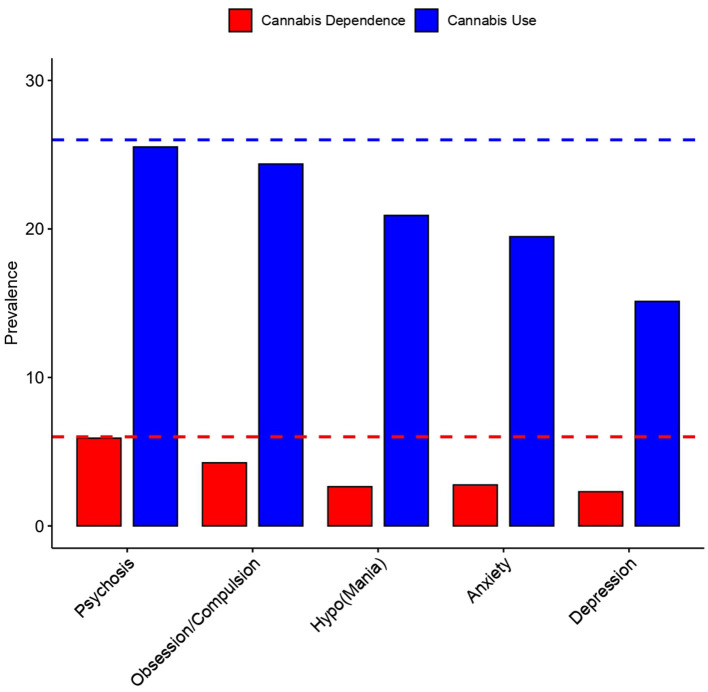
The prevalence of having ever used cannabis was 24.4% (n = 70) in individuals with OCS (n = 288), greater than that reported for the population as a whole (9.7%) and greater than that for those with other psychiatric symptoms (hypomania, 20.9%; anxiety, 19.5%; and depression, 15.1%) except psychosis (25.5%) (Figure 1). The prevalence of having ever used cannabis was similar in those with only OS (15.8%, n = 149) as in those with only CS (15.2%, n = 172).
Estimation of Cannabis Dependence in Individuals With Obsessive-Compulsive Symptomatology
The prevalence of having ever been dependent on cannabis in individuals with OCS was greater (4.3%, n = 12) than that found in the population as a whole (0.6%). Greater dependence was also observed in this group than in individuals with other psychiatric symptomatologies (hypomania, 2.6%; anxiety, 2.8%; depression, 2.3%) except psychosis (5.9%). However, dependence was greater in individuals with only CS (2.2%, n = 22) than in those with only OS (1.8%, n = 15).
Comparison of the Genetic Risk in Individuals With OCS for OCD in the Use of Cannabis
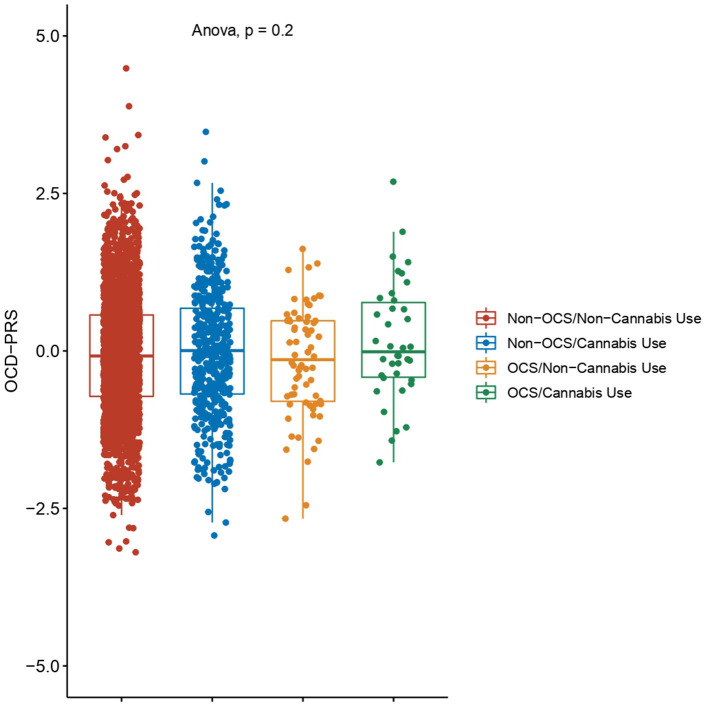
The subsample used for genotyping had the following distribution: 81.8% (n = 2,658 individuals) with no cannabis use or OCS, 14.9% (n = 485 individuals) having ever used cannabis but with no OCS, 2.1% (n = 68 individuals) with OCS but no cannabis use, and 1.2% (n = 38 individuals) with OCS and having ever used cannabis. The PRS for OCD was constructed using 11,959 SNPs, which passed the quality control test. The OCD-PRS comparison found no statistically significant differences between the different groups (F = 1.5, p = 0.2020) (Figure 2).
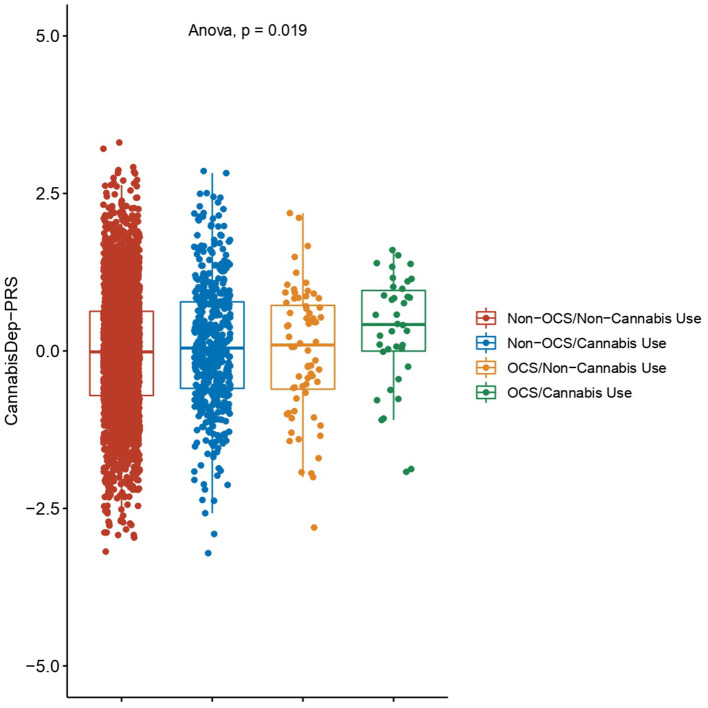
The PRS for dependence on cannabis was constructed using 13,485 SNPs, which passed the quality control test. The CannabisDep-PRS comparison found statistically significant differences between the different groups (F = 3.3, p = 0.0192) (Figure 3). The post-hoc comparisons found that the CannabisDep-PRS between individuals with OCS with cannabis use were not significantly different from those of individuals with OCS but with no cannabis use (p = 0.2010). Individuals with OCS and cannabis use had the highest CannabisDep-PRS value (m = 0.3151), and the difference from the value for those without OCS or cannabis use was statistically significant (p = 0.0390).
Discussion
Cannabis dependence and use has increased in recent years, as have proposals for the use of THC derivatives as pharmacological agents in areas such as psychiatry and oncology (ref. 33–ref. 36). In psychiatry, these derivatives could improve the symptomatology of some disorders, mainly those related to stress, such as Tourette’s syndrome, anxiety, and post-traumatic stress disorder (ref. 16, ref. 22, ref. 37–ref. 40). Even a non-psychoactive derivative (cannabidiol) has been used to treat substance use disorders (ref. 41, ref. 42). There are case studies that suggest a possible improvement in OCD after treatment with THC derivatives (ref. 17). A pilot clinical trial found that use of THC derivatives with exposure therapy has a synergic effect on the treatment of obsession and compulsion on individuals diagnosed with OCD (ref. 43), and its use as a therapeutic agent should still be explored. But we cannot disregard the effect of the continuous use of cannabis on the development of cannabis use disorder where its use is already problematic. We found that the prevalence of cannabis dependence in individuals with obsessive-compulsive symptomatology (OCS) was second (at 4.3%) only to its prevalence in those with psychosis (5.9%) (ref. 44). This prevalence in those with OCS is interesting, given that psychosis, but not OCD, has been strongly associated with use of or dependence on cannabis (ref. 45). Such an association has been found for other psychiatric disorders, including depression, anxiety, and suicide attempts, and for psychosis manifested at earlier ages (ref. 45–ref. 48). We do not, however, know of its effect on OCS or on the development of psychosis.
One of the important aspects to consider in the relationship between cannabis and OCD is the development of cannabis dependence either through recreational use or in pharmacological applications. This development has been thought of as a complex phenotype that must include different risk factors, such as the genetic one, in its development (ref. 49–ref. 51). The genome scans have found hundreds or thousands of associated genetic variations that have been used to calculate polygenic risk scores (PRS) (ref. 52–ref. 55). We have found that the PRS for cannabis dependence was greater in those with OCD who used cannabis than in those who did not use it. Individuals with a high genetic risk who use cannabis might thus increase their risk of dependence either through recreational use or with pharmacological derivatives of THC. PRS have been used not only as predictors of risk, but also as markers of pharmacological response to psychoactive agents and in pharmacogenomic studies (ref. 56–ref. 59). It might be hypothesized that the use of the PRS for cannabis dependence could be useful in predicting which individuals are at high risk, and to determine whether pharmacological treatment based on THC derivatives would be useful, or would exacerbate obsessive-compulsive symptomatology.
Study Limitations
Although we found associations between obsessive-compulsive symptomatology and the use of or dependence on cannabis, a limitation of this study is its lack of direct psychiatric diagnostic evaluation of the individuals surveyed. A further limitation was our inability to conduct a longitudinal evaluation of OCD symptoms, before or after cannabis use, to evaluate the symptomatological changes brought about by that use. Finally, because of the sample size, our analysis of genetic risk was able to evaluate only the use of cannabis, and not dependence.
Conclusions
The use of and dependence on cannabis was found to be greater in the Mexican population among individuals with obsessive-compulsive symptomatology than in those with anxiety or depression, but less than in those with psychosis. The genetic risk for cannabis dependence was also associated with cannabis use in individuals with obsessive-compulsive symptomatology. It may be possible in future pharmacogenomic studies to determine the response rates of individuals with different genetic risk scores.
Data Availability Statement
The genomic datasets generated for this study can be found in the European Variation Archive (EVA, PRJEB37766).
Ethics Statement
The studies involving human participants were reviewed and approved by the research and ethics committees of the Instituto Nacional de Psiquiatría Ramón de la Fuente Muñiz and the Instituto Nacional de Medicina Genómica. Written informed consent was provided by the participants or their parents or legal guardians.
Author Contributions
HN, NL, JM-M, AG-M, and JV developed the analyses and wrote the first version of the manuscript. JM-M, JV, and MB-G performed bioinformatics and statistical analyses. JV, CF, MB-G, and MM-M contributed to data collection. BC, AA, JM-M, and AG-M contributed to the genetic experiments. HN, MM-M, and JV conceived, designed, and coordinated the genetic analysis. All authors contributed to the article and approved the submitted version.
Conflict of Interest
The authors declare that the research was conducted in the absence of any commercial or financial relationships that could be construed as a potential conflict of interest.
References
- AM Ruscio, DJ Stein, WT Chiu, RC Kessler. The epidemiology of obsessive-compulsive disorder in the national comorbidity survey replication.. Mol Psychiatry. (, 2010. [DOI | PubMed]
- M Subramaniam, E Abdin, JA Vaingankar, SA Chong. Obsessive-compulsive disorder: prevalence, correlates, help-seeking and quality of life in a multiracial asian population.. Soc Psychiatry Psychiatr Epidemiol. (, 2012. [DOI | PubMed]
- LF Fontenelle, MV Mendlowicz, M Versiani. The descriptive epidemiology of obsessive-compulsive disorder.. Prog Neuro-Psychopharmacology Biol Psychiatry. (, 2006. [DOI | PubMed]
- JF Leckman, D Denys, HB Simpson, D Mataix-Cols, E Hollander, S Saxena. Obsessive-compulsive disorder: a review of the diagnostic criteria possible subtypes dimensional specifiers for DSM-V.. Depress Anxiety. (, 2010. [DOI | PubMed]
- H Nicolini. Serotonin transporter gene polymorphisms & obsessive-compulsive disorder.. Indian J Med Res. (, 2010. [PubMed]
- S Pallanti, G Grassi, A Cantisani, E Sarrecchia, M Pellegrini. Obsessive–compulsive disorder comorbidity: clinical assessment and therapeutic implications.. Front Psychiatry. (, 2011. [DOI | PubMed]
- DJ Stein, DLC Costa, C Lochner, EC Miguel, YCJ Reddy, RG Shavitt. Obsessive–compulsive disorder.. Nat Rev Dis Prim. (, 2019. [DOI | PubMed]
- DJA Smit, D Cath, NR Zilhão, HF Ip, D Denys, A den Braber. Genetic meta-analysis of obsessive–compulsive disorder and self-report compulsive symptoms.. Am J Med Genet Part B Neuropsychiatr Genet. (, 2020. [DOI | PubMed]
- N Hazari, J Narayanaswamy, G Venkatasubramanian. Neuroimaging findings in obsessive-compulsive disorder: a narrative review to elucidate neurobiological underpinnings.. Indian J Psychiatry. (, 2019. [DOI | PubMed]
- S Saxena, RG Bota, AL Brody. Brain-behavior relationships in obsessive-compulsive disorder.. Semin Clin Neuropsychiatry. (, 2001. [DOI | PubMed]
- SP Whiteside, JD Port, JS Abramowitz. A meta-analysis of functional neuroimaging in obsessive-compulsive disorder.. Psychiatry Res Neuroimaging. (, 2004. [DOI | PubMed]
- RR Kayser, I Snorrason, M Haney, FS Lee, HB Simpson. The endocannabinoid system: a New treatment target for obsessive compulsive disorder?. Cannabis Cannabinoid Res. (, 2019. [DOI | PubMed]
- CA Rabinak, M Angstadt, CS Sripada, JL Abelson, I Liberzon, MR Milad. Cannabinoid facilitation of fear extinction memory recall in humans.. Neuropharmacology. (, 2013. [DOI | PubMed]
- CA Rabinak, M Angstadt, M Lyons, S Mori, MR Milad, I Liberzon. Cannabinoid modulation of prefrontal-limbic activation during fear extinction learning and recall in humans.. Neurobiol Learn Mem. (, 2014. [DOI | PubMed]
- ME Bowers, KJ Ressler. An overview of translationally informed treatments for posttraumatic stress disorder: animal models of pavlovian fear conditioning to human clinical trials.. Biol Psychiatry. (, 2015. [DOI | PubMed]
- B Lutz, G Marsicano, R Maldonado, CJ Hillard. The endocannabinoid system in guarding against fear, anxiety and stress.. Nat Rev Neurosci. (, 2015. [DOI | PubMed]
- N Szejko, C Fremer, KR Müller-Vahl. Cannabis improves obsessive-compulsive disorder—Case report and review of the literature.. Front Psychiatry. (, 2020. [DOI | PubMed]
- A Zehra, J Burns, CK Liu, P Manza, CE Wiers, ND Volkow. Cannabis addiction and the brain: a review.. J Neuroimmune Pharmacol. (, 2018. [DOI | PubMed]
- E Kroon, L Kuhns, E Hoch, J Cousijn. Heavy cannabis use, dependence and the brain: a clinical perspective.. Addiction. (, 2020. [DOI | PubMed]
- J Santaella-Tenorio, NS Levy, LE Segura, PM Mauro, SS Martins. Cannabis use disorder among people using cannabis daily/almost daily in the united states, 2002–20.. Drug Alcohol Depend. (, 2019. [DOI | PubMed]
- KA Memedovich, LE Dowsett, E Spackman, T Noseworthy, F Clement. The adverse health effects and harms related to marijuana use: an overview review.. C Open. (, 2018. [DOI | PubMed]
- DJE Lowe, JD Sasiadek, AS Coles, TP George. Cannabis and mental illness: a review.. Eur Arch Psychiatry Clin Neurosci. (, 2019. [DOI | PubMed]
- JA Pasman, KJH Verweij, Z Gerring, S Stringer, S Sanchez-Roige, JL Treur. GWAS of lifetime cannabis use reveals new risk loci, genetic overlap with psychiatric traits, and a causal influence of schizophrenia.. Nat Neurosci. (, 2018. [DOI | PubMed]
- J Villatoro, ME Medina-Mora, C Fleiz Bautista, López M Moreno, NO Robles, Gamiño M Bustos. El consumo de drogas en méxico: resultados de la encuesta nacional de adicciones.. 2012. [DOI]
- ME Medina-Mora, T Real. The drug scene in mexico and the road ahead.. Adicciones. (, 2013. [DOI | PubMed]
- MT Pato, JL Sobell, H Medeiros, C Abbott, BM Sklar, PF Buckley. The genomic psychiatry cohort: partners in discovery.. Am J Med Genet B Neuropsychiatr Genet. (, 2013. [DOI | PubMed]
- AR Docherty, TB Bigdeli, AC Edwards, S Bacanu, D Lee, MC Neale. Genome-wide gene pathway analysis of psychotic illness symptom dimensions based on a new schizophrenia-specific model of the OPCRIT.. Schizophr Res. (, 2015. [DOI | PubMed]
- SM Hartz, CN Pato, H Medeiros, P Cavazos-Rehg, JL Sobell, JA Knowles. Comorbidity of severe psychotic disorders with measures of substance use.. JAMA Psychiatry. (, 2014. [DOI | PubMed]
- S Purcell, B Neale, K Todd-Brown, L Thomas, MAR Ferreira, D Bender. PLINK: a tool set for whole-genome association and population-based linkage analyses.. Am J Hum Genet. (, 2007. [DOI | PubMed]
- AT Marees, H de Kluiver, S Stringer, F Vorspan, E Curis, C Marie-Claire. A tutorial on conducting genome-wide association studies: quality control and statistical analysis.. Int J Methods Psychiatr Res. (, 2018. [DOI | PubMed]
- MP Conomos, MB Miller, TA Thornton. Robust inference of population structure for ancestry prediction and correction of stratification in the presence of relatedness.. Genet Epidemiol. (, 2015. [DOI | PubMed]
- LL Cavalli-Sforza. The human genome diversity project: past, present and future.. Nat Rev Genet. (, 2005. [DOI | PubMed]
- MB Bridgeman, DT Abazia. Medicinal cannabis: history, pharmacology, and implications for the acute care setting.. P T. (, 2017. [PubMed]
- M Pratt, A Stevens, M Thuku, C Butler, B Skidmore, LS Wieland. Benefits and harms of medical cannabis: a scoping review of systematic reviews.. Syst Rev. (, 2019. [DOI | PubMed]
- Y Mouhamed, A Vishnyakov, B Qorri, M Sambi, SMS Frank, C Nowierski. Therapeutic potential of medicinal marijuana: an educational primer for health care professionals.. Drug Healthc Patient Saf. (, 2018. [DOI | PubMed]
- Therapeutic effects of cannabis and cannabinoids. In:. The Health Effects of Cannabis and Cannabinoids: The Current State of Evidence and Recommendations for Research., 2017
- KR Müller-Vahl. Treatment of tourette syndrome with cannabinoids.. Behav Neurol. (, 2013. [DOI | PubMed]
- KR Müller-Vahl, H Prevedel, K Theloe, H Kolbe, HM Emrich, U Schneider. Treatment of tourette syndrome with delta-9-tetrahydrocannabinol (Δ9-THC): no influence on neuropsychological performance.. Neuropsychopharmacology. (, 2003. [DOI | PubMed]
- KR Müller-Vahl, U Schneider, H Prevedel, K Theloe, H Kolbe, T Daldrup. Δ9-tetrahydrocannabinol (THC) is effective in the treatment of tics in Tourette syndrome: A 6-week randomized trial.. J Clin Psychiatry. (, 2003. [DOI | PubMed]
- M Mergler, M Driessen, U Havemann-Reinecke, D Wedekind, C Lüdecke, M Ohlmeier. Differential relationships of PTSD and childhood trauma with the course of substance use disorders.. J Subst Abuse Treat. (, 2018. [DOI | PubMed]
- Y Chye, E Christensen, N Solowij, M Yücel. The endocannabinoid system and cannabidiol’s promise for the treatment of substance use disorder.. Front Psychiatry. (, 2019. [DOI | PubMed]
- G Gonzalez-Cuevas, R Martin-Fardon, TM Kerr, DG Stouffer, LH Parsons, DC Hammell. Unique treatment potential of cannabidiol for the prevention of relapse to drug use: preclinical proof of principle.. Neuropsychopharmacology. (, 2018. [DOI | PubMed]
- RR Kayser, M Raskin, I Snorrason, DM Hezel, M Haney, HB Simpson. Cannabinoid augmentation of exposure-Based psychotherapy for obsessive-compulsive disorder.. J Clin Psychopharmacol. (, 2020. [DOI | PubMed]
- BJ Sherman, AL McRae-Clark. Treatment of cannabis use disorder: current science and future outlook.. Pharmacotherapy. (, 2016. [DOI | PubMed]
- A Hasan, R von Keller, CM Friemel, W Hall, M Schneider, D Koethe. Cannabis use and psychosis: a review of reviews.. Eur Arch Psychiatry Clin Neurosci. (, 2020. [DOI | PubMed]
- BN Subodh, N Sharma, R Shah. Psychosocial interventions in patients with dual diagnosis.. Indian J Psychiatry. (, 2018. [DOI | PubMed]
- KK Kedzior, LT Laeber. A positive association between anxiety disorders and cannabis use or cannabis use disorders in the general population- a meta-analysis of 31 studies.. BMC Psychiatry. (, 2014. [DOI | PubMed]
- L Naji, T Rosic, B Dennis, M Bhatt, N Sanger, J Hudson. The association between cannabis use and suicidal behavior in patients with psychiatric disorders: an analysis of sex differences.. Biol Sex Differ. (, 2018. [DOI | PubMed]
- DB Kosty, JR Seeley, RF Farmer, JJ Stevens, PM Lewinsohn. Trajectories of cannabis use disorder: risk factors, clinical characteristics and outcomes.. Addiction. (, 2017. [DOI | PubMed]
- KE Courtney, MH Mejia, J Jacobus. Longitudinal studies on the etiology of cannabis use disorder: a review.. Curr Addict Reports. (, 2017. [DOI | PubMed]
- EN Dugas, MP Sylvestre, E Ewusi-Boisvert, M Chaiton, A Montreuil, J O’Loughlin. Early risk factors for daily cannabis use in young adults.. Can J Psychiatry. (, 2019. [DOI | PubMed]
- CM Lewis, E Vassos. Prospects for using risk scores in polygenic medicine.. Genome Med. (, 2017. [DOI | PubMed]
- NR Wray, T Lin, J Austin, JJ McGrath, IB Hickie, GK Murray. From basic science to clinical application of polygenic risk scores: a primer.. JAMA Psychiatry. (. [DOI | PubMed]
- GK Murray, T Lin, J Austin, JJ McGrath, IB Hickie, NR Wray. Could polygenic risk scores be useful in psychiatry? a review.. JAMA Psychiatry. (. [DOI | PubMed]
- E Eeltink, MZ van der Horst, JR Zinkstok, CM Aalfs, JJ Luykx. Polygenic risk scores for genetic counseling in psychiatry: lessons learned from other fields of medicine.. Neurosci Biobehav Rev. (. [DOI | PubMed]
- G Gibson. On the utilization of polygenic risk scores for therapeutic targeting.. PLoS Genet. (, 2019. [DOI | PubMed]
- ML Santoro, V Ota, S de Jong, C Noto, LM Spindola, F Talarico. Polygenic risk score analyses of symptoms and treatment response in an antipsychotic-naive first episode of psychosis cohort.. Transl Psychiatry. (, 2018. [DOI | PubMed]
- JP Zhang, D Robinson, J Yu, J Gallego, WW Fleischhacker, RS Kahn. Schizophrenia polygenic risk score as a predictor of antipsychotic efficacy in first-episode psychosis.. Am J Psychiatry. (, 2019. [DOI | PubMed]
- MK Hofmeijer-Sevink, P van Oppen, HJ van Megen, NM Batelaan, DC Cath, NJA van der Wee. Clinical relevance of comorbidity in obsessive compulsive disorder: the netherlands oCD association study.. J Affect Disord. (, 2013. [DOI | PubMed]