
Alien plants of Europe: introduction pathways, gateways and time trends
Abstract
The Convention on Biological Diversity (CBD) pathways classification framework used in the implementation of the European Union’s (EU) Regulation 1143/2014 on invasive alien species (IAS Regulation) has recently been adopted by the European Alien Species Information Network (EASIN), the official information system supporting the implementation of the IAS Regulation. In the current paper, the result of an alignment of the primary introduction pathways of all alien plants in Europe included in the EASIN catalogue is presented, based on the CBD framework. In total, 6,250 alien plant taxa (marine plants excluded), both alien to Europe (native range outside Europe) and alien in Europe (native range partially in Europe) are reported. Altogether 5,175 plant taxa had their primary introduction pathway aligned based on the CBD framework, while for the rest the pathway remains unknown. In addition, the taxonomy, year and country of its first record in the wild are provided for each taxon. Our analyses reveal that the main primary introduction pathways of alien plants into Europe are linked to accidental escapes from ornamental and horticultural activities. Northwestern European countries seem to act as the main gateway areas of alien plants into Europe. Recent first observations of new alien taxa growing spontaneously exhibit a contemporary accelerating trend for plants alien to Europe, particularly linked to ornamental and horticultural activities. On the other hand, the number of new plants alien in Europe seems to have stabilized over the last few decades. The present work can assist in the prioritization of introduction pathways control, with the target of slowing down the rate of alien plants introductions into Europe, following also the requirements of the IAS Regulation.
Article type: Research Article
Keywords: Alien species, Biodiversity, Plants, Europe, Pathways, Gateways, Time trends, CBD
Affiliations: Faculty of Biology, National and Kapodistrian University of Athens, Department of Ecology and Systematics, Athens, Greece; Nicolaus Copernicus University, Institute for the Study, Conservation and Restoration of Cultural Heritage, Toruń, Poland; Faculty of Biology, National and Kapodistrian University of Athens, Department of Botany, Athens, Greece; European Commission, Joint Research Centre (JRC), Ispra, Italy
License: ©2021 Arianoutsou et al. CC BY 4.0 This is an open access article distributed under the terms of the Creative Commons Attribution License, which permits unrestricted use, distribution, reproduction and adaptation in any medium and for any purpose provided that it is properly attributed. For attribution, the original author(s), title, publication source (PeerJ) and either DOI or URL of the article must be cited.
Article links: DOI: 10.7717/peerj.11270 | PubMed: 34141463 | PMC: PMC8176916
Relevance: Relevant: mentioned in keywords or abstract
Full text: PDF (823 KB)
Introduction
Alien species represent a significant risk to the receiving environments (ref. Pejchar & Mooney, 2009; ref. Simberloff et al., 2013; ref. Jeschke et al., 2014; ref. Roiloa, Yu & Barreiro, 2020). New introductions of alien species have been accelerated in recent decades by the rapid globalization, urbanization and intensification of human activities (ref. Hulme, 2009; ref. Roques et al., 2016; ref. Seebens et al., 2017). Climate change and disturbance of natural ecosystems due to extreme climatic events are expected to further increase the risk of new introductions (ref. Masters & Norgrove, 2010; ref. Dainese et al., 2017; ref. Dullinger et al., 2017).
According to the EU Regulation 1143/2014 on the prevention and management of the introduction and spread of invasive alien species (ref. European Union, 2014), the term “alien species” applies to any taxa “introduced outside their natural range”, including any hybrids and varieties “that might survive and subsequently reproduce”. Invasive Alien Species (IAS) refers to species “whose introduction or spread has been found to threaten or adversely impact upon biodiversity and related ecosystem services” (ref. European Union, 2014).
The EU Regulation 1143/2014 (hereafter referred to as the IAS Regulation) requires EU Member States to carry out a comprehensive analysis and prioritization of the pathways of introduction and spread of IAS of Union concern (ref. European Union, 2014). In this context, databases are important for gathering, sharing and disseminating information on alien species, which are crucial for management, scientific and educational purposes. In Europe, the project Delivering Alien Species Inventories for Europe (ref. DAISIE, 2009) represented an important milestone in creating a European database of alien species. Additionally, similar initiatives were undertaken at a regional scale, such as the NOBANIS European Network on Invasive Alien Species (ref. NOBANIS, 2020) and the East and South European Network for Invasive Alien Species (ref. ESENIAS, 2020). It is noteworthy to report also Global datasets, such as the Global Biodiversity Information Facility (ref. GBIF, 2020) and the CABI-Invasive Species Compendium (ref. CABI, 2020), which include records of alien species in Europe.
Aiming to aggregate and integrate existing information on alien species in Europe, the European Alien Species Information Network (ref. EASIN, 2020) has been developed by the European Commission’s Joint Research Centre (ref. Katsanevakis et al., 2012). EASIN acts as a single aggregation point for sharing and disseminating information, where available knowledge on alien species from various data sources is standardized, harmonized and integrated (ref. Katsanevakis et al., 2015; ref. Deriu et al., 2017). EASIN aims to underpin alien species related policy and management decisions (ref. Katsanevakis et al., 2015), and constitutes the core of the information system supporting EU Member States in the implementation of the IAS Regulation (ref. European Union, 2014; Art. 25).
Identification of key-recipient regions of alien introductions is essential, since it may help to predict, prevent, and control future introductions, pinpointing geographical areas where management should be focused (ref. Vermeij, 1996). In addition, since most alien species are extremely difficult to control after their establishment (ref. Genovesi, 2005; ref. Vilà et al., 2010), scientific effort should be directed at finding appropriate means to prevent their entry into new areas, by managing their potential pathways (ref. Hulme, 2009; ref. Hulme, 2015; ref. McGeoch et al., 2016; ref. Ojaveer et al., 2018; ref. Tsiamis et al., 2020).
Pathway management is an essential aspect in tackling biological invasions and can benefit from applying a consistent classification, hierarchy, and terminology (ref. Essl et al., 2015). To aid this effort, a standardized pathways terminology and hierarchical classification was proposed by ref. Hulme et al. (2008) and largely adopted by EASIN in 2012 (ref. Katsanevakis et al., 2012). The framework set by ref. Hulme et al. (2008) has been extensively used in various studies assessing introduction pathways across different environments and taxonomic groups (ref. Katsanevakis et al., 2013; ref. Roques et al., 2016; ref. Pergl et al., 2017).
The global increasing threat of alien species has led the Convention on Biological Diversity (CBD) to a comprehensive review of introduction pathways (CBD 2014), which aims to improve the understanding and the consistency of those pathways. This review has become a global standard of terminology for introduction pathways and a key requirement for interoperability and harmonization of databases (ref. Deriu et al., 2017; ref. Groom et al., 2017; ref. Groom et al., 2019; ref. Saul et al., 2017), risk analysis and large-scale studies (ref. Pergl et al., 2017; ref. Tsiamis et al., 2018). The CBD pathways classification framework includes six principal pathway categories (Release, Escape, Transport-contaminants, Transport-stowaway, Corridors, and Unaided), most of them hosting several subcategories (44 in total).
The CBD classification framework is used in the implementation of the IAS Regulation and was recently adopted by EASIN. To this end, EASIN aligned its pathways’ information with the CBD framework, including taxa from various taxonomic groups and habitats (ref. Tsiamis, Cardoso & Gervasini, 2017; ref. Pergl et al., 2020). However, the bulk of the information on the alien plant pathways included in EASIN (> 5,500 taxa) until recently was not aligned with the CBD categorization. This paper aims to fill this gap, presenting basic information on all alien plant taxa included in EASIN and their pathways after their alignment with the CBD scheme. More specifically, the objectives of the current work are: (a) to highlight the main introduction pathways of alien plants in Europe, (b) to explore the first records in the wild in Europe (i.e., not in cultivation or nurseries, hereinafter called as “the wild”) by assessing which countries act as the major gateways, and (c) to investigate the temporal trends of first records of new alien plants and related pathways, with emphasis on the more recent decades. Such analysis can assist the prioritization of pathways management, which can contribute to slowing the rate of alien species introductions into Europe’s wild, in line with the targets of the IAS Regulation.
Materials & Methods
Pan-European inventory
For the present analysis, we used the catalogue of alien plant taxa (species, subspecies and hybrids) reported in Europe, as updated by EASIN until the end of 2019 (Table S1). Only vascular plants (Tracheophyta) have been included in the analysis. Mosses (Bryophyta), liverworts (Marchantiophyta), marine vascular plants and algae were not taken into account. Alien plant taxa correspond to records found in the wild as spontaneous (casual or established/naturalized). Alien plants that have been found only in cultivation and have never been observed growing wild were excluded.
The EASIN catalogue of alien plants is mainly based on information retrieved from DAISIE (45% contribution to the EASIN records), NOBANIS (29%), (ref. Online Atlas of the British and Irish flora, 2018) (8%) and Manual of the Alien Plants of Belgium (ref. Verloove, 2020) (6%). The remaining EASIN plant records originate from several other global, European, regional and national databases (Table S2) and scientific publications.
The EASIN catalogue contains taxa which are considered as (a) alien to Europe (i.e., taxa with a native range outside Europe, as defined by ref. Lambdon et al., 2008), (b) alien in Europe (i.e., taxa with native range partially in Europe, as defined by ref. Lambdon et al., 2008), (c) cryptogenic (i.e., taxa with no definite evidence of their alien or native status in Europe), and (d) questionable (i.e., taxa whose presence in Europe is uncertain, possible misidentifications, as well as taxa with unresolved taxonomic status). A taxon is included in the inventory if it is considered as alien in at least one European country, including the European part of the Macaronesia (the Azores, Canary Islands, Madeira). In order to standardize the nomenclature, World Flora Online (ref. World Flora Online (WFO), 2020) was mainly used. The ref. Euro+Med (2020), the Plants of the World Online (ref. Plants of the World Online (POWO), 2020; ref. The Plant List, 2020) and the National Biodiversity Network of the UK (ref. National Biodiversity Network (NBN), 2020) were additionally used. For the subsequent analyses, only alien taxa to and in Europe were considered, while cryptogenic and questionable taxa were excluded.
Primary pathways: The classification of pathways for alien plants’ primary introduction followed the CBD classification framework (ref. CBD, 2014; ref. Hulme et al., 2008), and the technical guide of application by ref. Harrower et al. (2017). This guide provided additional clarifications on the distinction between CBD pathways, for example between the subcategories “Horticulture” and “Ornamental purpose other than horticulture”. The former applies to plants that have escaped from commercial facilities (nurseries, greenhouses) or during the transport of horticultural products. The latter applies when the escape occurs from landscaped habitats or plant collections, excluding botanical gardens, which is a distinct subcategory.
Original information on pathways was based on data from DAISIE, NOBANIS, EPPO and other sources as provided in Table S3. For 8% of the taxa, expert judgment was used for pathway assignment based on CBD categorization. For several taxa, the pathway assignment could be decided only for the main CBD pathway categories but not for the subcategories, due to lack of adequate information. To this end, we have added the following subcategories:
- Release in nature: unknown;
- Escape from confinement: unknown;
- Transport-contaminant: unknown;
- Transport-stowaway: unknown.
Gateways: based on the information of the main sources appearing in Table S2, the countries of the first observations of alien plants in the wild were identified (hereafter referred to as gateway countries). Taxa first found from Macaronesia were assigned to the corresponding country (e.g., if a taxon was first found in the Canary Islands the gateway country would be Spain).
Time-trends: the year of the first record of an alien plant in the wild was used as the best available estimate of the year of its initial occurrence. In the case of taxa alien in Europe, the first record in a European country outside its native range was used.
Data analyses: pathway patterns were analyzed separately for taxa alien to Europe, and taxa alien in Europe. In addition, archaeophytes (i.e., alien taxa that arrived in Europe before 1500 AD) and neophytes (i.e., taxa that arrived after 1500 AD) were also distinguished based on ref. Pyšek et al. (2004). For several taxa there was high uncertainty on the gateways and time-trends of the first record in the wild due to lack of data, especially concerning old records. Therefore, detailed analyses for the main gateway countries per taxonomic group (Families) were performed for alien plants of Europe recorded for the first time in the wild after 1950, for which the uncertainty level was lower. To simplify the graphic analyses, we grouped introduction pathways with a minor contribution to the generic group “Rest pathways”. Several taxa were linked to more than one CBD introduction pathway subcategory. To avoid double-counting of species for a specific gateway country or Family a value of 1/k was provided for each of the k associated pathways so that the overall contribution of each species to each gateway country or Family is always equal to 1.
Results
Pan-European inventory
In total, 6,250 alien, 8 cryptogenic and 24 questionable plant taxa have been reported as spontaneous in the wild by 2019. Among the alien taxa, 3,021 are alien to Europe and 3,229 are alien in Europe, both cases including naturalized and casual taxa. The Families with the higher numbers of alien taxa are Asteraceae (11.4%), Poaceae (9.7%), Fabaceae (6.8%), Rosaceae (6.4%), and Brassicaceae (4%).
Primary pathways of introduction
Primary pathways of introduction of alien plants into Europe were assigned to 5,175 taxa, while for the remaining taxa the pathway was marked as “Unknown” since no relevant published information was found.
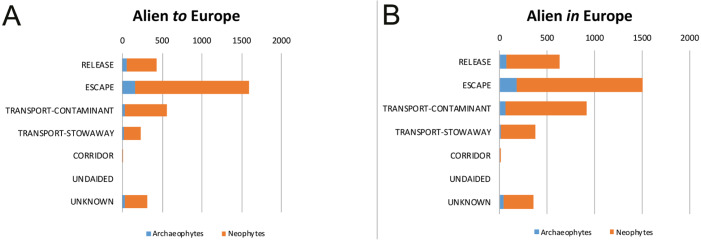
Regarding both taxa alien to Europe and in Europe, dominant pathways correspond to the main CBD categories “Escape”, “Transport-Contaminant” and “Release” (Fig. 1).
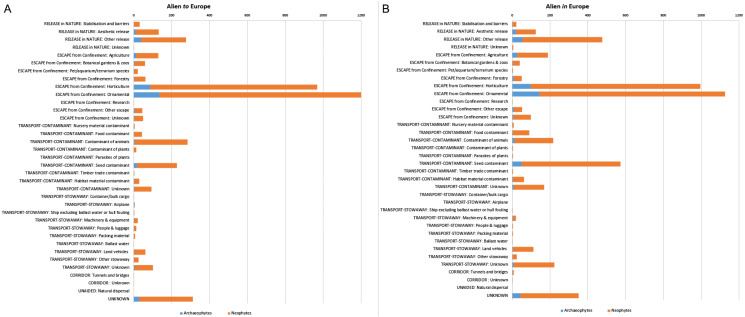
When it comes to the CBD subcategories, the highest number of taxa alien to Europe were associated with “Escape from confinement: ornamental” (hereafter referred to as ornamental), “Escape from confinement: horticulture” (hereafter referred to as horticulture), “Transport-contaminant: contaminant on animals”, “Release in nature: other release”, and “Transport-contaminant: seed contaminant” (hereafter referred to as seed contamination) (Fig. 2A). A similar pattern is shown by the taxa alien in Europe although the pathway “Transport-contaminant: contaminant on animals” has a minor role in alien taxa introductions compared to the aforementioned pathways (Fig. 2B). We should note that several CBD subcategory pathways were associated with very low numbers of plant introductions, both for taxa alien to Europe and taxa alien in Europe.
Gateway countries
The gateway countries were identified for 5,746 taxa. Overall, for taxa alien to Europe, the most important gateway countries are the United Kingdom, Belgium, Portugal and Austria (Fig. S1). Considering taxa alien in Europe, the top-ranking countries are the United Kingdom, Sweden, Belgium and Denmark (Fig. S1).
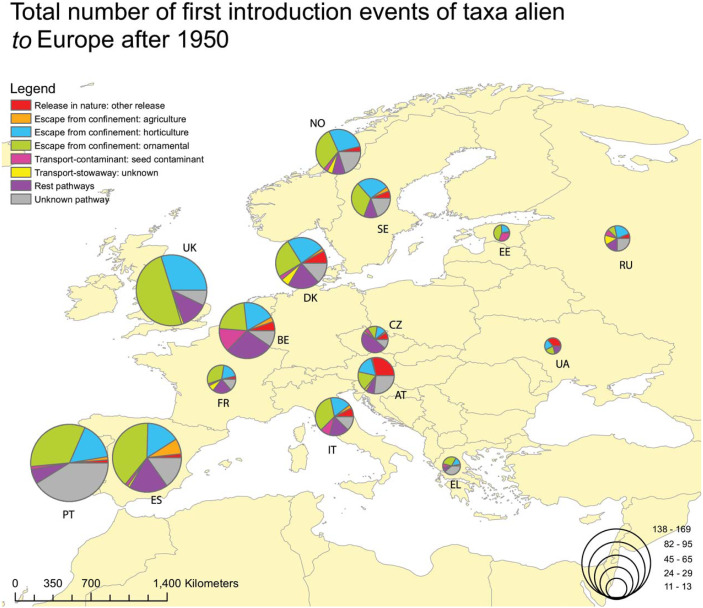
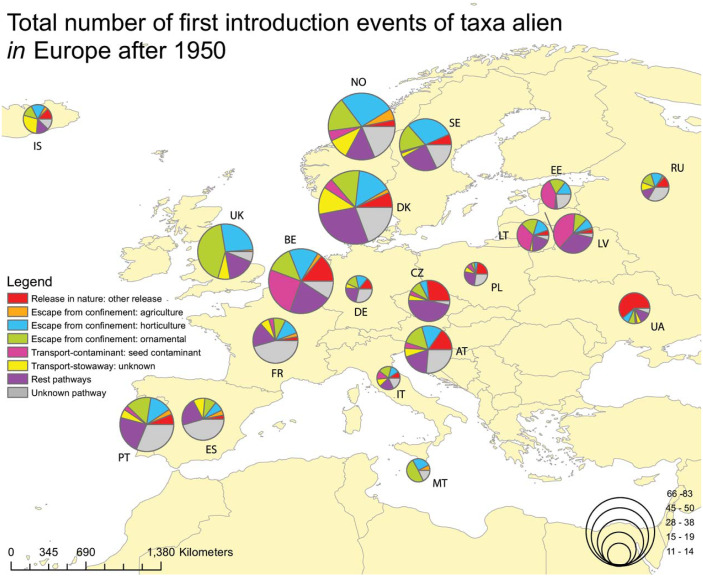
When focusing on alien plants recorded for the first time in the wild after 1950, the higher numbers of alien taxa to Europe were reported from Portugal, the United Kingdom, Spain and Belgium, and they were related to a large extent with ornamental and horticulture escapes (Fig. 3). For taxa alien in Europe firstly recorded after 1950, the higher numbers were reported from Denmark, Norway, Belgium and the United Kingdom. Again, the most common pathways were escapes from ornamental and horticulture (Fig. 4). The seed contamination pathway was relatively high for Belgium.
Time-trends
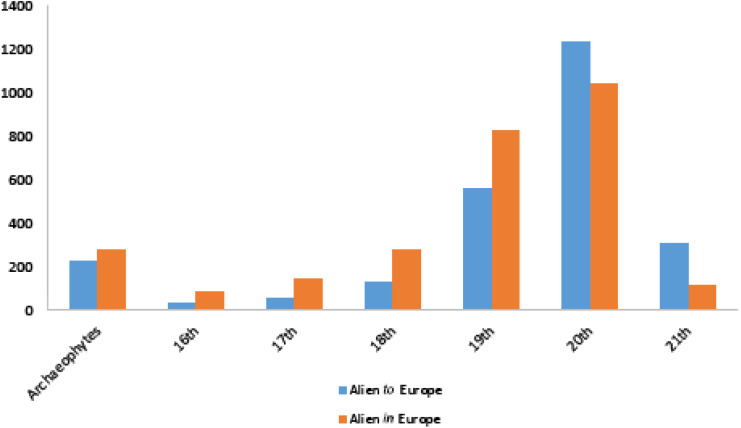
The year of the first record of an alien plant in the wild (or in areas outside their native distribution for taxa alien in Europe) was documented for 5,296 taxa. Among the alien taxa, 506 taxa are archaeophytes while the remaining are neophytes. The rate of newly recorded alien plants to European wild is constantly increasing from the 16th to the 20th century (Fig. 5). When it comes to taxa alien in Europe, this rate was also accelerating from the 16th up to the 19th century, while slowing down in the 20th century (Fig. 5).
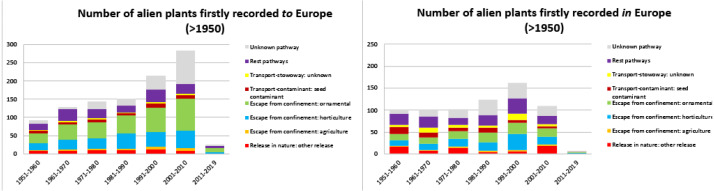
Focusing on alien plants observed for the first time after 1950, the number of taxa alien to Europe shows an increasing trend during the recent decades, except for the period 2011–2019 (Fig. 6A). On the other hand, the number of first records of new alien plants in Europe seems to be stable during the same period (Fig. 6B), with the exception again of the very low number reported for the period 2011–2019. For taxa alien to Europe, the main CBD introduction pathways subcategories are associated with escapes from ornamental and horticulture (Fig. 6A). For taxa alien in Europe, introduction pathways appear more diverse during the last decades (Fig. 6B).
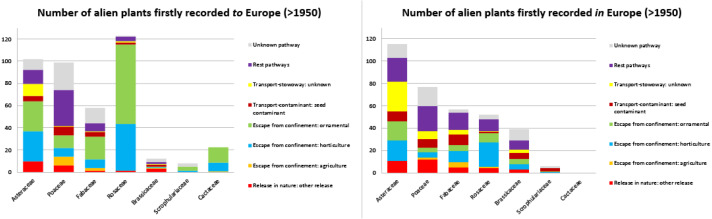
The taxonomic analysis at the Family level reveals that Rosaceae, Asteraceae, Poaceae and Fabaceae, contribute with the highest numbers of first records of alien plants after 1950 to Europe. Ornamental purposes and horticulture are their main introduction pathways, except for Poaceae for which the main pathways either vary or are unknown (Fig. 7A). For plants that appeared after 1950 in Europe, the Families hosting the highest numbers are Asteraceae, Poaceae, Fabaceae, Rosaceae and Brassicaceae. Patterns of pathways are not consistent across Families (Fig. 7B).
Discussion
Alien plants constitute a major group of alien species reported for Europe (EASIN, 2020). In addition, Europe (together with America) is the continent with the highest numbers of alien plant species across the globe (ref. Van Kleunen et al., 2015; ref. Pyšek et al., 2017). It should also be mentioned that by 2020, out of the 66 invasive alien species included in the list of IAS of Union concern, 36 (55%) are plants.
There are several studies on alien plants in Europe, focusing on one or few species (e.g., ref. Moravcova et al., 2006; ref. Perglova, Pergl & Pyšek, 2006; ref. Kollmann, Banuelos & Nielsen, 2007) or checklists at a local, regional or country-level (e.g., ref. Boršić et al., 2008; ref. Arianoutsou et al., 2010; ref. Stešević & Petrović, 2010; ref. Medvecka et al., 2012; ref. Petrova, Vladimirov & Georgiev, 2013; ref. Barina et al., 2014; ref. Maslo, 2016; ref. Gudžinskas, Petrulaitis & Žalneravičius, 2017; ref. Bomanowska et al., 2019; ref. Burda & Koniakin, 2019). Extended inventories covering alien plant taxa have been undertaken by DAISIE at a European scale (ref. Lambdon et al., 2008; ref. Pyšek et al., 2009), and by the Global Naturalized Alien Flora (GLONAF) and the Global Register of Introduced and Invasive Species (GRIIS) at a global scale (ref. van Kleunen et al., 2015; ref. Pyšek et al., 2017; ref. Pagad et al., 2018).
ref. Pyšek et al. (2017) reported 4,139 alien plant taxa as naturalized in Europe. In the current study, a considerably higher number of taxa (2,111 more) is reported, which can be attributed to the inclusion of both naturalized and casual taxa, as well as taxa reported from Macaronesia and the European Caucasian area, that is Georgia, Armenia etc.
The analysis of introduction pathways following the CBD categorization revealed that the dominant pathway is “Escape”, which is also reported for biological invasions at a global scale (ref. Essl et al., 2015). At the subcategory level, the most common pathways are escapes associated with ornamental and horticultural activities, both for taxa alien to and in Europe. The same pattern was previously reported by several studies in Europe (ref. Bell, Wilen & Stanton, 2003; ref. Dehnen-Schmutz et al., 2007a; ref. Dehnen-Schmutz et al., 2007b; ref. Lambdon et al., 2008; ref. van Kleunen et al., 2018; ref. Aymerich & Sáez, 2019). Intentional release for various purposes and transport through contaminants on animals are also important pathways for alien plants into Europe. Moreover, seed contamination should be highlighted as one of the main pathways, in particular for taxa that are alien in Europe, in line with the results of similar studies in Europe (ref. Ferus et al., 2015; ref. Cossu et al., 2019) and outside the continent (ref. Wilson et al., 2016; ref. Oseland et al., 2020).
NW European countries are serving as gateway countries for a high number of alien plants. This should be attributed to a long history in horticulture, gardening, ornamental plant trade and relationships with European overseas territories. This is particularly true for countries with a long tradition in botanical research, and landscape architecture, such as the United Kingdom, Belgium, Sweden and Austria. Better sampling effort could also be encountered as one of the reasons (ref. van Kleunen et al., 2015; ref. Celesti-Grapow et al., 2016). During the last decades (>1950), other countries also act as remarkable gateways, such as Spain and Portugal for taxa alien to Europe. However, this should be related to recent findings in the Macaronesia area due to an intensified monitoring effort (e.g., ref. Silva, Ojeda Land & Rodrıguez Luengo, 2008; ref. Verloove et al., 2017a; ref. Verloove et al., 2017b) and to several “acclimatisation gardens” (e.g., the Acclimatisation Gardens of La Orotava in the Canary Islands). Similarly, Denmark and Norway are reported as important gateways for alien taxa in Europe after 1950, which could also be the result of increased sampling effort and availability of information (e.g., via the NOBANIS database). On the other hand, the southern European countries (except for Italy) do not seem to act as important gateways, but this could be related to the scarcity of relevant studies. The latter stresses the need for enhanced sampling and availability of related data across Europe.
Time trends reveal an accelerating rate of first observations of new alien taxa in the wild since the 16th century (see also ref. Lambdon et al., 2008), a result that should be attributed to the increased urbanization and international trade coupled with an intensification in the recording efforts. The number of plants firstly recorded in the wild as alien to Europe exhibits a remarkable increase in the 20th century, and a constant increase between 1951 and 2010, coupled with an increasing trend of plant escapes associated with ornamental and horticulture pathways. These findings are in agreement with the results of previous studies (e.g., ref. Pyšek et al., 2003; ref. Walker, 2007; ref. Pyšek et al., 2009; ref. Seebens et al., 2017; ref. Aymerich & Sáez, 2019). On the other hand, the rate of first observations of alien taxa in Europe decreases in the 20th century and becomes rather stable during the period 1951-2010.
For both taxa alien to and in Europe, the number of first observations in the wild significantly drops during the last decade (2011–2019). However, we believe that this fall in numbers should be attributed to the time lag between the occurrence of a taxon in the wild and the time of its reporting (see also ref. Crooks, 2005; ref. Rouget et al., 2016; ref. Smith et al., 2018; ref. Zenetos et al., 2019). It is possible that information on observations of new alien taxa could be still unpublished or in local repositories, thus remaining absent in several databases and scientific literature.
Since the 1950s, Asteraceae, Poaceae, Fabaceae and Rosaceae are amongst the richest Families in numbers of first observations of alien plants, as reported also by ref. Arianoutsou et al. (2013) for the Mediterranean biome and ref. Pyšek et al. (2017) at a global level. Similar patterns are also observed in checklists of alien flora at country and European level (e.g., ref. Lambdon et al., 2008; ref. Celesti-Grapow et al., 2009; ref. Celesti-Grapow et al., 2016; ref. Arianoutsou et al., 2010; ref. Pyšek et al., 2012; ref. Petrova, Vladimirov & Georgiev, 2013; ref. Del Guacchio & La Valva, 2018; ref. Uludag et al., 2017; ref. Galasso et al., 2018). Asteraceae, Poaceae, and Fabaceae are mostly represented by herbaceous plants expected to be more easily dispersed and become established in new environments, while Rosaceae includes trees and woody shrubs commonly used as ornamental plants and in horticulture (see also ref. Pyšek et al., 2017). Cactaceae are also important for plants of ex-European origin reported in islands, such as the Macaronesia (ref. Otto & Verloove, 2016; ref. Verloove, Salas-Pascual & MarreroRodrıguez, 2018; ref. Verloove, 2019), and the Mediterranean Islands (ref. Celesti-Grapow et al., 2016).
Following the recently observed trend, the number of alien plant taxa of Europe is likely to further increase in the near future, especially due to new arrivals of taxa non-native to Europe and associated with ornamental and horticulture purposes. This reveals and stresses a priority need for more effective control of these kinds of plants and their pathways. Increased attention should be given to Families with the higher numbers of new taxa appearing after 1950 (e.g., Rosaceae, Asteraceae, Cactaceae). According to Article 11 of the IAS Regulation, Member States must carry out a comprehensive analysis of the introduction pathways of IAS in their territory and identify those that require priority action. The current paper can contribute to this action by providing the top-priority primary pathways of alien plants into Europe from 1950 to date, which can be crucial for effective prevention and appropriate management (ref. Brunel et al., 2010; ref. McGeoch et al., 2016). In addition, the information provided on the CBD introduction pathways can support the risk assessments required by the IAS regulation (ref. Roy et al., 2018), for prioritization and pest risk analysis following IPPC/EPPO standards (ref. Brunel et al., 2010), as well as for horizon-scanning exercises (ref. Roy et al., 2019; ref. Tsiamis et al., 2020).
When it comes to the CBD categorization framework, the vast majority of alien plants have been associated with a few specific pathways compared to the total of the CBD subcategory pathways. Several CBD pathways were not assigned at all (e.g., Release in nature: fishery in the wild) or were relevant for only a few taxa (e.g., Corridor: tunnels and bridges). It should be noted, however, that the accurate determination of an alien species’ pathway is not always an easy task due to the limited evidence available, and it may be characterized by high levels of uncertainty (ref. Katsanevakis et al., 2013; ref. Pergl et al., 2020), setting the need for experts’ judgment (ref. Essl et al., 2015). Indeed, for several taxa it was impossible to conclude on a specific CBD subcategory or the introduction pathway was completely unknown.
Applying the CBD pathways subcategories to alien plants was not always straightforward because of the overlap between pathway subcategories. For example, during the current alignment exercise, it was not always clear which plant introductions corresponded to horticulture or ornamental activities or both. Some CBD pathways are too broad, such as “Transport-contaminant: contaminant on animals”, which can refer to activities related to the breeding of animals and trade, but mainly with plant seeds attached to their fur. In addition, in the scientific literature, the introduction pathways were described with various terms (e.g., gardening; ref. van Kleunen et al., 2018), which can correspond to multiple CBD subcategories. Therefore, several CBD subcategories would need further clarification (e.g., the distinction between the horticulture and ornamental pathways) and we would stress the need for commonly accepted definitions and related interpretations of the CBD pathways, ensuring consistent alignment outcomes (see also ref. Tsiamis, Cardoso & Gervasini, 2017). Towards that aim, ref. Pergl et al. (2020) have recently proposed specific amendments that could improve the interpretation and clarity of the pathway categories which can lead to a better use of the CBD pathways categorization. For example, ref. Pergl et al. (2020) have further clarified the distinction between ornamental and horticulture pathways, which is based on the escapes from gardens and other landscaped habitats (ornamental) versus the escapes from commercial, industrial facilities (horticulture).
Conclusions
Our research shows that the dominant pathways of primary introductions of alien plants into Europe are linked with accidental escapes from ornamental and horticultural activities. Northwestern European countries seem to act as the main gateway countries for alien plants, although biases such as the monitoring effort should be taken into account. Recent first records of alien plants in the wild exhibit a contemporary accelerating trend for plants alien to Europe, particularly linked with ornamental and horticulture pathways. On the other hand, the number of alien plants in Europe seems to be stabilized during the last decades.
The present work can assist in the prioritization of pathways management, aiming to slow down the rate of new alien plant introductions into Europe, following also the requirements of the IAS Regulation.
The availability of related data on alien plants of Europe is dynamic; knowledge gaps need to be addressed and more information will come to light by future studies, in particular on species’ introduction pathways. Pathways used in plant introductions are also dynamic through time. Increased arrivals could be expected in the near future, due to the need for species used in forestry, agriculture and as biofuel that are more adaptable to climate change.
Finally, it should be highlighted that the current work focused exclusively on the primary introduction pathways of alien plants into Europe. However, addressing the secondary pathways of their dispersal within Europe is also crucial to avoid further spread to other countries.
Supplementary Materials
- Alien plant taxa in the wild of Europe based on the EASIN CatalogueList of alien plant taxa (species, subspecies and hybrids) of Europe as included in the EASIN Catalogue by 2019. Information on taxa authorities, category, year and country of first record into the wild of Europe, environment, taxonomic tree, taxa alien in Europe and pathways based on CBD are provided for each taxon. Mosses (Bryophyta), liverworts (Marchantiophyta), marine vascular plants and algae were not considered. (XLS)
- Sources of the EASIN dataset of alien plants of EuropeGlobal, European, regional and national databases from where information was extracted for creating the EASIN dataset on alien plants of Europe (see Table S1 ), including information on year and gateway country of first record into Europe’s wild of each alien taxon. (DOCX)
- Sources of pathway information of alien plants of EuropeGlobal, European, regional and national databases as well as scientific articles from where information was extracted for assigning primary pathways for the first records of alien plants into Europe’s wild (see Table S1). (DOCX)
References
- M Arianoutsou, I Bazos, P Delipetrou, Y Kokkoris. The alien flora of Greece: taxonomy, life traits and habitat preferences. Biological Invasions, 2010. [DOI]
- M Arianoutsou, P Delipetrou, M Vilà, PG Dimitrakopoulos, L Celesti-Grapow, G Wardell-Johnson, L Henderson, N Fuentes, W Ugarte-Mendes, PW Rundel. Comparative patterns of plant invasions in the mediterranean biome. PLOS ONE, 2013. [DOI | PubMed]
- P Aymerich, L Sáez. Checklist of the vascular alien flora of Catalonia (northeastern Iberian Peninsula, Spain). Mediterranean Botany, 2019. [DOI]
- Z Barina, M Rakaj, G Somogyi, Z Eros-Honti, D Pifko. The alien flora of Albania: history, current status and future trends. Weed Research, 2014. [DOI]
- CE Bell, CA Wilen, AE Stanton. Invasive plants of horticultural origin. Hortscience, 2003. [DOI]
- A Bomanowska, W Adamowski, I Kirpluk, A Otraba, A Rewicz. Invasive alien plants in Polish national parks threats to species diversity. PeerJ, 2019. [DOI | PubMed]
- I Boršić, M Milović, I Dujmović, S Bogdanovic, P Cigić, I Rešetnik, T Nikolić, B Mitić. Preliminary check-list of invasive alien plant species (IAS) in Croatia. Natura Croatica, 2008
- S Brunel, G Schrader, G Brundu, G Fried. Emerging invasive alien plants for the Mediterranean Basin. EPPO Bulletin, 2010. [DOI]
- RI Burda, SN Koniakin. The non-native woody species of the flora of Ukraine: introduction, naturalization and invasion. Biosystems Diversity, 2019. [DOI]
- CABI (2020)CABI2020Invasive species compendiumCAB InternationalWallingford, UKhttps://www.cabi.org/isc
- Convention on biological diversity. Pathways of introduction of invasive species, their prioritization and management. 2014
- L Celesti-Grapow, A Alessandrini, PV Arrigoni, E Banfi, L Bernardo, M Bovio, G Brundu, MR Cagiotti, I Camarda, E Carli, F Conti, S Fascetii, G Galasso, V Gubellini, V La Valva, F Lucchese, S Marchiori, P Mazzola, S Peccenini, L Poldini, F Pretto, F Prosser, C Siniscalo, MC Villani, L Viegi, T Wilham, C Blasi. The inventory of the non-native flora of Italy. Plant Biosystems, 2009. [DOI]
- L Celesti-Grapow, L Bassi, G Brundu, I Camarda, E Carli, G D’Auria, E Del Guacchio, G Domina, G Ferretti, B Foggi, L Lazzaro, P Mazzola, S Peccenini, F Pretto, A Stinca, C Blasi. Plant invasions on small Mediterranean islands: an overview. Plant Biosystems, 2016. [DOI]
- TA Cossu, V Lozano, W Stuppy, G Brundu. Seed contaminants: an overlooked pathway for the introduction of non-native plants in Sardinia (Italy). Plant Biosystems, 2019. [DOI]
- JA Crooks. Lag times and exotic species: the ecology and management of biological invasions in slow-motion. Ecoscience, 2005. [DOI]
- M Dainese, S Aikio, PE Hulme, A Bertolli, F Prosser, L Marini. Human disturbance and upward expansion of plants in a warming climate. Nature Climate Change, 2017. [DOI]
- DAISIE (2009)DAISIE2009Handbook on alien species in EuropeSpringerBerlin399
- K Dehnen-Schmutz, J Touza, C Perrings, M Williamson. The horticultural trade and ornamental plant invasions in Britain. Conservation Biology, 2007a. [DOI | PubMed]
- K Dehnen-Schmutz, J Touza, C Perrings, M Williamson. A century of the ornamental plant trade and its impact on invasion success. Diversity and Distributions, 2007b. [DOI]
- E Del Guacchio, V La Valva. The non-native vascular flora of Campania (southern Italy). Plant Biosystems – An International Journal Dealing with all Aspects of Plant Biology, 2018. [DOI]
- I Deriu, F D’Amico, K Tsiamis, E Gervasini, AC Cardoso. Handling big data of alien species in europe: the european alien species information network geodatabase. Frontiers in ICT, 2017. [DOI]
- I Dullinger, J Wessely, O Bossdorf, W Dawson, F Essl, A Gattringer, G Klonner, H Kreft, M Kuttner, D Moser, J Pergl, P Pyšek, W Thuiller, M Van Kleunen, P Weigelt, M Winter, S Dullinger. Climate change will increase the naturalization risk from garden plants in Europe. Global Ecology and Biogeography, 2017. [DOI | PubMed]
- EASIN (2020)EASIN2020European Commission – Joint Research Centre – European Alien Species Information Network (EASIN)https://easin.jrc.ec.europa.eu/
- East and south european network for invasive alien species. 2020
- F Essl, S Bacher, T Blackburn, O Booy, G Brundu, S Brunel, AC Cardoso, R Eschen, B Gallardo, B Galil, E García-Berthou, P Genovesi, G Groom, C Harrower, PE Hulme, S Katsanevakis, M Kenis, I Kühn, S Kumschick, AF Martinou, W Nentwig, C O’Flynn, S Pagad, J Pergl, P Pyšek, W Rabitsch, DM Richardson, A Roques, HE Roy, R Scalera, S Schindler, H Seebens, S Vanderhoeven, M Vilà, JRU Wilson, A Zenetos, JM Jeschke. Crossing frontiers in tackling pathways of biological invasions. ioScience, 2015
- European Union. Regulation (EU) No 1143/2014 of the European Parliament and of the Council on the prevention and management of the introduction and spread of invasive alien species. Official Journal of the European Union, 2014
- Euro+Med PlantBase – the information resource for Euro-Mediterranean plant diversity. 2020
- P Ferus, C Sirbu, P Eliaš jr, J Konopkova, L Ďurišova, C Samuil, A Oprea. Reciprocal contamination by invasive plants: analysis of trade exchange between Slovakia and Romania. Biologia, 2015. [DOI]
- G Galasso, F Conti, L Peruzzi, NMG Ardenghi, E Banfi, L Celesti-Grapow, A Albano, A Alessandrini, G Bacchetta, S Ballelli, M Bandini Mazzanti, G Barberis, L Bernardo, C Blasi, D Bouvet, M Bovio, L Cecchi, E Del Guacchio, G Domina, S Fascetti, L Gallo, L Gubellini, A Guiggi, D Iamonico, M Iberite, P Jiménez-Mejías, E Lattanzi, D Marchetti, E Martinetto, RR Masin, P Medagli, NG Passalacqua, S Peccenini, R Pennesi, B Pierini, L Podda, L Poldini, F Prosser, FM Raimondo, F Roma-Marzio, L Rosati, A Santangelo, A Scoppola, S Scortegagna, A Selvaggi, F Selvi, A Soldano, A Stinca, RP Wagensommer, T Wilhalm, F Bartolucci. An updated checklist of the vascular flora alien to Italy. Plant Biosystems – An International Journal Dealing with all Aspects of Plant Biology, 2018. [DOI]
- GBIF home page. 2020
- Eradications of invasive alien species in Europe: a review. Biological Invasions, 2005. [DOI]
- QJ Groom, T Adriaens, P Desmet, A Simpson, A De Wever, I Bazos, AC Cardoso, L Charles, A Christopoulou, A Gazda, H Helmisaari, D Hobern, M Josefsson, F Lucy, D Marisavljevic, T Oszako, J Pergl, O Petrovic-Obradovic, C Prévot, HP Ravn, G Richards, A Roques, HE Roy, MA Rozenberg, R Scalera, E Tricarico, T Trichkova, D Vercayie, A Zenetos, S Vanderhoeven. Seven recommendations to make your invasive alien species data more useful. Frontiers in Applied Mathematics and Statistics, 2017. [DOI]
- Q Groom, P Desmet, L Reyserhove, T Adriaens, D Oldoni, S Vanderhoeven, SJ Baskauf, A Chapman, M McGeoch, R Walls, J Wieczorek, JRU Wilson, PFF Zermoglio, A Simpson. Improving Darwin core for research and management of alien species. Biodiversity Information Science and Standards, 2019. [DOI]
- Z Gudžinskas, L Petrulaitis, E Žalneravičius. New woody alien plant species recorded in Lithuania. Botanica Lithuanica, 2017. [DOI]
- CA Harrower, R Scalera, S Pagad, K Schönrogge, HE Roy. Guidance for interpretation of CBD categories on introduction pathways. Technical note prepared by IUCN for the european commission, 2017
- PE Hulme. Trade, transport and trouble: managing invasive species pathways in an era of globalization. Journal of Applied Ecology, 2009. [DOI]
- PE Hulme. Invasion pathways at a crossroad: policy and research challenges for managing alien species introductions. Journal of Applied Ecology, 2015. [DOI]
- PE Hulme, S Bacher, M Kenis, S Klotz, I Kuhn, D Minchin, W Nentwig, S Olenin, V Panov, J Pergl, P Pysek, A Roques, D Sol, W Solarz, M Vilà. Grasping at the routes of biological invasions: a framework for integrating pathways into policy. Journal of Applied Ecology, 2008. [DOI]
- JM Jeschke, S Bacher, TM Blackburn, JT Dick, F Essl, T Evans, M Gaertner, PE Hulme, I Kuhn, A Mrugała, J Pergl, P Pyšek, W Rabitsch, A Ricciardi, DM Richardson, A Sendek, M Vilà, M Winter, S Kumschick. Defining the impact of non-native species. Conservation Biology, 2014. [DOI | PubMed]
- S Katsanevakis, K Bogucarskis, F Gatto, J Vandekerkhove, I Deriu, AC Cardoso. Building the European Alien Species Information Network (EASIN): a novel approach for the exploration of distributed alien species data. BioInvasions Records, 2012. [DOI]
- S Katsanevakis, I Deriu, F D’Amico, AL Nunes, SP Sanchez, F Crocetta, M Arianoutsou, I Bazos, A Christopoulou, G Curto, P Delipetrou, Y Kokkoris, V Panov, W Rabitsch, A Roques, R Scalera, SM Shirley, E Tricarino, A Vannini, A Zenetos, S Zervou, A Zikos, AC Cardoso. European Alien Species Information Network (EASIN): supporting European policies and scientific research. Management of Biological Invasions, 2015. [DOI]
- S Katsanevakis, A Zenetos, C Belchior, AC Cardoso. Invading European Seas: assessing pathways of introduction of marine aliens. Ocean and Coastal Management, 2013. [DOI]
- J Kollmann, MJ Banuelos, SL Nielsen. Effects of virus infection on growth of the invasive alien Impatiens glandulifera. Preslia, 2007
- PW Lambdon, P Pyšek, C Basnou, M Hejda, M Arianoutsou, F Essl, V Jarošík, J Pergl, M Winter, P Anastasiu, P Andriopoulos, I Bazos, G Brundu, L Celesti-Grapow, P Chassot, P Delipetrou, M Josefsson, S Kark, S Klotz, Y Kokkoris, I Kühn, H Marchante, I Perglová, J Pino, M Vilà, A Zikos, D Roy, PE Hulme. Alien flora of Europe: species diversity, temporal trends, geographical patterns and research needs. Preslia, 2008
- S Maslo. Preliminary list of Invasive Alien Species (IAS) in Bosnia and Herzegovina. Herbologia, 2016. [DOI]
- G Masters, L Norgrove. Climate change and invasive alien species. CABI Working Paper 1, 2010
- MA McGeoch, P Genovesi, PJ Bellingham, MJ Costello, C McGrannachan, A Sheppard. Prioritizing species, pathways, and sites to achieve conservation targets for biological invasion. Biological Invasions, 2016. [DOI]
- J Medvecka, J Kliment, J Majekova, L Halada, M Zaliberova, E Gojdičova, V Ferakova, I Jarolimek. Inventory of the alien flora of Slovakia. Preslia, 2012
- L Moravcova, P Pyšek, J Pergl, I Perglova, V Jarošik. Seasonal pattern of germination and seed longevity in the invasive species Heracleum mantegazzianum. Preslia, 2006
- NBN Gateway, UK. 2020
- NOBANIS: European Network of Invasive Alien Species. 2020
- H Ojaveer, BS Galil, JT Carlton, H Alleway, P Goulletquer, M Lehtiniemi, A Marchini, W Miller, A Occhipinti-Ambrogi, M Peharda, GM Ruiz, SL Williams, A Zaiko. Historical baselines in marine bioinvasions: implications for policy and management. PLOS ONE, 2018. [DOI | PubMed]
- Online Atlas of the British and Irish flora. 2018
- E Oseland, M Bish, C Spinka, K Bradley. Examination of commercially available bird feed for weed contaminants. Invasive Plant Science and Management, 2020
- R Otto, F Verloove. New xenophytes from La Palma (Canary Islands, Spain), with emphasis on naturalized and (potentially) invasive species. Collectanea Botanica, 2016. [DOI]
- S Pagad, P Genovesi, L Carnevali, D Schigel, MA McGeoch. Introducing the global register of introduced and invasive species. Scientific Data, 2018. [PubMed]
- L Pejchar, HA Mooney. Invasive species, ecosystem services and human well-being. Trends in Ecology & Evolution, 2009. [PubMed]
- J Pergl, G Brundu, CA Harrower, AC Cardoso, P Genovesi, S Katsanevakis, V Lozano, I Perglova, W Rabitsch, G Richards, A Roques, SL Rorke, R Scalera, K Schönrogge, A Stewart, E Tricarico, K Tsiamis, A Vannini, M Vila, A Zenetos, HE Roy. Applying the convention on biological diversity pathway classification to alien species in Europe. NeoBiota, 2020
- J Pergl, P Pyšek, S Bacher, F Essl, P Genovesi, CA Harrower, PE Hulme, JM Jeschke, M Kenis, I Kühn, I Perglová, W Rabitsch, A Roques, DB Roy, HE Roy, M Vilà, M Winter, W Nentwig. Troubling travellers: are ecologically harmful alien species associated with particular introduction pathways?. NeoBiota, 2017. [DOI]
- I Perglova, J Pergl, P Pyšek. Flowering phenology and reproductive effort of the invasive alien plant Heracleum mantegazzianum. Preslia, 2006
- A Petrova, V Vladimirov, V Georgiev. Invasive alien species of vascular plants in Bulgaria, 2013
- Plants of the world online. 2020
- P Pyšek, J Danihelka, J Sadlo, J Chrtek Jr, M Chytry, V Jarošik, Z Kaplan, F Krahulec, L Moravcova, J Pergl, K Stajerova, L Ticky. Catalogue of alien plants of the Czech Republic (2nd edition): checklist update, taxonomic diversity and invasion patterns. Preslia, 2012
- P Pyšek, PW Lambdon, M Arianoutsou, I Kuhn, J Pino, M Winter. Alien vascular plants of Europe. Handbook of alien species in Europe: DAISIE invading nature, 2009
- P Pyšek, J Pergl, F Essl, B Lenzner, W Dawson, H Kreft, P Weigelt, M Winter, J Kartesz, M Nishino, LA Antonova, JF Barcelona, FJ Cabezas, D Cardenas, J Cardenas-Toro, N Castano, E Chacon, C Chatelain, S Dullinger, AL Ebel, E Figueiredo, N Fuentes, P Genovesi, Q Groom, L Henderson, Inderjit, A Kupriyano, S Masciadri, N Maurel, J Meerman, O Morozov, D Moser, D Nickrent, PM Nowak, S Pagad, A Patzelt, PB Pelser, H Seebens, WS Shu, J Thomas, M Velayos, E Weber, JJ Wieringa, MP Baptiste, M van Kleunen. Naturalized alien flora of the world: species diversity, taxonomic and phylogenetic patterns, geographic distribution and global hotspots of plant invasion. Preslia, 2017
- P Pyšek, DM Richardson, M Rejmánek, G Webster, M Williamson, J Kirschner. Alien plants in checklists and floras: towards better communication between taxonomists and ecologists. Taxon, 2004
- P Pyšek, J Sadlo, B Mandak, V Jarošik. Czech alien flora and a historical pattern of its formation: what came first to Central Europe?. Oecologia, 2003. [PubMed]
- SR Roiloa, F-H Yu, R Barreiro. EDITORIAL: plant invasions: mechanisms, impacts and management. Flora, 2020. [DOI]
- A Roques, MA Auger-Rozenberg, TM Blackburn, JR Garnas, P Pyšek, W Rabitsch, DM Richardson, MJ Wingfield, AM Liebhold, RP Duncan. Temporal and interspecific variation in rates of spread for insect species invading Europe during the last 200 years. Biological Invasions, 2016
- M Rouget, MP Robertson, JRU Wilson, C Hui, F Essl, JL Renteria, DM Richardson. Invasion debt –Quantifying future biological invasions. Biodiversity Research, 2016. [DOI]
- HE Roy, S Bacher, F Essl, T Adriaens, DC Aldridge, JDD Bishop, M BlackburnT, E Branquart, J Brodie, C Carboneras, EJ Cottier-Cook, GH Copp, HJ Dean, J Eilenberg, B Gallardo, M Garcia, E Garcia-Berthou, P Genovesi, PE Hulme, M Kenis, F Kerckhof, M Kettunen, D Minchin, W Nentwig, A Nieto, J Pergl, OL Pescott, JM Peyton, C Preda, A Roques, SL Rorke, R Scalera, S Schindler, K Schonrogge, J Sewell, W Solarz, AJA Stewart, E Tricarico, S Vanderhoeven, G van der Velde, M Vilà, CA Wood, A Zenetos, W Rabitsch. Developing a list of invasive alien species likely to threaten biodiversity and ecosystems in the European Union. Global Change Biology, 2019. [DOI | PubMed]
- HE Roy, W Rabitsch, R Scalera, A Stewart, B Gallardo, P Genovesi, F Essl, T Adriaens, S Bacher, O Booy, E Branquart, S Brunel, GH Copp, H Dean, B D’hondt, M Josefsson, M Kenis, M Kettunen, M Linnamagi, F Lucy, A Martinou, N Moore, W Nentwig, A Nieto, J Pergl, J Peyton, A Roques, S Schindler, K Schönrogge, W Solarz, PD Stebbing, T Trichkova, S Vanderhoeven, J van Valkenburg, A Zenetos, E Branquart. Developing a framework of minimum standards for the risk assessment of alien species. Journal of Applied Ecology, 2018. [DOI]
- WC Saul, HE Roy, O Booy, L Carnevali, H-J Chen, P Genovesi, CA Harrower, PE Hulme, S Pagad, J Pergl, JM Jeschke. Assessing patterns in introduction pathways of alien species by linking major invasion data bases. Journal of Applied Ecology, 2017
- H Seebens, TM Blackburn, EE Dyer, P Genovesi, PE Hulme, JM Jeschke, S Pagad, P Pyšek, M Winter, M Arianoutsou, S Bacher, B Blasius, G Brundu, C Capinha, L Celesti-Grapow, W Dawson, S Dullinger, N Fuentes, H Jäger, J Kartesz, M Kenis, H Kreft, I Kühn, B Lenzner, A Liebhold, A Mosena, D Moser, M Nishino, D Pearman, J Pergl, W Rabitsch, J Rojas-Sandoval, A Roques, S Rorke, S Rossinelli, HE Roy, R Scalera, S Schindler, K Štajerová, B Tokarska-Guzik, M van Kleunen, K Walker, P Weigelt, T Yamanaka, F Essl. No saturation in the accumulation of alien species worldwide. Nature Communications, 2017. [DOI]
- L Silva, E Ojeda Land, JL Rodrıguez Luengo. Invasive terrestrial Flora & Fauna of Macaronesia. TOP 100 in Azores, Madeira and Canaries, 2008
- D Simberloff, J-L Martin, P Genovesi, V Maris, DA Wardle, J Aronson, F Courchamp, B Galil, E Garcia-Berthou, M Pascal, P Pyšek, R Sousa, E Tabacchi, M Vilà. Impacts of biological invasions: what’s what and the way forward. Trends in Ecology & Evolution, 2013. [PubMed]
- RM Smith, RH Baker, DW Collins, A Korycinska, CP Malumphy, JC Ostoja-Starzewski, T Prior, D Pye, S Reid. Recent trends in non-native, invertebrate, plant pest establishments in Great Britain, accounting for time lags in reporting. Agricultural and Forest Entomology, 2018
- D Stešević, D Petrović. Preliminary list of plant invaders in Montenegro. Biologica Nyssana, 2010
- The Plant List (2020)The Plant List2020Version 1.1. Published on the Internethttp://www.theplantlist.org/15 April 2020
- K Tsiamis, E Azzurro, M Bariche, ME Çinar, F Crocetta, O De Clerck, B Galil, F Gómez, R Hoffman, K Jensen, L Kamburska, L Langeneck, MR Langer, Y Levitt-Barmats, M Lezzi, A Marchini, A Occhipinti-Ambrogi, H Ojaveer, S Piraino, N Shenkar, M Yankova, A Zenetos, A Žuljevic, AC Cardoso. Prioritizing marine invasive alien species in the European Union through horizon scanning. Aquatic Conservation: marine and Freshwater Ecosystems, 2020. [DOI]
- K Tsiamis, AC Cardoso, E Gervasini. The European alien species information network on the convention on biological diversity pathways categorization. NeoBiota, 2017
- K Tsiamis, A Zenetos, I Deriu, E Gervasini, AC Cardoso. The native distribution range of the European marine non-indigenous species. Aquatic Invasions, 2018
- A Uludag, N Aksoy, A Yazlik, ZF Arslan, E Yazmis, I Uremis, TA Cossu, Q Groom, J Pergl, P Pyšek, G Brundu. Alien flora of Turkey: checklist, taxonomic composition and ecological attributes. NeoBiota, 2017
- M Van Kleunen, W Dawson, F Essl, J Pergl, M Winter, E Weber, H Kreft, P Weigelt, J Kartesz, M Nishino, LA Antonova, JF Barcelona, FJ Cabezas, D Cárdenas, J Cárdenas-Toro, N Castaño, E Chacón, C Chatelain, AL Ebel, E Figueiredo, N Fuentes, QJ Groom, L Henderson, Inderjit, A Kupriyanov, S Masciadri, J Meerman, O Morozova, D Moser, DL Nickrent, A Patzelt, PB Pelser, MP Baptiste, M Poopath, M Schulze, H Seebens, W Shu, J Thomas, M Velayos, JJ Wieringa, P Pyšek. Global exchange and accumulation of non-native plants. Nature, 2015. [DOI | PubMed]
- M Van Kleunen, F Essl, J Pergl, G Brundu, M Carboni, S Dullinger, R Early, P González-Moreno, Q Groom, PE Hulme, C Kueffer, I Kühn, C Máguas, N Maurel, A Novoa, M Parepa, P Pyšek, H Seebens, R Tanner, J Touza, L Verbrugge, E Weber, W Dawson, H Kreft, P Weigelt, M Winter, G Klonner, MV Talluto, K Dehnen-Schmutz. The changing role of ornamental horticulture in plant invasions. Biological Reviews, 2018. [DOI | PubMed]
- F Verloove. New xenophytes from the Canary Islands (Gran Canaria and Tenerife; Spain). Acta Botanica Croatica, 2019. [DOI]
- F Verloove. Manual of the alien plants of Belgium, 2020
- F Verloove, Á Marrero Rodríguez, M Salas Pascual, A Guiggi. New records of Cactaceae from Gran Canaria (Canary Islands, Spain). Haseltonia, 2017a
- F Verloove, E Ojeda-Land, GF Smith, A Guiggi, JA Reyes-Betancort, C Samarín, A González Hernández, R Barone. New records of naturalised and invasive cacti (Cactaceae) from Gran Canaria and Tenerife, Canary Islands, Spain. Bradleya, 2017b
- F Verloove, M Salas-Pascual, A Marrero Rodríguez. New records of alien plants for the flora of Gran Canaria (Canary Islands, Spain). Flora Mediterranea, 2018
- GJ Vermeij. An agenda for invasion biology. Biological Conservation, 1996
- M Vilà, C Basnou, P Pyšek, M Josefsson, P Genovesi, S Gollasch, W Nentwig, S Olenin, A Roques, D Roy, PE Hulme. How well do we understand the impacts of alien species on ecosystem services? A pan-European, cross-taxa assessment. Frontiers in Ecology and the Environment, 2010
- KJ Walker. The last thirty five years: recent changes in the flora of the British Isles. Watsonia, 2007
- World Flora Online. 2020
- CE Wilson, KL Castro, GB Thurston, A Sissons. Pathway risk analysis of weed seeds in imported grain: A Canadian perspective. 2016. [DOI]
- A Zenetos, E Gratsia, A Cardoso, K Tsiamis. Time lags in reporting of biological invasions: the case of Mediterranean Sea. Mediterranean Marine Science, 2019. [DOI]