
Transcriptomic dissection of floral identity and trichome-derived metabolite pathways in Cannabis sativa L.
Abstract
Abstract:
Cannabis sativa L. has a long history of medicinal and industrial use, with female flowers as the primary source of bioactive cannabinoids and terpenoids synthesized in glandular trichomes. Despite its importance, the genetic mechanisms governing flower development, sex determination, and secondary metabolite biosynthesis remain incompletely understood. Here, we combined transcriptomic and comparative genomic analysis to elucidate the molecular networks underlying these traits. Integrating 117 RNA-Seq datasets and phylogenetic analyses across nine C. sativa genomes, we identified 31 orthogroups of MADS-box transcription factors. Expression profiling highlighted distinct candidates for male and female flower identity, consistent with the ABCDE model. AP3, PI/GLO, and MIKCS clades were preferentially expressed in male flowers, whereas AGL6, FLC-like, and Bsister genes predominated in female flowers. Analyses of pollen-associated genes underscored roles for sugar metabolism and transport in male fertility. Profiling cannabinoid and terpenoid biosynthetic genes confirmed strong trichome expression and revealed a key distinction: upstream polyketide, MEV, MEP, and the terpenoid pathways showed conserved expression across chemotypes, whereas the cannabinoid pathway displayed chemotype-specific profiles. Collectively, these findings provide an integrative framework for floral development and secondary metabolism in C. sativa, offering targets for functional validation and breeding to optimize agronomic and medicinal traits in modern cultivars.
Graphic abstract:
Supplementary Information:
The online version contains supplementary material available at 10.1007/s00425-026-05043-6.
Article type: Research Article
Keywords: ABCDE model, Flower development, Cannabinoids, Photoperiod response, Terpenoids, MADS-box genes
Affiliations: https://ror.org/00xb6aw94grid.412331.60000 0000 9087 6639Laboratório de Química e Função de Proteínas e Peptídeos, Centro de Biociências e Biotecnologia, Universidade Estadual do Norte Fluminense Darcy Ribeiro, Av. Alberto Lamego, 2000, Parque Califórnia, Campos dos Goytacazes, RJ CEP 28013-602 Brazil
License: © The Author(s) 2026 CC BY 4.0 Open Access This article is licensed under a Creative Commons Attribution 4.0 International License, which permits use, sharing, adaptation, distribution and reproduction in any medium or format, as long as you give appropriate credit to the original author(s) and the source, provide a link to the Creative Commons licence, and indicate if changes were made. The images or other third party material in this article are included in the article’s Creative Commons licence, unless indicated otherwise in a credit line to the material. If material is not included in the article’s Creative Commons licence and your intended use is not permitted by statutory regulation or exceeds the permitted use, you will need to obtain permission directly from the copyright holder. To view a copy of this licence, visit http://creativecommons.org/licenses/by/4.0/.
Article links: DOI: 10.1007/s00425-026-05043-6 | PubMed: 42303908 | PMC: PMC13272610
Relevance: Moderate: mentioned 3+ times in text
Full text: PDF (8.9 MB)
Introduction
The use of Cannabis sativa L. female flowers (FF) dates back over 2,700 years, serving as medicinal, ritualistic, and recreational purposes across diverse cultures (Ren et al. ref. 2019). In modern contexts, cannabis is primarily consumed via two methods: combustion (smoking) and essential oil extraction. FF are the most valuable part of the plant due to their rich biochemical profile (Pieracci et al. ref. 2021; Ren et al. ref. 2019). These flowers are densely covered in glandular trichomes—microscopic resin-producing structures that synthesize a wide array of secondary metabolites, including cannabinoids, terpenoids, and flavonoids. These compounds are responsible for the plant therapeutic, psychoactive, and sensory properties (ElSohly & Slade ref. 2005; Ren et al. ref. 2019).
The primary metabolites produced in cannabis FF are cannabinoids, hydrocarbons, sugars, steroids, mono- and sesquiterpenes, flavonoids, amino acids, and nitrogenous compounds (ElSohly & Slade ref. 2005). Among these, cannabinoids are the most pharmacologically and commercially valuable, particularly delta-9-tetrahydrocannabinol (Δ9-THC) and cannabidiol (CBD), which are associated with both medicinal and adult-use applications (Gülck & Møller ref. 2020; Leinen et al. ref. 2023). Terpenoids also contribute significantly, especially in the context of adult use, as they shape the aroma and flavor profile of cannabis products (Hanuš & Hod ref. 2020; Rice & Koziel ref. 2015). Notably, the effects observed from smoking cannabis or using full-spectrum oils result from the combined action of multiple metabolites produced in trichomes, a phenomenon known as “entourage effect” (Ferber et al. ref. 2020).
C. sativa is a dioecious species, producing separate male and female plants. Although studies have shown that flower sex can be altered by chemical or environmental cues (Adal et al. ref. 2021), the genetic mechanisms underlying flower development and sex differentiation remain largely unresolved. In this study, we leveraged a comprehensive collection of RNA-Seq datasets from the Cannabis Expression Atlas (CannAtlas) (Barbosa-Xavier et al. ref. 2024) to investigate three key gene groups involved in cannabis flower biology: (i) MADS-box transcription factors (TFs); (ii) genes potentially associated with pollen development; and (iii) genes involved in cannabinoid and terpenoid biosynthetic pathways. These transcriptomic analyses were complemented by comparative genomics across multiple Cannabis genomes. Our findings reveal candidate genes associated with flower morphology and sex determination, as well as key enzymes driving cannabinoid and terpenoid production in trichomes.
Materials and methods
Expression data
Expression data (in transcripts per million, TPM) from 117 RNA-Seq samples—comprising trichomes (n=59), FF (n=34), male flowers (MF, n=18), and induced male flowers (IMF,n= 6)—along with their metadata, were obtained from the CannAtlas (Barbosa-Xavier et al. ref. 2024).
MADS-box phylogenetic and orthology analysis
We used the PlantTFDB v5.0 prediction tool (Tian et al. ref. 2020) to identify MADS-box TFs across nine C. sativa varieties with publicly available genome and protein sequence data (Table 1). To determine orthologous relationships across these nine C. sativa genomes, we employed OrthoFinder v3.0.1b1 (Emms & Kelly ref. 2019). The MADS-box protein sequences reported by Ristevski (ref. 2023) were used as references to identify orthogroups (OGs) containing MADS-box genes. Only OGs with at least one reference MADS-box protein were retained for downstream analysis. Protein sequences within each OG were aligned using MAFFT v7.525 (Katoh & Standley ref. 2013), and maximum-likelihood phylogenies were reconstructed using IQ-TREE v2.3.6 (Minh et al. ref. 2020) under default parameters. Phylogenetic trees were visualized with FigTree v1.4.4 (Rambaut ref. 2012), and OG alignments were further inspected using the NCBI Multiple Sequence Alignment Viewer v1.26.0.
Table 1: Cannabis varieties used in MADS-box analysis
| Genome | Reference | Source databaseProtein sequence source |
|---|---|---|
| Jamaican Lion mother + Y | (K. McKernan et al. ref. 2018, ref. 2020) | RefSeq* |
| Pink Pepper | (Ryu et al. ref. 2024) | RefSeq |
| Purple Kush | (Bakel et al. ref. 2011; Laverty et al. ref. 2019) | CannabisGDB |
| Finola | (Bakel et al. ref. 2011; Laverty et al. ref. 2019) | CannabisGDB |
| CBDrx18 (Cs10) | (Grassa et al. ref. 2018, ref. 2021) | CannabisGDB |
| LA Confidential | Steep Hill Genetics | CannabisGDB |
| Chemdog91 | Courtagen Life Sciences | CannabisGDB |
| Pineapple Banana Bubba Kush | Steep Hill Genetics | CannabisGDB |
| Cannatonic | Phylos Bioscience | CannabisGDB |
*The Y region was manually collected from Jamaican Lion father files and appended to the Jamaican Lion mother genome (as used in CannAtlas).
Male flower development genes
We conducted BLAST (Altschul et al. ref. 1997) searches against CannAtlas using three reference gene sets to identify genes potentially related to pollen development and male function in C. sativa: (i) 62 sugar metabolism‐related reference genes from Liu et al. (ref. 2021a, ref. b), (ii) 61 candidate genes associated with masculinization in cannabis proposed by Adal et al. (ref. 2021), and (iii) 185 reference genes implicated in male sterility in Chinese cabbage (Brassica rapa) (Huang et al. (ref. 2020). BLAST searches were performed with the following parameters: similarity_matrix = BLOSUM62, e-value ≤ 0.001, qcov_hsp_perc ≥ 80 and, max_target_seqs = 1. The assignment of the functional category was based on the classification established in each reference study. We used the expression classification from CannAtlas to identify the homologous genes Tissue-Specific to MF or IMF and also the Group-Enriched ones for MF + IMF.
Cannabinoid and terpenoid pathway genes
Genes involved in cannabinoid and terpenoid biosynthetic pathways, as reported by Kovalchuk et al. (ref. 2020), were retrieved from Genbank and used to extract expression data from CannAtlas. All genes were successfully identified in CannAtlas. BLAST searches were conducted with the following parameters: per_identity = 80, e-value ≤ 1e-10, and qcov_hsp_perc ≥ 90.
Enrichment analysis
Enrichment analyses of Gene Ontology (OG), KEGG pathways, and TF family were performed using a Fisher’s exact test in R, with significance defined by a Benjamini–Hochberg adjusted p-value < 0.05.
Results and discussion
Identification of MADS-box orthogroups across cannabis varieties and analysis of their expression in male and female flowers
The MADS-box TF family plays a central role in the ABCDE genetic model of flower identity, which governs the specification and differentiation of sepals, petals, stamens, carpels, and ovules (F. Chen et al. ref. 2017). This model describes how the combinatorial expression of specific MADS-box TFs defines floral organ identity and coordinates flower morphogenesis, ensuring proper reproductive development (Coen & Meyerowitz ref. 1991). Using Arabidopsis thaliana MADS-box TFs as reference, Ristevski (ref. 2023) identified 68 cannabis MADS-box TFs in the C. sativa ‘Cs10’ genome (CBDrx-18), which were distributed across 18 phylogenetic clades. These include members of both type I (Mα, Mβ and Mγ) and type II (MIKCS, Bsister, PI/GLO, AP3, AGL12, SVP, AGL15, AGL17, AG, TM3, FLC-like, FLC, AGL6, SQUA, and SEP) MADS-box genes.
To expand this analysis, we used the PlantTFDB prediction tool to identify MADS-box TFs across nine C. sativa varieties with publicly available genomes (Table 2). Based on the total number of predicted TFs per genome, we found that MADS-box genes account for an average of 4.57% of all cannabis TFs (Table 2). In the CBDrx-18 (Cs10) genome, our approach identified 76 MADS-box genes, including all the 68 genes reported by Ristevski (ref. 2023). This result supports the accuracy and sensitivity of the strategy used in both studies.
Table 2: MADS-box TF distribution across nine cannabis varieties
| Variety | # Total TFs | # MADS TFs | % MADS |
|---|---|---|---|
| Jamaican Lion mother + Y | 1532 | 70 | 4.57 |
| Pink Pepper | 2315 | 123 | 5.31 |
| Purple Kush | 1816 | 77 | 4.24 |
| Finola | 1694 | 77 | 4.55 |
| CBDrx18 (Cs10) | 1399 | 76 | 5.43 |
| LA Confidential | 1055 | 43 | 4.08 |
| Chemdog91 | 789 | 35 | 4.44 |
| Pineapple Banana Bubba Kush | 920 | 36 | 3.91 |
| Cannatonic | 949 | 44 | 4.64 |
| Mean | 1385.44 | 64.56 | 4.57 |
OrthoFinder grouped 95.5% of the input genes (280,293 out of 293,409 predicted proteins) into 17,972 OGs. Among these, 0.5% (1,467 genes) were assigned to 596 variety-specific OGs (Table S1), with the majority concentrated in Purple Kush, Jamaican Lion, and Finola, which together accounted for 420 of the variety-specific OGs (Table S2). To explore MADS-box orthology across C. sativa varieties, we used OrthoFinder with the 68 MADS-box TFs identified by Ristevski (ref. 2023) in the CBDrx-18 (Cs10) genome as reference. We identified 31 OGs containing at least one MADS-box gene, of which 23 included at least one of the reference MADS-box TFs (Table S3). Among these, only two OGs grouped genes from more than one phylogenetic clade: OG0000096 included representatives of AG, AGL6, FLC, and SEP (Figure 1), while OG0000433 contained genes from the FLC-like and TM3 clades (Table 3 and S3). The remaining reference genes were distributed across distinct OGs as follows: AP3, AGL17, AGL12, AGL15, SVP, SQUA, Bsister, and PI/GLO, each mapped to separate OGs, whereas Mα, Mβ, Mγ and MIKCS reference genes were distributed across 5, 3, 3, and 2 OGs, respectively (Table 3 and S3).
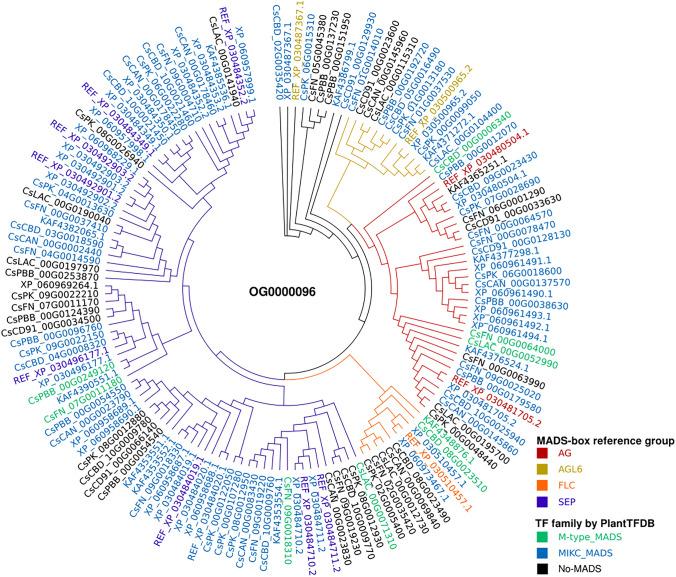
Table 3: Number of MADS-box* and non-MADS** genes in each reference clade of each OG
| OG | MADS ref. clade | Ref. | CBDRx-18 | Cannatonic | Chemdog91 | Finola | JL_Mother_Y | LA Confidential | Pineapple BBK | Purple Kush | Pink Pepper | Total | |||||||||
|---|---|---|---|---|---|---|---|---|---|---|---|---|---|---|---|---|---|---|---|---|---|
| MADS | MADS | Non-MADS | MADS | Non-MADS | MADS | Non-MADS | MADS | Non-MADS | MADS | Non-MADS | MADS | Non-MADS | MADS | Non-MADS | MADS | Non-MADS | MADS | Non-MADS | |||
| OG0000033 | AP3 | 1 | 1 | 1 | 1 | 1 | 1 | 1 | 1 | 8 | |||||||||||
| OG0000096 | AG | 2 | 3 | 2 | 1 | 1 | 4 | 2 | 2 | 1 | 1 | 1 | 3 | 2 | 1 | 7 | 33 | ||||
| OG0000096 | AGL6 | 2 | 1 | 1 | 1 | 2 | 1 | 1 | 1 | 1 | 2 | 1 | 14 | ||||||||
| OG0000096 | FLC | 1 | 1 | 1 | 1 | 1 | 1 | 1 | 1 | 2 | 10 | ||||||||||
| OG0000096 | SEP | 9 | 5 | 2 | 5 | 1 | 2 | 7 | 2 | 6 | 1 | 3 | 3 | 3 | 6 | 4 | 19 | 1 | 79 | ||
| OG0000207 | AGL17 | 9 | 1 | 4 | 1 | 2 | 2 | 6 | 1 | 5 | 4 | 1 | 2 | 3 | 3 | 1 | 7 | 13 | 4 | 69 | |
| OG0000366 | Mg | 4 | 5 | 5 | 3 | 9 | 3 | 5 | 1 | 2 | 6 | 6 | 49 | ||||||||
| OG0000433 | TM3 | 3 | 3 | 1 | 1 | 1 | 1 | 1 | 2 | 2 | 1 | 3 | 1 | 1 | 3 | 10 | 34 | ||||
| OG0000433 | FLC-like | 1 | 2 | 1 | 2 | 2 | 1 | 1 | 10 | ||||||||||||
| OG0000580 | Ma | 2 | 2 | 2 | 1 | 2 | 1 | 4 | 2 | 3 | 2 | 2 | 1 | 2 | 2 | 3 | 3 | 5 | 39 | ||
| OG0000736 | Mb | 1 | 1 | 1 | 1 | 1 | 1 | 1 | 1 | 8 | |||||||||||
| OG0000955 | SVP | 4 | 2 | 1 | 1 | 1 | 1 | 3 | 3 | 2 | 3 | 3 | 6 | 30 | |||||||
| OG0001105 | MIKCS | 3 | 1 | 1 | 1 | 2 | 1 | 4 | 3 | 1 | 1 | 1 | 1 | 3 | 1 | 24 | |||||
| OG0001107 | Mb | 2 | 3 | 5 | |||||||||||||||||
| OG0001251 | SQUA | 3 | 2 | 1 | 1 | 1 | 4 | 3 | 2 | 3 | 3 | 4 | 27 | ||||||||
| OG0001495 | MIKCS | 2 | 1 | 1 | 1 | 2 | 2 | 1 | 1 | 8 | 19 | ||||||||||
| OG0001697 | Ma | 3 | 2 | 2 | 3 | 1 | 1 | 4 | 3 | 19 | |||||||||||
| OG0001926 | Mb | 3 | 3 | 3 | 1 | 1 | 3 | 2 | 2 | 3 | 21 | ||||||||||
| OG0001966 | Mg | 1 | 2 | 1 | 1 | 5 | 2 | 1 | 1 | 2 | 16 | ||||||||||
| OG0002119 | Ma | 2 | 1 | 2 | 2 | 3 | 1 | 1 | 1 | 5 | 18 | ||||||||||
| OG0002194 | Bsister | 3 | 1 | 1 | 1 | 2 | 1 | 1 | 1 | 2 | 3 | 16 | |||||||||
| OG0002853 | Ma | 2 | 1 | 2 | 1 | 1 | 1 | 1 | 4 | 13 | |||||||||||
| OG0003904 | Ma | 1 | 1 | 1 | 3 | ||||||||||||||||
| OG0005875 | PI/GLO | 1 | 1 | 1 | 1 | 1 | 2 | 7 | |||||||||||||
| OG0006023 | AGL12 | 1 | 1 | 1 | 1 | 2 | 1 | 1 | 1 | 1 | 1 | 11 | |||||||||
| OG0007459 | AGL15 | 1 | 1 | 1 | 2 | 5 | |||||||||||||||
| OG0008462 | Mg | 1 | 1 | 2 | |||||||||||||||||
| Total | 68 | 44 | 9 | 29 | 11 | 17 | 12 | 59 | 13 | 46 | 14 | 24 | 20 | 27 | 12 | 49 | 17 | 112 | 6 | 589 | |
*MADS-box genes predicted by PlantTFDB
** Genes belonging to MADS-box orthogroups that have lost the MADS-box domains
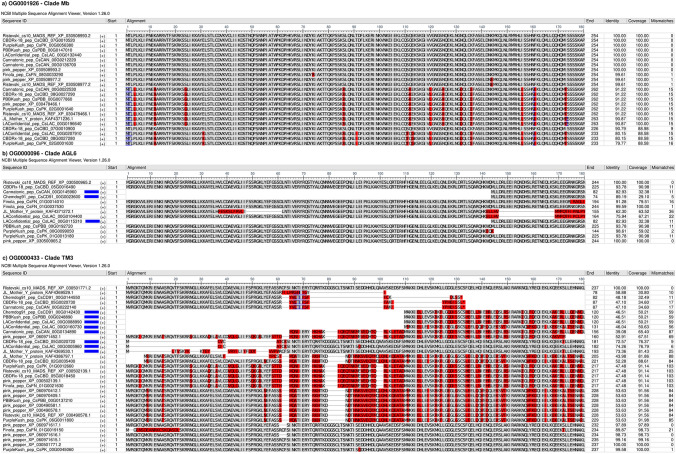
Some OGs also included genes that were not predicted as MADS-box or as members of any TF family by the PlantTFDB pipeline (Table 3). To understand why these genes appeared in MADS-box clades, we examined their multiple sequence alignments (MSA) and found that, although they showed partial alignment with MADS-box genes, they lost the conserved N-terminal MADS-box domain (Figs. 2 and S1–S17). This domain is essential for the canonical function of the MADS-box TFs and its absence explains why the homologs that lost them were not recognized by PlantTFDB. Finally, we used CannAtlas to assess expression patterns of the identified cannabis MADS-box TFs in male and FF (Figure 3).
The variation in the number of MADS-box genes observed across cultivars within the identified orthogroup clades (Tables 2 and 3) represents a technical consequence of our phylogenomic pipeline—driven by PlantTFDB prediction and OrthoFinder orthology inference—rather than authentic evolutionary divergence. As detailed in Supplementary Table S8, the genomes analyzed in this study differ substantially in assembly contiguity and predicted proteome size, directly shifting the baseline for gene discovery. High-quality assemblies such as Pink Pepper (scaffold N50: 77 Mb; 39,959 proteins) and CBDrx18 (scaffold N50: 91.9 Mb; 33,371 proteins) contrast sharply with more fragmented assemblies such as Chemdog91 (scaffold N50: 2.3 kb; 16,538 proteins) and LA Confidential (scaffold N50: 2.6 kb; 24,494 proteins), despite the latter having high sequencing coverage (300x and 50x, respectively). Importantly, the “chromosome-level” classification can be misleading for Purple Kush (scaffold N50: 133.9 kb; 12,836 contigs) and Finola (scaffold N50: 370.5 kb; 5,303 contigs), which, despite their assembly-level designation, exhibit contiguity metrics more typical of contig- or scaffold-level assemblies. In highly fragmented assemblies, gene predictions within specific orthogroups are frequently truncated or missed, particularly for gene families prone to tandem duplication such as SEP, thereby reducing the number of genes recoverable by homology-based and phylogenetic approaches. The apparent absence of conserved clades such as AP3 in some cultivars is therefore more likely an artifact of annotation incompleteness than a true biological absence. Therefore, resolving these genomic discrepancies is important to establish a reliable and stable basis for the ABCDE model of Cannabis. By demonstrating that these central regulators of floral identity are evolutionarily conserved across varieties, despite prominent assembly artifacts, we provide the community with a reliable and validated catalog of target genes. This report can prevent future functional studies and molecular breeding programs from misinterpreting technical annotation gaps as genuine losses of lineage-specific genes, ensuring that efforts to optimize sexual expression and agronomic traits of the species are anchored in a robust evolutionary orthology.
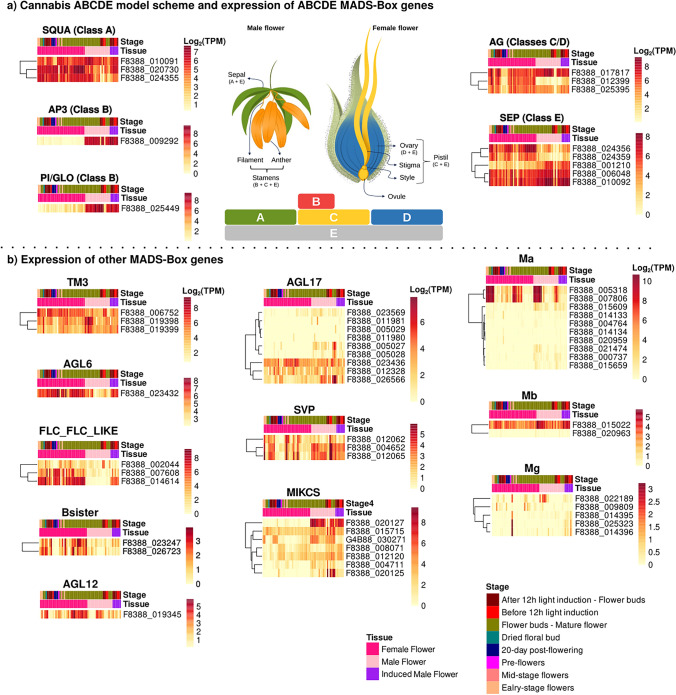
We identified 60 MADS-box TFs in CannAtlas, representing all clades described by Ristevski (ref. 2023), except for AGL15 (Figure 3). Genes from the AGL6, FLC-like, and Bsister clades, as well as SEP genes F8388_024356 and F8388_024359, and the AG gene F8388_012399, showed high expression in FF (Figure 3). In contrast, all genes from the AP3, PI/GLO, SVP, and MIKCS clades, along with the SEP gene F8388_001210, are predominantly expressed in MF (Figure 3). The remaining AG and SEP genes, as well as representatives from other MADS-box clades, exhibit relatively balanced expression between MF and FF (Figure 3). The differential expression of SEP homologues between male and female flowers is also reported by Garcia-de Heer et al. (ref. 2025), who identified six SEP homologues in cannabis with distinct sex-biased expression patterns and proposed potential subfunctionalization of the SEP subfamily in sex determination. Experimental support for a role of SEP genes in C. sativa floral development comes from Adal et al. (ref. 2025), who showed that overexpression of csSEP1 accelerates flowering in Arabidopsis thaliana, suggesting that at least some cannabis SEP genes retain ancestral regulatory functions, even as others may have undergone subfunctionalization toward sex-specific roles as proposed by Garcia-de Heer et al. (ref. 2025). Our orthology-based analysis across nine C. sativa genomes complements these findings by placing the differentially expressed SEP genes within conserved orthogroups, offering a comparative genomic perspective on their evolutionary relationships and functional diversification.
According to the ABCDE model of floral organ identity (F. Chen et al. ref. 2017; Dreni & Kater ref. 2014; H. Liu et al. ref. 2021a, ref. b), the major classes of MADS-box genes are defined as follows:
- Class A: SQUAMOSA (SQUA)/APETALA1 (AP1);
- Class B: APETALA3 (AP3) and PISTILLATA (PI/GLO);
- Class C: AGAMOUS (AG);
- Class D: SHATTERPROOF (SHP) and SEEDSTICK (STK), (from AG subfamily);
- Class E: SEPALLATA (SEP).
In addition to these core classes, other MADS-box genes such as AGL6, FLC, FLC‑like, AGL17, TM3, SVP, MIKCS, AGL12, Bsister, and AGL15 are also implicated in flowering processes (H. Liu et al. ref. 2021a, ref. b; Ristevski ref. 2023; Shah et al. ref. 2022).
The ABCDE model suggests that the male reproductive organ—the stamen (anther and filament)—is specified by the combined action of class B, C, and E genes (Figure 3) (Gioppato & Dornelas ref. 2019). Based on the expression patterns observed here (Figure 3), we propose that the class B genes AP3 (F8388_009292) and PI/GLO (F8388_025449), the class C/D AG (F8388_017817), and class E SEP (F8388_001210) are strong candidates for regulators of MF identity in C. sativa. This is consistent with Garcia-de Heer et al. (ref. 2025), who reported preferential expression of AP3 and PI homologues in male flowers and their downregulation following ethephon-induced feminization, suggesting a direct role of class B genes in specifying unisexual floral identity in cannabis. While their study focused on a single chemotype under ethephon treatment, our analysis integrates 117 RNA-Seq samples across multiple chemotypes and genotypes, providing a broader transcriptomic context that corroborates and extends these findings. Additionally, the MIKCS genes—particularly F8388_020127—also show higher expression in MF, suggesting a possible role in MF development (Figure 3). Although MIKCS genes have been previously linked to pollen development (Gramzow & Theissen ref. 2010), their roles in broader aspects of floral morphogenesis remain poorly understood.
MADS-box genes from classes C, D, E, and Bsister are known to be involved in the development of female reproductive organs such as the ovary, style, and stigma (Figure 3) (de Folter et al. ref. 2006; Gioppato & Dornelas ref. 2019). Our data support that the C/D gene AG (F8388_012399), the E genes SEP (F8388_024356 and F8388_024359), and Bsister genes (F8388_023247 and F8388_026723) are likely regulators of FF identity in cannabis (Figure 3). In addition, AGL6 (F8388_023432) and FLC-like (F8388_007608 and F8388_014614) genes also exhibit higher expression in FF, further suggesting their involvement in FF development (Figure 3).
Although experimental validation is required to confirm the functional roles of these candidate genes, our integrative analysis using publicly available transcriptomic data provides a valuable foundation for prioritizing MADS-box TFs involved in sex-specific floral development in C. sativa.
Identification and expression patterns of candidate genes involved in pollen development
To investigate genes beyond the canonical MADS‐box regulators involved in MF development in C. sativa, we conducted BLAST searches against CannAtlas using three reference gene sets. First, from the 62 sugar metabolism‐related genes reported in maize by Liu et al. (ref. 2021a, ref. b), we identified 35 homologs in CannAtlas, of which 8 displayed preferential expression in both genetic MF and IMF (Figure 4, Table S4). Second, among the 61 candidate genes proposed by Adal et al. (ref. 2021) as associated with masculinization in cannabis, 37 homologs were detected in CannAtlas, with 9 showing preferential expression in MF and IMF (Figure 4, Table S4). Third, from the 185 reference genes implicated in male sterility in Chinese cabbage by Huang et al. (ref. 2020), we identified 42 homologs in CannAtlas, of which 19 exhibited preferential expression in MF and IMF (Figure 4, Table S4).
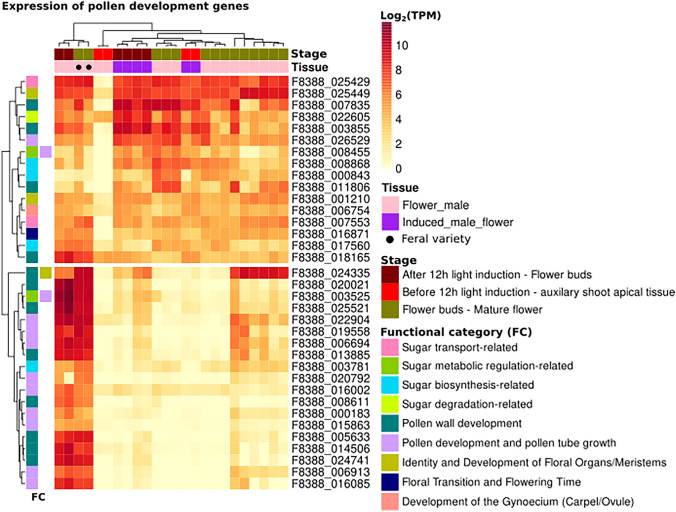
Huang et al. (ref. 2020) grouped their gene set into four functional categories: pollen development and tube growth, pollen wall development, phytohormone regulation, and TFs. Similarly, Adal et al. (ref. 2021) classified their candidates by specific functions in flower development. Building on these frameworks, we assigned the 35 CannAtlas genes identified in our analysis to 9 functional categories (FC) related to flower and pollen development (Figure 4, Table S5).
Notably, nearly all genes under “pollen development and pollen tube growth”, together with approximately two-thirds of those in “pollen wall development”, exhibit high expression in MF samples collected after 12 hours of light induction—coinciding with the onset of floral development. A similar expression pattern was also observed in MF samples from two feral varieties (SAMN20863695 and SAMN20863694). In contrast, 16 genes across multiple categories show comparable expression levels in both MF and IMF, with most showing little to no expression in MF samples collected before the 12 h light induction mark (i.e., at the axillary shoot apical meristem stage). This expression pattern suggests the existence of a light‐triggered developmental switch that initiates a coordinated gene expression program essential for MF development, including genes involved in pollen formation.
Among the 16 genes expressed similarly in MF and IMF were four MADS-box TFs. Two of these—F8388_001210 (class E, SEP) and F8388_025449 (class B, PI/GLO)—are canonical ABCDE model genes that govern floral organ identity and are essential for stamen specification. The other two—F8388_006754 and F8388_016871—are non-ABCDE MADS-box genes. F8388_006754, a putative AGL6-like gene (58.98% similarity to OsMADS6 (Table S4)), has been associated with gynoecium development (Table S5), while F8388_016871, a putative AGL15-like gene (56.45% similarity to AGL15_ARATH (Table S4)), has been implicated in floral transition and regulation of flowering time (Table S5). Interestingly, although AGL6-like (F8388_006754) is typically linked to female organ formation, its expression in MF suggests it may play a repressive role in this context. A similar mechanism has been described in Silene latifolia, where Hardenack et al. (1994) and Bačovský et al. (ref. 2022) showed that altered expression of MADS-box genes, including class B genes PISTILATA and APETALA3, correlates with repression of gynoecium development in MF. Likewise, Di Stilio et al. (ref. 2005) proposed that in dioecious species, sex determination may involve modulation of floral homeotic gene activity, particularly through the downregulation of female organ identity programs during male flower development. Taken together, these findings support the hypothesis that AGL6-like (F8388_006754) contributes to repressing gynoecium formation in male C. sativa flowers, thereby facilitating proper stamen development.
Among the 9 sugar-related genes identified, seven displayed similar expression levels in both MF and IMF, suggesting a conserved role in pollen development across genetic and chemically induced contexts. Two of these genes encode sugar transporters from the SWEET family (F8388_007553 and F8388_025429). Along this, other two transporters classified with mixed expression at CannAtlas also had considerable expression in male flowers: a sucrose/H⁺ symporter (F8388_000867), and a UDP-galactose/UDP-glucose transporter (F8388_001017) (Table S4). These transporters likely help sustain the high-energy demands for pollen development and pollen tube elongation. In Arabidopsis, disruption of sucrose transport impairs pollen germination and shortens pollen tubes, underscoring the critical role of sugar supply in reproductive success (De Angeli ref. 2022; Reinders ref. 2016). In addition, two genes associated with sugar metabolism regulation—a putative L-ascorbate oxidase (F8388_003525) and a MYB TF (F8388_008455)—may contribute to modulating redox balance and secondary metabolism during pollen development, processes that influence osmotic regulation and energy availability, both essential for pollen tube growth (Li et al. ref. 2020). We also identified two hexosyltransferases (F8388_000843 and F8388_008868) and a 1,3-β-glucan synthase (F8388_017560) involved in sugar biosynthesis. Hexosyltransferases catalyze the transfer of hexoses to elongating polysaccharide chains, contributing to the formation of cell wall components such as hemicelluloses and pectins (Li et al. ref. 2020). Meanwhile, 1,3-β-glucan synthases drive callose production, a structural component of the pollen wall that reinforces integrity during maturation (Nishikawa et al. ref. 2005). Collectively, these genes likely coordinate dynamic remodeling of the pollen cell wall through the regulated synthesis and deposition of carbohydrate polymers, ensuring structural stability and functionality in both MF and IMF.
Five genes related to pollen wall development also showed comparable expression levels in both MF and IMF, supporting a shared molecular program for pollen wall formation across both flower types. These include a cytochrome P450 (F8388_003855), a NAD-dependent epimerase/dehydratase (F8388_007835), a chalcone synthase (F8388_011806), a beta-galactosidase (F8388_024335), and a pectinesterase (F8388_018165). These enzymes act in the biosynthesis and remodeling of the structurally complex pollen wall layers. Cytochrome P450 enzymes contribute to anther cuticle development and sporopollenin biosynthesis, both essential for the outer exine layer (Ma et al. ref. 2022; Yang et al. ref. 2014). NAD-dependent epimerases/dehydratases facilitate sugar residue modification for polysaccharide biosynthesis (Usadel et al. ref. 2004). Chalcone synthase catalyzes the first committed step in flavonoid biosynthesis, critical for pollen viability and wall integrity (Buer et al. ref. 2010). Beta-galactosidases participate in cell wall remodeling by cleaving galactose-containing polysaccharides, enabling proper wall expansion and maturation (Ban et al. ref. 2020). Pectinesterases modulate pectin methylesterification, thereby adjusting wall porosity, rigidity, and elasticity (Cankar et al. ref. 2014). Additionally, some genes appear to contribute to both pollen development and pollen tube growth, such as a short-chain dehydrogenase/reductase (SDR, F8388_026529) and the previously mentioned MYB TF (F8388_008455), highlight the coordinated regulation of wall biosynthesis and signaling pathways required for male gametophyte function.
Upstream cannabinoid and terpenoid pathway genes show parallel expression in hemp and marijuana
The FF of C. sativa have historically been the most utilized part of the plant due to their psychotropic and medicinal properties. In plant physiology, secondary metabolite production is commonly associated with defense responses against biotic and abiotic stresses. In cannabis, this defensive role is largely mediated by glandular trichomes—specialized epidermal structures on FF that synthesize and store a wide array of secondary metabolites, including cannabinoids and terpenoids.
To gain deeper insight into the functional roles of trichome-specific genes identified in CannAtlas (Barbosa-Xavier et al. ref. 2024), we performed enrichment analyses for Gene Ontology (GO), metabolic pathway (KEGG), and TF families. The enriched GO and KEGG terms strongly point to the biosynthesis, modification, and storage of secondary metabolites (Figure 5).
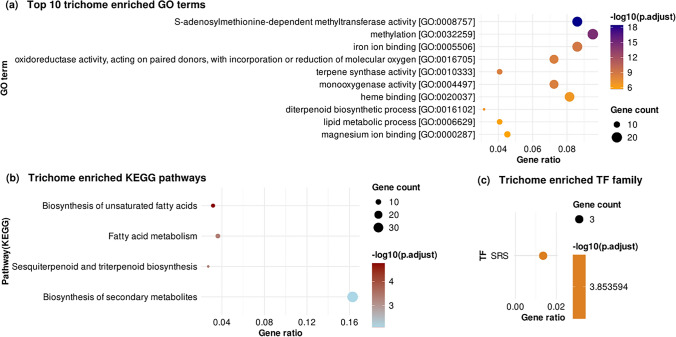
Among the enriched GO terms (Figure 5a), S-adenosylmethionine-dependent methyltransferase activity and methylation are particularly relevant, reflecting the role of methylation in enhancing the bioactivity, chemical stability, and defense potential of secondary metabolites such as cannabinoids and terpenoids (C. Zhang et al. ref. 2021). Additional enrichment in ion binding, heme binding, and monooxygenase activity (Figure 5a) highlights the contribution of cytochrome P450 enzymes, which participate in the structural diversification of secondary metabolites and modulate their chemical properties (Layer et al. ref. 2010). The enrichment of oxidoreductase activity (Figure 5a) underscores the oxidative processes necessary for synthesizing bioactive compounds. Terpene synthase activity (Figure 5a) was also significantly enriched, consistent with the role of volatile terpenes in repelling herbivores and inhibiting microbial pathogens (MacWilliams et al. ref. 2023). GO terms related to the diterpenoid biosynthesis and lipid metabolism (Figure 5a) support the production of cannabinoids and their fatty acid precursors.
KEGG enrichment analysis (Figure 5b) corroborated these patterns. Enrichment of unsaturated fatty acid biosynthesis and fatty acid metabolism point to the generation of precursors for signaling molecules like jasmonic acid, a key hormone in plant defense (Luo et al. ref. 2019; Marks et al. ref. 2009). The enrichment of sesquiterpenoid and triterpenoid biosynthesis highlights the trichome role in producing antimicrobial and insect-repellent compounds, while the broad enrichment of secondary metabolite biosynthesis emphasizes the specialized metabolic capacity of trichomes.
TF enrichment (Figure 5c) revealed the SRS (SHI-related sequence) family as significantly overrepresented. This TF family regulates both trichome development and secondary metabolism (J. Zhang et al. ref. 2020), suggesting that SRS TFs coordinate structural and chemical components of the cannabis defense system. Taken together, these results highlight cannabis glandular trichomes as hubs of defensive metabolism, integrating gene regulation, specialized metabolite biosynthesis, and adaptive responses to environmental challenges.
Cannabinoids and terpenes are the most extensively investigated compounds in C. sativa for their medicinal or recreational importance. A detailed understanding of their metabolic pathways is essential for strategies aimed at manipulating metabolite content in cannabis plants. To identify key genes involved in these pathways, we performed BLAST searches in CannAtlas using proteins previously characterized in cannabinoid and terpenoid biosynthesis (Kovalchuk et al. ref. 2020), including those from upstream pathways such as polyketide, methylerythritol (MEP), and mevalonate (MEV) (Kovalchuk et al. ref. 2020). This search identified 42 genes (Table S6). Given that these secondary metabolites are synthesized and stored in glandular trichomes of FF, we assessed their expression in flower and trichome samples (Figure 6).
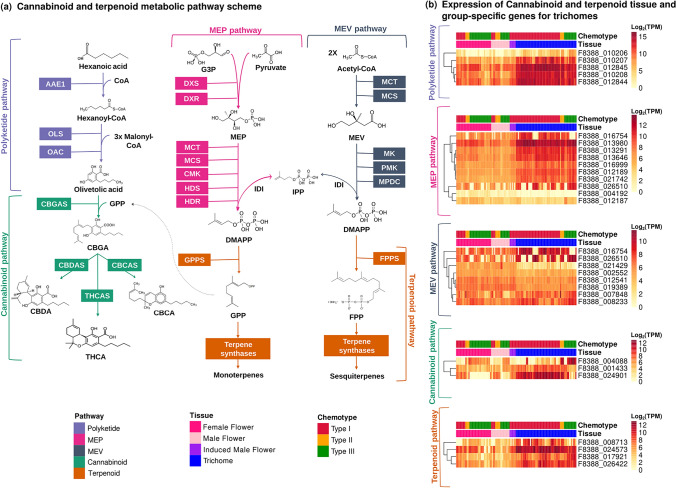
The polyketide pathway, which produces olivetolic acid, involves three core enzymes: Acyl-Activating Enzymes (AAEs), Olivetol Synthase (OLS), and Olivetolic Acid Cyclase (OAC), with OLS and OAC being directly implicated in cannabinoid biosynthesis (Thomas et al. ref. 2020). We identified 13 polyketide-related genes (Table S6), including six AAEs classified as “expressed-in-all” and two as “mixed” in CannAtlas. Two OLS genes (F8388_010207, F8388_010208) and two OAC genes (F8388_012844, F8388_012845) showed trichome-specific expression, while another OLS gene (F8388_010206) was enriched in trichomes and IMF (Table S7). Of the eight MEP pathway genes identified (Table S6), four were expressed in all samples, two showed trichome-specific expression—including HDS (F8388_013291) and HDR (F8388_013980)—and one was leaf-specific (Table S7). All six MEV pathway genes were classified as “expressed-in-all”. Notably, isopentenyl-diphosphate delta-isomerase (IDI), which interconverts the MEP- and MEV-derived IPP and DMAPP to form the isoprenoid backbone (Krause et al. ref. 2023), was represented by two genes, one of which (F8388_016754) was trichome-specific. Together, these results indicate that genes from the polyketide and MEP pathways are preferentially expressed in trichomes. Importantly, no consistent expression differences were observed between hemp and marijuana varieties, nor between MF and FF, suggesting conservation of upstream cannabinoid biosynthetic pathways across chemotypes and sexual morphs.
We identified five genes directly involved in the cannabinoid biosynthetic pathway: three prenyltransferases (F8388_001433, F8388_008405, and F8388_013365), one Cannabidiolic Acid Synthase (CBDAS, F8388_004088), and one Tetrahydrocannabinolic Acid Synthase (THCAS, F8388_024901) (Table S6). Of these, THCAS and the prenyltransferase F8388_001433 were trichome-specific; CBDAS is group-enriched in FF and stems; the prenyltransferase F8388_008405 is mixed; and F8388_013365 is expressed-in-all tissues (Table S7). The classification of CBDAS as group-enriched in FF and stems, rather than trichome-specific, likely reflects both chemotype distribution and the methodology used by Barbosa-Xavier et al. (ref. 2024), which relies on median expression across samples. Approximately 70% of the trichome samples in the dataset originated from type I chemotypes, which typically show low CBDAS expression, potentially underestimating its trichome specificity. A similar bias could have occurred for THCAS had the dataset been skewed toward type III chemotypes. These observations highlight how sample composition and classification thresholds can affect the apparent tissue specificity of cannabinoid biosynthesis genes.
Cannabigerolic acid (CBGA), the central precursor of cannabinoids, is synthesized via alkylation of OAC and GPP, a reaction catalyzed by a CsPT1 aromatic prenyltransferase (CBGAS) (Innes & Vergara ref. 2023). The gene F8388_001433 shows high sequence identity to several prenyltransferases (Table S6), including CsPT7 (98.4%), CsPT1 (83.9%), and CsPT4 (78.7%). CsPT4 and CsPT7 are closely related to CsPT1, and CsPT4 has also been shown to catalyze CBGA formation in vivo (Luo et al. ref. 2019; Rea et al. ref. 2019). These similarities strongly suggest that F8388_001433 functions as an aromatic prenyltransferase involved in CBGA biosynthesis. Expression data support this functional assignment: THCAS, CBDAS, and CBGAS (F8388_001433) were more highly expressed in trichomes than in whole flowers (Figure 6b). Moreover, THCAS and CBGAS were preferentially expressed in type I and II chemotypes, while CBDAS was more highly expressed in type II and III chemotypes (Figure 6b), consistent with their roles in defining cannabinoid profiles.
Unexpected expression patterns were detected in certain type III hemp samples. Trichome samples SAMN09747685, SAMN09747688, and SAMN09747691, labeled as type III hemp (Finola strain) (Livingston et al. ref. 2020), displayed type II-like expression profiles (Figure 6b). These samples are biological replicates from BioProject PRJNA483805, which otherwise shows consistent type III expression. We hypothesize that these samples may have been inadvertently contaminated with trichomes from type I varieties, such as Purple Kush or Hindu Kush, which were analyzed alongside Finola by Livingston et al. (ref. 2020) using two-photon microscopy and disc cell counting analysis. A second discrepancy was observed in the samples SAMN42101035, SAMN42101034, and SAMN42101033 from the MW6-15 cultivar (BioProject PRJNA1128734). Although described by Welling et al. (ref. 2023) as an industrial hemp line (type III), these samples displayed a type I expression profile, characterized by high THCAS expression and complete absence of CBDAS (Figure 6b). Such inconsistencies may reflect sample mislabeling, cross-contamination, or previously unrecognized chemotypic diversity, and warrant further validation.
Regarding terpenoid biosynthesis, we identified eight candidate genes (Table S6): three with root-specific expression, three with trichome-specific, one group-enriched in trichomes and IMF, and one with low expression (Table S7). Trichome-specific terpene synthases genes (F8388_008713, F8388_024573, F8388_026422) and the group-enriched gene (F8388_017921) all exhibited markedly higher expression in trichomes compared to whole-flower samples (Figure 6). Importantly, their expression showed no clear bias toward specific chemotypes. This pattern suggests that terpenoid biosynthesis is broadly active across both hemp and marijuana varieties, likely independent of cannabinoid chemotype-defining genes.
Overall, despite chemotypic differences between hemp and marijuana, genes in the upstream cannabinoid and terpenoid pathways show similar expression profiles (Figure 6), highlighting conserved mechanisms of defense specialization in C. sativa.
Conclusion
This study advances our understanding of C. sativa flower development by identifying OGs of MADS-box genes and analyzing their expression in MF and FF. Our results point to the involvement of specific MADS-box genes in flower organ development and sex differentiation. In parallel, sugar metabolism-related genes were linked to fertility and pollen wall formation, underscoring key metabolic processes in male reproductive structures. Expression profiling of cannabinoid and terpenoid biosynthetic genes further confirmed their strong tissue specificity, particularly in trichomes, emphasizing the finely tuned regulation of secondary metabolite production. Collectively, these findings establish a molecular framework for future functional studies and identify promising targets for metabolic engineering and breeding strategies aimed at optimizing flower traits and bioactive compound profiles in cannabis.
Supplementary Materials
References
- AM Adal, K Doshi, L Holbrook, SS Mahmoud. Comparative RNA-Seq analysis reveals genes associated with masculinization in female Cannabis sativa. Planta, 2021. [DOI | PubMed]
- AM Adal, R Sajaditabar, T Nguyen, SS Mahmoud. Differential gene expression analysis reveals transcription factors that control flower initiation and development in Cannabis sativa. Biocatal Agric Biotechnol, 2025. [DOI]
- SF Altschul, TL Madden, AA Schäffer, J Zhang, Z Zhang, W Miller, DJ Lipman. Gapped BLAST and PSI-BLAST: a new generation of protein database search programs. Nucleic Acids Res, 1997. [DOI | PubMed]
- A De Angeli. Pollen likes sugars: sucrose-specific transport by AtSWEET13. Proc Natl Acad Sci U S A, 2022. [DOI | PubMed]
- V Bačovský, R Čegan, E Tihlaříková, V Neděla, V Hudzieczek, L Smrža, T Janíček, V Beneš, R Hobza. Chemical genetics in Silene latifolia elucidate regulatory pathways involved in gynoecium development. J Exp Bot, 2022. [DOI | PubMed]
- H van Bakel, JM Stout, AG Cote, CM Tallon, AG Sharpe, TR Hughes, JE Page. The draft genome and transcriptome of Cannabis sativa. Genome Biol, 2011. [DOI | PubMed]
- Q Ban, J Jiao, Y He, M Jin, J Rao. Ectopic expression of the persimmon β-galactosidase gene DkGAL2 promotes leaf growth, delays dark-induced senescence and enhances tolerance to abiotic stress in Arabidopsis. Sci Hortic, 2020. [DOI]
- K Barbosa-Xavier, F Pedrosa-Silva, F Almeida-Silva, TM Venancio. Cannabis expression atlas: a comprehensive resource for integrative analysis of Cannabis sativa L. gene expression. Physiol Plant, 2024. [DOI | PubMed]
- CS Buer, N Imin, MA Djordjevic. Flavonoids: new roles for old molecules. J Integr Plant Biol, 2010. [DOI | PubMed]
- K Cankar, A Kortstee, MAJ Toonen, M Wolters-Arts, R Houbein, C Mariani, P Ulvskov, B Jorgensen, HA Schols, RGF Visser, LM Trindade. Pectic arabinan side chains are essential for pollen cell wall integrity during pollen development. Plant Biotechnol J, 2014. [DOI | PubMed]
- F Chen, X Zhang, X Liu, L Zhang. Evolutionary Analysis of MIKCc-Type MADS-Box Genes in Gymnosperms and Angiosperms. Front Plant Sci, 2017. [DOI | PubMed]
- Y-T Chen, C-C Chang, C-W Chen, K-C Chen, Y-W Chu. MADS-Box Gene Classification in Angiosperms by Clustering and Machine Learning Approaches. Front Genet, 2019. [DOI | PubMed]
- ES Coen, EM Meyerowitz. The war of the whorls: genetic interactions controlling flower development. Nature, 1991. [DOI | PubMed]
- L Dreni, MM Kater. MADS reloaded: evolution of the AGAMOUS subfamily genes. New Phytol, 2014. [DOI | PubMed]
- MA ElSohly, D Slade. Chemical constituents of marijuana: the complex mixture of natural cannabinoids. Life Sci, 2005. [DOI | PubMed]
- DM Emms, S Kelly. OrthoFinder: phylogenetic orthology inference for comparative genomics. Genome Biol, 2019. [DOI | PubMed]
- SG Ferber, D Namdar, D Hen-Shoval, G Eger, H Koltai, G Shoval, L Shbiro, A Weller. The “entourage effect”: terpenes coupled with cannabinoids for the treatment of mood disorders and anxiety disorders. Curr Neuropharmacol, 2020. [DOI | PubMed]
- S de Folter, AV Shchennikova, J Franken, M Busscher, R Baskar, U Grossniklaus, GC Angenent, RGH Immink. A Bsister MADS-box gene involved in ovule and seed development in Petunia and Arabidopsis. Plant J, 2006. [DOI | PubMed]
- L Garcia-de Heer, Q Guo, J Mieog, M Nolan, L Liu, N Dimopoulos, R Melzer, T Kretzschmar. Transcriptomic analysis of ethephon-induced sex reversion of male Cannabis sativa reveals changes in expression of floral homeotic genes and a distinct trichome morphology. J Exp Bot, 2025. [DOI | PubMed]
- HA Gioppato, MC Dornelas. When Bs are better than As: the relationship between B-class MADS-box gene duplications and the diversification of perianth morphology. Trop Plant Biol, 2019. [DOI]
- L Gramzow, G Theissen. A hitchhiker’s guide to the MADS world of plants. Genome Biol, 2010. [DOI | PubMed]
- CJ Grassa, JP Wenger, C Dabney, SG Poplawski, ST Motley, TP Michael, CJ Schwartz, GD Weiblen. A complete Cannabis chromosome assembly and adaptive admixture for elevated cannabidiol (CBD) content. bioRxiv, 2018. [DOI]
- CJ Grassa, GD Weiblen, JP Wenger, C Dabney, SG Poplawski, S Timothy Motley, TP Michael, CJ Schwartz. A new cannabis genome assembly associates elevated cannabidiol (CBD) with hemp introgressed into marijuana. New Phytol, 2021. [DOI | PubMed]
- T Gülck, BL Møller. Phytocannabinoids: origins and biosynthesis. Trends Plant Sci, 2020. [DOI | PubMed]
- LO Hanuš, Y Hod. Terpenes/terpenoids in cannabis: are they important?. Med Cannabis Cannabinoids, 2020. [DOI | PubMed]
- S Huang, S Peng, Z Liu, C Li, C Tan, R Yao, D Li, X Li, L Hou, H Feng. Investigation of the genes associated with a male sterility mutant (msm) in Chinese cabbage (Brassica campestris ssp. Pekinensis) using RNA-Seq. Mol Genet Genomics, 2020. [DOI | PubMed]
- PA Innes, D Vergara. Genomic description of critical cannabinoid biosynthesis genes. Botany, 2023. [DOI]
- K Katoh, DM Standley. MAFFT multiple sequence alignment software version 7: improvements in performance and usability. Mol Biol Evol, 2013. [DOI | PubMed]
- I Kovalchuk, M Pellino, P Rigault, R van Velzen, J Ebersbach, JR Ashnest, M Mau, ME Schranz, J Alcorn, RB Laprairie, JK McKay, C Burbridge, D Schneider, D Vergara, NC Kane, TF Sharbel. The genomics of cannabis and its close relatives. Annu Rev Plant Biol, 2020. [DOI | PubMed]
- T Krause, P Wiesinger, D González-Cabanelas, N Lackus, TG Köllner, T Klüpfel, J Williams, J Rohwer, J Gershenzon, A Schmidt. HDR, the last enzyme in the MEP pathway, differently regulates isoprenoid biosynthesis in two woody plants. Plant Physiol, 2023. [DOI | PubMed]
- KU Laverty, JM Stout, MJ Sullivan, H Shah, N Gill, L Holbrook, G Deikus, R Sebra, TR Hughes, JE Page, H van Bakel. A physical and genetic map of Cannabis sativa identifies extensive rearrangements at the THC/CBD acid synthase loci. Genome Res, 2019. [DOI | PubMed]
- G Layer, J Reichelt, D Jahn, DW Heinz. Structure and function of enzymes in heme biosynthesis. Protein Sci, 2010. [DOI | PubMed]
- ZJ Leinen, R Mohan, LS Premadasa, A Acharya, M Mohan, SN Byrareddy. Therapeutic potential of cannabis: a comprehensive review of current and future applications. Biomedicines, 2023. [DOI | PubMed]
- C Li, D Meng, MA Piñeros, Y Mao, AM Dandekar, L Cheng. A sugar transporter takes up both hexose and sucrose for sorbitol-modulated in vitro pollen tube growth in apple[OPEN]. Plant Cell, 2020. [DOI | PubMed]
- H Liu, L Yang, Z Tu, S Zhu, C Zhang, H Li. Genome-wide identification of MIKC-type genes related to stamen and gynoecium development in Liriodendron. Sci Rep, 2021. [DOI | PubMed]
- S Liu, Z Li, S Wu, X Wan. The essential roles of sugar metabolism for pollen development and male fertility in plants. Crop J, 2021. [DOI]
- SJ Livingston, TD Quilichini, JK Booth, DCJ Wong, KH Rensing, J Laflamme-Yonkman, SD Castellarin, J Bohlmann, JE Page, AL Samuels. Cannabis glandular trichomes alter morphology and metabolite content during flower maturation. Plant J, 2020. [DOI | PubMed]
- X Luo, MA Reiter, L d’Espaux, J Wong, CM Denby, A Lechner, Y Zhang, AT Grzybowski, S Harth, W Lin, H Lee, C Yu, J Shin, K Deng, VT Benites, G Wang, EEK Baidoo, Y Chen, I Dev, CJ Petzold, JD Keasling. Complete biosynthesis of cannabinoids and their unnatural analogues in yeast. Nature, 2019. [DOI | PubMed]
- H Ma, Y Wu, R Lv, H Chi, Y Zhao, Y Li, H Liu, Y Ma, L Zhu, X Guo, J Kong, J Wu, C Xing, X Zhang, L Min. Cytochrome P450 mono-oxygenase CYP703A2 plays a central role in sporopollenin formation and ms5ms6 fertility in cotton. J Integr Plant Biol, 2022. [DOI | PubMed]
- J MacWilliams, E Peirce, WJ Pitt, M Schreiner, T Matthews, L Yao, C Broeckling, P Nachappa. Assessing the adaptive role of cannabidiol (CBD) in Cannabis sativa defense against cannabis aphids. Front Plant Sci, 2023. [DOI]
- MD Marks, L Tian, JP Wenger, SN Omburo, W Soto-Fuentes, J He, DR Gang, GD Weiblen, RA Dixon. Identification of candidate genes affecting Δ9-tetrahydrocannabinol biosynthesis in Cannabis sativa. J Exp Bot, 2009. [DOI | PubMed]
- KJ McKernan, Y Helbert, LT Kane, H Ebling, L Zhang, B Liu, Z Eaton, S McLaughlin, S Kingan, P Baybayan, G Concepcion, M Jordan, A Riva, W Barbazuk, T Harkins. Sequence and annotation of 42 cannabis genomes reveals extensive copy number variation in cannabinoid synthesis and pathogen resistance genes. bioRxiv, 2020. [DOI]
- K McKernan, Y Helbert, LT Kane, H Ebling, L Zhang, B Liu, Z Eaton, L Sun, ET Dimalanta, S Kingan, P Baybayan, M Press, W Barbazuk, T Harkins. Cryptocurrencies and Zero Mode Wave guides: An unclouded path to a more contiguous Cannabis sativa L genome assembly. OSF, 2018. [DOI]
- BQ Minh, HA Schmidt, O Chernomor, D Schrempf, MD Woodhams, A von Haeseler, R Lanfear. IQ-TREE 2: new models and efficient methods for phylogenetic inference in the genomic era. Mol Biol Evol, 2020. [DOI | PubMed]
- S Nishikawa, GM Zinkl, RJ Swanson, D Maruyama, D Preuss. Callose (β-1,3 glucan) is essential for Arabidopsispollen wall patterning, but not tube growth. BMC Plant Biol, 2005. [DOI | PubMed]
- Y Pieracci, R Ascrizzi, V Terreni, L Pistelli, G Flamini, L Bassolino, F Fulvio, M Montanari, R Paris. Essential oil of Cannabis sativa L: comparison of yield and chemical composition of 11 hemp genotypes. Molecules, 2021. [DOI | PubMed]
- KA Rea, JA Casaretto, MS Al-Abdul-Wahid, A Sukumaran, J Geddes-McAlister, SJ Rothstein, TA Akhtar. Biosynthesis of cannflavins A and B from Cannabis sativa L.. Phytochemistry, 2019. [DOI | PubMed]
- A Reinders. Fuel for the road – sugar transport and pollen tube growth. J Exp Bot, 2016. [DOI | PubMed]
- M Ren, Z Tang, X Wu, R Spengler, H Jiang, Y Yang, N Boivin. The origins of cannabis smoking: chemical residue evidence from the first millennium BCE in the Pamirs. Sci Adv, 2019. [DOI]
- S Rice, JA Koziel. Characterizing the smell of marijuana by odor impact of volatile compounds: an application of simultaneous chemical and sensory analysis. PLoS ONE, 2015. [DOI | PubMed]
- Ristevski, N. (2023). MADS Box Genes in Cannabis sativa: A Genomic and Phylogenetic Analysis. La Trobe University.
- B-R Ryu, G-J Gim, Y-R Shin, M-J Kang, M-J Kim, T-H Kwon, Y-S Lim, S-H Park, J-D Lim. Chromosome-level haploid assembly of Cannabis sativa L. cv. Pink Pepper. Sci Data, 2024. [DOI | PubMed]
- S Schilling, CA Dowling, J Shi, L Ryan, DJL Hunt, E O’Reilly, AS Perry, O Kinnane, PF McCabe, R Melzer. The cream of the crop: biology, breeding, and applications of Cannabis sativa. Annual Plant Reviews online, 2021
- L Shah, A Sohail, R Ahmad, S Cheng, L Cao, W Wu. The roles of MADS-Box genes from root growth to maturity in Arabidopsis and rice. Agronomy, 2022. [DOI]
- VS Di Stilio, EM Kramer, DA Baum. Floral MADS box genes and homeotic gender dimorphism in Thalictrum dioicum (Ranunculaceae) – a new model for the study of dioecy. Plant J, 2005. [DOI | PubMed]
- F Thomas, C Schmidt, O Kayser. Bioengineering studies and pathway modeling of the heterologous biosynthesis of tetrahydrocannabinolic acid in yeast. Appl Microbiol Biotechnol, 2020. [DOI | PubMed]
- F Tian, D-C Yang, Y-Q Meng, J Jin, G Gao. PlantRegMap: charting functional regulatory maps in plants. Nucleic Acids Res, 2020. [DOI | PubMed]
- B Usadel, U Schlüter, M Mølhøj, M Gipmans, R Verma, J Kossmann, W-D Reiter, M Pauly. Identification and characterization of a UDP-d-glucuronate 4-epimerase in Arabidopsis. FEBS Lett, 2004. [DOI | PubMed]
- M Welling, M Deseo, M O’Brien, J Clifton, A Bacic, M Doblin. Metabolomic analysis of methyl jasmonate treatment on phytocannabinoid production in Cannabis sativa. Front Plant Sci, 2023. [DOI | PubMed]
- S Yadav, N Ghimire, V Lahutiya. A comprehensive review of the production technology of Cannabis sativa L. with its current legal status and botanical features. Fundam Appl Agric, 2023. [DOI]
- X Yang, D Wu, J Shi, Y He, F Pinot, B Grausem, C Yin, L Zhu, M Chen, Z Luo, W Liang, D Zhang. Rice CYP703A3, a cytochrome P450 hydroxylase, is essential for development of anther cuticle and pollen exine. J Integr Plant Biol, 2014. [DOI | PubMed]
- C Zhang, SA Sultan, R T, X Chen. Biotechnological applications of S-adenosyl-methionine-dependent methyltransferases for natural products biosynthesis and diversification. Bioresour Bioprocess, 2021. [DOI | PubMed]
- J Zhang, J Yan, S Huang, G Pan, L Chang, J Li, C Zhang, H Tang, A Chen, D Peng, A Biswas, C Zhang, L Zhao, D Li. Genetic Diversity and Population Structure of Cannabis Based on the Genome-Wide Development of Simple Sequence Repeat Markers. Front Genet, 2020. [DOI | PubMed]
- Rambaut, A. (2012). FigTree (Version 1.4.4) [Computer software]. http://tree.bio.ed.ac.uk/software/figtree/
- Releaf. (2023, July 6). Exploring the anatomy of the cannabis flower. https://releaf.co.uk/education/cannabis-101/medical-cannabis/exploring-the-anatomy-of-the-cannabis-flower