
Harnessing Cannabis sativa as a dual-use platform for biohydrogen production and pharmaceutical synthesis: a hypothesis and theory
Abstract
Cannabis sativa, long established as a cornerstone of the pharmaceutical and industrial fiber markets, represents a radical and underexplored platform for renewable energy innovation. In this Hypothesis and Theory framework, we introduce a novel, patented (Provisional Patent No. 63916615) dual-use bio-refinery paradigm. This model harnesses engineered cannabis photosynthesis to drive green hydrogen production without compromising its established value as a high-yield medicinal crop. By strategically redirecting photosynthetic electron flow toward oxygen-protected hydrogenase activity, it is possible to generate molecular hydrogen at commercially relevant scales while maintaining plant viability. Unique to this model is the ability to leverage over $10 billion in existing controlled-environment agriculture (CEA) infrastructure, bypassing the capital-intensive barriers that have hindered traditional algal biohydrogen systems. We outline a tripartite circular economy strategy that integrates hydrogen capture during the vegetative phase with the subsequent harvest of therapeutic cannabinoids and industrial biomass. This convergence of synthetic biology, clean energy, and biomedicine positions cannabis as a uniquely versatile multipurpose crop capable of fueling both the pharmaceutical industry and the global transition to a sustainable hydrogen economy.
Article type: Research Article
Keywords: biohydrogen, circular economy, green hydrogen, photosynthesis, synthetic biology
Affiliations: Georgia Institute of Cannabis Research, Medicinal Cannabis of Georgia LLC, Augusta, GA, United States; Center for Excellence in Research, Scholarship and Innovation (CERSI), Dental College of Georgia, Augusta, Augusta University, Augusta, GA, United States
License: Copyright © 2026 Wang and Baban. CC BY 4.0 This is an open-access article distributed under the terms of the Creative Commons Attribution License (CC BY). The use, distribution or reproduction in other forums is permitted, provided the original author(s) and the copyright owner(s) are credited and that the original publication in this journal is cited, in accordance with accepted academic practice. No use, distribution or reproduction is permitted which does not comply with these terms.
Article links: DOI: 10.3389/fpls.2026.1833491 | PMC: PMC13230014
Relevance: Moderate: mentioned 3+ times in text
Full text: PDF (1.1 MB)
Introduction
The global transition toward a net-zero carbon economy necessitates the development of scalable, carbon-negative energy sources (ref. Ali et al., 2024). While hydrogen (H2) is a premier clean energy carrier, biological production methods have traditionally struggled with economic viability due to low feedstock density and high infrastructure costs (ref. Chandrasekhar et al., 2015; ref. Weixian et al., 2023). We propose that Cannabis sativa, a crop already optimized for high-density biomass and metabolic output, serves as the ideal biological “factory” to overcome these hurdles.
Rationale and advantages of cannabis as a hydrogen crop
The rationale for advancing Cannabis sativa as a biohydrogen crop rests on its unique combination of agronomic, societal, and biotechnological advantages (ref. Hussain et al., 2021; ref. Brar et al., 2022). Unlike algae, where biomass is largely consumed during production, cannabis offers a multipurpose lifecycle that ensures value generation beyond energy capture (ref. Brar et al., 2022; ref. Ahsan et al., 2025). As detailed in T1, the cannabis biorefinery model offers significantly higher Net Present Value (NPV) and a faster Return on Investment (ROI) compared to traditional green algae or cyanobacteria systems, primarily due to the secondary market for high-value metabolites.
Table 1: Comparative analysis of biohydrogen feedstocks.
| Parameter | Cannabis sativa | Green algae | Cyanobacteria | Cannabis advantage |
|---|---|---|---|---|
| H2 Yield | 0.5-2 mmol/g/h | 2-5 mmol/g/h | 0.5-3 mmol/g/h | Lower but offset by multi-product |
| Biomass | 20-30 ton/ha/yr | 10-50 ton/ha/yr | 5-20 ton/ha/yr | 2-3x higher |
| Product Value | Very High | Low | Low | $10K-50K/ha cannabinoids |
| Land Use | High | Very High | High | Existing infrastructure |
| Water | Moderate-High | High | Moderate | Comparable |
| Infrastructure | High (farms exist) | Low (need reactors) | Low (need facilities) | $10B+ industry |
| Food Competition | None | None | None | Ethical advantage |
| Regulatory | High (GMO+cannabis) | Moderate (GMO) | Low-Moderate | Complex but doable |
| Scalability | High (field) | Moderate (reactors) | Moderate (ponds) | Agricultural advantage |
| O2 Sensitivity | High | High | Moderate | All face challenge |
| Tech Readiness | TRL 2-3 | TRL 4-6 | TRL 4-5 | Catching up |
| Economic Model | Multi-revenue | Single revenue | Single revenue | Risk diversification |
| Market | Energy + Medical | Energy | Energy | Bridges two markets |
| NPV (20-year) | $500K-2M/ha | $100K-300K/ha | $50K-200K/ha | 3-5x higher |
| Break-Even | 3-5 years | 7-10 years | 8-12 years | Faster ROI |
*Estimates based on theoretical calculations.
The superiority of this platform is further evidenced by several key factors:
- Biomass & Photosynthesis: Its rapid growth and dense foliage contribute to exceptional biomass yields and elevated photosynthetic capacity.
- Non-Food Status: As a non-food crop, it avoids the ethical “food vs. fuel” concerns associated with diverting edible crops like corn for ethanol.
- Pharma-Energy Convergence: Its leaves and flowers provide therapeutic and nutraceutical products (CBD, terpenes), while stalks generate industrial-grade biomass.
- Infrastructure Adaptability: Legalization trends have driven major advances in Controlled-Environment Agriculture (CEA). This established infrastructure, valued at over $10 billion, is readily adaptable for energy farming, significantly lowering the barrier to entry for green hydrogen production.
Cannabis sativa has undergone a dramatic transformation in its industrial status over the past decade. As of 2025, the global industrial hemp market is valued at approximately $7.5 billion and is projected to exceed $27.7 billion by 2033, driven by demand across textiles, nutraceuticals, construction materials, and cosmetics (ref. Grand View Research, 2025). In the United States, the 2018 Farm Bill federally legalized hemp cultivation, triggering rapid expansion of CEA infrastructure specifically designed for cannabis production, now estimated to exceed $10 billion in capital investment. Internationally, the European Union, Canada, and Australia have established regulatory frameworks supporting both medicinal and industrial hemp. This existing and growing industrial infrastructure represents a critical enabling factor for our proposed dual-use biorefinery model, as the capital-intensive barrier to entry for green hydrogen production is substantially reduced when built upon an already-established cannabis cultivation ecosystem.
The dual-use biorefinery paradigm (the hypothesis)
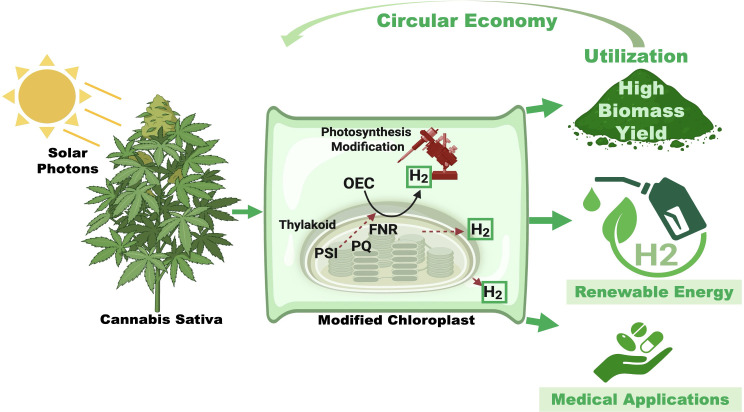
We hypothesize that C. sativa can be biotechnologically steered to function as a dual-output system by integrating hydrogenase-expressing synthetic pathways directly into the chloroplast genome. This approach enables the capture of molecular H2 during the plant’s intense vegetative growth phase, without compromising the downstream production of high-value cannabinoids and industrial biomass. Unlike conventional biohydrogen systems that sacrifice biomass for energy, this dual-use paradigm preserves, and indeed leverages, the full metabolic output of the plant across its lifecycle.
Synthetic biology and chloroplast modification
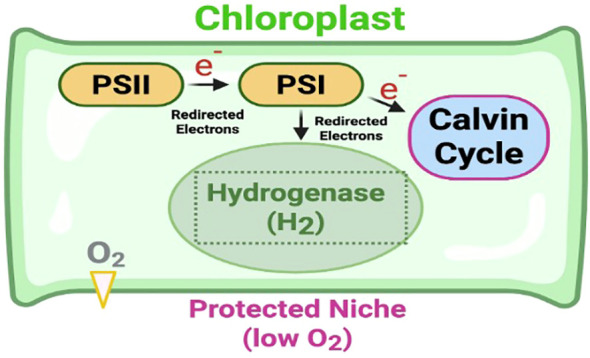
The primary challenge in biological H2 production is the sensitivity of hydrogenase enzymes to the oxygen (O2) produced during photosynthesis (ref. Cha et al., 2025). To overcome this, our model proposes the engineering of an oxygen-protected niche within the chloroplast. At the molecular level, our proposed engineering strategy involves three key interventions. First, heterologous expression of an oxygen-tolerant [FeFe]-hydrogenase, such as those characterized in Clostridium acetobutylicum or engineered variants from Chlamydomonas reinhardtii, into the cannabis chloroplast genome via plastid transformation (ref. Demuez et al., 2007; ref. Wegelius et al., 2018). Second, targeted downregulation of competing electron sinks, specifically the ferredoxin-NADP+ reductase (FNR) pathway, to redirect photosynthetic electron flow from carbon fixation toward proton reduction. Third, co-expression of oxygen-scavenging enzymes (e.g., glucose oxidase or leghemoglobin) within the chloroplast stroma to create and maintain the low-O2 microenvironment essential for sustained hydrogenase activity (ref. Demuez et al., 2007; ref. Appel et al., 2022). Together, these modifications create a metabolically partitioned chloroplast capable of simultaneous carbon fixation and hydrogen evolution.
As illustrated in f1, the proposed synthetic pathway involves redirecting the photosynthetic electron flow. Under specific physiological conditions, electrons generated from Photosystem II (PSII) and Photosystem I (PSI) are intercepted and funneled toward a heterologously expressed hydrogenase (H2ase). This enzyme, localized within a protected micro-compartment, facilitates the reduction of protons into molecular H2 without compromising the primary carbon fixation required for biomass accumulation (ref. Wu et al., 2010; ref. Wegelius et al., 2018).
The tripartite sustainability cycle
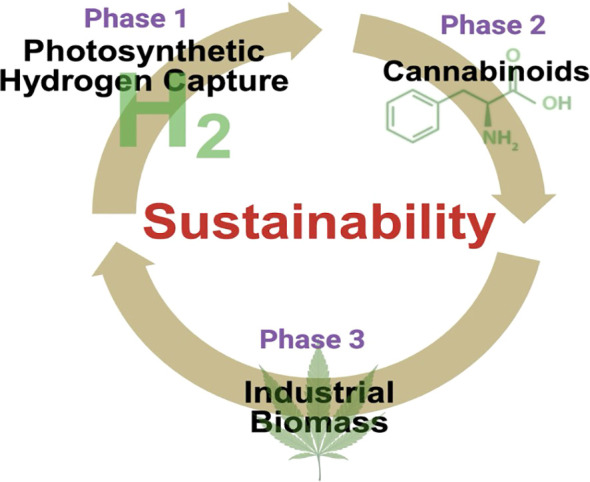
The economic viability of our proposed dual-use paradigm relies on a staggered, multi-phase harvest model. Unlike traditional bioenergy crops that are destroyed during energy extraction, C. sativa facilitates a sequential recovery of value.
As depicted in f2, the Tripartite Sustainability Cycle begins with Phase I: Photosynthetic H2 Capture. During the peak vegetative growth stage, gaseous H2 is harvested within closed-loop CEA systems. Following this, the plant enters Phase II: Cannabinoid Synthesis, where the metabolic energy is redirected toward the production of high-value secondary metabolites (e.g., CBD and terpenes) in the glandular trichomes. Finally, Phase III: Industrial Biomass Recovery involves the processing of the remaining stalks and shives into industrial fiber or carbon-sequestering biochar, ensuring a zero-waste, circular economy.
Beyond hydrogen and cannabinoids, Cannabis sativa offers a remarkably diverse portfolio of industrial outputs that strengthen its circular economy value proposition. Hemp fiber derived from the stalks is among the strongest natural fibers known, with applications in textiles, construction composites, and biodegradable packaging (ref. Enarevba and Haapala, 2024; ref. Shelly et al., 2025). Hemp-derived biochar, produced from post-harvest lignocellulosic residues via pyrolysis, serves as a long-term carbon sequestration agent and soil amendment, improving water retention and microbial diversity in agricultural settings (ref. Puglia et al., 2023). Hemp seed oil, rich in omega-3 and omega-6 fatty acids, has applications in nutraceuticals, cosmetics, and bioplastics (ref. Brar et al., 2022). This multi-stream valorization model ensures that virtually no biomass fraction is wasted, positioning cannabis as one of the most versatile and economically resilient crops available for circular bioeconomy integration.
Strategic implementation and economic outlook
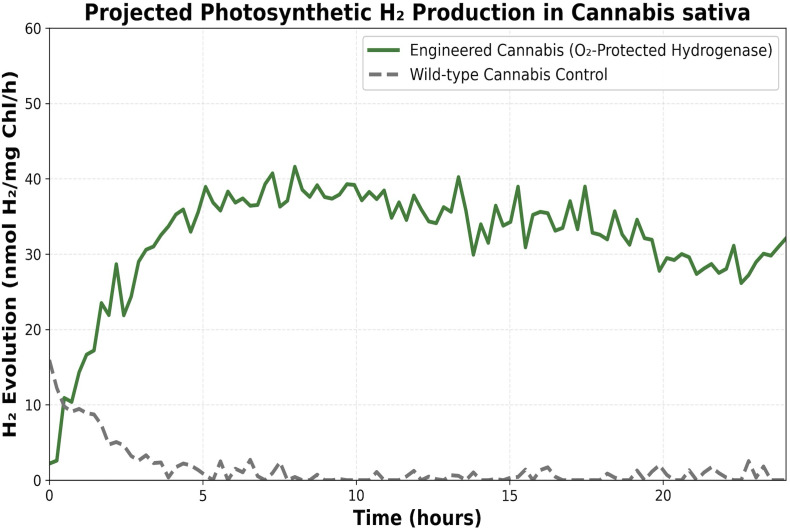
The feasibility of our dual-use paradigm depends on the efficiency of photosynthetic H2 evolution. While wild-type C. sativa exhibits baseline levels of H2 production under certain anaerobic conditions, it is insufficient for industrial energy capture.
As projected in f3, our synthetic biology approach aims to achieve sustained, high-level H2 evolution. By optimizing the electron flux and protecting the hydrogenase enzyme (as detailed in f1), the engineered strains are expected to maintain an elevated production rate (nmol H2/mg Chl/h) throughout the vegetative growth phase. This sustained output, compared to the transient and low-level production of wild-type controls, provides the necessary volume for capture within Controlled-Environment Agriculture (CEA) facilities. This elevated yield, combined with the $10 billion existing infrastructure, positions the Cannabis biorefinery as a commercially viable source of green H2.
Conclusion
Cannabis sativa stands at the intersection of the most disruptive shifts in modern industry: the legalization of medicinal biotechnologies and the urgent need for carbon-negative energy transition. By adopting this patented dual-use framework, we can transform one of the world’s most valuable crops into an engine for a sustainable, hydrogen-powered future.
Several significant challenges must be acknowledged in the translation of this hypothesis to practice. First, the genetic transformation of Cannabis sativa chloroplasts remains technically demanding, as stable plastid transformation protocols for cannabis are less established than for model organisms such as tobacco (ref. Wegelius et al., 2018; ref. Narra et al., 2025). Second, the metabolic burden imposed by heterologous hydrogenase expression may compete with cannabinoid biosynthesis, requiring careful regulatory tuning of gene expression across growth phases. Third, the scalability of H2 capture within CEA systems introduces engineering challenges related to gas-tight enclosures, hydrogen safety, and capture efficiency. Fourth, the regulatory landscape governing genetically modified cannabis varies considerably across jurisdictions, which may limit near-term deployment in certain markets (ref. Hussain et al., 2021). To overcome these challenges, we propose a phased development roadmap: beginning with proof-of-concept studies in model plant systems (e.g., tobacco), followed by transient expression studies in cannabis, and ultimately progressing to stable chloroplast transformation with regulatory engagement. Collaborative frameworks between synthetic biologists, agricultural engineers, and regulatory bodies will be essential to advance this platform toward commercial viability.
References
- S. M. Ahsan, M. Injamum-Ul-Hoque, M. M. Rahman, S. M. Kang, I. J. Lee, H. W. Choi. Improved biomass production and secondary metabolism: A critical review of grafting in Cannabis sativa.. Plants (Basel), 2025. [DOI | PubMed]
- O. M. Ali, Maka, G. Tarik, Elsaye, Elsaye. The pathway towards decarbonisation and net-zero emissions by 2050: The role of solar energy technology.. Green Technol. Sustain, 2024. [DOI | PubMed]
- J. Appel, S. Craig, M. Theune, V. Hüren, S. Künzel, B. Forberich. Evidence for electron transfer from the bidirectional hydrogenase to the photosynthetic complex I (NDH-1) in the cyanobacterium Synechocystis sp. PCC 6803.. Microorganisms, 2022. [DOI | PubMed]
- K. K. Brar, Y. Raheja, B. S. Chadha, S. Magdouli, S. K. Brar, Y. H. Yang. A paradigm shift towards production of sustainable bioenergy and advanced products from Cannabis/hemp biomass in Canada.. Biomass Convers Biorefin, 2022. [DOI | PubMed]
- M. Cha, M. S. Park, S. J. Kim. Biological routes for biohydrogen production: A clean and carbon-free fuel.. Biotechnol. J., 2025. [DOI | PubMed]
- K. Chandrasekhar, Y. J. Lee, D. W. Lee. Biohydrogen production: strategies to improve process efficiency through microbial routes.. Int. J. Mol. Sci., 2015. [DOI | PubMed]
- M. Demuez, L. Cournac, O. Guerrini, P. Soucaille, L. Girbal. Complete activity profile of Clostridium acetobutylicum [FeFe]-hydrogenase and kinetic parameters for endogenous redox partners.. FEMS Microbiol. Lett., 2007. [DOI | PubMed]
- D. R. Enarevba, K. R. Haapala. The emerging hemp industry: A review of industrial hemp materials and product manufacturing.. AgriEngineering, 2024. [DOI | PubMed]
- Grand View Research (2025). Industrial hemp market size, share & Trends analysis report. Available online at: https://www.grandviewresearch.com/industry-analysis/industrial-hemp-market (Accessed March 2, 2026).
- T. Hussain, G. Jeena, T. Pitakbut, N. Vasilev, O. Kayser. Cannabis sativa research trends, challenges, and new-age perspectives.. iScience, 2021. [DOI | PubMed]
- M. Narra, I. Nakazato, B. Polley, S. Arimura, G. N. Woronuk, P. K. Bhowmik. Recent trends and advances in chloroplast engineering and transformation methods.. Front. Plant Sci., 2025. [DOI | PubMed]
- M. Puglia, N. Morselli, M. Lumi, G. Santunione, S. Pedrazzi, G. Allesina. Assessment of hemp hurd-derived biochar produced through different thermochemical processes and evaluation of its potential use as soil amendment.. Heliyon, 2023. [DOI | PubMed]
- D. Shelly, S. Lee, S. Park. Hemp fiber and its bio-composites: a short review part II—applications and life cycle assessment.. Adv. Compos Hybrid Mater., 2025. [DOI | PubMed]
- A. Wegelius, N. Khanna, C. Esmieu, G. D. Barone, F. Pinto, P. Tamagnini. Generation of a functional, semisynthetic [FeFe]-hydrogenase in a photosynthetic microorganism.. Energy Environ. Sci., 2018. [DOI | PubMed]
- C. Weixian, L. Tianpei, R. Yangyi, W. Jiaming, C. Hui, W. Qiang. Biological hydrogen with industrial potential: Improvement and prospection in biohydrogen production.. J. Clean Prod., 2023. [DOI | PubMed]
- S. Wu, R. Huang, L. Xu, G. Yan, Q. Wang. Improved hydrogen production with expression of hemH and lba genes in chloroplast of Chlamydomonas reinhardtii.. J. Biotechnol., 2010. [DOI | PubMed]