
The toxicology of orally administered Δ9-tetrahydrocannabinol in sheep
Abstract
Introduction:
As part of a larger study to assess the potential value of industrial hemp biomass (the low Δ9-tetrahydrocannabinol (Δ9-THC) variety of Cannabis sativa L.) as a feed for ruminants, a pharmacokinetics study of Δ9-THC, one of the main cannabinoids of interest, was undertaken. In undertaking this study, the toxicology of orally administered Δ9-THC was incidentally investigated and was discussed in the current paper.
Methods:
Eight Merino ewes were administered with two per os (PO) doses of 88.5 mg Δ9-THC/kg bodyweight (BW) 12 h apart. Blood samples were taken periodically to determine the pharmacokinetics of Δ9-THC but also to check blood troponin I concentrations post dose administration as in the pharmacokinetics study there were adverse effects to the heart following intravenous administration of Δ9-THC.
Results:
Following the PO dose of Δ9-THC, the pharmacokinetics were able to be determined (and were published separately); however, significant adverse clinical signs were observed in the sheep. Clinical signs included ataxia (stumbling, swaying), abnormal posture (head held low, head resting on the wall of the pen, back legs crossed over), somnolence, wool pulling, increased salivation, a prolonged reduction in feed intake and consequent decrease in BW. Plasma troponin I concentrations were elevated in three of the eight sheep following the PO dose of Δ9-THC.
Conclusions:
The adverse clinical signs noted have implications for iHemp biomass as a potential feed for ruminants due to both animal health and production effects. Further research is required to investigate appropriate feeding strategies for iHemp biomass to be utilised as a feed for ruminants.
Article type: Research Article
Keywords: Δ, Body weight, Feed intake, Industrial hemp, Ruminants, Troponin I
Affiliations: School of Agricultural, Environmental and Veterinary Sciences, Charles Sturt University, Wagga Wagga, NSW 2650, Australia; ChemCentre, Bentley, WA 6983, Australia; SAGE Consultancy, Dianella, WA 6059, Australia; The Vet Pharmacist, East Fremantle, WA 6158, Australia; Curtin Medical School, Curtin Health Innovation Research Institute, Curtin University, Bentley, WA 6002, Australia
License: © 2026 The Authors. Published by Elsevier B.V. CC BY 4.0 This is an open access article under the CC BY license (http://creativecommons.org/licenses/by/4.0/).
Article links: DOI: 10.1016/j.toxrep.2026.102221 | PubMed: 41732551 | PMC: PMC12925283
Relevance: Relevant: mentioned in keywords or abstract
Full text: PDF (728 KB)
Introduction
For industrial hemp (iHemp) biomass, the low Δ9-tetrahydrocannabinol (Δ9-THC) variety of Cannabis sativa L., to be a suitable feed for ruminants it needs to be nutritionally suitable and not cause any adverse health or production effects. Toxicity following oral exposure to Δ9-THC has occurred in a range of species, including donkeys ref. [1], monkeys ref. [2], ref. [3], dogs ref. [3], ref. [4], cats ref. [5], rats and mice ref. [6]. A range of clinical signs have been identified across species, including but not limited to; depression, lethargy, ataxia, tachycardia, bradycardia, tachypnoea, bradypnea, anorexia, hyperactivity to stimuli, muscle tremors, mydriatic pupils, hypersalivation, disorientation, hypothermia, constipation and urinary incontinence ref. [1], ref. [3], ref. [4], ref. [5], ref. [6].
The maximum allowable concentration for total THC (total THC calculated based upon Δ9-THC + 0.877 * THCA) to be present in an iHemp crop in New South Wales (NSW), Australia is 1 % (Hemp Industry Act 2008). The effects upon ruminants grazing iHemp biomass with this concentration of THC is largely unknown. Following feeding sheep diets containing either 0.002 % total THC ref. [7] or 0.015 % total THC ref. [8] or 0.067 % total THC ref. [9], ref. [10], feeding goats diets containing 0.02 % total THC ref. [11] and feeding cattle diets containing 0.065 % total THC ref. [12], no significant adverse effects were noted; however, following feeding cattle diets containing 0.1 % total THC some adverse effects were identified ref. [13]. These adverse effects included a significant decrease in respiratory and heart rates, along with changes in behaviour including increased yawning, salivation, nasal secretion, somnolence, pronounced tongue play, unsteady gait, unusually long periods of standing, abnormal posture and a reduction in feed intake ref. [13]. Furthermore, in a case study where five cattle ingested a high Δ9-THC hemp hay (exact concentration unknown) clinical signs of Δ9-THC toxicosis included muscle tremors, mydriasis, hypersalivation, reluctance to move, incoordination and frothing from the mouth, with ultimately fatalities occurring in four of the five animals ref. [14]. Following IV administration of either 160 mg Δ9-THC/kg BW or 18.7 mg Δ9-THC/kg BW to two different sheep ref. [15], a range of clinical signs were observed before fatality occurred in both sheep, attributed to a cardiac effect of Δ9-THC, of which was identified by plasma troponin I assay ( ref. [16]; unpub data). Whether feeding sheep iHemp biomass with cannabinoids closer to the maximum allowable limit in Australia will cause adverse effects is largely unknown, necessitating further research before it should be fed to ruminants.
In undertaking a study of the pharmacokinetics of Δ9-THC in sheep (results on the pharmacokinetics of Δ9-THC published separately by Stevens et al. ref. [17]), it became apparent that per os (PO) administration resulted in adverse effects in sheep, and these effects were the focus of the current study.
Materials and methods
The study was conducted at the Department of Primary Industry and Regional Development (DPIRD) Animal Nutrition Unit at Wagga Wagga, NSW. Approval was obtained from both CSU Animal Ethics Committee (Protocol Number: A22440) and NSW DPIRD Animal Ethics Committee (Protocol Number: OAEC-0547) prior to commencement of the study. The study was compliant with the Animal Research Act 1985 (as amended) in accordance with the Australian Code of Practice for the Care and Use of Animals for Scientific Purposes.
Experimental design
The experimental protocol for the larger pharmacokinetics study that the current study was part of has been previously reported ref. [17]. Results reported in the current study are only of the clinical signs that arose as part of the pharmacokinetics study. In summary, eight Merino ewes of approximately 24 months of age were administered with two PO doses of 88.5 mg Δ9-THC/kg BW 12 h apart. This dosage was based on the worst-case grazing scenario, in which sheep would graze an iHemp crop at the maximum allowable limit, being 1 % in NSW (Hemp Industry Act 2008). The dosage took into account an approximate feed intake of 3.5 % BW ref. [8] and the potential for all the tetrahydrocannabinolic acid (THCA) in the plant to be converted into Δ9-THC. For the final dose, a 50 % dose reduction was applied to reduce the potential of the dosage resulting in fatality.
All sheep were dosed according to BW. The required amount of a 73.2 % Δ9-THC resin (Little Green Pharma®, Western Australia) was weighed using calibrated scales (Sartorius, Germany), then dissolved in dimethyl sulfoxide (DMSO) (Sigma-Aldrich, USA). All doses were administrated via an orogastric tube, followed by 10 mL of DMSO to flush the tube to ensure full delivery of the dose solution. A new orogastric tube was used for each sheep to ensure there was no cross contamination.
The experimental period comprised a total of 62 d, including a dietary and housing adaptation period of 34 d followed by a 28 d sample collection period.
Clinical observation
The sheep were closely observed, and monitoring sheets were filled out for each sheep based upon clinical signs reported by Wagner et al. ref. [13]. Clinical observations recorded included physiological (changes in pupil size, heart rate, respiratory rate, capillary refill, salivation, nasal secretion, reflexes) and behavioural (changes in gait, time standing/sitting, posture, somnolence, response to stimuli, wool pulling).
Feed intake and analysis
Throughout the experimental period the sheep were fed ad libitum a ration comprised of wheaten chaff and a commercially available sheep pellet. Refusals were measured daily to enable determination of daily dry matter intake (DMI).
Before analysis, all DMI data were assessed for the model assumptions of normality by histograms and plotting residuals. Dry matter intake data were analysed using Repeated Measures Analysis, using the Mixed Model procedure in SAS statistical program (SAS Institute Inc., 1997). For the analysis, “week” was examined as the fixed effect with “animal” examined as a random effect and initial liveweight examined as a covariate. By referring to the Bayesian Information Criterion, the most appropriate covariance structure for each analysis was determined ref. [18]. The final model included the fixed effect of “week”, with “animal” as a random effect. All data were recorded as least squares means ± SE of the least square means. Differences were significant when p < 0.05.
Blood collection and analysis
Blood samples were taken from a catheter located in the jugular vein for each sheep. Prior to dosing a 0 h blood sample was taken. Following PO delivery of the first half of the dose, blood samples were taken at 12 h, 24 h, 36 h, 48 h, 72 h, 96 h, 120 h, 144 h, 168 h, 192 h, 216 h, 240 h, 264 h, 288 h, 312 h, 336 h, 504 h and 672 h for subsequent analysis of cannabinoids as part of the larger pharmacokinetics study but also for troponin I concentrations.
Troponin I was analysed at Gribbles Veterinary Pathology, Clayton Victoria using the Siemens Centaur instrument with a Chemiluminescent Immunoassay method. Troponin I concentrations were analysed to check whether there was an effect upon the heart following Δ9-THC administration, as occurred previously in humans ref. [19], ref. [20] and also when undertaking the pharmacokinetics of Δ9-THC in sheep ( ref. [16]; unpub data). Troponin I concentrations were measured at the timepoint when plasma Δ9-THC concentrations were at their greatest in each animal (range 12 – 168 h post dosing). As the assay utilised in the current study was not specific to sheep, there was no reference range provided for normal plasma troponin I concentrations. In the literature, a normal reference range for plasma troponin I concentrations in healthy sheep varies; however, a range of 0–100 ng/L can be assumed based upon the available literature ref. [21], ref. [22], ref. [23] and all time zero samples associated with the larger pharmacokinetics study analysed previously by the authors.
Results
Clinical signs
Within 24 h of administration of the dose all eight sheep developed ataxia (stumbling, swaying), abnormal posture (head held low, head resting on the wall of the pen, back legs crossed over), somnolence and wool pulling to varying degrees, with two sheep also exhibiting increased salivation. Clinical signs became less apparent within 24–48 h; however, wool pulling persisted for 7 d for all sheep.
Feed intake
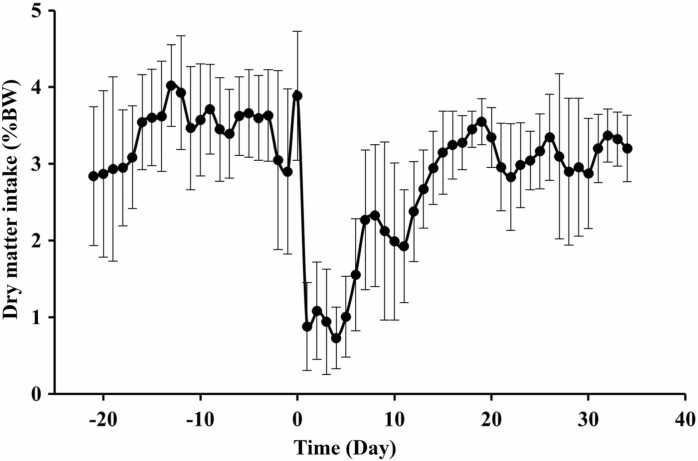
For the first 12 h following PO administration of Δ9-THC, there was a transient increase in DMI followed by a significant (p < 0.001) anorexic effect over the first week post dosing (Table 1), with DMI not returning to (almost) pre-dosing levels until three weeks post dosing (Fig. 1). As a consequence of the reduced DMI, there were changes in BW across the experimental period, from a mean ± SD BW of 47.75 ± 3.49 kg on Day 0 (day of administering the Δ9-THC), to 43.13 ± 3.40 kg on Day 14, and 49.50 ± 3.23 kg on Day 21 post Δ9-THC administration.
Table 1: Weekly average dry matter intake for eight Merino ewes PO administered with 177 mg Δ9-THC/kg BW.
| Dry matter intake (% BW)a | ||||
|---|---|---|---|---|
| One week pre-dosing | First week post-dosing | Second week post dosing | Third week post dosing | p-value |
| 3.4 (±0.138)a | 1.2 (±0.138)c | 2.3 (±0.138)b | 3.3 % (±0.138)a | < 0.0001 |
a Values are least squares means ± standard error of the least squares means. Values within a row with different superscripts are significantly different (p < 0.05).
Plasma troponin I concentrations
Mean ± SD plasma troponin I concentration was 96.3 ± 87.57 ng/L (range 13 – 275 ng/L), with three of the eight sheep having plasma troponin I concentrations > 100 ng/L (144, 146 and 275 ng/L).
Discussion
Δ9-THC toxicity is multisystemic resulting in various physiological and behavioural changes ref. [24], with some variation between species. The sheep developed ataxia, abnormal posture, increased salivation, increased somnolence, and became anorexic which resulted in a concurrent reduction in BW. Similar clinical signs have been reported in other species, including cattle ref. [13], ref. [14], donkeys ref. [1], monkeys ref. [2], ref. [3], dogs ref. [3], ref. [4], cats ref. [5], rats and mice ref. [6]. The timing of the first appearance of clinical signs varied between animals but clinical signs were evident in all sheep within the first 24 h post administration. Following ingestion of cannabis buds two donkeys exhibited clinical signs 24–36 h post ingestion and made a full recovery within 24 h following the appearance of clinical signs ref. [1]. Similarly in dogs, clinical signs post ingestion appeared anywhere from 5 min to 96 h with clinical signs lasting between 30 min to 96 h post first appearance ref. [4], ref. [25]. The timeline of the appearance and disappearance of clinical signs in other species generally aligned with that observed for sheep in the current study, except for the wool pulling and anorexia.
Wool pulling
The primary cause of the wool pulling identified in the current study was unknown. Intake of Δ9-THC may have potentially induced a side effect similar to delusional infestation which occasionally occurs in humans who use marijuana. Delusional infestation is a feeling of the skin being infested with organisms or inanimate particles ref. [26], which can result in itching, biting and crawling sensations in/on the skin ref. [27]. As wool pulling occurred until at least the maximum concentration of Δ9-THC was reached in the plasma, which occurred at mean ± SD 97.50 ± 65.55 h post dose administration ref. [17], a similar condition as delusional infestation may have contributed to the sheep wool pulling. Alternatively, wool pulling in sheep can occur due to the stress of an indoor environment or overcrowding ref. [28]; however, these sheep were well-adapted into their indoor individual pens where they were housed for a total of 69 d, with wool pulling only evident during the first week post dosing and at no other time. Additionally, wool pulling may occur due to nutritional needs not being met, such as when sheep have a deficiency in sulphur ref. [29], zinc ref. [30] or fibre ref. [31]. As the sheep were eating inconsistently post dose administration, there was the potential that the nutritional state of the sheep may have contributed to the observed wool pulling and assist in explaining why wool pulling ceased once the sheep returned to their normal (pre-dose) eating pattern.
Feed intake
PO administration of 87.5 mg Δ9-THC/kg BW (half ultimate dose) resulted in a short-term (< 12 h) increase in feed intake, which was followed by a profound anorexic effect over the first week post dosing and resulted in a short-term decrease in BW. A similar pattern was identified following IV administration of the l-isomer of Δ9-THC to sheep, with feed intake increased during the first 30 min post exposure (this effect was not observed following dosing with the d-isomer), before feed intake decreased 24 h post dosing of both the L- and d-isomer of Δ9-THC ref. [32]. When iHemp biomass containing diets were fed to sheep there was no change in feed intake ref. [7], ref. [8]; however, when made into silage and fed to cattle there was a significant reduction in feed intake ref. [13]. The difference between these feeding studies was most likely attributed to the cannabinoid concentration of the feed. The iHemp hay diet fed to the sheep contained 0.03 % Δ9-THC, which equated to an average daily intake of 0.94 mg Δ9-THC/kg BW ref. [8], whilst the cattle were fed iHemp silage containing 0.1 % Δ9-THC, which resulted in an average daily intake of 3.1 mg Δ9-THC/kg BW ref. [13]. As Δ9-THC intake increases, effects upon feed intake appear to become more pronounced. Therefore, if iHemp biomass is to be used as a feed for ruminants the concentration of Δ9-THC will need to be carefully considered to ensure there are no adverse effects upon animal production.
Troponin I
Troponin I is a protein found in myocardial muscle that is released when damage occurs ref. [33]. Elevation in plasma troponin concentrations have been identified in humans post cannabis use with troponin concentrations found to trend down after cessation of cannabis use ref. [19], ref. [20]. In the current study three of the eight sheep had increased plasma troponin I concentrations, indicating the PO dose administered elicited a mildly toxic myocardial effect. Troponin I concentrations were only measured at one timepoint for each animal in the current study and, therefore, there may have been more than just three sheep to experience elevated troponin I concentrations post dose administration that were not detected at the timepoints selected.
In humans that use cannabis, the risk of cardiac complications increases with the concentration of Δ9-THC present in the product ref. [34] and the duration of use ref. [35]; however, once cannabis use is ceased, the risk of cardiac complications decreases rapidly ref. [34]. Based on the elevated plasma troponin I concentrations identified in the current study, if ruminants were to graze iHemp biomass there is the chance of an adverse myocardial effect occurring. The risk of an adverse myocardial effect occurring would potentially increase if ruminants were to graze iHemp for an extended period, with a concentration of Δ9-THC closer to the maximum allowable limit of 1 %. Therefore, further research is required to investigate what prolonged exposure of Δ9-THC, as would occur under grazing conditions, would mean for ruminant health before iHemp biomass should be incorporated into ruminant diets.
iHemp as a feed
To date iHemp biomass has mainly been investigated as part of a ruminant diet ref. [7], ref. [8], ref. [9], ref. [11], ref. [13] and not the full diet. There is the potential for iHemp biomass to be utilised as only a proportion of the diet, as occurred in the aforementioned studies; however, it was still valid to investigate the worst-case scenario in which iHemp biomass comprised the majority of the ration, as there are anecdotal reports (from Australia and New Zealand) that it has been utilised as a grazing crop.
From the current study, administration of Δ9-THC at 177 mg/kg BW (equivalent to a 0.5 % iHemp crop), caused adverse clinical signs to arise; however, when a dose of 18.7 mg/kg BW (equivalent to an approximately 0.05 % Δ9-THC iHemp crop) was PO administered to a sheep, no adverse effects were identified ref. [17]. Furthermore, no clinical effects were observed when sheep were fed diets containing either 56 % iHemp stubble with 0.002 % total THC for 56 d ref. [7], or 42 % iHemp hay with 0.015 % total THC for 22 d ref. [8] or 20 % spent hemp biomass with 0.067 % total THC for 56 d ref. [9], ref. [10]. Similarly, no clinical effects were observed following feeding goats iHemp biomass containing 0.02 % total THC for 70 d ref. [11] or cattle fed spent hemp biomass containing 0.065 % total THC for 28 d ref. [12]; however, cattle fed a hemp silage containing 0.1 % total THC for 6 d displayed a range of clinical signs ref. [13]. Based upon these studies, somewhere between a 0.05 % and 0.1 % Δ9-THC crop is the upper safe limit for ruminants to graze iHemp biomass without compromising productivity or welfare. Further research is required to confirm what the upper safe limit may be.
It should be noted that the dose solutions utilised in the current study were comprised of a cannabinoid resin and effects from other plant secondary metabolites normally present in iHemp biomass, may influence the levels of Δ9-THC that ruminants can graze before an adverse effect is observed, with potential varietal differences ref. [36]. Additionally, there are a range of other cannabinoids in iHemp biomass ref. [37], which have the potential to exert a pharmacological effect upon the animal ref. [38], ref. [39] and contaminate animal products post consumption ref. [7], ref. [9], ref. [40]. One of the other main cannabinoids of iHemp is cannabidiol (CBD). Generally, iHemp biomass contains a greater concentration of CBD than Δ9-THC ref. [37], ref. [41]; however, adverse pharmacological effects tend to be lessor for CBD than Δ9-THC but may still occur ref. [42]. Sheep exposed to the same concentration of CBD as the concentration of Δ9-THC administered in the current study had no adverse effects identified post administration ref. [15]. Further research into the other cannabinoids contained in iHemp biomass is warranted before iHemp or iHemp byproducts should be a feed for ruminants.
Conclusions
The concentration of the cannabinoids, especially Δ9-THC, in iHemp biomass will be an important aspect to consider if it is to be a feed for livestock to ensure there are no adverse effects upon the animal and consequently, production characteristics. Based off the current study and available literature, the upper safe limit for Δ9-THC consumption for ruminants would lie somewhere between a 0.05 % and a 0.1 % Δ9-THC iHemp crop, before a toxic effect was observed.
CRediT authorship contribution statement
Gaye L. Krebs: Writing – review & editing, Supervision, Project administration, Methodology, Investigation, Formal analysis, Conceptualization. Colin J. Scrivener: Writing – review & editing, Supervision, Project administration, Methodology, Investigation, Formal analysis, Conceptualization. Glenys K. Noble: Writing – review & editing, Supervision, Project administration, Methodology, Investigation, Formal analysis, Conceptualization. Scott H. Edwards: Writing – review & editing, Supervision, Project administration, Methodology, Investigation, Formal analysis, Conceptualization. Sarah A. Stevens: Writing – review & editing, Writing – original draft, Supervision, Project administration, Methodology, Investigation, Formal analysis, Conceptualization. Bronwyn L. Blake: Methodology, Funding acquisition, Conceptualization. Zi Xuan Tai: Validation, Methodology, Investigation. Christopher D. May: Validation, Methodology, Investigation. Christopher E. Petzel: Writing – review & editing, Supervision, Project administration, Methodology, Investigation, Conceptualization. Leon N. Warne: Writing – review & editing, Resources. Kenneth C. Dods: Methodology, Funding acquisition, Conceptualization.
Funding
This research was funded by 10.13039/501100009207AgriFutures Australia, grant number PRJ-013007 (Opening the gates to hemp-grazed livestock in Australia—Phase 2).
Declaration of Competing Interest
The authors declare that they have no known competing financial interests or personal relationships that could have appeared to influence the work reported in this paper
References
- A.H. Fitzgerald, G. Magnin, E. Pace, K. Bischoff, T. Pinn-Woodcock, R. Vin, M. Myhre, E. Comstock, S. Ensley, J.F. Coetzee. Marijuana toxicosis in 2 donkeys. J. Vet. Diagn. Invest, 2022. [DOI | PubMed]
- G.R. Thompson, R.W. Fleischman, H. Rosenkrantz, M.C. Braude. Oral and intravenous toxicity of delta 9-tetrahydrocannabinol in rhesus monkeys. Toxicol. Appl. Pharm., 1974. [DOI]
- G.R. Thompson, H. Rosenkrantz, U.H. Schaeppi, M.C. Braude. Comparison of acute oral toxicity of cannabinoids in rats, dogs and monkeys. Toxicol. Appl. Pharm., 1973. [DOI]
- P. Janczyk, C.W. Donaldson, S. Gwaltney. Two hundred and thirteen cases of marijuana toxicoses in dogs. Vet. Hum. Toxicol., 2004. [PubMed]
- A. Janeczek, M. Zawadzki, P. Szpot, A. Niedzwiedz. Marijuana intoxication in a cat. Acta Vet. Scand., 2018. [DOI | PubMed]
- R.N. Phillips, R.F. Turk, R.B. Forney. Acute toxicity of Δ9-tetrahydrocannabinol in rats and mice. Proc. Soc. Exp. Biol. Med., 1971. [DOI | PubMed]
- G.L. Krebs, D.W. De Rosa, D.M. White, B.L. Blake, K.C. Dods, C.D. May, Z.X. Tai, E.H. Clayton, E.E. Lynch. Intake, nutrient digestibility, rumen parameters, growth rate, carcase characteristics and cannabinoid residues of sheep fed pelleted rations containing hemp (Cannabis sativa L.) stubble. Transl. Anim. Sci., 2021. [DOI]
- S.A. Stevens, G.L. Krebs, C.J. Scrivener, G.K. Noble, B.L. Blake, K.C. Dods, C.D. May, Z.X. Tai, E.H. Clayton, E.E. Lynch, K. Johnson. Nutrient digestibility, rumen parameters and (cannabinoid) residues in sheep fed a pelleted diet containing green hemp (Cannabis sativa L.) biomass. Transl. Anim. Sci., 2022. [DOI]
- A. Irawan, R.N. Muchiri, N.B. Parker, R.B. van Breemen, S. Ates, M. Bionaz. Cannabinoid residuals in tissues of lambs fed spent hemp biomass and consumer’s exposure assessment. Food Chem. Toxicol., 2024. [DOI]
- N.B. Parker, M. Bionaz, H.R. Ford, A. Irawan, E. Trevisi, S. Ates. Assessment of spent hemp biomass as a potential ingredient in ruminant diet: nutritional quality and effect on performance, meat and carcass quality, and hematological parameters in finishing lambs. J. Anim. Sci., 2022. [DOI]
- T. Ran, Z. Xu, W. Yang, D. Liu, D. Wu. Partially substituting alfalfa hay with hemp forage in the diet of goats improved feed efficiency, ruminal fermentation pattern and microbial profiles. Anim. Nutr., 2024. [DOI | PubMed]
- A. Irawan, D.G. Nosal, R.N. Muchiri, R.B. van Breemen, S. Ates, J. Cruickshank, J. Ranches, C.T. Estill, A. Thibodeau, M. Bionaz. Cannabinoid distribution and clearance in feeding spent hemp biomass to dairy cows and the potential exposure to Δ9-THC by consuming milk. J. Agric. Food Chem., 2025. [DOI | PubMed]
- B. Wagner, P. Gerletti, P. Fürst, O. Keuth, T. Bernsmann, A. Martin, B. Schäfer, J. Numata, M.C. Lorenzen, R. Pieper. Transfer of cannabinoids into the milk of dairy cows fed with industrial hemp could lead to Δ9-THC exposure that exceeds acute reference dose. Nat. Food, 2022. [DOI | PubMed]
- D. Driemeier. Marijuana (Cannabis sativa) toxicosis in cattle. Vet. Hum. Toxicol., 1998
- 15Blake, B., Krebs, G., May, C., Stevens, S., Dods, K., Paganoni, B., 2023 Opening the gates to hemp-grazed livestock in Australia. Phase 2 Report. Agrifutures Australia Publication no. 24-181. Available online: 〈https://agrifutures.com.au/product/opening-the-gates-to-hemp-grazed-livestock-phase-2/〉 (accessed on 29 January 2026).
- 16Stevens, S.A., Edwards, S.H., Noble, G.K., Scrivener, C.J., Petzel, C.E., Lynch, E.E., May, C.D., Tai, Z.X., Blake, B.L., Dods, K.C., Warne, L.N., Suttie, J.J., Krebs, G.L., 2025. The cardiac toxicology of Δ9-tetrahydrocannabinol in sheep. Manuscript submitted for publication.
- S.A. Stevens, S.H. Edwards, G.K. Noble, C.J. Scrivener, G.L. Krebs, C.E. Petzel, C.D. May, Z.X. Tai, B.L. Blake, K.C. Dods, L.N. Warne. The pharmacokinetics of Δ9-tetrahydrocannabinol in sheep. Animals, 2024. [DOI | PubMed]
- R.C. Littell, J. Pendergast, R. Natarajan. Modelling covariance structure in the analysis of repeated measures data. Stat. Med., 2000. [PubMed]
- Z.R. Malik, A.V. Doodnauth, Z. Razaq, S. Shamail, J. Kirupakaran, J. Allen. Marijuana induced troponinemia – an unusual case of elevated troponins. Prog. Med. Sci., 2021. [DOI]
- N. Nway, S. Pandey, T. Chowdhury, M. Shankar, K. Panigrahi. A case report of cannabis abuse: a surprising etiology of elevated troponin. Cureus, 2023. [DOI]
- T. Karapinar, Y. Eroksuz, E. Beytut, I. Sozdutmaz, H. Eroksuz, M. Dabak. Increased plasma cardiac troponin I concentration in lambs with myocarditis. Vet. Clin. Pathol., 2012. [DOI | PubMed]
- A. Kirbas, E. Baydar, F.M. Kandemir, E. Dorman, O. Kizil, B.A. Yildirim. Evaluation of serum cardiac troponin I concentration in sheep with acute ruminal lactic acidosis. Vet. Arh., 2014
- F. Leonardi, B. Passeri, A. Fusari, P. De Razza, C. Beghi, R. Lorusso, A. Corradi, P. Botti. Cardiac troponin I (cTnI) concentration in an ovine model of myocardial ischemia. Res. Vet. Sci., 2008. [DOI | PubMed]
- N.D. Vaziri, R. Thomas, M. Sterling, K. Seiff, M.V. Pahl, J. Davila, A. Wilson. Toxicity with intravenous injection of crude marijuana extract. Clin. Toxicol., 1981. [DOI | PubMed]
- J.C. Godbold, B.J. Hawkins, M.G. Woodward. Acute oral marijuana poisoning in the dog. J. Am. Vet. Med. Assoc., 1979. [DOI | PubMed]
- C.L. Marshall, V. Williams, C. Ellis, R.E. Taylor, A.P. Bewley. Delusional infestation may be caused by recreational drug usage in some patients, but they may not disclose their habit. Clin. Exp. Dermatol., 2017. [DOI | PubMed]
- J. Prakash, R. Shashikumar, P.S. Bhat, K. Srivastava, S. Nath, A. Rajendran. Delusional parasitosis: Worms of the mind. Ind. Psychiatry J., 2012. [DOI | PubMed]
- R. Parés, P. Llonch, X. Such, X. Manteca. Wool-pulling behaviour appears in a production system with grazing restriction and can be assessed through wool inspection. Appl. Anim. Behav. Sci., 2023. [DOI]
- H. Youde, C. Huaitao. Studies on the pathogenesis of Shimao Zheng (fleece-eating) in sheep and goats. Vet. Res. Commun., 2001. [DOI | PubMed]
- Y. Akgul, Z.T. Agaoglu, A. Kaya, T. Sahin. The relationship between the syndromes of wool eating and alopecia in Akkaraman and Morkaraman sheep fed corn silage and blood changes (haemotological, biochemical and trace elements). Isr. J. Vet. Med., 2001
- S. Vasseur, D.R. Paull, S.J. Atkinson, I.G. Colditz, A.D. Fisher. Effects of dietary fibre and feeding frequency on wool biting and aggressive behaviours in housed Merino sheep. Aust. J. Exp. Agric., 2006. [DOI]
- C. McLaughlin, C.A. Baile, P. Bender. Cannabinols and feeding in sheep. Psychopharmacol, 1979. [DOI]
- S.M. Wells, M. Sleeper. Cardiac troponins. J. Vet. Emerg. Crit. Care, 2008. [DOI]
- M.A. Mittleman, R.A. Lewis, M. Maclure, J.B. Sherwood, J.E. Muller. Triggering myocardial infarction by marijuana. Circulation, 2001. [DOI | PubMed]
- E. Yahud, G. Paul, M. Rahkovich, L. Vasilenko, Y. Kogan, E. Lev, A. Laish-Farkash. Cannabis induced cardiac arrhythmias: a case series. Eur. Heart J. Case Rep., 2020. [DOI]
- D. Jin, K. Dai, Z. Xie, J. Chen. Secondary metabolites profiled in cannabis inflorescences, leaves, stem barks, and roots for medicinal purposes. Sci. Rep., 2020. [DOI | PubMed]
- T. Glivar, J. Eržen, S. Kreft, M. Zagožen, A. Čerenak, B. Čeh, E.T. Benković. Cannabinoid content in industrial hemp (Cannabis sativa L.) varieties grown in Slovenia. Ind. Crop Prod., 2020. [DOI]
- A. Austrich-Olivares, M.S. García-Gutiérrez, L. Illescas, A. Gasparyan, J. Manzanares. Cannabinoid CB1 receptor involvement in the actions of CBD on anxiety and coping behaviors in mice. Pharmaceuticals, 2022. [DOI | PubMed]
- I. Yamamoto, K. Watanabe, T. Matsunaga, T. Kimura, T. Funahashi, H. Yoshimura. Pharmacology and toxicology of major constituents of marijuana—on the metabolic activation of cannabinoids and its mechanism. J. Toxicol. Toxin Rev., 2003. [DOI]
- G. Fruge, G. Magnin, R. Jessup, B. Bruner, M. Kleinhenz, M.L. Drewery. Cannabinoid transference and retention in tissues of beef steers fed hemp leaves. Food Addit. Contam. Part A, 2025. [DOI]
- K. Mechtler, J. Bailer, K. De Hueber. Variations of Δ9-THC content in single plants of hemp varieties. Ind. Crops Prod., 2004. [DOI]
- M.A. Huestis, R. Solimini, S. Pichini, R. Pacifici, J. Carlier, F.P. Busardò. Cannabidiol adverse effects and toxicity. Curr. Neuropharmacol., 2019. [DOI | PubMed]