
Harmonization of clinical practice guidelines for primary prevention and screening: actionable recommendations and resources for primary care
Abstract
Background:
Clinical practice guidelines (CPGs) synthesize high-quality information to support evidence-based clinical practice. In primary care, numerous CPGs must be integrated to address the needs of patients with multiple risks and conditions. The BETTER program aims to improve prevention and screening for cancer and chronic disease in primary care by synthesizing CPGs into integrated, actionable recommendations. We describe the process used to harmonize high-quality cancer and chronic disease prevention and screening (CCDPS) CPGs to update the BETTER program.
Methods:
A review of CPG databases, repositories, and grey literature was conducted to identify international and Canadian (national and provincial) CPGs for CCDPS in adults 40–69 years of age across 19 topic areas: cancers, cardiovascular disease, chronic obstructive pulmonary disease, diabetes, hepatitis C, obesity, osteoporosis, depression, and associated risk factors (i.e., diet, physical activity, alcohol, cannabis, drug, tobacco, and vaping/e-cigarette use). CPGs published in English between 2016 and 2021, applicable to adults, and containing CCDPS recommendations were included. Guideline quality was assessed using the Appraisal of Guidelines for Research and Evaluation (AGREE) II tool and a three-step process involving patients, health policy, content experts, primary care providers, and researchers was used to identify and synthesize recommendations.
Results:
We identified 51 international and Canadian CPGs and 22 guidelines developed by provincial organizations that provided relevant CCDPS recommendations. Clinical recommendations were extracted and reviewed for inclusion using the following criteria: 1) pertinence to primary prevention and screening, 2) relevance to adults ages 40–69, and 3) applicability to diverse primary care settings. Recommendations were synthesized and integrated into the BETTER toolkit alongside resources to support shared decision-making and care paths for the BETTER program.
Conclusions:
Comprehensive care requires the ability to address a person’s overall health. An approach to identify high-quality clinical guidance to comprehensively address CCDPS is described. The process used to synthesize and harmonize implementable clinical recommendations may be useful to others wanting to integrate evidence across broad content areas to provide comprehensive care. The BETTER toolkit provides resources that clearly and succinctly present a breadth of clinical evidence that providers can use to assist with implementing CCDPS guidance in primary care.
Supplementary Information:
The online version contains supplementary material available at 10.1186/s12875-024-02388-3.
Article type: Research Article
Keywords: Clinical practice guidelines, Prevention, Primary care, Screening, Chronic disease
Affiliations: https://ror.org/0160cpw27grid.17089.37Department of Family Medicine, University of Alberta, Edmonton, AB Canada; https://ror.org/0160cpw27grid.17089.37Office of Lifelong Learning and the Physician Learning Program, Faculty of Medicine and Dentistry, University of Alberta, Edmonton, AB Canada; https://ror.org/03dbr7087grid.17063.330000 0001 2157 2938Department of Family and Community Medicine, University of Toronto, Toronto, ON Canada; https://ror.org/03cw63y62grid.417199.30000 0004 0474 0188Peter Gilgan Centre for Women’s Cancers, Women’s College Hospital, Toronto, ON Canada; https://ror.org/043q8yx54grid.419890.d0000 0004 0626 690XOntario Institute for Cancer Research, Toronto, ON Canada; https://ror.org/04haebc03grid.25055.370000 0000 9130 6822Discipline of Family Medicine, Memorial University of Newfoundland, St. John’s, NL Canada; Newfoundland and Labrador Centre for Health Information, St. John’s, NL Canada; https://ror.org/021g17t44grid.488425.70000 0000 9944 1447College of Physicians and Surgeons of Ontario, Toronto, ON Canada; https://ror.org/03yjb2x39grid.22072.350000 0004 1936 7697Department of Family Medicine, University of Calgary, Calgary, AB Canada; grid.413574.00000 0001 0693 8815Alberta Health Services, Alberta, AB Canada; https://ror.org/0160cpw27grid.17089.37Department of Medicine, University of Alberta, Edmonton, AB Canada; https://ror.org/03yjb2x39grid.22072.350000 0004 1936 7697Arnie Charbonneau Cancer Institute, University of Calgary, Calgary, AB Canada; https://ror.org/03cw63y62grid.417199.30000 0004 0474 0188Family and Community Medicine, Women’s College Hospital, Toronto, ON Canada; https://ror.org/02nt5es71grid.413574.00000 0001 0693 8815Strategic Clinical Networks, Alberta Health Services, Calgary, AB Canada; grid.416166.20000 0004 0473 9881Department of Family Medicine, Mount Sinai Hospital, Sinai Health System, Toronto, ON Canada; https://ror.org/04haebc03grid.25055.370000 0000 9130 6822Discipline of Emergency Medicine, Memorial University of Newfoundland, St. John’s, NL Canada; https://ror.org/017343w90grid.423371.00000 0004 0473 9195Canadian Cancer Society, Toronto, ON Canada; Centre for Effective Practice, Toronto, ON Canada
License: © The Author(s) 2024 CC BY 4.0 Open Access This article is licensed under a Creative Commons Attribution 4.0 International License, which permits use, sharing, adaptation, distribution and reproduction in any medium or format, as long as you give appropriate credit to the original author(s) and the source, provide a link to the Creative Commons licence, and indicate if changes were made. The images or other third party material in this article are included in the article’s Creative Commons licence, unless indicated otherwise in a credit line to the material. If material is not included in the article’s Creative Commons licence and your intended use is not permitted by statutory regulation or exceeds the permitted use, you will need to obtain permission directly from the copyright holder. To view a copy of this licence, visit http://creativecommons.org/licenses/by/4.0/. The Creative Commons Public Domain Dedication waiver (http://creativecommons.org/publicdomain/zero/1.0/) applies to the data made available in this article, unless otherwise stated in a credit line to the data.
Article links: DOI: 10.1186/s12875-024-02388-3 | PubMed: 38711031 | PMC: PMC11071261
Relevance: Moderate: mentioned 3+ times in text
Full text: PDF (337 KB)
Background
Turning the tide on chronic disease is a major health system priority and integral to improving health outcomes, services, and costs. Seventy-three percent of Canadians 65 years of age and older have at least 1 of the 10 most common cancers and/or chronic diseases [ref. 1]. Many of these could be prevented through management of modifiable risk factors and early detection through screening [ref. 2].
Primary care provides the first contact for patients in the healthcare system and therefore is an ideal setting to implement cancer and chronic disease prevention and screening (CCDPS) in Canada. Unfortunately, a substantial gap exists between clinical recommendations for CCDPS and actual practice [ref. 2–ref. 6]. Due to a fragmented healthcare system and provider time constraints, implementation of guidelines tends to focus on recommendations for specific organ systems, medical conditions, or single risk factors [ref. 6, ref. 7]. Initiatives such as the Canadian Cardiovascular Harmonized National Guidelines Endeavour (C-CHANGE) [ref. 8–ref. 10] and the Building on Existing Tools to Improve Chronic Disease Prevention and Screening in Primary Care (BETTER) program [ref. 6, ref. 11] exemplify efforts to present compilations of high-quality, evidence-based recommendations across multiple conditions in a way that is accessible and actionable by primary care providers (PCPs).
The BETTER program [ref. 12], with over 15 years of in-depth study, has developed a novel, comprehensive approach to CCDPS in primary care based on the Chronic Care Model (CCM), which identifies essential elements needed to provide comprehensive, proactive care for patients with chronic conditions from health promotion to disease management [ref. 13–ref. 15]. This approach introduces an enhanced role, the Prevention Practitioner (PP), typically undertaken by a clinician not responsible for ongoing care decisions or routine care. The PP works directly with patients to determine which CCDPS actions they are eligible to receive, and through a process involving shared decision-making and S.M.A.R.T. (specific, measurable, attainable, realistic, time-bound) goal setting, develops a unique, personalized “prevention prescription” with each patient [ref. 16]. The evidence-based prevention prescription is rooted in harmonized, high-quality CCDPS guidelines and tailored to patients based on their medical history, risk factors, and family history. This cost-effective intervention has been demonstrated to improve uptake of CCDPS actions in urban primary care settings as compared to usual care [ref. 2] and similar improvements have been observed in rural and remote communities [ref. 17] and public health settings [ref. 18] across Canada.
In this paper, we describe the rigorous process undertaken to synthesize and harmonize high-quality CCDPS clinical practice guidelines (CPGs) to update the clinical recommendations used in the BETTER program. This work was part of the Building on Existing Tools to Improve Cancer and Chronic Disease Prevention and Screening in Primary Care for Wellness of Cancer Survivors and Patients (BETTER WISE) project, a multi-provincial cluster randomized controlled trial (cRCT) [ref. 19]. The results from the BETTER WISE trial, including patient-level outcomes to assess the effectiveness of the approach and qualitative findings describing the impacts of the global pandemic of coronavirus disease 2019 (COVID-19) on the trial and overall prevention and screening services in primary care, are reported elsewhere [ref. 20–ref. 22]. We also describe the updated BETTER toolkit, a unique set of resources and tools aimed at supporting prevention of multiple cancers and chronic conditions in the primary care setting. Refinement of the toolkit was undertaken due to changes to the clinical evidence since its last iteration and to include new content areas informed by emerging evidence and feedback received from end-users. The BETTER toolkit informs the PP role and provides PCPs with accessible evidence-based clinical practice tools to address CCDPS.
Methods
Overview of the evidence review and CPG harmonization process
The process used to search, identify, appraise, synthesize, and harmonize CPGs for the BETTER program builds on our previous work [ref. 6, ref. 11], and involved the development of a compilation of robust CCDPS recommendations across the targeted conditions and risk factors while ensuring these were actionable and implementable in diverse settings across Canada. The clinical recommendations previously included were appliable to patients 40–65 years of age and encompassed the following areas: 1) cancers—breast, cervical, colorectal, lung and prostate; 2) chronic diseases – diabetes, cardiovascular disease, and obesity; 3) other conditions – depression; and 4) lifestyle risk factors – diet, physical activity, and alcohol and tobacco use. As described elsewhere [ref. 6, ref. 11], implementation science theories, models, and frameworks were used to inform the BETTER program and the approach undertaken to update the clinical evidence for the program to ensure that these recommendations were relevant, practical, feasible, and implementable in primary care settings.
The BETTER evidence review and CPG synthesis/harmonization process involved 3 main phases: 1) evidence review and identification of high-quality CPGs; 2) guideline synthesis and harmonization to standardize recommendations; and 3) refinement of the BETTER toolkit. These 3 phases were conceptualized within the Canadian Institutes of Health Research (CIHR) knowledge-to-action process model, a conceptual framework that depicts the process of knowledge translation as a continuous cycle with knowledge creation at the core and the activities related to “action” or application/implementation of created knowledge at the periphery [ref. 6, ref. 11, ref. 19, ref. 23]. This model has been identified as an implementation tool that can guide the process of translating evidence into practice [ref. 24]. This process culminated in the refinement and creation of knowledge resources and tools to support primary prevention and screening for relevant cancers and chronic diseases: the BETTER toolkit. Composed of clinical tools that succinctly and visually represent the clinical recommendations used in the program as well as a collection of accessible programs and resources available to providers and patients to support CCDPS efforts, the BETTER toolkit includes: a health survey, care paths for prevention and screening, a prevention prescription, a S.M.A.R.T. goals sheet, and bubble diagrams which provide CCDPS targets for patients at average risk.
Phase 1: evidence review and identification of high-quality CPGs
Review of the literature
An evidence review involving a targeted search strategy developed by the Centre for Effective Practice (CEP) [ref. 25] (a non-profit independent knowledge translation organization based in Toronto, Canada,) was conducted for 19 topics related to CCDPS in the following areas: 1) cancers—breast, cervical, colorectal, lung and prostate; 2) chronic diseases – chronic obstructive pulmonary disease (COPD), diabetes, cardiovascular disease, hepatitis C, obesity, and osteoporosis/bone health; 3) other conditions – depression; and 4) lifestyle risk factors – diet, physical activity, alcohol, cannabis, drug, tobacco, and vaping/e-cigarette use.
Search criteria and search strategy
The search updated the previous evidence review, which was conducted in 2016 [ref. 6, ref. 11], and was limited to CPGs published in English between 2016 and 2021 focused on adults. Priority was given to Canadian guidelines (national and provincial – Alberta, Ontario, Newfoundland and Labrador, and Nova Scotia as these jurisdictions were engaged in the BETTER WISE project or actively implementing the BETTER program). Guidelines were excluded if they solely provided recommendations for diagnosis, treatment, or management of cancer, and not screening or prevention of cancer, or if they were not applicable to the primary care setting as the focus of the BETTER program is primary prevention and screening of cancer and chronic disease in primary care.
The 4-step search strategy used by the CEP to identify CPGs for each topic is described in Table 1. Specific details regarding the search strategies for each topic are provided in Appendix 1. Titles and abstracts of CPGs identified through this search were reviewed for relevance, and promising results were retrieved in full-text for further consideration.
Table 1: Four-step search process for high-quality clinical practice guidelines
| 1) Topic-specific Databases:• Ontario Health: Cancer Care Ontario: https://www.cancercareontario.ca/en/guidelines-adviceCanadian Partnership Against Cancer Guidelines Databasea: https://www.partnershipagainstcancer.ca/work-with-us/procurement/procurement-bid/cancer-guidelines-database/ |
| 2) Clinical Practice Guideline Databases:• ECRI Guidelines Trust: https://www.ecri.org/solutions/ecri-guidelines-trust• Canadian Medical Association (CMA) CPG Infobase: https://joulecma.ca/cpg/homepage |
| 3) Key Guideline Developers:• Canadian Task Force on Preventive Health Care: https://canadiantaskforce.ca/guidelines/published-guidelines/• National Institute for Health and Care Excellence: http://www.nice.org.uk/• Scottish Intercollegiate Guidelines Network: https://www.sign.ac.uk/our-guidelines/• Toward Optimized Practice (TOP) Practice Guidelines: https://actt.albertadoctors.org/cpgs/• U.S. Preventative Services Task Force: http://www.ahrq.gov/clinic/prevnew.htm• Province Specific Bodies – Alberta Health Services – Eastern Health – Health Quality Ontario – Nova Scotia Health – Ontario Health |
| 4) Grey Literature via a General Internet SearchGoogle: ([Topic terms] AND [“Guideline” or “Screening guideline”]). First 3 pages of results examined |
aThe Canadian Partnership Against Cancer has ceased funding for the Cancer Guidelines Database and it is no longer available online
CPG quality appraisal
Full-text guidelines underwent an initial quality appraisal using the Appraisal of Guidelines for Research and Evaluation (AGREE) II Instrument, the purpose of which is to evaluate the process of CPG development and quality of reporting [ref. 26]. To pass the initial quality check performed by trained reviewers at the CEP, a guideline had to include clear recommendations linked to levels of evidence and be based on a systematic review of the literature (items 7 and 12 in the “Rigour of Development” domain of AGREE II). CPGs that fulfilled these criteria were appraised independently by 2 reviewers using the full AGREE II, consisting of 23 items across 6 domains and an overall quality score, in preparation for Phase 2. These appraisals were subsequently reviewed by a lead expert reviewer and reconciled into a single score to provide an overall summary of the methodological quality of each guideline.
A review was also conducted to identify guidelines published by provincial organizations in the 4 jurisdictions of interest. Provincial guidance documents published between 2016 and 2021, regardless of whether or not they passed the “Rigour of Development” criteria described above, were included for review in Phase 2 because of their relevance to the local context, as the BETTER program was actively being implemented in these jurisdictions and we needed to ensure that the recommendations incorporated into the program would be actionable, accounting for regional differences. The recommendations from the included high-quality CPGs and key provincial guidelines were extracted into evidence tables for review in Phase 2, which also included each recommendation’s level of evidence and the strength of recommendation, where available.
Phase 2: guideline synthesis and harmonization to standardize recommendations
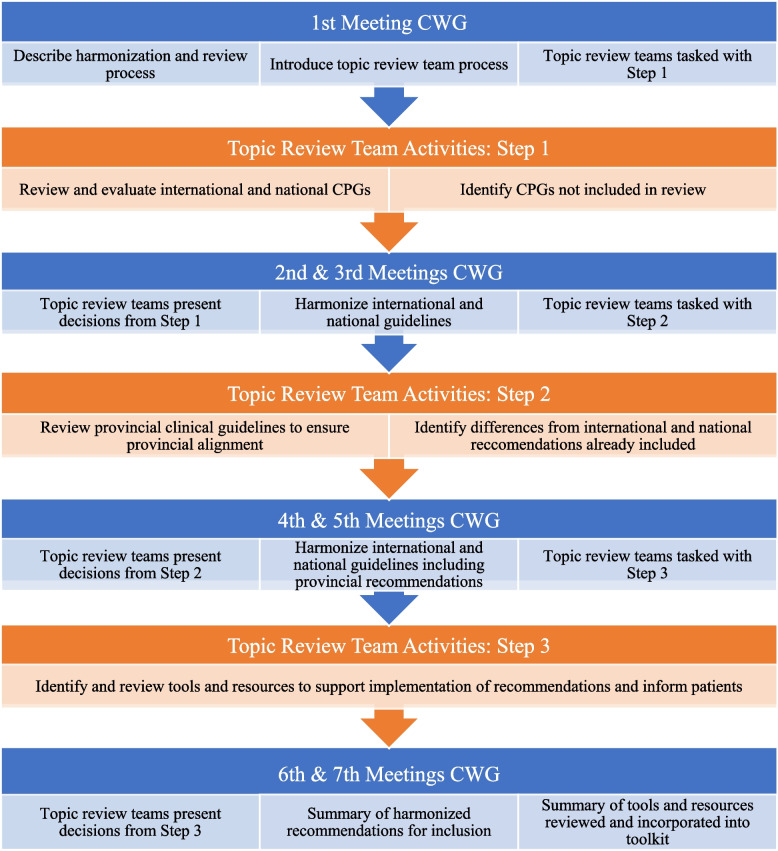
The BETTER Clinical Working Group (CWG) was convened for 5 months (January to May 2022) to review the international and Canadian CPGs identified through Phase 1 and to integrate recommendations and resources for inclusion in the BETTER program (see Fig. 1). Members of the CWG included patients, health policy experts (regional, provincial, federal; government and non-government), PCPs, content experts (e.g., cancer, obesity, diabetes, lifestyle risk factors), and primary care and primary healthcare researchers who shared their perspectives to synthesize and harmonize the identified CPGs into clear, actionable recommendations. In this phase, the CWG was divided into 3 topic-review teams based on their area(s) of expertise:
- Cancer team (5 members), focusing on breast, cervical, colorectal, lung, and prostate cancer;
- Chronic disease team (10 members), focusing on cardiovascular disease, COPD, depression, diabetes, hepatitis C, obesity, and osteoporosis; and
- Lifestyle risk factor team (4 members), focusing on alcohol, cannabis, drug, tobacco, and vaping/e-cigarette use, diet, and physical activity.
Topic-review teams worked independently to evaluate each recommendation within their ambit for clarity, actionability, and to determine if the recommendation could be operationalized in the primary care setting based on the following criteria: 1) focus on primary prevention and screening; 2) relevance to adults 40–69 years of age, the age group to which most CCDPS recommendations apply; and 3) applicability to primary care settings across different Canadian jurisdictions. Specifically, team members voted “yes” (i.e., include in BETTER), “no” (i.e., do not include in BETTER) with rationale for any “no” votes clearly documented, and “maybe” (i.e., further discussion required). The topic-review teams presented their assessments to the larger CWG at scheduled meetings. Any disagreements or ambiguities were resolved through discussion until consensus for inclusion or exclusion was reached. In cases where multiple individual recommendations for a topic were endorsed for inclusion, these were combined, harmonized, and simplified when appropriate, through group discussion. Recommendations emerging from provincial guidance documents that did not meet the initial quality appraisal criteria were reviewed and harmonized alongside those derived from the high-quality CPGs to ensure that recommendations were actionable in different contexts. Most of these provincial recommendations were consistent with those already incorporated, though there were some regional differences. For example, provincial guidance differed in regard to the criteria that should be used to determine the appropriate screening modality for an individual at elevated risk for colon cancer, all of which were reasonable based upon the high-quality guidance. Any jurisdictional nuances, such as differences in frequency of screening, were captured and indicated in the harmonized recommendations. Across all topics, individual and family risk factors (e.g., genetics, pre-existing medical conditions [personal or family], ethnic background) were incorporated to ensure that recommendations specific to high-risk and average-risk individuals were clear [ref. 11].
In Step 1, each topic-review team reviewed the international and national CPG recommendations identified through Phase 1 (see Fig. 1). As part of this first step, members were also asked to identify any high level international and national guidelines of which they were aware that were not included in their review. In Step 2, international and national clinical recommendations that reached consensus for inclusion were compared with provincial recommendations and policies to determine whether they were implementable in the 4 Canadian provinces of interest. For example, at the time of these discussions, the use of low-dose computed tomography (CT) scan for lung cancer screening, flexible sigmoidoscopy for average-risk colorectal cancer screening, and HPV testing for cervical cancer screening each varied among the different provinces. Any provincial clinical recommendations that differed from those already included and which were necessary to comply with a province’s approach to CCDPS were accepted for inclusion, noting the specific relevance to that province.
Finally, in Step 3, the topic-review teams reviewed the tools and resources previously included in the BETTER program [ref. 6, ref. 11] alongside new tools/resources that were identified through our search strategy. Teams reflected on the tools’ clarity (i.e., use of unambiguous, understandable language), applicability (e.g., to diverse populations, patients 40–69 years of age), and clinical usefulness (e.g., for primary care settings and PPs). Validity was also considered for assessment tools (e.g., Patient Health Questionnaire 2-item (PHQ-2) [ref. 27] screen for depression, QRISK3 [ref. 28] cardiovascular disease risk calculator, and General Practice Physical Activity Questionnaire (GPPAQ) [ref. 29] screen for aerobic physical activity). Through this process, teams assembled updated, relevant, and useful clinician and/or patient-facing tools and resources to support the implementation of recommendations.
Phase 3: refinement of the BETTER toolkit
The final CPG recommendations selected for inclusion were synthesized and harmonized using succinct, clear, and actionable language while considering PCPs’ and PPs’ scope of practice, role in patient care, and linkages to community resources. These recommendations were then used to refine the existing BETTER toolkit to assist PCPs and PPs with the implementation of recommendations. The toolkit provides PCPs and patients with the tools and resources needed to: 1) evaluate the individual patient’s risks for cancer and chronic disease, 2) identify CCDPS action(s) relevant to the patient, and 3) educate and prevent cancer and chronic diseases through a process of shared decision-making, resulting in a personalized ‘prevention prescription’ and actionable goals for the patient [ref. 11].
Results
Search results and clinical recommendations
The titles and abstracts of 6,038 CPGs identified through the search strategy were reviewed for relevance to CCDPS and primary care settings. Of these, 243 guidelines were retrieved, considered in full-text, and underwent initial quality appraisal. CPGs that passed the initial quality appraisal and that were further assessed using the full AGREE II received an overall quality score between 0 and 7, where a higher score indicates higher overall quality, with 7 indicating a CPG of the highest quality [ref. 26]. Thirteen percent of the CPGs assessed using the full AGREE II received an overall quality score of 4, 28% received a score of 5, 55% received a score of 6, and 4% received a score of 7 (see Appendix 3 for full AGREE II scores, including scores for overall quality). After excluding those that did not meet the inclusion or quality criteria, Phase 1 yielded 51 CPGs which provided current, relevant CCDPS recommendations for the general population (see Fig. 2). A summary of the search results is provided in Appendix 2.
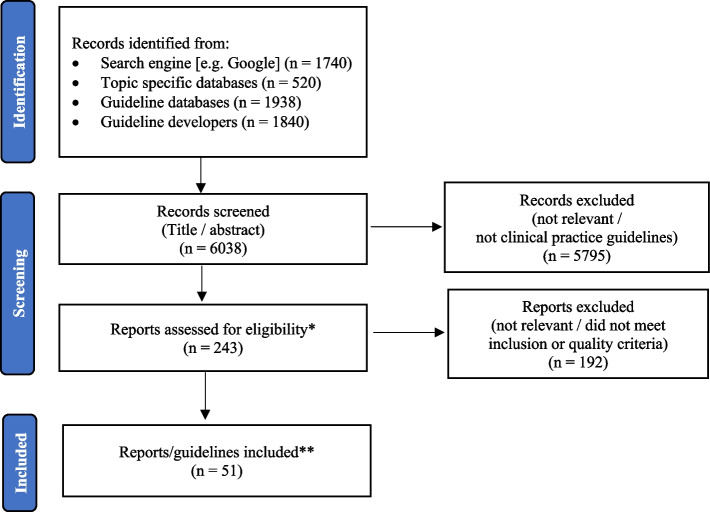
Supplementary searches identified an additional 22 guidelines by provincial organizations in Alberta, Ontario, Nova Scotia, and Newfoundland and Labrador, which were also reviewed by the BETTER CWG in Phase 2. Discussions within topic-review teams and the larger CWG determined that 3 of the new topics proposed (COPD, hepatitis C, and drug use) did not have sufficient evidence for inclusion (e.g., lack of prevention and screening CPGs for the topic, focus on diagnosis, treatment, and/or management) and thus were excluded from the final recommendations, resulting in 16 topics included in the program – 3 new: osteoporosis/bone health, cannabis use, and vaping/e-cigarette use. Notably, there were no CPGs published between 2016 and 2021 that met our criteria for inclusion on the topic of depression. The decision made by the CWG was to include a recommendation to screen for depression since this was already a part of the BETTER program. The final recommendations and resources/tools included in the BETTER program are presented in Tables 2 and 3, respectively.
Table 2: Summary of primary prevention and screening recommendations for adults 40–69 years of age
| Topic | Recommendation |
|---|---|
| Alcohol Screening Recommendations [ref. 31–ref. 38] | • All adults: Annual screen for alcohol consumption• Alcohol drinking recommendations are: o Limit alcohol o Adults: ≤ 6 drinks per week o No binge drinking (≥ 4 drinks for men and ≥ 3 drinks for women in one sitting) |
| Breast Cancer Screening Recommendations [ref. 39–ref. 45] | • Screen women without personal history of, or elevated risk for, breast cancer every 2 years with mammogram starting at age 50• Annual MRI screening in addition to mammography starting at age 30 for women in very high-risk population subgroups as defined below (if meet criteria refer to PCP to verify risk and appropriate screening): o Known mutation in BRCA1, BRCA2 or other gene predisposing to a markedly elevated breast cancer risk OR o Untested first-degree relative of a carrier of such a gene mutation OR o FH consistent with a hereditary breast cancer syndrome and estimated personal lifetime cancer risk > 25%OR o Women who received chest radiation (not chest x-ray) before age 30 and at least 8 years previously (e.g. as treatment for Hodgkin’s Lymphoma) o AB – women meeting any of the criteria above should receive an annual MRI, mammogram, and clinical breast exam starting at age 30• Consider referral to genetics if any of the following: o Personal and/or FH of ovarian cancer any age (epithelial) o Family member with BRCA1/BRCA2 mutation o High risk ethnicity (e.g. Ashkenazi Jewish, Icelandic) + personal and/or FH of hereditary breast and ovarian related cancers (breast, ovarian, male breast, pancreatic, prostate with Gleason Score ≥ 7) o ON – women meeting any of the criteria above should be refered to the Ontario Breast Screening Program• For women with one or two first-degree relatives with invasive breast cancer, but who do not meet the criteria for referral to genetics or MRI screening: o Annual mammography starting 5 to 10 years younger than the youngest case in the family, but no earlier than age 25 and no later than age 40 o Annual clinical breast examination starting at age 25 |
| Cannabis Use Screening Recommendations [ref. 46] | • All adults: screen annually for non-prescribed cannabis use (including edibles and oils)• Encourage reduction/cessation• Refer for counseling, program, or discussion with PCP |
| Cardiovascular Disease Recommendations [ref. 9, ref. 36, ref. 47–ref. 49] | • All adults: blood pressure should be measured annually o Target for individuals diagnosed with DM or CKD = ≤ 130/80 o Target for individuals without a DM or CKD diagnosis = ≤ 140/90 o Refer individuals above these targets to PCP for diagnosis and management• Perform CVD risk assessment in persons with Type 2 Diabetes, men > 40 years of age and women > 50 years of age or post-menopausal (exclude individuals with familial hypercholesterolemia) o Recommend every 3–5 years if low/moderate risk (< 10%) or every year if high risk (≥ 10%) or risks change• Use QRISK3 calculator for CVD risk or choose a CVD risk calculator and use it consistently• Refer to PCP to discuss statin if: o moderate to high risk on QRISK3 or CVD calculator used• Refer to PCP to discuss ACE/ARB if: o Individual has personal history of DM or CAD or CVD or PVD or HTN or KD (eGFR < 60 or microalbuminuria) AND o Individual is not already on an ACE/ARB• Recommend statins for all adults > 40 with DM |
| Cervical Cancer Screening Recommendations [ref. 50–ref. 55] | • Women at average risk: routine screening for cervical cancer using a Pap test every 3 years or HPV test every 5 years• Women following a hysterectomy with removal of the cervix who have no history of a high-grade precancerous lesion should not be screened• Women following a hysterectomy with removal of the cervix with a history of a high-grade precancerous lesion should be screened annually using a vault smear• Women who are immunocompromised (e.g., on immune-suppressing medications, post-organ transplant, HIV positive, or undergoing cancer treatment) should receive annual screening using a pap test |
| Colorectal Cancer Screening Recommendations [ref. 56–ref. 63] | • Adults at average risk: screen for colorectal cancer with FIT (or FOBT) every 2 years or flexible sigmoidoscopy every 5 years or colonoscopy every 10 years starting at age 50 o ON: individuals who choose to be screened with flexible sigmoidoscopy should be screened every 10 years• Adults at increased (high) risk should be screened as follows: o Single first degree relative with CRC at age ≥ 60 ▪ AB – FIT starting at 40 ▪ NL – FIT starting at 50 ▪ NS – FIT or FOBT or colonoscopy starting at 40 ▪ ON – Colonoscopy every 5 years or as directed starting at age 50 or 10 years younger than the youngest case in the family o Single first degree relative with CRC at age < 60 or two first degree relatives with CRC at any age ▪ AB – Colonoscopy starting at 40 or 10 years younger than the youngest case in the family (repeat as indicated) ▪ NL & ON – Colonoscopy starting at 50 or 10 years younger than the youngest case in the family ▪ NS – Colonoscopy every 5 years starting at age 40 or 10 years younger than the youngest case in the family o Single second degree relative with CRC diagnosis at age < 50 – colonoscopy starting at 50 (repeat as directed by findings) o Personal history of Crohn’s, UC, FAP, HNPCC, LS – colonoscopy at discretion of GI o Carrier of mutation in LS gene or untested first degree relative of a LS mutation carrier – colonoscopy every 1–2 years starting at age 20–25 or 2–5 years younger than the youngest case in the family if that diagnosis was made at age < 25, whichever is earlier• Refer individuals with suspected LS to PCP to discuss genetics referral |
| Depression Screening Recommendations [ref. 64–ref. 67] | • Use PHQ-2 to screen annually for depression in all individuals |
| Diabetes Screening Recommendations [ref. 49, ref. 68–ref. 73] | • Adults at average risk: screening for diabetes using FBS/FBG or HbA1c should be performed every 3 years starting at 40 years of age o If FBS/FBG is 6.0–6.9 mmol/L or HbA1c is 6.0–6.4%, repeat FBS/FBG or HbA1c at 6-months ▪ If no change, refer to PCP for discussion of physical activity, diet, and pharmacotherapy o If FBS is ≥ 7 mmol/L or HbA1c is ≥ 6.5% refer to PCP for management and discussion of physical activity, diet, and pharmacotherapy• Recommend annual screening for high-risk individuals who meet at least one of the following: o CKD o CVD o Family history of a first-degree relative with type 2 diabetes o From a community of color – African, Caribbean, Black, East Asian, Southeast Asian, South Asian, and Latin o History of gestational diabetes o HTN or elevated BP or on HTN medication o Hyperlipidemia o Low socio-economic status o Medications (glucocorticoids, atypical antipsychotics, HAART) o Of African, Arab, Asian, Hispanic, Indigenous, or South Asian descent o Obesity (BMI ≥ 30) or abdominal obesity (High waist circumference) o Past impaired FBS/FBG or HbA1c o Polycystic ovarian disease• Adults with a DM diagnosis o Recommend retina screening every 1–2 years o Recommend CKD screening using random urine ACR and serum creatinine converted into an eGFR every year |
| Lung Cancer Screening [ref. 74–ref. 76] | • Screen for lung cancer among adults ≥ 55 years of age with at least a 30 pack-year smoking history, who currently smoke or quit smoking less than 15 years ago, with low-dose CT scan every year up to three consecutive years o ON – adults ≥ 55 years of age with at least a 20-year smoking history should be referred to PCP for referral to the Ontario Lung Screening Program• Screening should only be done in health care settings with access to screening resources, expertise in early diagnosis and treatment of lung cancer |
| Nutrition/Diet Screening Recommendations [ref. 9, ref. 33, ref. 36, ref. 47, ref. 48, ref. 68, ref. 77, ref. 78] | • All adults: screen for healthy eating behaviours• Encourage Mediterranean-style diet with variety of vegetables, fruit, healthy proteins and unsaturated fats• Encourage limiting intake of refined sugar• In individuals at risk for type 2 diabetes encourage dietary patterns used to reduce risk of diabetes: Mediterranean-style, DASH, AHEI |
| Obesity Screening Recommendations [ref. 79–ref. 82] | • For individuals who have indicated willingness to discuss weight and after asking permission, screen all individuals with height, weight, BMI o For those with BMI ≥ 30 refer to PCP for discussion of root cause assessment, lifestyle, risk stratification with Edmonton Obesity Staging Scale, optimization of medications, and need for referral• Measure WC if BMI 25.0—29.9 o For those with high WC refer to PCP for discussion of root cause assessment, lifestyle, risk stratification with Edmonton Obesity Staging Scale, optimization of medications, and need for referral o High waist circumference is defined as: ▪ For South Asian, Chinese, Malay, Asian Indian, Japanese, or South and Central Amerian ethnic backgrounds: • ≥ 90 cm for Men • ≥ 80 cm for Women ▪ For Europid, Sub-Saharan African, Eastern Mediterranean, and Middle East (Arab) ethnic backgrounds; • ≥ 94 cm for Men • ≥ 80 cm for Women ▪ For North American ethnic background: • ≥ 102 cm for Men • ≥ 88 cm for Women • These cutoffs may also be used for the Europid ethnic group ▪ Europid includes ethnic backgrounds from Europe, Northeast Atlantic, North Africa, the Horn of Africa, West Asia, and Central Asia |
| Osteoporosis/Bone Health Screening Recommendations [ref. 33, ref. 77, ref. 83–ref. 88] | • Women at average risk: screen for osteoporosis among women ≥ 65 years of age if no bone density screen has been completed since age 60• Recommend bone mineral density screening in adults ≥ 50 years of age who present with a fragility fracture after age 40 and is at risk for future fractures• Recommend considering a fracture risk assessment for high-risk individuals ≥ 50 years of age who meet at least one of the following (particularly in the presence of other risk factors): o BMI < 20 kg/m2 o Consume > 3 drinks containing alcohol per day o Current smoker* o Living with HIV o Low bone mineral density on DXA/DEXA o On long-term antidepressant treatment (in particular, SSRIs) o Parental history of osteoporosis o Parental history of hip fracture* o Prolonged use of glucocorticoids (at least 3-months in the previous year at a prednisone-equivalent dose > 7.5 mg daily)* o Taking proton pump inhibitors o Using thiazolidinediones (antidiabetic medication) o Personal history of: ▪ a neurological disease (including Alzheimer’s disease, Parkinson’s disease, multiple sclerosis and stroke) or ▪ asthma or ▪ chronic liver disease or ▪ diabetes or ▪ epilepsy taking enzyme-inducing antiepilectic agents or ▪ inflammatory bowel disease* or malabsorption* or ▪ hyperparathyroidism* or other endocrine* disases or ▪ moderate to severe chronic kidney disease (eGFR < 60 ml/min/1.73 m2) or ▪ rheumatoid arthritis* or systemic lupus erythematosus* o Men ▪ Personal history of prostate cancer and taking GnRH agonists o Women ▪ History of previously untreated early menopause ▪ Taking aromatase inhibitors* o AB – adults ≥ 50 years of age who meet at least one of the * criteria above should be considered for bone mineral density screening |
| Physical Activity Recommendations [ref. 9, ref. 33, ref. 36, ref. 47–ref. 49, ref. 68, ref. 77, ref. 78, ref. 89, ref. 90] | • All adults: 150–300 min of moderate intensity physical activity or 75–150 min of vigorous intensity physical activity per week, with activity time divided up so that a person is active most days of the week o If a person is unable to perform moderate intensity physical activity, they should exercise up to their maximum safe capacity• All adults: strength or resistance training ≥ 2 days per week |
| Prostate Cancer Screening Recommendations [ref. 91–ref. 95] | • Do not recommend routine PSA screening• Provide individuals with information about prostate cancer screening and refer to PCP if the individual is: o ≥ 45 years old AND from a Black ethnic background or has a family history of a first degree relative with a prostate cancer diagnosis OR o ≥ 50 years old |
| Tobacco Use, Vaping/E-cigarette Screening Recommendations [ref. 9, ref. 33, ref. 36, ref. 47, ref. 49, ref. 75, ref. 96–ref. 99] | • All adults: screen annually for commercial tobacco use (cigarettes, tobacco products) and nicotine use (vaping/e-cigarettes; non-prescribed) o Does not include tobacco used for ceremonial purposes• Encourage reduction/cessation• Refer for counseling, program, or discussion with PCP |
AB Alberta, ACE Angiotensin converting enzyme, ACR Albumin to creatinine ratio, AHEI Alternate Healthy Eating Index, ARB Angiotensin II receptor blocker, BMI Body mass index, BRCA Breast cancer gene, CAD Coronary artery disease, CKD Chronic kidney disease, CRC Colorectal cancer, CVD Cardiovascular disease, CT Computed tomography, DASH Dietary Approaches to Stop Hypertension, DM Diabetes mellitus, DXA/DEXA Dual energy x-ray absorptiometry, eGFR estimated glomerular filtration rate, FAP Familial adenomatous polyposis, FBS Fasting blood sugar, FBG Fasting blood glucose, FH Family history, FIT Fecal immunochemical test, FOBT Fecal occult blood test, GI Gastroenterologist, GnRH Gonadotropin-releasing hormone, HAART Highly active antiretroviral therapy, HbA1c Hemoglobin A1c, HNPCC Hereditary non-polyposis colorectal cancer, HTN Hypertension, HPV Human papillomavirus, KD Kidney disease, LS Lynch syndrome, MRI Magnetic resonance imaging, NL Newfoundland and Labrador, NS Nova Scotia, ON Ontario, PCP Primary care provider, PHQ-2 Patient Health Questionnaire 2-item, PSA Prostate-specific antigen, PVD Peripheral vascular disease, SSRI Selective serotonin reuptake inhibitor, UC Ulcerative colitis, WC Waist circumference
Table 3: BETTER program resources and tools list
| Topic Scope | Name | Tool Type | URL | Jurisdictional Availability |
|---|---|---|---|---|
| Alcohol | Alcohol or drug use tools and programs | Website | https://mha.nshealth.ca/en/topics/symptoms/alcohol-or-drug-use | Nova Scotia |
| Alcohol | Alcohol Screening, Brief Intervention & Referral: A Clinical Guide | PDF handout | https://www.rcdhu.com/wp-content/uploads/2017/03/Alcohol-Screening-Brief-Intervention-Referral.pdf | National |
| Alcohol | Alcohol Use Disorders Identification Test (AUDIT-C) | PDF handout | https://www.mirecc.va.gov/cih-visn2/Documents/Clinical/AUDIT-C.pdf | National |
| Alcohol | Breaking Free: Confidential wellness and recovery support program | Online program | https://www.breakingfreeonline.ca/ | Ontario and Newfoundland & Labrador |
| Alcohol | Get Help with Substance Use | Online tool | https://www.canada.ca/en/health-canada/services/substance-use/get-help-problematic-substance-use.html | National |
| Alcohol | Limit alcohol | Website | https://cancer.ca/en/cancer-information/reduce-your-risk/limit-alcohol | National |
| Alcohol | Limit alcohol to reduce your cancer risk | PDF handout | https://prevent.cancer.ca/wp-content/uploads/2019/05/CMPR_1pgr_LimitAlcohol-EN.pdf | National |
| Alcohol | National Institute on Alcohol Abuse and Alcoholism website | Website | www.niaaa.nih.gov | National |
| Alcohol | Questions about cutting back on alcohol | PDF handout | https://www.rxfiles.ca/rxfiles/uploads/documents/alcohol-patient-booklet.pdf | National |
| Alcohol | Rethink your drinking | Website | http://www.rethinkyourdrinking.ca/ | National |
| Alcohol | Single Item Alcohol Screening Questionnaire (SASQ) | PDF handout | https://www.icsi.org/wp-content/uploads/2021/11/Brief-Screen-FINAL.pdf | National |
| Bone health/ Osteoporosis | Fracture Risk Assessment (FRAX) Tool for Canada | Online tool | https://www.sheffield.ac.uk/FRAX/tool.aspx?country=19 | National |
| Bone health/ Osteoporosis | Fragility Fracture Decision Aid | Online tool | https://frax.canadiantaskforce.ca/ | National |
| Bone health/ Osteoporosis | How much calcium do we need? | Website | https://osteoporosis.ca/calcium-requirements/ | National |
| Bone health/ Osteoporosis | Nutrition Guide for Calcium & Vitamin D for Prevention and Treatment of Osteoporosis | PDF handout | https://www.albertahealthservices.ca/assets/info/nutrition/if-nfs-ng-calcium-and-vitamin-d.pdf | Alberta |
| Bone health/ Osteoporosis | Qfracture | Online tool | https://qfracture.org/ | National |
| Bone health/ Osteoporosis | Take Action- Prevent a Fall Before it Happens | PDF handout | https://myhealth.alberta.ca/Alberta/AlbertaDocuments/take-action-fall-prevention-booklet.pdf | Alberta |
| Breast Cancer | Breast Cancer Screening – it’s never this obvious | PDF handout | https://www.cancercareontario.ca/sites/ccocancercare/files/assets/OBSPBrochureNotObvious.pdf | Ontario |
| Breast Cancer | Breast Cancer Screening & Diagnosis Pathway Map | PDF handout | https://www.cancercareontario.ca/sites/ccocancercare/files/assets/BreastCancerScreeningandDiagnosisPathwayMap.pdf | Ontario |
| Breast Cancer | Breast Cancer Screening for Women at High Risk | Website | https://www.cancercareontario.ca/en/guidelines-advice/cancer-continuum/screening/breast-cancer-high-risk-women | Ontario |
| Breast Cancer | Breast Cancer Screening for Women not at Increased Risk, Age 40–49 | PDF handout | EN:https://canadiantaskforce.ca/wp-content/uploads/2020/04/CTFPHC_Breast_Cancer_1000_Person-Single-Pages-40-49-Final.pdfFR:https://canadiantaskforce.ca/wp-content/uploads/2020/04/CTFPHC_Breast_Cancer_1000_Person-Single-Pages-French_40-49_Final.pdf | National |
| Breast Cancer | Breast Cancer Screening for Women not at Increased Risk, Age 50–59 | PDF handout | EN:https://canadiantaskforce.ca/wp-content/uploads/2020/04/CTFPHC_Breast_Cancer_1000_Person-Single-Pages-50-59-Final.pdfFR:https://canadiantaskforce.ca/wp-content/uploads/2020/04/CTFPHC_Breast_Cancer_1000_Person-Single-Pages-French_50-59.pdf | National |
| Breast Cancer | Breast Cancer Screening for Women not at Increased Risk, Age 60–69 | PDF handout | EN:https://canadiantaskforce.ca/wp-content/uploads/2020/04/CTFPHC_Breast_Cancer_1000_Person-Single-Pages-60-69-Final.pdfFR:https://canadiantaskforce.ca/wp-content/uploads/2020/04/CTFPHC_Breast_Cancer_1000_Person-Single-Pages-French_60-69.pdf | National |
| Breast Cancer | Breast Cancer Screening for Women not at Increased Risk, All Ages | PDF handout | EN: https://canadiantaskforce.ca/wp-content/uploads/2020/04/CTFPHC_Breast_Cancer_1000_Person-Final.pdfFR: https://canadiantaskforce.ca/wp-content/uploads/2020/04/CTFPHC_Breast_Cancer_1000_Person_All_Ages_French_Final.pdf | National |
| Breast Cancer | Breast Screening | PDF handout | https://www.cancercareontario.ca/sites/ccocancercare/files/assets/CancerScreeningToolkitBreastScreening.pdf | Ontario |
| Breast Cancer | Breast screening—do I really need a mammogram? | PDF handout | https://screeningforlife.ca/wp-content/uploads/2019/12/BREAST001-Brochure-Do-I-Really-Need-Rev-2021-07.pdf?pdf=BREAST001-Brochure-Do-I-Really-Need-Rev-2021-07 | Alberta |
| Breast Cancer | Breast screening—the basics of breast cancer | PDF handout | EN:https://screeningforlife.ca/wp-content/uploads/2019/12/BREAST003-Brochure-The-Basics-Rev-2021-07.pdf?pdf=BREAST003-Brochure-The-Basics-Rev-2021-07FR:https://screeningforlife.ca/wp-content/uploads/2019/12/ABCSP-The-Basics-of-Breast-Cancer-French-Aug-2019.pdf?pdf=ABCSP+The-Basics-of-Breast-Cancer-French-Aug-2019 | Alberta |
| Breast Cancer | Breast Screening Program | Website | https://cancercare.easternhealth.ca/prevention-and-screening/breast-screening-program/ | Newfoundland & Labrador |
| Breast Cancer | Get Screened (for breast cancer) | Website | https://screeningforlife.ca/breast/get-screened/ | Alberta |
| Breast Cancer | Get screened for breast cancer | Website | https://cancer.ca/en/cancer-information/find-cancer-early/get-screened-for-breast-cancer | National |
| Breast Cancer | Guideline Recommendation: Breast Cancer Screening for Women Not at Increased Risk, Age 40–49 | PDF handout | EN:https://canadiantaskforce.ca/wp-content/uploads/2020/06/CTFPHC_Breast_Cancer_Shared_Decision_Making_Tool_40-49_Final.pdfFR:https://canadiantaskforce.ca/wp-content/uploads/2020/08/CTFPHC_Breast_Cancer_Shared_Decision_Making_Tool_French_40-49_FR.pdf | National |
| Breast Cancer | Guideline Recommendation: Breast Cancer Screening for Women Not at Increased Risk, Age 50–59 | PDF handout | EN:https://canadiantaskforce.ca/wp-content/uploads/2020/06/CTFPHC_Breast_Cancer_Shared_Decision_Making_Tool_50-59_Final.pdfFR:https://canadiantaskforce.ca/wp-content/uploads/2020/08/CTFPHC_Breast_Cancer_Shared_Decision_Making_Tool_French_50-59.pdf | National |
| Breast Cancer | Guideline Recommendation: Breast Cancer Screening for Women Not at Increased Risk, Age 60–69 | PDF handout | EN:https://canadiantaskforce.ca/wp-content/uploads/2020/06/CTFPHC_Breast_Cancer_Shared_Decision_Making_Tool_60-69_Final.pdfFR:https://canadiantaskforce.ca/wp-content/uploads/2020/08/CTFPHC_Breast_Cancer_Shared_Decision_Making_Tool_French_60-69.pdf | National |
| Breast Cancer | Hereditary Breast and Ovarian Cancer | PDF handout | https://geneticseducation.ca/wp-content/uploads/2013/12/GECKO-on-the-run-HBOC-FINAL-April-2016.pdf | National |
| Breast Cancer | Honouring the First Nations path of well-being: Breast Cancer Screening | PDF handout | First Nations:https://www.cancercareontario.ca/sites/ccocancercare/files/assets/ACCUBreastFactSheet-FN.pdf | Ontario |
| Breast Cancer | Honouring the Inuit path of well-being: Breast Cancer Screening | PDF handout | Inuit:https://www.cancercareontario.ca/sites/ccocancercare/files/assets/ACCUBreastFactSheet-Inuit_0.pdf | Ontario |
| Breast Cancer | Honouring the Métis path of well-being: Breast Cancer Screening | PDF handout | Metis:https://www.cancercareontario.ca/sites/ccocancercare/files/assets/ACCUBreastFactSheet-Metis.pdf | Ontario |
| Breast Cancer | IBIS Breast Cancer Risk Assessment Tool | Online tool | https://ibis.ikonopedia.com/ | National |
| Breast Cancer | Know your breasts | Online tool | https://cancer.ca/en/cancer-information/find-cancer-early/know-your-body/know-your-breasts | National |
| Breast Cancer | Making An Informed Decision About Breast Cancer Screening for Women 50 and Older | PDF handout | https://screeningforlife.ca/wp-content/uploads/Informed-Decision-Making-Rev-2021-07.pdf?pdf=Informed-Decision-Making-Rev-2021-07 | Alberta |
| Breast Cancer | My family health portrait | Online tool | http://kahuna.clayton.edu/jqu/FHH/html/index.html | National |
| Breast Cancer | Nova Scotia Breast Screening Program | Website | https://breastscreening.nshealth.ca/ | Nova Scotia |
| Breast Cancer | Ontario Breast Screening Program (OBSP) | Program | https://www.cancercareontario.ca/en/cancer-care-ontario/programs/screening-programs/ontario-breast-obsp | Ontario |
| Breast Cancer | Ontario Breast Screening Program (OBSP) Guidelines Summary | PDF handout | https://www.cancercare.on.ca/common/pages/UserFile.aspx?fileId=349883 | Ontario |
| Breast Cancer | Point of Care Hereditary Breast and Ovarian Cancer (GEC-KO) | PDF handout | https://geneticseducation.ca/uploads/HBOC%20triage%20tool%20Part%201%20and%202%20-%20Final%20-July2019.pdf | National |
| Breast Cancer | Red Flags Point of Care tool (GEC-KO) | PDF handout | http://geneticseducation.ca/wp-content/uploads/2013/03/Red-flags-POC-quick-reference.pdf | National |
| Breast Cancer | Risks for breast cancer | Website | https://cancer.ca/en/cancer-information/cancer-types/breast/risks | National |
| Breast Cancer | Should I be screened for breast cancer? | PDF handout | EN:https://cdn.cancer.ca/-/media/files/cancer-information/resources/publications/should-i-be-screened-for-breast-cancer/ccs-breastcancerscreening-en-hires.pdfFR:https://cdn.cancer.ca/-/media/files/cancer-information/resources/publications/should-i-be-screened-for-breast-cancer/ccs-breastcancerscreening-fr-hires.pdf | National |
| Breast Cancer | Symptoms of breast cancer | Online tool | https://cancer.ca/en/cancer-information/cancer-types/breast/signs-and-symptoms | National |
| Cancer—General | Canadian Cancer Society website | Website | https://cancer.ca/en/ | National |
| Cancer—General | Cancer Care for Health Care Professionals | Website | https://cancercare.easternhealth.ca/health-care-professionals/ | Newfoundland & Labrador |
| Cancer—General | Cancer Care Ontario webpage | Website | https://www.cancercareontario.ca/en | Ontario |
| Cancer—General | Cancer Care Program: Tips for Protecting Your Health | Website | https://library.nshealth.ca/Cancer/Prevention | Nova Scotia |
| Cancer—General | Cancer Prevention and Screening | Website | https://cancercare.easternhealth.ca/prevention-and-screening/ | Newfoundland & Labrador |
| Cancer—General | Cancer Screening in Alberta | PDF handout | https://screeningforlife.ca/wp-content/uploads/AHS_CancerScreeninginAB_Revised.pdf?pdf=AHS_CancerScreeninginAB_Revised | Alberta |
| Cancer—General | Cancer Screening Programs | Website | https://library.nshealth.ca/Cancer/Screening | Nova Scotia |
| Cancer—General | Check your family history | Website | https://cancer.ca/en/cancer-information/reduce-your-risk/check-your-family-history | National |
| Cancer—General | Eat well | Website | https://cancer.ca/en/cancer-information/reduce-your-risk/eat-well | National |
| Cancer—General | Explore prevention program | Website | https://cancer.ca/en/cancer-information/reduce-your-risk/explore-prevention-programs | National |
| Cancer—General | First Nations, Inuit, Métis and Urban Indigenous Cancer Screening Resources | Website | https://www.cancercareontario.ca/en/get-checked-cancer/indigenous-cancer-screening-resources | Ontario |
| Cancer—General | Get Checked for Cancer | Website | https://www.cancercareontario.ca/en/get-checked-cancer | Ontario |
| Cancer—General | Have a healthy body weight | Website | https://cancer.ca/en/cancer-information/reduce-your-risk/have-a-healthy-body-weight | National |
| Cancer—General | Healthier Together website | Website | https://www.healthiertogether.ca/health-conditions/cancer/ | Alberta |
| Cancer—General | It’s My Life! Stop Cancer Before it Starts | Website | EN: https://itsmylife.cancer.ca/FR: https://cestmavie.cancer.ca/ | National |
| Cancer—General | Limit alcohol | Website | https://cancer.ca/en/cancer-information/reduce-your-risk/limit-alcohol | National |
| Cancer—General | Live smoke-free | Website | https://cancer.ca/en/cancer-information/reduce-your-risk/live-smoke-free | National |
| Cancer—General | My CancerIQ: Learn Your Risk | Online tool | https://www.mycanceriq.ca/ | Ontario |
| Cancer—General | My family health portrait | Online tool | http://kahuna.clayton.edu/jqu/FHH/html/index.html | National |
| Cancer—General | MyHealthAlberta | Website | https://myhealth.alberta.ca/health/healthy-living/Pages/default.aspx | Alberta |
| Cancer—General | Personalized Cancer Genomic Medicine Resource Toolkit | PDF handout | https://geneticseducation.ca/uploads/cancer_toolkit_gecko_june_2018.pdf | National |
| Cancer—General | Red Flags Point of Care tool (GEC-KO) | PDF handout | http://geneticseducation.ca/wp-content/uploads/2013/03/Red-flags-POC-quick-reference.pdf | National |
| Cancer—General | Red Flags to identify patients with risk of a hereditarycancer syndrome | PDF handout | https://geneticseducation.ca/wp-content/uploads/2014/02/POC-Hereditary-Cancer-Syndrome-triage-tool-FINAL.pdf | National |
| Cancer—General | Reduce your risk | Website | https://cancer.ca/en/cancer-information/reduce-your-risk | National |
| Cancer—General | Screening for Life website | Website | http://screeningforlife.ca/ | Alberta |
| Cancer—General | Screening in 2SLGBTQI + communities | Website | https://cancer.ca/en/cancer-information/find-cancer-early/screening-in-lgbtq-communities | National |
| Cancer—General | What can I do to reduce my risk of cancer? | Website | https://www.canada.ca/en/public-health/services/chronic-diseases/cancer/what-reduce-risk-cancer.html | National |
| Cancer—General | What is Cancer? What is Screening? | PDF handout | https://www.cancercareontario.ca/sites/ccocancercare/files/assets/CancerScreeningToolkitWhatIsCancerScreening.pdf | Ontario |
| Cannabis | 10 ways to reduce risks to your health when using cannabis | PDF handout | https://www.camh.ca/-/media/files/pdfs—reports-and-books—research/canadas-lower-risk-guidelines-cannabis-pdf.pdf | National |
| Cannabis | 7 Things You Need to Know about Edible Cannabis | PDF handout | https://www.ccsa.ca/sites/default/files/2019-06/CCSA-7-Things-About-Edible-Cannabis-2019-en.pdf | National |
| Cannabis | A Guide to Cannabis for Older Adults | PDF handout | https://www.ccsa.ca/sites/default/files/2020-07/CCSA-Cannabis-Use-Older-Adults-Guide-2020-en.pdf | National |
| Cannabis | Be in the know about legal cannabis in Nova Scotia | Website | https://novascotia.ca/cannabis/ | Nova Scotia |
| Cannabis | Cannabinoids: Overview | PDF handout | https://www.rxfiles.ca/RxFiles/uploads/documents/Pain-QandA-cannabinoids.pdf | National |
| Cannabis | Cannabis and Your Health: 10 ways to reduce risk with using | PDF handout | https://www.camh.ca/-/media/files/pdfs—reports-and-books—research/canadas-lower-risk-guidelines-cannabis-poster.pdf | National |
| Cannabis | Cannabis, heart disease and stroke | Website | https://www.heartandstroke.ca/heart-disease/risk-and-prevention/lifestyle-risk-factors/heavy-alcohol-use/cannabis-heart-disease-and-stroke | National |
| Cannabis | Knowing Your Limits with Cannabis: A Practical Guide to Assessing Your Cannabis Use | Website | https://www.ccsa.ca/sites/default/files/2022-04/CCSA-Knowing-Your-Limits-with-Cannabis-Guide-2022-en.pdf | National |
| Cannabis | Questions about cannabis and the answers that may surprise you: A booklet for people thinking about starting medical cannabis | PDF handout | https://www.rxfiles.ca/rxfiles/uploads/documents/Cannabis-Medical-Patient-Booklet.pdf | National |
| Cannabis | What you need to know if you choose to consume cannabis | PDF handout | https://www.canada.ca/content/dam/hc-sc/documents/services/drugs-medication/cannabis/resources/what-you-need-to-know-if-you-choose-to-consume-cannabis-eng.pdf | National |
| Cannabis | Your Cannabis Questions Answered | Website | https://www.gov.nl.ca/cannabis/ | Newfoundland & Labrador |
| Cardiovascular Disease | Are you at risk for heart disease or stroke? | PDF handout | https://heartstrokeprod.azureedge.net/-/media/1-stroke-best-practices/resources/patient-resources/hs-f20-areyouatrisk-booklet-en-v3.ashx?rev=dfd751bf37b446bca8b1678591ec94a3 | National |
| Cardiovascular Disease | DASH diet recipes | Website | http://www.mayoclinic.org/healthy-lifestyle/recipes/dash-diet-recipes/rcs-20077146 | National |
| Cardiovascular Disease | Framingham Risk Score (FRS) | PDF handout | https://ccs.ca/app/uploads/2020/12/FRS_eng_2017_fnl1.pdf | National |
| Cardiovascular Disease | Healthy eating for healthy blood pressure | PDF handout | https://www.mountsinai.on.ca/care/fammed/patient-resources/hypertension/hypertension-nutrition.pdf | National |
| Cardiovascular Disease | How to Manage Your Cholesterol | PDF handout | https://heartstrokeprod.azureedge.net/-/media/pdf-files/iavc/health-information-catalogue/amgencholesterol_broch_en_web.ashx?la=en&rev=c8e68e5957c54322a85828229039ca00 | National |
| Cardiovascular Disease | Hypertension Canada | Website | https://hypertension.ca | National |
| Cardiovascular Disease | In brief: Your guide to lowering your blood pressure with DASH | PDF handout | https://www.nhlbi.nih.gov/files/docs/public/heart/dash_brief.pdf | National |
| Cardiovascular Disease | Managing Your Blood Pressure | PDF handout | https://heartstrokeprod.azureedge.net/-/media/pdf-files/canada/health-information-catalogue/en-managing-your-blood-pressure.ashx?la=en&rev=44da5a0d78c040789e53b7a52864e849 | National |
| Cardiovascular Disease | MyHealthAlberta | https://myhealth.alberta.ca/health/healthy-living/Pages/default.aspx | Alberta | |
| Cardiovascular Disease | PEER Simplified Guideline: Prevention and Management of Cardiovascular Disease Risk in Primary Care | PDF handout | https://actt.albertadoctors.org/CPGs/Lists/CPGDocumentList/CVD-Risk-CPG.pdf | Alberta |
| Cardiovascular Disease | Prevention and Management of CVD Risk in Primary Care—Lipid Algorithm | PDF handout | https://actt.albertadoctors.org/CPGs/Lists/CPGDocumentList/CVD-Risk-Summary.pdf | Alberta |
| Cardiovascular Disease | QRisk3 | Online tool | https://qrisk.org/three/ | National |
| Cardiovascular Disease | Reducing Your Risk for Heart Attacks & Strokes | PDF handout | https://actt.albertadoctors.org/CPGs/Lists/CPGDocumentList/Reducing-CVD-Risk-Patient-Handout.pdf#search=reducing%20cvd%20risk%20patient | National |
| Cardiovascular Disease | Salt and Sodium: Get the Facts | PDF handout | https://www.mountsinai.on.ca/care/fammed/patient-resources/nutrition/salt-and-sodium-get-the-facts.pdf/at_download/file | National |
| Cardiovascular Disease | Statin Choice Decision Aid | Online tool | https://statindecisionaid.mayoclinic.org/ | National |
| Cardiovascular Disease | The Absolute CVD Risk/ Benefit Calculator | Online tool | https://cvdcalculator.com/ | National |
| Cervical Cancer | Cervical screening—do I really need a Pap test? | PDF handout | EN:https://screeningforlife.ca/wp-content/uploads/2019/12/ACCSP-Do-I-Really-Need-a-Pap-Test-Brouchure-Aug-20-2019.pdf?pdf=ACCSP+Do+I+Really+Need+a+Pap+Test+Brouchure+Aug+20+2019FR:https://screeningforlife.ca/wp-content/uploads/2019/12/ACCSP-Do-I-Really-Need-a-Pap-Test-Brochure-French-Aug-2019.pdf?pdf=ACCSP+Do+I+Really+Need+a+Pap+Test+Brochure+French+Aug+2019 | Alberta |
| Cervical Cancer | Cervical Screening Information | PDF handout | https://www.cancercareontario.ca/sites/ccocancercare/files/assets/CancerScreeningToolkitCervicalScreening.pdf | Ontario |
| Cervical Cancer | Cervical Screening Program | Website | https://cancercare.easternhealth.ca/prevention-and-screening/cervical-screening-program/ | Newfoundland & Labrador |
| Cervical Cancer | Frequently Asked Questions about Cervical Cancer Screening—For Clinicians | PDF handout | EN:http://canadiantaskforce.ca/wp-content/uploads/2016/06/2013-cervical-cancer-clinician-faq-en.pdfFR:https://canadiantaskforce.ca/wp-content/uploads/2016/09/2013-cervical-cancer-clinician-faq-fr.pdf | National |
| Cervical Cancer | Frequently Asked Questions about Cervical Cancer Screening—For Patients | PDF handout | EN:http://canadiantaskforce.ca/wp-content/uploads/2016/05/2013-cervical-cancer-patient-faq-en.pdfFR:https://canadiantaskforce.ca/wp-content/uploads/2016/09/2013-cervical-cancer-patient-faq-fr.pdf | National |
| Cervical Cancer | Get screened (cervical cancer) | Website | https://screeningforlife.ca/cervical/get-screened/ | Alberta |
| Cervical Cancer | Get screened for cervical cancer | Website | https://cancer.ca/en/cancer-information/find-cancer-early/get-screened-for-cervical-cancer | National |
| Cervical Cancer | Honouring the First Nations path of well-being: Cervical Cancer Screening | PDF handout | First Nations:https://www.cancercareontario.ca/sites/ccocancercare/files/assets/ACCUCervicalFactSheet-FN.pdf | Ontario |
| Cervical Cancer | Honouring the Inuit path of well-being: Cervical Cancer Screening | PDF handout | Inuit:https://www.cancercareontario.ca/sites/ccocancercare/files/assets/ACCUCervicalFactSheet-Inuit.pdf | Ontario |
| Cervical Cancer | Honouring the Métis path of well-being: Cervical Cancer Screening | PDF handout | Metis:https://www.cancercareontario.ca/sites/ccocancercare/files/assets/ACCUCervicalFactSheet-Metis.pdf | Ontario |
| Cervical Cancer | Ontario Cervical Screening Program (OCSP) Screening Recommendations Summary | PDF handout | https://www.cancercareontario.ca/en/system/files_force/derivative/OCSPScreeningGuidelines.pdf | Ontario |
| Cervical Cancer | Pap test brochure—Take a Closer Look | PDF handout | https://www.cancercareontario.ca/sites/ccocancercare/files/assets/OCSPRightTimeBrochure.pdf | Ontario |
| Cervical Cancer | Risk factors for cervical cancer | Website | https://cancer.ca/en/cancer-information/cancer-types/cervical/risks | National |
| Cervical Cancer | Should you be screened for cervical cancer? | PDF handout | http://canadiantaskforce.ca/wp-content/uploads/2016/05/2013-cervical-cancer-patient-algorithm-en.pdf | National |
| Cervical Cancer | Who should be screened for cervical cancer? | PDF handout | EN:http://canadiantaskforce.ca/wp-content/uploads/2016/06/2013-cervical-cancer-clinician-algorithm-en.pdfFR:https://canadiantaskforce.ca/wp-content/uploads/2016/09/2013-cervical-cancer-clinician-algorithm-fr.pdf | National |
| Colorectal Cancer | Colon Cancer Check (CCC)- Guide to Average Risk Screening with the Fecal Immunochemical Test (FIT) in Ontario | PDF handout | https://www.cancercareontario.ca/sites/ccocancercare/files/assets/H-FIT_PCC_2742_ClinicalToolForProviders.pdf | Ontario |
| Colorectal Cancer | Colon Cancer Information | PDF handout | https://www.cancercareontario.ca/sites/ccocancercare/files/assets/CancerScreeningToolkitColonScreening.pdf | Ontario |
| Colorectal Cancer | Colon Cancer Screening Program | Website | https://cancercare.easternhealth.ca/prevention-and-screening/colon-cancer-screening/ | Newfoundland & Labrador |
| Colorectal Cancer | Colorectal Cancer Screening—Common Questions | PDF handout | https://screeningforlife.ca/wp-content/uploads/2019/12/ACRCSP-Brochure-Colorectal-Cancer-Screening-Common-Questions-Aug-2019.pdf?pdf=ACRCSP+Brochure+Colorectal+Cancer+Screening+Common+Questions+Aug+2019 | Alberta |
| Colorectal Cancer | Does My Patient Need A Fecal Immunochemical Test (FIT)? | PDF handout | https://screeningforlife.ca/wp-content/uploads/2020/02/ACRCSP-Does-my-patient-need-a-FIT.pdf?pdf=ACRCSP+Does+my+patient+need+a+FIT | Alberta |
| Colorectal Cancer | Everything You Need to Know About Colon Cancer Screening | PDF handout | https://library.nshealth.ca/ld.php?content_id=35488441 | Nova Scotia |
| Colorectal Cancer | Get screened (colorectal cancer) | Website | https://screeningforlife.ca/colorectal/get-screened/ | Alberta |
| Colorectal Cancer | Get screened for colorectal cancer | Website | https://cancer.ca/en/cancer-information/find-cancer-early/get-screened-for-colorectal-cancer | National |
| Colorectal Cancer | Honouring the First Nations path of well-being: Colon Cancer Screening | PDF handout | First Nations:https://www.cancercareontario.ca/sites/ccocancercare/files/assets/ACCUColonFactSheet-FN.pdf | Ontario |
| Colorectal Cancer | Honouring the Inuit path of well-being: Colon Cancer Screening | PDF handout | Inuit:https://www.cancercareontario.ca/sites/ccocancercare/files/assets/ACCUColonFactSheet-Inuit.pdf | Ontario |
| Colorectal Cancer | Honouring the Métis path of well-being: Colon Cancer Screening | PDF handout | Métis:https://www.cancercareontario.ca/sites/ccocancercare/files/assets/ACCUColonFactSheet-Metis.pdf | Ontario |
| Colorectal Cancer | Lynch Syndrome point of care tool (GEC-KO) | Document | http://geneticseducation.ca/wp-content/uploads/2014/02/POC-LS-tool-Part1-and-2-FINAL-Oct-2014.pdf | National |
| Colorectal Cancer | MyHealthAlberta | Website | https://myhealth.alberta.ca/health/healthy-living/Pages/default.aspx | Alberta |
| Colorectal Cancer | Risk factors for colorectal cancer | Website | https://cancer.ca/en/cancer-information/cancer-types/colorectal/risks | National |
| Colorectal Cancer | Screening for Colorectal Cancer—Clinician Recommendation Table | PDF handout | EN:https://canadiantaskforce.ca/wp-content/uploads/2016/05/ctfphccolorectal-cancerrecommendation-tablefinal160121-1.pdfFR:https://canadiantaskforce.ca/wp-content/uploads/2016/09/ctfphccolorectal-cancerrecommendation-tablefrenchfinal.pdf | National |
| Colorectal Cancer | Screening for Colorectal Cancer—Patient Frequently Asked Questions | PDF handout | http://canadiantaskforce.ca/wp-content/uploads/2016/05/ctfphccolorectal-cancerpatient-faqfinal-updated160222.pdf | National |
| Colorectal Cancer | When to use theFecal Immunochemical Test (FIT) | PDF handout | https://screeningforlife.ca/wp-content/uploads/2019/12/ACRCSP-When-to-use-FIT-flow-chart-Nov-2016.pdf?pdf=ACRCSP+When+to+use+FIT+flow+chart+Nov+2016 | Alberta |
| Diabetes | Are you at risk? | PDF handout | https://guidelines.diabetes.ca/docs/patient-resources/are-you-at-risk.pdf | National |
| Diabetes | Canadian Diabetes Risk Questionnaire (CANRISK) | PDF handout | http://canadiantaskforce.ca/wp-content/uploads/2016/05/2012-type-2-diabetes-canrisk-en.pdf | National |
| Diabetes | Diabetes Fact Sheet | PDF handout | https://www.diabetes.ca/diabetescanadawebsite/media/managing-my-diabetes/tools%20and%20resources/diabetes-fact-sheet.pdf?ext=.pdf | National |
| Diabetes | Just the Basics—Tips for Healthy Eating | PDF handout | https://www.diabetes.ca/DiabetesCanadaWebsite/media/Managing-My-Diabetes/Tools%20and%20Resources/just-the-basics.pdf?ext=.pdf | National |
| Diabetes | Just the Basics—Tips for Healthy Eating (Aboriginal English version) | PDF handout | https://www.diabetes.ca/DiabetesCanadaWebsite/media/Managing-My-Diabetes/Tools%20and%20Resources/just-the-basics-aboriginal-english.pdf?ext=.pdf | National |
| Diabetes | Patient Finnish Diabetes Risk Score (FINDRISK) | PDF handout | https://canadiantaskforce.ca/wp-content/uploads/2016/05/2012-type-2-diabetes-patient-findrisc-en.pdf | National |
| Diabetes | Prediabetes Fact Sheet | PDF handout | https://www.diabetes.ca/diabetescanadawebsite/media/managing-my-diabetes/tools%20and%20resources/prediabetes-fact-sheet.pdf?ext=.pdf | National |
| Diabetes | Questions about Type 2 Diabetes and the answers that may surprise you | PDF handout | https://www.rxfiles.ca/rxfiles/uploads/documents/diabetes-patient-booklet.pdf | National |
| Diabetes | Screening for Type 2 Diabetes in the Adult Population 2012—FAQ for Patients | PDF handout | http://canadiantaskforce.ca/wp-content/uploads/2016/05/2012-type-2-diabetes-patient-faq-en.pdf | National |
| Diabetes | Type 2 Diabetes—The Basics | PDF handout | https://www.diabetes.ca/diabetescanadawebsite/media/managing-my-diabetes/tools%20and%20resources/type-2-diabetes-the-basics.pdf?ext=.pdf | National |
| Diabetes | Type 2 Diabetes (GECKO On-the-run) | PDF handout | https://geneticseducation.ca/wp-content/uploads/2014/07/GECKO-On-the-Run-Type-II-Diabetes-FINAL-Feb-April-2014.pdf | National |
| Hepatitis C | Recommendations on Hepatitis C Screening for Adults—Clinician FAQs | PDF handout | https://canadiantaskforce.ca/wp-content/uploads/2017/04/CTFPHC_Hepatitis-C_Clinician-FAQ_v10_FINAL-1.pdf | National |
| Lung Cancer | Learning about Lung Cancer Screening | Website | https://myhealth.alberta.ca/health/AfterCareInformation/pages/conditions.aspx?HwId=abq1915 | Alberta |
| Lung Cancer | Lung Cancer Screening—Clinician FAQ | PDF handout | EN:http://canadiantaskforce.ca/wp-content/uploads/2016/05/ctfphclung-cancerclinician-faqfinalv2-1.pdfFR:https://canadiantaskforce.ca/wp-content/uploads/2016/09/ctfphclung-cancerclinician-faqfrenchv2.pdf | National |
| Lung Cancer | Lung Cancer Screening—Patient Tool—Benefits vs Harms | PDF handout | EN:http://canadiantaskforce.ca/wp-content/uploads/2016/05/ctfphclung-cancerharms-and-benefitsfinal.pdfFR:https://canadiantaskforce.ca/wp-content/uploads/2016/09/ctfphclung-cancerharms-and-benefitsfrench-1.pdf | National |
| Lung Cancer | Risks for lung cancer | Website | https://cancer.ca/en/cancer-information/cancer-types/lung/risks | National |
| Lung Cancer | Finding lung cancer early | Website | https://cancer.ca/en/cancer-information/cancer-types/lung/finding-cancer-early | National |
| Mental Health | Addiction & Mental Health Information for Health Professionals | Website | https://www.albertahealthservices.ca/info/Page11536.aspx | Alberta |
| Mental Health | BounceBack | Program | https://bounceback.cmha.ca/ | National |
| Mental Health | Bridge the gapp | Program | https://www.bridgethegapp.ca/ | National |
| Mental Health | Connex Ontario | Program | https://www.connexontario.ca/en-ca/ | Ontario |
| Mental Health | Depression Information Sheet | PDF handout | https://www.nshealth.ca/sites/nshealth.ca/files/patientinformation/0766.pdf | Nova Scotia |
| Mental Health | Distress and Crisis Ontario | Online tool | https://www.dcontario.org/locations/ | Ontario |
| Mental Health | Distress Thermometer—National Cancer Comprehensive Network (NCCN) | PDF handout | https://www.nccn.org/docs/default-source/patient-resources/nccn_distress_thermometer.pdf?sfvrsn=ef1df1a2_6 | National |
| Mental Health | eMentalHealth—Mental Health Services, Help and Support in Your Community | Website | https://www.ementalhealth.ca/ | National |
| Mental Health | Find mental health and addiction services in your community | Online tool | https://www.ontario.ca/page/mental-health-services | Ontario |
| Mental Health | Generalized Anxiety Disorder 7-item (GAD-7) scale | PDF handout | https://www.thenationalcouncil.org/wp-content/uploads/2021/04/GAD708.19.08Cartwright.pdf?daf=375ateTbd56 | National |
| Mental Health | Health Line | Website | https://www.811healthline.ca/medical-advice-and-health-information/ | Newfoundland & Labrador |
| Mental Health | Mental Health and Addictions Helplines and Resources | Website | https://www.gov.nl.ca/hcs/mentalhealth-committee/mentalhealth/ | Newfoundland & Labrador |
| Mental Health | Mental Health Helpline | Website | https://www.albertahealthservices.ca/findhealth/Service.aspx?id=6810&serviceAtFacilityID=1047134 | Alberta |
| Mental Health | Patient Health Questionnaire (PHQ-9) | PDF handout | https://agencymeddirectors.wa.gov/Files/AssessmentTools/13-PHQ-9%20form.pdf | National |
| Mental Health | Provincial Mental Health and Addictions Crisis Line | Website | https://mha.nshealth.ca/en | Nova Scotia |
| Mental Health | Recovery Colleges | Website | https://cmha.ca/what-we-do/national-programs/recovery-colleges/ | National |
| Mental Health | Screening for Depression in Primary Care | PDF handout | https://canadiantaskforce.ca/wp-content/uploads/2016/05/2013-depression-clinician-algorithm-and-faq-en.pdf | National |
| Mental Health | Wellness Together Canada | Program | https://www.wellnesstogether.ca/en-CA | National |
| Nutrition/Diet | Affordable Healthy Eating—Eat well and save money | PDF handout | https://www.gov.nl.ca/healthyeating/affordable/wp-content/uploads/sites/3/2021/05/Affordable-Healthy-Eating-Final-Oct-2020.pdf | Newfoundland & Labrador |
| Nutrition/Diet | Canada’s Food Guide: Eat Well. Live Well (Snapshot) | PDF handout | https://food-guide.canada.ca/artifacts/CFG-snapshot-EN.pdf | National |
| Nutrition/Diet | Canada’s Food Guide: Eat Well. Live Well (Snapshot)—All Languages | PDF handout | https://www.canada.ca/en/health-canada/services/canada-food-guide/resources/snapshot/languages.html | National |
| Nutrition/Diet | Canada’s Food Guide: Healthy eating recommendations | PDF handout | https://food-guide.canada.ca/sites/default/files/artifact-pdf/HEPs-Guide-nw-en.pdf | National |
| Nutrition/Diet | Eat well | Website | https://cancer.ca/en/cancer-information/reduce-your-risk/eat-well | National |
| Nutrition/Diet | Eating well for weight and health | PDF handout | https://www.albertahealthservices.ca/assets/info/nutrition/if-nfs-eating-well-for-weight-and-health.pdf | National |
| Nutrition/Diet | Fibre and Whole grains | Website | https://www.heartandstroke.ca/healthy-living/healthy-eating/fibre-and-whole-grains | National |
| Nutrition/Diet | Fibre Facts | PDF handout | https://www.albertahealthservices.ca/assets/info/nutrition/if-nfs-fibre-facts.pdf | National |
| Nutrition/Diet | Free Health and Wellness Programs | PDF handout | https://cht.cdha.nshealth.ca/selectCourse.aspx?unitId=All#:~:text=The%20Community%20Health%20Teams%20in,available%20spaces%20are%20listed%20below | Nova Scotia |
| Nutrition/Diet | Grocery shopping the healthy way | PDF handout | https://www.albertahealthservices.ca/assets/info/nutrition/if-nfs-grocery-shopping.pdf | National |
| Nutrition/Diet | Half Your Plate | Website | https://www.halfyourplate.ca/ | National |
| Nutrition/Diet | Hants Health and Wellness Team | Website | https://www.nshealth.ca/service-details/Hants%20Health%20and%20Wellness%20Team | Nova Scotia |
| Nutrition/Diet | Health Lifestyle Group | Website | https://www.nshealth.ca/service-details/Health%20Lifestyle%20Group | Nova Scotia |
| Nutrition/Diet | Healthy eating basics | Website | https://www.heartandstroke.ca/healthy-living/healthy-eating/healthy-eating-basics | National |
| Nutrition/Diet | Healthy Eating in Newfoundland & Labrador Resource Centre | Website | https://nlfoodaction.ca/for-your-health/ | Newfoundland & Labrador |
| Nutrition/Diet | Healthy Snacking | PDF handout | https://www.albertahealthservices.ca/assets/info/nutrition/if-nfs-healthy-snacking.pdf | National |
| Nutrition/Diet | Label reading the healthy way | PDF handout | https://www.albertahealthservices.ca/assets/info/nutrition/if-nfs-label-reading.pdf | National |
| Nutrition/Diet | Meal-planning Toolkit | PDF handout | https://heartstrokeprod.azureedge.net/-/media/pdf-files/canada/meal-planning-toolkit/heart-and-stroke-meal-planning-toolkit.ashx?la=en&rev=28136383253f4fb28272b04b0ce488fc | National |
| Nutrition/Diet | Mediterranean Style of Eating | PDF handout | https://www.albertahealthservices.ca/assets/info/nutrition/if-nfs-mediterranean-style-of-eating.pdf | National |
| Nutrition/Diet | My Menu Planner | Online tool | https://www.unlockfood.ca/en/MenuPlanner.aspx | National |
| Nutrition/Diet | Nutrition and Lifestyle Choices to Manage Blood Pressure | PDF handout | https://albertahealthservices.ca/assets/info/nutrition/if-nfs-nutrition-and-lifestyle-choices-to-manage-bp.pdf | National |
| Nutrition/Diet | The DASH Diet to lower high blood pressure | Website | https://www.heartandstroke.ca/healthy-living/healthy-eating/dash-diet | National |
| Nutrition/Diet | The Mediterranean Diet: A Guide to Healthy EatingEating | PDF handout | https://www.dietitians.ca/DietitiansOfCanada/media/Documents/Mediterranean%20Diet%20Toolkit/Mediterranean-Diet-Toolkit-A-Guide-to-Healthy-Eating-(handout).pdf | National |
| Nutrition/Diet | Tips to spend less money on food | PDF handout | https://www.albertahealthservices.ca/assets/info/nutrition/if-nfs-tips-to-spend-less-money-on-food.pdf | National |
| Nutrition/Diet | Using the Nutrition Facts Table: % Daily Value | PDF handout | https://www.canada.ca/content/dam/canada/health-canada/migration/healthy-canadians/alt/pdf/publications/eating-nutrition/label-etiquetage/fact-fiche-eng.pdf | National |
| Obesity | 5As of Obesity Management—Practitioner Guide | Website | https://obesitycanada.ca/wp-content/uploads/2018/02/Practitioner_Guide_Personal_Use.pdf | National |
| Obesity | Adult Weight Management | Website | https://www.albertahealthservices.ca/info/Page13023.aspx | Alberta |
| Obesity | Edmonton Obesity Staging System | PDF handout | http://www.drsharma.ca/wp-content/uploads/edmonton-obesity-staging-system-staging-tool.pdf | National |
| Obesity | Obesity Canada website | Website | https://obesitycanada.ca | National |
| Obesity | Prevention and Harm Reduction of Obesity | PDF handout | https://obesitycanada.ca/wp-content/uploads/2021/05/4-Prevention-and-Harm-Reduction-v5-with-links.pdf | National |
| Obesity | Thinking about your weight? What about your health?—A healthy eating, active living and positive body image resource for adults | PDF handout | https://www.gov.nl.ca/hcs/files/publications-pdf-healthyliving-thinking-about-your-weight-what-about-health.pdf | National |
| Physical Activity | Canadian 24-Hour Movement Guidelines for Adults aged 18–64 years | Website | https://csepguidelines.ca/wp-content/uploads/2022/05/24HMovementGuidelines-Adults-18-64-ENG.pdf | National |
| Physical Activity | Canadian 24-Hour Movement Guidelines for Adults aged 65 years and older | Website | https://csepguidelines.ca/wp-content/uploads/2022/05/24HMovementGuidelines-Adults-65-ENG.pdf | National |
| Physical Activity | Move More, Sit Less | Website | https://cancer.ca/en/cancer-information/reduce-your-risk/move-more-sit-less | National |
| Physical Activity | Movement Counselling Tool for Adults aged 18–64 years | PDF handout | https://csepguidelines.ca/wp-content/uploads/2020/11/24MGCounsellingTool-Adults18-64_2-1.pdf | National |
| Physical Activity | Movement Counselling Tool for Adults aged 65 years and older | PDF handout | https://csepguidelines.ca/wp-content/uploads/2022/05/24MGCounsellingTool-Adults65.pdf | National |
| Physical Activity | Particpaction—At-home exercise videos | Website | https://www.participaction.com/en-ca/content/fit-break-videos | National |
| Physical Activity | Physical Activity for Adults (18 – 64 years) | Website | https://hi.easternhealth.ca/healthy-living/physical-activity/physical-activity-for-adults/ | Newfoundland & Labrador |
| Physical Activity | Physical Activity for Older Adults (65 years +) | Website | https://hi.easternhealth.ca/healthy-living/physical-activity/physcial-activity-for-older-adults-65-years/ | Newfoundland & Labrador |
| Physical Activity | Physical activity tips for adults (18–64 years) | PDF handout | https://www.canada.ca/content/dam/phac-aspc/migration/phac-aspc/hp-ps/hl-mvs/pa-ap/assets/pdfs/07paap-eng.pdf | National |
| Physical Activity | Physical activity tips for older adults (65 years and older) | PDF handout | https://www.canada.ca/content/dam/phac-aspc/migration/phac-aspc/hp-ps/hl-mvs/pa-ap/assets/pdfs/08paap-eng.pdf | National |
| Physical Activity | Resistance Exercises Handout | PDF handout | https://www.diabetes.ca/DiabetesCanadaWebsite/media/Managing-My-Diabetes/Tools%20and%20Resources/resistance-exercise.pdf?ext=.pdf | National |
| Physical Activity | Stay Active in the Winter | PDF handout | https://www.edmontonsouthsidepcn.ca/app/uploads/Stay-Active-in-Winter.pdf | National |
| Physical Activity | Walk this Way Kit | PDF handout | http://parc.ophea.net/sites/parc-dev.ophea.net/files/pdfs/Resources/WalkthisWayEnglishKit.pdf | National |
| Prostate Cancer | Benefits and Harms of PSA Screening | PDF handout | EN:http://canadiantaskforce.ca/wp-content/uploads/2016/12/CTFPHC_Prostate-Cancer_HarmsBenefits_FINAL.pdfFR:https://canadiantaskforce.ca/wp-content/uploads/2016/10/ctfphcprostate-cancerharmsbenefitsfrenchfinal.pdf | National |
| Prostate Cancer | Find prostate cancer | Website | https://cancer.ca/en/cancer-information/find-cancer-early/find-prostate-cancer | National |
| Prostate Cancer | Prostate Cancer Information | Website | https://myhealth.alberta.ca/health/pages/conditions.aspx?hwid=hw78220&lang=en-ca#hw78222 | Alberta |
| Prostate Cancer | Prostate Cancer Resources (Cancer Care Ontario) | Website | https://www.cancercareontario.ca/en/types-of-cancer/prostate | Ontario |
| Prostate Cancer | Prostate Cancer Screening: Should I Have a PSA Test? | Website | https://myhealth.alberta.ca/health/pages/conditions.aspx?hwid=aa38144&lang=en-ca#zx3721 | Alberta |
| Prostate Cancer | PSA Screening: Patient FAQ | PDF handout | EN:http://canadiantaskforce.ca/wp-content/uploads/2016/05/2014-prostate-cancer-patient-faq-colour-en.pdfFR:https://canadiantaskforce.ca/wp-content/uploads/2016/10/2014-prostate-cancer-patient-faq-french160111.pdf | National |
| Prostate Cancer | PSA Screening: Primary Care Practitioner FAQ | PDF handout | EN:https://canadiantaskforce.ca/wp-content/uploads/2016/05/2014-prostate-cancer-clinician-faq-colour-en.pdfFR:https://canadiantaskforce.ca/wp-content/uploads/2016/10/2014-prostate-cancer-clinician-faq-colour-fr.pdf | National |
| Prostate Cancer | PSA Test Decision Grid (Cancer Care Ontario) | PDF handout | https://www.cancercareontario.ca/sites/ccocancercare/files/assets/CCOProstateAntigen.pdf | Ontario |
| Prostate Cancer | Risks for prostate cancer | Website | https://cancer.ca/en/cancer-information/cancer-types/prostate/risks | National |
| Prostate Cancer | Should I get screened for prostate cancer? | PDF handout | EN:https://cdn.cancer.ca/-/media/files/cancer-information/resources/publications/should-i-get-screened-for-prostate-cancer/pcc_psa_brochure_2021_websingle_en.pdfFR:https://cdn.cancer.ca/-/media/files/cancer-information/resources/publications/should-i-get-screened-for-prostate-cancer/pcc_psa_brochure_2021_lowsingle_fr.pdf | National |
| Prostate Cancer | The harms of screening greatly outweigh the benefits | PDF handout | http://canadiantaskforce.ca/wp-content/uploads/2016/09/2014-prostate-cancer-infographic-en.pdf | National |
| Smoking/Tobacco Use | 7 Tips to Lower Your Risk When Using Nicotine | PDF handout | https://www.nicotinedependenceclinic.com/en/Documents/Quick%20Tips.pdf | National |
| Smoking/Tobacco Use | AlbertaQuits | Program | https://albertaquits.healthiertogether.ca | Alberta |
| Smoking/Tobacco Use | Be Tobacco-Wise: Learn about the benefits of quitting smoking (First Nations) | PDF handout | First Nations:https://www.cancercareontario.ca/sites/ccocancercare/files/assets/TobaccoWiseBrochureFirstNations.pdf | Ontario |
| Smoking/Tobacco Use | Be Tobacco-Wise: Learn about the benefits of quitting smoking (Inuit) | PDF handout | Inuit:https://www.cancercareontario.ca/sites/ccocancercare/files/assets/TobaccoWiseBrochureInuit.pdf | Ontario |
| Smoking/Tobacco Use | Be Tobacco-Wise: Learn about the benefits of quitting smoking (Métis) | PDF handout | Metis:https://www.cancercareontario.ca/sites/ccocancercare/files/assets/TobaccoWiseFNIMBrochureMetis.pdf | Ontario |
| Smoking/Tobacco Use | Benefits of Quitting Smoking—Information for First Nations, Inuit, Métis and Urban Indigenous Peoples | PDF handout | https://tobaccowise.cancercareontario.ca/sites/cqco/files/assets/ITP-SmokingFlyer-BenefitsQuit_EN.pdf | Ontario |
| Smoking/Tobacco Use | Build Smoke-Free | Program | https://www.buildsmokefree.ca/en | National |
| Smoking/Tobacco Use | Build Your Quit Plan | Online tool | https://smokefree.gov/build-your-quit-plan | National |
| Smoking/Tobacco Use | Get help to quit smoking or vaping | Website | https://cancer.ca/en/living-with-cancer/how-we-can-help/get-help-to-quit-smoking | National |
| Smoking/Tobacco Use | One Step at a Time: Help Someone Quit | PDF handout | https://cancer.ca/en/cancer-information/resources/publications/osaat-help-someone-quit | National |
| Smoking/Tobacco Use | Help to Quit Tobacco | Website | https://www.smokershelp.net/ | Newfoundland & Labrador |
| Smoking/Tobacco Use | Indigenous Tobacco Program | Website | https://tobaccowise.cancercareontario.ca/en | Ontario |
| Smoking/Tobacco Use | Live smoke-free | Website | https://cancer.ca/en/cancer-information/reduce-your-risk/live-smoke-free | National |
| Smoking/Tobacco Use | Lower-Risk Nicotine Use Guidelines | PDF handout | https://www.nicotinedependenceclinic.com/en/Documents/Recommendations.pdf | National |
| Smoking/Tobacco Use | My Quit: Your Personalized Quit Plan | Online tool | https://myquit.ca/prepare/ | Ontario |
| Smoking/Tobacco Use | Quit Map: Find support to quit smoking and vaping nearby, online, by phone and elsewhere | Website | www.cancer.ca/quitmap | National |
| Smoking/Tobacco Use | Quitting Smoking (Tobacco) | Website | https://hi.easternhealth.ca/healthy-living/smoking-alcohol-cannabis/tobacco/ | Newfoundland & Labrador |
| Smoking/Tobacco Use | Quitting smoking: Deciding to quit | Website | https://www.canada.ca/en/health-canada/services/smoking-tobacco/quit-smoking.html | National |
| Smoking/Tobacco Use | Quitting Tobacco Toolkit | Website | https://lunghealth.ca/tobacco/ | National |
| Smoking/Tobacco Use | Smokers’ Helpline | Program | http://www.smokershelpline.ca/ | PEI, Ontario, Manitoba, Saskatchewan and Yukon |
| Smoking/Tobacco Use | Smoking and tobacco | Website | https://www.heartandstroke.ca/heart-disease/risk-and-prevention/lifestyle-risk-factors/smoking-and-tobacco | National |
| Smoking/Tobacco Use | Steps to Quitting Smoking—Information for First Nations, Inuit, Métis and Urban Indigenous Peoples | PDF handout | https://tobaccowise.cancercareontario.ca/sites/cqco/files/assets/ITP-SmokingFlyer-QuitSmoking_EN.pdf | Ontario |
| Smoking/Tobacco Use | STOP Smoking Cessation Program | Program | https://www.nicotinedependenceclinic.com/en/stop/join-stop | Ontario |
| Smoking/Tobacco Use | Talk Tobacco—Indigenous Quit Smoking and Vaping Support | Program | https://smokershelpline.ca/talktobacco | National |
| Smoking/Tobacco Use | Tobacco & Vaping Information for Health Professionals | Website | https://www.albertahealthservices.ca/info/Page17580.aspx | Alberta |
| Smoking/Tobacco Use | Tobacco and Oral Health | PDF handout | https://www.nshealth.ca/sites/nshealth.ca/files/patientinformation/1867.pdf | Nova Scotia |
| Smoking/Tobacco Use | Tobacco Free Nova Scotia | Program | https://tobaccofree.novascotia.ca/ | Nova Scotia |
| Smoking/Tobacco Use | Tobacco, Vaping & Cannabis Program (Information for Albertans) | Website | https://www.albertahealthservices.ca/info/Page17590.aspx | Alberta |
| Smoking/Tobacco Use | One Step at a Time: You Can Quit | PDF handout | https://cancer.ca/en/cancer-information/resources/publications/osaat-you-can-quit | National |
| Social Services | 211—National Resources and Supports | Website | http://211.ca/ | National |
| Social Services | 211 Resource Lists—Edmonton and Area | Online tool and PDF handout | http://edmonton.cmha.ca/211-resource-lists/#.WKdk0RBeYn1 | Alberta |
| Substance Use | 10 Steps to an ASSIST-Linked Brief Intervention | PDF handout | https://www.assistportal.com.au/download/10-steps-brief-intervention-2018/?wpdmdl=520&masterkey=5dd7d2646d566 | National |
| Substance Use | Addiction & Mental Health Information for Health Professionals | Website | https://www.albertahealthservices.ca/info/Page11536.aspx | Alberta |
| Substance Use | Addiction Helpline | Website | https://www.albertahealthservices.ca/findhealth/Service.aspx?id=1008399&serviceAtFacilityID=1047128 | Alberta |
| Substance Use | Addiction Services | Website | https://novascotia.ca/dhw/addictions/ | Nova Scotia |
| Substance Use | Alcohol or drug use tools and programs | Website | https://mha.nshealth.ca/en/topics/symptoms/alcohol-or-drug-use | Nova Scotia |
| Substance Use | Alcohol, Smoking, and Substance Involvement Screening Test (ASSIST)—Lite | PDF handout | PDF:https://www.assistportal.com.au/download/assist-lite-form-download-for-printing/?wpdmdl=639&masterkey=5f43a151c1859Fillable Form:https://www.assistportal.com.au/download/assist-lite-electronic-form/?wpdmdl=652&masterkey=602625689ff9c | National |
| Substance Use | Alcohol, Smoking, and Substance Involvement Screening Test (ASSIST) Tools and Resources | Website | https://www.assistportal.com.au/resources/ | National |
| Substance Use | ASSIST Brief Intervention in Primary Care | Document | https://www.assistportal.com.au/download/assist-bi-manual-for-phc/?wpdmdl=780&masterkey60481d7d34624 | National |
| Substance Use | Breaking Free: Confidential wellness and recovery support program | Online program | https://www.breakingfreeonline.ca/ | Ontario and Newfoundland & Labrador |
| Substance Use | Fundamentals of Addiction | Website | https://www.camh.ca/en/professionals/treating-conditions-and-disorders/fundamentals-of-addiction | National |
| Substance Use | Get Help with Substance Use | Online tool | https://www.canada.ca/en/health-canada/services/substance-use/get-help-problematic-substance-use.html | National |
| Substance Use | Get help with substance use | Online tool | https://www.canada.ca/en/health-canada/services/substance-use/get-help-problematic-substance-use.html | National |
| Substance Use | Mental Health and Addictions Helplines and Resources | Website | https://www.gov.nl.ca/hcs/mentalhealth-committee/mentalhealth/ | Newfoundland & Labrador |
| Substance Use | Older Adults (Where to go when you are looking for help) | PDF handout | https://www.camh.ca/-/media/files/community-resource-sheets/older-adults-resources-pdf | Ontario |
| Substance Use | Provincial Mental Health and Addictions Crisis Line | Website | https://mha.nshealth.ca/en | Nova Scotia |
| Substance Use | Stigma around drug use | Website | https://www.canada.ca/en/health-canada/services/opioids/stigma.html | National |
| Substance Use | Substance Use and Addiction | Website | https://hi.easternhealth.ca/healthy-living/mental-health/substance-use-and-addiction/ | Newfoundland & Labrador |
| Substance Use | Substance Use and Withdrawal Management Services—Michael Garron Hospital | Program | https://www.tehn.ca/programs-services/mental-health-addiction/substance-use-withdrawal-management-services | Ontario |
| Substance Use | Supporting People Who Use Substances | PDF handout | https://www.heretohelp.bc.ca/sites/default/files/supporting-people-who-use-substances-update.pdf | National |
| Substance Use | Talking about drugs | Website | https://www.canada.ca/en/health-canada/services/substance-use/talking-about-drugs.html | National |
| Substance Use | Understanding Addiction | PDF handout | https://www.camh.ca/-/media/files/mi-index-other-languages/english-understanding-addiction | National |
| Substance Use | Wellness Together Canada | Program | https://www.wellnesstogether.ca/en-CA | National |
| Vaping/E-cigarettes | 7 Tips to Lower Your Risk When Using Nicotine | PDF handout | https://www.nicotinedependenceclinic.com/en/Documents/Quick%20Tips.pdf | National |
| Vaping/E-cigarettes | About Vaping | Website | https://www.canada.ca/en/health-canada/services/smoking-tobacco/vaping.html | National |
| Vaping/E-cigarettes | E-cigarettes and Vaping | Website | https://www.nicotinedependenceclinic.com/en/electronic-nicotine-delivery-systems-(ends) | National |
| Vaping/E-cigarettes | E-cigarettes/Vaping Information and Resources | Website | https://smokershelp.net/vaping/ | Newfoundland & Labrador |
| Vaping/E-cigarettes | Get help to quit smoking or vaping | Website | https://cancer.ca/en/living-with-cancer/how-we-can-help/get-help-to-quit-smoking | National |
| Vaping/E-cigarettes | Help to Quit Tobacco | Website | https://smokershelp.net/ | Newfoundland & Labrador |
| Vaping/E-cigarettes | Lower-Risk Nicotine Use Guidelines | PDF handout | https://www.nicotinedependenceclinic.com/en/Documents/Recommendations.pdf | National |
| Vaping/E-cigarettes | My Quit: Your Personalized Quit Plan | Online tool | https://myquit.ca/prepare/ | Ontario |
| Vaping/E-cigarettes | Quit Map: Find support to quit smoking and vaping nearby, online, by phone and elsewhere | Website | www.cancer.ca/quitmap | National |
| Vaping/E-cigarettes | Smoking and tobacco | Website | https://www.heartandstroke.ca/heart-disease/risk-and-prevention/lifestyle-risk-factors/smoking-and-tobacco | National |
| Vaping/E-cigarettes | Talk Tobacco—Indigenous Quit Smoking and Vaping Support | Program | https://smokershelpline.ca/talktobacco | National |
| Vaping/E-cigarettes | Tobacco & Vaping Information for Health Professionals | Website | https://www.albertahealthservices.ca/info/Page17580.aspx | Alberta |
| Vaping/E-cigarettes | Tobacco Harm Reduction—E-cigarettes | PDF handout | https://www.albertahealthservices.ca/assets/info/trp/if-trp-primer-tobacco-harm-reduction-e-cigarettes.pdf | Alberta |
| Vaping/E-cigarettes | Tobacco, Vaping & Cannabis Program Information for Albertans | Website | https://www.albertahealthservices.ca/info/Page17590.aspx | Alberta |
| Vaping/E-cigarettes | Vaping and quitting smoking | Website | https://www.canada.ca/en/health-canada/services/smoking-tobacco/vaping/smokers.html | National |
| Vaping/E-cigarettes | Vaping and Your Health | PDF handout | https://www.cancercareontario.ca/system/files_force/derivative/PCC_4159_Vaping_Handout_0.pdf?download=1 | Ontario |
| Vaping/E-cigarettes | Vaping and Your Health brochure for First Nations, Inuit, Métis and Urban Indigenous Peoples | PDF handout | https://www.cancercareontario.ca/system/files_force/derivative/FNIM_VapingAndYourHealth_EN.pdf?download=1 | Ontario |
| Vaping/E-cigarettes | Vaping Information and Resources | Website | https://hi.easternhealth.ca/healthy-living/smoking-alcohol-cannabis/vaping/ | Newfoundland & Labrador |
| Vaping/E-cigarettes | Vaping Information and Resources | Website | https://novascotia.ca/vaping/ | Nova Scotia |
| Vaping/E-cigarettes | Vaping Products Including E-cigarettes—Evidence summary (Ontario Health) | PDF handout | https://www.cancercareontario.ca/en/file/52376/download?token=sZvqxeF7 | Ontario |
| Vaping/E-cigarettes | What you Need to Know About E-cigarettes | Website | https://cancer.ca/en/cancer-information/reduce-your-risk/live-smoke-free/what-you-need-to-know-about-e-cigarettes | National |
EN English language, FR French language
Updates to the BETTER toolkit
The updated BETTER toolkit consists of clinical practice tools and resources that help assess patients, support patient education, shared decision-making, and self-management, including regional, provincial, and national resources that patients can access (via a provider or self-referral) to help them achieve their health goals. The BETTER toolkit includes:
- The BETTER Primary Prevention and Screening Maps (Figs. 3a and b, 4a, and b), depict the harmonized clinical recommendations included in the BETTER program for adults 40–69 years of age (summarized in Table 2). Represented as care paths for each CCDPS topic, the maps are intended to help PCPs determine a patient’s eligibility for CCDPS as well as appropriate next steps, including frequency of screening and recommended screening modality based on personal medical history, family history, and genetics.
- A patient survey, which captures a patient’s detailed prevention and screening history, including lifestyle risks and family history. The survey contains validated tools (e.g., PHQ-2, GPPAQ) and documents patients’ level of confidence and how prepared they are to make changes.
- The BETTER Bubble Diagrams (Figs. 5a and b), which are patient- and clinician- friendly representations of the BETTER prevention and screening maps with sex specific targets for patients at average risk. A blank version can be used as a patient-teaching tool to illustrate the patient’s current health status and their risk factors for each ‘bubble’ to help guide the conversation.
- A prevention prescription (Fig. 6), which provides a summary of the patient’s risk for cancer and chronic disease, their screening and prevention targets, and any follow-up actions that may be required.
- A goals sheet (Fig. 7) that summarizes the patient’s personalized, self-directed, actionable S.M.A.R.T. goals.
- A compilation of regional, provincial, and national resources and tools for patients and PCPs to support implementation of CCDPS recommendations, inform patients, and support patients’ health goals (Table 3).
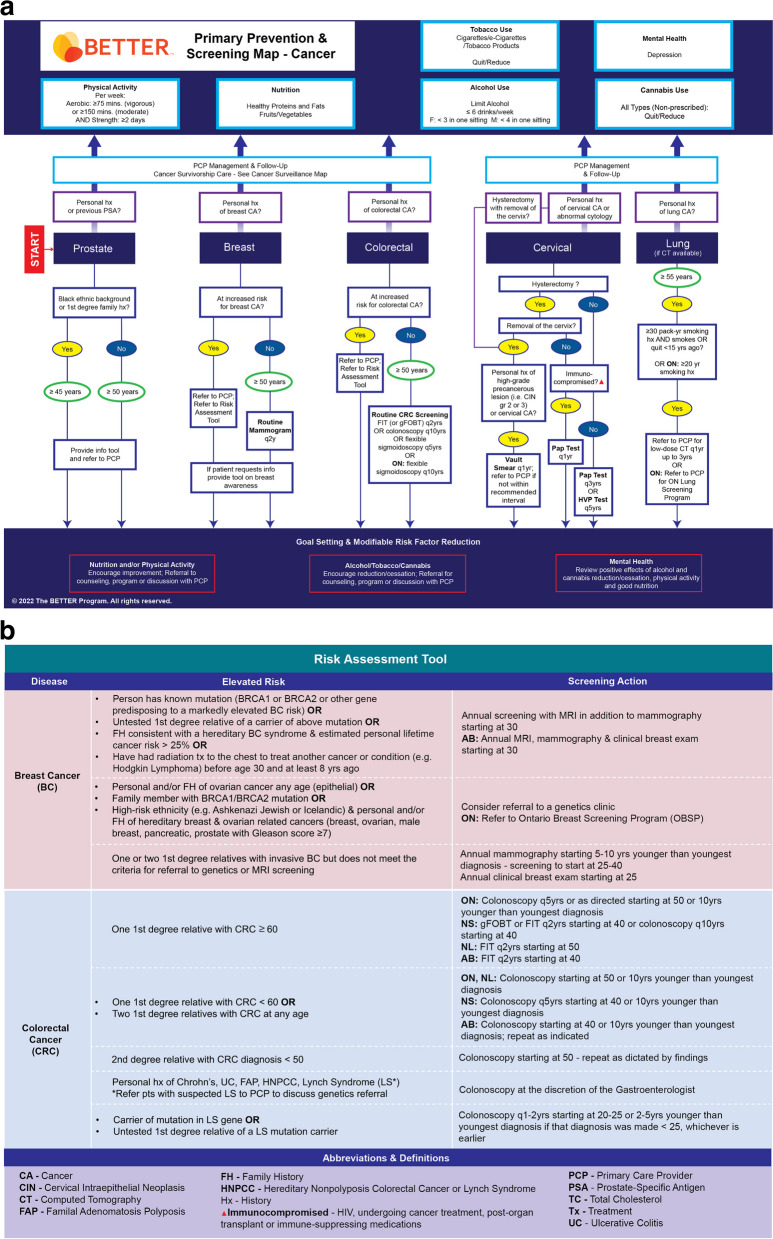
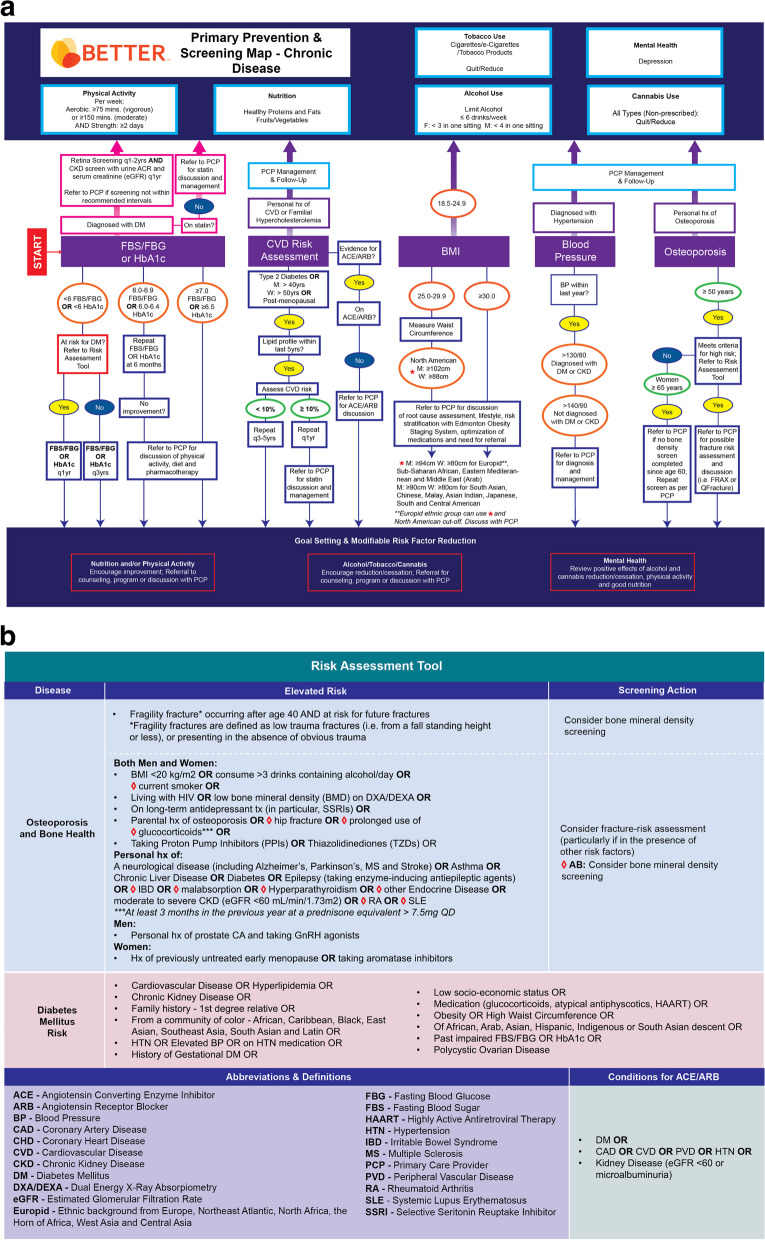
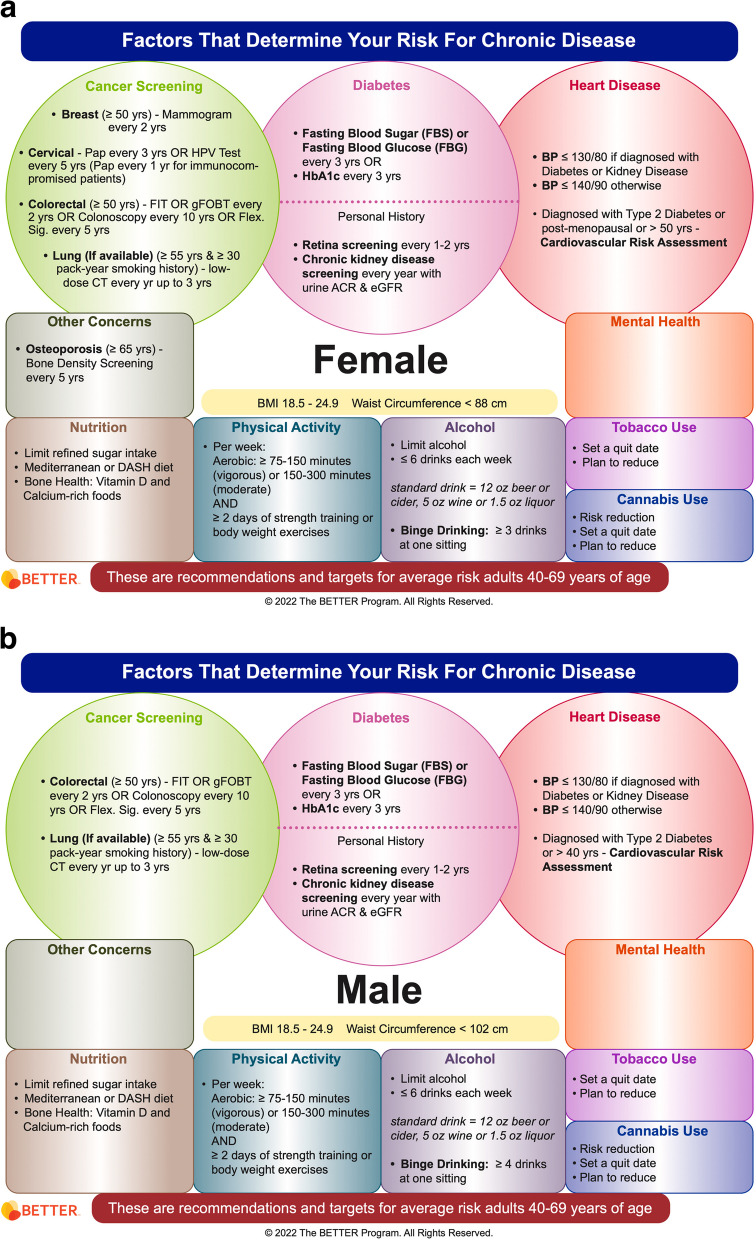
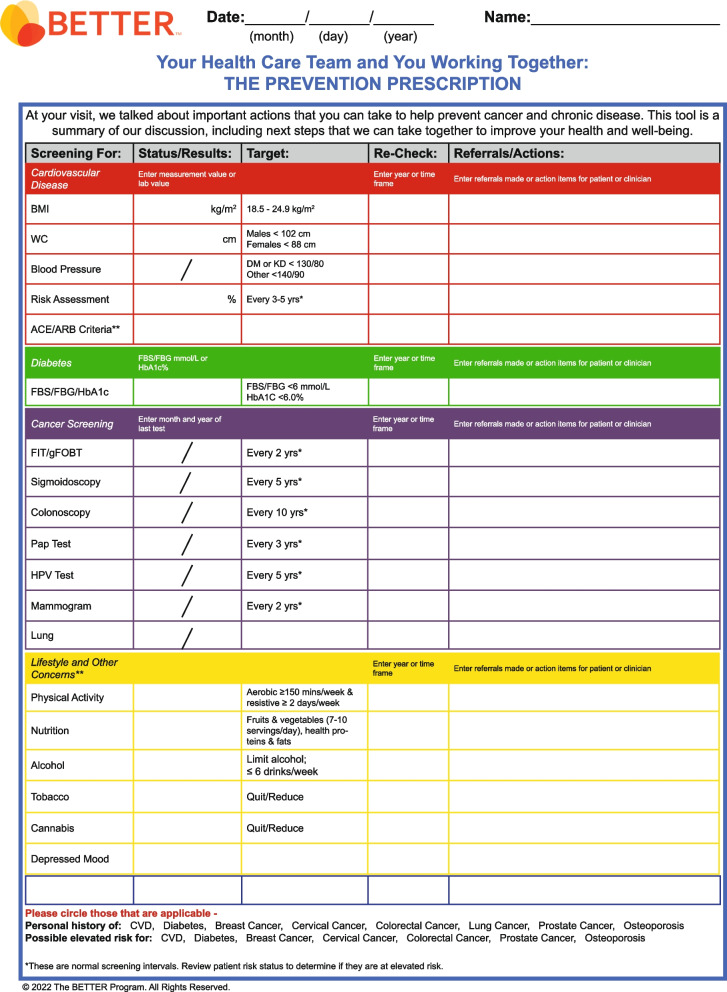
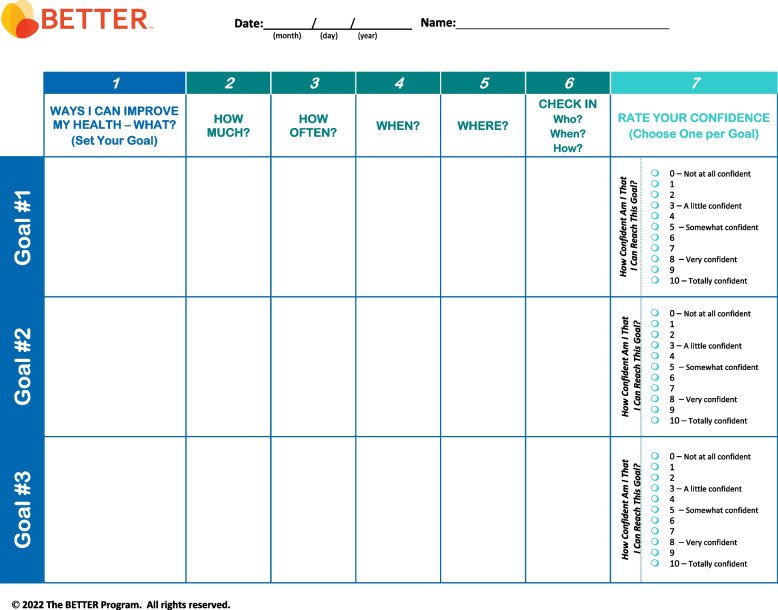
Discussion
Improving CCDPS in primary care is crucial to reducing the burden of cancer and chronic disease and increasing the sustainability of the healthcare system. In this paper, we describe the development of a comprehensive suite of resources and harmonization of recommendations that support CCDPS in patients 40–69 years of age. These are tailored to the individual by taking their personal medical history, family history, and genetics into consideration and for implementation in 4 Canadian provinces by incorporating provincial guidance. Stakeholders and end-users representing diverse perspectives (patients, policy makers, clinicians, and researchers) were engaged throughout the process to ensure that the clinical recommendations integrated into the BETTER program would be relevant, usable, and implementable.
Our evidence review involved a structured search of CPG databases, guideline developers, and grey literature to compile evidence-based clinical recommendations for CCDPS applicable to adults in the primary care setting. The resulting clinical recommendations expanded the age group for the BETTER program from 40–65 to 40–69 and added 3 new primary prevention and screening topics to the comprehensive scope of the program. In addition, clinical recommendations for secondary prevention of diabetes were introduced – retinopathy screening and screening for chronic kidney disease (see Table 2).
Informed by 51 international and Canadian CPGs and 22 guidelines from provincial organizations across 16 topics, the refined BETTER toolkit includes updated CCDPS care maps with succinct, clear, actionable recommendations that translate clinical evidence to PCPs to inform patient care, a streamlined patient survey to capture a patient’s prevention and screening history, and agenda setting tools to help set expectations for discussions with patients. The BETTER tools can be used at point of care to identify outstanding CCDPS actions and provide opportunities to address prevention and screening comprehensively, across many cancers and chronic diseases, with individual patients while considering their health goals, values, and preferences.
Initiated by the 1995 Institute of Medicine report Setting Priorities for Clinical Practice Guidelines [ref. 30], several decades of investment have resulted in robust methods to create high-quality guidelines; however, to achieve intended outcomes, CPGs must be implementable in real-world practice. The BETTER program has demonstrated that nuanced clinical tools can be designed to facilitate decision-making between PCPs and patients across multiple chronic diseases and lifestyle factors [ref. 2, ref. 17, ref. 18]. In this evidence review, we extended our topic scope, included health policy makers and patients in the evidence synthesis process, and tailored the included clinical recommendations for implementation in 4 Canadian provinces. The BETTER program process, grounded in the intersection between clinical practice, health policy, and systematic evidence, addresses a needed step to ensure feasible implementation of CPGs.
We recognize that our approach has limitations. Our population of interest was limited to adults 40–69 years of age with a focus on CCDPS and related risk factors. However, we believe that our approach may be useful to extend the work to different age groups, secondary prevention, and chronic disease management. All guidelines included in our review were published between 2016 and 2021 and as a result, recommendations from recent research, including guidelines published following the COVID-19 pandemic, would have been missed. For example, while the BETTER toolkit was being refined, two Canadian CPGs relating to cardiovascular disease [ref. 9] and alcohol use [ref. 31] were published in 2022 and 2023, respectively. To ensure that the recommendations used in the BETTER program remained clinically relevant, a subset of the BETTER CWG reviewed the CPGs and decided to include their recommendations. This highlights the importance of periodically and consistently reviewing the existing evidence to ensure that clinical practice is informed by the best current guidance. Though the clinical guidance was tailored to 4 jurisdictions in Canada and may not be applicable to other global jurisdictions or Canadian regions, the national recommendations included are relevant to a broad Canadian audience, and the tailoring methods used may prove useful to others when incorporating guidance for use in their context.
We developed a structured approach to synthesizing and blending CPG recommendations for application into primary care settings as described in our previous work [ref. 6, ref. 11]. The process involved members of the Clinical Working Group sharing their diverse perspectives during group discussions to reach consensus for inclusion, harmonization, and synthesis of clinical recommendations extracted from high-quality CPGs. Though this approach is novel and not as recognized as other methodological approaches, such as the Delphi Method, it may still be used to guide and inform others on how to incorporate current clinical guidance into practice. Lastly, members of the Clinical Working Group were not asked to declare possible conflicts of interest prior to their involvement in the evidence review process; however, they represented diverse groups (PCPs, other healthcare professionals, patients, health policy specialists, content experts, researchers) from 4 Canadian Provinces, many of whom are authors on this manuscript and who have declared any competing interests here.
Conclusions
The process used by the BETTER program to synthesize and harmonize international and Canadian CPG recommendations resulted in a suite of tools and resources to support CCDPS in primary care practice. This approach incorporates diverse perspectives of patients, PCPs, and health policy makers to ensure usability in real-world practice. Used together, the BETTER toolkit provides resources and tools that clearly and succinctly express the breath of high-quality clinical evidence that was synthesized into actionable recommendations to help inform patient care and enable primary care providers to address CCDPS comprehensively in their clinical settings. The methods used may be applicable to others contemplating integrating evidence across broad content areas in primary care to help facilitate comprehensive care. The updated BETTER toolkit is available to PCPs and interprofessional team members practicing in Canadian primary care settings through the BETTER program [ref. 12].
Supplementary Materials
References
- 1.Public Health Agency of Canada. Prevalence of Chronic Diseases and Risk Factors among Canadians aged 65 years and older 2020 2020 [Available from: https://www.canada.ca/en/services/health/publications/diseases-conditions/prevalence-chronic-disease-risk-factors-canadians-aged-65-years-older.html.
- E Grunfeld, D Manca, R Moineddin, KE Thorpe, JS Hoch, D Campbell-Scherer. Improving chronic disease prevention and screening in primary care: results of the BETTER pragmatic cluster randomized controlled trial. BMC Fam Pract, 2013. [DOI | PubMed]
- KS Yarnall, KI Pollak, T Ostbye, KM Krause, JL Michener. Primary care: is there enough time for prevention?. Am J Public Health, 2003. [DOI | PubMed]
- J Porter, C Boyd, MR Skandari, N Laiteerapong. Revisiting the time needed to provide adult primary care. J Gen Intern Med, 2023. [DOI | PubMed]
- R Grol. Successes and failures in the implementation of evidence-based guidelines for clinical practice. Med Care, 2001. [PubMed]
- D Campbell-Scherer, J Rogers, D Manca, K Lang-Robertson, S Bell, G Salvalaggio. Guideline harmonization and implementation plan for the BETTER trial: building on existing tools to improve chronic disease prevention and screening in family practice. CMAJ Open, 2014. [DOI | PubMed]
- DP Manca, M Greiver, JC Carroll, G Salvalaggio, A Cave, J Rogers. Finding a BETTER way: a qualitative study exploring the prevention practitioner intervention to improve chronic disease prevention and screening in family practice. BMC Fam Pract, 2014. [DOI | PubMed]
- SW Tobe, JA Stone, T Anderson, S Bacon, AYY Cheng, SS Daskalopoulou. Canadian Cardiovascular Harmonized National Guidelines Endeavour (C-CHANGE) guideline for the prevention and management of cardiovascular disease in primary care: 2018 update. CMAJ, 2018. [DOI | PubMed]
- R Jain, JA Stone, G Agarwal, JG Andrade, SL Bacon, HS Bajaj. Canadian Cardiovascular Harmonized National Guideline Endeavour (C-CHANGE) guideline for the prevention and management of cardiovascular disease in primary care: 2022 update. CMAJ, 2022. [DOI | PubMed]
- SW Tobe, JA Stone, M Brouwers, O Bhattacharyya, KM Walker, M Dawes. Harmonization of guidelines for the prevention and treatment of cardiovascular disease: the C-CHANGE Initiative. CMAJ, 2011. [DOI | PubMed]
- DP Manca, D Campbell-Scherer, K Aubrey-Bassler, K Kandola, C Aguilar, J Baxter. Developing clinical decision tools to implement chronic disease prevention and screening in primary care: the BETTER 2 program (building on existing tools to improve. Implement Sci, 2015. [DOI | PubMed]
- 12.The BETTER Program [Available from: www.better-program.ca.
- T Bodenheimer, EH Wagner, K Grumbach. Improving primary care for patients with chronic illness. JAMA, 2002. [DOI | PubMed]
- EH Wagner, BT Austin, M Von Korff. Organizing care for patients with chronic illness. Milbank Q, 1996. [DOI | PubMed]
- VJ Barr, S Robinson, B Marin-Link, L Underhill, A Dotts, D Ravensdale. The expanded Chronic Care Model: an integration of concepts and strategies from population health promotion and the Chronic Care Model. Hosp Q, 2003. [PubMed]
- N Sopcak, C Fernandes, MA O’Brien, D Ofosu, M Wong, T Wong. What is a prevention visit? A qualitative study of a structured approach to prevention and screening – the BETTER WISE project. BMC Fam Pract, 2021. [DOI | PubMed]
- 17.Aubrey-Bassler K, Fernandes C, Penney C, Cullen R, Meaney C, Sopcak N, et al. The effectiveness of a proven chronic disease prevention and screening intervention in diverse and remote primary care settings: an implementation study on the BETTER 2 Program. BJGP Open. 2019;3(3). https://bjgpopen.org/content/3/3/bjgpopen19X101656.
- AK Lofters, MA O’Brien, R Sutradhar, AD Pinto, NN Baxter, P Donnelly. Building on existing tools to improve chronic disease prevention and screening in public health: a cluster randomized trial. BMC Public Health, 2021. [DOI | PubMed]
- DP Manca, C Fernandes, E Grunfeld, K Aubrey-Bassler, M Shea-Budgell, A Lofters. The BETTER WISE protocol: building on existing tools to improve cancer and chronic disease prevention and screening in primary care for wellness of cancer survivors and patients – a cluster randomized controlled trial embedded in a mixed methods design. BMC Cancer, 2018. [DOI | PubMed]
- DP Manca, C Fernandes, A Lofters, K Aubrey-Bassler, M Shea-Budgell, D Campbell-Scherer. Results from the BETTER WISE trial: a pragmatic cluster two arm parallel randomized controlled trial for primary prevention and screening in primary care during the COVID-19 pandemic. BMC Prim Care, 2023. [DOI | PubMed]
- N Sopcak, C Fernandes, D Ofosu, M Wong, I Khalil, T Wong. Facilitators and Barriers to the Implementation of BETTER WISE, a Chronic Disease and Prevention Intervention in Canada: A Qualitative Study. Glob Implement Res Appl, 2023. [DOI | PubMed]
- N Sopcak, M Wong, C Fernandes, D Ofosu, I Khalil, D Manca. Prevention and screening during the COVID-19 pandemic: qualitative findings from the BETTER WISE project. BMC Prim Care, 2023. [DOI | PubMed]
- ID Graham, J Logan, MB Harrison, SE Straus, J Tetroe, W Caswell. Lost in knowledge translation: time for a map?. J Contin Educ Health Prof, 2006. [DOI | PubMed]
- P Nilsen. Making sense of implementation theories, models and frameworks. Implement Sci, 2015. [DOI | PubMed]
- 25.Centre for Effective Practice [Available from: https://cep.health/.
- MC Brouwers, ME Kho, GP Browman, JS Burgers, F Cluzeau, G Feder. AGREE II: advancing guideline development, reporting and evaluation in health care. CMAJ, 2010. [DOI | PubMed]
- K Kroenke, RL Spitzer, JB Williams. The Patient Health Questionnaire-2: validity of a two-item depression screener. Med Care, 2003. [DOI | PubMed]
- J Hippisley-Cox, C Coupland, P Brindle. Development and validation of QRISK3 risk prediction algorithms to estimate future risk of cardiovascular disease: prospective cohort study. BMJ, 2017. [DOI | PubMed]
- 29.National Health Service. The General Practice Physical Activity Questionnaire (GPPAQ): A screening tool to assess adut physical activity levels within primary care. 2009.
- 30.Institute of Medicine. Setting Priorities for Clinical Practice Guidelines. Field MJ, editor. Washington (DC): National Academy Press; 1995.
- 31.Paradis C, Butt P, Shield K, Poole N, Wells S, Naimi T, et al. Canada’s Guidance on Alcohol and Health: Final Report. Ottawa, ON; 2023.
- 32.British Columbia Centre on Substance Use. Provincial Guideline for the Clinical Management of High-Risk Drinking and Alcohol Use Disorder. British Columbia Centre on Substance Use (BCCSU); 2019.
- 33.Allen S, Forney-Gorman A, Homan M, Kearns A, Kramlinger A, Sauer M. Diagnosis and Treatment of Osteoporosis. Institute for Clinical Systems Improvement; 2017.
- SJ Curry, AH Krist, DK Owens, MJ Barry, AB Caughey. Screening and Behavioral Counseling Interventions to Reduce Unhealthy Alcohol Use in Adolescents and Adults: US Preventive Services Task Force Recommendation Statement. JAMA, 2018. [DOI | PubMed]
- 35.The Management of Substance Use Disorders Work Group. VA/DoD Clinical Practice Guideline for the Management of Substance Use Disorders. In: Department of Veterans Affairs and Department of Defense, editor.: Department of Veterans Affairs and Department of Defense; 2021.
- DM Rabi, KA McBrien, R Sapir-Pichhadze, M Nakhla, SB Ahmed, SM Dumanski. Hypertension Canada’s 2020 Comprehensive Guidelines for the Prevention, Diagnosis, Risk Assessment, and Treatment of Hypertension in Adults and Children. Can J Cardiol, 2020. [DOI | PubMed]
- 37.ASaP+ Alcohol Use: Recommendation, Rationale and Supplemental References. Alberta Health Services, Alberta Cancer Prevention Legacy Fund; 2019.
- 38.Quality Standards: Problematic Alcohol Use and Alcohol Use Disorder. Care for People 15 Years of Age and Older. Ontario Health (Health Quality Ontario); 2020.
- 39.Nova Scotia Breast Screening of Average Risk Women. Nova Scotia Health Authority; 2019.
- C Hamashima, CC Hamashima, M Hattori, S Honjo, Y Kasahara. The Japanese Guidelines for Breast Cancer Screening. Jpn J Clin Oncol, 2016. [DOI | PubMed]
- 41.Clinical Practice Guidelines – Breast Disease Site: Indications for Use of Breast Magnetic Resonance Imaging (MRI). Eastern Health; 2018.
- S Klarenbach, N Sims-Jones, G Lewin, H Singh, G Theriault, M Tonelli. Recommendations on screening for breast cancer in women aged 40–74 years who are not at increased risk for breast cancer. Can Med Assoc J, 2018. [DOI | PubMed]
- A Migowski, GAE Silva, MBK Dias, M Diz, DR Sant’Ana, P Nadanovsky. Guidelines for early detection of breast cancer in Brazil. II – New national recommendations, main evidence, and controversies. Cad Saude Publica, 2018. [PubMed]
- 44.Ontario Breast Screening Program (OBSP). Guidelines Summary. Ontario Health (Cancer Care Ontario ); 2015.
- 45.Breast Cancer Screening. Summary of the Clinical Practice Guideline Toward Optimized Practice. 2015.
- B Fischer, C Russell, P Sabioni, W van den Brink, B Le Foll, W Hall. Lower-Risk Cannabis Use Guidelines: A Comprehensive Update of Evidence and Recommendations. Am J Public Health, 2017. [DOI | PubMed]
- DK Arnett, RS Blumenthal, MA Albert, AB Buroker, ZD Goldberger, EJ Hahn. 2019 ACC/AHA Guideline on the Primary Prevention of Cardiovascular Disease: A Report of the American College of Cardiology/American Heart Association Task Force on Clinical Practice Guidelines. J Am Coll Cardiol, 2019. [DOI | PubMed]
- 48.The Management of Dyslipidemia for Cardiovascular Risk Reduction Working Group. VA/DoD Clinical Practice Guideline for the Management of Dyslipidemia for Cardiovascular Risk Reduction. In: Department of Veterans Affairs and Department of Defense, editor.: Department of Veterans Affairs and Department of Defense. 2020.
- 49.Revised Screening Maneuvers Menu for Adults: Alberta Screening and Prevention Program (ASaP). Toward Optimized Practice. 2017.
- ETH Fontham, AMD Wolf, TR Church, R Etzioni, CR Flowers, A Herzig. Cervical cancer screening for individuals at average risk: 2020 guideline update from the American Cancer Society. CA Cancer J Clin, 2020. [DOI | PubMed]
- SJ Curry, AH Krist, DK Owens, MJ Barry, AB Caughey. Screening for Cervical Cancer: US Preventive Services Task Force Recommendation Statement. JAMA, 2018. [DOI | PubMed]
- 52.Cervical Cancer Screening Clinical Practice Guideline. Toward Optimized Practice; 2016.
- 53.Ontario Cervical Screening Program (OCSP) Screening Recommendations Summary. Ontario Health (Cancer Care Ontario); 2020.
- 54.Health Professional Guide: Cervical Screening Practice Guidelines. In: Program NSCC, editor.: Nova Scotia Health Authority; 2019.
- 55.Cervical Screening Guidelines for Newfoundland and Labrador. Cervical Screening Initiatives; 2016.
- Recommendations on screening for colorectal cancer in primary care. CMAJ, 2016. [DOI | PubMed]
- KW Davidson, MJ Barry, CM Mangione, M Cabana, AB Caughey. Screening for Colorectal Cancer: US Preventive Services Task Force Recommendation Statement. JAMA, 2021. [DOI | PubMed]
- LM Helsingen, PO Vandvik, HC Jodal, T Agoritsas, L Lytvyn, JC Anderson. Colorectal cancer screening with faecal immunochemical testing, sigmoidoscopy or colonoscopy: a clinical practice guideline. BMJ, 2019. [DOI | PubMed]
- D Leddin, DA Lieberman, F Tse, AN Barkun, AM Abou-Setta, JK Marshall. Clinical Practice Guideline on Screening for Colorectal Cancer in Individuals With a Family History of Nonhereditary Colorectal Cancer or Adenoma: The Canadian Association of Gastroenterology Banff Consensus. Gastroenterology, 2018. [DOI | PubMed]
- AMD Wolf, ETH Fontham, TR Church, CR Flowers, CE Guerra, SJ LaMonte. Colorectal cancer screening for average-risk adults: 2018 guideline update from the American Cancer Society. CA Cancer J Clin, 2018. [DOI | PubMed]
- 61.Colorectal Cancer Screening Clinical Practice Guideline. Toward Optimized Practice; 2020.
- 62.ColonCancerCheck (CCC) Guide to Average Risk Screening with the Fecal Immunochemical Test (FIT) in Ontario. Ontario Health (Cancer Care Ontario); 2020.
- 63.Clinical Practice Guidelines: Newfoundland & Labrador Colon Screening Program (NLCSP). Eastern Health; 2019.
- 64.Depression in adults: recognition and management. NICE Clinical guideline. National Institute for Health and Care Excellence; 2009.
- M Joffres, A Jaramillo, J Dickinson, G Lewin, K Pottie, E Shaw. Recommendations on screening for depression in adults. CMAJ, 2013. [DOI | PubMed]
- AL Siu, K Bibbins-Domingo, DC Grossman, LC Baumann, KW Davidson. Screening for Depression in Adults: US Preventive Services Task Force Recommendation Statement. JAMA, 2016. [DOI | PubMed]
- 67.Trangle M, Gursky J, Haight R, Hardwig J, Hinnenkamp T, Kessler D, et al. Adult Depression in Primary Care. Institute for Clinical Systems Improvement; Updated March 2016.
- D Canada. Clinical Practice Guidelines for the Prevention and Management of Diabetes in Canada. Can J Diabetes, 2018
- KW Davidson, MJ Barry, CM Mangione, M Cabana, AB Caughey. Screening for Prediabetes and Type 2 Diabetes: US Preventive Services Task Force Recommendation Statement. JAMA., 2021. [DOI | PubMed]
- 70.The Management of Type 2 Diabetes Mellitus in Primary Care Work Group. VA/DoD Clinical Practice Guideline for the Managment of Type 2 Diabetes Mellitus in Primary Care. In: Department of Veterans Affairs and Department of Defense, editor.: Department of Veterans Affairs and Department of Defense. 2017.
- G Grunberger, J Sherr, M Allende, T Blevins, B Bode, Y Handelsman. American Association of Clinical Endocrinology Clinical Practice Guideline: The Use of Advanced Technology in the Management of Persons With Diabetes Mellitus. Endocr Pract, 2021. [DOI | PubMed]
- 72.Quality Standards: Prediabetes and Type 2 Diabetes. Care for People of All Ages. Ontario Health (Health Quality Ontario); 2021.
- 73.Rosella L, Bornstein S, Mackey S, Grignon M. Prevention and Screening for Type 2 Diabetes in Newfoundland and Labrador. St. John’s, NL: Newfoundland & Labrador Centre for Applied Health Research, Memorial University. 2016.
- AH Krist, KW Davidson, CM Mangione, MJ Barry, M Cabana. Screening for Lung Cancer: US Preventive Services Task Force Recommendation Statement. JAMA., 2021. [DOI | PubMed]
- PJ Mazzone, GA Silvestri, LH Souter, TJ Caverly, JP Kanne, HA Katki. Screening for Lung Cancer: CHEST Guideline and Expert Panel Report. Chest, 2021. [DOI | PubMed]
- 76.Guidelines and Advice: Lung Cancer Screening Information for Healthcare Providers: Ontario Health (Cancer Care Ontario); n.d. [Available from: https://www.cancercareontario.ca/en/guidelines-advice/cancer-continuum/screening/lung-cancer-screening-information
- 77.Osteoporosis Prevention, Screening, and Diagnosis: ACOG Clinical Practice Guideline No. 1. Obstet Gynecol. 2021;138(3):494-506.
- AH Krist, KW Davidson, CM Mangione, MJ Barry, M Cabana. Behavioral Counseling Interventions to Promote a Healthy Diet and Physical Activity for Cardiovascular Disease Prevention in Adults With Cardiovascular Risk Factors: US Preventive Services Task Force Recommendation Statement. JAMA., 2020. [DOI | PubMed]
- SJ Curry, AH Krist, DK Owens, MJ Barry, AB Caughey. Behavioral Weight Loss Interventions to Prevent Obesity-Related Morbidity and Mortality in Adults: US Preventive Services Task Force Recommendation Statement. JAMA., 2018. [DOI | PubMed]
- 80.The Management of Adult Overweight and Obesity Work Group. VA/DoD Clinical Practice Guideline for the Management of Adult Overweight and Obesity. In: Department of Veterans Affairs and Department of Defense, editor.: Department of Veterans Affairs and Department of Defense. 2020.
- S Wharton, DCW Lau, M Vallis, AM Sharma, L Biertho, D Campbell-Scherer. Obesity in adults: a clinical practice guideline. CMAJ, 2020. [DOI | PubMed]
- 82.Nutrition Guideline: Adult Obesity Care. Alberta Health Services, Nutrition Services. 2020.
- 83.Scottish Intercollegiate Guidelines Network (SIGN). Management of osteoporosis and the prevention of fragility fractures. Edinburgh: Scottish Intercollegiate Guidelines Network (SIGN). 2021.
- R Eastell, CJ Rosen, DM Black, AM Cheung, MH Murad, D Shoback. Pharmacological Management of Osteoporosis in Postmenopausal Women: An Endocrine Society* Clinical Practice Guideline. J Clin Endocrinol Metab, 2019. [DOI | PubMed]
- SJ Curry, AH Krist, DK Owens, MJ Barry, AB Caughey. Screening for Osteoporosis to Prevent Fractures: US Preventive Services Task Force Recommendation Statement. JAMA, 2018. [DOI | PubMed]
- A Qaseem, MA Forciea, RM McLean, TD Denberg, MJ Barry. Treatment of Low Bone Density or Osteoporosis to Prevent Fractures in Men and Women: A Clinical Practice Guideline Update From the American College of Physicians. Ann Intern Med, 2017. [DOI | PubMed]
- D Shoback, CJ Rosen, DM Black, AM Cheung, MH Murad, R Eastell. Pharmacological Management of Osteoporosis in Postmenopausal Women: An Endocrine Society Guideline Update. J Clin Endocrinol Metab., 2020. [DOI]
- 88.Diagnosis and Managment of Osteoporosis. Clinical Practice Guideline.: Toward Optimized Practice; 2016.
- 89.WHO guidelines on physical activity and sedentary behaviour. Geneva; 2020.
- R Ross, JP Chaput, LM Giangregorio, I Janssen, TJ Saunders, ME Kho. Hour Movement Guidelines for Adults aged 18–64 years and Adults aged 65 years or older: an integration of physical activity, sedentary behaviour, and sleep. Appl Physiol Nutr Metab, 2020. [DOI | PubMed]
- DC Grossman, SJ Curry, DK Owens, K Bibbins-Domingo, AB Caughey. Screening for Prostate Cancer: US Preventive Services Task Force Recommendation Statement. JAMA., 2018. [DOI | PubMed]
- HB Carter, PC Albertsen, MJ Barry, R Etzioni, SJ Freedland, KL Greene. Early detection of prostate cancer: AUA Guideline. J Urol, 2013. [DOI | PubMed]
- RA Rendon, RJ Mason, K Marzouk, A Finelli, F Saad, A So. Canadian Urological Association recommendations on prostate cancer screening and early diagnosis. Can Urol Assoc J, 2017. [DOI | PubMed]
- 94.Cancer Care Ontario Position Statement on Prostate Cancer Screening using the Prostate-Specific Antgen (PSA) Test. Ontario Health (Cancer Care Ontario); 2017.
- N Bell, S Connor Gorber, A Shane, M Joffres, H Singh, J Dickinson. Recommendations on screening for prostate cancer with the prostate-specific antigen test. CMAJ, 2014. [DOI | PubMed]
- AH Krist, KW Davidson, CM Mangione, MJ Barry, M Cabana. Interventions for Tobacco Smoking Cessation in Adults, Including Pregnant Persons: US Preventive Services Task Force Recommendation Statement. JAMA, 2021. [DOI | PubMed]
- 97.Registered Nurses’ Association of Ontario. Integrating Tobacco Interventions into Daily Practice. Toronto, ON; 2017.
- 98.Clinical Support Primer: Tobacco Harm Reduction – E-Cigarettes Alberta Health Services (Tobacco Reduction Program); 2019.
- 99.Vaping products including e-cigarettes. Ontario Health (Cancer Care Ontario); 2020.