
Selective TRPV2 Antagonists Derived from the Natural Product Piperlongumine Inhibit Cancer Cell Migration and Metastasis
Abstract
TRPV2 is the least studied member of the vanilloid TRP subfamily despite its emerging relevance in cancer metastasis, pain, and inflammation. Although several small-molecule TRPV2 modulators have been reported, including the natural products piperlongumine (PL) and cannabidiol, all lack selectivity, complicating the interpretation of phenotypic readouts and functional insights into the role of the channel in health and disease. Here, we report a series of PL-based derivatives rationally designed to maintain TRPV2 antagonism while eliminating covalent off-target activity associated with the electrophilic groups present in PL. Using electrophysiological and calcium fluorescence imaging assays in HEK293T cells and DRG nociceptors, we identified HKC54 as the most potent TRPV2 antagonist to date (IC50 = 0.4 μM), displaying ∼50-fold selectivity over TRPV1 and ∼70-fold selectivity over TRPA1. Cellular thermal shift assays demonstrated direct TRPV2 engagement, and molecular dynamics and docking studies suggest a near-identical binding mode of the derivatives to PL. To assess proteome-wide selectivity, we pursued an unbiased chemoproteomic strategy and developed photoaffinity probes derived from PL and noncovalent derivative HKC22. Whereas the PL-based probe labeled many established covalent and noncovalent PL targets (e.g., GSTP1, GSTO1, STAT3, and KEAP1), no off-targets were detected for HKC22, suggesting high selectivity for TRPV2. Finally, PL derivatives inhibited cancer cell migration in vitro and suppressed metastasis in vivo, underscoring the therapeutic potential of selective TRPV2 antagonists.
Affiliations: † Yusuf Hamied Department of Chemistry, 2152University of Cambridge, Lensfield Road, Cambridge CB2 1EW, U.K.; ‡ GIMM – Gulbenkian Institute for Molecular Medicine, Avenida Prof. Egas Moniz, Lisboa 1649-028, Portugal; § Instituto de Investigación, Desarrollo e Innovación en Biotecnología Sanitaria de Elche (IDiBE), Universidad Miguel Hernandez, Avda. Universidad s/n, Elche 03202, Spain; ∥ Chemprecise Lda, Torres Vedras 2560-247, Portugal; ⊥ Research Institute for Medicines (iMed.ULisboa), Faculty of Pharmacy, Universidade de Lisboa, Lisbon 1649-003, Portugal; # CeMM Research Center for Molecular Medicine of the Austrian Academy of Sciences, Vienna 1090, Austria; ∇ Departamento de Química, Universidad de La Rioja, Instituto de Investigación en Química (IQUR), Logroño 26006, Spain; ○ Translational Chemical Biology Group, Spanish National Cancer Research Centre 26 (CNIO), Madrid 28029, Spain
License: © 2026 The Authors. Published by American Chemical Society CC BY 4.0 This article is licensed under CC-BY 4.0
Article links: DOI: 10.1021/acschembio.5c00935 | PubMed: 41879799 | PMC: PMC13097083
Relevance: Moderate: mentioned 3+ times in text
Full text: PDF (6.5 MB)
Introduction
Transient receptor potential (TRP) channels are a superfamily of membrane proteins that contribute to calcium homeostasis. With over 50 characterized members, they constitute the second largest family of voltage-gated-like ion channels after the potassium superfamily.ref. ref1 Members share a conserved membrane topology of six transmembrane segments (S1–S6), with a pore-forming loop between S5 and S6. The N- and C-terminal tails are cytoplasmic.ref. ref2 The mammalian TRPV (vanilloid) subfamily comprises six members (TRPV1–6) grouped into thermosensitive, calcium-nonselective TRPV1–4, and calcium-selective TRPV5–6. TRPV1 is the best studied owing to its critical role in thermosensation and nociception and the discovery that capsaicin directly activates the channel. In contrast, TRPV2 is not activated by capsaicin, despite sharing ∼50% sequence identity with TRPV1, and remains the least characterized TRPV member at the molecular level.ref. ref2 TRPV2 is activated by physical stimuli including heat (> 52 °C), mechanical stretch, and osmotic swelling.ref. ref2
TRPV2 is broadly expressed in the brain, vascular smooth muscle cells, gastrointestinal tract, macrophages, and urothelial tract. Correspondingly, it is known to play vital roles in neuronal development, cardiac function, and immunity.ref. ref3 Aberrant expression of TRPV2 has been implicated in muscular dystrophy,ref. ref4 cardiomyopathy,ref. ref5 diabetes,ref. ref6 and multiple cancers.ref7,ref8 Notably, TRPV2 appears to drive cancer cell invasion and metastasis rather than proliferation. Despite its important roles in physiology and disease, few endogenous or synthetic chemical modulators of TRPV2 are known, and most lack selectivity across the TRP superfamily, complicating interpretation of phenotypic readouts in systems that coexpress several TRP channels.ref. ref2
Cannabinoids, including (−)-trans-Δ9-tetrahydrocannabinol, cannabidiol (CBD), and δ9-tetrahydrocannabivarin, are among the most potent TRPV2 agonists but activate several other TRPV2 channels; CBD is also a potent activator of TRPV1 and TRPA1.ref. ref2 Additional nonselective agonists include probenecid,ref9−ref10ref11 2-aminoethoxydiphenyl borate,ref11−ref12ref13 and nonpsychotropic cannabinoid Δ9-tetra-hydrocannabiorcol (C16).ref. ref11 Among antagonists, ruthenium red is potent but broadly nonselective.ref11,ref13,ref14 Tranilast and its derivativesref. ref5 have been used as TRPV2-specific antagonists, but direct, selective antagonism remains insufficiently validated.ref. ref2 Valdecoxibref. ref15 and SET2ref. ref16 were purported to be subtype-selective TRPV2 antagonists, yet their proteome-wide selectivity has not been profiled. These limitations underscore the need for selective TRPV2 modulators and the systematic characterization of their proteome-wide targets.
Photoaffinity labeling (PAL) is a valuable approach for profiling ligand-protein interactions in the native cellular environment. Uniquely, by conjugating a photoreactive group and click handle to a ligand, PAL can capture both covalent and reversible transient interactions. When coupled with MS-based proteomics, PAL enables unbiased assessment of proteome-wide selectivity and direct target engagement. PAL has previously been used to profile TRPC3 and TRPC5 ligands,ref17,ref18 providing precedent for TRP-channel profiling, but no PAL probes targeting any TRPV member have been reported. To complement chemoproteomic approaches, orthogonal strategies, such as the cellular thermal shift assay (CETSA), are often employed to confirm target engagement. CETSA measures changes in protein thermal stability upon ligand binding, and although initially optimized for soluble cytosolic proteins, recent advances incorporating mild detergents now permit its application to membrane proteins, including multipass transmembrane proteins like TRPV2.ref41,ref42 Together, PAL and CETSA provide complementary approaches to validate both binding and selectivity of candidate TRPV2 antagonists in a physiologically relevant context.
We previously identified the alkaloid natural product piperlongumine (PL; piplartine) as an allosteric antagonist of TRPV2 using the machine learning platform SPiDER.ref. ref19 A cryo-EM structure of PL bound to full-length rat TRPV2 (3.4 Å; PDB: 6WKN) revealed a noncovalent binding mode: the acyclic imide carbonyl forms key hydrogen bonds with T522 and R539, a methoxy substituent on the phenyl ring engages G530, and the Michael acceptors contribute hydrophobic contacts with Y525, V543, and L513.ref. ref19 Although PL contains two electrophilic Michael acceptors and covalently modifies numerous cellular proteins including KEAP1,ref. ref20 GSTO1,ref. ref21 and STAT3,ref. ref22 washout experiments demonstrated reversible TRPV2 inhibition, and no covalent adducts were evident in the cryo-EM structure. PL has potent anticancer and antiviral properties,ref23−ref24ref25ref26ref27ref28ref29 but its electrophilicity drives extensive off-target covalent reactivity. Therefore, given that PL engages TRPV2 noncovalently, we hypothesized that PL derivatives lacking the electrophilic groups could retain TRPV2 antagonism while minimizing off-target interactions.
In this study, we report the design, synthesis, and characterization of PL derivatives that lack the key electrophilic groups that cause covalent off-targets yet maintain and improve TRPV2 antagonism. Using electrophysiological and calcium fluorescence imaging assays in both HEK293T cells and rat dorsal root ganglion (DRG) neurons, we identify HKC54 as the most potent TRPV2 antagonist described to date (IC50 = 0.4 μM), displaying ∼50-fold selectivity over TRPV1 and ∼70-fold selectivity over TRPA1. To characterize target engagement and proteome-wide selectivity, we developed PAL probes derived from PL and noncovalent derivative HKC22, the first PAL probe for any TRPV channel. Proteomic analysis revealed no detectable off-targets for HKC22, in stark contrast to the PL-based probe, which labeled numerous known covalent and noncovalent PL targets. CETSA confirmed direct target engagement of TRPV2 by HKC22 and HKC54, and molecular docking and dynamics provided insight into the near-identical binding mode of the analogues to PL. Finally, TRPV2 is emerging as an important antimetastasis target, and HKC22 and HKC54 exhibited potent inhibition of cellular migration in vitro and in vivo. Therefore, the PL derivatives presented herein represent a promising starting point for the development of selective TRPV2 antagonists that possess potent antimetastatic activity.
Results
Design of PL Derivatives to Remove Covalent Off-Targets
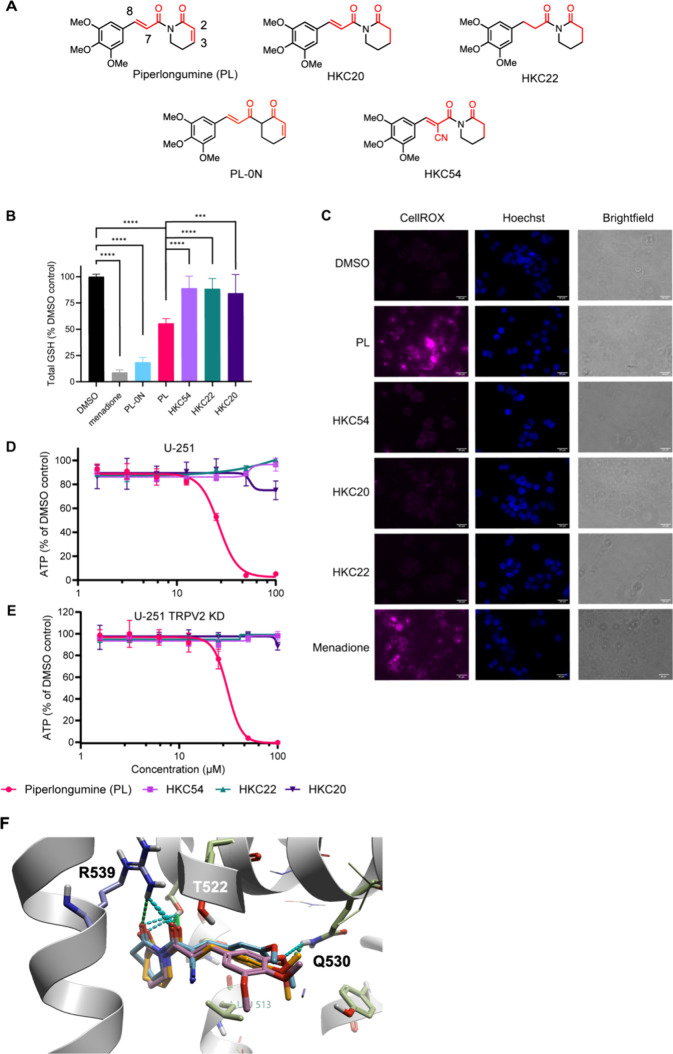
Since PL forms noncovalent interactions with TRPV2, we reasoned that removing or modifying the electrophilic groups of PL could both mitigate irreversible covalent off-targets and increase selectivity for TRPV2. The structure–activity relationship (SAR) of PL for its covalent targets is well-documented.ref. ref30 However, the SAR for reversibly binding TRPV2 remains unexplored. To that end, we designed and synthesized a range of PL analogues with different degrees of unsaturation and electrophilicity (Figure A); HKC54 contains a cyanoacrylamide that can form reversible covalent protein interactions.ref. ref31 Previous SAR studies have demonstrated that 2,3-olefin is particularly important for glutathione (GSH) depletion, reactive oxygen species (ROS) elevation, and cytotoxicity of PL.ref21,ref28 Moreover, small-molecule thiols undergo preferential heteroconjugation to C3 over C8 in vitro.ref. ref32 Therefore, we prioritized analogues lacking the more reactive C2–C3 olefin. The C7–C8 olefin, though not as reactive as C2–C3, may be required for binding TRPV2 since it imposes some conformational rigidity, and the π bond itself may be important for the hydrophobic interactions formed with Y525, V543, and L513.ref. ref33 To evaluate whether the derivatives had the same binding mode as PL, we performed molecular docking of HKC22 and HKC54 in the PL binding site of the PL-bound TRPV2 cryo-EM structure (Figure F). We observed a near-identical binding mode of the derivatives to PL, except that HKC22 and HKC54 appear to engage both of their carbonyl groups in hydrogen bonding interactions to R539, whereas only the acyclic carbonyl of PL engages in hydrogen bonds to R539 (and T522) (Figure S1A–C). To further model the binding mode and assess its stability, we performed a 300 ns molecular dynamics (MD) simulation of HKC22 bound to membrane-embedded TRPV2. The binding mode of the ligand remains stable, with key interactions mirroring those formed by PL (Figure S1D–F). These include a CH/π interaction between the aromatic ring of HKC22 and L513, along with hydrogen bonds between the exocyclic carbonyl group of the ligand and the hydroxyl side chain of T522, and between one of the aromatic methoxy groups and the amide −NH2 side chain of Q530. Taken together, the molecular docking and MD results suggest that the designed PL derivatives retain the same key interactions with TRPV2 even in the absence of one or both electrophilic groups. We next sought to evaluate whether the phenotypic effects of covalent off-targets, namely GSH depletion, ROS induction, and cytotoxicity,ref. ref28 had been removed as a surrogate measure of enhanced selectivity for TRPV2.
Confirming the Phenotypic Effects of Covalent Off-Target Removal
To compare the extent of GSH depletion caused by PL and derivatives, we measured total GSH levels using the GSH/GSSG-Glo assay following treatment of MCF-7 breast cancer cells for 6 h with 20 μM of each compound (menadione, PL-0N, PL, HKC54, HKC22, and HKC20) or vehicle control. We used the naphthoquinone menadione as a positive control since it is known to dramatically deplete GSH and induce the formation of ROS such as superoxide and hydrogen peroxide.ref34,ref35 None of the PL derivatives which lack the C2–C3 olefin (Figure A) significantly depleted the levels of total GSH (Figure B). PL depleted total GSH levels by ∼45% (p < 0.0001) compared to vehicle control and derivatives HKC54, HKC22, and HKC20. Treatment with PL-0N,ref. ref36 which lacks the imide in PL and consequently has a more electrophilic C2–C3 olefin, led to a ∼80% reduction in total GSH, similar to positive control menadione which reduced levels by ∼90%. To evaluate the ability of PL and derivatives to induce ROS, we performed fluorescence imaging using a redox-sensitive dye, CellROX Deep Red, following treatment of MCF-7 cells for 4 h with 20 μM of each compound (menadione, PL, HKC54, HKC22, and HKC20) or vehicle control. Again, menadione was used as a positive control. Only PL and menadione induced visible ROS (Figure C), highlighting the importance of C2–C3 olefin for the induction of oxidative stress observed upon PL treatment. Collectively, the lack of GSH depletion and ROS induction suggest that removing the C2–C3 olefin abolishes the phenotypic effects of irreversible covalent off-target engagement even when the C7–C8 olefin is still present (HKC20) or modified (HKC54).
We next measured the effect of PL and derivatives on the cell viability of multiple cancer cell lines (Figures D,E and S2A–D). The removal of the electrophilic groups of PL has been shown to significantly diminish its cytotoxicity in multiple studies.ref21,ref30 We chose a range of GBM cell lines (U-251, U-251 TRPV2 KD, and U-87 MG) due to our prior study that investigated PL-mediated TRPV2 inhibition in the context of GBM.ref. ref19 In addition, we selected two acute myeloid leukemia (AML) cell lines (MOLM-13 and HEL) since PL has demonstrated high potency in AML cells and selectivity over nontransformed cells.ref37,ref38 It is evident that only PL significantly reduces cell viability in all cell lines tested (Figures D,E and S2A–D). Having demonstrated that the characteristic phenotypic effects that rely on the electrophilic groups of PL were abolished upon Michael acceptor removal, we next sought to investigate whether the TRPV2 antagonism was crucially maintained by the PL derivatives.
Noncovalent Piperlongumine Derivatives Maintain TRPV2 Antagonism
To evaluate the ability of PL derivatives to inhibit TRPV2-mediated Ca2+ influx, HEK293T cells were transfected with hTRPV2-RFP and loaded with the Ca2+-sensitive dye Fura-2 AM (5 μM, 1 h). As a negative control, cells were transfected with the RFP pcDNA3.1(+) empty vector. Ratiometric imaging (F 340/F 380) revealed robust Ca2+ influx upon stimulation with agonist CBD (4 μM), which was markedly reduced following pretreatment with PL and derivatives (5 μM). All tested PL derivatives significantly inhibited CBD-evoked Ca2+ influx compared with PL itself, with HKC22 displaying the most significant inhibition (p < 0.0001; one-way ANOVA, Tukey’s test; Figure A,B). These results provide insight into the SAR of reversible TRPV2 inhibition and demonstrate that TRPV2 inhibition is crucially maintained and even significantly improved after removal of one (HKC20) or both (HKC22) of PL’s Michael acceptors. Moreover, an α-cyano group (HKC54) is tolerated and results in improved calcium influx inhibition relative to PL.
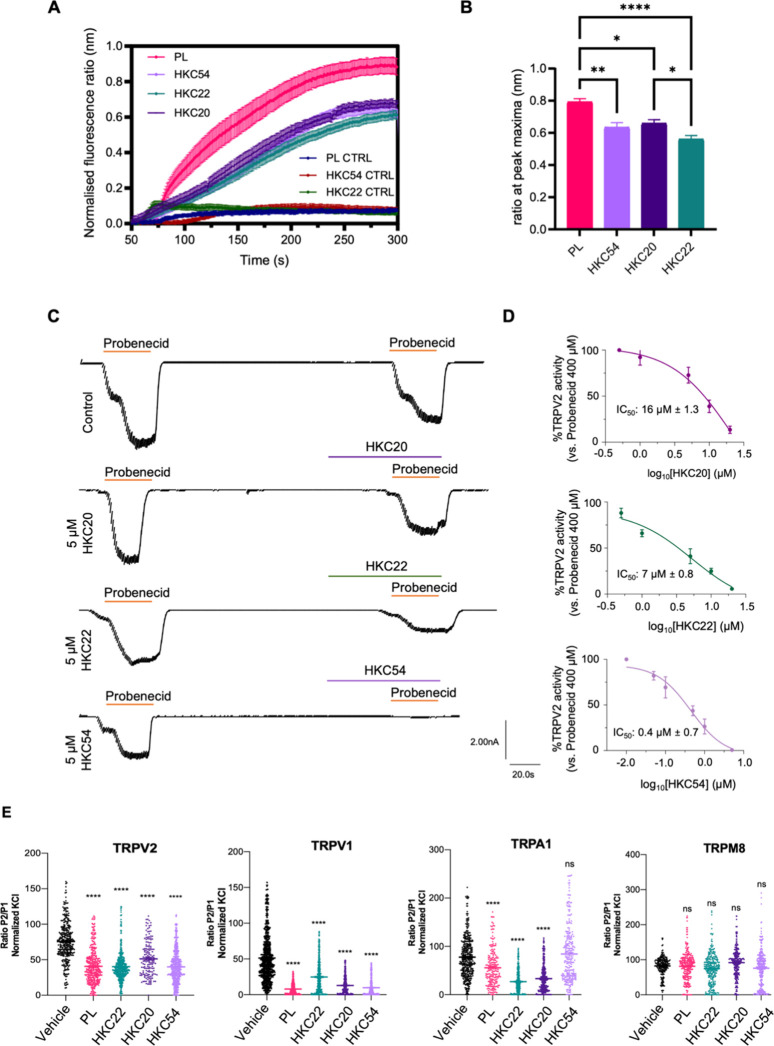
To assess the activity of the PL derivatives under more physiologically relevant conditions, we next measured their effects on TRPV2 in primary cultures of rat neonatal DRG neurons in both electrophysiological and calcium fluorescence imaging experiments (Figure C,D). DRG neurons provide a native-like environment for the study of thermoTRP channels.ref. ref39 In the electrophysiological recordings, all tested PL derivatives significantly inhibited the probenecid-evoked TRPV2 current at a fixed concentration (5 μM), with HKC54 exhibiting the greatest potency and effectively reducing the current to near baseline levels (Figure C). In the calcium fluorescence imaging assays, HKC20 and HKC22 produced clear concentration-dependent inhibition of probenecid-evoked Ca2+ influx, measured using Ca2+-sensitive dye Fluo-4 AM, with IC50 values of 16 and 7 μM, respectively (Figure D). Notably, HKC54 exhibited markedly higher potency with a submicromolar IC50 of 0.4 μM, representing the most potent TRPV2 antagonist reported to date (Figure D).
We next investigated the selectivity of the PL derivatives for TRPV2 over structurally homologous thermoTRP channels TRPV1 (the ‘capsaicin receptor’), TRPA1 (the ‘chemical nociceptor’ or ‘wasabi receptor’), and TRPM8 (the ‘cold and menthol receptor’) by performing analogous calcium fluorescence imaging assays in DRG neurons (Figure E). The pore domain is highly conserved across all TRP-channel subfamilies, but the cytoplasmic N- and C-termini differ substantially.ref. ref40 TRPV2 shares 50% sequence homology with TRPV1 but, unlike TRPV1, is not activated by capsaicin.ref. ref41 The PL derivatives were initially tested at a fixed concentration (10 μM), at which all derivatives significantly inhibited calcium influx evoked by the TRPV1 agonist capsaicin, thus acting as TRPV1 antagonists (Figure E), with PL being the most potent. Similarly, PL and all derivatives except HKC54 significantly inhibited calcium influx induced by the TRPA1 agonist allyl isothiocyanate (AITC), with HKC22 being the most potent and PL the weakest antagonist (Figure E). No significant agonism or antagonism of TRPM8 was measured for any compound (Figure E). To further characterize these effects, we performed TRPV1 and TRPA1 dose–response calcium fluorescence imaging studies (Figures S3 and S4). HKC54 demonstrated approximately 50-fold and 70-fold selectivity for TRPV2 over TRPV1 and TRPA1, respectively, with IC50 values of 20.1 and 29.3 μM (Figures S3D and S4D). In contrast, HKC20 appears to be most potent against TRPV1 (IC50 = 1.7 μM; Figure S3C), and HKC22 is most potent against TRPA1 (IC50 = 1.1 μM; Figure S4B). Collectively, these results demonstrate that while PL and its derivatives retain some activity toward other thermoTRP channels, HKC54 exhibits markedly improved selectivity for TRPV2 over TRPV1 and TRPA1, establishing it as the most potent and selective TRPV2 antagonist in this series.
Evidence of Direct TRPV2 Target Engagement by CETSA
To confirm the direct target engagement of TRPV2 by the PL derivatives, we performed CETSA (Figure A). Performing CETSA for membrane proteins had been challenging in the past because early protocols, optimized for soluble cytosolic targets, used detergent-free extraction buffers that precluded membrane protein recovery. The introduction of mild detergents in updated workflows now enables reliable detection of compound-induced changes in membrane protein thermal stability, including multipass transmembrane proteins such as TRPV2.ref42,ref43 To this end, we incubated MDA-MB-231 breast cancer cell lysates with 10 μM HKC22, HKC54, or vehicle control and subjected them to a temperature gradient between 45 and 85 °C in 5 °C increments. Immunoblot analysis revealed significant and reproducible thermal stabilization of TRPV2 upon treatment with HKC22 and HKC54 compared to vehicle control (Figures B and S5A).
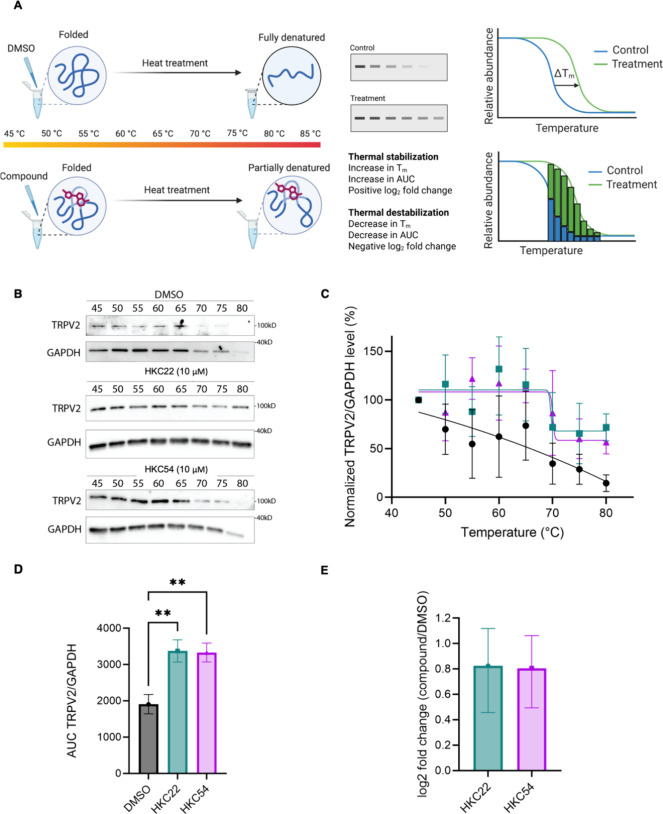
To quantify this stabilization, we first normalized the remaining soluble TRPV2 fraction to GAPDH across the full temperature range (Figure C). Because membrane and phase-separating proteins often exhibit nonsigmoidal melting profiles, we quantified stabilization using an area under the curve (AUC)-based approach, which provides a more reliable measure of compound-induced thermal stabilization than relying solely on a T m-centric approach.ref44,ref45 HKC22 and HKC54 treatment significantly stabilized TRPV2 (p < 0.01; one-way ANOVA, Tukey’s test; Figure D), reflected by a log2 fold-change (FC) of 0.8 (approximately 1.7-fold increase) in AUC relative to vehicle control (Figure E). These results, together with the electrophysiological measurements and calcium fluorescence imaging assays (Figure ), provide strong evidence of direct TRPV2 engagement by the PL derivatives. We next sought to profile the proteome-wide selectivity of the PL derivatives relative to PL by developing photoaffinity probes.
Photoaffinity Labeling Demonstrates Proteome-Wide Selectivity of Noncovalent PL Derivative
To profile the proteome-wide targets of the noncovalent PL derivatives and assess their selectivity relative to PL, we developed photoaffinity probes derived from PL and derivative HKC22, named Photo-PL and Photo-HKC22, respectively (Figure B). To identify a suitable site for PAL linker conjugation that would preserve both binding interactions and bioactivity, we considered the cryo-EM structure of PL-bound TRPV2 (PDB: 6WKN), previous SAR studies of PL that focused on its covalent targets, and earlier reports describing PL-based activity-based probes (ABPs).ref. ref19 Although ABPs can effectively capture direct covalent targets, they fail to identify transient and reversible interactions that can be captured by PAL probes.ref. ref46 Consistent with this, previously reported PL-based ABPs did not label known noncovalent PL-binding proteins, such as TRPV2ref. ref19 and GSTP1.ref. ref32 All reported PL-based ABPs were functionalized at the para-position of the phenyl ring, which appears solvent-exposed in the PL-bound TRPV2 structure (Figure A). We therefore conjugated a “minimalist” PAL linker to this position, comprising an alkyl diazirine photoreactive group and a bioorthogonal alkyne handle for downstream click chemistry, to form Photo-PL and Photo-HKC22 (Figure B).ref47,ref48 Importantly, we retained the trimethoxyphenyl substituents absent in previously reported ABP PL-5, as it is a key pharmacophore for both the microtubule-destabilizing activity of PLref. ref49 and the noncovalent TRPV2 inhibition mediated by PL (Figure S1A).
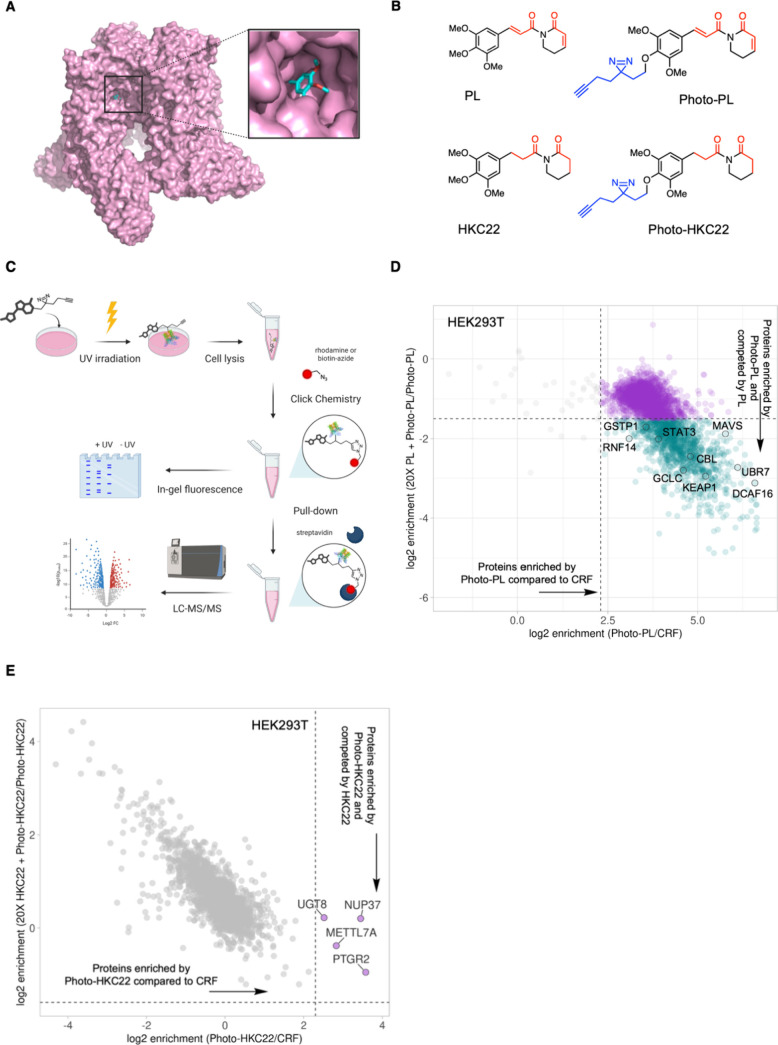
Molecular docking of Photo-HKC22 in the PL-bound TRPV2 structure confirmed that the PAL linker could be accommodated without steric hindrance (Figure S6A). Consistent with this, both photoaffinity probes phenocopied the effects of PL and HKC22 on PANC-1 cell viability (Figure S6B). The overall PAL workflow for either visualization of protein photolabeling by in-gel fluorescence or detection of probe-labeled proteins by LC-MS/MS is outlined (Figure C).
The optimal concentration of PAL probe can vary with the system under study.ref. ref50 Hence, we first performed initial gel fluorescence studies to determine suitable probe concentrations for subsequent competition and LC-MS/MS studies. HEK293T cells were treated with a range of concentrations of Photo-PL and Photo-HKC22, UV irradiated (365 nm, 5 min, on ice), lysed, and subjected to CuAAC conjugation with TAMRA-azide. SDS-PAGE and fluorescence imaging revealed clear UV- and concentration-dependent protein labeling for both probes (Figure S6D,F). As expected, Photo-PL exhibited partial UV-independent labeling due to its intrinsic electrophilic reactivity (Figure S6F). We performed PAL in live cells rather than in cell lysate as this preserves the native subcellular localization of targets, and the two settings have been shown to produce distinct sets of protein hits.ref48,ref51
From these results, we selected a probe concentration of 20 μM for subsequent experiments. To determine whether the UV-dependent bands arose from nonspecific diazirine labeling, we repeated the PAL workflow using 20 μM Photo-HKC22 or Photo-PL with pretreatment of increasing concentrations (up to 20-fold excess) of the parent compound HKC22 or PL (Figure S6E,G). Varying the concentration of the parent competitor required to compete an individual protein band has been shown to reflect its binding affinity.ref. ref52 However, after correcting for protein loading, no significant reduction in fluorescence intensity was observed for any major bands labeled by Photo-HKC22, indicating that they likely resulted from nonspecific diazirine-mediated labeling (Figure S6E).
To achieve higher sensitivity beyond that of in-gel fluorescence, we next performed LC-MS/MS proteomic analysis of the probe-labeled proteome (Figure C). The same cell line (HEK293T) and treatment conditions (20 μM probe; 5 min UV irradiation) were used as in the in-gel fluorescence assays. In the resulting scatter plots (Figure D,E), the x-axis represents FC enrichment of proteins labeled by the PAL probe relative to a simple diazirine- and alkyne-containing control constant region fragment (CRF; Figure S6C), used to exclude proteins likely labeled nonspecifically by the diazirine. The y-axis indicates competition by pretreatment with excess parent compound (HKC22 or PL), with proteins in the lower-right quadrant (enriched and competed) considered putative “true” targets. Only four proteins were enriched by Photo-HKC22 relative to the CRF, and none showed significant competition by HKC22 (Figure E), indicating no identifiable direct targets under these conditions. In contrast, performing the same workflow with Photo-PL and PL revealed numerous enriched and competed proteins, including many known covalent and noncovalent targets of PL, such as GSTP1, GSTO1, KEAP1, and STAT3 (Figure D). This stark difference confirms the validity and sensitivity of the PAL approach while underscoring the markedly reduced off-target activity and enhanced selectivity of HKC22 relative to PL.
A key objective of these PAL experiments was to confirm direct labeling of TRPV1, TRPV2, and TRPA1 by Photo-HKC22. However, HEK293T cells express TRPA1ref53,ref54 and TRPV2ref53,ref56 at very low levels and TRPV1ref53,ref55,ref56 at low levels, which likely prevented their detection. HEK293T cells were nonetheless selected for initial optimization due to their high proteome coverageref. ref57 and the availability of a curated list of proteins frequently labeled nonspecifically by diazirines (“frequent hitters”), which were excluded from the analysis.ref. ref58 Taken together, the absence of detectable off-targets of Photo-HKC22, in contrast with the broad labeling observed with Photo-PL, suggests that HKC22 exhibits a highly selective binding profile toward TRPV1, TRPV2, and TRPA1. Having established the selectivity and direct TRPV2 engagement of the PL derivatives, we next evaluated their functional effects in in vitro and in vivo models of cancer metastasis.
Noncovalent PL Derivative Inhibits Cancer Cell Migration In Vitro and In Vivo
TRPV2 is emerging as an important antimetastasis target; nonselective TRPV2 antagonists have been shown to impair cancer cell migration without affecting cell viability.ref. ref16 Having shown that the PL derivatives do not significantly affect the viability of multiple cancer cell lines (Figures D,E and S2), we next investigated whether they could inhibit cancer cell migration. We assessed the effect of PL and PL derivatives (HKC22 and HKC54) on cancer cell migration using in vitro wound healing assays. Confluent U-251 WT and U-251 TRPV2 knockdown (KD) cells (Figure D) were treated with PL, HKC22, or HKC54, and the scratch area was quantified at 0, 20, 40, and 60 h. In U-251 WT cells, all treatments significantly inhibited migration compared to that of DMSO (Figure A,B). In TRPV2 KD cells, HKC54 had no significant effect; HKC22 produced minimal inhibition, and PL retained activity similar to WT cells, likely reflecting its polypharmacology (Figure A,C). We also performed wound healing assays in confluent PANC-1 cells, treating with PL and HKC22 and quantifying scratch area at 0 and 8 h. Both compounds significantly reduced migration in TRPV2-expressing cells (Figure S7A–C). These results, consistent across two highly migratory cancer cell lines, support TRPV2 as an antimetastatic target and demonstrate that small-molecule TRPV2 antagonists can inhibit cancer cell migration in a TRPV2-dependent manner without affecting cell viability. Unlike previous studies, which exclusively examined the effects of PL derivatives on cancer cell viability, our work demonstrates their ability to inhibit cancer cell migration.ref27,ref28,ref58
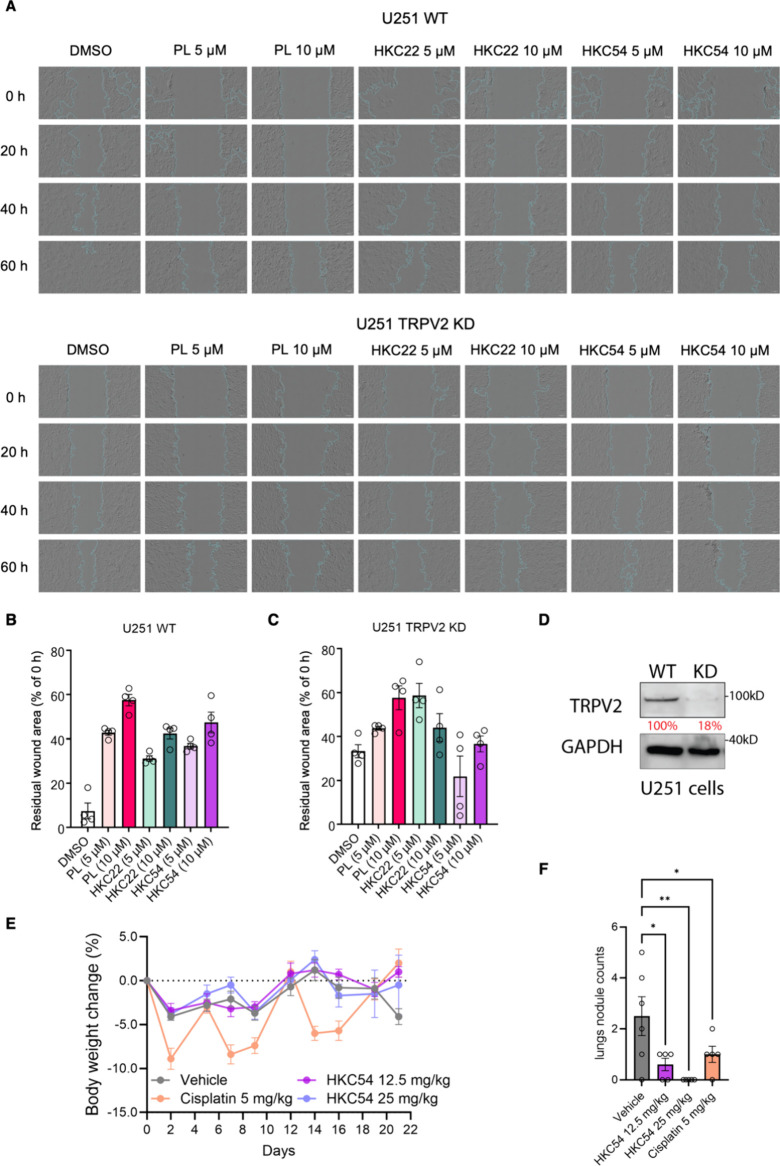
Given the promising effects of the PL derivatives on in vitro cancer cell migration, we next investigated their antimetastatic activity in vivo in a 4T1-Luc2 lung metastasis model of breast cancer in Balb/c mice. This syngeneic model is widely used to study tumor growth and metastasis as it preserves the intact immune system, the host stroma, and the extracellular matrix (ECM).ref59−ref60ref61ref62 We first performed a maximum tolerated dose (MTD) study to assess the toxicity of PL derivatives in mice. Compounds were administered via intraperitoneal injection every other day for a total of five doses (Figure S8A). All derivatives were well tolerated up to 25 mg/kg, resulting in < 5% body weight loss within 5 days after the final dose (Figure S8B). Based on its superior TRPV2 selectivity in wound healing assays, we selected HKC54 for in vivo antimetastatic evaluation. Mice inoculated with 4T1-Luc2 cells were treated with HKC54 at doses of 12.5 or 25 mg/kg every other day for a total of five doses, and the body weight was monitored throughout the study. Cisplatin (5 mg/kg, twice weekly for five doses), an FDA-approved chemotherapy agent, was included as a comparator.ref63,ref64
HKC54 treatment did not cause body weight loss, whereas cisplatin induced a modest but tolerable decrease (Figure E). Notably, both HKC54 doses produced a marked reduction in lung metastatic nodules relative to cisplatin in all treated mice (Figures F and S8C), indicating that HKC54 effectively inhibits tumor metastasis in vivo. Overall, these findings establish HKC54 as the most potent TRPV2 antagonist reported to date and reveal its ability to inhibit cancer cell migration and metastasis without affecting the cell viability. This expands the functional landscape of PL derivatives beyond their previously reported selective cytotoxicity toward cancer cells to include selective, TRPV2-dependent antimetastatic activity.
Discussion
In this work, we developed and characterized a novel class of selective TRPV2 antagonists derived from the natural product PL, building upon our previous machine learning-aided discovery of PL as an allosteric TRPV2 antagonist.ref. ref19 By strategically removing the electrophilic groups of PL, we eliminated phenotypic effects associated with covalent off-target interactions, such as GSH depletion, ROS induction, and nonspecific cytotoxicity, while preserving potent TRPV2 antagonism. This rational redesign yielded HKC54, which represents the most potent TRPV2 antagonist reported to date (IC50 = 0.4 μM). Calcium fluorescence imaging assays in both HEK239T cells and DRG neurons, together with electrophysiological recordings in DRG neurons, confirmed the robust inhibition of TRPV2-mediated Ca2+ influx. Notably, HKC54 exhibited approximately 50-fold and 70-fold selectivity for TRPV2 over structurally homologous thermoTRP channels TRPV1 and TRPA1, respectively, underscoring its remarkable selectivity for TRPV2 among thermoTRP channels. Direct target engagement of TRPV2 by HKC54 and HKC22 was further supported by CETSA, while molecular docking and MD simulations suggested a near-identical binding mode of HKC54 and HKC22 to that of PL observed in our previous cryo-EM structure.ref. ref19 Finally, HKC54 demonstrated potent antimetastatic activity in both in vitro and in vivo models of metastasis. Together, these findings establish HKC54 as a potent subtype-selective TRPV2 antagonist.
Our SAR findings align with previous studies showing that PL depletes intracellular GSH by ∼60% in EJ bladder carcinoma cells, whereas PL derivatives lacking the C2–C3 olefin fail to do so.ref. ref28 Similarly, only compounds retaining this electrophilic site induce detectable ROS.ref. ref28 Therefore, our results corroborate previous reports that the C2–C3 olefin, rather than C7–C8 olefin, is critical for PL’s GSH depletion, ROS induction activity, covalent reactivity, and associated cytotoxicity.ref21,ref28
Interestingly, our SAR analyses also revealed that subtle structural modifications to the PL scaffold confer distinct selectivity profiles across the thermoTRP channels. HKC20 emerged as a potent TRPV1 antagonist (IC50 = 1.7 μM), whereas HKC22 displayed inhibitory activity toward TRPV1, TRPA1, and TRPV2. TRPV1 and TRPA1 have been implicated in the pain pathway and have been the subject of extensive research for the development of novel analgesics and anti-inflammatory agents.ref. ref65 To rationalize the additional dual antagonism of TRPA1 and TRPV1 by PL and derivatives HKC20 and HKC22, we considered their function and other known chemical modulators. Both channels sense noxious chemical stimuli, such as capsaicin, allicin, and cinnamaldehyde, and are coexpressed in many nociceptive neurons; 30–50% of TRPV1-expressing neurons also express TRPA1.ref66,ref67 Moreover, there is evidence that TRPV1 and TRPA1 interact to form a heterotetramer,ref68−ref69ref70 and both have critical but redundant roles in acute noxious heat sensing.ref. ref71 Correspondingly, many natural and synthetic compounds affect both channels.ref72,ref73 Understanding the dual antagonism was further informed by SAR studies of piperine and related black pepper-derived natural products, which act as dual TRPV1/TRPA1 agonists and are structurally similar to PL derivatives.ref74,ref75 In these studies, neither the degree of unsaturation nor the aliphatic chain length dictated activity (Figure S9). Instead, the piperidine ring and the methylene-dioxy phenyl substituent were the key pharmacophores.ref74,ref75 This is consistent with the PL derivatives, which all contain a lactam ring and trimethoxy-substituted phenyl ring and where saturated, noncovalent derivatives retain activity. Whereas piperine derivatives function as agonists, PL and its derivatives act as antagonists. Small structural modifications can switch TRP-channel modulators from agonists to antagonists; for example, demethylation of TRPA1 antagonist AP-19 converts it into an agonist.ref. ref76 Similarly, we hypothesize that the additional carbonyl present in the lactam ring of PL and its analogues, relative to the piperine derivatives, which forms key hydrogen bonds to R539 and T522, drives this functional inversion. We also hypothesize that the α-cyano group present in HKC54 can be accommodated only in the TRPV2 binding site, which leads to its stark subtype-selectivity. These findings underscore the versatility of the PL scaffold as a foundation for designing selective or multitarget thermoTRP channel modulators. Future work to obtain structural information on the PL derivatives bound to TRPV1, TRPV2, and TRPA1 would not only validate our SAR analyses, molecular docking, and MD results but also structurally enable medicinal chemistry efforts to optimize thermoTRP channel modulators with improved pharmacokinetic properties.
We developed photoaffinity probe Photo-HKC22 based on one of our most active PL derivatives, fully saturated noncovalent HKC22. This probe enabled us to profile the proteome-wide selectivity of HKC22, revealing no detectable off-targets and suggesting high selectivity for thermoTRPs TRPV1, TRPA1, and TRPV2. In stark contrast, the photoaffinity probe derived from PL itself, Photo-PL, extensively labeled the proteome, capturing numerous known noncovalent and covalent targets of PL, such as GSTP1, GSTO1, KEAP1, and STAT3. This indicates that conjugation of the PAL linker did not perturb binding of Photo-PL, and it could be accommodated in the PL binding site of all labeled targets. This comparison highlights two important points. First, electrophilic natural products such as PL should not be assumed to engage their targets exclusively through covalency; Photo-PL captured noncovalent targets, such as GSTP1, that previous PL-derived activity-based probes failed to detect. Second, our work demonstrates that the electrophilic moieties within such natural products are not always essential for target binding; fully saturated HKC22 retained the binding and potent antagonism of TRPV2.
A limitation of our study is that we did not observe labeling of TRPV1, TRPV2, and TRPA1 by Photo-PL or Photo-HKC22, which likely reflects their very low expression in HEK239T cells. While we cannot fully exclude the possibility that the PAL linker perturbs probe binding to TRPV2, the probe design was guided by the PL-bound TRPV2 cryo-EM structure, molecular docking indicated that the PAL linker could be accommodated without steric hindrance, and the probe phenocopied the effects of HKC22 on cell viability. Moreover, Photo-PL retained the engagement of many known targets of PL, suggesting that the PAL linker does not perturb these interactions. A similar challenge was encountered in TRPC5 PAL studies and resolved by channel overexpression.ref. ref17 Instead, we used the CETSA to demonstrate direct target engagement of TRPV2 by both HKC22 and HKC54. To further establish Photo-HKC22 as a useful ‘pocket probe’ for thermoTRPs and for future thermoTRP ligand development, subsequent studies should implement the PAL workflow either in a cell line with higher endogenous expression of thermoTRP channels or in cells engineered to overexpress TRPV2. A further limitation is that the proteome-wide selectivity of HKC54 was not evaluated, although HKC54 exhibited no phenotypic effects of irreversible covalent off-target engagement typical of PL, measured by GSH depletion, ROS induction, and cytotoxicity. Developing a photoaffinity probe analogous to Photo-HKC22 would enable the proteome-wide selectivity of HKC54 to be assessed, strengthening its use as a selective TRPV2 antagonist.
There is accumulating evidence that TRPV2 is a key driver of cancer cell migration, rather than growth.ref. ref77 It is thought that TRPV2 enhances cancer cell migration by inducing the expression of key proteasesMMP2, MMP9, and cathepsin Bthat remodel the ECM and are markers of cell invasion.ref78,ref79 In addition, TRPV2 maintains an elevated intracellular calcium concentration, critical to cancer cell migration ability.ref. ref79 Our initial in vivo results in a 4T1-Luc2 lung metastasis model of breast cancer suggest that developing selective TRPV2 antagonists represents a promising strategy to combat metastasis. This is even more pertinent given that antimetastasis agents are an under-represented category of oncology drugs, in part due to multiple late-stage clinical failures and a lack of sufficient or standardized approval criteria.ref. ref80 Moreover, although the number of deaths caused by breast cancer over the past decade is in decline, the proportion of deaths caused by metastatic disease has remained stable at 75%.ref. ref81 Although we used an immunocompetent syngeneic murine model that is commonly used to study metastasis, we acknowledge that there is currently no single preclinical model that accurately reflects the complexity of the metastatic process in patients with cancer.ref. ref80 Future studies with more optimized PL-based TRPV2 antagonists will involve multiple different preclinical models to better understand which step(s) in the metastatic process the compounds are inhibiting.
Finally, the development of selective, noncovalent TRPV2 antagonists brings the potential to develop targeted protein degradation (TPD) modalities. Unlike covalent inhibitors such as PL, noncovalent ligands such as HKC22 and HKC54 could serve as modular TRPV2 binders in TRPV2-targeting degraders to enable substoichiometric target turnover. TRPV2 is overexpressed in many cancers; therefore, this ability could be critical to regulating aberrant TRPV2 expression levels. For example, high TRPV2 expression characterizes the advanced and aggressive castration-resistant prostate cancer phenotype, and TRPV2 silencing was shown to reduce prostate cancer cell growth and invasion.ref. ref79 The cryo-EM structure of PL-bound TRPV2 reveals numerous lysine residues adjacent to the PL binding site that are cytosolically accessible for ubiquitination by intracellular E3 ligases (Figure S10). Interestingly, TRIM21, a membrane-localized E3 ligase that was recently discovered to be the endogenous regulator of TRPV2 responsible for its K48-linked ubiquitination and degradation,ref. ref82 has already been coopted for TPD using the TRIM21 ligand acepromazine in TRIM21-recruiting PROTACs (“TrimTACs”),ref. ref83 providing a potential strategy to directly target TRPV2 for degradation. In addition, Nedd4-2 has been shown to endogenously regulate TRPA1ref. ref84 and TRPV6ref. ref85 and so could represent an alternative E3 ligase to target TRPV2 or TRPA1 with noncovalent PL derivatives as the protein-binding ligand. Together, these findings highlight promising opportunities for the rational development of TRPV2-directed degraders that may further potentiate the antimetastatic effects already demonstrated by HKC54.
Supplementary Materials
References
- M. Almén, K. J. Nordström, R. Fredriksson, H. B. Schiöth. Mapping the Human Membrane Proteome: A Majority of the Human Membrane Proteins Can Be Classified According to Function and Evolutionary Origin. BMC Biology, 2009. [DOI | PubMed]
- A. Perálvarez-Marín, P. Doñate-Macian, R. Gaudet. What Do We Know about the Transient Receptor Potential Vanilloid 2 (TRPV2) Ion Channel?. FEBS Journal, 2013. [DOI | PubMed]
- Q. Liu, X. Wang. Effect of TRPV2 Cation Channels on the Proliferation, Migration and Invasion of 5637 Bladder Cancer Cells. Experimental and therapeutic medicine, 2013. [DOI | PubMed]
- Y. Iwata, Y. Katanosaka, Y. Arai, K. Komamura, K. Miyatake, M. Shigekawa. A Novel Mechanism of Myocyte Degeneration Involving the Ca2+-Permeable Growth Factor-Regulated Channel. J. Cell Biol., 2003. [DOI | PubMed]
- Y. Iwata, Y. Katayama, Y. Okuno, S. Wakabayashi. Novel Inhibitor Candidates of TRPV2 Prevent Damage of Dystrophic Myocytes and Ameliorate against Dilated Cardiomyopathy in a Hamster Model. Oncotarget, 2018. [DOI | PubMed]
- E. Hisanaga, M. Nagasawa, K. Ueki, R. N. Kulkarni, M. Mori, I. Kojima. Regulation of Calcium-Permeable TRPV2 Channel by Insulin in Pancreatic β-Cells. Diabetes, 2009. [DOI | PubMed]
- M. Nabissi, M. B. Morelli, M. Santoni, G. Santoni. Triggering of the TRPV2 Channel by Cannabidiol Sensitizes Glioblastoma Cells to Cytotoxic Chemotherapeutic Agents. Carcinogenesis, 2013. [DOI | PubMed]
- A. Oulidi, A. Bokhobza, D. Gkika, F. Vanden Abeele, V. Lehen’kyi, L. Ouafik, B. Mauroy, N. Prevarskaya. TRPV2Mediates Adrenomedullin Stimulation of Prostate and Urothelial Cancer Cell Adhesion, Migration and Invasion. PLoS One, 2013. [DOI | PubMed]
- C. McClenaghan, F. Zeng, J. M. Verkuyl. TRPA1 Agonist Activity of Probenecid Desensitizes Channel Responses: Consequences for Screening. Assay Drug Dev Technol., 2012. [DOI | PubMed]
- S. Bang, K. Y. Kim, S. Yoo, S.-H. Lee, S. W. Hwang. Transient Receptor Potential V2 Expressed in Sensory Neurons Is Activated by Probenecid. Neurosci. Lett., 2007. [DOI | PubMed]
- L. Zhang, C. Simonsen, L. Zimova, K. Wang, L. Moparthi, R. Gaudet, M. Ekoff, G. Nilsson, U. A. Hellmich, V. Vlachova, P. Gourdon, P. M. Zygmunt. Cannabinoid Non-Cannabidiol Site Modulation of TRPV2 Structure and Function. Nat. Commun., 2022. [DOI | PubMed]
- H.-Z. Hu, Q. Gu, C. Wang, C. K. Colton, J. Tang, M. Kinoshita-Kawada, L.-Y. Lee, J. D. Wood, M. X. Zhu. 2-Aminoethoxydiphenyl Borate Is a Common Activator of TRPV1, TRPV2, and TRPV3*. J. Biol. Chem., 2004. [DOI | PubMed]
- M. P. Neeper, Y. Liu, T. L. Hutchinson, Y. Wang, C. M. Flores, N. Qin. Activation Properties of Heterologously Expressed Mammalian TRPV2: EVIDENCE FOR SPECIES DEPENDENCE*. J. Biol. Chem., 2007. [DOI | PubMed]
- A. Neuberger, K. D. Nadezhdin, A. I. Sobolevsky. Structural Mechanisms of TRPV6 Inhibition by Ruthenium Red and Econazole. Nat. Commun., 2021. [DOI | PubMed]
- Y. Bluhm, R. Raudszus, A. Wagner, N. Urban, M. Schaefer, K. Hill. Valdecoxib Blocks Rat TRPV2 Channels. Eur. J. Pharmacol., 2022. [DOI | PubMed]
- H. Chai, X. Cheng, B. Zhou, L. Zhao, X. Lin, D. Huang, W. Lu, H. Lv, F. Tang, Q. Zhang, W. Huang, Y. Li, H. Yang. Structure-Based Discovery of a Subtype-Selective Inhibitor Targeting a Transient Receptor Potential Vanilloid Channel. J. Med. Chem., 2019. [DOI | PubMed]
- C. C. Bauer, A. Minard, I. B. Pickles, K. J. Simmons, E. Chuntharpursat-Bon, M. P. Burnham, N. Kapur, D. J. Beech, S. P. Muench, M. H. Wright, S. L. Warriner, R. S. Bon. Xanthine-Based Photoaffinity Probes Allow Assessment of Ligand Engagement by TRPC5 Channels. RSC Chemical Biology, 2020. [DOI | PubMed]
- S. Kiyonaka, K. Kato, M. Nishida, K. Mio, T. Numaga, Y. Sawaguchi, T. Yoshida, M. Wakamori, E. Mori, T. Numata, M. Ishii, H. Takemoto, A. Ojida, K. Watanabe, A. Uemura, H. Kurose, T. Morii, T. Kobayashi, Y. Sato, C. Sato, I. Hamachi, Y. Mori. Selective and Direct Inhibition of TRPC3 Channels Underlies Biological Activities of a Pyrazole Compound. Proc. Natl. Acad. Sci. U. S. A., 2009. [DOI | PubMed]
- J. Conde, R. A. Pumroy, C. Baker, T. Rodrigues, A. Guerreiro, B. B. Sousa, M. C. Marques, B. P. de Almeida, S. Lee, E. P. Leites, D. Picard, A. Samanta, S. H. Vaz, F. Sieglitz, M. Langini, M. Remke, R. Roque, T. Weiss, M. Weller, Y. Liu, S. Han, F. Corzana, V. A. Morais, C. C. Faria, T. Carvalho, P. Filippakopoulos, B. Snijder, N. L. Barbosa-Morais, V. Y. Moiseenkova-Bell, G. J. L. Bernardes. Allosteric Antagonist Modulation of TRPV2 by Piperlongumine Impairs Glioblastoma Progression. ACS Cent. Sci., 2021. [DOI | PubMed]
- J. Pei, Y. Xiao, X. Liu, W. Hu, A. Sobh, Y. Yuan, S. Zhou, N. Hua, S. G. Mackintosh, X. Zhang, K. B. Basso, M. Kamat, Q. Yang, J. D. Licht, G. Zheng, D. Zhou, D. Lv. Piperlongumine Conjugates Induce Targeted Protein Degradation. Cell Chem. Biol., 2023. [DOI | PubMed]
- L. Li, Y. Zhao, R. Cao, L. Li, G. Cai, J. Li, X. Qi, S. Chen, Z. Zhang. Activity-Based Protein Profiling Reveals GSTO1 as the Covalent Target of Piperlongumine and a Promising Target for Combination Therapy for Cancer. Chem. Commun., 2019. [DOI]
- Y. H. Kim, Y. J. Yoon, Y.-J. Lee, C.-H. Kim, S. Lee, D. H. Choung, D. C. Han, B.-M. Kwon. Piperlongumine Derivative, CG-06, Inhibits STAT3 Activity by Direct Binding to STAT3 and Regulating the Reactive Oxygen Species in DU145 Prostate Carcinoma Cells. Bioorg. Med. Chem. Lett., 2018. [DOI | PubMed]
- Chapter 1 – Alkaloids. In. Lead Compounds from Medicinal Plants for the Treatment of Cancer;, 2013
- D. P. Bezerra, C. Pessoa, M. O. de Moraes, N. Saker-Neto, E. R. Silveira, L. V. Costa-Lotufo. Overview of the Therapeutic Potential of Piplartine (Piperlongumine). European Journal of Pharmaceutical Sciences, 2013. [DOI | PubMed]
- T. Banerjee, S. Chaudhuri. The Crystal and Molecular Structure of N-(3,4,5-Trimethoxycinnamoyl)-Δ3-Piperidine-2-One, an Amide Alkaloid (Piperlongumine), C17H19NO5. Can. J. Chem., 1986. [DOI]
- P. M. Boll, J. Hansen, O. Simonsen, N. Thorup. Synthesis and Molecular Structure of Piplartine (=piperlongumine). Tetrahedron, 1984. [DOI]
- L. Raj, T. Ide, A. U. Gurkar, M. Foley, M. Schenone, X. Li, N. J. Tolliday, T. R. Golub, S. A. Carr, A. F. Shamji, A. M. Stern, A. Mandinova, S. L. Schreiber, S. W. Lee. Selective Killing of Cancer Cells by a Small Molecule Targeting the Stress Response to ROS. Nature, 2012. [DOI]
- D. J. Adams, M. Dai, G. Pellegrino, B. K. Wagner, A. M. Stern, A. F. Shamji, S. L. Schreiber. Synthesis, Cellular Evaluation, and Mechanism of Action of Piperlongumine Analogs. Proc. Natl. Acad. Sci. U.S.A., 2012. [DOI | PubMed]
- C. Tang, A. R. Coelho, M. Rebelo, H. Kiely-Collins, T. Carvalho, G. J. L. Bernardes. A Selective SARS-CoV-2 Host-Directed Antiviral Targeting Stress Response to Reactive Oxygen Species. ACS Cent. Sci., 2023. [DOI | PubMed]
- K. Piska, A. Gunia-Krzyżak, P. Koczurkiewicz, K. Wójcik-Pszczoła, E. Pękala. Piperlongumine (Piplartine) as a Lead Compound for Anticancer Agents – Synthesis and Properties of Analogues: A Mini-Review. Eur. J. Med. Chem., 2018. [DOI | PubMed]
- J. M. Bradshaw, J. M. McFarland, V. O. Paavilainen, A. Bisconte, D. Tam, V. T. Phan, S. Romanov, D. Finkle, J. Shu, V. Patel, T. Ton, X. Li, D. G. Loughhead, P. A. Nunn, D. E. Karr, M. E. Gerritsen, J. O. Funk, T. D. Owens, E. Verner, K. A. Brameld, R. J. Hill, D. M. Goldstein, J. Taunton. Prolonged and Tunable Residence Time Using Reversible Covalent Kinase Inhibitors. Nat. Chem. Biol., 2015. [DOI | PubMed]
- W. Harshbarger, S. Gondi, S. B. Ficarro, J. Hunter, D. Udayakumar, D. Gurbani, W. D. Singer, Y. Liu, L. Li, J. A. Marto, K. D. Westover. Structural and Biochemical Analyses Reveal the Mechanism of Glutathione S-Transferase Pi 1 Inhibition by the Anti-Cancer Compound Piperlongumine. J. Biol. Chem., 2017. [DOI | PubMed]
- P. A. Schwartz, P. Kuzmic, J. Solowiej, S. Bergqvist, B. Bolanos, C. Almaden, A. Nagata, K. Ryan, J. Feng, D. Dalvie, J. C. Kath, M. Xu, R. Wani, B. W. Murray. Covalent EGFR Inhibitor Analysis Reveals Importance of Reversible Interactions to Potency and Mechanisms of Drug Resistance. Proc. Natl. Acad. Sci. U.S.A., 2014. [DOI | PubMed]
- J.-S. Sun, Y.-H. Tsuang, W.-C. Huang, L.-T. Chen, Y.-S. Hang, F.-J. Lu. Menadione-Induced Cytotoxicity to Rat Osteoblasts. CMLS, Cell. mol. life sci., 1997. [DOI | PubMed]
- Y. J. Kim, Y. K. Shin, D. S. Sohn, C. S. Lee. Menadione Induces the Formation of Reactive Oxygen Species and Depletion of GSH-Mediated Apoptosis and Inhibits the FAK-Mediated Cell Invasion. Naunyn-Schmiedeberg’s Arch. Pharmacol., 2014. [DOI | PubMed]
- G. Zazeri, A. P. R. Povinelli, C. S. Le Duff, B. Tang, M. L. Cornelio, A. M. Jones. Synthesis and Spectroscopic Analysis of Piperine- and Piperlongumine-Inspired Natural Product Scaffolds and Their Molecular Docking with IL-1β and NF-κB Proteins. Molecules, 2020. [DOI | PubMed]
- S. Pei, M. Minhajuddin, K. P. Callahan, M. Balys, J. M. Ashton, S. J. Neering, E. D. Lagadinou, C. Corbett, H. Ye, J. L. Liesveld, K. M. O’Dwyer, Z. Li, L. Shi, P. Greninger, J. Settleman, C. Benes, F. K. Hagen, J. Munger, P. A. Crooks, M. W. Becker, C. T. Jordan. Targeting Aberrant Glutathione Metabolism to Eradicate Human Acute Myelogenous Leukemia Cells. J. Biol. Chem., 2013. [DOI | PubMed]
- Y. Liao, X. Niu, B. Chen, H. Edwards, L. Xu, C. Xie, H. Lin, L. Polin, J. W. Taub, Y. Ge, Z. Qin. Synthesis and Antileukemic Activities of Piperlongumine and HDAC Inhibitor Hybrids against Acute Myeloid Leukemia Cells. J. Med. Chem., 2016. [DOI | PubMed]
- A. Patapoutian, A. M. Peier, G. M. Story, V. Viswanath. ThermoTRP Channels and beyond: Mechanisms of Temperature Sensation. Nat. Rev. Neurosci, 2003. [DOI | PubMed]
- K. E. Huffer, A. A. Aleksandrova, A. Jara-Oseguera, L. R. Forrest, K. J. Swartz. Global Alignment and Assessment of TRP Channel Transmembrane Domain Structures to Explore Functional Mechanisms. eLife, 2020. [DOI | PubMed]
- M. R. Cohen, K. W. Huynh, D. Cawley, V. Y. Moiseenkova-Bell. Understanding the Cellular Function of TRPV2 Channel through Generation of Specific Monoclonal Antibodies. PLoS One, 2013. [DOI | PubMed]
- A. Kawatkar, M. Schefter, N.-O. Hermansson, A. Snijder, N. Dekker, D. G. Brown, T. Lundbäck, A. X. Zhang, M. P. Castaldi. CETSA beyond Soluble Targets: A Broad Application to Multipass Transmembrane Proteins. ACS Chem. Biol., 2019. [DOI | PubMed]
- M. Hashimoto, E. Girardi, R. Eichner, G. Superti-Furga. Detection of Chemical Engagement of Solute Carrier Proteins by a Cellular Thermal Shift Assay. ACS Chem. Biol., 2018. [DOI | PubMed]
- Thermal Tracks: A Gaussian Process-Based Framework for Universal Melting Curve Analysis Enabling Unconstrained Hit Identification in Thermal Proteome Profiling Experiments.. ArXiv arXiv:2508.09659v1., 2025
- J. G. V. Vranken, J. Li, J. Mintseris, T.-Y. Wei, C. M. Sniezek, M. Gadzuk-Shea, S. P. Gygi, D. K. Schweppe. Large-Scale Characterization of Drug Mechanism of Action Using Proteome-Wide Thermal Shift Assays. eLife, 2024. [DOI | PubMed]
- Z. Lin, Y. Amako, F. Kabir, H. A. Flaxman, B. Budnik, C. M. Woo. Development of Photolenalidomide for Cellular Target Identification. J. Am. Chem. Soc., 2022. [DOI | PubMed]
- L. P. Conway, A. M. Jadhav, R. A. Homan, W. Li, J. S. Rubiano, R. Hawkins, R. M. Lawrence, C. G. Parker. Evaluation of Fully-Functionalized Diazirine Tags for Chemical Proteomic Applications. Chem. Sci., 2021. [DOI | PubMed]
- Z. Li, P. Hao, L. Li, C. Y. J. Tan, X. Cheng, G. Y. J. Chen, S. K. Sze, H.-M. Shen, S. Q. Yao. Design and Synthesis of Minimalist Terminal Alkyne-Containing Diazirine Photo-Crosslinkers and Their Incorporation into Kinase Inhibitors for Cell- and Tissue-Based Proteome Profiling. Angew. Chem., Int. Ed., 2013. [DOI]
- M. J. Meegan, S. Nathwani, B. Twamley, D. M. Zisterer, N. M. O’Boyle. Piperlongumine (Piplartine) and Analogues: Antiproliferative Microtubule-Destabilising Agents. Eur. J. Med. Chem., 2017. [DOI | PubMed]
- A. L. Mackinnon, J. Taunton. Target Identification by Diazirine Photo-Cross-Linking and Click Chemistry. Current protocols in chemical biology, 2009. [DOI | PubMed]
- A. E. Speers, B. F. Cravatt. Profiling Enzyme Activities In Vivo Using Click Chemistry Methods. Chemistry & Biology, 2004. [DOI | PubMed]
- P. C. Theodoropoulos, W. Wang, A. Budhipramono, B. M. Thompson, N. Madhusudhan, M. A. Mitsche, J. G. McDonald, J. K. De Brabander, D. Nijhawan. A Medicinal Chemistry-Driven Approach Identified the Sterol Isomerase EBP as the Molecular Target of TASIN Colorectal Cancer Toxins. J. Am. Chem. Soc., 2020. [DOI | PubMed]
- M. Uhlen, L. Fagerberg, B. M. Hallstrom, C. Lindskog, P. Oksvold, A. Mardinoglu, A. Sivertsson, C. Kampf, E. Sjostedt, A. Asplund, I. Olsson, K. Edlund, E. Lundberg, S. Navani, C. A.-K. Szigyarto, J. Odeberg, D. Djureinovic, J. O. Takanen, S. Hober, T. Alm, P.-H. Edqvist, H. Berling, H. Tegel, J. Mulder, J. Rockberg, P. Nilsson, J. M. Schwenk, M. Hamsten, K. von Feilitzen, M. Forsberg, L. Persson, F. Johansson, M. Zwahlen, G. von Heijne, J. Nielsen, F. Ponten. Tissue-Based Map of the Human Proteome. Science, 2015. [DOI | PubMed]
- Cell line – TRPA1 – The Human Protein Atlas. https://www.proteinatlas.org/ENSG00000104321-TRPA1/cell+line (accessed February 2023).
- Cell line – TRPV2 – The Human Protein Atlas. https://www.proteinatlas.org/ENSG00000187688-TRPV2/cell+line (accessed February 2023).
- Cell line – TRPV1 – The Human Protein Atlas. https://www.proteinatlas.org/ENSG00000196689-TRPV1/cell+line (accessed February 2023).
- T. Geiger, A. Wehner, C. Schaab, J. Cox, M. Mann. Comparative Proteomic Analysis of Eleven Common Cell Lines Reveals Ubiquitous but Varying Expression of Most Proteins. Mol. Cell Proteomics, 2012. [DOI]
- F. Offensperger, G. Tin, M. Duran-Frigola, E. Hahn, S. Dobner, C. W. A. Ende, J. W. Strohbach, A. Rukavina, V. Brennsteiner, K. Ogilvie, N. Marella, K. Kladnik, R. Ciuffa, J. D. Majmudar, S. D. Field, A. Bensimon, L. Ferrari, E. Ferrada, A. Ng, Z. Zhang, G. Degliesposti, A. Boeszoermenyi, S. Martens, R. Stanton, A. C. Müller, J. T. Hannich, D. Hepworth, G. Superti-Furga, S. Kubicek, M. Schenone, G. E. Winter. Large-Scale Chemoproteomics Expedites Ligand Discovery and Predicts Ligand Behavior in Cells. Science, 2024. [DOI | PubMed]
- Z. V. Boskovic, M. M. Hussain, D. J. Adams, M. Dai, S. L. Schreiber. Synthesis of Piperlogs and Analysis of Their Effects on Cells. Tetrahedron, 2013. [DOI]
- Y. Zhang, G.-L. Zhang, X. Sun, K.-X. Cao, C. Ma, N. Nan, G.-W. Yang, M.-W. Yu, X.-M. Wang. Establishment of a Murine Breast Tumor Model by Subcutaneous or Orthotopic Implantation. Oncol Lett., 2018. [DOI | PubMed]
- K. Tao, M. Fang, J. Alroy, G. G. Sahagian. Imagable 4T1Model for the Study of Late Stage Breast Cancer. BMC Cancer, 2008. [DOI | PubMed]
- K. Takahashi, N. Nagai, K. Ogura, K. Tsuneyama, I. Saiki, T. Irimura, Y. Hayakawa. Mammary Tissue Microenvironment Determines T Cell-Dependent Breast Cancer-Associated Inflammation. Cancer Sci., 2015. [DOI | PubMed]
- R. F. Ozols, B. N. Bundy, B. E. Greer, J. M. Fowler, D. Clarke-Pearson, R. A. Burger, R. S. Mannel, K. DeGeest, E. M. Hartenbach, R. Baergen. Phase III Trial of Carboplatin and Paclitaxel Compared with Cisplatin and Paclitaxel in Patients with Optimally Resected Stage III Ovarian Cancer: A Gynecologic Oncology Group Study. J. Clin. Oncol., 2003. [DOI | PubMed]
- G. V. Kondagunta, J. Bacik, A. Donadio, D. Bajorin, S. Marion, J. Sheinfeld, G. J. Bosl, R. J. Motzer. Combination of Paclitaxel, Ifosfamide, and Cisplatin Is an Effective Second-Line Therapy for Patients with Relapsed Testicular Germ Cell Tumors. J. Clin Oncol, 2005. [DOI | PubMed]
- A.-P. Koivisto, M. G. Belvisi, R. Gaudet, A. Szallasi. Advances in TRP Channel Drug Discovery: From Target Validation to Clinical Studies. Nat. Rev. Drug Discov, 2022. [DOI | PubMed]
- K. Kobayashi, T. Fukuoka, K. Obata, H. Yamanaka, Y. Dai, A. Tokunaga, K. Noguchi. Distinct Expression of TRPM8, TRPA1, and TRPV1 mRNAs in Rat Primary Afferent Neurons with Aδ/c-Fibers and Colocalization with Trk Receptors. Journal of Comparative Neurology, 2005. [DOI | PubMed]
- A. N. Akopian, N. B. Ruparel, N. A. Jeske, K. M. Hargreaves. Transient Receptor Potential TRPA1 Channel Desensitization in Sensory Neurons Is Agonist Dependent and Regulated by TRPV1-Directed Internalization. Journal of Physiology, 2007. [DOI | PubMed]
- N. Hellwig, N. Albrecht, C. Harteneck, G. Schultz, M. Schaefer. Homo- and Heteromeric Assembly of TRPV Channel Subunits. J. Cell Sci., 2005. [DOI | PubMed]
- A. Staruschenko, N. A. Jeske, A. N. Akopian. Contribution of TRPV1-TRPA1 Interaction to the Single Channel Properties of the TRPA1 Channel *. J. Biol. Chem., 2010. [DOI | PubMed]
- M. J. M. Fischer, D. Balasuriya, P. Jeggle, T. A. Goetze, P. A. McNaughton, P. W. Reeh, J. M. Edwardson. Direct Evidence for Functional TRPV1/TRPA1 Heteromers. Pflugers Arch – Eur. J. Physiol, 2014. [DOI | PubMed]
- I. Vandewauw, K. De Clercq, M. Mulier, K. Held, S. Pinto, N. Van Ranst, A. Segal, T. Voet, R. Vennekens, K. Zimmermann, J. Vriens, T. Voets. A TRP Channel Trio Mediates Acute Noxious Heat Sensing. Nature, 2018. [DOI | PubMed]
- L. J. Macpherson, A. E. Dubin, M. J. Evans, F. Marr, P. G. Schultz, B. F. Cravatt, A. Patapoutian. Noxious Compounds Activate TRPA1 Ion Channels through Covalent Modification of Cysteines. Nature, 2007. [DOI | PubMed]
- M. J. Caterina, M. A. Schumacher, M. Tominaga, T. A. Rosen, J. D. Levine, D. Julius. The Capsaicin Receptor: A Heat-Activated Ion Channel in the Pain Pathway. Nature, 1997. [DOI | PubMed]
- E. A. Correa, E. D. Högestätt, O. Sterner, F. Echeverri, P. M. Zygmunt. In Vitro TRPV1 Activity of Piperine Derived Amides. Bioorg. Med. Chem., 2010. [DOI | PubMed]
- Y. Okumura, M. Narukawa, Y. Iwasaki, A. Ishikawa, H. Matsuda, M. Yoshikawa, T. Watanabe. Activation of TRPV1 and TRPA1 by Black Pepper Components. Biosci., Biotechnol., Biochem., 2010. [DOI | PubMed]
- J. DeFalco, D. Steiger, A. Gustafson, D. E. Emerling, M. G. Kelly, M. A. J. Duncton. Oxime Derivatives Related to AP18: Agonists and Antagonists of the TRPA1 Receptor. Bioorg. Med. Chem. Lett., 2010. [DOI | PubMed]
- P. Pomorski. Calcium Regulation of Cell Migration. Postepy Biochem., 2009. [PubMed]
- J. Winkler, A. Abisoye-Ogunniyan, K. J. Metcalf, Z. Werb. Concepts of Extracellular Matrix Remodelling in Tumour Progression and Metastasis. Nat. Commun., 2020. [DOI | PubMed]
- M. Monet, V. Lehen’kyi, F. Gackiere, V. Firlej, M. Vandenberghe, M. Roudbaraki, D. Gkika, A. Pourtier, G. Bidaux, C. Slomianny, P. Delcourt, F. Rassendren, J.-P. Bergerat, J. Ceraline, F. Cabon, S. Humez, N. Prevarskaya. Role of Cationic Channel TRPV2 in Promoting Prostate Cancer Migration and Progression to Androgen Resistance. Cancer Res., 2010. [DOI | PubMed]
- R. L. Anderson, T. Balasas, J. Callaghan, R. C. Coombes, J. Evans, J. A. Hall, S. Kinrade, D. Jones, P. S. Jones, R. Jones, J. F. Marshall, M. B. Panico, J. A. Shaw, P. S. Steeg, M. Sullivan, W. Tong, A. D. Westwell, J. W. A. Ritchie. A Framework for the Development of Effective Anti-Metastatic Agents. Nat. Rev. Clin Oncol, 2019. [DOI | PubMed]
- H. Dillekås, M. S. Rogers, O. Straume. Are 90% of Deaths from Cancer Caused by Metastases?. Cancer Med., 2019. [DOI | PubMed]
- Y.-Y. Guo, Y. Gao, Y.-L. Zhao, C. Xie, H. Gan, X. Cheng, L.-P. Yang, J. Hu, H.-B. Shu, B. Zhong, D. Lin, J. Yao. Viral Infection and Spread Are Inhibited by the Polyubiquitination and Downregulation of TRPV2 Channel by the Interferon-Stimulated Gene TRIM21. Cell Rep., 2024. [DOI | PubMed]
- Selective Degradation of Multimeric Proteins via Chemically Induced Proximity to TRIM21.. 2024
- S. Wang, S. Qi, Y. Kogure, H. Kanda, L. Tian, S. Yamamoto, K. Noguchi, Y. Dai. The Ubiquitin E3 Ligase Nedd4–2 Relieves Mechanical Allodynia through the Ubiquitination of TRPA1 Channel in Db/Db Mice. European Journal of Neuroscience, 2021. [DOI | PubMed]
- W. Zhang, T. Na, G. Wu, H. Jing, J.-B. Peng. Down-Regulation of Intestinal Apical Calcium Entry Channel TRPV6 by Ubiquitin E3 Ligase Nedd4–2. J. Biol. Chem., 2010. [DOI | PubMed]