
The endemic plants of Mozambique: diversity and conservation status
Abstract
An annotated checklist of the 271 strict-endemic taxa (235 species) and 387 near-endemic taxa (337 species) of vascular plants in Mozambique is provided. Together, these taxa constitute c. 9.3% of the total currently known flora of Mozambique and include five strict-endemic genera (Baptorhachis, Emicocarpus, Gyrodoma, Icuria and Micklethwaitia) and two near-endemic genera (Triceratella and Oligophyton). The mean year of first publication of these taxa is 1959, with a marked increase in description noted following the onset of the two major regional floristic programmes, the “Flora of Tropical East Africa” and “Flora Zambesiaca”, and an associated increase in botanical collecting effort. New taxa from Mozambique continue to be described at a significant rate, with 20 novelties described in 2018. Important plant families for endemic and near-endemic taxa include Fabaceae, Rubiaceae and Euphorbiaceae s.s. There is a high congruence between species-rich plant families and endemism with the notable exceptions of the Poaceae, which is the second-most species rich plant family, but outside of the top ten families in terms of endemism, and the Euphorbiaceae, which is the seventh-most species rich plant family, but third in terms of endemism. A wide range of life-forms are represented in the endemic and near-endemic flora, with 49% being herbaceous or having herbaceous forms and 55% being woody or having woody forms. Manica Province is by far the richest locality for near-endemic taxa, highlighting the importance of the cross-border Chimanimani-Nyanga (Manica) Highlands shared with Zimbabwe. A total of 69% of taxa can be assigned to one of four cross-border Centres of Endemism: the Rovuma Centre, the Maputaland Centre sensu lato, and the two mountain blocks, Chimanimani-Nyanga and Mulanje-Namuli-Ribaue. Approximately 50% of taxa have been assessed for their extinction risk and, of these, just over half are globally threatened (57% for strict-endemics), with a further 10% (17% for strict-endemics) currently considered to be Data Deficient, highlighting the urgent need for targeted conservation of Mozambique’s unique flora. This dataset will be a key resource for ongoing efforts to identify “Important Plant Areas – IPAs” in Mozambique, and to promote the conservation and sustainable management of these critical sites and species, thus enabling Mozambique to meet its commitments under the Convention on Biological Diversity (CBD).
Article type: Research Article
Keywords: centre of endemism, checklist, conservation, flora, herbarium, IUCN Red List, range-restricted
Affiliations: Royal Botanic Gardens, Kew (RBG Kew), Richmond, Surrey, TW9 3AE, UK Royal Botanic Gardens Richmond United Kingdom; 30 Warren Lane, East Dean, East Sussex BN20 0EW, UK Unaffiliated East Dean United Kingdom; Instituto de Investigação Agrária de Moçambique (IIAM), P.O. Box 3658, Mavalane, Maputo, Mozambique Instituto de Investigação Agrária de Moçambique Maputo Mozambique; Durrell Institute of Conservation and Ecology, School of Anthropology and Conservation, Marlowe Building, University of Kent, Canterbury, Kent, CT2 7NR, UK University of Kent Canterbury United Kingdom; Department of Biological Sciences, Eduardo Mondlane University, P.O. Box 257, Maputo, Mozambique Eduardo Mondlane University Maputo Mozambique; Lancaster Environment Centre, Lancaster University, Lancaster, LA1 4YQ, UK Lancaster University Lancaster United Kingdom; Herbarium, Nieuwelaan 38, Meise 1860, Belgium Herbarium Meise Belgium
License: Iain Darbyshire, Jonathan Timberlake, Jo Osborne, Saba Rokni, Hermenegildo Matimele, Clayton Langa, Castigo Datizua, Camila de Sousa, Tereza Alves, Alice Massingue, Jeneen Hadj-Hammou, Sonia Dhanda, Toral Shah, Bart Wursten CC BY 4.0 This is an open access article distributed under the terms of the Creative Commons Attribution License (CC BY 4.0), which permits unrestricted use, distribution, and reproduction in any medium, provided the original author and source are credited.
Article links: DOI: 10.3897/phytokeys.136.39020 | PubMed: 31866738 | PMC: PMC6920223
Relevance: Relevant: mentioned in keywords or abstract
Full text: PDF (6.5 MB)
Introduction
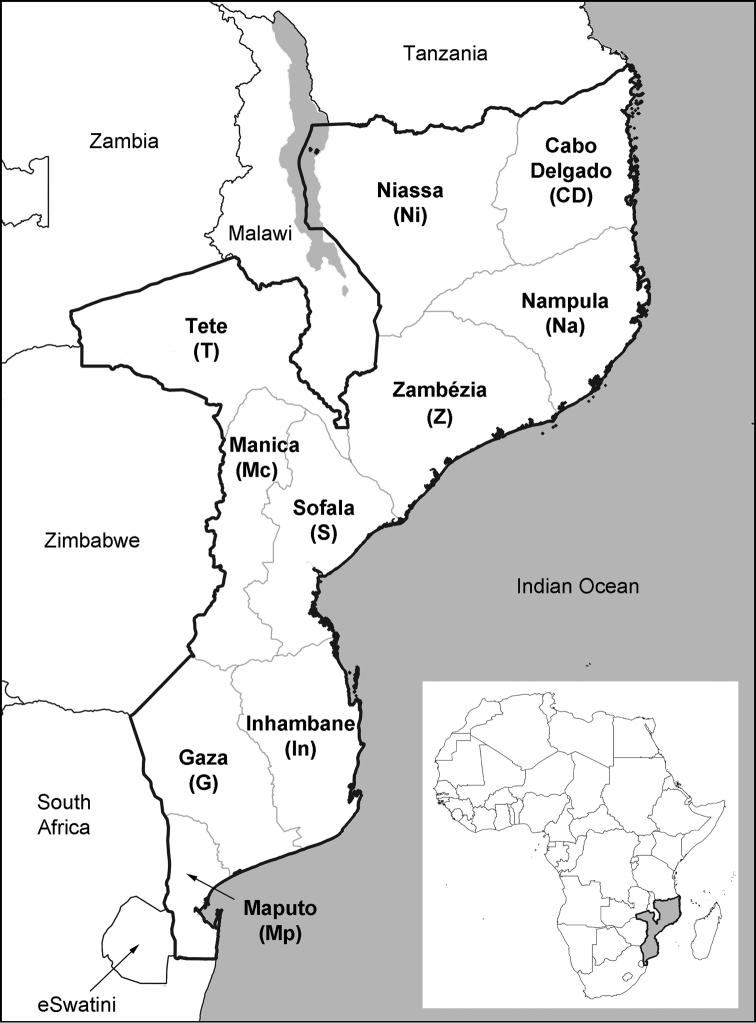
Endemic species are an important component of a country’s biodiversity stewardship and natural capital (ref. Mapaura 2002). Narrowly restricted endemics are often amongst the species most sensitive to environmental change and disturbance, and so at highest risk of extinction (ref. Crisp et al. 2001; ref. Işik 2011; ref. Borokini 2014; ref. Abdelaal et al. 2018; ref. Orsenigo et al. 2018). These species therefore form important components for a range of methods for identifying and conserving biodiversity priorities, such as Important Plant Areas (ref. Darbyshire et al. 2017), Key Biodiversity Areas (ref. IUCN 2016), and the site criteria of the Alliance for Zero Extinction (ref. Ricketts et al. 2005; http://zeroextinction.org/the-alliance/about-the-alliance/). Furthermore, endemic species can be an important consideration when applying the mitigation hierarchy in environmental impact assessments associated with industrial or commercial development projects, particularly at the avoidance and offsetting stages. Therefore, it is important for countries to have an accurate record of their endemic flora, including how many and which species are endemic, and where they are found. At this time of unparalleled rates of biodiversity loss, it is essential to mobilise such information so that countries can effectively prioritise the conservation and sustainable management of their natural resources (ref. Onana 2013). This paper presents the first detailed account of the endemic flora of Mozambique, a biodiversity-rich country in southern tropical Africa (Fig. 1).
Mozambique: species richness, phytogeography and centres of endemism
Despite its obvious diversity and interest, the flora of Mozambique has received only limited and patchy coverage, particularly when compared to the floras of neighbouring countries. ref. Frodin (2001) estimated the total Mozambican flora as approximately 5,500 species, but noted this was likely to be an under-estimate as “many parts of the country remain imperfectly known” (p. 529). ref. Da Silva et al. (2004) listed only 3,932 indigenous species in their SABONET checklist of Mozambique, of which 177 were noted as endemic. However, it was acknowledged that this list, compiled primarily using specimens held at the LMA and LMU herbaria in Maputo (herbarium acronyms follow Thiers [continuously updated]) with additional records from literature sources, was only provisional, and it has proven to be under-representative. As a good example, ref. da Silva et al. (2004) record nine species of Barleria L. (Acanthaceae), but in the “Flora Zambesiaca” (F.Z.) account of Acanthaceae, 33 species of Barleria are listed for Mozambique (ref. Darbyshire et al. 2015). In an independent, and more comprehensive analysis, ref. Timberlake et al. (2006) documented 5,692 taxa and 251 endemics in Mozambique including cross-border range-restricted endemics, with an endemism rate of 4.4%. With F.Z. (1960–present) nearing completion, a more accurate measure of species richness in Mozambique is now possible. As of August 2019, the “Flora of Mozambique” website (ref. Hyde et al. 2019a) and associated database of species records, which combine data from F.Z. with updates from relevant literature and field surveys, lists 6,157 native and naturalised species. This figure continues to grow at a rapid rate as targeted botanical surveys of new and botanically interesting areas are conducted, adding new records and new species to science. For example, during surveys of the coastal dry forests in the most north-eastern part of Mozambique in Cabo Delgado Province between 2003 and 2009, during which over 3,000 botanical collections were made, a total of 738 plant taxa were recorded. Of these, 68 were new records for Mozambique, and a further 36 taxa were either entirely new to science or previously known only from fragmentary material and so undescribed (ref. Timberlake et al. 2011).
Mozambique (Fig. 1) derives its rich and varied plant life in part from its diverse geography, geology and climate, including the influence of its extensive Indian Ocean coastline. These factors have resulted in a wide range of habitats and complex biogeography. Thirteen terrestrial ecoregions are recorded in Mozambique (https://ecoregions2017.appspot.com/; ref. Olson et al. 2001; ref. Burgess et al. 2004; ref. Dinerstein et al. 2017). Moreover, Mozambique features several recognised Centres of Plant Endemism. The majority of the country is included within the Zambezian Regional Centre of Endemism (ref. White 1983), which is widely distributed across southern tropical Africa. Of greater significance in terms of concentrations of range-restricted species, are four cross-border Centres of Endemism (Fig. 2). The first is the recently proposed Rovuma Centre (ref. Burrows and Timberlake 2011) of northeast Mozambique and southeast Tanzania, an extension of the previously recognised Lindi Local Centre in Tanzania (ref. Clarke 2001) or a part of the wider Swahelian Centre of Endemism in coastal East Africa (ref. Clarke 1998). The Rovuma Centre extends along the Mozambique coast through Cabo Delgado, Nampula and Zambézia Provinces approximately as far south as the city of Quelimane (J. Burrows, pers. comm.). The second is the Maputaland Centre (ref. van Wyk 1996; ref. van Wyk and Smith 2001), shared with South Africa and eSwatini (formerly Swaziland), which extends along the coastal lowlands of southern Mozambique to the Limpopo River. This region has several recognised Sub-Centres including the Lebombo Mountains, which straddle the border of the three countries (ref. van Wyk and Smith 2001; ref. Loffler and Loffler 2005). In a wider sense, the Maputaland Centre potentially also extends further northwards from the mouth of the Limpopo River all the way to the mouth of the Save River in Inhambane Province, although this has also been proposed as a putative Centre of Endemism in its own right, the Inhambane Centre (J. Burrows, pers. comm.; A. Massingue, unpubl. data). The third cross-border Centre of Endemism is the Chimanimani-Nyanga (or Manica) Highlands that run along the border with Zimbabwe and form the north-eastern-most extent of the Great Escarpment of southern Africa (ref. Clark et al. 2011). These mountains are well known for their rich floras and high plant endemism (ref. Wild 1964; ref. Mapaura 2002; ref. Clark et al. 2017; ref. Wursten et al. 2017; ref. Cheek et al. 2018). The fourth comprises the larger massifs of the belt of inselbergs running from southern Malawi to Zambézia and Nampula Provinces of northern Mozambique (ref. Bayliss et al. 2014). The most significant peaks are Mount Mulanje (including Mount Mchese) and the Zomba Plateau in Malawi, and Mounts Namuli, Mabu, Inago and the Ribaue Mountains in Mozambique – here shortened to the Mulanje-Namuli-Ribaue Mountains. Mount Mulanje is well established as a site of botanical importance with high endemism (ref. Strugnell 2002, ref. 2006), but the botanical importance of the Mozambique massifs and their links to Mulanje are also becoming increasingly evident (ref. Timberlake et al. 2009, ref. 2012; ref. Harris et al. 2011; ref. Bayliss et al. 2014; ref. Downes and Darbyshire 2017). The latter two Centres form a part of the Africa-wide Afromontane Archipelago-like Centre of Endemism of ref. White (1983).
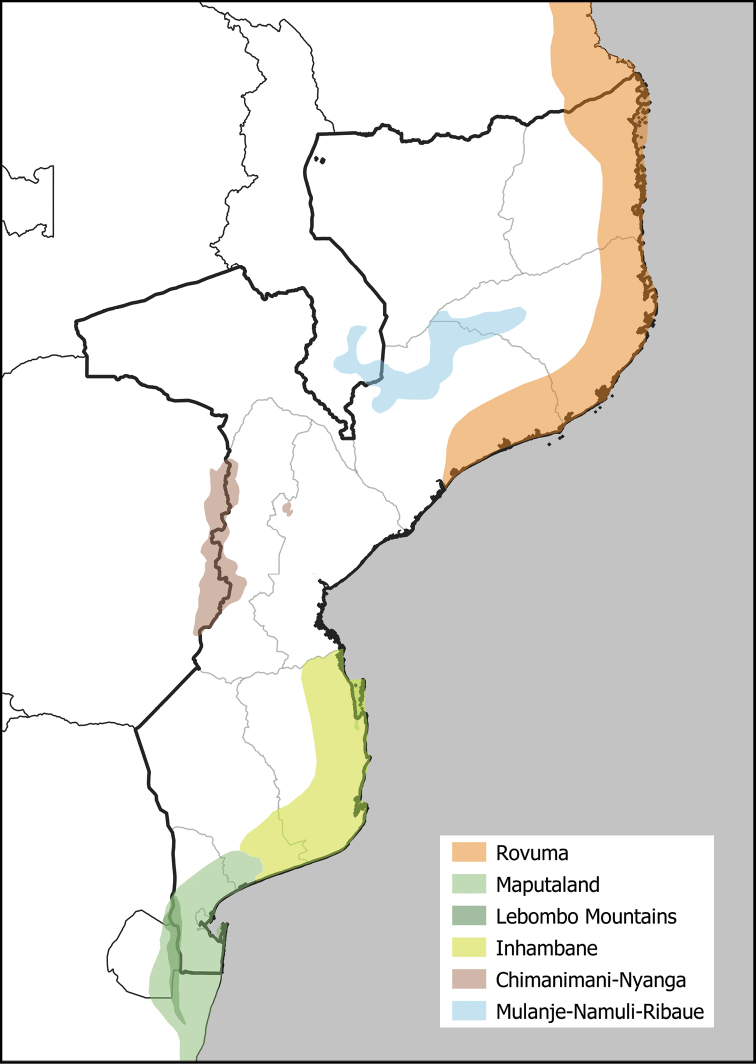
As these four important Centres of Plant Endemism all cross national borders, it is clearly evident that the political boundary of Mozambique does not reflect species distributions and biogeographic patterns. When considering endemic taxa, therefore, it is pertinent to include within this review those cross-border range-restricted taxa that have a globally significant portion of their range in Mozambique, rather than restricting coverage to taxa that only occur within the political border. Hence the definition of the endemic plants is here extended to include all such relevant near-endemic taxa.
Motivation for the current study: conservation of the Mozambique flora
In order to address Mozambique’s commitments under the Convention on Biological Diversity (CBD), the “National Strategy and Action Plan of Biological Diversity of Mozambique 2015–2035” (ref. MITADER 2015) sets out a series of detailed national targets for documenting and conserving the biodiversity of Mozambique. Target 6 of this strategy aims to “by 2025, have at least 30% of habitats of endemic and/or threatened flora and fauna species with strategies and action plans for their conservation in place” with a series of related priority actions, including:
• Action 6.1: establish and implement coordinated programs for the systematic assessment of the conservation status of endemic and endangered species;
• Action 6.2: identify and describe the Areas of Plant Importance;
• Action 6.3: disseminate the Red data Book on national flora and fauna.
To address these targets, and to enable effective conservation of Mozambique’s plant diversity in light of increasingly severe pressure on natural resources, a number of botanical initiatives have been launched. A plant Red Listing programme and working group was established in 2011 through the IUCN-SSC Southern African Plant Specialist Group, with the current aim to complete at least 400 new or updated plant species assessments in the period 2017–2020, focussing on strict-endemic and near-endemic species of Mozambique (ref. IUCN SSC Southern African Plant Specialist Group 2017; ref. Matimele 2019). In 2015, the Instituto de Investigação Agrária de Moçambique (the Agrarian Research Institute of Mozambique – IIAM) and the Royal Botanic Gardens, Kew (Kew), together with in-country and international collaborators, launched the “Tropical Important Plant Areas: Mozambique" project (https://www.kew.org/science/projects/tropical-important-plant-areas-tipas-mozambique). This project aims to combine existing data and expertise with targeted field survey data to identify and document Important Plant Areas (IPAs) in Mozambique, and to promote the conservation and sustainable management of these critical sites. This builds on the provisional identification of IPAs through the Southern African Botanical Diversity Network (SABONET) programme (ref. Smith 2005). Further, it draws on the series of extensive botanical surveys in sites of high biodiversity interest across Mozambique that have been conducted by IIAM, Kew and collaborators over the past 15 years. Documentation of the endemic taxa and where they occur is an important step in the IPA and Red Listing programmes, and so provides the motivation for the detailed checklist presented here.
Materials and methods
Key resources for compiling the checklist
Compilation of the checklist was based primarily upon extensive reviews of literature on the taxonomy and floristics of Mozambique and neighbouring countries, combined with reference to relevant herbarium collections (notably at BM, BNRH, EA, K, LISC, LMA, LMU, NH, P, PRE and SRGH; herbarium codes follow Thiers [continuously updated]), and the authors’ collective knowledge of the Mozambican flora. A key source for information on the plants of Mozambique, and the starting point for this current work, is the “Flora Zambesiaca” series (F.Z.; 1960–present; http://apps.kew.org/efloras/search.do). This Flora is currently c. 90% complete, with 13 volumes and 47 parts published to date (ref. Exell and Wild 1960, ref. Timberlake and Martins 2015). We have also had access to completed and partially completed accounts for the outstanding volumes: Apocynaceae (Part 2), Commelinaceae, Asteraceae (Compositae) in part, Cyperaceae, and Hyacinthaceae. However, it should be noted that Asteraceae may be under-represented in this checklist in view of the fact that this family has not yet been completed for F.Z.
The “Flora de Moçambique” project ran alongside F.Z. from 1969, but was discontinued in 1981. The accounts in this Flora were derived from F.Z., but with some additional specimen citations and Mozambique-relevant habitat information, thus providing useful additional information for the current work. However, ref. Beentje (2016) estimates that this Flora is less than 40% complete. Other key published works used repeatedly are the recently published landmark volume “Trees and Shrubs [of] Mozambique” (T.S.M.; ref. Burrows et al. 2018); the first national Plant Red List for Mozambique produced through the SABONET programme (S.R.D.L.; ref. Izidine and Bandeira 2002); the field guide to wild flowers of southern Mozambique (ref. Bandeira et al. 1997); and reports on recent botanical surveys and checklists of key localities in Mozambique (ref. Timberlake et al. 2007, ref. 2009, ref. 2010, ref. 2011, ref. 2012, ref. 2016a, ref. 2016b; ref. Bayliss et al. 2010; ref. Harris et al. 2011; ref. Müller et al. 2012; ref. Clark et al. 2017; ref. Wursten et al. 2017). The “Flora of Tropical East Africa” (1952–2012; ref. Beentje 2012, ref. 2016) was also an important source of information for many northern near-endemic species. Key online sources that were widely consulted are the “Flora of Mozambique and Flora of Zimbabwe” sites (ref. Hyde et al. 2019a, ref. 2019b), the ref. African Plant Database (2019), the IUCN Red List of Threatened Species (ref. IUCN 2019), the Botanical Database of Southern Africa / Plants of Southern Africa (ref. South African National Biodiversity Institute 2019), the Red List of South African Plants (ref. South African National Biodiversity Institute 2017) and Plants of the World Online (ref. POWO 2019).
Definitions of endemism and near-endemism
The taxa treated in the checklist are either strictly endemic to Mozambique (i.e. they only occur within its political borders – labelled E), or are “near-endemic” (NE), as defined by one or more of the following criteria:
(a) the majority of the taxon’s range lies within Mozambique, and they are scarce and/or highly range-restricted beyond (NE1); and/or
(b) the global range of the taxon is less than 10,000 km2 (NE2); and/or
(c) the taxon is known globally from five or fewer localities (NE3).
The aim is to include all taxa for which Mozambique has a particularly high responsibility for their global survival and protection, thus those taxa that have the majority of their range in Mozambique, but are also widespread and/or frequent in other parts of southeast tropical Africa are excluded. For example, Barleriarepens Nees (Acanthaceae) is widely distributed along the East African coast, but with the majority of its distribution in Mozambique because of the vast length of the country’s coastline. However, we do include under (b) and (c) those taxa that do not necessarily have the majority of their range in Mozambique but, because of their highly restricted range and/or scarcity, the Mozambique portion of the population is of global significance to their future survival. We acknowledge that no definition of “near-endemic” is perfect, but we have tried to be as objective as possible when applying the criteria set out above. We have tried to be exhaustive, but our intention is to maintain this list and publish additions and amendments as they are uncovered.
Estimates of range size used in (b) above are based on mapping of known locality data. An offline BRAHMS database (https://herbaria.plants.ox.ac.uk/bol/) of all known collections and sight records of endemic, range-restricted and threatened species is in advanced progress at RBG Kew and IIAM, with approximately 6,000 records compiled to date. Hence, for most of the species on the list we have an accurate measure of range size. For others, where the data are yet to be finalised, ranges have been estimated, aided where available by use of data available via the GeoCAT tool (http://geocat.kew.org/; ref. Bachman et al. 2011); this includes access to relevant GBIF data (ref. GBIF.org 2019). In most cases, the range size is based on the Minimum Convex Polygon (MCP) method commonly applied in the calculation of extent of occurrence (EOO) in the IUCN Red List criteria (ref. Joppa et al. 2016; ref. Bachman et al. 2011; ref. IUCN 2012). However, in a few circumstances where species have highly disjunct distributions with unsuitable habitat in most of the intervening areas, we have estimated range based on the known localities. Of particular note are montane species that are found in the Chimanimani-Nyanga (Manica) Highlands along the Mozambique-Zimbabwe border, but which also extend to Mount Gorongosa, an isolated peak over 100 km to the east in Sofala Province. This usually results in a MCP range of over 10,000 km2 (depending on the distribution within the Manica Highlands), but as there is no suitable montane habitat in the intervening region, we treat this range as being less than 10,000 km2, and include these species as near-endemics.
Taxonomy and literature sources
Plant family circumscription follows the Angiosperm Phylogeny Group (APG IV) classification for flowering plants (ref. Stevens 2001 onwards; ref. Angiosperm Phylogeny Group 2016), the Pteridophyte Phylogeny Group (PPG 1; 2016) classification for pteridophytes, and ref. Christenhusz et al. (2011) for gymnosperms. Accepted names of species and infraspecific taxa generally follows the ref. African Plant Database (2019; henceforth APD) except in rare cases where the APD has not been updated to the most recent name, or in the few cases where we disagree with the species circumscription adopted by APD, e.g. Elaeodendronfruticosum N.Robson, which is treated as a synonym of E.matabelicum Loes. in APD, but we follow ref. Burrows et al. (2018) in recognising it as distinct. Where the taxonomic concept adopted is not universally accepted, or where a taxon has been very recently re-combined, the alternative name is given in brackets. Included on the checklist are all published endemic and near-endemic taxa, together with eight new taxa that are currently either in press or in the late stages of preparation (e.g. Cyanotisnamuliensis Faden, Sericanthechimanimaniensis Wursten & de Block) such that we are confident of their status. Only species, subspecies and varieties are included in this list; we do not include endemic or near-endemic forms. We have additionally compiled a list of undescribed taxa that are provisionally considered to be endemic or near-endemic to Mozambique, but that have not yet been studied in sufficient detail or are represented by incomplete specimens, for example Dicliptera spp. B, C and E of F.Z. (ref. Darbyshire et al. 2015). These are not presented in the checklist, but are available on request from the corresponding author, and included in some of the analyses in the Results and Discussion. Highly doubtful and imperfectly known taxa are excluded. For example, both Acaciapurpurea Bolle and Oxyanthusquerimbensis Klotzsch were described from collections made in Mozambique by Wilhelm Peters in the mid-nineteenth century (ref. Peters 1861), and are believed to have been destroyed during the bombing of the Berlin Herbarium in World War II. These species were treated in F.Z. as insufficiently known, and potentially conspecific with other, more widespread species (ref. Brenan 1970; ref. Bridson and Verdcourt 2003).
The date of the original publication (the protologue) is recorded for each taxon. As the aim is to chart the discovery of Mozambique’s endemic flora, it is the date of first publication of the taxon that is of importance, rather than the publication date of the currently accepted name. In many cases these are one and the same, for example Euphorbiaangularis Klotzsch (in ref. Peters 1861: 92) has been the accepted name ever since its first publication. However, many taxa have changed genus or taxonomic rank since they were first published; for example, the combination for the endemic Barleriasetosa (Klotzsch) I.Darbysh. was first published in 2015 (ref. Darbyshire et al. 2015), but is based on B.prionitisL.var.setosa Klotzsch, published in ref. Peters (1861: 209), hence 1861 is the date of first publication of this taxon.
For each taxon, we include key references for further information on the plant and its distribution and ecology. Wherever relevant, we include the F.Z. volume and page number, and the page number in T.S.M. and S.R.D.L. For taxa that have been described since the relevant F.Z. volume, we cite the protologue. For those taxa that have changed name or taxonomic rank since F.Z. (for example, have been transferred to a different genus), we cite the relevant F.Z. volume and page number for the taxon account, but also cite the protologue for the currently accepted name.
Plant life-forms
The growth habit and life cycle of each species are recorded using a simple classification, with six main categories: tree, shrub, liana, herb, pteridophyte and cycad. The herb category is further subdivided into annual (a), perennial (p), succulent-perennial (s), epiphytic-perennial (e), climbing-perennial (c), geophyte (geo), graminoid (gram-a for annual and gram-p for perennial) and seagrass. Trees and shrubs also have a succulent subdivision. Species with variation in growth habit and/or life cycle are recorded in two or more categories.
Distribution and phytogeography
Taxa known only from the type specimen or type locality are noted. The distribution of each taxon within Mozambique is then recorded, first by scoring which of the provinces it is recorded in (Maputo City Province is included within Maputo Province, hence 10 provinces, Fig. 1), and second by recording key localities in Mozambique arranged by province. The latter are taken from the BRAHMS database noted above, and from additional site observations from the authors. We have attempted to standardise the Mozambican place names, but have used anglicised forms where they are in common use in the literature and/or in gazetteers (such as Mt Mabu and Ribaue Mts, rather than Serra de Mabu and Serra do Ribáuè), and we have avoided use of Portuguese accents on place names, as these are often inconsistently applied. This locality information is provided to help with future study of these species, and to assist with the identification and demarcation of Important Plant Areas. It is not intended to be exhaustive and should not be read as such.
For near-endemic species, the other country (or countries) in which the species occurs is recorded, together with a brief note of key localities; these are not intended to be exhaustive or specific, rather to show how far the species extends beyond Mozambique.
Finally, in order to provide phytogeographic context, the taxa are provisionally assigned where possible to botanical Centres of Endemism (see Introduction). We exclude the widespread Zambezian Regional Centre (ref. White 1983), instead focussing on the more restricted cross-border Centres: (1) Rovuma; (2) Maputaland sensu lato, which we subdivide into (2a) Maputaland sensu stricto (coastal lowlands north to Limpopo River), (2b) Lebombo Mountains (Sub-) Centre, and (2c) Inhambane (Sub-) Centre; (3) Eastern Afromontane, which we subdivide into (3a) Chimanimani-Nyanga (Manica) Highlands, and (3b) Mulanje-Namuli-Ribaue Mountains.
Extinction risk using the IUCN Red List
Using the categories and criteria of the IUCN Red List (ref. IUCN 2012, ref. 2019), the extinction risk is recorded if the taxon has been assessed; the Red List provides additional information on these species, and so can be considered a further key reference. Red List assessments in need of updating are marked with an asterisk; in most cases these were assessed using an earlier version of the Red List criteria. Red List assessments that have been finalised, but not yet published are listed in italics. Only global Red List assessments are included; we do not list the national assessments of ref. Izidine and Bandeira (2002), as these were highly provisional and are in the process of being re-evaluated on a global scale.
Results
An annotated checklist of the strict-endemic and near-endemic taxa of Mozambique is presented in Suppl. material 1, with a summary of the checklist provided in Appendix 1. It includes all taxa (species, subspecies and varieties) that have been described to date or are in the process of being described. In total, 658 taxa (572 species) are documented, comprising 271 strict-endemic taxa (235 species) and 387 near-endemic taxa (337 species) (Table 1, Fig. 3). In addition, 105 currently undescribed but potentially new taxa (98 species) that are believed to be strict-endemic or near-endemic are noted, but not included in Suppl. material 1 or Appendix 1. If the total number of native and naturalised vascular plant species in Mozambique is taken as ± 6,157 (as per ref. Hyde et al. 2019a), then approximately 3.8% of the species are strict-endemics, whereas the strict-endemics and near-endemics combined account for 9.3% of the plants in Mozambique at the species rank, discounting undescribed taxa. If undescribed taxa are included then approximately 10% of the flora of Mozambique is endemic or near-endemic.
Table 1.: Summary of endemic taxa in Mozambique. Note that genera are not included in the “Total taxa” row.
| Taxon rank | Mozambique strictendemics | Mozambique nearendemics | Mozambique strict-endemics and near-endemics |
| Genus | 5 | 2 | 7 |
| Species | 235 | 337 | 572 |
| Subspecies | 18 | 28 | 46 |
| Variety | 18 | 22 | 40 |
| Total taxa | 271 | 387 | 658 |
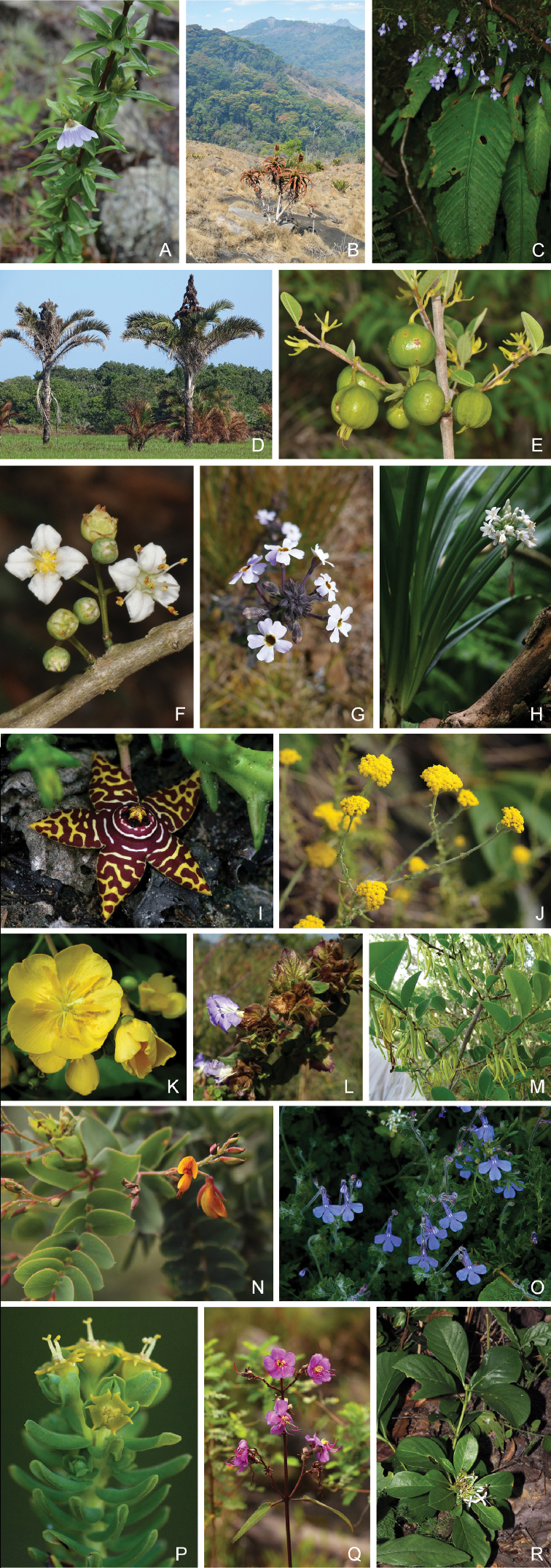
Mozambique currently has five strict-endemic genera, all of which are monospecific: Baptorhachis Clayton & Renvoize (Poaceae) from the granite inselbergs of Nampula Province; Emicocarpus K.Schum. & Schltr. (Apocynaceae) from sandy soils around Maputo Bay; Gyrodoma Wild (Asteraceae) widespread on alluvial plains, estuaries and margins of lagoons in coastal Mozambique from Zambézia Province southwards; and Icuria Wieringa (Fabaceae) and Micklethwaitia G.P.Lewis & Schrire (Fabaceae), both occurring as locally dominant trees in the coastal dry forests of northern Mozambique. A further two potential new strict-endemic genera in Asparagaceae (former Hyacinthaceae) are currently under research (T. Rulkens, pers. comm.). In addition, two monospecific genera are near-endemic to Mozambique: Triceratella Brenan (Commelinaceae), occurring in moist sands in coastal Zambézia Province, but also known from one locality in Zimbabwe; and Oligophyton H.P.Linder & G.Will. (Orchidaceae), restricted to the Chimanimani Mountains on the Zimbabwe-Mozambique border. Two other genera have their sole African representative in Mozambique: Dolichandrone Fenzl (Bignoniaceae) and Eriolaena DC. (Malvaceae), both of which are predominantly Asian genera (ref. Diniz 1988; ref. Dorr and Wurdack 2018).
Of the near-endemic taxa, 179 are shared with Zimbabwe, 93 with Tanzania, 79 with South Africa, 59 with Malawi, 20 with eSwatini, two with Madagascar and one each with Kenya and Zambia.
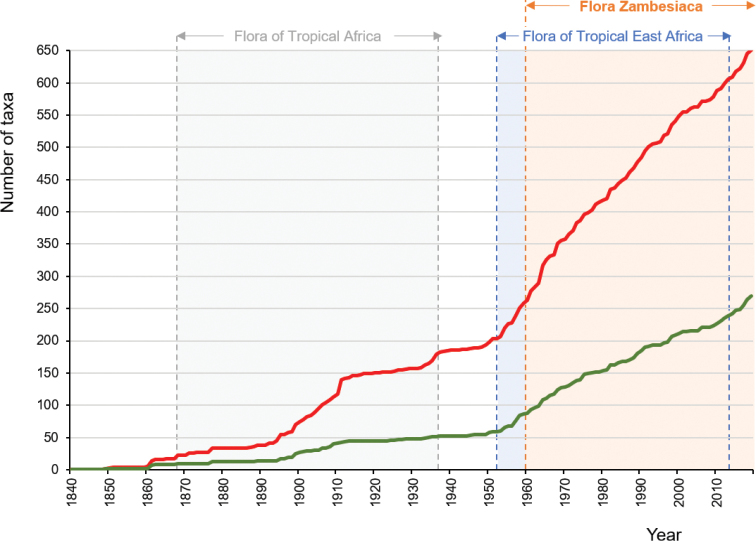
Tables 2–6 provide further summaries of the findings presented in Suppl. material 1, namely the most important plant families for strict-endemic and near-endemic taxa (Table 2); the range of life forms of these taxa (Table 3); their geographic distribution by province in Mozambique (Table 4); their distribution within recognised and proposed Centres of Endemism (Table 5); and the extinction risk status of these taxa (Table 6). These tables exclude unpublished taxa. Figure 4 charts the history of publication of the currently accepted strict-endemic and near-endemic taxa in scientific literature.
Table 2.: Important plant families for published endemic taxa in Mozambique. The 10 plant families with the highest number of endemic taxa, with comparison to the ten most species-rich plant families for the total Mozambican flora (derived from ref. Hyde et al. 2019a). Numbers refer to number of taxa; where two or more plant families share the same number of taxa, the “=” symbol is used to denote that these families have an equal standing in the table.
| Mozambique strict-endemics | Mozambique strict-endemics and near-endemics | Total vascular plants of Mozambique | |||
|---|---|---|---|---|---|
| 1. Fabaceae | 40 | 1. Fabaceae | 84 | 1. Fabaceae | 759 |
| 2. Euphorbiaceae | 26 | 2. Rubiaceae | 71 | 2. Poaceae | 445 |
| 3. Rubiaceae | 23 | 3. Euphorbiaceae | 42 | 3. Rubiaceae | 377 |
| 4. Malvaceae | 12 | 4. Lamiaceae | 30 | 4. Asteraceae | 352 |
| 5. Apocynaceae | 11 | 5.= Apocynaceae | 27 | 5. Orchidaceae | 232 |
| 6.= Acanthaceae | 10 | 5.= Asteraceae | 27 | 6. Acanthaceae | 219 |
| 6.= Lamiaceae | 10 | 7. Acanthaceae | 26 | 7.= Euphorbiaceae | 194 |
| 8. Lythraceae | 9 | 8.= Malvaceae | 21 | 7.= Malvaceae | 194 |
| 9.= Asphodelaceae | 8 | 8.= Orchidaceae | 21 | 9. Lamiaceae | 185 |
| 9.= Melastomataceae | 8 | 10. Asphodelaceae | 20 | 10. Apocynaceae | 156 |
Table 6.: Summary of the extinction risk status of published endemic taxa in Mozambique. The “% of taxa” figure for “Total taxa assessed” is given as a percentage of all the endemic (left) and endemic plus near-endemic (right) taxa listed in Appendix 1; for each of the Red List categories (LC = Least Concern; NT = Near Threatened; VU = Vulnerable; EN = Endangered; CR = Critically Endangered; DD = Data Deficient), the “% of taxa” is given as a percentage of those taxa that have been assessed.
| IUCN Red List Category | Mozambique strict-endemics | Mozambique strict-endemics and near-endemics | ||
| Number of taxa | % of taxa | Number of taxa | % of taxa | |
| Total taxa assessed | 145 | 53.5 | 332 | 50.5 |
| LC | 33 | 22.8 | 107 | 32.2 |
| NT | 4 | 2.8 | 19 | 5.7 |
| VU | 32 | 22.1 | 86 | 25.9 |
| EN | 32 | 22.1 | 69 | 20.8 |
| CR | 19 | 13.1 | 19 | 5.7 |
| DD | 25 | 17.2 | 32 | 9.6 |
Table 3.: Life forms (growth habits) of published endemic taxa of Mozambique. Note that species can fall under more than one habit category or sub-category. Numbers refer to number of taxa.
| Life form (growth habit) | Mozambique strict-endemics | Mozambique strict-endemics and near-endemics | |
|---|---|---|---|
| Tree | Non-succulent | 54 | 134 |
| Succulent | 2 | 9 | |
| Tree Total | 56 | 143 | |
| Shrub | Non-succulent | 103 | 283 |
| Succulent | 19 | 27 | |
| Shrub Total | 122 | 310 | |
| Liana | 7 | 28 | |
| Woody life forms Total | 144 | 363 | |
| Herb | Annual | 27 | 51 |
| Perennial – non-succulent | 67 | 175 | |
| Perennial -succulent | 12 | 28 | |
| Perennial -epiphyte | 1 | 4 | |
| Perennial – climber/twiner | 4 | 12 | |
| Perennial – geophyte | 14 | 43 | |
| Graminoid – annual | 2 | 4 | |
| Graminoid – perennial | 5 | 11 | |
| Seagrass | 1 | 2 | |
| Herb Total | 136 | 324 | |
| Pteridophyte | 0 | 1 | |
| Cycad | 4 | 11 | |
| Unknown | 1 | 1 | |
Table 4.: Summary of the geographic distribution of published endemic taxa in the ten provinces of Mozambique. The table is ordered alphabetically by Province; numbers refer to number of taxa.
| Province | Mozambique strict-endemics | Mozambique strict-endemics and near-endemics | Provincial endemics | Strict-endemics and near-endemics restricted to one Province |
|---|---|---|---|---|
| Cabo Delgado (CD) | 56 | 125 | 27 | 54 |
| Gaza (G) | 26 | 62 | 5 | 7 |
| Inhambane (I) | 48 | 93 | 15 | 17 |
| Manica (Mn) | 22 | 192 | 20 | 150 |
| Maputo (Mp) | 36 | 119 | 13 | 50 |
| Nampula (Na) | 86 | 154 | 29 | 38 |
| Niassa (Ni) | 19 | 40 | 10 | 21 |
| Sofala (S) | 47 | 105 | 16 | 21 |
| Tete (T) | 7 | 18 | 2 | 3 |
| Zambézia (Z) | 81 | 159 | 34 | 56 |
Table 5.: Number of published endemic taxa restricted to Centres and Sub-Centres of Endemism. For the Sub-Centres under (2) Maputaland and (3) [Eastern] Afromontane, taxa are only recorded if they are exclusive to that Sub-Centres.
| Centre of Endemism code | (Sub-) Centre of Endemism | Mozambique strict-endemics | Mozambique strict-endemics and near-endemics |
|---|---|---|---|
| 1 | Rovuma | 55 | 110 |
| 2 | Maputaland sensu lato (including Inhambane) | 50 | 114 |
| 2a | Maputaland sensu stricto | 13 | 32 |
| 2b | Lebombo Mountains (Sub-) Centre | 3 | 17 |
| 2c | Inhambane (Sub-) Centre | 20 | 20 |
| 3 | [Eastern] Afromontane sensu lato | 46 | 229 |
| 3a | Chimanimani-Nyanga (Sub-) Centre | 16 | 158 |
| 3b | Mulanje-Namuli-Ribaue (Sub-) Centre | 30 | 59 |
In Suppl. material 2, we provide a list of taxa that were considered for inclusion in the checklist during its preparation but were ultimately excluded as they did not meet the criteria set out in the Methodology.
For the sake of brevity in the following Discussion, we refer to the combined strict-endemic and near-endemic taxa as “endemics”, whilst we refer to “strict-endemics” if referring only to those taxa unique to Mozambique; the two groups are separated out in the accompanying tables.
Discussion
Species richness and endemism in the flora of Mozambique
Based on extrapolation from the RAINBIO mega-database – one of the most comprehensive datasets for plant diversity in tropical Africa, with distribution data for 25,356 native species (ref. Dauby et al. 2016) – ref. Sosef et al. (2017) estimated species richness in Mozambique as between 5,220–5,309 and recorded a relatively high rate of endemism (8.4%, equating to c. 440 spp.) compared to neighbouring countries of southern tropical Africa (Malawi 6.5%, Zambia 7.2%, Zimbabwe 7.6%), although notably lower than Tanzania to the north (19.4%). Current evidence demonstrates that the RAINBIO figure for total species richness is a significant under-estimate, with the total vascular flora currently at 6,157 species (ref. Hyde et al. 2019a), over 15% higher than the upper estimate of ref. Sosef et al. (2017). The known strict-endemism rate of 3.8% is considerably lower than the predicted endemism of ref. Sosef et al. (2017), but if we use the broader definition of endemism applied here to include cross-border near-endemics, then 9.3–10% of taxa are endemics (depending on omission or inclusion of unpublished taxa), which is comparable with the RAINBIO estimate. This figure is considerably higher than the 4.4% endemism rate earlier recorded by ref. Timberlake et al. (2006).
Whilst new discoveries are likely to continue to be made in Mozambique (see below), the percentage endemism of the flora is unlikely to increase, and may even decline as the rate of new country records of non-endemic taxa outstrips the rate of new taxon discovery. For example, in the surveys of the coastal dry forests of northeast Cabo Delgado in 2003–2009, the 68 records of taxa new to Mozambique (ref. Timberlake et al. 2011) included only six near-endemic taxa following the definition applied here. Hence, whilst the discovery of 36 putative new, endemic taxa during these surveys was quite exceptional for eastern tropical Africa in the twenty-first century, it was surpassed at the rate of 1.7:1 by the discovery of new country records of more widespread, non-endemic taxa.
Discovery of the endemic flora of Mozambique
There have been concerted efforts to document the tropical African flora for over a century and a half, with the first major sub-continental work – the “Flora of Tropical Africa” – dating back to 1868–1937 (ref. Beentje 2016), and the first strict-endemic plant species described in Mozambique as early as 1849 [Fornasiniaebeniferaref. Bertolini (1849) = Millettiaebenifera (Bertol.) J.E.Burrows & Lötter; see ref. Burrows et al. 2018]. Given these facts, the relatively recent discovery and/or description of many of Mozambique’s endemic plants – the mean year of first publication being 1959, or 1967 for strict-endemics (Fig. 4) – is somewhat surprising. A marked increase in taxon description is observed post-1950, which coincides with the onset of the major eastern African Flora projects – the first fascicle of “Flora of Tropical East Africa” was published in 1952 and the first part of “Flora Zambesiaca” in 1960 (ref. Beentje 2016). Coupled with these Flora projects was major regional-scale botanical exploration to collect herbarium material on which the Flora volumes could be based, and to fill the many gaps in our knowledge of these floristic regions. It was these combined efforts that resulted in the major discoveries of the Mozambique flora, a clear demonstration of how important an active Flora project can be in unlocking information on national and/or regional plant diversity. The completed Floras have, in turn, highlighted localities of high botanical interest, encouraging targeted collecting efforts in Mozambique particularly over the past two decades. Mozambique remains one of the African countries with the highest rates of new species publication. For example, in 2018, 20 new species and one new variety of vascular plants were described from the country, including eight new woody species in the “Trees and Shrubs [of] Mozambique” (ref. Burrows et al. 2018), and four new species of Memecylon L. in the Melastomataceae family (ref. Stone et al. 2018).
Of the published endemics, 60 (47 species, 3 subspecies, and 10 varieties) are known only from the type specimen and/or the type locality. This comprises nearly one quarter (22%) of the strict-endemics of Mozambique. A small number of these taxa are of somewhat doubtful status, for example Tecleacrenulata (Engl.) Engl. (Rutaceae) from Zambézia Province, and some may be subsumed within other, more widespread taxa following further research. However, most are accepted in all relevant taxonomic and floristic works (ref. African Plant Database 2019), and in many cases have been upheld in multiple treatments. The fact that these taxa are so poorly known demonstrates how limited our knowledge of the Mozambique flora remains, and reinforces the likelihood that further discoveries of narrowly range restricted endemics in Mozambique will be made through future botanical exploration.
Important plant families for endemic and near-endemic taxa in Mozambique
There is generally a high congruence between total species richness per plant family in Mozambique and those families that contain the highest number of endemics, with all but two of the families featuring in both lists of top ten families (Table 2). Fabaceae (Leguminosae) is the most species-rich plant family in Mozambique, and also has the highest number of published endemics. As in most of the African continent, the Fabaceae have diversified significantly in nearly all habitats and ecoregions of Mozambique, and display a large variety of life-forms (ref. Lewis et al. 2005). This, coupled with the high rate of endemism, indicates that the Fabaceae may be considered a suitable proxy group for the study of vascular plant distribution and diversity in Mozambique. Other families that combine high species diversity and high rates of endemism include Acanthaceae, Asteraceae, Malvaceae, Orchidaceae and Rubiaceae. In total, the ten most endemics-rich families contain over half (56%) of the total endemic taxa.
Some species-rich families do not, however, feature prominently in the endemics list, most notably the Poaceae, which is the second largest family in Mozambique, but falls outside the top ten families (twelfth) for endemics. This phenomenon is not isolated to Mozambique, and high proportions of grass taxa globally are known to have large ranges. ref. Linder et al. (2017) noted a range of ecological adaptations that enable grasses to successfully colonise and dominate many ecosystems, including effective long-distance dispersal through wind pollination and seed dispersal, ecological flexibility, resilience to disturbance, and an ability to modify environments by changing fire regimes and mammalian herbivory. Many of these factors could also facilitate wide ranges and abundance of individual grass species.
Conversely, some plant families feature more highly on the endemics list than in terms of total species richness. Euphorbiaceae is the third highest family for endemism, but only equal-seventh for total species richness; this is primarily a result of the high number of range-restricted Euphorbia species that occur in Mozambique, most of which are succulents (see Plant life forms below). Furthermore, three plant families feature on the list of families with the highest number of strict-endemics, but not amongst the most species-rich families. The first is Asphodelaceae, which is a result of the high number of Aloe L. species. Aloe is the single largest genus for endemics in Mozambique with many species being narrowly range-restricted in montane areas and inselbergs (ref. Carter et al. 2011). This is a general trend amongst aloes: while a few species are widespread, the majority have restricted distribution ranges (ref. Reynolds 1950; ref. Grace et al. 2011). The second is Lythraceae, a result of the high number of Ammannia L. (including Nesaea Comm. ex Kunth.) species that typically occur as small herbs in seasonal wetlands and ephemeral pools. This genus is one of the few groups of aquatic plants to support large numbers of narrowly restricted endemics, with many species known from only one or few collections (see ref. Fernandes 1978; ref. Verdcourt 1994). Ammannia should be considered a priority for future study here and elsewhere in tropical Africa with targeted field surveys required in order to better understand the diversity and distribution of this group. The third is Melastomataceae, which is driven largely by the closely related genera Memecylon and Warneckea Gilg, both of which are primarily forest taxa with high numbers of narrowly range-restricted species throughout their global range (see ref. Stone 2014). As an example, ref. Burrows et al. (2018) note that Namacubi Forest (at Quiterajo in Cabo Delgado Province) is home to seven species in these two genera, three of which are known nowhere else, and a further three of which are strict-endemics or near-endemics to northern Mozambique.
Plant life forms
A wide range of plant life forms are represented in the checklist (Table 3). Overall, just under half (49%) of taxa listed are herbaceous or have herbaceous forms, whilst just over half (55%) are woody or have woody forms – the small overlap is due to taxa that can be either perennial herbs or shrubs/lianas. Such a range of life forms is unsurprising in view of the wide range of habitats containing endemic and near-endemic species. As with the endemic flora of Zimbabwe (ref. Mapaura 2002), succulent taxa are well represented, with 58 taxa (c. 9%). This reflects the importance of rock outcrops and mountain ranges as key habitats for endemics, as these often support a specialised, drought-tolerant flora.
Geographic distribution of the endemic and near-endemic taxa of Mozambique
A detailed analysis of the geographic distribution of the endemic flora of Mozambique is premature until the collation of all the specimen and observation data is completed. However, some initial observations can be noted.
By far the most frequently recorded locality for endemics (see Suppl. material 1) is the Chimanimani Mountains (Manica Province, 128 taxa), which has more than double the number of these taxa when compared to the second-most frequently recorded site, Mount Namuli (Zambézia, 60 taxa). The Chimanimani Mountains were also noted as the principal locality in Zimbabwe for strict-endemic and near-endemic species (ref. Mapaura 2002). Other localities rich in endemics, with over 20 taxa each, include Quiterajo, the lower Rovuma River, Quirimbas National Park, and Palma and environs (Cabo Delgado); Pomene and Vilanculos (Inhambane); Tsetserra (Manica); Maputo municipality and Inhaca Island (Maputo); Nampula and environs, and the Ribaue Mountains (Nampula); Gorongosa National Park including Mount Gorongosa (Sofala); and Mocuba and environs (Zambezia). All of these localities are of high national and global importance for their assemblages of endemic and range-restricted taxa, and are clear candidates for inclusion in the Important Plant Areas network, although some have been heavily degraded by man and so are in danger of losing their botanical value. The most notable example is the Maputo municipality, where intact habitats are now reduced to small and isolated pockets, or have been largely destroyed by the rapid expansion of the capital city. Such loss of habitat may have resulted in local extinction of important taxa or, as with Emicocarpusfissifolius K.Schum. & Schltr. (ref. Matimele et al. 2016), potentially even global extinction.
There is considerable variation in the number of endemics at the provincial level (Table 4). When only strict-endemics are considered, Nampula and Zambézia provinces register the highest numbers. These two provinces are adjacent to one another and both combine significant stretches of coastal vegetation within the Rovuma Centre of Endemism and inselbergs and massifs associated with the Mulanje-Namuli-Ribaue belt of mountains. The wide range of associated habitats (including coastal dry forest and thickets, granite outcrops, submontane forest, montane grassland) are known to support significant numbers of endemic species. However, when near-endemics are included in the analysis, Manica is found to surpass Nampula and Zambézia in terms of both total numbers of taxa and taxa unique to a single province in Mozambique. This highlights the great importance of the Chimanimani-Nyanga Highlands for cross-border endemism. This also explains the high number of near-endemic taxa shared with Zimbabwe. The least rich province for endemics is Tete, despite being the third largest province in the country. Much of Tete is characterised by a prolonged dry season with extreme high temperatures, and with extensive stands of low-diversity mopane [Colophospermummopane (Benth.) Léonard] woodland. However, it is of note that parts of Tete are amongst the least well-explored regions botanically in Mozambique, and so numbers of endemics may be under-represented in this province.
Approximately 69% of taxa (453) can be assigned with confidence to one of the Centres or Sub-Centres of Endemism (Table 5), highlighting the importance of these mainly cross-border regions in terms of their unique and rich floras. Further, the two sub-centres of the [Eastern] Afromontane phytochorion – the Chimanimani-Nyanga Highlands and the Mulanje-Namuli-Ribaue Mountains – are well-defined, with most species readily assigned to one or the other, strengthening the case for treating them as separate Centres of Endemism. The Lebombo Mountains Sub-Centre of Maputaland is also well-represented by endemics, with 17 of the endemics confined to that Sub-Centre. Similarly, there is support for recognition of the Inhambane Sub-Centre with 20 strict-endemics confined to that region, although there is also considerable overlap between Inhambane and Maputaland sensu stricto, with 42 of the endemics shared between the two regions. Further research may nevertheless conclude that both the Lebombo Mountains and the Inhambane region should be considered as separate Centres of Endemism in their own right. The most important Centre of Endemism for numbers of endemics is again that of the Chimanimani-Nyanga Highlands. However, the Rovuma Centre is also notable for its high number of strict-endemics, a reflection of the high rates of species turnover between dry coastal forest patches within this phytogeographic region (ref. Timberlake et al. 2010, ref. 2011), with many species restricted to few or even single forest blocks.
Extinction risk in the endemic flora of Mozambique
To date, the global extinction risk status has been assessed for 332 (approximately 50%) of the endemics of Mozambique using the IUCN Red List categories and criteria (ref. IUCN 2012; Table 6). Of those assessed, 52% (57% of the strict-endemics) are considered to be globally threatened. The main causal factors behind this high rate of extinction risk are habitat loss and degradation driven by high population growth and resultant increasing demands for land, agricultural products and supplies of a range of natural resources, all of which place increasing pressure on natural habitats. This high rate of threat emphasises the urgent need for effective site-based conservation action and sustainable management to safeguard the future of Mozambique’s unique flora. Added to this is the fact that nearly 10% of the endemics (and over 17% of the strict-endemics) assessed are listed as Data Deficient, i.e. there is insufficient information on these taxa to provide a full assessment. This highlights how little is known about many of these apparently rare and poorly documented taxa, and the urgent need for targeted field surveys to gather information on range size, population size, and threats. It is quite possible that the percentage of threatened taxa will increase once these Data Deficient taxa are reassessed with more information to hand.
On a more positive note, approximately one third of endemics assessed are currently considered to be of Least Concern (LC) – i.e. they are not currently threatened on a global scale. Some of the endemics are widespread within Mozambique and can be locally abundant. For example, the strict-endemic Grewiatranszambesica Wild (Malvaceae) has an extent of occurrence of c. 220,000 km2 and is frequent in the central lowlands of the country (ref. Darbyshire et al. 2019). However, many of the LC species are much more range-restricted, but are not under threat owing to their habitat preferences. Many occur in rocky terrain and/or montane grasslands that are some of the least threatened habitats in Mozambique, due to a combination of remoteness, inaccessibility and limited agricultural value. A good example is the Chimanimani montane quartzite endemics, the majority of which are not significantly threatened (ref. Timberlake et al. 2016b).
For the Mozambique flora as a whole, as of July 2019, 1,050 plant taxa (c. 17% of the total vascular flora) are listed on the IUCN Red List (https://www.iucnredlist.org). A total of 812 (77%) of these taxa are listed as LC, a much higher percentage than the equivalent for the endemics. Therefore, whilst there is still a long way to go before an exhaustive Red List can be achieved for Mozambique, the focus of the IUCN-SSC Southern African Plant Specialist Group on the endemic flora appears to be an effective strategy in identifying the taxa in most urgent need of conservation action.
Conclusion: future priorities for the study of the endemic flora of Mozambique and its conservation
The checklist of endemic plants presented here provides a useful basis from which to build the evidence-base for effective conservation of the unique flora of Mozambique, for which the following next steps are underway:
• Complete the collation of existing data on endemic and near-endemic taxa, so that a detailed spatial analysis can be conducted to more accurately define Centres of Endemism and specific localities with concentrations of endemics. These results will allow for identification of critical knowledge gaps, and help effectively target sites for future field surveys.
• Complete a Red List of globally threatened species in Mozambique, with the eventual aims to assess the extinction risk for all endemic and near-endemic taxa, gather more information on species currently assessed as Data Deficient, and take active steps towards the conservation of all threatened species.
• Apply the accumulated plant distribution and Red List data, together with information on critical habitats, to identify and document Important Plant Areas. These data will also provide the botanical component for the identification of Key Biodiversity Areas.
Critical to the success of this work is the continued development of in-country capacity in field botany, taxonomy and conservation science in Mozambique, so that Mozambican practitioners are well placed to take forward the implementation of Mozambique’s commitments to protecting plant diversity under the CBD.
Summary checklist of the endemic and near-endemic vascular plant taxa of Mozambique. Strict-endemic taxa are listed in bold. “Endemism” categories are abbreviated as follows: E = strict-endemic; NE1 = majority of range in Mozambique; NE2 = global range < 10,000 km2, NE3 = taxon known from five sites or fewer. Under “Life form”, (a) = annual; (c) = herbaceous climbing perennial; (e) = epiphytic perennial; (geo) = geophyte; (gram-a) = annual graminoid; (gram-p) = perennial graminoid; (p) = perennial (terrestrial, non-succulent); (par) = parasitic perennial; (s) = succulent. Under “Type only”, Y = known only from the type specimen or type locality. “Provinces” of Mozambique are abbreviated as follows CD = Cabo Delgado; G = Gaza; In = Inhambane; Mc = Manica; Mp = Maputo; Na = Nampula; Ni = Niassa; S = Sofala; T = Tete; Z = Zambezia. Under “Other Countries”, provinces of South Africa are abbreviated as follows: KN = KwaZulu Natal; LP = Limpopo; MP = Mpumalanga. Centres of Endemism (“CoE”) are coded as follows: 1 = Rovuma; 2 = Maputaland sensu lato; 2a = Maputaland sensu stricto; 2b = Lebombo Mountains (Sub-) Centre; 2c = Inhambane (Sub-) Centre; 3 = [Eastern] Afromontane sensu lato; 3a = Chimanimani-Nyanga (Sub-) Centre; 3b = Mulanje-Namuli-Ribaue (Sub-) Centre. See Materials and methods section for further explanation.
| Family | Taxon | Endemism | Life form | Type only | Provinces | Other countries | CoE |
|---|---|---|---|---|---|---|---|
| Pteridophyta | |||||||
| Pteridaceae | Adiantummendoncae Alston | NE1 | fern | Mc, Na, S | Zimbabwe | ||
| gymnospermae | |||||||
| Zamiaceae | Encephalartosaplanatus Vorster | NE2+3 | cycad | Mp | eSwatini | 2b | |
| Zamiaceae | Encephalartoschimanimaniensis R.A.Dyer & I.Verd. | NE2+3 | cycad | Mc | Zimbabwe | 3a | |
| Zamiaceae | EncephalartosferoxG.Bertolsubsp.emersus P.Rousseau, Vorster & A.E.van Wyk | E | cycad | In | 2c | ||
| Zamiaceae | EncephalartosferoxG.Bertolsubsp.ferox | NE1 | cycad | G, In, Mp | South Africa KN | 2a, 2c | |
| Zamiaceae | Encephalartosgratus Prain | NE1 | cycad | Z | Malawi | 3b | |
| Zamiaceae | Encephalartosmunchii R.A.Dyer & I.Verd. | E | cycad | Mc | 3a | ||
| Zamiaceae | Encephalartosngoyanus I.Verd. | NE2 | cycad | Mp | eSwatini, South Africa KN | 2b | |
| Zamiaceae | Encephalartospterogonus R.A.Dyer & I.Verd. | E | cycad | Mc | 3a | ||
| Zamiaceae | Encephalartossenticosus Vorster | cycad | Mp | eSwatini, South Africa KN, MP | 2b | ||
| Zamiaceae | Encephalartosturneri Lavranos & D.L.Goode | E | cycad | Na, Ni | |||
| Zamiaceae | Encephalartosumbeluziensis R.A.Dyer | NE2 | cycad | Mp | eSwatini | 2b | |
| Angiospermae: Magnoliids | |||||||
| Annonaceae | Hexalobusmossambicensis N.Robson | E | shrub, tree | CD, Na | 1 | ||
| Annonaceae | Huberanthamossambicensis (Vollesen) Chaowasku | E | shrub | Z | 1 | ||
| Annonaceae | Monanthotaxismaputensis P.H.Hoekstra | NE1 | shrub, liana | G, In, Mp | South Africa KN | 2a, 2c | |
| Annonaceae | Monanthotaxissuffruticosa P.H.Hoekstra INED. | NE1+3 | shrub | CD, Na | Tanzania | 1 | |
| Annonaceae | Monanthotaxistrichantha (Diels) Verdc. | NE1 | shrub | CD, Na | Tanzania | 1 | |
| Annonaceae | Monodoracarolinae Couvreur | NE2+3 | shrub, tree | CD | Tanzania | 1 | |
| Annonaceae | Monodorastenopetala Oliv. | NE1 | shrub, tree | S, T | Malawi | ||
| Annonaceae | Uvariarovumae Deroin & Lötter | E | liana | CD | 1 | ||
| Annonaceae | Xylopialukei D.M.Johnson & Goyder | NE2 | shrub, tree | CD | Tanzania | 1 | |
| Annonaceae | Xylopiatenuipetala D.M.Johnson & Goyder | E | shrub, tree | CD | 1 | ||
| Annonaceae | Xylopiatorrei N.Robson | E | shrub | G, In, Mp, Na | 2a, 2c | ||
| Angiospermae: Monocots | |||||||
| Amaryllidaceae | Cryptostephanusvansonii I.Verd. | NE1 | herb (geo) | Mc, S, Z | Zimbabwe | 3a, 3b | |
| Amaryllidaceae | Tulbaghiafriesii Suess. | NE2+3 | herb (geo) | Mc | Zimbabwe | 3a | |
| Araceae | Stylochaetoneuryphyllum Mildbr. | NE1 | herb (geo) | CD, Na | Tanzania | 1 | |
| Araceae | StylochaetonnatalenseSchottsubsp.maximum (Engl.) Bogner & Haigh | NE3 | herb (geo) | Mp | Tanzania | ||
| Araceae | Stylochaetontortispathum Bogner & Haigh | E | herb (geo) | Y | CD | 1 | |
| Arecaceae | Raphiaaustralis Oberm. & Strey | NE1 | tree | Mp | South Africa KN | 2a | |
| Asparagaceae | Asparaguschimanimanensis Sebsebe | shrub | Mc | Zimbabwe | 3a | ||
| Asparagaceae | Asparaguspetersianus Kunth | NE1 | shrub | CD, S, Z | Tanzania | ||
| Asparagaceae | Asparagusradiatus Sebsebe | NE2+3 | shrub | Mp | eSwatini | 2b | |
| Asparagaceae | Chlorophytumpygmaeum(Weim.)Kativusubsp.rhodesianum (Rendle) Kativu | NE2 | herb (geo) | Mc | Zimbabwe | 3a | |
| Asparagaceae | Dracaenapedicellata (la Croix) Byng & Christenh. (=Sansevieriapedicellata la Croix) | NE1 | herb (s) | Mc | Zimbabwe | 3a | |
| Asparagaceae | Dracaenasubspicata (Baker) Byng & Christenh. (=Sansevieriasubspicata Baker) | E | herb (s) | Mp, Na, S, Z | |||
| Asparagaceae | Eriospermummackenii(Hook.f.)Bakersubsp.phippsii (Wild) P.L.Perry | NE2+3 | herb (geo) | Mc | Zimbabwe | 3a | |
| Asphodelaceae | Aloeargentifolia T.A.McCoy, Rulkens & O.J.Baptista | E | shrub (s) | CD | |||
| Asphodeleaceae | AloeballiiReynoldsvar.makurupiniensis Ellert | NE2 | herb (s) | Mc | Zimbabwe | 3a | |
| Asphodelaceae | Aloecannellii L.C.Leach | E | herb (s) | Mc | 3a | ||
| Asphodelaceae | Aloedecurva Reynolds | E | herb (s) | Mc | 3a | ||
| Asphodeleaceae | AloeexcelsaA.Bergervar.breviflora L.C.Leach | NE2 | tree (s) | Na, Z | Malawi | ||
| Asphodeleaceae | AloehazelianaReynoldsvar.hazeliana | NE2 | herb (s) | Mc | Zimbabwe | 3a | |
| Asphodeleaceae | AloehazelianaReynoldsvar.howmanii (Reynolds) S.Carter | NE2 | herb (s) | Mc | Zimbabwe | 3a | |
| Asphodeleaceae | AloeinyangensisChristianvar.kimberleyana S.Carter | NE2 | herb (s) | Mc | Zimbabwe | 3a | |
| Asphodeleaceae | AloemarlothiiA.Bergersubsp.orientalis Glen & D.S.Hardy | NE1 | tree (s) | G, Mp, S | eSwatini, South Africa KN | 2a, 2c | |
| Asphodeleaceae | Aloemawii Christian | NE1 | tree (s) | CD, Na, Ni, Z | Malawi, Tanzania | ||
| Asphodelaceae | AloemenyharthiiBakersubsp.ensifolia S.Carter | E | herb (s) | Na, Z | |||
| Asphodelaceae | Aloemossurilensis Ellert | E | herb (s) | Na | 1 | ||
| Asphodeleaceae | Aloemunchii Christian | NE2 | shrub (s), tree (s) | Mc | Zimbabwe | 3a | |
| Asphodeleaceae | Aloeplowesii Reynolds | NE2 | herb (s) | Mc | Zimbabwe | 3a | |
| Asphodelaceae | Aloeribauensis T.A.McCoy, Rulkens & O.J.Baptista | E | herb (s) | CD, Na | |||
| Asphodelaceae | Aloerulkensii T.A.McCoy & O.J.Baptista | E | herb (s) | Na | 3b | ||
| Asphodeleaceae | Aloesuffulta Reynolds | NE1 | herb (s) | Mp | Malawi, Zimbabwe, South Africa KN | ||
| Asphodelaceae | Aloetorrei I.Verd. & Christian | E | herb (s) | Z | 3b | ||
| Asphodeleaceae | Aloewildii (Reynolds) Reynolds | NE2 | herb (s) | Mc | Zimbabwe | 3a | |
| Asphodeleaceae | Aloidendrontongaense (Van Jaarsv.) Klopper & Gideon F.Sm. (=Aloetongaensis Van Jaarsv.) | NE1 | tree (s) | In, Mp, S | South Africa KN | ||
| Commelinaceae | Aneilemaarenicola Faden | NE2 | herb (a) | Mp | South Africa KN | 2a | |
| Commelinaceae | Aneilemamossambicense (Faden) Faden INED. (=A.dregeanumKunthsubsp.mossambicense Faden) | E | herb (p) | Na, Z | 1 | ||
| Commelinaceae | Cyanotischimanimaniensis Faden INED. | NE2+3 | herb (p) | Mc | Zimbabwe | 3a | |
| Commelinaceae | Cyanotisnamuliensis Faden INED. | E | herb (p) | Z | 3b | ||
| Commelinaceae | Triceratelladrummondii Brenan | NE3 | herb (a) | Z | Zimbabwe | ||
| Cymodoceaceae | Thalassodendronleptocaule Maria C.Duarte Bandeira & Romeiras | NE2 | herb (seagrass) | Mp | South Africa KN | ||
| Cyperaceae | Cyperuslongispicula Muasya & D.A.Simpson | NE3 | herb (gram-p) | Mc | Zimbabwe | ||
| Eriocaulaceae | Eriocauloninfaustum N.E.Br. | E | herb (a) | Y | Z | ||
| Eriocaulaceae | Eriocaulonmulanjeanum S.M.Phillips | NE1+3 | herb (a) | Z | Malawi | 3b | |
| Eriocaulaceae | Mesanthemumafricanum Moldenke | NE2 | herb (p) | Mc | Zimbabwe | 3a | |
| Hydrocharitaceae | Halophilaovalis(R.Br.)Hook.f.subsp.linearis (Hartog) Hartog | E | herb (seagrass) | In, Mp | |||
| Iridaceae | Dieramainyangense Hilliard | NE2+3 | herb (geo) | Mc | Zimbabwe | 3a | |
| Iridaceae | Dieramaplowesii Hilliard | NE2+3 | herb (geo) | Mc | Zimbabwe | 3a | |
| Iridaceae | Freesiagrandiflora(Baker)Klattsubsp.occulta J.C.Manning & Goldblatt | E | herb (geo) | Y | Z | ||
| Iridaceae | Gladiolusbrachyphyllus F.Bolus | NE2 | herb (geo) | Mp | eSwatini, South Africa MP | 2b | |
| Iridaceae | Gladioluszimbabweensis Goldblatt | NE1 | herb (geo) | Mc, Z | Zimbabwe | 3a | |
| Iridaceae | Hesperanthaballii Wild | NE2+3 | herb (geo) | Mc | Zimbabwe | 3a | |
| Iridaceae | Moraeaniassensis Goldblatt & J.C.Manning | E | herb (geo) | Y | Ni | ||
| Iridaceae | Tritoniamoggii Oberm. | E | herb (geo) | G, In, Mp, Z | 2a, 2c | ||
| Orchidaceae | Bonateapulchella Summerh. | NE1+3 | herb (geo) | Mp | South Africa KN, LP, MP | 2a | |
| Orchidaceae | Bulbophyllumballii P.J.Cribb | NE1 | herb (e) | Mc, Na, Z | Zimbabwe | 3a, 3b | |
| Orchidaceae | Cynorkisanisoloba Summerh. | NE2 | herb (geo) | Mc, S | Zimbabwe | 3a | |
| Orchidaceae | Cyrtorchisglaucifolia Summerh. | E | herb (e) | Na | |||
| Orchidaceae | Disachimanimaniensis (H.P.Linder) H.P.Linder | NE2+3 | herb (geo) | Mc | Zimbabwe | 3a | |
| Orchidaceae | Disazimbabweensis H.P.Linder | NE2+3 | herb (geo) | Mc | Zimbabwe | 3a | |
| Orchidaceae | Disperismozambicensis Schltr. | E | herb (geo) | Y | S | ||
| Orchidaceae | Eulophiabiloba Schltr. | E | herb (?geo) | Y | S | ||
| Orchidaceae | Eulophiabisaccata Kraenzl. | E | herb (geo) | Y | |||
| Orchidaceae | Habenariahirsutissima Summerh. | E | herb (geo) | Na, Ni | |||
| Orchidaceae | Habenariamosambicensis Schltr. | E | herb (?geo) | Y | S | ||
| Orchidaceae | HabenariastylitesRchb.f. & S.Mooresubsp.johnsonii (Rolfe) Summerh. | NE2+3 | herb (geo) | Ni | Tanzania | ||
| Orchidaceae | Liparishemipilioides Schltr. | E | herb (geo) | Y | S | ||
| Orchidaceae | Neobolusiaciliata Summerh. | NE2+3 | herb (geo) | Mc | Zimbabwe | 3a | |
| Orchidaceae | Oeceocladesperrieri (Schltr.) Garay & P.Taylor | NE3 | herb (p) | Mp, S | Madagascar | ||
| Orchidaceae | Oligophytondrummondii H.P.Linder & G.Will. | NE2+3 | herb (geo) | Mc | Zimbabwe | 3a | |
| Orchidaceae | Polystachyasonganiensis G.Will. | NE2 | herb (e) | Z | Malawi | 3b | |
| Orchidaceae | Polystachyasubumbellata P.J.Cribb & Podz. | NE2 | herb (e) | Mc, S | Zimbabwe | 3a | |
| Orchidaceae | Polystachyavalentina la Croix & P.J.Cribb | NE1 | herb (p) | Mc, Z | Zimbabwe | 3a, 3b | |
| Orchidaceae | Satyriumflavum la Croix | NE2+3 | herb (geo) | Mc | Zimbabwe | 3a | |
| Orchidaceae | Schizochiluslepidus Summerh. | NE2+3 | herb (geo) | Mc | Zimbabwe | 3a | |
| Poaceae | Alloeochaetenamuliensis Chippind. | E | herb (gram-p) | Z | 3b | ||
| Poaceae | Baptorhachisfoliacea (Clayton) Clayton | E | herb (gram-a) | Y | Na | 3b | |
| Poaceae | Brachychloafragilis S.M.Phillips | NE2 | herb (gram-a) | Mp | South Africa KN, LP | 2a | |
| Poaceae | Brachychloaschiemanniana (Schweick.) S.M.Phillips | NE1 | herb (gram-p) | G, In, Mp | South Africa KN | 2a, 2c | |
| Poaceae | Danthoniopsischimanimaniensis (J.B.Phipps) Clayton | NE2+3 | herb (gram-p) | Mc | Zimbabwe | 3a | |
| Poaceae | Digitariaappropinquata Goetgh. | E | herb (gram-a) | Y | Z | 3b | |
| Poaceae | Digitariafuscopilosa Goetgh. | E | herb (gram-p) | Y | Mc | 3a | |
| Poaceae | Digitariamegasthenes Goetgh. | E | herb (gram-p) | Ni, Z | |||
| Poaceae | Eragrostisdesolata Launert | NE2+3 | herb (gram-p) | Mc | Zimbabwe | 3a | |
| Poaceae | Eragrostismoggii De Winter | NE1 | herb (gram-p) | In, Mp | South Africa KN | 2a, 2c | |
| Poaceae | Eragrostissericata Cope | E | herb (gram-p) | In | 2c | ||
| Poaceae | Eriochloarovumensis (Pilg.) Clayton | NE1 | herb (gram-a) | Na, Ni, Z | Tanzania | ||
| Poaceae | Trichoneuraschlechteri Ekman | E | herb (gram-p) | In, Mp | 2a, 2c | ||
| Restionaceae | Platycaulosquartziticola (H.P.Linder) H.P.Linder & C.R.Hardy | NE2+3 | herb (gram-p) | Mc | Zimbabwe | 3a | |
| Velloziaceae | Xerophytaargentea (Wild) L.B.Sm. & Ayensu | NE2+3 | shrub, herb (p) | Mc | Zimbabwe | 3a | |
| Velloziaceae | Xerophytakirkii (Hemsl.) L.B.Sm. & Ayensu | NE1 | shrub, tree | Ni, Z | Malawi | 3b | |
| Velloziaceae | Xerophytapseudopinifolia Behnke | NE1 | shrub | Na, Ni, Z | Malawi | ||
| Velloziaceae | Xerophytasplendens (Rendle) N.L.Menezes | NE2+3 | shrub, tree | Z | Malawi | 3b | |
| Xyridaceae | Xyrisasterotricha Lock | NE2+3 | herb (p) | Mc | Zimbabwe | 3a | |
| Xyridaceae | Xyrismakuensis N.E.Br. | NE2 | herb (p) | Z | Malawi | 3b | |
| Zingiberaceae | Siphonochiluskilimanensis (Gagnep.) B.L.Burtt | E | herb (geo) | Na, S, Z | |||
| Angiospermae: Eu-Dicots | |||||||
| Acanthaceae | Barleriadelagoensis Oberm. | NE1 | herb (p), shrub | G, In, Mp, S | South Africa KN | ||
| Acanthaceae | Barleriafissimuroides I.Darbysh. | NE2+3 | shrub | Mc | Zimbabwe | 3a | |
| Acanthaceae | BarleriafulvostellataC.B.Clarkesubsp.mangochiensis I.Darbysh. | NE2+3 | herb (p), shrub | Ni | Malawi | ||
| Acanthaceae | Barlerialaceratiflora Lindau | NE2+3 | herb (p) | Na | Tanzania | 1 | |
| Acanthaceae | Barleriaoxyphylla Lindau | NE2 | herb (p) | Mp | eSwatini, South Africa MP | ||
| Acanthaceae | Barleriasetosa (Klotzsch) I.Darbysh. | E | herb (p), shrub | Na | 1 | ||
| Acanthaceae | Barleriatorrei I.Darbysh. | E | shrub | Ni | |||
| Acanthaceae | Barleriavollesenii I.Darbysh. | NE2+3 | herb (p) | Ni | Tanzania | ||
| Acanthaceae | Blepharisdunensis Vollesen | E | herb (p) | Na, Z | 1 | ||
| Acanthaceae | Blepharisgazensis Vollesen | E | herb (p) | G, S | |||
| Acanthaceae | Blepharisswaziensis Vollesen | NE2 | herb (p) | Mp | eSwatini, South Africa KN | 2b | |
| Acanthaceae | Blepharistorrei Vollesen | NE2+3 | herb (p) | Ni | Tanzania | ||
| Acanthaceae | Cephalophislukei Vollesen | NE3 | herb (p) | S | Kenya | ||
| Acanthaceae | Diclipteraquintasii Lindau | NE2 | herb (p) | Mp | South Africa KN | 2a | |
| Acanthaceae | Duospermadichotomum Vollesen | E | herb (p), shrub | CD | 1 | ||
| Acanthaceae | Ecboliumglabratum Vollesen | NE1 | herb (p) | G, Mp | eSwatini, South Africa KN, MP | 2a, 2b | |
| Acanthaceae | Ecboliumhastatum Vollesen | E | herb (p), shrub | G, In, Mp | 2a, 2c | ||
| Acanthaceae | Isoglossanamuliensis I.Darbysh. & T.Harris | E | herb (p) | Y | Z | 3b | |
| Acanthaceae | Justiciaattenuifolia Vollesen | NE1 | herb (p) | Ni | Tanzania | ||
| Acanthaceae | Justiciagorongozana Vollesen | E | herb (p) | CD, S | |||
| Acanthaceae | Justicianiassensis Vollesen | E | shrub | CD, Na | 1 | ||
| Acanthaceae | Justiciasubcordatifolia Vollesen & I.Darbysh. (=J.hedrenii Vollesen) | NE2 | herb (p) | Mc | Zimbabwe | 3a | |
| Acanthaceae | Lepidagathisplantaginea Mildbr. | NE1 | herb (p) | CD, Na | Tanzania | 1 | |
| Acanthaceae | Sclerochitonapiculatus Vollesen | NE1+2 | shrub | Mp | South Africa KN | 2a | |
| Acanthaceae | Sclerochitoncoeruleus (Lindau) S.Moore | NE1 | shrub | G, In, Mc, Na, Z | Zimbabwe | ||
| Acanthaceae | Sclerochitonhirsutus Vollesen | E | shrub | Z | 3b | ||
| Aizoaceae | Trianthemamozambiquense H.E.K.Hartmann & Liede | E | herb | Y | Mp | 2a | |
| Amaranthaceae | Caroxylonlittoralis (Moq.) Akhani & Roalson | NE2 | herb (p), shrub | In | Madagascar, Europa Is. | ||
| Amaranthaceae | Celosianervosa C.C.Towns. | E | herb | In, Mp, Na | |||
| Amaranthaceae | Celosiapandurata Baker | E | herb | S, Z | |||
| Amaranthaceae | Salicorniamossambicensis (Brenan) Piirainen & G.Kadereit | E | herb (p) | In | 2c | ||
| Anacardiaceae | Ozoroagomesiana R.Fern. & A.Fern. | E | shrub, tree | In | 2c | ||
| Anacardiaceae | Ozoroaobovata(Oliv.)R.Fern. & A.Fern.var.elliptica R.Fern. & A.Fern. | NE1 | shrub, tree | G, In, Mc, Mp, S, T, Z | Zimbabwe | ||
| Anacardiaceae | Rhusacuminatissima R.Fern. & A.Fern. (=Searsiaacuminatissima (R.Fern. & A.Fern.) Moffett) | NE1 | shrub, tree | Na, Z | Malawi | ||
| Apiaceae | Afrosciadiumrhodesicum (Cannon) P.J.D.Winter | NE2 | herb (p) | Mc | Zimbabwe | 3a | |
| Apiaceae | Centellaobtriangularis Cannon | E | herb (p) | Mc | 3a | ||
| Apiaceae | Pimpinellamulanjensis C.C.Towns. | NE2+3 | herb (p) | Z | Malawi | 3b | |
| Apocynaceae | Asclepiascucullata(Schltr.)Schltr.subsp.scabrifolia (S.Moore) Goyder | NE2+3 | herb (geo) | Mc | Zimbabwe | 3a | |
| Apocynaceae | Asclepiasgraminifolia (Wild) Goyder | NE2+3 | herb (geo) | Mc | Zimbabwe | 3a | |
| Apocynaceae | Aspidoglossumglabellum Kupicha | NE2+3 | herb (geo) | Mc | Zimbabwe | 3a | |
| Apocynaceae | Aspidoglossumhirundo Kupicha | NE1 | herb (geo) | Na, Z | Zimbabwe | ||
| Apocynaceae | Ceropegiaaloicola M.G.Gilbert INED. | E | herb (s) | Mp | 2b | ||
| Apocynaceae | Ceropegiachimanimaniensis M.G.Gilbert INED. | NE2+3 | herb (geo) | Mc | Zimbabwe | 3a | |
| Apocynaceae | Ceropegiacyperifolia Bruyns | E | herb (geo) | Ni | |||
| Apocynaceae | Ceropegiagracilidens Bruyns | E | herb (geo) | CD, Na, Z | |||
| Apocynaceae | Ceropegiamonteiroae Hook.f. | NE1 | herb (s) | In, Mp | South Africa KN | 2a, 2c | |
| Apocynaceae | Ceropegiamuchevensis M.G.Gilbert INED. | E | herb (s) | S | |||
| Apocynaceae | Ceropegianutans (Bruyns) Bruyns | E | herb (geo) | Z | 3b | ||
| Apocynaceae | Ceropegiavahrmeijeri (R.A.Dyer) Bruyns | NE1+2 | herb (geo) | Mp | South Africa KN | 2a | |
| Apocynaceae | Cynanchumoresbium (Bruyns) Goyder | E | herb (s) | Na | |||
| Apocynaceae | Emicocarpusfissifolius K.Schum.& Schltr. | E | herb (p) | Mp | 2a | ||
| Apocynaceae | Huerniaerectiloba L.C.Leach & Lavranos | E | shrub (s) | CD, Na, Z | |||
| Apocynaceae | Huernialeachii Lavranos | NE1+2 | herb (s) | Mc | Malawi | ||
| Apocynaceae | HuerniaverekeriStentsubsp.pauciflora (L.C.Leach) Bruyns | E | shrub (s) | In, S | |||
| Apocynaceae | HuerniavolkartiiWerderm. & Peitsch.var.repens (Lavranos) Lavranos | NE2+3 | herb (s) | Mc | Zimbabwe | ||
| Apocynaceae | Marsdeniacynanchoides Schltr. | NE1 | liana | CD, S, Z | Tanzania, Zimbabwe | ||
| Apocynaceae | Marsdeniagazensis S.Moore | NE2 | liana | Mc | Zimbabwe | 3a | |
| Apocynaceae | Orbeahalipedicola L.C.Leach | E | shrub (s) | S | |||
| Apocynaceae | Orbealongidens (N.E.Br.) L.C.Leach | NE1+2 | herb (s) | Mp | South Africa KN | 2a | |
| Apocynaceae | PachycarpusconcolorE.Mey.subsp.arenicola Goyder | NE2 | herb (geo) | Mp | South Africa KN | 2a | |
| Apocynaceae | Raphionacmepulchella Venter & R.L.Verh. | NE3 | herb (geo) | Mc | Zimbabwe | 3a | |
| Apocynaceae | Secamonedelagoensis Schltr. | NE1 | liana | G, In, Mp | South Africa KN | 2a, 2c | |
| Apocynaceae | Stapeliaunicornis C.A.Luckh. | NE2 | herb (s) | Mp | eSwatini, South Africa KN | 2b | |
| Apocynaceae | Stomatostemmapendulina Venter & D.V.Field (=Cryptolepispendulina (Venter & D.V.Field) P.I.Forst.) | E | shrub | Na, Z | |||
| Araliaceae | Cussoniaarenicola Strey | NE1 | shrub | In, Mp | South Africa KN | 2a, 2c | |
| Asteraceae | Adelostigmaathrixioides Steetz [uncertain species] | E | herb | In | 2c | ||
| Asteraceae | Anisopappuspaucidentatus Wild | NE2 | herb (p) | Mc | Zimbabwe | 3a | |
| Asteraceae | Asterchimanimaniensis W.Lippert (=Afroasterchimanimaniensis (W.Lippert) J.C.Manning & Goldblatt) | NE2 | herb (p) | Mc | Zimbabwe | 3a | |
| Asteraceae | Bothrioclinemoramballae (Oliv. & Hiern) O.Hoffm. | E | herb (s), shrub (s) | Na, Z | 3b | ||
| Asteraceae | Bothrioclinesteetziana Wild & G.V.Pope | E | herb (a) | In, Na, Z | |||
| Asteraceae | Chrysocomamozambicensis Ehr.Bayer | NE1 | shrub | In, Mp | South Africa KN, MP | 2a, 2c | |
| Asteraceae | Cinerariapulchra Cron | NE2 | herb (p), shrub | Mc, S | Zimbabwe | 3a | |
| Asteraceae | Distephanusinhacensis (G.V.Pope) R.G.C.Boon & Glen | NE1 | shrub, liana | G, In, Mp | South Africa KN | 2a, 2c | |
| Asteraceae | Gutenbergiawestii (Wild) Wild & G.V.Pope | NE1+2 | herb (p) | Mc | Zimbabwe | 3a | |
| Asteraceae | Gyrodomahispida (Vatke) Wild | E | herb (a) | G, In, Mp, S, Z | |||
| Asteraceae | Helichrysumacervatum S.Moore | NE2 | herb (p) | Mc | Zimbabwe | 3a | |
| Asteraceae | Helichrysumafricanum (S.Moore) Wild (=Calomeriaafricana (S.Moore) Heine) | NE2+3 | herb (p), shrub | Mc | Zimbabwe | 3a | |
| Asteraceae | Helichrysumchasei Wild | NE2 | herb (p) | Mc | Zimbabwe | 3a | |
| Asteraceae | Helichrysumlastii Engl. | NE2 | herb (p), shrub | Z | Malawi | 3b | |
| Asteraceae | Helichrysummoggii Wild | E | herb (p) | Mp | 2a | ||
| Asteraceae | Helichrysummoorei Staner | NE2+3 | herb (p) | Mc | Zimbabwe | 3a | |
| Asteraceae | Helichrysumrhodellum Wild | NE2+3 | herb (p) | Mc | Zimbabwe | 3a | |
| Asteraceae | Helichrysumsilvaticum Hilliard | herb (p) | G, In, Mp | South Africa KN | 2a, 2c | ||
| Asteraceae | Kleiniachimanimaniensis van Jaarsv. | NE2+3 | herb (s), shrub (s) | Mc | Zimbabwe | 3a | |
| Asteraceae | Lopholaenabrickellioides S.Moore | NE2+3 | shrub, tree | Mc | Zimbabwe | 3a | |
| Asteraceae | Schistostephiumoxylobum S.Moore | NE2 | herb (p), shrub | Mc | Zimbabwe | 3a | |
| Asteraceae | Senecioaetfatensis B.Nord. | NE2+3 | herb (p) | Mc | Zimbabwe | 3a | |
| Asteraceae | Senecioforbesii Oliv. & Hiern [uncertain species] | E | herb | Y | Unknown | ||
| Asteraceae | Seneciopeltophorus Brenan | NE2+3 | herb (p) | Z | Malawi | 3b | |
| Asteraceae | Vernoniacalvoana(Hook.f.)Hook.f.subsp.meridionalis (Wild) C.Jeffrey (=Baccharoidescalvoana (Hook.f.) Isawumi, El-Ghazaly & B.Nord. subsp.meridionalis (Wild) Isuwami, El-Ghazaly & B.Nord.) | NE2 | herb (p), shrub | Mc, S | Zimbabwe | 3a | |
| Asteraceae | VernoniamuelleriWildsubsp.muelleri | NE2 | shrub | Mc | Zimbabwe | 3a | |
| Asteraceae | Vernonianepetifolia Wild | NE2+3 | shrub | Mc | Zimbabwe | 3a | |
| Balsaminaceae | Impatienspsychadelphoides Launert | NE1 | herb (p) | Mc, Z | Zimbabwe | 3a, 3b | |
| Balsaminaceae | Impatienssalpinx G.M.Schulze & Launert | NE2 | herb (p) | Mc | Zimbabwe | 3a | |
| Balsaminaceae | Impatienswuerstenii S.B.Janssens & Dessein | E | herb (p) | S | 3a | ||
| Bignoniaceae | Dolichandronealba (Sim) Sprague | E | shrub, tree | G, In, Mp | 2a, 2c | ||
| Boraginaceae | Cordiamandimbana E.S.Martins | E | tree | Y | Ni | ||
| Boraginaceae | Cordiamegiae J.E.Burrows | E | tree | S | |||
| Boraginaceae | Cordiastuhlmannii Gürke | E | shrub, tree | S, Z | |||
| Burseraceae | Commiphoramombassensis Engl. | NE3 | shrub, tree | CD | Tanzania | 1 | |
| Burseraceae | Commiphoraschlechteri Engl. | NE1 | shrub, tree | G, In, Mp | South Africa KN, ?Zimbabwe | 2a, 2c | |
| Campanulaceae | Lobeliablantyrensis E.Wimm. | NE2 | herb (a), herb (p) | Z | Malawi | 3b | |
| Campanulaceae | Lobeliacobaltica S.Moore | NE2+3 | herb (a), herb (p) | Mc | Zimbabwe | 3a | |
| Campanulaceae | Wahlenbergiasubaphylla(Baker)Thulinsubsp.scoparia (Wild) Thulin | NE2+3 | herb (p) | Mc | Zimbabwe | 3a | |
| Capparaceae | CapparisvimineaHook.f. & Thomson ex Oliv.var.orthacantha (Gilg & Gilg-Ben.) DeWolf | NE2+3 | shrub | CD | Tanzania | 1 | |
| Capparaceae | Maeruaacuminata Oliv. | NE1 | shrub, tree | CD | Tanzania | 1 | |
| Capparaceae | Maeruaandradae Wild | E | herb (p), shrub | CD | 1 | ||
| Capparaceae | Maeruabrunnescens Wild | E | shrub | In, Mc, Mp, S, T, Z | |||
| Capparaceae | Maeruascandens (Klotzsch) Müll.Berol. ex B.D.Jacks. | E | shrub, liana | G, Na, T, Z | |||
| Capparaceae | Maeruaschliebenii Gilg-Ben. | NE1 | shrub | Na | Tanzania | 1 | |
| Caprifoliaceae | Pterocephaluscentennii M.J.Cannon | E | shrub | Y | Mc | 3a | |
| Caryophyllaceae | Dianthuschimanimaniensis S.S.Hooper | E | herb | Y | Mc | 3a | |
| Celastraceae | Crossopetalummossambicense I.Darbysh. | E | shrub | CD | 1 | ||
| Celastraceae | Elaeodendronfruticosum N.Robson | E | shrub, tree | G, In | 2a, 2c | ||
| Celastraceae | Gymnosporiaarenicola Jordaan | NE1 | shrub, tree | G, In, Mp, S, Z | South Africa KN | ||
| Celastraceae | Gymnosporiagurueensis (N.Robson) Jordaan | E | shrub, tree | Z | |||
| Celastraceae | Gymnosporiamarkwardii Jordaan | NE1 | shrub | In, Mp, Z | South Africa KN | ||
| Celastraceae | Gymnosporiaoxycarpa (N.Robson) Jordaan | NE2 | shrub | G | South Africa LP | ||
| Celastraceae | Maytenuschasei N.Robson | NE1 | shrub, tree | Mc, Z | Zimbabwe | 3a, 3b | |
| Celastraceae | Prionostemmadelagoensis(Loes.)N.Hallévar.delagoensis (=Hippocrateadelagoensis Loes.) | NE1 | shrub, liana | G, Mp | South Africa KN | 2a, 2c | |
| Celastraceae | Salaciaorientalis N.Robson | NE1 | shrub, liana | CD | Tanzania | 1 | |
| Chrysobalanaceae | Maranthesgoetzeniana (Engl.) Prance | NE1 | tree | Mc, Na, S, Z | Zimbabwe, Tanzania | 3a, 3b | |
| Cleomaceae | Cleomebororensis (Klotzsch) Oliv. (=Sieruelabororensis (Klotzsch) Roalson & J.C.Hall) | NE1 | herb (a) | G, Mp, S, Z | Tanzania, South Africa KN | ||
| Clusiaceae | Garciniaacutifolia N.Robson | NE1 | shrub, tree | CD | Tanzania | 1 | |
| Combretaceae | Combretumandradae Exell & J.G.García | NE1 | shrub, liana | CD, Na, Ni | Tanzania | ||
| Combretaceae | Combretumcaudatisepalum Exell & J.G.García | E | shrub | CD, Na | 1 | ||
| Combretaceae | Combretumlasiocarpum Engl. & Diels | E | shrub, tree | Na, T, Z | |||
| Combretaceae | Combretumlindense Exell & Mildbr. | NE2+3 | shrub, liana | CD | Tanzania | 1 | |
| Combretaceae | Combretumstocksii Sprague | E | shrub | CD | 1 | ||
| Combretaceae | Terminaliabarbosae (Exell) Gere & Boatwr. (=Pteleopsisbarbosae Exell) | E | tree | CD, Na | 1 | ||
| Convolvulaceae | Ipomoeaephemera Verdc. | E | herb (a) | Na, Z | |||
| Convolvulaceae | Ipomoeavenosa(Desr.)Roem. & Schult.subsp.stellaris(Baker) Verdc.var.obtusifolia Verdc. | E | herb (p) | Y | Mp | 2a | |
| Convolvulaceae | Turbina longiflora Verdc. | E | herb (c) | CD, In, Mp | |||
| Crassulaceae | Crassulaleachii R.Fern. | E | herb (p) | Mc | |||
| Crassulaceae | Crassulamaputensis R.Fern. | NE1 | herb (a), herb (p) | Mp | South Africa KN | 2a | |
| Crassulaceae | Crassulamorrumbalensis R.Fern. | E | herb (p) | Y | Z | ||
| Crassulaceae | Crassulazombensis Baker f. | NE2+3 | herb (p) | Z | Malawi | 3b | |
| Crassulaceae | Kalanchoeelizae A.Berger | NE1 | herb (s) | Na, Ni, Z | Malawi | ||
| Crassulaceae | Kalanchoefernandesii Raym.-Hamet | E | herb (p) | Y | Na | 1 | |
| Crassulaceae | Kalanchoehametiorum Raym.-Hamet | E | herb (p) | CD, Na, Z | |||
| Crassulaceae | KalanchoevelutinaWelw. ex Brittensubsp.chimanimaniensis (R.Fern.) R.Fern. | NE2+3 | herb (s) | Mc | Zimbabwe | 3a | |
| Cucurbitaceae | Eureiandraeburnea C.Jeffrey | NE1 | herb (c) | T | Zambia, Zimbabwe | ||
| Cucurbitaceae | Momordicahenriquesii Cogn. | NE1 | herb (c) | CD, Na | Tanzania | 1 | |
| Cucurbitaceae | Momordicamossambica H.Schaef. | E | liana | Y | Na | 1 | |
| Dichapetalaceae | Dichapetalumbarbosae Torre | NE1 | shrub, liana | CD, S, Z | Tanzania | ||
| Dichapetalaceae | Dichapetalumdeflexum (Klotzsch) Engl. | NE1 | shrub | CD, In, Na | Tanzania | ||
| Dichapetalaceae | Dichapetalummacrocarpum Engl. | NE1 | shrub | CD | Tanzania | 1 | |
| Dilleniaceae | Tetracerabussei Gilg | NE3 | shrub | Ni | Tanzania | ||
| Ebenaceae | Diospyrosrotundifolia Hiern | NE1 | tree | G, In, Mp | South Africa KN | 2a, 2c | |
| Ebenaceae | EuclearacemosaL.subsp.sinuata F.White | NE1 | shrub, tree | In, Mp | South Africa KN | 2a, 2c | |
| Ericaceae | Ericalanceolifera S.Moore | NE2 | shrub | Mc | Zimbabwe | 3a | |
| Ericaceae | EricapleiotrichaS.Moorevar.blaerioides (Wild) R.Ross | NE2 | shrub | Mc | Zimbabwe | 3a | |
| Ericaceae | EricapleiotrichaS.Moorevar.pleiotricha | NE2+3 | shrub | Mc | Zimbabwe | 3a | |
| Ericaceae | Ericawildii Brenan | NE2+3 | herb (p), shrub | Mc | Zimbabwe | 3a | |
| Erythroxylaceae | Nectaropetalumcarvalhoi Engl. | NE1+2 | shrub, tree | CD, Na | Tanzania? – see note in F.T.E.A. Erythroxylaceae: 8 (1984) | 1 | |
| Euphorbiaceae | Crotonaceroides Radcl.-Sm. | E | tree | In | 2c | ||
| Euphorbiaceae | Crotoninhambanensis Radcl.-Sm. | E | shrub, tree | In | 2c | ||
| Euphorbiaceae | Crotonkilwae Radcl.-Sm. | NE1 | shrub | CD, Na | Tanzania | 1 | |
| Euphorbiaceae | CrotonleuconeurusPaxsubsp.mossambicensis Radcl.-Sm. | E | shrub, tree | S, Z | |||
| Euphorbiaceae | Crotonogynopsisaustralis Kenfack & Gereau | NE2 | tree | Z | Tanzania | ||
| Euphorbiaceae | Erythrococcazambesiaca Prain | NE2 | shrub | S | Malawi | ||
| Euphorbiaceae | EuphorbiaambroseaeL.C.Leachvar.ambrosae | E | shrub (s) | In, S, Z | |||
| Euphorbiaceae | EuphorbiaambroseaeL.C.Leachvar.spinosa L.C.Leach | NE1 | shrub (s) | In, S, T | Malawi | ||
| Euphorbiaceae | Euphorbiaangularis Klotzsch | E | shrub (s) | CD, Na | 1 | ||
| Euphorbiaceae | Euphorbiabaylissii L.C.Leach | E | shrub (s) | G, In, Mp | 2a, 2c | ||
| Euphorbiaceae | Euphorbiabougheyi L.C.Leach | E | tree (s) | CD, In, S, Z | |||
| Euphorbiaceae | Euphorbiacitrina S.Carter | NE2 | shrub | Mc, S | Zimbabwe | 3b | |
| Euphorbiaceae | Euphorbiacontorta L.C.Leach | E | shrub (s) | Na, Ni, Z | |||
| Euphorbiaceae | Euphorbiacorniculata R.A.Dyer | E | shrub (s) | CD, Na, Ni | |||
| Euphorbiaceae | Euphorbiacrebrifolia S.Carter | NE2 | herb (p) | Mc | Zimbabwe | 3a | |
| Euphorbiaceae | Euphorbiacrenata (N.E.Br.) Bruyns (=Monadeniumcrenatum N.E.Br.) | E | herb (p) | Y | Mc | ||
| Euphorbiaceae | Euphorbiadecliviticola L.C.Leach | NE1+2+3 | shrub (s), tree (s) | Na, Z | Malawi | 3b | |
| Euphorbiaceae | EuphorbiadepauperataA.Rich.var.tsetserrensis S.Carter | NE2+3 | herb (p) | Mc | Zimbabwe | 3a | |
| Euphorbiaceae | EuphorbiagrandicornisBlancsubsp.grandicornis | NE1 | shrub (s) | G, Mc, Mp | eSwatini, South Africa KN | ||
| Euphorbiaceae | EuphorbiagrandicornisBlancsubsp.sejuncta L.C.Leach | E | shrub (s) | Na | |||
| Euphorbiaceae | Euphorbiagraniticola L.C.Leach | E | shrub (s), tree (s) | Mc | 3a | ||
| Euphorbiaceae | Euphorbiakeithii R.A.Dyer | NE2+3 | shrub (s), tree (s) | Mp | eSwatini | 2b | |
| Euphorbiaceae | EuphorbiaknuthiiPaxsubsp.johnsonii (N.E.Br.) L.C.Leach | E | shrub (s) | Mp, S | |||
| Euphorbiaceae | EuphorbiaknuthiiPaxsubsp.knuthii | NE1 | shrub (s) | Mp | eSwatini, South Africa KN, MP | 2a, 2b | |
| Euphorbiaceae | Euphorbiamarrupana Bruyns | E | shrub (s) | Ni | |||
| Euphorbiaceae | Euphorbiamlanjeana L.C.Leach | NE1+3 | shrub (s) | Na, Ni, Z | Malawi | ||
| Euphorbiaceae | Euphorbianamuliensis Bruyns | E | shrub (s) | Z | 3b | ||
| Euphorbiaceae | Euphorbianeohalipedicola Bruyns (=Synadeniumhalipedicola L.C.Leach) | E | shrub | Y | S | ||
| Euphorbiaceae | Euphorbianeorugosa Bruyns nom. inval. (=Monadeniumrugosum S.Carter) | NE2+3 | herb (p) | CD | Tanzania | 1 | |
| Euphorbiaceae | Euphorbiaplenispina S.Carter | E | shrub (s) | Mc | |||
| Euphorbiaceae | Euphorbiaramulosa L.C.Leach | E | shrub (s) | Na, Ni, Z | |||
| Euphorbiaceae | Euphorbiaschlechteri Pax | E | herb (p) | G, Mp | 2a | ||
| Euphorbiaceae | Euphorbiastenocaulis Bruyns | E | shrub (s) | Y | Z | ||
| Euphorbiaceae | Euphorbiatorrei (L.C.Leach) Bruyns | NE1 | shrub | CD | Tanzania | 1 | |
| Euphorbiaceae | Euphorbiaunicornis R.A.Dyer | E | shrub (s) | CD | |||
| Euphorbiaceae | JatrophalatifoliaPaxvar.subeglandulosa Radcl.-Sm. | E | herb (p) | Y | Mp | 2b | |
| Euphorbiaceae | Jatrophascaposa Radcl.-Sm. | E | herb (p) | Mp, Na, S | |||
| Euphorbiaceae | Jatrophasubaequiloba Radcl.-Sm. | E | shrub | In | 2c | ||
| Euphorbiaceae | Mallotusoppositifolius(Geiseler)Müll.Arg.var.lindicus (Radcl.-Sm.) Radcl.-Sm. | NE1 | tree | CD, Na | Tanzania | 1 | |
| Euphorbiaceae | Tragiaglabrata(Müll.Arg.)Pax & K.Hoffm.var.hispida Radcl.-Sm. | E | herb (c) | Y | Mp | 2a | |
| Euphorbiaceae | TragiashirensisPrainvar.glabriuscula Radcl.-Sm. | E | herb (p) | Y | Na | ||
| Euphorbiaceae | TragiashirensisPrainvar.shirensis | NE1 | herb (p) | Z | Malawi | ||
| Fabaceae | Acacialatispina J.E.Burrows & S.M.Burrows (=Vachellialatispina (J.E.Burrows & S.M.Burrows) Kyal. & Boatwr.) | E | tree | CD | 1 | ||
| Fabaceae | Acacialatistipulata Harms (=Senegalialatistipulata (Harms) Kyal. & Boatwr.) | NE1 | shrub | CD, Na, T | Tanzania | ||
| Fabaceae | Acaciaquiterajoensis Timberlake & Lötter | E | shrub, tree | CD | 1 | ||
| Fabaceae | Acaciatorrei Brenan (=Vachelliatorrei (Brenan) Kyal. & Boatwr.) | E | shrub | S | |||
| Fabaceae | Adenopodiaschlechteri (Harms) Brenan | E | liana, shrub | G, Mp | 2a | ||
| Fabaceae | Aeschynomeneaphylla Wild | NE2+3 | shrub | Mc | Zimbabwe | 3a | |
| Fabaceae | Aeschynomenechimanimaniensis Verdc. | NE2+3 | shrub | Mc | Zimbabwe | 3a | |
| Fabaceae | Aeschynomenegrandistipulata Harms | NE2+3 | shrub | Mc | Zimbabwe | 3a | |
| Fabaceae | Aeschynomeneinyangensis Wild | NE2+3 | shrub | Mc | Zimbabwe | 3a | |
| Fabaceae | AeschynomeneminutifloraTaub.subsp.grandiflora Verdc. | E | herb (a) | Na, Z | |||
| Fabaceae | AeschynomenemossambicensisVerdc.subsp.mossambicensis | E | herb (a), herb (p) | Na, Z | |||
| Fabaceae | Aeschynomenepawekiae Verdc. | NE2+3 | herb (p) | Ni | Malawi | ||
| Fabaceae | Baphiamacrocalyx Harms | NE1 | tree | CD | Tanzania | 1 | |
| Fabaceae | BaphiamassaiensisTaub.subsp.gomesii (Baker f.) Brummitt | E | shrub, tree | CD, In, Na, Ni | Tanzania? | ||
| Fabaceae | Baphiaovata Sim (=BaphiakirkiiBakersubsp.ovata (Sim) Soladoye) | E | shrub, tree | G, In | 2c | ||
| Fabaceae | BaphiapunctulataHarmssubsp.palmensis Soladoye | E | shrub, tree | Y | CD | 1 | |
| Fabaceae | Bauhiniaburrowsii E.J.D.Schmidt | E | shrub | In | 2c | ||
| Fabaceae | Berliniaorientalis Brenan | NE1 | tree | CD | Tanzania | 1 | |
| Fabaceae | Brachystegiaoblonga Sim | E | tree | Na, Z | 1 | ||
| Fabaceae | Busseaxylocarpa (Sprague) Sprague & Craib | E | tree | Mc | |||
| Fabaceae | Chamaecristaparalias (Brenan) Lock | E | herb (p), shrub, tree | In, Na | |||
| Fabaceae | Crotalariaassurgens Polhill | NE3 | herb (p) | Ni | Tanzania | ||
| Fabaceae | CrotalariaduraJ.M.Wood & M.S.Evanssubsp.mozambica Polhill | NE1 | herb (p), shrub | G, In, Mp | South Africa KN | 2a, 2c | |
| Fabaceae | Crotalariainsignis Polhill | NE2 | shrub | Mc | Zimbabwe | 3a | |
| Fabaceae | CrotalarialanceolataE.Mey.subsp.exigua Polhill | NE1 | herb (a), herb (p) | Na, Z | Malawi | ||
| Fabaceae | Crotalariamisella Polhill | E | herb (a) | CD | Tanzania? | 1 | |
| Fabaceae | Crotalariamocubensis Polhill | E | herb (a) | S, T, Z | |||
| Fabaceae | Crotalarianamuliensis Polhill & T.Harris | E | herb (a), herb (p) | Z | 3b | ||
| Fabaceae | Crotalariaparaspartea Polhill | E | herb (a) | Na | |||
| Fabaceae | Crotalariaphylicoides Wild | NE2+3 | herb (p), shrub | Mc | Zimbabwe | 3a | |
| Fabaceae | Crotalariaschlechteri Baker f. | NE1+2 | herb (p) | G, Mp | South Africa MP | 2a | |
| Fabaceae | Crotalariaschliebenii Polhill | NE1+2+3 | herb (a), herb (p) | Na | Tanzania | 1 | |
| Fabaceae | Crotalariatorrei Polhill | E | shrub | Z | 3b | ||
| Fabaceae | Dialiumschlechteri Harms | NE1 | tree | G, In, Mp | South Africa KN | 2a, 2c | |
| Fabaceae | Dichrostachyscinerea(L.)Wight & Arn.subsp.africanaBrenan & Brummittvar.pubescens Brenan & Brummitt | NE1 | shrub, tree | G, Mc, S | Zimbabwe | ||
| Fabaceae | Entadamossambicensis Torre | E | shrub | Na | |||
| Fabaceae | Entadastuhlmannii (Taub.) Harms | NE1 | liana | CD, Na, Z | Tanzania | 1 | |
| Fabaceae | Gelrebiarostrata (N.E.Br.) Gagnon & G.P.Lewis (=Caesalpiniarostrata N.E.Br.) | NE2+3 | shrub, liana | Mp | South Africa MP | 2a, 2b | |
| Fabaceae | Guibourtiasousae J.Leonard | E | tree | Y | In | 2c | |
| Fabaceae | Icuriadunensis Wieringa | E | tree | Na, Z | 1 | ||
| Fabaceae | Indigoferacecilii N.E.Br. | NE1 | herb (p), shrub | Mc, S | Zimbabwe | 3a | |
| Fabaceae | Indigoferaconcinna Baker | NE1 | herb (a) | CD, Na | Tanzania | 1 | |
| Fabaceae | Indigoferaemarginella A.Rich. var. marrupaënsis Schrire | E | shrub | Y | Ni | ||
| Fabaceae | IndigoferaerythrogrammaBakersubsp.nampulensis Schrire | NE1+3 | herb (a) | Na | Malawi | ||
| Fabaceae | Indigoferagobensis Schrire | E | herb (p) | Mp | 2b | ||
| Fabaceae | Indigoferagraniticola J.B.Gillett | NE2+3 | herb (a) | Na | Tanzania | 1 | |
| Fabaceae | Indigoferamendoncae J.B.Gillett | E | herb (p) | G, In | 2c | ||
| Fabaceae | Indigoferanamuliensis Schrire | E | herb (a) | Z | 3b | ||
| Fabaceae | IndigoferanyassicaGillivar.brevior (J.B.Gillett) J.B.Gillett | NE3 | herb (a), herb (p) | Ni | Tanzania | ||
| Fabaceae | Indigoferapodophylla Harv. | NE1 | herb (p) | G, In, Mp | South Africa KN | 2a, 2c | |
| Fabaceae | Indigoferapseudomoniliformis Schrire | E | shrub | Na, Ni, Z | |||
| Fabaceae | Indigoferatorrei J.B.Gillett | E | herb (p), shrub | G | |||
| Fabaceae | IndigoferavicioidesJaub. & Spachsubsp.excelsa Schrire | NE2+3 | herb (p), shrub | Mc | Zimbabwe | 3a | |
| Fabaceae | Lotuswildii J.B.Gillett | NE2 | herb (p), shrub | S | Zimbabwe | 3a | |
| Fabaceae | Macrotylomadecipiens Verdc. | E | herb | Y | Na | 1 | |
| Fabaceae | Micklethwaitiacarvalhoi (Harms) G.P.Lewis & Schrire | E | tree | CD, Na | 1 | ||
| Fabaceae | Millettiaebenifera (Bertol.) J.E.Burrows & Lötter | E | shrub, tree | G, In | 2c | ||
| Fabaceae | Millettiamakondensis Harms | NE1 | shrub | CD | Tanzania | 1 | |
| Fabaceae | Millettiamossambicensis J.B.Gillett | E | tree | Na, S | |||
| Fabaceae | Mimosamossambicensis Brenan | NE1 | shrub, liana | S, T | Malawi | ||
| Fabaceae | Ormocarpumschliebenii Harms | NE1 | shrub | CD, Na | Tanzania | 1 | |
| Fabaceae | Otholobiumfoliosum(Oliv.)C.H.Stirt.subsp.gazense (Baker f.) Verdc. | NE2+3 | shrub | Mc | Zimbabwe | 3a | |
| Fabaceae | Pearsoniamesopontica Polhill | NE2+3 | herb (p) | Mc | Zimbabwe | 3a | |
| Fabaceae | Rhynchosiachimanimaniensis Verdc. | NE2+3 | herb (p), shrub | Mc | Zimbabwe | 3a | |
| Fabaceae | RhynchosiaclivorumS.Mooresubsp.gurueensis Verdc. | E | herb (p), shrub | Y | Z | 3b | |
| Fabaceae | Rhynchosiagenistoides Burtt Davy | NE2+3 | shrub | Mp | South Africa MP | 2b | |
| Fabaceae | Rhynchosiastipata Meikle | NE2+3 | herb (c), herb (p) | Mc | Zimbabwe | 3a | |
| Fabaceae | Rhynchosiaswynnertonii Baker f. | NE2 | herb (c), liana | Mc | Zimbabwe | 3a | |
| Fabaceae | Rhynchosiatorrei Verdc. | E | shrub | Z | 3b | ||
| Fabaceae | Scorodophloeustorrei Lock | E | shrub, tree | Na, Z | 1 | ||
| Fabaceae | Sphenostyliszimbabweensis Mithen | NE3 | herb (c), herb (p) | Mc | Zimbabwe | 3a | |
| Fabaceae | Tephrosiachimanimaniana Brummitt | NE1+2+3 | shrub | Mc | Zimbabwe | 3a | |
| Fabaceae | Tephrosiafaulknerae Brummitt | E | shrub | Na, Z | |||
| Fabaceae | TephrosiaforbesiiBakersubsp.forbesii | NE1 | herb (p) | G, Mp | South Africa KN | 2a | |
| Fabaceae | TephrosiaforbesiiBakersubsp.inhacensis Brummitt | E | herb (p) | Mp | 2a | ||
| Fabaceae | Tephrosiagobensis Brummitt | NE2+3 | shrub | Mp | eSwatini | 2b | |
| Fabaceae | TephrosialongipesMeisn.var.drummondii (Brummitt) Brummitt | NE2+3 | herb (p) | Mc | Zimbabwe | 3a | |
| Fabaceae | TephrosialongipesMeisn.var.swynnertonii (Baker f.) Brummitt | NE2 | herb (p), shrub | Mc | Zimbabwe | 3a | |
| Fabaceae | Tephrosiamiranda Brummitt | E | shrub | Na | |||
| Fabaceae | Tephrosiamontana Brummitt | NE2 | shrub | Mc, S | Zimbabwe | 3a | |
| Fabaceae | Tephrosiapraecana Brummitt | NE2 | shrub, tree | Mc | Zimbabwe | 3a | |
| Fabaceae | TephrosiareptansBakervar.microfoliata (Pires da Lima) Brummitt | E | herb (a) | CD, Na, Z | 1 | ||
| Fabaceae | TephrosiawhyteanaBaker f.subsp.gemina Brummitt | E | shrub | Z | 3b | ||
| Fabaceae | Xyliamendoncae Torre | E | shrub, tree | In | 2c | ||
| Gentianaceae | Exacumzombense N.E.Br. | NE1 | herb (a) | Mc, Na, Ni, Z | Malawi | 3a, 3b | |
| Gentianaceae | Faroainvolucrata (Klotzsch) Knobl. | E | herb (a) | Na, Z | |||
| Geraniaceae | Geraniumexellii J.R.Laundon | NE2+3 | herb (p) | Mc | Zimbabwe | 3a | |
| Geraniaceae | Pelargoniummossambicense Engl. | NE2 | herb (p) | S | Zimbabwe | 3a | |
| Gesneriaceae | Streptocarpusacicularis I.Darbysh. & Massingue | E | herb (p) | Y | Mc | 3a | |
| Gesneriaceae | Streptocarpusbrachynema Hilliard & B.L.Burtt | E | herb | S | 3a | ||
| Gesneriaceae | Streptocarpuserubescens Hilliard & B.L.Burtt | NE2 | herb | Ni | Malawi | 3b | |
| Gesneriaceae | StreptocarpusgrandisN.E.Br.subsp.septentrionalis Hilliard & B.L.Burtt | NE2 | herb | Mc | Zimbabwe | 3a | |
| Gesneriaceae | Streptocarpushirticapsa B.L.Burtt | NE2 | herb (p) | Mc | Zimbabwe | 3a | |
| Gesneriaceae | Streptocarpusleptopus Hilliard & B.L.Burtt | NE2 | herb (p) | Z | Malawi | 3b | |
| Gesneriaceae | Streptocarpusmichelmorei B.L.Burtt | NE2 | herb (p) | Mc, S? | Zimbabwe | 3a | |
| Gesneriaceae | Streptocarpusmilanjianus Hilliard & B.L.Burtt | NE2+3 | herb (p) | Z | Malawi | 3b | |
| Gesneriaceae | Streptocarpusmontis-bingae Hilliard & B.L.Burtt | E | herb (p) | Y | Mc | 3a | |
| Gesneriaceae | Streptocarpusmyoporoides Hilliard & B.L.Burtt | E | herb (p) | Na | 3b | ||
| Gesneriaceae | Streptocarpusumtaliensis B.L.Burtt | NE2 | herb | Mc | Zimbabwe | 3a | |
| Lamiaceae | Acrotomemozambiquensis G.Taylor | E | herb (p) | Mp | 2a | ||
| Lamiaceae | Aeollanthusviscosus Ryding | NE2+3 | shrub | Mc | Zimbabwe | 3a | |
| Lamiaceae | Clerodendrumabilioi R.Fern. | E | herb (p) | Y | Na | 1 | |
| Lamiaceae | ClerodendrumcephalanthumOliv.subsp.cephalanthumvar.torrei R.Fern. | E | liana, shrub | Y? | CD | 1 | |
| Lamiaceae | Clerodendrumlutambense Verdc. | NE1+3 | shrub | CD | Tanzania | 1 | |
| Lamiaceae | ClerodendrumrobustumKlotzschvar.macrocalyx R.Fern. | E | herb (p) | Y | Mc | ||
| Lamiaceae | Coleuscaudatus (S.Moore) E.Downes & I.Darbysh. (=Plectranthuscaudatus S.Moore) | NE2+3 | herb (p) | Mc | Zimbabwe | 3a | |
| Lamiaceae | Coleuscucullatus (A.J.Paton) A.J.Paton (=Plectranthuscucullatus A.J.Paton) | E | herb (p), shrub | Na | 3b | ||
| Lamiaceae | Coleusnamuliensis E.Downes & I.Darbysh. | E | herb (p) | Z | 3b | ||
| Lamiaceae | Coleuspsammophilus (Codd) A.J.Paton (=Plectranthuspsammophilus Codd) | NE1 | herb (p) | In, Mp | South Africa KN | 2a, 2c | |
| Lamiaceae | Coleussessilifolius (A.J.Paton) A.J.Paton (=Plectranthussessilifolius A.J.Paton) | NE2 | herb (p) | Mc | Zimbabwe | 3a | |
| Lamiaceae | LeucasnyassaeGürkevar.velutina (C.H.Wright ex Baker) Sebald | E | herb (p) | Ni | |||
| Lamiaceae | Ocimumnatalense Ayob. ex A.J. Paton | NE2 | herb (p), shrub | G, Mp | South Africa KN | 2a | |
| Lamiaceae | Ocimumreclinatum (S.D.Will. & K.Balkwill) A.J.Paton | NE2 | herb (p) | Mp | South Africa KN | 2a | |
| Lamiaceae | Orthosiphonscedastophyllus A.J.Paton | NE2+3 | herb (p) | CD | Tanzania | 1 | |
| Lamiaceae | Plectranthuschimanimanensis S.Moore | NE1 | herb (p), shrub | Mc, S | Zimbabwe | 3a | |
| Lamiaceae | Plectranthusguruensis A.J.Paton | E | herb (p) | Z | 3b | ||
| Lamiaceae | Plectranthusmandalensis Baker | NE2 | herb (a), herb (p) | Z | Malawi | 3b | |
| Lamiaceae | Premnahans-joachimii Verdc. | NE2 | shrub | CD | Tanzania | 1 | |
| Lamiaceae | Premnatanganyikensis Moldenke | NE1 | shrub, tree | CD, Na | Tanzania | 1 | |
| Lamiaceae | Rothecaluembensis(De Wild.)R.Fern.subsp.niassensis (R.Fern.) R.Fern. | E | herb (p) | Ni | |||
| Lamiaceae | Rothecasansibarensis(Gürke)Steane & Mabb.subsp.sansibarensisvar.eratensis (R.Fern.) R.Fern. | E | shrub | Y | Na | ||
| Lamiaceae | Rothecateaguei (Hutch.) R.Fern. | NE2+3 | herb (p) | Mc | Zimbabwe | ||
| Lamiaceae | Rothecaverdcourtii (R.Fern.) R.Fern. | NE2 | shrub, tree | Mc | Zimbabwe | 3a | |
| Lamiaceae | Stachysdidymantha Brenan | NE2 | herb (p) | Z | Malawi | 3b | |
| Lamiaceae | Syncolostemonflabellifolius (S.Moore) A.J.Paton | NE2+3 | shrub, tree | Mc | Zimbabwe | 3a | |
| Lamiaceae | Syncolostemonnamapaensis D.F.Otieno | NE2+3 | herb (p) | Na | Tanzania | ||
| Lamiaceae | Syncolostemonoritrephes (Wild) D.F.Otieno | NE2+3 | herb (p), shrub | Mc | Zimbabwe | 3a | |
| Lamiaceae | Vitexcarvalhi Gürke | NE1 | shrub, tree | CD, Na | Tanzania | 1 | |
| Lamiaceae | Vitexmossambicensis Gürke | NE1 | tree | CD, Na | Tanzania | 1 | |
| Lentibulariaceae | Utriculariapodadena P.Taylor | NE2+3 | herb (p) | Ni | Malawi | ||
| Linaceae | Hugoniaelliptica N.Robson | E | shrub, liana | Z | 1 | ||
| Linaceae | Hugoniagrandiflora N.Robson | NE3 | shrub, tree, liana | CD | Tanzania | 1 | |
| Linderniaceae | Crepidorhopalonflavus (S.Moore) I.Darbysh. & Eb.Fisch. (=Linderniaflava S.Moore) | NE2 | herb (p) | Mc | Zimbabwe | 3a | |
| Linderniaceae | Crepidorhopalonnamuliensis I.Darbysh. & Eb.Fisch. | E | herb (p) | Z | 3b | ||
| Loranthaceae | Agelanthusdeltae (Baker & Sprague) Polhill & Wiens | E | shrub (par) | S, T, Z | |||
| Loranthaceae | Agelanthusigneus (Danser) Polhill & Wiens | NE1+3 | shrub (par) | CD, S, T, Z | Tanzania | ||
| Loranthaceae | Agelanthuspatelii Polhill & Timberlake INED. | NE2+3 | shrub (par) | Z | Malawi | 3b | |
| Loranthaceae | Englerinaoedostemon (Danser) Polhill & Wiens | NE2 | shrub (par) | Mc | Zimbabwe | 3a | |
| Loranthaceae | Englerinaschlechteri (Engl.) Polhill & Wiens | E | shrub (par) | G, In, Mp | 2a, 2c | ||
| Loranthaceae | Englerinaswynnertonii (Sprague) Polhill & Wiens | NE2+3 | shrub (par) | Mc | Zimbabwe | 3a | |
| Loranthaceae | Englerinatriplinervia (Baker & Sprague) Polhill & Wiens | NE3 | shrub (par) | CD, Na | Tanzania | 1 | |
| Loranthaceae | Helixantheraschizocalyx T.Harris, I.Darbysh. & Polhill | E | shrub (par) | Z | 3b | ||
| Lythraceae | Ammanniaelata R.Fern. | E | herb (a) | Y | Z | ||
| Lythraceae | Ammanniafernandesiana S.A.Graham & Gandhi | E | herb (p) | In, S | |||
| Lythraceae | Ammanniagazensis (A.Fern.) S.A.Graham & Gandhi | E | herb (a) | Y | G | ||
| Lythraceae | Ammannialinearis (Hiern) S.A.Graham & Gandhi | NE1 | herb (a) | Na, S, Z | Tanzania | ||
| Lythraceae | Ammanniamoggii (A.Fern.) S.A.Graham & Gandhi | E | herb (p) | Y | Na | 1 | |
| Lythraceae | Ammanniamossambicensis (A.Fern. & Diniz) S.A.Graham & Gandhi | NE3 | herb (a), herb (p) | Na | Tanzania, Zimbabwe | ||
| Lythraceae | Ammanniaparvula S.A.Graham & Gandhi | E | herb (a) | Na | |||
| Lythraceae | Ammanniapedroi (A.Fern. & Diniz) S.A.Graham & Gandhi | E | herb (a) | CD, Na | 1 | ||
| Lythraceae | Ammanniapolycephala (Peter) S.A.Graham & Gandhi | E | herb (p) | S | |||
| Lythraceae | Ammanniaramosissima (A.Fern. & Diniz) S.A.Graham & Gandhi | E | herb (a) | Y | Ni | ?Malawi | |
| Lythraceae | Ammanniaspathulata (A.Fern.) S.A.Graham & Gandhi | E | herb (p) | Y | S | ||
| Malpighiaceae | AcridocarpusnatalitiusA.Juss.var.linearifolius Launert | NE1 | shrub, tree, liana | In, Mp | eSwatini, South Africa KN | 2a | |
| Malpighiaceae | Triaspishypericoides(DC.)Burch.subsp.canescens (Engl.) Immelman | NE2 | shrub | Mp | South Africa MP | 2b | |
| Malpighiaceae | Triaspissuffulta Launert | E | liana | In | 2c | ||
| Malvaceae | Colacheringoma Cheek | E | tree | S | |||
| Malvaceae | Colaclavata Mast. | E | tree | S, Z | |||
| Malvaceae | Colamossambicensis Wild | NE1 | tree | Mc, Na, S, Z | Malawi, Tanzania | ||
| Malvaceae | Corchorusvelutinus Wild | NE1 | shrub | G, In | Zimbabwe, South Africa LP | ||
| Malvaceae | Dombeyalastii K.Schum. | E | shrub | Z | 3b | ||
| Malvaceae | Dombeyaleachii Wild | E | shrub | Na | 3b | ||
| Malvaceae | Eriolaenarulkensii Dorr | E | shrub, tree | CD | 1 | ||
| Malvaceae | Glyphaeatomentosa Mast. | NE1 | shrub, tree | Na, S, Z | Malawi | ||
| Malvaceae | Grewiafilipes Burret | NE2+3 | shrub, tree | CD | Tanzania | 1 | |
| Malvaceae | Grewiahornbyi Wild | NE1 | shrub | G, In, Mc, Mp, S, T | Zimbabwe, South Africa KN | ||
| Malvaceae | Grewialimae Wild | E | shrub, tree | CD | 1 | ||
| Malvaceae | GrewiaoccidentalisL.var.littoralis Wild | E | shrub | G, In, Mp | 2a, 2c | ||
| Malvaceae | Grewiatranszambesica Wild | E | shrub, tree | CD, Na, S, Z | |||
| Malvaceae | Hermanniamicropetala Harv. | NE1 | herb (p), shrub | G, In, Mp, S | South Africa KN | 2a, 2c | |
| Malvaceae | Hermanniatorrei Wild | E | herb (p), shrub | Y | G | 2c | |
| Malvaceae | Hibiscusburtt-davyi Dunkley | NE3 | shrub, tree | Mc | Malawi, Zimbabwe | 3a, 3b | |
| Malvaceae | Hibiscusrupicola Exell | E | herb (p), shrub | Y | T | ?Malawi | |
| Malvaceae | Hibiscustorrei Baker f. | E | herb (p), shrub | Y | Ni | ||
| Malvaceae | Microcosmicrothyrsa (K.Schum. ex Burret) Burret (=Grewiamicrothyrsa K.Schum. ex Burret) | NE1 | shrub | G, In, Mp | South Africa KN, LP | 2a, 2b, 2c | |
| Malvaceae | Thespesiamossambicensis (Exell & Hillc.) Fryxell | E | shrub, tree | CD | 1 | ||
| Malvaceae | Triumfettakirkii Mast. | NE1 | herb (a) | CD, Na, S | Tanzania | ||
| Melastomataceae | Antherotomaangustifolia (A.Fern. & R.Fern.) Jacq.-Fél. | E | herb (p), shrub | CD, Na | 1 | ||
| Melastomataceae | DissotisjohnstonianaBaker f.var.johnstoniana (=Dissotidendronjohnstonianum(Baker f.)Ver,-Lib. & G.Kadereitvar.johnstonianum) | NE2+3 | shrub | Z | Malawi | 3b | |
| Melastomataceae | Dissotispulchra A.Fern. & R.Fern. | NE2+3 | herb (p), shrub | Mc | Zimbabwe | 3a | |
| Melastomataceae | Dissotisswynnertonii (Baker f.) A.Fern. & R.Fern. (=Pseudosbeckiaswynnertonii (Baker f.) A. Fern. & R.Fern.) | NE2+3 | shrub | Mc | Zimbabwe | 3a | |
| Melastomataceae | Memecylonaenigmaticum R.D.Stone | E | shrub | Y | CD | 1 | |
| Melastomataceae | Memecylonincisilobum R.D.Stone & I.G.Mona | E | tree | G | 2a | ||
| Melastomataceae | Memecyloninsulare A.Fern. & R.Fern. | E | shrub | In | 2c | ||
| Melastomataceae | Memecylonnubigenum R.D.Stone & I.G.Mona | NE1+2+3 | tree | Na, Z | Malawi | 3b | |
| Melastomataceae | Memecylonrovumense R.D.Stone & I.G.Mona | NE2+3 | shrub, tree | CD | Tanzania | 1 | |
| Melastomataceae | Memecylontorrei A.Fern. & R.Fern. | E | shrub, tree | CD, Na | 1 | ||
| Melastomataceae | Warneckeaalbiflora R.D.Stone & N.P.Tenza | E | tree | CD | 1 | ||
| Melastomataceae | Warneckeacordiformis R.D.Stone | E | shrub, tree | CD | 1 | ||
| Melastomataceae | Warneckeaparvifolia R.D.Stone & Ntetha | NE2+3 | shrub, tree | Mp | South Africa KN | 2a | |
| Melastomataceae | Warneckeasessilicarpa (A.Fern. & R.Fern.) Jacq.-Fel. | E | shrub, tree | Na | 1 | ||
| Melastomataceae | Warneckeasousae (A.Fern. & R.Fern.) A.E.van Wyk | NE1 | shrub, tree | CD, Na, S, Z | Tanzania | ||
| Melianthaceae | Bersamaswynnertonii Baker f. | NE2 | shrub, tree | Mc | Zimbabwe | 3a | |
| Menispermaceae | Albertisiadelagoensis (N.E.Br.) Forman | NE1 | shrub, liana | In, Mp, Na, S, Z | South Africa KN | ||
| Menispermaceae | Cissampeloshirta Klotzsch | NE1 | liana | G, In, Mp | South Africa KN | 2a, 2c | |
| Menispermaceae | Tinosporamossambicensis Engl. | NE3 | liana | Unknown | Tanzania | ||
| Moraceae | Bosqueiopsiscarvalhoana Engl. | shrub | CD, Na | Tanzania | 1 | ||
| Moraceae | Dorsteniazambesiaca Hijman | E | herb (p) | Na, S | |||
| Moraceae | Ficusmuelleriana C.C.Berg | E | shrub | Mc | 3a | ||
| Myricaceae | Myricachimanimaniana (Verdc. & Polhill) Christenh. & Byng (=Morellachimanimaniana Verdc.& Polhill) | NE2+3 | shrub | Mc | Zimbabwe | 3a | |
| Myrtaceae | Syzygiumkomatiense Byng & Pahlad. | NE2+3 | tree | Mp | South Africa MP | 2b | |
| Myrtaceae | Syzygiumniassense Byng & J.E.Burrows | NE1 | tree | CD, Na, Ni, S, Z | Tanzania? | ||
| Ochnaceae | Ochnaangustata N.Robson | E | shrub, tree | CD, Na, S, Z | |||
| Ochnaceae | Ochnabeirensis N.Robson | E | shrub, tree | S | |||
| Ochnaceae | Ochnadolicharthros F.M.Crawford & I.Darbysh. | E | shrub | CD | 1 | ||
| Oleaceae | Oleachimanimani Kupicha | NE2+3 | shrub, tree | Mc | Zimbabwe | 3a | |
| Orobanchaceae | Buchnerachimanimaniensis Philcox | NE2 | herb (a), herb (p) | Mc | Zimbabwe | 3a | |
| Orobanchaceae | Buchneranamuliensis Skan | E | herb (a) | S, Z | |||
| Orobanchaceae | Buchnerasubglabra Philcox | NE2+3 | herb (a) | Mc | Zimbabwe | 3a | |
| Orobanchaceae | Buchnerawildii Philcox | NE2 | herb (a), herb (p) | Mc | Zimbabwe, ?Malawi | 3a | |
| Orobanchaceae | Strigadiversifolia Pires de Lima | E | herb (a) | Y | CD | 1 | |
| Orobanchaceae | Strigajunodii Schinz | NE1 | herb (p) | In, Mp | South Africa KN, MP | 2a, 2c | |
| Passifloraceae | Adeniadolichosiphon Harms | NE1 | herb (c) | CD, Mc, S, Z | Tanzania | ||
| Passifloraceae | Adeniamossambicensis W.J.de Wilde | E | herb (c) | Y | Na | ||
| Passifloraceae | Adeniazambesiensis R.Fern. & A.Fern. | E | herb (c) | Y | Z | ||
| Passifloraceae | Triclicerasauriculatum (A.Fern. & R.Fern.) R.Fern. | E | herb (a) | Na | |||
| Passifloraceae | Tricliceraselatum (A.Fern. & R.Fern.) R.Fern. | E | herb (a) | Na | |||
| Passifloraceae | Tricliceraslanceolatum (A.Fern. & R.Fern.) R.Fern. | E | herb (a) | Na, S | |||
| Passifloraceae | Tricliceraslongepedunculatum(Mast.)R.Fern.var.eratense R.Fern. | E | herb (p) | Na | |||
| Penaeaceae | Oliniachimanimani T.Shah & I.Darbysh. | NE2+3 | shrub, tree | Mc | Zimbabwe | 3a | |
| Peraceae | Clutiasessilifolia Radcl.-Sm. | NE2+3 | shrub | Mc | Zimbabwe | 3a | |
| Phyllanthaceae | PhyllanthusbernierianusMüll.Arg.var.glaber Radcl.-Sm. | NE2+3 | shrub | Mc | Zimbabwe | 3a | |
| Phyllanthaceae | Phyllanthusmanicaensis Jean F.Brunel ex Radcl.-Sm. | E | herb (p) | Mc | ?Zimbabwe | 3a | |
| Phyllanthaceae | PhyllanthusreticulatusPoir.var.orae-solis Radcl.-Sm. | E | shrub, tree | Mp | 2a | ||
| Phyllanthaceae | Phyllanthustsetserrae Jean F.Brunel ex Radcl.-Sm. | E | herb (p) | Y | Mc | 3a | |
| Podostemaceae | Inversodicraeatorrei (C.Cusset) Cheek | E | herb (p) | Z | 3b | ||
| Polygalaceae | Carpolobiasuaveolens Meikle | E | shrub, tree | CD, In, Na, S, Z | |||
| Polygalaceae | Polygalaadamsonii Exell | NE2+3 | herb (a) | Na, Z | Malawi | 3b | |
| Polygalaceae | Polygalafrancisci Exell | E | herb (p), shrub | In, Mp | ?Zimbabwe | 2a, 2c | |
| Polygalaceae | Polygalalimae Exell | E | herb (a) | Y | CD | 1 | |
| Polygalaceae | Polygalatorrei Exell | E | herb (p) | Y | Mp | 2a | |
| Polygalaceae | Polygalazambesiaca Paiva | NE2 | shrub | Mc | Zimbabwe | 3a | |
| Primulaceae | Lysimachiagracilipes (P.Taylor) U.Manns & Anderb. | NE2+3 | herb (p) | S | Zimbabwe | 3a | |
| Proteaceae | Faurearacemosa Farmar | NE1+3 | tree | Z | Malawi | 3b | |
| Proteaceae | Faurearubriflora Marner | NE2 | tree | Mc | Zimbabwe | 3a | |
| Proteaceae | Leucospermumsaxosum S.Moore | NE3 | shrub | Mc | Zimbabwe, South Africa LP MP | 3 | |
| Proteaceae | ProteacaffraMeisn.subsp.gazensis (Beard) Chisumpa & Brummitt | NE2 | shrub, tree | Mc, S | Zimbabwe | 3a | |
| Proteaceae | Proteaenervis Wild | NE2+3 | herb (p) | Mc | Zimbabwe | 3a | |
| Putranjivaceae | DrypetesgerrardiiHutch.var.angustifolia Radcl.-Sm. | E | shrub, tree | Y | Mc | ||
| Rhizophoraceae | Cassipoureamossambicensis (Brehmer) Alston | NE1 | shrub, tree | CD, In, Mp | Tanzania, eSwatini, South Africa KN | ||
| Rubiaceae | Afrocanthiumngonii (Bridson) Lantz | NE2 | shrub, tree | Mc | Zimbabwe | 3a | |
| Rubiaceae | Afrocanthiumracemulosum(S.Moore)Lantzvar.nanguanum (Tennant) Bridson | NE1 | shrub, tree | CD, Z | Tanzania | 1 | |
| Rubiaceae | Afrocanthiumvollesenii (Bridson) Lantz | NE3 | shrub, tree | CD, Na | Tanzania | 1 | |
| Rubiaceae | Anthospermumammanioides S.Moore | NE1 | shrub | Mc, S | Zimbabwe | 3a | |
| Rubiaceae | Anthospermumvallicola S.Moore | NE1 | shrub | Mc, S | Zimbabwe | 3a | |
| Rubiaceae | Anthospermumzimbabwense Puff | NE2 | shrub | Mc | Zimbabwe | 3a | |
| Rubiaceae | CanthiumoligocarpumHiernsubsp.angustifolium Bridson | NE1 | tree | Mc, S | Zimbabwe | 3a | |
| Rubiaceae | Catunaregamstenocarpa Bridson | NE1 | shrub, tree | CD, Na, Ni, Z | Tanzania | ||
| Rubiaceae | Catunaregamswynnertonii (S.Moore) Bridson | NE1 | shrub, tree | CD, G, Mc, Na, S, T, Z | Zimbabwe | ||
| Rubiaceae | Chassaliacolorata J.E.Burrows | E | shrub | CD | 1 | ||
| Rubiaceae | Coffeasalvatrix Swynn. & Phillipson | NE1 | shrub, tree | Mc, Z | Tanzania, Malawi, Zimbabwe | ||
| Rubiaceae | Coffeaschliebenii Bridson | NE2 | shrub, tree | CD | Tanzania | 1 | |
| Rubiaceae | Conostomiumgazense Verdc. | E | herb (p) | Y | G | 2c | |
| Rubiaceae | Cuvieraschliebenii Verdc. | NE1 | shrub, tree | CD, Na, Z | Tanzania | 1 | |
| Rubiaceae | Didymosalpinxcallianthus J.E.Burrows & S.M.Burrows | NE1+2+3 | shrub | CD | Tanzania | 1 | |
| Rubiaceae | Empogonajenniferae Cheek | NE2+3 | tree | Mc | Zimbabwe | 3a | |
| Rubiaceae | Empogonamaputensis (Bridson & A.E.van Wyk) Tosh & Robbr. | NE2+3 | shrub | Mp | South Africa KN | 2a | |
| Rubiaceae | Heinsiamozambicensis (Verdc.) J.E.Burrows & S.M.Burrows | E | shrub | Na | 1 | ||
| Rubiaceae | Hymenodictyonaustro-africanum J.E.Burrows & S.M.Burrows | NE2 | shrub, tree | G | South Africa LP | ||
| Rubiaceae | Hyperacanthusmicrophyllus (K.Schum.) Bridson | NE1 | shrub, tree | G, Mp, Na, S | South Africa KN, ?Zimbabwe | ||
| Rubiaceae | Leptactinapapyrophloea Verdc. | NE1+3 | tree | CD | Tanzania | 1 | |
| Rubiaceae | Oldenlandiacana Bremek. | NE2 | herb (a) | Mc | Zimbabwe | 3a | |
| Rubiaceae | Oldenlandiaverrucitesta Verdc. | E | herb (a), herb (p) | Y | Z | ||
| Rubiaceae | OtiophorainyanganaN.E.Br.subsp.inyangana | NE1+2 | herb (p), shrub | Mc | Zimbabwe | 3a | |
| Rubiaceae | OtiophorainyanganaN.E.Br.subsp.parvifolia (Verdc.) Puff | NE1+2 | herb (p), shrub | Mc | Zimbabwe | 3a | |
| Rubiaceae | Otiophoralanceolata Verdc. | NE1+2 | herb (p), shrub | Mc | Zimbabwe | 3a | |
| Rubiaceae | Oxyanthusbiflorus J.E.Burrows & S.M.Burrows | NE1+2+3 | shrub | CD | Tanzania | 1 | |
| Rubiaceae | Oxyanthuslatifolius Sond. | NE1 | tree | G, In, Mp, S, Z | South Africa KN | ||
| Rubiaceae | Oxyanthusstrigosus Bridson & J.E.Burrows | NE1+2 | shrub | CD | Tanzania | 1 | |
| Rubiaceae | Pavettachapmanii Bridson | NE2 | shrub, tree | Z | Malawi | 3b | |
| Rubiaceae | PavettacomostylaS.Mooresubsp.comostylavar.inyangensis (Bremek.) Bridson | NE1+2 | shrub, tree | Mc, S | Zimbabwe | 3a | |
| Rubiaceae | Pavettacuralicola J.E.Burrows | E | shrub | CD, Na | 1 | ||
| Rubiaceae | Pavettadecumbens K.Schum. & K.Krause | NE1 | shrub | CD, Na, S, Z | Tanzania | 1 | |
| Rubiaceae | Pavettadianeae J.E.Burrows & S.M.Burrows | E | shrub | CD, Na, Z | 1 | ||
| Rubiaceae | PavettagardeniifoliaA.Rich.var.appendiculata (De Wild.) Bridson | E | shrub, tree | Ni, Z | |||
| Rubiaceae | Pavettagracillima S.Moore | NE1 | shrub | In, Mc, S | Zimbabwe | ||
| Rubiaceae | Pavettagurueensis Bridson | E | shrub | Z | 3b | ||
| Rubiaceae | Pavettaincana Klotzsch | E | shrub | T | |||
| Rubiaceae | Pavettaklotzschiana K.Schum. | NE1 | shrub | CD, In, Mc, Na, S, T, Z | Malawi, Zimbabwe | ||
| Rubiaceae | Pavettalindina Bremek. | NE1+2 | shrub | CD | Tanzania | 1 | |
| Rubiaceae | Pavettamicropunctata Bridson | NE1+2 | shrub | Na | Tanzania | 1 | |
| Rubiaceae | Pavettamocambicensis Bremek. | E | shrub | CD, Na | 1 | ||
| Rubiaceae | Pavettapumila N.E.Br. | E | shrub | S | |||
| Rubiaceae | Pavettatendagurensis Bremek. | NE1 | shrub | CD, Na | Tanzania | 1 | |
| Rubiaceae | Pavettaumtalensis Bremek. | NE1+2 | shrub, tree | Mc | Zimbabwe | 3a | |
| Rubiaceae | Pavettavanwykiana Bridson | NE2 | shrub | Mp | South Africa KN | 2a, 2b | |
| Rubiaceae | Pentaszanzibarica(Klotzsch)Vatkesubsp.milangiana (Verdc.) Verdc. | NE1 | herb (p), shrub | Na, Z | Malawi | 3b | |
| Rubiaceae | Polysphaeriaharrisii I.Darbysh. & C.Langa | E | shrub | Z | 3b | ||
| Rubiaceae | Polysphaeriaribauensis I. Darbysh. & C.Langa | E | shrub | Na | 3b | ||
| Rubiaceae | PsychotriaambonianaK.Schum.subsp.mosambicensis (E.M.A.Petit) Verdc. | E | shrub | G, In, Mp | 2a, 2c | ||
| Rubiaceae | Psychotriaangustibracteata (Verdc.) J.E.Burrows | NE1 | shrub, tree | Mc, Na, S, Z | Zimbabwe | 3a, 3b | |
| Rubiaceae | Psydraxfragrantissimus (K.Schum.) Bridson | NE1 | shrub, tree | Mp | South Africa KN | 2a | |
| Rubiaceae | Psydraxmicans (Bullock) Bridson | NE1 | tree, liana | CD, Na, S | Tanzania | ||
| Rubiaceae | Psydraxmoggii Bridson | E | shrub, tree | CD, G, In, Mp, Na, S | |||
| Rubiaceae | Pyrostriachapmanii Bridson | NE1+2+3 | shrub, tree | Na, Z | Malawi | 3b | |
| Rubiaceae | Rothmanniafischeri(K.Schum.)Bullocksubsp.moramballae (Hiern) Bridson | NE1 | tree | CD, In, Mc, Mp, S, Z | South Africa KN; Zimbabwe | ||
| Rubiaceae | Rytigyniacelastroides(Baill.)Verdc.varaustralis Verdc. | NE1 | shrub | In, Mp | South Africa KN | 2a, 2c | |
| Rubiaceae | Rytigyniatorrei Verdc. | E | shrub | CD, Na | |||
| Rubiaceae | Sericanthechimanimaniensis Wursten & De Block INED. | NE1+2 | shrub, tree | Mc | Zimbabwe | 3a | |
| Rubiaceae | Spermacocekirkii (Hiern.) Verdc. | E | herb (a), herb (p) | G, In, S, Z | |||
| Rubiaceae | Spermacoceschlechteri K.Schum. ex Verdc. | E | herb (p) | In, Na, S, Z | ?Tanzania | ||
| Rubiaceae | Tarennalongipedicellata (J.G.García) Bridson | E | shrub | S, Z | |||
| Rubiaceae | Tarennapembensis J.E.Burrows | E | tree | CD, Na | 1 | ||
| Rubiaceae | Triainolepissancta Verdc. | E | shrub | In | 2c | ||
| Rubiaceae | Tricalysiacoriacea(Benth.)Hiernsubsp.angustifolia (J.G.Garcia) Robbr. | NE1 | shrub, tree | Mc, S | Zimbabwe | 3a | |
| Rubiaceae | Tricalysiaignota Bridson | NE2+3 | shrub, tree | Mc | Malawi; Zimbabwe | 3a, 3b | |
| Rubiaceae | Tricalysiajasminiflora(Klotzsch)Benth. & Hook.f. ex Hiernvar.hypotephros Brenan | E | shrub, tree | Z | |||
| Rubiaceae | Tricalysiaschliebenii Robbr. | NE1 | shrub | CD, Na, Z | Tanzania | 1 | |
| Rubiaceae | Tricalysiasemidecidua Bridson | NE1 | shrub | CD | Tanzania | 1 | |
| Rubiaceae | Vangueriadomatiosa J.E.Burrows | E | tree | CD | 1 | ||
| Rubiaceae | Vangueriamonteiroi (Oliv.) Lantz (=Lagyniasmonteiroi (Oliv.) Bridson) | NE1 | shrub, tree | G, Mp | eSwatini, South Africa KN | 2a, 2c | |
| Rutaceae | Tecleacrenulata (Engl.) Engl. (=Todalliacrenulata Engl.) | E | unknown | Y | Z | ||
| Rutaceae | Veprisallenii I.Verd. | E | shrub, tree | CD | Possibly Tanzania | 1 | |
| Rutaceae | Vepriscarringtoniana Mendonça | NE1 | shrub | In, Mp | eSwatini, South Africa KN, LP, MP | 2a, 2b, 2c | |
| Rutaceae | Veprisdrummondii Mendonça | NE2+3 | shrub | Mc | Zimbabwe | 3a | |
| Rutaceae | Veprismacedoi (Exell & Mendonça) Mziray | E | tree | Na | 3b | ||
| Rutaceae | Veprismyrei (Exell & Mendonça) Mziray | NE1 | shrub, tree | In, S, T | Malawi, Zimbabwe | ||
| Rutaceae | Zanthoxylumdelagoense P.G.Waterman | E | shrub, tree | G, In, Mp, S | 2a, 2c | ||
| Rutaceae | Zanthoxylumtenuipedicellatum (Kokwaro) Vollesen | NE2+3 | shrub, tree | Na | Tanzania | 1 | |
| Santalaceae | Thesiumchimanimaniense Brenan | NE2+3 | herb (p) | Mc | Zimbabwe | 3a | |
| Santalaceae | Thesiumdolichomeres Brenan | NE2+3 | herb (p) | Mc | Zimbabwe | 3a | |
| Santalaceae | Thesiuminhambanense Hilliard | E | herb (p) | Y | In | Possibly Malawi | 2c |
| Santalaceae | Thesiumpygmaeum Hilliard | NE2+3 | herb (p) | Mc | Zimbabwe | 3a | |
| Santalaceae | Thesiumvahrmeijeri Brenan | NE1 | herb (a) | In, Mp | South Africa KN | 2a, 2c | |
| Santalaceae | Viscumlittorum Polhill & Wiens | E | shrub | CD | 1 | ||
| Sapindaceae | Allophylusmossambicensis Exell | E | shrub | G, In | 2a, 2c | ||
| Sapindaceae | Allophylustorrei Exell & Mendonça | E | shrub, tree | CD, Na | |||
| Sapotaceae | Synsepalumchimanimani S.Rokni & I.Darbysh. | NE2+3 | shrub, tree | Mc | Zimbabwe | 3a | |
| Sapotaceae | Synsepalummuelleri (Kupicha) T.D.Penn. | NE1 | shrub, tree | Na, Z | Malawi | 3b | |
| Scrophulariaceae | Jamesbritteniacarvalhoi (Engl.) Hilliard | NE2 | herb (p), shrub | Mc, S | Zimbabwe | 3a | |
| Scrophulariaceae | Selagoanatrichota Hilliard | NE2+3 | herb (p) | Mc | Zimbabwe | 3a | |
| Scrophulariaceae | Selagoswynnertonii(S.Moore)Eylesvar.leiophylla (Brenan) Hilliard | NE2 | herb (p) | Mc | Zimbabwe | 3a | |
| Solanaceae | Solanumlitoraneum A.E.Gonç. | E | shrub | In, Mp | 2a, 2c | ||
| Solanaceae | Solanumtorreanum A.E.Gonç. | NE1 | herb (c) | Mp | eSwatini, South Africa KN MP | 2a | |
| Thymelaeaceae | Gnidiachapmanii B.Peterson | NE2+3 | shrub | Z | Malawi | 3b | |
| Thymelaeaceae | Struthiolamontana B.Peterson | NE2+3 | shrub | Mc | Zimbabwe | 3a | |
| Thymelaeaceae | Synaptolepisoliveriana Gilg | NE1 | shrub, liana | CD, G, In, Mp, Na, Z | South Africa KN | ||
| Vahliaceae | Vahliacapensis(L.f.)Thunb.subsp.macrantha (Klotzsch) Bridson | E | herb (a), herb (p) | Mc, S, Z | Possibly Madagascar | ||
| Verbenaceae | ChascanumangolenseMoldenkesubsp.zambesiacum (R.Fern.) R.Fern. | NE2+3 | shrub, herb (p) | In | Malawi | ||
| Verbenaceae | Chascanumschlechteri(Gürke)Moldenkevar.torrei Moldenke | E | herb (p) | Y | Mp | 2a | |
| Verbenaceae | Lantanaswynnertonii Moldenke | NE1 | shrub | Mc, Z | Zimbabwe | 3a, 3b | |
| Vitaceae | Cissusaristolochiifolia Planch. | NE1 | herb (c) | Na, Z | Malawi | 3b | |
| Vitaceae | Cissusbathyrhakodes Werderm. | NE1 | herb (p) | CD, Mc, Z | Tanzania | ||
| Vitaceae | Cyphostemmabarbosae Wild & R.B.Drumm. | NE1 | herb (geo) | Mp | eSwatini, South Africa KN, MP | 2b | |
References
- M Abdelaal, M Fois, G Fenu, G Bacchetta. Critical checklist of the endemic vascular plants of Egypt.. Phytotaxa, 2018. [DOI]
- African Plant Database (2019) African Plant Database (version 3.4.0). Conservatoire et Jardin botaniques de la Ville de Genève and South African National Biodiversity Institute, Pretoria. http://www.ville-ge.ch/musinfo/bd/cjb/africa/ [accessed 26.06.2019]
- An update of the Angiosperm Phylogeny Group classification for the orders and families of flowering plants: APG IV.. Botanical Journal of the Linnean Society, 2016. [DOI]
- S Bachman, J Moat, AW Hill, J de la Torre, B Scott. Supporting red list threat assessments with GeoCAT: Geospatial conservation assessment tool.. ZooKeys, 2011. [DOI]
- S Bandeira, D Bolnick, F Barbosa. 1997
- J Bayliss, J Monteiro, L Fishpool, C Congdon, I Bampton, C Bruessow, H Matimele, A Banze, J Timberlake. 2010
- J Bayliss, J Timberlake, W Branch, C Bruessow, S Collins, C Congdon, M Curran, C de Sousa, R Dowsett, F Dowsett-Lemaire, L Fishpool, T Harris, E Herrmann, S Georgiadis, M Kopp, B Liggitt, A Monadjem, H Patel, D Ribeiro, C Spottiswoode, P Taylor, S Willcock, P Smith. The discovery, biodiversity and conservation of Mabu forest – The largest medium-altitude rainforest in southern Africa.. Oryx, 2014. [DOI]
- H Beentje. 2012
- H Beentje. Tropical African floras: Progress, gaps, and future.. Symbolae Botanicae Upsalienses, 2016
- A Bertolini. Miscellanea Botanica Octava.. Novi Commentarii Academiae Scientiarum Instituti Bononiensis, 1849
- TI Borokini. A systematic compilation of endemic flora in Nigeria for conservation management.. Journal of Threatened Taxa, 2014. [DOI]
- JPM Brenan, JPM Brenan. Leguminosae (Mimosoideae). In:. Crown Agents for Oversea Governments and Administrations, London,, 1970
- DM Bridson, B Verdcourt, GV Pope. Rubiaceae (part 3). In:. Royal Botanic Gardens, Kew,, 2003
- N Burgess, J D’Amico Hales, E Underwood, E Dinerstein, D Olson, I Itoua, J Schipper, T Ricketts, K Newman. 2004
- J Burrows, J Timberlake. 2011. [DOI]
- J Burrows, S Burrows, M Lötter, E Schmidt. 2018
- S Carter, JJ Lavranos, LE Newton, CC Walker. 2011
- M Cheek, H Chipanga, I Darbyshire. Notes on the plant endemics of the quartzitic slopes of Mt Chimanimani (Mozambique and Zimbabwe), and a new, Critically Endangered species, Empogona jenniferae (Rubiaceae-Coffeeae).. Blumea, 2018. [DOI]
- MJM Christenhusz, JL Reveal, A Farjon, MF Gardiner, RR Mill, MW Chase. A new classification and linear sequence of extant gymnosperms.. Phytotaxa, 2011. [DOI]
- VR Clark, NP Barker, L Mucina. The Great Escarpment of southern Africa: A new frontier for biodiversity exploration.. Biodiversity and Conservation, 2011. [DOI]
- VR Clark, JR Timberlake, MA Hyde, A Mapaura, M Coates Palgrave, BT Wursten, P Ballings, JE Burrows, HP Linder, GK McGregor, C Chapano, DCH Plowes, SL Childes, S Dondeyne, T Müller, NP Barker. A first comprehensive account of floristic diversity and endemism of the Nyanga Massif, Manica Highlands (Zimbabwe-Mozambique).. Kirkia, 2017
- GP Clarke, CR Huxley, JM Lock, DF Cutler. A new regional centre of endemism in Africa. In:. Royal Botanic Gardens, Kew,, 1998
- GP Clarke. The Lindi local centre of endemism in SE Tanzania.. Systematics and Geography of Plants, 2001. [DOI]
- MD Crisp, S Laffan, HP Linder, A Monro. Endemism in the Australian flora.. Journal of Biogeography, 2001. [DOI]
- MC Da Silva, S Izidine, AB Amude. 2004
- I Darbyshire, K Vollesen, Kelbessa Ensermu, JR Timberlake, ES Martins. Acanthaceae (Part 2). In:. Royal Botanic Gardens, Kew,, 2015
- I Darbyshire, S Anderson, A Asatryan, A Byfield, M Cheek, C Clubbe, Z Ghrabi, T Harris, CD Heatubun, J Kalema, S Magassouba, B McCarthy, W Milliken, B de Montmollin, E Nic Lughadha, JM Onana, D Saïdou, A Sârbu, K Shrestha, EA Radford. Important Plant Areas: Revised selection criteria for a global approach to plant conservation.. Biodiversity and Conservation, 2017. [DOI]
- I Darbyshire, JE Burrows, MT Alves, I Chelene, C Datizua, C de Sousa, V Fijamo, C Langa, AO Massingue, J Massunde, HA Matimele, PA Mucaleque, J Osborne, S Rokni, P Sitoe. 2019. [DOI]
- G Dauby, R Zaiss, A Blach-Overgaard, L Catarino, T Damen, V Deblauwe, S Dessein, J Dransfield, V Droissart, MC Duarte, H Engledow, G Fadeur, R Figueira, RE Gereau, OJ Hardy, DJ Harris, J de Heij, S Janssens, Y Klomberg, AC Ley, BA Mackinder, P Meerts, JL van de Poel, B Sonké, MSM Sosef, T Stévart, P Stoffelen, J-C Svenning, P Sepulchre, X van der Burgt, JJ Wieringa, TLP Couvreur. RAINBIO: A mega-database of tropical African vascular plants distributions.. PhytoKeys, 2016. [DOI]
- E Dinerstein, D Olson, A Joshi, C Vynne, ND Burgess, E Wikramanayake, N Hahn, S Palminteri, P Hedao, R Noss, M Hansen, H Locke, EC Ellis, B Jones, CV Barber, R Hayes, C Kormos, V Martin, E Crist, W Sechrest, L Price, JEM Baillie, D Weeden, K Suckling, C Davis, N Sizer, R Moore, D Thau, T Birch, P Potapov, S Turubanova, A Tyukavina, N de Souza, L Pintea, JC Brito, OA Llewellyn, AG Miller, A Patzelt, SA Ghazanfar, J Timberlake, H Klöser, Y Shennan-Farpón, R Kindt, J-P Barnekow Lillesø, P van Breugel, L Graudal, M Voge, KF Al-Shammari, M Saleem. An Ecoregion-Based Approach to Protecting Half the Terrestrial Realm.. Bioscience, 2017. [DOI | PubMed]
- MA Diniz, E Launert. Bignoniaceae. In:. Flora Zambesiaca Managing Committee, London,, 1988
- LJ Dorr, KJ Wurdack. A new disjunct species of Eriolaena (Malvaceae, Dombeyoideae) from Continental Africa.. PhytoKeys, 2018. [DOI]
- E Downes, I Darbyshire. Coleus namuliensis and Coleus caudatus (Lamiaceae): A new species and a new combination in the Afromontane flora of Mozambique and Zimbabwe.. Blumea, 2017. [DOI]
- AW Exell, H Wild. 1960
- A Fernandes, E Launert. Lythraceae. In:. Flora Zambesiaca Managing Committee, London,, 1978
- D Frodin. 2001. [DOI]
- GBIF.org (2019) GBIF Home Page. https://www.gbif.org [accessed 21.10.2019]
- OM Grace, RR Klopper, E Figueiredo, GF Smith. 2011
- T Harris, I Darbyshire, R Polhill. New species and range extensions from Mt Namuli, Mt Mabu and Mt Chiperone in northern Mozambique.. Kew Bulletin, 2011. [DOI]
- MA Hyde, BT Wursten, P Ballings, M Coates Palgrave. 2019a
- MA Hyde, BT Wursten, P Ballings, M Coates Palgrave. 2019b
- K Işik. 2011
- IUCN (2012) IUCN Red List Categories and Criteria. Version 3.1, 2nd edn. IUCN Species Survival Commission, Gland. 1–32. http://www.iucnredlist.org/technical-documents/categories-and-criteria/2001-categories-criteria [accessed 26.06.2019]
- IUCN (2016) A global standard for the identification of Key Biodiversity Areas, version 1.0, 1st edn. IUCN, Gland. https://portals.iucn.org/library/node/46259 [accessed 31.05.2019]
- IUCN (2019) The IUCN Red List of Threatened Species. Version 2019-2. https://newredlist.iucnredlist.org/ [accessed 12.08.2019]
- IUCN SSC Southern African Plant Specialist Group (2017) IUCN SSC Southern African Plant Specialist Group: 2016–17 report. https://www.iucn.org/sites/dev/files/2016-2017_southern_african_plant_sg_report.pdf [Accessed 28.06.2019]
- S Izidine, SO Bandeira, JS Golding. Mozambique. In:. Southern African Botanical Diversity Network Report No. 14. SABONET, Pretoria,, 2002
- LN Joppa, SH Butchart, M Hoffmann, SP Bachman, HR Akçakaya, JF Moat, M Böhm, RA Holland, A Newton, B Polidoro, A Hughes. Impact of alternative metrics on estimates of extent of occurrence for extinction risk assessment.. Conservation Biology, 2016. [DOI | PubMed]
- G Lewis, B Schrire, B Mackinder, M Lock. 2005
- HP Linder, CER Lehmann, S Archibald, CP Osborne, DM Richardson. Global grass (Poaceae) success underpinned by traits facilitating colonization, persistence and habitat transformation.. Biological Reviews of the Cambridge Philosophical Society, 2017. [DOI | PubMed]
- L Loffler, P Loffler. 2005
- A Mapaura. Endemic plant species of Zimbabwe.. Kirkia, 2002
- H Matimele. 2019. [DOI]
- HA Matimele, D Raimondo, S Bandeira, JE Burrows, I Darbyshire, AO Massingue, J Timberlake. 2016. [DOI]
- MITADER (2015) National strategy and action plan of biological diversity of Mozambique (2015–2035). Ministério da Terra, Ambiente e Desenvolvimento Rural (MITADER), Républica de Moçambique. https://www.cbd.int/doc/world/mz/mz-nbsap-v3-en.pdf [accessed 26.06.2019]
- T Müller, A Mapaura, B Wursten, C Chapano, P Ballings, R Wild. 2012
- DM Olson, E Dinerstein, ED Wikramanayake, ND Burgess, GVN Powell, EC Underwood, JA D’Amico, I Itoua, HE Strand, JC Morrison, CJ Loucks, TF Allnutt, TH Ricketts, Y Kura, JF Lamoreux, WW Wettengel, P Hedao, KR Kassem. 2001. [DOI]
- JM Onana, JM Onana. Synopsis de especès végétales vasculaires endémiques et rares du Cameroun. Check-liste pour la gestation durable et la conservation de la biodiversité. In:. 40. Ministère de la Recherche Scientifique et de l’Innovation (MINRESI), Yaoundé,, 2013
- S Orsenigo, C Montagnani, G Fenu, D Gargano, L Peruzzi, T Abeli, A Alessandrini, G Bacchetta, F Bartolucci, M Bovio, C Brullo, S Brullo, A Carta, M Castello, D Cogoni, F Conti, G Domina, B Foggi, M Gennai, D Gigante, M Iberite, C Lasen, S Magrini, EV Perrino, F Prosser, A Santangelo, A Selvagii, A Stinca, I Vagge, M Villani, RP Wagensommer, T Wilhalm, N Tartaglini, E Duprè, C Blasi, G Rossi. Red Listing plants under full national responsibility: Extinction risk and threats in the vascular flora endemic to Italy.. Biological Conservation, 2018. [DOI]
- WCH Peters. 1861
- POWO (2019) Plants of the World Online. Facilitated by the Royal Botanic Gardens, Kew. http://www.plantsoftheworldonline.org/ [accessed 21.10.2019]
- A community-derived classification for extant lycophytes and ferns.. Journal of Systematics and Evolution, 2016. [DOI]
- GW Reynolds. 1950
- TH Ricketts, E Dinerstein, T Boucher, TM Brooks, SHM Butchart, M Hoffmann, JF Lamoreux, J Morrison, M Parr, JD Pilgrim, ASL Rodrigues, W Sechrest, GE Wallace, K Berlin, J Bielby, ND Burgess, DR Church, N Cox, D Knox, C Loucks, GW Luck, LL Master, R Moore, R Naidoo, R Ridgely, GE Schatz, G Shire, H Strand, W Wettengel, E Wikramanayake. Pinpointing and preventing imminent extinctions.. Proceedings of the National Academy of Sciences of the United States of America, 2005. [DOI | PubMed]
- TJ Smith. 2005
- M Sosef, G Dauby, A Blach-Overgaard, X van der Burgt, L Catarino, T Damen, V Deblauwe, S Dessein, J Dransfield, V Drioissart, MC Duarte, H Engledow, G Fadeur, R Figueira, RE Gereau, OJ Hardy, DJ Harris, J de Heij, S Janssens, Y Klomberg, AC Ley, BA Mackinder, P Meerts, JL van de Poel, B Sonké, T Stévart, P Stoffelen, J-C Svenning, P Sepulchre, R Zaiss, JJ Wieringa, TLP Couvreur. Exploring the floristic diversity of tropical Africa.. BMC Biology, 2017. [DOI | PubMed]
- South African National Biodiversity Institute (2017) Red List of South African Plants, Version 2017.1. South African National Biodiversity Institute (SANBI). http://redlist.sanbi.org [accessed 21.03.2019]
- South African National Biodiversity Institute (2019) Botanical Database of Southern Africa (BODATSA). http://posa.sanbi.org/ [accessed 21.10.2019]
- PF Stevens. 2001
- RD Stone. The species-rich paleotropical genus Memecylon (Melastomataceae): Molecular phylogenetics and revised infrageneric classification of the African species.. Taxon, 2014. [DOI]
- RD Stone, IG Mona, S Ramdhani. 2018. [DOI]
- AM Strugnell. Endemics of Mt Mulanje. The endemic spermatophytes of Mt Mulanje, Malawi.. Systematics and Geography of Plants, 2002
- AM Strugnell. 2006
- Thiers B [continuously updated] Index Herbariorum: A global directory of public herbaria and associated staff. New York Botanical Garden’s Virtual Herbarium. http://sweetgum.nybg.org/science/ih/ [accessed 26.06.2019]
- JR Timberlake, ES Martins. 2015
- J Timberlake, JS Golding, P Smith, SA Ghazanfar, H Beentje. A preliminary analysis of endemic and threatened plants of the Flora Zambesiaca area. In:. Proceedings of the 17th AETFAT Congress, Addis Ababa, Ethiopia. Royal Botanic Gardens, Kew,, 2006
- J Timberlake, J Bayliss, T Alves, S Baena, J Francisco, T Harris, C de Sousa. 2007
- J Timberlake, F Dowsett-Lemaire, J Bayliss, T Alves, S Baena, C Bento, K Cook, J Francisco, T Harris, P Smith, C de Sousa. 2009
- J Timberlake, D Goyder, F Crawford, O Pascal. 2010
- J Timberlake, D Goyder, F Crawford, J Burrows, GP Clarke, Q Luke, H Matimele, T Müller, O Pascal, C de Sousa, T Alves. Coastal dry forests in northern Mozambique.. Plant Ecology and Evolution, 2011. [DOI]
- J Timberlake, J Bayliss, F Dowsett-Lemaire, C Congdon, B Branch, S Collins, M Curran, RJ Dowsett, L Fishpool, J Francisco, T Harris, M Kopp, C de Sousa. 2012
- J Timberlake, I Darbyshire, M Cheek, A Banze, V Fijamo, J Massunde, H Chipanga, D Muassinar. 2016a
- JR Timberlake, I Darbyshire, B Wursten, J Hadj-Hammou, P Ballings, A Mapaura, H Matimele, A Banze, H Chipanga, D Muassinar, M Massunde, I Chelene, J Osborne, T Shah. 2016b
- AE Van Wyk. 1996. [DOI]
- AE Van Wyk, GF Smith. 2001
- B Verdcourt, RM Polhill. Lythraceae. In:. A.A. Balkema, Rotterdam,, 1994
- F White. 1983
- H Wild. The endemic species of the Chimanimani Mountains and their significance.. Kirkia, 1964
- B Wursten, J Timberlake, I Darbyshire. The Chimanimani Mountains: an updated checklist.. Kirkia, 2017