
Assessment of the Acute Toxicity and Anxiolytic‐Like Effect of α‐Humulene in Adult Zebrafish (Danio rerio)
Abstract
The sesquiterpene α‐humulene (alpha‐humulene, humulene, or HUM) is recognized for its anti‐inflammatory actions. However, its pharmacological potential in the central nervous system (CNS) remains largely unexplored. In this study, we evaluated the acute toxicity and behavioral responses of adult zebrafish (Danio rerio) to intraperitoneal (IP) injection of HUM. The behavioral parameters examined were number of line crossings (open‐field test) and time spent in the light zone of the tank (light/dark test). Then were performed experiments with standard antagonists to investigate the possible mechanism of action. Humulene exhibited low acute toxicity (LD50 > 40 mg kg−1, IP) and produced a maximal anxiolytic‐like effect at an intermediate dose of 20 mg kg−1 IP. The pharmacological dissection revealed that this effect was independent of the benzodiazepine (BZD) allosteric binding site on the gamma‐aminobutyric acid (GABA) type A receptor (GABAAR), but it was completely reversed by granisetron (GRAN), a serotonin (5‐HT) type 3 receptor (5‐HT3R) antagonist. Further in silico analysis revealed a low‐affinity binding and an allosteric interaction of α‐humulene, respectively, with GABAAR and 5‐HT3R channels. Together, these results suggest a noncanonical mechanism involving both GABAergic and serotonergic systems.
Article type: Research Article
Keywords: alpha‐humulene, anxiolytic‐like effect, natural product, sesquiterpene, zebrafish
Affiliations: Department of Chemical‐Biology, Post‐Graduate Program in Chemical‐Biology Regional University of Cariri, Pimenta Campus Crato Ceará Brazil; Laboratory of Chemical‐Pharmacology and Environmental Bioassays, Post‐Graduate Program in Natural Sciences State University of Ceará Fortaleza Ceará Brazil; Graduate Program in Sociobiodiversity and Sustainable Technologies University of International Integration of Afro‐Brazilian Lusophony Redenção Ceará Brazil; Nursing Collegiate, Petrolina Campus Federal University of São Francisco Vale Petrolina Pernambuco Brazil
License: © 2026 The Author(s). Chemistry & Biodiversity published by Wiley‐VHCA AG. CC BY 4.0 This is an open access article under the terms of the http://creativecommons.org/licenses/by/4.0/ License, which permits use, distribution and reproduction in any medium, provided the original work is properly cited.
Article links: DOI: 10.1002/cbdv.71534 | PubMed: 42503214 | PMC: PMC13401976
Relevance: Moderate: mentioned 3+ times in text
Full text: PDF (2.0 MB)
Introduction
Natural products of plant origin constitute a primary source for the discovery and development of new drugs, perpetuating a millennial therapeutic tradition in the treatment of various pathologies. In this context, essential oils stand out for their diverse chemical composition and broad pharmacological potential. Among their constituents, terpenes and terpenoids are the largest class of bioactive metabolites with ecological importance and therapeutic potential. Going beyond empirical use, research seeks to elucidate the mechanism of action of these compounds, demonstrating their specific interactions in living systems and consolidating their therapeutic applications [ref. 1, ref. 2, ref. 3, ref. 4, ref. 5, ref. 6]. Structurally, these components consist of repeating isoprene units, which are five‐carbon hydrocarbons [ref. 1, ref. 3, ref. 5], and have been shown to induce positive behavioral responses in preclinical models of human neuropsychiatric disorders [ref. 7, ref. 8, ref. 9, ref. 10, ref. 11, ref. 12, ref. 13, ref. 14]. They are classified by the number of isoprene units they contain (e.g., monoterpenes have two units). About one‐quarter of the terpene fractions in these oils are monoterpenes and sesquiterpenes. Notably, sesquiterpenes, which are formed from three linked isoprene units, are the most diverse subclass of terpenes and can have acyclic, monocyclic, bicyclic, or tricyclic structures [ref. 1, ref. 3, ref. 5, ref. 15].
A candidate from this subclass is alpha‐humulene (α‐humulene). Plants containing this compound are used to treat insomnia, depression, nervousness, delirium, anxiety, and digestive disorders, and some of these are also important for the pharmaceutical and beverage industries. HUM is generally present alongside its more prominent isomer, β‐caryophyllene (BCP), and isocaryophyllene. BCP stands out in the literature across various preclinical models, which include studies using zebrafish, and exhibits anxiolytic, antidepressant, and anticonvulsant activities [ref. 7, ref. 8, ref. 9, ref. 10, ref. 11, ref. 16, ref. 17, ref. 18, ref. 19, ref. 20, ref. 21, ref. 22, ref. 23, ref. 24, ref. 25, ref. 26, ref. 27, ref. 28, ref. 29, ref. 30, ref. 31].
The literature on humulene indicates its involvement in proliferative cellular pathways, which are linked to potential treatments for inflammatory and neoplastic diseases. In practical applications, this terpene serves as a marker in the essential oil of the medicinal plant “erva‐baleeira” (Varronia curassavica Jacq. Cordiaceae), the active ingredient in Acheflan, a Brazilian topical anti‐inflammatory phytopharmaceutical [ref. 16, ref. 17, ref. 18, ref. 19, ref. 20, ref. 21, ref. 22, ref. 23, ref. 24, ref. 25, ref. 26, ref. 27, ref. 28, ref. 29, ref. 30, ref. 31]. This highlights HUM’s direct role in the therapeutic efficacy of this medicinal product.
Even in this context, there is a research gap regarding the action of humulene in behavioral disease models, which prompted the conduct of this work. In vitro and rodent in vivo assays are the primary sources demonstrating the pharmacological potential of this terpene, but few evaluate its action on CNS targets and behavioral parameters [ref. 32, ref. 33, ref. 34, ref. 35, ref. 36, ref. 37]. Moreover, data on its toxicological profile and safety are scarce [ref. 16, ref. 18].
Translational rodent models are useful tools for studying diseases; however, they are limited by high cost and low throughput. For example, the housing and chronic treatment of these animals with drugs is expensive and time‐consuming. Thus, the selection of complementary models in research on the phenotype of neuropsychiatric disorders, such as anxiety, and their conserved mechanisms is encouraged [ref. 38].
Over the last three decades, research using the Danio rerio (D. rerio) model has deepened the understanding of the neurobiology of vertebrate behavior and human neurological diseases. This species exhibits genetic homology with mammals. Genome sequencing has shown that 70% of human genes have at least one ortholog in zebrafish, and 84% of genes associated with human diseases are conserved in zebrafish [ref. 39]. This vertebrate is currently the second‐most‐used laboratory animal (after the mouse), with a well‐defined behavioral phenotype and established paradigms for its study. This species has low maintenance costs, rapid development, high fecundity, ease of drug administration, and similarity to mammals in the morphology and functions of various tissues and organs, including the brain and its main circuits: neurotransmitter systems and evolutionarily conserved stress‐related neuroendocrine mechanisms [ref. 40, ref. 41]. From this perspective, this study aimed to evaluate the acute toxicity and characterize the anxiolytic potential of α‐humulene using adult zebrafish as a translational model for behavioral and pharmacological screening.
Results and Discussion
Acute Toxicity Evaluation
This protocol evaluated the acute toxic effect of humulene at three doses in adult zebrafish. The doses chosen were 4, 20, and 40 mg kg−1 (HUM‐4, HUM‐20, and HUM‐40, respectively). Following the HUM intraperitoneal (IP) injections, no death occurred in the 96 hour period, and the fish did not present any apparent anatomical or behavioral altered feature (p > 0.05). The median (Mdn) lethal dose was estimated to be greater than 40 mg kg−1 (LD50> 40 mg kg−1).
Information on α‐humulene toxicity is limited [ref. 16, ref. 18]. According to Chaves et al., it has rapid topical and oral absorption but low oral bioavailability, which can be justified by its extensive first‐pass metabolism [ref. 34, ref. 42, ref. 43, ref. 44, ref. 45, ref. 46]. In vivo and in vitro pharmacokinetic evidence indicate high initial hepatic concentrations, rapid clearance, and intense enzymatic modulation (significant inhibition or induction of phase I enzymes and strong induction of phase II enzymes) in human, rat, and mouse liver and microsomal models [ref. 43, ref. 44, ref. 45]. Two hours after IP injection, HUM concentration in mouse plasma was almost undetectable. This reflects its lipophilic nature, which suggests rapid diffusion across biological membranes, as well as rapid metabolism. Its elimination half‐life was 118.5 min for the oral route and 55 min for the intravenous route [ref. 42]. This rapid elimination can be interpreted as a positive sign, as it may reduce the risks of pronounced systemic toxicity. Also, it is important to note that the HUM’s action on hepatic enzymes is inferred as potentially chemopreventive.
Related to behavioral analysis, Schwarz et al. reported that oral gavage (OG) of HUM at 200 or 500 mg kg−1 had no impact on locomotor activity nor nociception in mice, causing small but significant hypothermia [ref. 34]. Intratracheal administration in rats caused no mortality but resulted in pulmonary hemorrhage, though the damage extent was not visually pronounced [ref. 46]. In an antitumor treatment protocol, this component caused weight loss in mice [ref. 47], whereas in a model of airway inflammation, treated animals showed weight gain similar to the control group (untreated), supporting a low side‐effect profile [ref. 48].
In vitro evidence suggests that humulene has specific cellular targets for its toxic activity, with effects that are concentration‐dependent across different cell lines [ref. 19, ref. 47, ref. 49, ref. 50]. It demonstrated selective cytotoxicity for neoplastic cells [ref. 16, ref. 18, ref. 19, ref. 20, ref. 21], but in normal human neurons, it induced an increase in reactive oxygen species (ROS) and a reduction in glutathione, with loss of cell viability after 24 h of incubation [ref. 33]; in human mast cells, its toxic action was considered minimal [ref. 51]. In mouse microglia, it reduced viability by 30%–50% after three hours of incubation [ref. 34], but in rat astrocytes, it decreased ROS production and increased antioxidant defenses [ref. 37].
Furthermore, this sesquiterpene has insecticidal, larvicidal, and molluscicidal action and suggests selectivity for these invertebrate targets, as it did not affect the survival or the swimming activity of the species Gambusia affinis (mosquitofish) at concentrations effective against the target mosquito larvae [ref. 52, ref. 53, ref. 54, ref. 55, ref. 56].
In summary, the doses of α‐humulene used in D. rerio were found to be safe based on their observed acute toxicity. These data establish, for the first time, a safety window for acute doses up to 40 mg kg−1 (IP) in this in vivo model, providing a parameter for future investigations. Despite ambiguous reports in isolated cell cultures, the compound had no observable toxicity in adult zebrafish.
Locomotor Activity Assessment
This protocol evaluated the effect of the selected humulene doses, the same as those used in the acute toxicity assay, on the locomotor activity of adult zebrafish in the open field test. The parameter observed was the number of line crossings. In addition to the group for each dose tested, two control groups were also analyzed for comparison. Diazepam (DZP), standard anxiolytic BZD drug) was used as the positive control and the vehicle solution of 3% dimethyl sulfoxide (DMSO3%) as the negative control. After treatments, each animal was observed in an open‐field apparatus for 5 min (0–300 s).
Figure 1 shows the results for the effect of humulene on the locomotor activity of adult zebrafish in the open field test. The one‐way ANOVA indicated a statistically significant difference among groups, F(4,25) = 198.3; p < 0.001; ω 2 = 0.963 (95% CI: 0.930 to 0.977). Tukey’s post–hoc comparisons showed that the DMSO3% group had a higher number of crossings than the groups treated with humulene doses or DZP, a: DMSO3% versus HUM‐4 (ΔM = 119, 95% CI: 100.14 to 137.85; p < 0.001; g = 9.87); DMSO3% versus HUM‐20 (ΔM = 146, 95% CI: 127.14 to 164.85; p < 0.001; g = 12.11); DMSO3% versus HUM‐40 (ΔM = 150.83, 95% CI: 131.98 to 169.69; p < 0.001; g = 12.52); and DMSO3% versus DZP (ΔM = 145, 95% CI: 126.14 to 163.85; p < 0.001; g = 12.03).
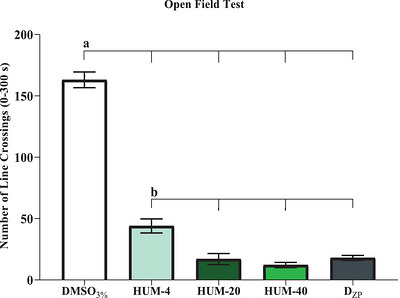
Comparison among the doses demonstrated greater reduction in line crossings as the dose increased. HUM‐4 caused a less pronounced reduction, while HUM‐40 produced the greatest reduction in crossings, b: HUM‐4 versus HUM‐20 (ΔM = 27, 95% CI: 8.14 to 45.85; p < 0.01; g = 2.24); HUM‐4 versus HUM‐40 (ΔM = 31.83, 95% CI: 12.98 to 50.69; p < 0.001; g = 2.64); HUM‐20 and HUM‐40 did not differ significantly from each other. The positive control DZP was also more effective in reducing line crossings than humulene lowest dose, b: HUM‐4 versus DZP (ΔM = 26, 95% CI: 7.14 to 44.85; p < 0.01; g = 2.15). HUM‐20 or HUM‐40 did not differ significantly from DZP.
The open field test allows evaluation of innate behavioral tendencies in zebrafish, such as neophobia and thigmotaxis (aversion to novel environments and the center of the apparatus), as well as the animal’s general locomotor activity [ref. 57, ref. 58, ref. 59, ref. 60, ref. 61, ref. 62, ref. 63, ref. 64]. This reflects the conserved evolution between this vertebrate and mammals, including deficits in the control of these behaviors, and validates it as a translational model for screening psychoactive drugs [ref. 65, ref. 66, ref. 67, ref. 68, ref. 69, ref. 70, ref. 71]. The number of line crossings is an indicator of exploratory behavior that can be related to anxiety. A fish that crosses the line repeatedly may be hyperactive due to handling or a new environment, or may be high‐exploring due to low anxiety. On the other hand, immobility can be interpreted as a reflection of freezing associated with anxiety or as sedation resulting from a treatment, leading to ambiguous interpretations [ref. 57, ref. 58, ref. 59, ref. 60, ref. 61, ref. 62, ref. 63].
All three doses of humulene reduced the number of line crossings made by zebrafish in a monotonic dose‐response fashion. This significant reduction in locomotor activity aligns with findings for its biogenic relative BCP, which has a sedative effect in D. rerio [ref. 8, ref. 9]. In rodents, LaVigne et al. reported that mice treated with HUM (IP) alone exhibited moderate cataleptic behavior—mostly mediated by adenosine type two A receptor (A2A) and partially by endocannabinoid type one receptor (CB1)—however, the hypolocomotor measurements had no statistical significance [ref. 35]. Additionally, Schwarz et al. did not observe altered motor response in mice to humulene treatment (OG) [ref. 34], and Seekins et al. results for the acute antinociceptive effect of HUM (IP) do not suggest a sedation and/or motor suppression confound in mice [ref. 72]. The dose‐dependent reduction in the number of crossings indicates that α‐humulene modulates the exploratory activity of the animals, which may reflect both an anxiolytic effect and adverse motor sedation. Given this, the light/dark test was employed as a complementary tool to allow specific dissociation between these behavioral components, as widely validated in the literature for this species [ref. 57, ref. 58, ref. 59, ref. 60, ref. 61, ref. 62, ref. 63].
Anxiolytic‐Like Effect Assessment
This protocol evaluated the anxiolytic response of adult zebrafish to humulene at chosen doses in the light/dark test (0–300 s). The control groups used for comparisons were the same as previously mentioned. The parameter observed was the time spent in the tank’s light zone. The translational effect of a substance may be determined by changes in zebrafish scototaxis (preference for the dark zone of the tank), as the aversion to the bright environment reflects the approach‐avoidance conflict characteristic of anxiety models. Thus, the effects of anxiolytic drugs are observed by an increase in the time spent in the bright zone of the tank [ref. 57, ref. 58, ref. 59, ref. 60, ref. 61, ref. 62, ref. 63, ref. 64, ref. 65, ref. 66, ref. 67, ref. 68, ref. 69, ref. 70, ref. 71].
Figure 2 shows the investigation results on the anxiolytic‐like effect of α‐humulene in adult zebrafish using the light/dark test. Welch’s ANOVA indicated a statistically significant difference among groups, F(4,11) = 23.42; p < 0.001; ω 2 = 0.625 (95% CI: 0.319 to 0.760). The Games–Howell post–hoc test showed that treatments increased time spent in the light zone compared to the negative control group. The comparisons were as follows, a: DMSO3% versus HUM‐4 (ΔM = −70.33, 95% CI: −116.97 to −23.69; p < 0.01; e = 5); DMSO3% versus HUM‐20 (ΔM = −161.50, 95% CI: −287 to −35.96; p < 0.05; e = 5.42); DMSO3% versus HUM‐40 (ΔM = −88.67, 95% CI: −154.13 to −23.20; p < 0.05; e = 5.27); and DMSO3% versus DZP (ΔM = −202, 95% CI: −320.89 to −83.10; p < 0.01; e = 4.62).
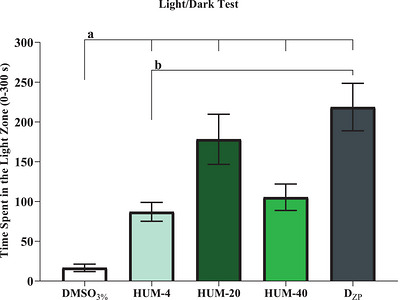
Humulene reduced the anxiety parameter in zebrafish similarly to the positive control DZP, with a statistically significant difference observed only with the lowest dose HUM‐4, in which the standard anxiolytic drug promoted a greater increase in the time spent in the light zone of the tank, b: HUM‐4 versus DZP (ΔM = −131.67, 95% CI: −248.86 to −14.47; p < 0.05; e = 38.98). No significant differences occurred between HUM‐20 and HUM‐40, nor did HUM‐20 and HUM‐40 differ significantly from DZP. The effect size for HUM‐20 (e = 5.42) was greater than that of DZP (e = 4.62), which highlights the significance of this result. Although the difference between 20 and 40 mg kg−1 was not statistically significant, the graph suggests a non‐monotonic dose‐response, with the anxiolytic effect reaching a plateau or even decreasing at the highest dose. This may result from reduced specificity and interactions with various neurotransmitter systems, leading to functional antagonism of the desired effect [ref. 8, ref. 11, ref. 14, ref. 73, ref. 74, ref. 75, ref. 76, ref. 77].
As a natural polypharmacolgical agent, with evidence for its interaction with endocannabinoid and adenosine neuromodulating targets, we proposed that humulene would also interact with the GABAergic and serotonergic systems to elicit the behavioral response observed in D. rerio. Supporting our supposition, previous data pointed that the anxiolytic‐like effect of BCP in mice was mediated by the classical GABAergic BZD pathway [ref. 78], and Seekins et al. suggest that HUM would also affect the central dopamine and serotonin signaling to lead the antinociceptive behavior in mice [ref. 72]. Aligned with this, the third set of experiments was conducted to assess the possible involvement of GABA and 5‐HT targets in the mechanism of action of α‐humulene. The investigation proceeded with dose HUM‐20 justified by the absence of a statistical difference between its effect and that of the HUM‐40 dose and the DZP control, as well as the result of HUM‐40 in the open field test indicating a greater depressant potential on the animals’ locomotor activity, which could lead to misleading interpretations.
GABAergic Neuromodulation
To investigate the anxiolytic mechanism of humulene via the GABA pathway, zebrafish were divided into experimental and control groups. The assayed group was treated with flumazenil (FLZ, GABAAR antagonist) followed by HUM‐20 (HUM + FLZ), with behavioral assessment in the light/dark test (0–300 s). Control groups received DZP + FLZ, DZP alone, FLZ alone or DMSO3%.
Figure 3 presents the results of GABAergic neuromodulation on the anxiolytic‐like effect of α‐humulene in adult zebrafish assessed in the light/dark test. Welch’s ANOVA revealed a statistically significant difference among groups, F(5,13) = 100.4; p < 0.001; ω 2 = 0.784 (95% CI: 0.611 to 0.859). The Games–Howell post–hoc comparisons showed increased time in the bright zone for the treated groups compared to the negative control group, a: DMSO3% versus HUM‐20 (ΔM = −161.50, 95% CI: −294.92 to −28.08; p < 0.05; e = 5); DMSO3% versus HUM + FLZ (ΔM = −264, 95% CI: −306 to −221.94; p < 0.001; e = −1.51); DMSO3% versus DZP (ΔM = −202, 95% CI: −328.35 to −75.65; p < 0.01; e = 4.62); DMSO3% versus DZP + FLZ (ΔM = −66.83, 95% CI: −120.84 to −12.82; p < 0.05; e = 5.36).
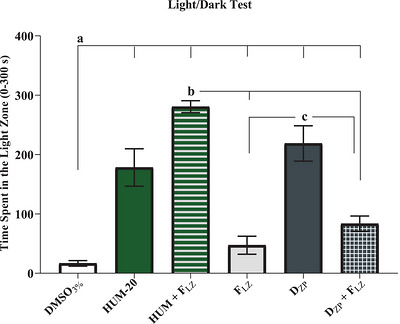
The antagonist was able to reverse the action of the DZP control, but the same was not observed with humulene, b: HUM + FLZ vs. FLZ (ΔM = 233.50, 95% CI: 168.15 to 298.85; p < 0.001; e = 17.75); HUM + FLZ versus DZP + FLZ (ΔM = 197.17, 95% CI: 130.40 to 254.93; p < 0.001; e = 147.19). c: DZP versus FLZ (ΔM = 171.50, 95% CI: 46.72 to 296.28; p < 0.01; e = 112.35); DZP versus DZP + FLZ (ΔM = 135.17, 95% CI: 10.93 to 259.40; p < 0.05; e = 110.54).
Although there was no statistical difference between HUM‐20 and HUM + FLZ, the HUM + FLZ group showed greater statistical significance than the isolated terpene dose when compared with the DMSO3% control. This is corroborated by the significance of the HUM + FLZ versus DZP + FLZ comparison and also by the absence of a statistical difference between DZP and HUM + FLZ (p > 0.4). These comparisons suggest an additive effect of FLZ with the terpene.
GABA is the main inhibitory neurotransmitter of the central nervous system (CNS). Its GABAAR targets are widely distributed in the vertebrate CNS. They are transmembrane channels, formed by the union of five highly heterogeneous protein subunits (pentamers). In mammals, 19 subunits (α [ref. 1, ref. 2, ref. 3, ref. 4, ref. 5, ref. 6], β [ref. 1, ref. 2, ref. 3], γ [ref. 1, ref. 2, ref. 3], δ, ε, θ, φ, ρ [ref. 1, ref. 2, ref. 3]) are recognized. This heterogeneity allows for the presence of various subpopulations of these channels, composed of distinct arrangements with specific topologies and sensitivities to other endogenous agents, drugs, and GABA itself. Zebrafish has 23 subunits (α [1; 2a/b; 3‐5; 6a/b]; β [ref. 1, ref. 2, ref. 3, ref. 4], γ [ref. 1, ref. 2, ref. 3], δ, φ, ζ, ρ [1; 2a/b; 3a/b]) with spatial expressions and electrophysiological sensitivities to the neurotransmitter that suggest conserved properties. When activated by GABA, these channels allow the influx of chloride ions into neurons, leading to hyperpolarization and reduced excitability [ref. 79, ref. 80].
Flumazenil’s clinical function is to reverse the hypnotic and sedative effects of BZD. Its antagonism is competitive and of high affinity for an allosteric site on GABAARs that contain the γ2 subunit. It physically occupies this target, preventing other ligands from modulating receptor activity. This blockade occurs with both positive allosteric modulators (PAM), which enhance the action of the endogenous agonist, and negative allosteric modulators (NAM), which reduce its action [ref. 81, ref. 82, ref. 83].
Previous studies have shown that GABAergic modulation by terpenoids is likely independent of the γ2 subunit presence in the GABAAR pentamer, and is also influenced by a cyclic molecular structure with oxygenated groups [ref. 36, ref. 78]. Regarding the sesquiterpene and sesquiterpenoid subclasses, in addition to oxygenated functions in the ligand molecule, the presence of the γ2 or δ subunit in the channel appears to determine selectivity in the triggered response [ref. 36]. In Xenopus laevis oocytes containing channels formed by rat α1β2 subunits, BCP (bicyclic structure) caused a small boost in electrical current in response to GABA, while its derivative, caryophyllene oxide (bicyclic and oxygenated structure), had no influence. In human embryonic kidney cells (HEK‐293), which expressed a murine α1β2γ2 arrangement, characteristic of phasic (synaptic) GABAARs, these isomers were not relevant for the reinforcement or reduction of the response current [ref. 84].
Another study demonstrated that BCP had no action on channels formed by α1β2 subunits, while its hydroxylated derivative, β‐caryolanol, increased the electrical response current to GABA mediated by these channels. On channels with α4β3δ and α4β3δ arrangements, characteristic of tonic (extrasynaptic) GABAAR, these two agents reduced the response current to the neurotransmitter. However, in phasic channels, α1β2γ2, they did not reinforce or reduce the response current [ref. 36]. Interestingly, Oliveira demonstrated that FLZ and bicuculline reversed the anxiolytic effect of orally administered BCP in mice, suggesting a PAM mechanism in phasic GABAAR channels containing the γ2 subunit [ref. 78].
In the study by Janzen et al. [ref. 36], humulol (a hydroxylated derivative of HUM) had complex effects. In HEK‐293 cells expressing α1β2 channels, this agent potentiated the maximum GABA response current, whereas in cells expressing recombinant phasic α1β2γ2 channels, it reduced it. In mouse hippocampal neurons (which naturally express GABAARs with various subunit arrangements), humulol again decrease the response current. This same effect was observed in those cells expressing channels with α4β3δ arrangement, thereby inferring a negative allosteric modulatory action. The authors reported that humulene had a negative allosteric modulator effect only on HEK‐293 expressing tonic α4β3δ channels, as it reduced the maximal electrical current response to GABA.
Tonic GABAARs (such as α4β3δ and α6β3δ) are located outside synapses; they are targets of neurosteroids and alcohol, and have high affinity and slow desensitization to GABA. This allows, even at low concentrations of this neurotransmitter in the extracellular environment, for the maintenance of basal inhibitory conductance independent of presynaptic action potentials. The induction of hyperpolarization by neurosteroids, with consequent reduction of neuronal excitability, is potent and capable of causing anesthesia. The loss of motility in zebrafish larvae caused by progesterone and glutamate‐pregnenolone, for example, may be a clue to the presence of channels with a tonic‐acting α4β3δ configuration conserved in this species. These receptors lack the classic BZD binding site and would not respond to FLZ [ref. 81, ref. 85, ref. 86, ref. 87, ref. 88, ref. 89].
However, Hanchar et al. showed the high‐affinity binding of the imidazo‐benzodiazepines [3H]RO15‐4513 and FLZ to native bovine cerebellar α6βδ and to recombinant α4β3δ GABAARs expressed in HEK‐293T cells. Additionally, FLZ competitively inhibited the binding of RO15‐4513, an alcohol antagonist, to α6βδ and α4β3δ, demonstrating that, unlike other classical BZD site ligands, it may act on GABA tonic receptors [ref. 90]. Further, Kuver and Smith presented that FLZ is a negative allosteric modulator at the recombinant α4β2δ type, and prolonged exposure to this drug reduced the surface expression of these channels [ref. 91].
The additive effect of FLZ on anxiolysis caused by HUM‐20 can be explained by the ability of α‐humulene to act as a negative allosteric modulator at tonic GABA receptors containing the δ subunit (α4β3δ), as demonstrated in vitro [ref. 36]. In this scenario, FLZ would block this negative modulatory action, unmasking the primary anxiolytic effect. This interpretation is consistent with the high‐layer binding of FLZ to receptors containing the δ subunit [ref. 90] and with the presence of such receptors in zebrafish [ref. 80]. The NAM action of humulene at tonic receptors may become predominant at higher doses, counterbalancing its main effect and explaining the non‐monotonic response profile presented. Furthermore, the classic BZD pathway can be ruled out as the primary mediator of humulene’s motor effects, since FLZ did not reverse its anxiolytic action in the light/dark test.
Serotonergic Neuromodulation
The investigation of the anxiolytic mechanism of humulene via the serotonin pathway was conducted by treating zebrafish with cyproheptadine (CYPRO, metabotropic serotonin type 2A receptor, 5‐HT2AR, antagonist, OG), pizotifen (PZTF, a selective antagonist of the metabotropic serotonin type 1A and 2A/2C receptors, 5‐HT1AR, 5‐HT2A/2CR; OG), or granisetron (GRAN, 5‐HT3R antagonist, OG) before administering HUM‐20 (IP). These groups (HUM + CYPRO, HUM + PZTF, and HUM + GRAN) were then assessed with the light/dark test (0–300 s). Controls included groups that received fluoxetine (FLUOX) plus antagonists (FLUOX + CYPRO, FLUOX + PZTF, and FLUOX + GRAN), only FLUOX, CYPRO, PZTF, GRAN, or DMSO3%.
Figure 4 shows the results of CYPRO’s action on α‐humulene’s anxiolytic‐like effect in zebrafish via the 5‐HT pathway. The Kruskal–Wallis test showed a statistically significant difference among groups, H(5) = 29.58; p < 0.001; η 2 = 0.819 (95% CI: 0.758 to 0.927). Dunn’s post–hoc significant comparisons were a: DMSO3% versus HUM‐20 (z = ‐3.683; Wi = 3.917 Wj = 26.33; p < 0.01; rrb = 1.0); DMSO3% versus FLUOX (z = −4.645; Wi = 3.917 Wj = 32.17; p < 0.001; rrb = 1.0), and DMSO3% versus HUM + CYPRO (z = −3.028; Wi = 3.917 Wj = 22.33; p < 0.01; rrb = 1.00); b: HUM‐20 versus FLUOX + CYPRO (z = 2.603; Wi = 26.33 Wj = 10.50; p < 0.01; rrb = −1.0); c: FLUOX versus FLUOX + CYPRO (z = 3.563; Wi = 3.167 Wj = 10.50; p < 0.01; rrb = −1.0).
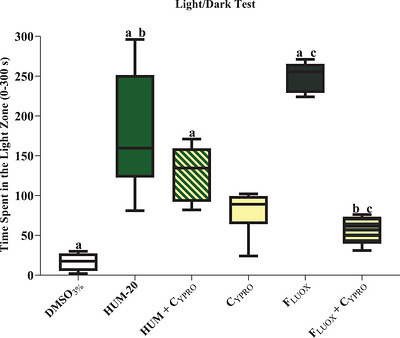
When associated with the FLUOX control, CYPRO caused a significant reduction in the anxiolytic parameter (p < 0.001), which is corroborated by previous studies with zebrafish model, where the presence of this antagonist reduced the effect of the FLUOX control [ref. 65, ref. 66, ref. 67, ref. 68, ref. 69, ref. 70, ref. 71]. In this present, CYPRO alone did not have a significant anxiolytic effect, which differs from those studies that demonstrated an anxiolytic effect of this drug alone administered to D. rerio [ref. 65, ref. 66, ref. 67, ref. 68, ref. 69, ref. 70, ref. 71]. The effect of humulene was not abolished by CYPRO (HUM‐20 vs. HUM + CYPRO, p = 1), however, the graphic illustration shows that the presence of this antagonist reduced the time spent in the light zone. Even so, compared to the DMSO3% control, the HUM + CYPRO group remained anxiolytic with statistical significance (p < 0.05). This result indicate that the HUM mechanism of action does not directly involve metabotropic receptors 5‐HTR2A but still suggest that its behavioral effect is mediated by 5‐HT targets. The further experiment using the antagonist PZTF, selective for the 5‐HT1AR and 5‐HT2A/2CR subtypes, also confirm this initial result.
Figure 5 presents the results of the investigation of the action of PZTF on the anxiolytic‐like mechanism of α‐humulene in zebrafish via the 5‐HT pathway. Welch’s ANOVA showed a statistically significant difference between groups, F(5,13) = 137.9; p < 0.001; ω 2 = 0.845 (95% CI: 0.720 to 0.900). The Games–Howell post–hoc comparisons were a: DMSO3% versus HUM‐20 (ΔM = −161.50, 95% CI: −294.92 to −28.08; p < 0.05; e = 5); DMSO3% versus HUM + PZTF (ΔM = −128.67, 95% CI: −165.45 to −91.88; p < 0.001; e = 1.07); DMSO3% versus FLUOX (ΔM = −233.33, 95% CI: −265.47 to −201.19; p < 0.001; e = −5.99).
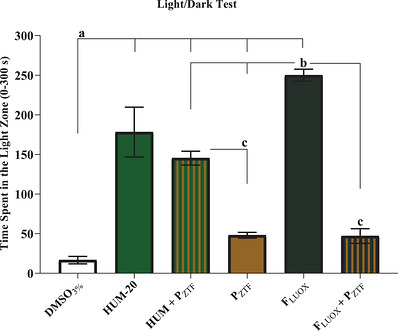
PZTF was able to reduce the effect of FLUOX, b: FLUOX versus FLUOX + PZTF (ΔM = 203, 95% CI: 161.27 to 244.72; p < 0.001; e = 130.69); FLUOX versus PZTF (ΔM = 202, 95% CI: 170.48 to 233.51; p < 0.01; e = 125.82). However, its action was less effective in the animals treated with humulene, c: HUM + PZTF versus FLUOX + PZTF (ΔM = 98.33, 95% CI: 54.10 to 142.56; p < 0.001; e = 75.45); HUM + PZTF versus PZTF (ΔM = 97.33, 95% CI: 60.81 to 133.85; p < 0.001; e = 71.51).
The group treated only with the antagonist had a longer time spent in the light zone than the negative control, a: DMSO3% versus PZTF (ΔM = −31.33, 95% CI: −52.20 to −10.45; p < 0.01; e = 4.55). However, this data does not point to an anxiolytic action, which is corroborated by previous studies that used this antagonist in D. rerio [ref. 65, ref. 66, ref. 67, ref. 68, ref. 69, ref. 70, ref. 71]. There was no statistical difference between FLUOX and HUM‐20 (p > 0.3), also this positive control had greater significance when compared to the group that received the terpene plus the antagonist, b: FLUOX versus HUM + PZTF (ΔM = 104.67, 95% CI: 64.27 to 145.05; p < 0.001; e = 126.30), however, it does not seem to reflect a main interaction of HUM with 5‐HT1AR and 5‐HT2A/2CR targets. Thus, it is inferred that α‐humulene does not act on 5‐HT classical metabotropic receptors and allows for a hypothesis of noncanonical interaction with the serotonergic system, possibly directed at fast signaling targets, such as the 5‐HT3R ionotropic channels. This hypothesis was tested in the experiment using GRAN, a selective 5‐HT3R blocker.
Figure 6 presents the results for the GRAN action on the anxiolytic‐like mechanism of α‐humulene in zebrafish via the 5‐HT pathway. Welch’s ANOVA showed a statistically significant difference between groups, F(5,13) = 128.5; p < 0.001; ω 2 = 0.863 (95% CI: 0.753 to 0.912). The Games–Howell post–hoc comparisons found that both treatments, HUM‐20 and FLUOX, increased time spent in the light zone versus the negative control group, a: DMSO3% versus HUM‐20 (ΔM = −161.50, 95% CI: −294.92 to −28.08; p < 0.05; e = 5.42); DMSO3% versus FLUOX (ΔM = −233.33, 95% CI: −265.47 to −201.19; p < 0.001; e = −5.99).
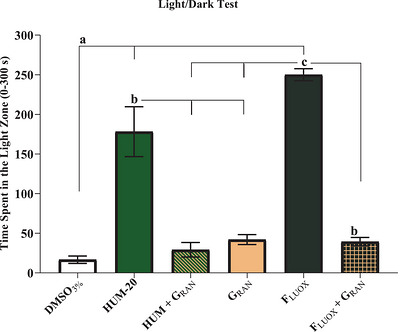
GRAN was effective in reversing the anxiolytic response of fish treated with both humulene and FLUOX, b: HUM‐20 versus GRAN (ΔM = 136.16, 95% CI: 3.32 to 269; p < 0.05; e = 88.23); FLUOX versus GRAN (ΔM = 208, 95% CI: 173.71 to 242.28; p < 0.001; e = 130.55); HUM‐20 versus HUM + GRAN (ΔM = 149, 95% CI: 17.23 to 280.77; p < 0.05; e = 88.61). c: FLUOX versus FLUOX + GRAN (ΔM = 210.66, 95% CI: 177.75 to 243.57; p < 0.001; e = 129.77); HUM‐20 versus FLUOX + GRAN (ΔM = 138.83, 95% CI: 5.66 to 272; p < 0.05; e = 86.97); FLUOX versus HUM + GRAN (ΔM = 220.83, 95% CI: 179.43 to 262.23; p < 0.001; e = 131.53). There was no statistical difference in anxiety‐like behavior among the HUM + GRAN, FLUOX + GRAN, and DMSO3% control groups, nor between FLUOX and HUM‐20.
The 5‐HT3 receptors are part of the Cys‐loop family of ligand‐gated ion channels, a group that also includes the nicotinic acetylcholine, GABAA, and glycine receptors. These channels are pentamers composed of the same monomer (3A) or different monomers (3A and 3B). Subunits 3A and 3B are identified in rodents and humans; notably, humans also have 3C–3E. In zebrafish, subunits A and B are present, and they are orthologous to the human A and B subunits. When serotonin binds, 5‐HT3R allows the passing of positive ions, such as sodium, potassium, and calcium—the incorporation of 3B subunit decreases the pentamer permeability to calcium—leading to rapid, transient excitation of the neuronal membrane. They are expressed in structures including the hippocampus, the frontal and entorhinal cortices, the amygdala, and the nucleus accumbens. The distribution of 5‐HT3R in these regions, therefore, serves as a predictive reference for their pharmacological manipulation in behavioral assays. Furthermore, about 80% of these receptors are located on synaptic terminals, where their activation can modulate the release of dopamine, norepinephrine, GABA, acetylcholine, glutamate, substance P, cholecystokinin, and 5‐HT itself [ref. 92, ref. 93, ref. 94, ref. 95, ref. 96, ref. 97].
Granisetron acts competitively and selectively at the orthosteric site of the 5‐HT3 channel, preventing 5‐HT from physically occupying the site and blocking its excitatory actions. Its expected clinical effect is to prevent hyperstimulation of specific excitatory pathways, particularly in conditions of elevated serotonergic tone, such as emesis and vomiting caused by chemotherapy [ref. 93]. In presynaptic neurons, 5‐HT3R antagonism tends to suppress dopaminergic transmission and increase depressive symptoms. Its activation results in the facilitation of GABA release and a reduction in anxiety‐like behaviors, an effect that is counteracted by agents like GRAN. Therefore, the inhibition of these receptors on the presynaptic membrane may produce anxious and depressive phenotypes [ref. 93].
Nowicki et al. demonstrated that zebrafish treated with ondansetron, the prototype of 5‐HT3R antagonist class, increased bottom‐dwelling in the novel tank test, a behavior interpreted as anxiety [ref. 98]. In the rodent model literature, the 5‐HT3R antagonism has shown promising anxiolytic and antidepressant effects, but also anxiogenic effects. This does not support the inference of an isolated role for 5‐HT and 5‐HT3R in modulating these states, but rather suggests a circuit‐dependent action. For example, increased 5‐HT activity in the amygdala increases the expression of anxious behaviors, whereas in the periaqueductal gray matter, it has a panicolytic effect [ref. 93, ref. 94, ref. 99].
Most 5‐HT3R antagonists derived from natural sources lack structural similarity to serotonin. Among the structurally related phytoconstituents that modulate voltage‐gated and/or ligand‐gated ion channels, terpenoids (oxygenated terpenes) such as menthol, citral, geraniol, and eucalyptol inhibit the maximal 5‐HT response in a concentration‐dependent manner and do not compete with GRAN for the orthosteric site. Modeling assays predict that these ligands bind in a transmembrane cavity at the interface between adjacent subunits, a phenomenon probably explained by their lipophilicity [ref. 92, ref. 93, ref. 100]. This suggests that oxygenated functional groups (hydroxyl, ketone, aldehyde, and ester, among others) in this class of natural molecules are necessary for their interaction with Cys‐loop family ion channels.
Other lipophilic and oxygenated natural agents, similar to terpenoids, inferred as NAM at 5‐HT3R, are the cannabinoids Δ9‐tetrahydrocannabinol (exogenous) and anandamide (endogenous). In the results of Barann et al., these components inhibited the 5‐HT response current in HEK‐293 cells expressing recombinant human 5‐HT3R. This effect was not blocked by rimonabant, antagonist of the CB1 receptor, which allowed an inference about a modulatory action at an allosteric target site in these channels [ref. 101].
The work of LaVigne et al. revealed the cannabimimetic action of HUM in mice, suggesting low‐potency agonism or positive modulation at CB1, as well as modulatory effects on plasma membrane dynamics (attributed to its lipophilicity) in regard to affect the synthesis or degradation of endogen cannabinoids [ref. 35]. In zebrafish, this neuromodulator system has expression profiles similar to those in mammals. Its receptor targets can be detected as early as the embryonic stage in this species and CB1 shares 70% protein sequence identity with its human ortholog [ref. 39, ref. 102]. Therefore, it is possible that α‐humulene shares with other cannabinoids a modulatory feature on 5‐HT3R which leads to the behavioral response observed in D. rerio.
To further support these results and the hypothesis for the α‐humulene anxiolytic‐like action mechanism, a molecular docking protocol was conducted to evaluate the possible interactions of this sesquiterpene with the human GABAAR and the mouse 5‐HT3AR. The findings are presented below.
Molecular Docking
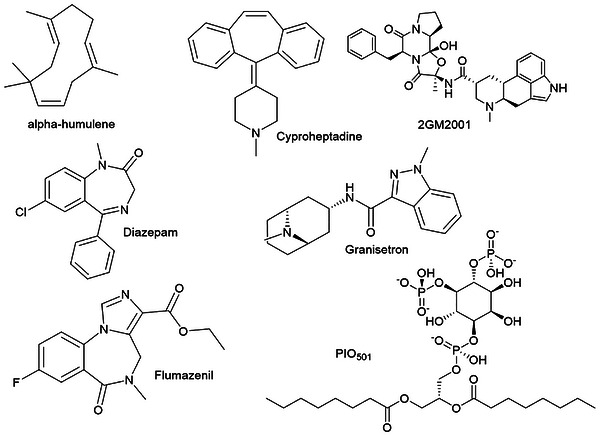
All docking and redocking simulations yielded root mean square deviation (RMSD) values less than or equal to the established reference threshold of 2.0 Å [ref. 103], demonstrating the robustness and internal consistency of the computational protocol employed (Table 1). For the GABAA receptor, the analysis revealed RMSD values of 0.14 Å (PIO501/GABAAR), 1.38 Å (FLZ/GABAAR), 1.41 Å (α‐humulene/GABAAR), and 2.00 Å (DZP/GABAAR), indicating excellent reproducibility of the crystallographic binding modes across distinct ligand classes. With respect to the 5‐HT3A receptor, all tested ligands (Figure 7) exhibited RMSD values of 2.0 Å, which is fully acceptable within the methodological cutoff and further supports the reliability of the docking strategy. Collectively, these results confirm that the selected parameters and scoring procedures were adequate to reproduce experimentally observed poses, thereby providing a solid basis for subsequent interaction and affinity analyses.
TABLE 1: Initial result of the molecular docking simulation on the human GABAA and mouse 5‐HT3A receptors.
| Ligands | Human GABAA receptors | Mouse 5‐HT3A receptors | ||
|---|---|---|---|---|
| Energy affinity (kcal/mol) | RMSD (Å) | Energy affinity (kcal/mol) | RMSD (Å) | |
| α‐Humulene | Pose 9/−5.1 | 1.41 | Pose 1/−7.8 | 2.00 |
| PIO501 | Pose 8/−5.1 | 0.14 | — | — |
| Diazepam | Pose 2/−6.5 | 2.00 | — | — |
| Flumazenil | Pose 2/−5.6 | 1.38 | — | — |
| 2GM2001 | — | — | Pose 2/−10.8 | 2.00 |
| Cyproheptadine | — | — | Pose 1/−9.7 | 2.00 |
| Granisetron | — | — | Pose 1/−9.2 | 2.00 |
Interactions of Targets
The docking analyses conducted for both the GABAA and 5‐HT3A receptors provided mechanistic insights into the binding characteristics of α‐humulene relative to well‐established pharmacological standards. The redocking validation confirmed the reliability of the computational protocol, as the co‐crystallized ligands PIO501 (GABAAR) and 2GM2001 (5‐HT3AR) reproduced their crystallographic poses with RMSD values within the accepted threshold of 2.0 Å, supporting the robustness of the subsequent simulations.
Interactions at the Human GABAA Receptor
The standard BZD, DZP, displayed the characteristic interaction triad at the BZD site—π–π stacking with phenylalanine (PHE 310), polar stabilization through serine (SER 388), and hydrophobic support from isoleucine (ILE 392)—closely matching crystallographic observations [ref. 104]. FLZ, used as the inverse/neutral modulator reference, maintained anchoring interactions with PHE 310 and lysine (LYS 312), indicative of its antagonistic profile. The co‐crystallized ligand PIO501, used for redocking validation, engaged with arginine (ARG 249), SER 388, LYS 312, and glutamate (GLU 303), forming a dense network that defines the canonical boundaries of the BZD allosteric binding site (Figure 8).
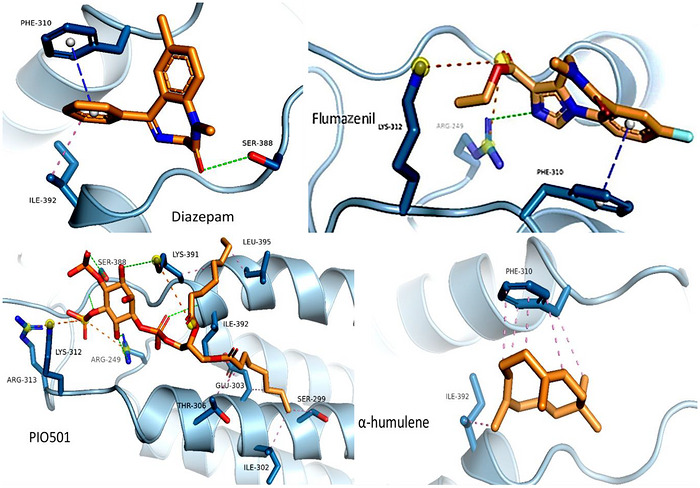
Relative to the standards, α‐humulene exhibited a significantly hydrophobic interaction profile, interacting mainly with PHE 310 and ILE 392, without forming the characteristic hydrogen bonds observed for DZP and PIO501 (Figure 8). Similarly, Janzen et al. also reported in silico the purely hydrophobic interaction of HUM at the DZP binding site in GABARA [ref. 36]. This pattern is consistent with compounds that act as low‐affinity modulators, relying primarily on hydrophobic complementarity rather than classical BZD pharmacophores. Such profile is coherent with mild anxiolytic or sedative‐like activities reported for sesquiterpenes in vivo [ref. 105, ref. 106]. Thus, if α‐humulene can positively modulate GABA ionotropic channels (such as phasic GABAARs) out of the BZD‐binding site, this may explain the failing of FLZ to reverse its effect. However, this low‐affinity mechanism does not seem to be the major promoter of anxiolysis, yet it allows us to infer a contributor to a relaxant and/or sedative effect in vivo, as it would enhance the GABAergic inhibition.
Interactions at the Mouse 5‐HT3A Receptor
The orthosteric reference ligand 2GM2001 exhibited the expected network of interactions with tyrosine (TYR 109), tryptophan (TRP 125), phenylalanine (PHE 330, 331, and 351), consistent with structural data available for the 5‐HT3 receptor family [ref. 107, ref. 108]. GRAN, a clinically validated antagonist, showed strong cation‐π and π–π interactions within this aromatic‐rich pocket, reinforcing its efficient orthosteric blockade, as widely reported in the literature. CYPRO, although a nonselective antagonist, demonstrated a more hydrophobic signature within the binding cavity, engaging with residues such as valine (VAL 111), leucine (LEU 52), and threonine (THR 110) (Figure 9), which is compatible with its broader receptor profile and less rigid orthosteric anchoring [ref. 109].
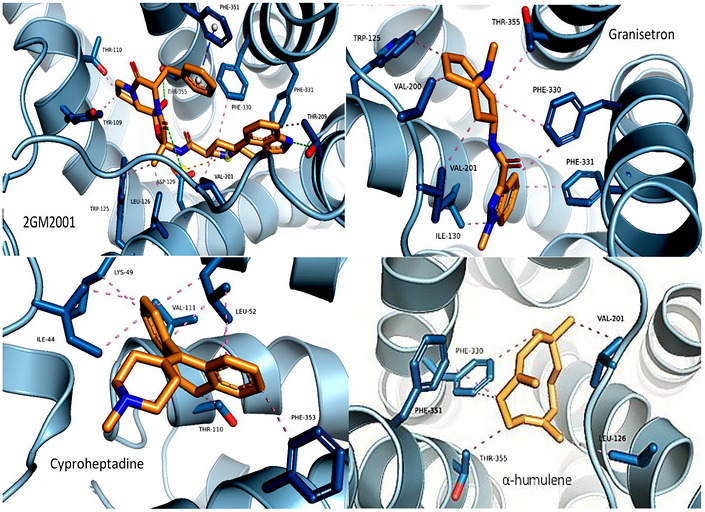
In contrast, α‐humulene occupied predominantly hydrophobic regions of the cavity and interacted with PHE 330 and 351, VAL 201, and LEU 126 through Van der Waals forces. The absence of polar or cationic interactions, in addition to its incomplete overlap with the GRAN/2GM2001 orthosteric region, strongly suggests a nonclassical modulatory binding mode (Figure 9). Similar hydrophobic terpene interactions have been associated with mild attenuation of serotonergic signaling and behavioral effects in zebrafish models [ref. 110, ref. 111]. Thus, the docking data support the hypothesis that α‐humulene modulates 5‐HT3R function allosterically or semi‐orthosterically, rather than acting as a canonical agonist or competitive antagonist.
Comparative Interpretation and Mechanistic Implications
Collectively, the docking results reveal that the reference ligands—GRAN and CYPRO for 5‐HT3AR, and DZP, FLZ, and PIO501 for phasic GABAAR—exhibit patterns of high‐affinity orthosteric or allosteric binding. Their interaction profiles serve as robust benchmarks against which α‐humulene can be evaluated.
In both receptors, α‐humulene consistently adopted hydrophobic and non‐orthosteric poses, suggesting a mechanism of action based on allosteric modulation rather than competitive binding. This type of receptor engagement is typical for lipophilic terpenoids lacking polar substituents. It has been associated with neuromodulatory effects mediated through subtle conformational adjustments rather than direct agonism or antagonism [ref. 112]. These findings provide molecular rationale for the in vivo outcomes. The joint modulation of GABAergic and serotonergic pathways, both through hydrophobic allosteric contacts, may account for the observed responses of adult zebrafish Thus, the docking results not only corroborate the behavioral profile but clarify the distinct mechanistic differences between HUM and the standard ligands used in this study.
Integrated Discussion
Alpha‐humulene induces an anxiolytic‐like effect in adult zebrafish. The results suggest a non‐monotonic dose‐response profile, which was not blocked by FLZ, but it was completely abolished by the antagonist GRAN, demonstrating a dependent mechanism on the fast 5‐HT neurotransmission (Table 2). This contrasts with previous findings for its isomer, BCP, which had its anxiolytic effect reversed by FLZ, but was not abolished by ondansetron [ref. 78].
TABLE 2: Summary of pharmacological blockade experiments for hum‐20 anxiolytic‐like effect in adult zebrafish.
| Target pathways | Antagonists used | Predicted results if involved | Observed results | Conclusion |
|---|---|---|---|---|
| GABAAR—BZD Site | Flumazenil | Reversal of effect | No reversal; inferred secondary mechanism of negative allosteric modulation at tonic GABAAR; (Figure 3). | Independent |
| 5‐HT2 Receptors | Cyproheptadine | Reversal of effect | No reversal; (Figure 4). | Independent |
| 5‐HT1A, 5‐HT2A/2C Receptors | Pizotifen | Reversal of effect | No reversal; (Figure 5). | Independent |
| 5‐HT3 Receptor | Granisetron | Reversal of effect | Complete reversal; inferred I. Positive allosteric modulation at 5‐HT3R or II. A subsequent recruitment of the 5‐HT3R signaling (Figure 6) | Dependent |
To test the hypothesis that humulene would act similarly to classic anxiolytics like DZP, zebrafish were pretreated with FLZ, a competitive antagonist that selectively blocks the BZD allosteric binding site on GABAAR. FLZ failed to reverse the anxiolytic effect of HUM‐20. The HUM + FLZ group remained highly anxiolytic, showing no statistical difference from the HUM‐20 group alone. The experiment was validated, as FLZ pretreatment successfully reversed the anxiolytic effect of the positive control DZP. Interestingly, the data suggest a subtle, additive or potentiating effect, as the HUM + FLZ group showed greater statistical significance (versus the DMSO3% control) than HUM‐20 alone. This may be caused by the HUM allosteric negative modulation at a subpopulation of tonic GABAARs (previous in vitro reports), which would become functionally dominant, counteracting its own primary effect at higher doses, and further provides an explanation for the D. rerio behavioral non‐monotonic dose‐response to humulene.
Although HUM promoted a monotonic dose‐dependent reduction in the zebrafish locomotor activity in the open field test, an effect shared by the positive control DZP, the subsequent demonstration of HUM‐20 anxiolysis in the presence of FLZ may distinguish that open field result from the BZD‐sedation phenotype. Otherwise, it suggests an adverse cataleptic‐like motor suppression, which is corroborated by previous observations in mice, where humulene produced cataleptic behavior mediated by A2A and CB1 receptors [ref. 35].
Having excluded the canonical GABA pathway, the investigation turned to the next major anxiety circuit: the serotonergic system. Pretreatment with CYPRO (a broad 5‐HT2R antagonist) and PZTF (a 5‐HT1AR and 5‐HT2A/2CR antagonist) failed to reverse the anxiolytic effect of HUM‐20, what allowed us to rule out the direct involvement of the metabotropic 5‐HT1A, 5‐HT2A/2C receptors. Pretreatment with GRAN, a selective 5‐HT3R antagonist, completely abolished the anxiolytic‐like effect of HUM‐20. The behavior of the HUM‐20 + GRAN group was not statistically different to the negative control (DMSO3%) group. This result pinpoints the HUM’s mechanism to a specific excitatory pathway, as the 5‐HT3 receptors, ligand‐gated ionic channels, are part of the Cys‐loop family (along with GABAARs) and mediate rapid, transient excitation in neuronal membranes.
Despite lacking oxygenated functions in its monocyclic molecule, HUM is lipophilic, which may favor interaction with hydrophobic sites of 5‐HT3R within the plasma membrane. One proposition for its direct action is that α‐humulene is a positive allosteric modulator at those channels. As a PAM, it would not activate the receptor itself but would enhance the effect of endogenous serotonin, consistent with anxiolysis. As a competitive antagonist at the orthosteric site, GRAN would block the anxiolytic effect by preventing the primary binding of 5‐HT to the channel, which is necessary for HUM’s proper function.
Accordingly, in silico analyses revealed plausible interactions of this terpene with hydrophobic transmembrane regions, consistent with noncanonical modulation of ionotropic receptors. Together with behavioral pharmacology, these findings corroborate that α‐humulene may act through an allosteric mechanism that enhances fast serotonergic signaling via 5‐HT3R. In the rodent and nonhuman primate adult forebrain 5‐HT3R is predominantly expressed in subpopulations of GABAergic interneurons that do not express parvalbumin and/or somatostatin [ref. 113, ref. 114, ref. 115, ref. 116, ref. 117, ref. 118, ref. 119, ref. 120]. In the zebrafish telencephalon, the expression of GABAergic interneurons points to the evolutionary conservation of neuromodulation mechanisms with other vertebrate groups, also including the presence of genes for 5‐HT3R channels [ref. 121, ref. 122]. Thus, we hypothesize that the α‐humulene effect observed in D. rerio may be directly mediated by 5‐HT3R, which promotes the activation of telencephalic GABA‐releasing neurons to inhibit excitatory neuron cells that elicit aversive‐fear behavior.
In line with previous reports, another possible interpretation is that the humulene anxiolytic‐like effect would be primarily mediated by endocannabinoid and adenosine targets [ref. 34, ref. 35]. We hypothesize that α‐humulene interaction on both endocannabinoid CB1 and adenosine A2A receptors promotes subsequent 5‐HT3R fast signaling in circuits involved in the zebrafish scototactic avoidance. The A2A component may directly facilitates the local 5‐HT release in D. rerio telencephalon [ref. 123, ref. 124, ref. 125], while the CB1 component disinhibits serotonergic raphe nuclei by reducing the inhibitory tone of GABA [ref. 126, ref. 127, ref. 128, ref. 129, ref. 130, ref. 131]. The augmented serotonin phasic surge targets the ionotropic 5‐HT3 channels expressed on local GABAergic interneurons, which rapidly cause neuronal depolarization and a consequent localized release of GABA. This final GABA output would inhibit excitatory cells in anxiety‐driving circuits, resulting in the anxiolytic‐like behavioral response. Although this hypothesis is plausible for mammals, supported by previous evidence in rodent models [ref. 34, ref. 35], the present study did not directly investigate this possibility for the zebrafish model. Future experiments employing selective antagonists, such as rimonabant for CB1 and SCH58261 for A2A, may elucidate whether α‐humulene acts primarily on the endocannabinoid and/or adenosinergic targets to unleash an upstream cascade that recruits the serotonergic fast signaling or as a direct modulator of the 5‐HT3 receptor.
Conclusions
This study demonstrates that the sesquiterpene α‐humulene did not exhibit acute toxicity and induced anxiolytic‐like behavior in adult zebrafish. Mechanistic investigation revealed a pharmacology independent of the BZD binding site on the GABA type A channel. This effect was completely reversed by GRAN, implicating rapid serotonergic signaling as a crucial component of the resulting behavior. The convergence of behavioral, mechanistic, and computational evidence positions this sesquiterpene as a promising natural product for modulating mood and anxiety‐related behavior via nonclassical serotonin target. Furthermore, the low acute toxicity and absence of a positive interaction at the classical BZD site suggest that humulene, and possibly its derivatives, could be investigated as prototypes for a new class of anxiolytics with less sedative side effects. Future studies should evaluate chronic toxicity, refine pharmacokinetic and behavioral parameters, and employ selective antagonists of A2A and CB1 receptors, as well as other 5‐HT receptor subtypes, including neurochemical measurements to fully unravel direct circuit‐level interactions and corroborate the mechanistic insights provided by our pharmacological and in silico approaches.
Experimental Section
Drugs
The following substances were used: α‐humulene (Sigma–Aldrich, 96% ≥ pure), DZP (NeoQuímica), DMSO (Dynamic), FLZ (Sandoz), FLUOX (Teuto), CYPRO (Cobavital), PZTF (Sandomigran), and GRAN (Kytril) (Table 3).
TABLE 3: Summary of pharmacological agents, doses, and administration protocols.
| Compounds | Doses (mg kg−1) | Vehicles | Administration routes | Volume (µL) | Timing |
|---|---|---|---|---|---|
| Alpha‐humulene | 4, 20, 40 | DMSO3% | Intraperitoneal | 20 | 30 min pretest |
| Dimethyl sulfoxide (DMSO) | Solution of 3% DMSO (DMSO3%) | N/A | Intraperitoneal | 10 | 30 min pretest |
| Diazepam (DZP) | 4 | N/A | Intraperitoneal | 10 | 30 min pretest |
| Fluoxetine (FLUOX) | 0.05 | N/A | Intraperitoneal | 10 | 30 min pretest |
| Flumazenil (FLZ) | 0.05 | N/A | Intraperitoneal | 10 | 45 min pretest |
| Cyproheptadine (CYPRO) | 32 | N/A | Oral gavage | 10 | 45 min pretest |
| Pizotifen (PZTF) | 32 | N/A | Oral gavage | 10 | 45 min pretest |
| Granisetron (GRAN) | 20 | N/A | Oral gavage | 10 | 45 min pretest |
Animals
Zebrafish (aged 90–120 days; 0.4 ± 0.1 g; 3.5 ± 0.5 cm) of the wild strain, of both sexes, were acquired from a local aquarium store (Fortaleza, Ceará, Brazil). The animals were maintained in a 10 L glass tank (30 × 15 × 20 cm) (stocking density of five fish per liter), with dechlorinated water (ProtecPlus) and external hang‐on filters, at a temperature of 28°C, pH 7.0, and a 14 h / 10 h (light / dark) circadian cycle. The fish received feed (Alcon Basic) ad libitum until 24 h before the experiments.
The prior sample size calculus was performed using GPower 3.1.9.7 software for F‐tests (One‐way ANOVA) [ref. 132, ref. 133, ref. 134]. The values for effect size (f), alpha (α), power (assuming β = 0.2), and groups (N) were 0.5, 0.05, 0.8, and 18, respectively. Thus, the total sample size suggested was 108 for the behavioral tests. In order to comply with the 3Rs principles, the groups of fish assessed in the open field test were the same used in the light/dark test. Additionally, the control groups and the chosen anxiolytic dose values were used for comparisons in the pharmacological dissection set of experiments. The study was approved by the Ethics Committee on the Use of Animals of the State University of Ceará (CEUA‐UECE; n° 04983945/2023), in accordance with the Ethical Principles of Animal Research.
General Protocol
The experiments occurred on three occasions. First, acute toxicity was assessed to determine the safety of humulene at three doses chosen for the experiments. Second, once nontoxic features were observed, these same doses were used in the open field followed by the light/dark tests to evaluate its effects on the zebrafish behavioral response. Third, a single dose of humulene (which previously showed better anxiolytic efficacy in the light/dark test) was combined with pharmacological antagonists in a repeated light/dark test to investigate its mechanism of action. Adult zebrafish of both sexes were randomly selected and allocated between the groups, ensuring balanced distribution among all experimental groups. Each group set for experimentation had a number of six animals, and all behavioral assessments were performed blindly by the experimenters.
The handling was conducted by first placing each fish in a container filled with cold water (10°C–12°C) for one to three minutes until it reached a state of reduced opercular movements and swimming activity. Then, it was transferred to a moist sponge and treated, whether by IP injection or OG. A micropipette was used for the OG. The sesquiterpene was diluted in a vehicle solution of DMSO3%, and the doses (4, 20, or 40 mg kg− 1) were injected intraperitoneally at a volume of 20 microliters by an insulin syringe (0.5 mL; UltraFine BD) with a 30G gauge needle. The DMSO3% concentration was selected based on established protocols in the literature for IP administration in adult zebrafish, and is widely used as a vehicle for lipophilic compounds in behavioral assays with this species [ref. 135, ref. 136, ref. 137, ref. 138]. The other drugs used were diluted only in distilled water. Immediately after treatment, the fish were placed in a beaker (250 mL) filled with home aquarium water (150 mL) at 28°C for recovery to follow the behavioral assessment. Soon after finishing the experiments, fish were euthanized by immersion in ice‐chilled water (0°C–2°C) for 10 min [ref. 63, ref. 64, ref. 65, ref. 66, ref. 67, ref. 68, ref. 69, ref. 70, ref. 71, ref. 139].
Acute Toxicity Evaluation
Fishes (n = 6) were treated intraperitoneally with HUM‐4, HUM‐20, or HUM‐40. After treatments, the animals were left undisturbed for 96 h to assess mortality. The number of dead fish in each group was recorded every 24 h. The lethal dose capable of killing 50% of the animals (LD50) was determined by the Trimmed Spearman–Karber mathematical method, with a 95% confidence interval [ref. 140].
Locomotor Activity Assessment
Groups (n = 6) were treated with HUM‐4, HUM‐20, HUM‐40, DZP (4 mg kg−1; 10 µl, IP, positive control), or DMSO3% (10 µL, IP, negative control). After 30 min of treatment, the animals were individually placed in Petri dishes (10 × 15 cm; with quadrants on the bottom), containing the same water from their home tank. The number of line crossings was recorded (0–300 s) [ref. 63, ref. 64, ref. 65, ref. 66, ref. 67, ref. 68, ref. 69, ref. 70, ref. 71].
Anxiolytic‐Like Effect Assessment
For this protocol, a glass tank (30 × 15 × 20 cm) was divided into a bright area and a dark area. It was filled up to reach a 3 cm water (dechlorinated tap water) column. This novel and shallow environment, different from the conventional home tank, is capable of inducing anxiety‐like behavior.
The tested doses of humulene, control groups, and treatment routes were the same as previously described in the locomotor activity assessment protocol. The animals were individually placed in the light/dark tank, and the anxiolytic effect was evaluated by recording the time that each fish remained in the bright zone of the tank during the 5 min test period [ref. 63, ref. 64, ref. 65, ref. 66, ref. 67, ref. 68, ref. 69, ref. 70, ref. 71].
GABAergic Neuromodulation
The investigation of the possible involvement of the GABAergic pathway in the anxiolytic‐like effect of humulene was performed by pre‐treating the animals with FLZ (0.05 mg kg−1, 10 µL, IP) before the light/dark test. The fishes (n = 6) received FLZ 15 min before the administration of the most effective anxiolytic dose of humulene (HUM‐20; 20 µL; IP) identified in the previous light/dark test. Besides the groups DMSO3% alone and DZP alone, a group that received only FLZ and another that received DZP plus FLZ were included as controls. After 30 min of the treatments, the animals were subjected to the light/dark test for behavioral assessment [ref. 63, ref. 64, ref. 65, ref. 66, ref. 67, ref. 68, ref. 69, ref. 70, ref. 71].
Serotonergic Neuromodulation
To investigate the possible involvement of the serotonergic pathway in the anxiolytic‐like effect of humulene, groups (n = 6) were treated with CYPRO (32 mg kg−1, 10 µL, OG), PZTF (32 mg kg−1, 10 µL, OG), or GRAN (20 mg kg−1, 10 µL, OG) 15 min before injection of HUM‐20 (20 µL, IP). The control groups were DMSO3%; FLUOX (0.05 mg kg−1, 10 µL, IP); CYPRO; PZTF; GRAN; FLUOX plus CYPRO; FLUOX plus PZTF; or FLUOX plus GRAN. After 30 min of the treatments, the animals were subjected to the light/dark test for behavioral assessment (0–300 s) [ref. 63, ref. 64, ref. 65, ref. 66, ref. 67, ref. 68, ref. 69, ref. 70, ref. 71].
Molecular Docking
Computational Codes
To carry out the simulations, the codes used were: MarvinSketch 19.12.0 [ref. 141], Avogadro [ref. 142], Autodocktools [ref. 143], AutoDockVina [ref. 144], UCSF Chimera [ref. 145], Discovery studio visualizer viewer [ref. 146], and Pymol [ref. 147].
Ligand Design and Optimization
The chemical structure of the tested ligand and the standard ligands of each receptor (GABAAR and 5‐HT3AR) studied in the simulation were drawn using the MarvinSketch code [ref. 141], saved at physiological pH (Figure 7), and the lowest energy conformers were optimized using the Avogadro code [ref. 142], configured to use steepest descent algorithm with cycles of 50 iterations, applying the MMFF94 force field (Merck Molecular Force Field) [ref. 148, ref. 149].
General Docking Procedures
To evaluate the possible interaction of α‐humulene on GABAA and 5‐HT3A receptors, molecular docking simulations were performed using the human GABAAR structure (PDB 6HUP) [ref. 104] and the mouse 5‐HT3AR structure (PDB 6NP0) [ref. 150]. This choice is justified by the high structural homology between zebrafish and mammalian receptors: zebrafish GABAAR subunits share 60%–98% amino acid identity with their human orthologs [ref. 6], and the electrophysiological properties of these receptors are conserved among vertebrates [ref. 10]; likewise, the 5‐HT3AR gene is conserved across species, and mouse structures are routinely used as templates for modeling 5‐HT3 receptors in other organisms [ref. 3, ref. 7]. Thus, these crystallographic structures provide a reliable basis for predicting ligand‐receptor interactions in the zebrafish model. The preparation of protein structures was performed using the AutoDockTools code [ref. 151], where missed residues were added to Kollman charges and polar hydrogen atoms [ref. 152, ref. 153].
Molecular docking simulations were performed using AutoDockVina code [ref. 144], configured to run the Lamarckian Genetic Algorithm (LGA) and Exhaustiveness 64 [ref. 154]. Fifty independent simulations were performed using a simulation grid centered on the target in order to involve the entire protein structure with the axes: 125,281 (x), 139,534 (y), and 136,018 (z), size parameters 35Å (x), 35Å (y), and 35Å (z) with the GABAAR receiver and axes: ‐20.908595 (x), 10.200848 (y), and 21.639785 (z), size parameters 35Å (x), 35Å (y), and 35Å (z) with channel 5‐HT3A. To validate the docking simulations, a redocking procedure was performed using the co‐crystallized ligand PIO501 [ref. 153] for the GABAA receptor, and the co‐crystallized ligand 2GM2001 for the 5‐HT3A receptor.
The statistical parameter RMSD with values up to 2.0 Å [ref. 102] and affinity energy, with values close to −6.0 kcal/mol [ref. 155, ref. 156], and the affinity energy was also used to assess the stability of the complexes formed. Using the values of the distances between the donor and acceptor atoms, it was evaluated the intensity of the hydrogen bonds (H‐Bond) classified as strong bonds when they present distances between 2.5–3.1 Å, average bonds between 3.1–3.55 Å and weak bonds when they present length greater than 3.55 Å [ref. 157].
Statistical Analysis of Behavioral Data
Analyses were carried out using the JASP 0.95.2.0 software. No data normalization nor transformation was applied, and outliers were not excluded; all data points were included in the analyses. Normality was assessed by the Shapiro–Wilk test (p > 0.05) and homogeneity of variances by Levene’s test (p > 0.05). Data are expressed as mean ± standard error of the mean (SEM) for parametric data, or as Mdn with interquartile range (IQR) for nonparametric data. All groups had a number of six animals, therefore the total sample size for the statistical analysis of the locomotor activity in the open field test was 30 animals. For the statistical analysis of the anxiolytic‐like effect in the light/dark test was 30 animals. The sample size for each statistical analysis of the anxiolytic‐like effect under the action of each standard antagonist used in the light/dark test was 36 animals. The sex of the animals was not included as an independent factor, since previous studies do not indicate significant sex differences in the behavioral tests used and under the tested conditions [ref. 158, ref. 159].
All statistical tests were one‐tailed with significance set at 5% (p < 0.05, α = 0.95, and β = 0.80). Data meeting normality and homogeneity of variance criteria were analyzed by one‐way ANOVA followed by Tukey’s post–hoc test. Data with normal distribution but heterogeneous variance were subjected to one‐way ANOVA with Welch’s correction, followed by Games–Howell post–hoc test. Non‐normally distributed data were analyzed by the Kruskal–Wallis test, followed by Dunn’s post–hoc test. For overall group differences, omega squared (ω 2) [ref. 160] or eta squared (η 2) [ref. 161, ref. 162] were reported as effect sizes. For specific pairwise comparisons, Hedges’ g [ref. 163, ref. 164, ref. 165] (for parametric data), unbiased effect size “e” [ref. 166] (for normal distributed data with heterogeneous variance) or rank‐biserial correlation (rrb) [ref. 167, ref. 168] (for nonparametric data) were reported. In the text, mean difference (ΔM), 95%CI, Mdn, IQR, mean rank (W), and Z‐score (z) are provided as appropriate.
Author Contributions
The manuscript was written through equal contributions of all authors. All authors have given approval to the final version of the manuscript.
Conflicts of Interest
The authors declare no conflicts of interest.
References
- Plant‐Based Secondary Metabolites as Natural Remedies: A Comprehensive Review on Terpenes and Their Therapeutic Applications,”. Frontiers in Pharmacology, 2025. [DOI]
- Plant‐Derived Natural Products: A Source for Drug Discovery and Development,”. Drugs and Drug Candidates, 2024. [DOI]
- Essential Oils: Chemistry and Pharmacological Activities,”. Biomolecules, 2023. [DOI | PubMed]
- Medicinal Plants Used for Anxiety, Depression, or Stress Treatment: An Update,”. Molecules, 2022. [DOI | PubMed]
- Terpenes and Terpenoids as Main Bioactive Compounds of Essential Oils, Their Roles in human Health and Potential Application as Natural Food Preservatives,”. Food Chemistry: X, 2022. [DOI]
- Interaction of Plant Extracts With Central Nervous System Receptors,”. Medicines (Basel), 2017. [DOI | PubMed]
- Beta‐Caryophyllene, a Cannabinoid Receptor Type 2 Selective Agonist, in Emotional and Cognitive Disorders,”. International Journal of Molecular Sciences, 2024. [DOI | PubMed]
- Effects of Super‐Class Cannabis Terpenes Beta‐caryophyllene and Alpha‐Pinene on Zebrafish Behavioural Biomarkers,”. Scientific Reports, 2022. [DOI | PubMed]
- Cannabinoid Type‐2 Receptors Modulate Terpene Induced Anxiety‐Reduction in Zebrafish,”. Biomedicine & Pharmacotherapy, 2023. [DOI]
- Beta‐Caryophyllene Attenuates Short‐Term Recurrent Seizure Activity and Blood‐brain‐barrier Breakdown After Pilocarpine‐induced Status Epilepticus in Rats,”. Brain Research, 2022. [DOI]
- β‐Caryophyllene, a CB2 Receptor Agonist Produces Multiple Behavioral Changes Relevant to Anxiety and Depression in Mice,”. Physiology & Behavior, 2014. [DOI | PubMed]
- Sex Differences in the Anxiolytic Properties of Common Cannabis Terpenes, Linalool and β‐Myrcene, in Mice,”. NeuroSci 2024, 2024. [DOI]
- Investigation of Mechanisms of Action Involved in the Antidepressant‐Like Effect of Trans,Trans‐Farnesol in Mice,”. Chemico‐Biological Interactions, 2023. [DOI | PubMed]
- Evidence for the Involvement of the GABAergic, but not Serotonergic Transmission in the Anxiolytic‐Like Effect of Bisabolol in the Mouse Elevated plus Maze,”. Naunyn‐Schmiedeberg’s Archives of Pharmacology, 2017. [DOI | PubMed]
- The Complexity of Sesquiterpene Chemistry Dictates Its Pleiotropic Biologic Effects on Inflammation,”. Molecules, 2022. [DOI]
- The Clinical Translation of α‐Humulene—A Scoping Review,”. Planta Medica, 2024. [DOI | PubMed]
- Novel Insights Into the Immunomodulatory Effects of Caryophyllane Sesquiterpenes: A Systematic Review of Preclinical Studies,”. Applied Sciences, 2022. [DOI]
- Pharmacological and Toxicological Activities of α‐Humulene and Its Isomers: A Systematic Review,”. Trends in Food Science & Technology, 2021. [DOI]
- Role of Caryophyllane Sesquiterpenes in the Entourage Effect of Felina 32 Hemp Inflorescence Phytocomplex in Triple Negative MDA‐MB‐468 Breast Cancer Cells,”. Molecules, 2021. [DOI | PubMed]
- Chemopreventive Potential of Caryophyllane Sesquiterpenes: An Overview of Preliminary Evidence,”. Cancers, 2020. [DOI]
- Anti‐Cancer Potential of Cannabinoids, Terpenes, and Flavonoids Present in Cannabis ,”. Cancers (Basel), 2020. [DOI]
- Medicinal Properties of Terpenes Found in Cannabis Sativa and Humulus Lupulus ,”. European Journal of Medicinal Chemistry, 2018. [DOI | PubMed]
- Humulus Lupulus L., a Very Popular Beer Ingredient and Medicinal Plant: Overview of Its Phytochemistry, Its Bioactivity, and Its Biotechnology,”. Phytochemistry Reviews, 2018. [DOI]
- Copaifera of the Neotropics: A Review of the Phytochemistry and Pharmacology,”. International Journal of Molecular Sciences, 2018. [DOI | PubMed]
- Biologically Active Compounds From Hops and Prospects for Their Use,”. Comprehensive Reviews in Food Science and Food Safety, 2016. [DOI | PubMed]
- Development of a High‐Performance Liquid Chromatography Method for Quantification of Isomers β‐Caryophyllene and α‐Humulene in Copaiba Oleoresin Using the Box‐Behnken Design,”. Journal of Chromatography B, 2013. [DOI]
- Chemical Composition and Antimicrobial Activity of the Essential Oil of Cordia Verbenacea DC,”. Journal of Ethnopharmacology, 2004. [DOI | PubMed]
- Anti‐inflammatory and Anti‐allergic Properties of the Essential Oil and Active Compounds From Cordia Verbenacea ,”. Journal of Ethnopharmacology, 2007. [DOI | PubMed]
- Development and Validation of a Quantification Method for α‐Humulene and Trans‐Caryophyllene in Cordia Verbenacea by High Performance Liquid Chromatography,”. Revista Brasileira de Farmacognosia, 2019. [DOI]
- Topical Application of Acheflan® on Rat Skin Injury Accelerates Wound Healing: A Histopathological, Immunohistochemical and Biochemical Study,”. BMC Complementary and Alternative Medicine, 2015. [DOI]
- Obtaining β‐Caryophyllene From Cordia Verbenacea De Candolle by Supercritical Fluid Extraction,”. Journal of Supercritical Fluids, 2008. [DOI]
- Anti‐Inflammatory Effects of Nanoparticles Containing Alpha‐Humulene in a Model of Alzheimer’s Disease,”. Journal of Advances in Medicine and Medical Research, 2024. [DOI]
- Sesquiterpene‐Evoked Phytochemical Toxicity in PC12 Neuronal Cells Reveals a Variable Degree of Oxidative Stress and Alpha‐Tocopherol and Glutathione‐dependent Protection,”. Current Research in Toxicology, 2023. [DOI]
- Terpenes From Cannabis sativa Induce Antinociception in a Mouse Model of Chronic Neuropathic Pain via Activation of Adenosine A2A Receptors,”. Pain, 2024. [DOI]
- Cannabis Sativa Terpenes are Cannabimimetic and Selectively Enhance Cannabinoid Activity,”. Scientific Reports, 2021. [DOI]
- Sesquiterpenes and Sesquiterpenoids Harbor Modulatory Allosteric Potential and Affect Inhibitory GABAA Receptor Function in Vitro,”. Journal of Neurochemistry, 2021. [DOI | PubMed]
- Protective Effects of the Essential Oil of Salvia fruticosa and Its Constituents on Astrocytic Susceptibility to Hydrogen Peroxide‐Induced Cell Death,”. Journal of Agricultural and Food Chemistry, 2009. [DOI | PubMed]
- Aquatic Blues: Modeling Depression and Antidepressant Action in Zebrafish,”. Progress in Neuro‐Psychopharmacology and Biological Psychiatry, 2014. [DOI | PubMed]
- A Review on the Bioactivity of Cannabinoids on Zebrafish Models: Emphasis on Neurodevelopment,”. Biomedicines, 2022. [DOI | PubMed]
- Towards Translational Modeling of Behavioral Despair and Its Treatment in Zebrafish,”. Behavioral Brain Research, 2022. [DOI]
- Seizures Induced by Pentylenetetrazole in the Adult Zebrafish: A Detailed Behavioral Characterization,”. PLoS ONE, 2013. [DOI | PubMed]
- Pharmacokinetics and Tissue Distribution of the Sesquiterpene α‐Humulene in Mice,”. Planta Medica, 2008. [DOI | PubMed]
- Antioxidant, Pro‐Oxidant and Other Biological Activities of Sesquiterpenes,”. Current Topics in Medicinal Chemistry, 2014. [DOI | PubMed]
- The Inhibitory Effects of Beta‐Caryophyllene, Beta‐Caryophyllene Oxide and Alpha‐Humulene on the Activities of the Main Drug‐Metabolizing Enzymes in Rat and human Liver in Vitro,”. Chemico‐Biological Interactions, 2017. [DOI | PubMed]
- Preventive Enhancement of Hepatic Phase I and Phase II Enzyme in the Carcinogenesis Prevention by an Anti‐Inflammatory Sesquiterpene α‐Humulene,”. Bulletin of Chiba University of Science, 2021
- Toxicity Studies on Clove Cigarette Smoke and Constituents of Clove: Determination of the LD50 of Eugenol by Intratracheal Instillation in Rats and Hamsters,”. Archives of Toxicology, 1986. [DOI | PubMed]
- Humulene Inhibits Hepatocellular Carcinoma Cell Proliferation and Induces Apoptosis Through the Inhibition of Akt Signaling,”. Food and Chemical Toxicology, 2019. [DOI]
- Preventive and Therapeutic Anti‐Inflammatory Properties of the Sesquiterpene Alpha‐Humulene in Experimental Airways Allergic Inflammation,”. British Journal of Pharmacology, 2009. [DOI | PubMed]
- Regulation of Interleukin‐8 Secretion in human Intestinal Epithelial Caco‐2 Cells by α‐Humulene,”. Biofactors, 2004. [DOI | PubMed]
- 50 B. M. Barbosa , Efeito Dos Sesquiterpenos α‐humuleno e β‐cariofileno sobre Linhagens Celulares Derivadas de Carcinomas Mamários (São Paulo State University, 2019), http://hdl.handle.net/11449/191141.
- Humulene Inhibits Acute Gastric Mucosal Injury by Enhancing Mucosal Integrity,”. Antioxidants, 2021. [DOI | PubMed]
- Insecticidal Activity of Camphene, Zerumbone and α‐Humulene From Cheilocostus Speciosus Rhizome Essential Oil Against the Old‐World Bollworm Helicoverpa Armigera ,”. Ecotoxicology and Environmental Safety, 2018. [DOI | PubMed]
- Essential Oils From Varronia Curassavica (Cordiaceae) Accessions and Their Compounds (E)‐caryophyllene and α‐humulene as an Alternative to Control Dorymyrmex Thoracius (Formicidae: Dolichoderinae),”. Environmental Science and Pollution Research, 2019. [DOI | PubMed]
- Biological Activity of Humulus Lupulus (L.) Essential Oil and Its Main Components Against Sitophilus Granaries (L.),”. Biomolecules, 2020. [DOI | PubMed]
- Humulene and β‐Elemene From Syzygium zeylanicum (Myrtaceae) Essential Oil: Highly Effective and Eco‐friendly Larvicides Against Anopheles subpictus, Aedes albopictus, and Culex tritaeniorhynchus (Diptera: Culicidae),”. Parasitology Research, 2016. [DOI | PubMed]
- Lantana camara Essential Oils From Vietnam: Chemical Composition, Molluscicidal, and Mosquito Larvicidal Activity,”. Chemistry & Biodiversity, 2021. [DOI | PubMed]
- Examining Behavioural Test Sensitivity and Locomotor Proxies of Anxiety‐Like Behaviour in Zebrafish,”. Scientific Reports, 2023. [DOI | PubMed]
- Zebrafish as an Emerging Model for Studying Complex Brain Disorders,”. Trends in Pharmacological Sciences, 2014. [DOI | PubMed]
- Sex Differences Shape Zebrafish Performance in a Battery of Anxiety Tests and in Response to Acute Scopolamine Treatment,”. Neuroscience Letters, 2021. [DOI | PubMed]
- Modeling Anxiety Using Adult Zebrafish: A Conceptual Review,”. Neuropharmacology, 2012. [DOI | PubMed]
- Effects of Anxiolytics in Zebrafish: Similarities and Differences Between Benzodiazepines, Buspirone and Ethanol,”. Pharmacology Biochemistry and Behavior, 2011. [DOI | PubMed]
- 62 A. Stewart , C. Maximino , T. M. Brito , et al., “Neurophenotyping of Adult Zebrafish Using the Light/Dark Box Paradigm,” in Zebrafish Neurobehavioral Protocols, eds. A. Kalueff , J. Cachat , Vol 51 (Neuromethods, 2011), 157–167, 10.1007/978-1-60761-953-6_13.
- Adult Zebrafish (Danio rerio): An Alternative Behavioral Model of Formalin‐Induced Nociception,”. Zebrafish, 2017. [DOI | PubMed]
- Impact of Sex and Environmental Conditions on the Responses to Pain in Zebrafish,”. Brazilian Journal of Pain, 2021. [DOI]
- Maerua angolensis Stem Bark Extract Reverses Anxiety and Related Behaviours in Zebrafish—Involvement of GABAergic and 5‐HT Systems,”. Journal of Ethnopharmacoly, 2017. [DOI]
- Synthesis, Molecular Docking, ADMET and Evaluation of the Anxiolytic Effect in Adult Zebrafish of Synthetic Chalcone (E)‐3‐(4‐(dimethylamino)phenyl)‐1‐(2‐ hydroxyphenyl)prop‐2‐en‐1‐one: An in Vivo and in Silico Approach,”. Fundamental & Clinical Pharmacology, 2024. [DOI | PubMed]
- Protein Fraction From Artocarpus altilis Pulp Exhibits Antioxidant Properties and Reverses Anxiety Behavior in Adult Zebrafish via the Serotoninergic System,”. Journal of Functional Foods, 2020. [DOI]
- Anxiolytic‐Like Effect in Adult Zebrafish (Danio rerio) Through GABAergic System and Molecular Docking Study of Chalcone (E)‐1‐(2‐hydroxy‐3,4,6‐trimethoxyphenyl)‐3‐(4‐methoxyphenyl)prop‐2‐en‐1 One,”. Biointerface Research in Applied Chemistry, 2023. [DOI]
- Anxiolytic‐Like Effect of Natural Product 2‐hydroxy‐3,4,6‐Trimethoxyacetophenone Isolated From Croton Anisodontus in Adult Zebrafish via Serotonergic Neuromodulation Involvement of the 5‐HT System,”. Naunyn‐Schmiedeberg’s Archives of Pharmacology, 2021. [DOI | PubMed]
- Antibacterial Activity and Anxiolytic Effect in Adult Zebrafish of Genus Lippia L. species,”. Plants, 2023. [DOI | PubMed]
- Anxiolytic Effects of N‐(4,5‐dihydro‐5‐oxo‐1,2‐dithiolo‐[4,3,b]‐pyrrole‐6‐yl)‐N‐methylformamide, a Pyrroloformamide Isolated From a Marine Streptomyces sp. in Adult Zebrafish by the 5‐HT System,”. Journal of Biomolecular Structure and Dynamics, 2023. [DOI | PubMed]
- Select Terpenes From Cannabis sativa Are Antinociceptive in Mouse Models of Post‐Operative Pain and Fibromyalgia via Adenosine A2a Receptors,”. Pharmacological Reports, 2025. [DOI | PubMed]
- The Hormesis Principle of Neuroplasticity and Neuroprotection,”. Cell Metabolism, 2024. [DOI | PubMed]
- In Vitro Hormetic Investigation of Thymol on Human Fibroblast and Gastric Adenocarcinoma Cells,”. Molecules, 2020. [DOI | PubMed]
- Hormones and Endocrine‐Disrupting Chemicals: Low‐Dose Effects and Nonmonotonic Dose Responses,”. Endocrine Reviews, 2012. [DOI | PubMed]
- Cannabidiol Reverses the Reduction in Social Interaction Produced by Low Dose Δ9‐tetrahydrocannabinol in Rats,”. Pharmacology, Biochemistry and Behavior, 2009. [DOI | PubMed]
- The Occurrence of Hormetic Dose Responses in the Toxicological Literature, the Hormesis Database: An Overview,”. Toxicology and Applied Pharmacology, 2005. [DOI | PubMed]
- Estudos Toxicológicos e Neurofarmacológicos Não Clínicos de β‐cariofileno e Do Seu Complexo de Inclusão—β‐cariofileno/Metil β‐ciclodextrina Ph.D. Thesis; Federal University of Piauí, (. 2019
- GABAA Receptors: Structure, Function, Pharmacology, and Related Disorders,”. Journal of Genetic Engineering and Biotechnology, 2021. [DOI | PubMed]
- Characterization of Zebrafish GABAA Receptor Subunits,”. Scientific Reports, 2021. [DOI | PubMed]
- GABAA Receptor: Positive and Negative Allosteric Modulators,”. Neuropharmacology, 2018. [DOI | PubMed]
- Structure of a Human Synaptic GABAA Receptor,”. Nature, 2018. [DOI | PubMed]
- Pharmacology of the Beta‐carboline FG‐7,142, a Partial Inverse Agonist at the Benzodiazepine Allosteric Site of the GABA A Receptor: Neurochemical, Neurophysiological, and Behavioral Effects,”. CNS Drug Reviews, 2007. [DOI | PubMed]
- GABA(A) Receptor Modulation by Terpenoids From Sideritis Extracts,”. Molecular Nutrition and Food Research, 2014. [DOI | PubMed]
- Neurosteroid Interactions With Synaptic and Extrasynaptic GABA(A) Receptors: Regulation of Subunit Plasticity, Phasic and Tonic Inhibition, and Neuronal Network Excitability,”. Psychopharmacology, 2013. [DOI | PubMed]
- Pharmacological Characterization of a Novel Cell Line Expressing human α4β3δ GABAA Receptors,”. British Journal of Pharmacology, 2002. [DOI | PubMed]
- GABAA Receptor α4 Subunits Mediate Extrasynaptic Inhibition in Thalamus and Dentate Gyrus and the Action of Gaboxadol,”. Proceedings of the National Academy of Sciences, 2006. [DOI]
- Effects of Progestogen Neurosteroids on Locomotor Activity in Zebrafish Embryos and Larvae,”. Fish Physiology and Biochemistry, 2025. [DOI | PubMed]
- Effects of Pregnanolone Glutamate and Its Metabolites on GABAA and NMDA Receptors and Zebrafish Behavior,”. ACS Chemical Neuroscience, 2023. [DOI | PubMed]
- Ethanol Potently and Competitively Inhibits Binding of the Alcohol Antagonist Ro15‐4513 to α4/6β3δ GABA‐A Receptors,”. Proceedings of the National Academy of Sciences, 2006. [DOI]
- Flumazenil Decreases Surface Expression of α4β2δ GABAA Receptors by Increasing the Rate of Receptor Internalization,”. Brain Research Bulletin, 2016. [DOI | PubMed]
- Phytoconstituents Targeting the Serotonin 5‐HT3 Receptor: Promising Therapeutic Strategies for Neurological Disorders,”. ACS Pharmacology Translational Science, 2024. [DOI | PubMed]
- 5‐HT3 receptor Antagonism a Potential Therapeutic Approach for the Treatment of Depression and Other Disorders,”. Current Neuropharmacology, 2021. [DOI | PubMed]
- Investigação do papel dos receptores 5‐HT3 do Núcleo Dorsal Da Ráfe na Modulação de Comportamentos Relacionados à Ansiedade em Ratas M.S. Thesis, Rio Grande do Norte Federal University, (. 2016
- The Serotonin 5‐HT3 Receptor: A Novel Neurodevelopmental Target,”. Frontiers in Cellular Neuroscience, 2013. [DOI | PubMed]
- Gene: htr3a (ZDB‐GENE‐071012‐5). Zebrafish Information Network ZFIN. University of Oregon, Eugene, OR 97403‐5274,
- Gene: htr3b (ZDB‐GENE‐071012‐4). Zebrafish Information Network ZFIN. University of Oregon, Eugene, OR 97403‐5274,
- Serotonin Antagonists Induce Anxiolytic and Anxiogenic‐Like Behavior in Zebrafish in a Receptor‐subtype Dependent Manner,”. Pharmacology Biochemistry and Behavior, 2014. [DOI | PubMed]
- Role of 5‐HT3 Receptors in the Antidepressant Response,”. Pharmaceuticals, 2011. [DOI]
- Natural Negative Allosteric Modulators of 5‐HT3 Receptors,”. Molecules, 2018. [DOI | PubMed]
- Direct Inhibition by Cannabinoids of human 5‐HT3A Receptors: Probable Involvement of an Allosteric Modulatory Site,”. British Journal of Pharmacology, 2002. [DOI | PubMed]
- In Vivo Evaluation of Cannabis Sativa Full Extract on Zebrafish Larvae Development, Locomotion Behavior and Gene Expression,”. Pharmaceuticals (Basel), 2021. [DOI | PubMed]
- An Alternative Method for the Evaluation of Docking Performance: RSR vs RMSD,”. Journal of Chemical Information and Modeling, 2008. [DOI | PubMed]
- GABAA Receptor Signaling Mechanisms Revealed by Structural Pharmacology,”. Nature, 2019. [DOI | PubMed]
- Anxiolytic‐Like Effects of Inhaled Linalool Oxide in Experimental Mouse Anxiety Models,”. Pharmacology Biochemistry and Behavior, 2011. [DOI | PubMed]
- Central Nervous System and Analgesic Profiles of Lippia Genus,”. Revista Brasileira de Farmacognosia, 2019. [DOI]
- Structural Insight Into the Serotonin (5‐HT) Receptor family by Molecular Docking, Molecular Dynamics Simulation and Systems Pharmacology Analysis,”. Acta Pharmacologica Sinica, 2019. [DOI | PubMed]
- The 5‐HT3 Receptor—the Relationship Between Structure and Function,”. Neuropharmacology, 2009. [DOI | PubMed]
- Serotonin 5‐HT7 Receptor Agents: Structure‐Activity Relationships and Potential Therapeutic Applications in central Nervous System Disorders,”. Pharmacology & Therapeutics, 2011. [DOI | PubMed]
- Zebrafish as a Useful Tool in the Research of Natural Products with Potential Anxiolytic Effects,”. Frontiers in Behavioral Neuroscience, 2022. [DOI | PubMed]
- Activation and Modulation of Recombinantly Expressed Serotonin Receptor Type 3A by Terpenes and Pungent Substances,”. Biochemical and Biophysical Research Communications, 2015. [DOI | PubMed]
- Taming THC: Potential Cannabis Synergy and Phytocannabinoid Terpenoid Entourage Effects,”. British Journal of Pharmacology, 2011. [DOI | PubMed]
- Serotonin Engages Divergent 5‐HT Receptor Pathways for Cell Type‐Resolved Modulation of Prefrontal Layer 5 Microcircuits,”. British Journal of Pharmacology (, 2026. [DOI]
- Role of 5‐hydroxytryptamine Type 3 Receptors in the Regulation of Anxiety Reactions,”. Journal of Zhejiang University Science B, 2024. [DOI | PubMed]
- In Vivo Excitation of GABA Interneurons in the Medial Prefrontal Cortex Through 5‐HT3 Receptors,”. Cerebral Cortex, 2004. [DOI | PubMed]
- 5‐HT3 receptors Mediate Serotonergic Fast Synaptic Excitation of Neocortical Vasoactive Intestinal Peptide/Cholecystokinin Interneurons,”. Journal of Neuroscience, 2002. [DOI | PubMed]
- Segregation of Serotonin 5‐HT2A and 5‐HT3 Receptors in Inhibitory Circuits of the Primate Cerebral Cortex,”. Journal of Comparative Neurology, 2000. [DOI | PubMed]
- A Novel Subpopulation of 5‐HT Type 3A Receptor Subunit Immunoreactive Interneurons in the Rat Basolateral Amygdala,”. Neuroscience, 2007. [DOI | PubMed]
- The 5‐HT3 Receptor Is Present in Different Subpopulations of GABAergic Neurons in the Rat Telencephalon,”. Journal of Neuroscience, 1997. [DOI | PubMed]
- Presynaptic 5‐HT3 Receptor‐Mediated Modulation of Synaptic GABA Release in the Mechanically Dissociated Rat Amygdala Neurons,”. Journal of Physiology, 2000. [DOI | PubMed]
- Molecular Organization of Neuronal Cell Types and Neuromodulatory Systems in the Zebrafish Telencephalon,”. Current Biology, 2024. [DOI | PubMed]
- Asymmetric Distribution of Pallial‐Expressed Genes in Zebrafish (Danio rerio),”. European Journal of Neuroscience, 2020. [DOI | PubMed]
- Identification of Zebrafish A2 Adenosine Receptors and Expression in Developing Embryos,”. Gene Expression Patterns, 2009. [DOI | PubMed]
- Differential Effects of Adenosine Receptor Subtypes on Release and Reuptake of Hippocampal Serotonin,”. European Journal of Neuroscience, 1999. [DOI | PubMed]
- Effects of Adenosine Receptor Subtypes on Hippocampal Extracellular Serotonin Level and Serotonin Reuptake Activity,”. Journal of Neurochemistry, 1997. [DOI | PubMed]
- Putative Activation of the CB1 Cannabinoid Receptors Prevents Anxiety‐Like Behavior, Oxidative Stress, and GABA Decrease in the Brain of Zebrafish Submitted to Acute Restraint Stress,”. Frontiers in Behavioral Neuroscience, 2021. [DOI | PubMed]
- GABAergic Neurons in the Dorsal Raphe Nucleus Regulate Social Hierarchy in Mice,”. Communications Biology, 2025. [DOI | PubMed]
- GABAergic Neurons in the Dorsal Raphe Nucleus That Express 5‐HT3A Receptors Participate in Responses to Stress Hormones,”. Neuroscience, 2020. [DOI | PubMed]
- Target‐specific Modulation of the Descending Prefrontal Cortex Inputs to the Dorsal Raphe Nucleus by Cannabinoids,”. Proceedings of the National Academy of Sciences, 2016. [DOI]
- Raphe GABAergic Neurons Mediate the Acquisition of Avoidance After Social Defeat,”. The Journal of Neuroscience, 2013. [DOI | PubMed]
- Modulation of the Serotonin System by Endocannabinoid Signaling,”. Neuropharmacology, 2011. [DOI | PubMed]
- Statistical Power Analyses Using G*Power 3.1: Tests for Correlation and Regression Analyses,”. Behavior Research Methods, 2009. [DOI | PubMed]
- Sample Size Determination and Power Analysis Using the G*Power Software”,”. Journal of Educational Evaluation for Health Professions, 2021. [DOI | PubMed]
- Sample Size, Power and Effect Size Revisited: Simplified and Practical Approaches in Pre‐Clinical, Clinical and Laboratory Studies,”. Biochemia Medica, 2021. [DOI]
- Serotonergic Neuromodulation of Natural Products Isoreserpine and Isoreserpiline in Adult Zebrafish: An in Silico and in Vivo Investigation,”. Chemistry & Biodiversity, 2025. [DOI | PubMed]
- Diterpene Sonderianin Isolated From Croton blanchetianus Exhibits Acetylcholinesterase Inhibitory Action and Anxiolytic Effect in Adult Zebrafish (Danio rerio) by 5‐HT System,”. Journal of Biomolecular Structure and Dynamics, 2022. [DOI | PubMed]
- Synthesis and Anxiolytic Effect of Europium Metallic Complex Containing Lapachol [Eu(DBM)3.LAP] in Adult Zebrafish Through Serotonergic Neurotransmission: In Vivo and in Silico Approach,”. Journal of Biomolecular Structure and Dynamics, 2024. [DOI | PubMed]
- Anxiolytic‐Like Effect of a Chalcone Derivative in Adult Zebrafish: Involvement of the GABAergic and Serotonergic Systems,”. Pharmaceuticals, 2023. [DOI | PubMed]
- Methods of Humane Killing of Laboratory Fish: FELASA Working Group Recommendations,”. Laboratory Animals, 2025. [DOI | PubMed]
- OECD Guidelines for the Testing of Chemicals. Test No. 203: Fish, Acute Toxicity Test. Section 2, (OECD Publishing, 2025),. [DOI]
- MarvinSketch and MarvinView: Molecule Applets for the World Wide Web (. 2019
- Avogadro: An Advanced Semantic Chemical Editor, Visualization, and Analysis Platform,”. Journal of Cheminformatics, 2012. [DOI | PubMed]
- ‘Using AutoDock 4 and AutoDock Vina With AutoDockTools: A Tutorial, The Scripps Research Institute Molecular Graphics Laboratory, (. 2012
- AutoDock Vina: Improving the Speed and Accuracy of Docking With a New Scoring Function, Efficient Optimization, and Multithreading,”. Journal of Computational Chemistry, 2010. [DOI | PubMed]
- UCSF Chimera—A Visualization System for Exploratory Research and Analysis,”. Journal of Computational Chemistry, 2004. [DOI | PubMed]
- Discovery Studio Modeling Environment,”. Dassault Systèmes Release, 2016
- “The PyMOL Molecular Graphics System,” (Schrödinger LLC, 2020), Version 2.3.
- Merck Molecular Force Field. I. Basis, Form, Scope, Parameterization, and Performance of MMFF94,”. Journal of Computational Chemistry, 1996. [DOI]
- Anti‐MRSA Activity of Curcumin in Planktonic Cells and Biofilms and Determination of Possible Action Mechanisms,”. Microbial Pathogenesis, 2021. [DOI | PubMed]
- Molecular Mechanism of Setron‐Mediated Inhibition of Full‐Length 5‐HT3A Receptor,”. Nature Communications, 2019. [DOI]
- AutoDock4 and AutoDockTools4: Automated Docking With Selective Receptor Flexibility,”. Journal of Computational Chemistry, 2009. [DOI | PubMed]
- α‐Glucosidase Inhibition by Luteolin: Kinetics, Interaction and Molecular Docking,”. International Journal of Biological Macromolecules, 2014. [DOI | PubMed]
- GABAA Receptor Participation in Anxiolytic and Anticonvulsant Effects of (E)‐3‐(furan‐2‐yl)‐1‐(2hydroxy‐3,4,6‐trimethoxyphenyl)prop‐2‐en‐1‐one in Adult Zebrafish,”. Neurochemistry International, 2022. [DOI | PubMed]
- Virtual Screening Based on Molecular Docking of Possible Inhibitors of Covid‐19 Main Protease,”. Microbial Pathogenesis, 2020. [DOI | PubMed]
- In Silico Predictive Model to Determine Vector‐Mediated Transport Properties for the Blood‐Brain Barrier Choline Transporter,”. Advances and Applications in Bioinformatics and Chemistry, 2014. [DOI | PubMed]
- Evaluation of the ADME, Toxicological Analysis and Molecular Docking Studies of the Anacardic Acid Derivatives With Potential Antibacterial Effects Against Staphylococcus aureus ,”. Journal of Analytical & Pharmaceutical Research, 2021. [DOI]
- NGL Viewer: Web‐Based Molecular Graphics for Large Complexes,”. Bioinformatics, 2018. [DOI | PubMed]
- Anxiolytic‐Like Effects of Acute Serotonin‐Releasing Agents in Zebrafish Models of Anxiety: Experimental Study and Systematic Review,”. Acta Neuropsychiatrica, 2025. [DOI]
- Anxiolytic Effects of Fluoxetine and Nicotine Exposure on Exploratory Behavior in Zebrafish,”. PeerJ, 2016. [DOI | PubMed]
- Demystifying Omega Squared: Practical Guidance for Effect Size in Common Analysis of Variance Designs,”. Psychological Methods, 2025. [DOI | PubMed]
- Eta Squared and Partial Eta Squared as Measures of Effect Size in Educational Research,”. Educational Research Review, 2011. [DOI]
- 162 J. Cohen , Statistical Power Analysis for the Behavioral Sciences, 2nd ed. (Lawrence Erlbaum Associates Publishers (EA), 1988): 579.
- Tamanho de efeito: G de Hedges (Hedges’s g), Blog Psicometria Online, (. 2024
- Calcular e Apresentar Tamanhos do Efeito em Trabalhos Científicos: As Limitações do p < 0,05 na Análise de Diferenças de Médias de Dois Grupos,”. Revista Portuguesa de Investigação Comportamental e Social, 2015
- Calculating and Reporting Effect Sizes to Facilitate Cumulative Science: A Practical Primer for t‐Tests and ANOVAs,”. Frontiers in Psychology, 2013. [DOI | PubMed]
- Effect Sizes of the Differences Between Means Without Assuming Variance Equality and Between a Mean and a Constant,”. Heliyon, 2020. [DOI | PubMed]
- O Que É Correlação Posto‐bisserial? Blog Psicometria Online, can be found under, (. 2025
- The Simple Difference Formula: An Approach to Teaching Nonparametric Correlation,”. Comprehensive Psychology, 2014. [DOI]