
Thymol Chemotype Thymus vulgaris L. Hydrolate: Volatile Chemical Fraction Composition and Antimicrobial Activity Against Bacterial and Fungal Pathogens
Abstract
The increasing prevalence of antimicrobial resistance necessitates the development of alternative antimicrobial agents derived from natural sources. This study evaluated the volatile chemical profile and antimicrobial activity of a thymol‐containing hydrolate obtained from Thymus vulgaris L. against a panel of 14 clinically and economically relevant microorganisms. Headspace‐gas chromatography–mass spectrometry analysis revealed thymol (79.9%) and linalool (17.4%) as the predominant constituents of the hydrolate. Antimicrobial activity was assessed using disc diffusion and broth microdilution assays to determine inhibition zones and minimum inhibitory concentrations. The hydrolate exhibited pronounced activity against Gram‐positive bacteria, with the largest inhibition zones observed for Staphylococcus aureus and the lowest MIC values for the same strain (MIC50 = 5.765 mg/mL; MIC90 = 6.341 mg/mL). Gram‐negative bacteria displayed moderate susceptibility, with MIC50 values ranging from 13.605 to 15.946 mg/mL. Yeasts showed lower susceptibility (Candida albicans MIC50 = 25.450 mg/mL), while filamentous fungi exhibited the highest resistance (Botrytis cinerea MIC50 = 46.013 mg/mL). Overall antimicrobial efficacy followed the pattern: Gram‐positive bacteria > Gram‐negative bacteria > yeasts > filamentous fungi. These findings demonstrate that thymol hydrolate possesses substantial antimicrobial potential, particularly against Gram‐positive pathogens, and may represent a promising natural alternative to synthetic antimicrobial agents for applications in food preservation and cosmetic formulations.
Article type: Research Article
Keywords: HS‐GC‐MS, antimicrobial activity, natural preservative, bacteria, filamentous fungi, yeasts
Affiliations: Department of Chemistry and Technologies of Drug Sapienza University Rome Italy; Laboratory of Natural Sciences Biomolecular Innovation Group Faculty of Agronomy Universidad Autónoma de Nuevo León Cd. Gral. Escobedo Nuevo León Mexico; Laboratory of Biotechnology and Plant Improvement Centre of Biotechnology of Sfax Sfax Tunisia; Department of Environmental Sciences and Nutrition Higher Institute of Applied Sciences and Technology of Mahdia University of Monastir Monastir Tunisia; Institute of Horticulture Faculty of Horticulture and Landscape Engineering Slovak University of Agriculture Nitra Slovakia; School of Medical & Health Sciences VIZJA University Warszawa Poland
License: © 2026 The Author(s). Chemistry & Biodiversity published by Wiley‐VHCA AG. CC BY 4.0 This is an open access article under the terms of the http://creativecommons.org/licenses/by/4.0/ License, which permits use, distribution and reproduction in any medium, provided the original work is properly cited.
Article links: DOI: 10.1002/cbdv.71425 | PubMed: 42290406 | PMC: PMC13266581
Relevance: Moderate: mentioned 3+ times in text
Full text: PDF (500 KB)
Introduction
Antimicrobial resistance is recognized as one of the most serious challenges in modern medicine and food safety. The excessive and often inappropriate use of synthetic antimicrobial agents has accelerated the emergence of multidrug‐resistant pathogens, thereby intensifying the need for alternative antimicrobial strategies derived from natural sources. In this context, essential oils and their aqueous by‐products, known as hydrolates or hydrosols, have attracted increasing scientific interest due to their broad‐spectrum antimicrobial activity, biodegradability, and comparatively lower toxicity [ref. 1, ref. 2].
Hydrolates are produced as secondary products during steam distillation or hydrodistillation of aromatic plants for essential oil extraction. Unlike essential oils, which are composed of highly concentrated volatile compounds, hydrolates consist predominantly of water‐soluble aromatic constituents and small quantities of dissolved essential oil components, typically ranging from 0.02% to 0.2% [ref. 3]. Although hydrolates contain lower concentrations of bioactive compounds, numerous studies have demonstrated their notable antimicrobial activity [ref. 3, ref. 4]. Moreover, hydrolates are often considered to have a favorable safety profile, although their regulatory status may vary depending on application and region, making them suitable for applications in the food, pharmaceutical, and cosmetic industries [ref. 5].
Thymus vulgaris L. (common thyme) is an aromatic plant belonging to the Lamiaceae family and is widely used in Mediterranean cuisine as well as in traditional medicine. Thyme essential oil is characterized by a high content of phenolic monoterpenes, predominantly thymol (30%–70%) and carvacrol (3%–15%), which are largely responsible for its strong antimicrobial properties [ref. 6]. Thymol exerts antimicrobial effects through multiple mechanisms, including disruption of microbial cell membranes, increased membrane permeability, and interference with cellular energy metabolism [ref. 5, ref. 7].
Despite extensive research on thyme essential oil, hydrolates derived from Thymus vulgaris L. have received comparatively less attention in the scientific literature [ref. 4]. Given their milder sensory profile, lower toxicity, and ease of application, a systematic evaluation of the antimicrobial efficacy of thyme hydrolates is essential for their potential incorporation into modern food preservation systems [ref. 3].
Foodborne and spoilage microorganisms represent major threats to public health, food quality, and food security. Gram‐positive bacteria such as Staphylococcus aureus, Listeria monocytogenes, and Enterococcus faecalis are frequently associated with foodborne diseases and contamination [ref. 8]. Similarly, Gram‐negative pathogens, including Escherichia coli, Salmonella enterica, and Yersinia enterocolitica are among the most common causative agents of food contamination and outbreaks [ref. 9]. In addition, fungal pathogens, particularly yeasts of the genus Candida and filamentous fungi such as Botrytis cinerea and Fusarium solani cause significant economic losses in agriculture and postharvest storage.
The aim of the present study was to evaluate the antimicrobial activity of a thymol‐containing hydrolate against a panel of clinically and economically relevant microorganisms, including Gram‐positive and Gram‐negative bacteria, yeasts, and filamentous fungi. Minimum inhibitory concentrations (MIC50 and MIC90) were determined using the broth microdilution method. Furthermore, the correlation between disc diffusion assay results and MIC values was assessed to evaluate the suitability of disc diffusion as a rapid screening method. Finally, the antimicrobial efficacy of thymol hydrolate was compared with previously published data on other plant‐derived hydrolates to establish its relative potency. This study contributes to the growing body of evidence supporting plant hydrolates as sustainable and effective alternatives to conventional antimicrobial agents for applications in food preservation and cosmetic formulations.
Material and Methods
Hydrolate Sample
A thymol‐containing hydrolate (thyme hydrosol) was obtained from HANUS s.r.o. (Nitra, Slovakia; EAN: 8588008728161). According to the manufacturer’s specifications, the product was produced by steam distillation of flowering aerial parts of Thymus vulgaris L. (Lamiaceae) of the thymol chemotype. The hydrolate consisted of a 100% aqueous distillate without the addition of preservatives or synthetic additives. The product was stored at 4°C in its original dark glass bottle until further use.
Volatile Chemical Composition of Thymus vulgaris L. Hydrolate
The chemical characterization of the volatile fraction of hydrolate was performed by the use of a Perkin–Elmer Headspace Turbo‐matrix 40 autosampler (Waltham, MA, USA) connected directly to the GC–MS apparatus. About 2 mL of Thymus vulgaris L. were placed in 20 mL vial sealed with headspace PTFE‐coated silicone rubber septa and cap. The operative parameters were optimized and following Garzoli et al. [ref. 10] with some minor modifications. The GC capillary column housed in the oven was a Varian Factor Four VF‐5 (60 m × 0.32 mm ID, DF = 1.0 µm) and helium was the carrier gas at a flow rate of 1 mL/min. The temperature program was set as follows: 60°C up to 220°C for 20 min at a rate of 6°C min−1. For the identification of components, a match between the mass spectra and those found in the databases of the NIST and Wiley libraries was performed. Furthermore, the linear retention indices (LRIs) were calculated for each component and compared with those obtained by use of a mixture of n‐alkanes (C8–C30) injected under the same conditions. The relative amounts expressed as average percentages were calculated by peak area normalization from GC‐FID chromatograms. All analyses were conducted in triplicate.
Microorganisms and Cultivation Conditions
The antimicrobial activity of thymol hydrolate was evaluated against a panel of selected bacterial and fungal strains obtained from the Czech Collection of Microorganisms (CCM). The bacterial panel included Gram‐positive species E. faecalis (CCM 4224), L. monocytogenes (CCM 4699), and Staphylococcus aureus subsp. aureus (CCM 4423), as well as Gram‐negative species E. coli (CCM 3953), S. enterica subsp. enterica (CCM 3807), and Y. enterocolitica (CCM 7204ᵀ). The fungal panel consisted of opportunistic yeasts Candida albicans (CCM 8136), C. glabrata (CCM 8270), C. krusei (CCM 8271), C. parapsilosis (CCM 8260), and C. tropicalis (CCM 8264), as well as filamentous fungi B. cinerea (CCM F‐314), F. solani (CCM 8014), and Trichoderma harzianum (CCM F‐470).
Bacterial strains were cultivated in Mueller–Hinton Broth (MHB; Oxoid, Basingstoke, UK), yeasts in Sabouraud dextrose broth (SDB; Oxoid), and filamentous fungi in potato dextrose broth (PDB; Oxoid). Incubation was performed at 37°C for bacteria and at 25°C for yeasts and filamentous fungi for 24 h (bacteria and yeasts) or 5–7 days (filamentous fungi). Prior to antimicrobial testing, microbial suspensions were adjusted to the 0.5 McFarland turbidity standard, corresponding to approximately 1.5 × 10⁸ CFU/mL, to ensure uniform inoculum density across all experiments.
Agar Disc Diffusion Assay
Preliminary screening of the antimicrobial activity of thymol hydrolate was conducted using the agar disc diffusion method. Sterile paper discs (6 mm diameter) were impregnated with 10 µL of hydrolate and placed onto Mueller–Hinton Agar (MHA) plates inoculated with bacterial suspensions, Sabouraud Dextrose Agar (SDA) plates inoculated with yeasts, or potato dextrose agar (PDA) plates inoculated with filamentous fungi. Plates were incubated at 37°C for bacterial strains and at 25°C for yeasts and filamentous fungi for 24 h (bacteria and yeasts) or 5–7 days (filamentous fungi). Following incubation, the diameters of inhibition zones surrounding each disc, including the 6 mm disc diameter, were measured and recorded. Sterile distilled water served as the negative control. Positive controls included cefoxitin for Gram‐positive bacteria, gentamicin for Gram‐negative bacteria, and amphotericin B (10 µg) for yeasts and filamentous fungi (Oxoid, Basingstoke, UK). All assays were performed in triplicate.
Determination of Minimum Inhibitory Concentrations (MIC50 and MIC90)
MIC50 and MIC90 of thymol hydrolate were determined using the broth microdilution method in sterile 96‐well microtiter plates. Each well contained 100 µL of microbial suspension adjusted to the 0.5 McFarland standard and 100 µL of hydrolate serially diluted two‐fold in Mueller–Hinton Broth (MHB) for bacteria or Sabouraud Dextrose Broth (SDB) for yeasts and filamentous fungi. Hydrolate concentrations ranged from 100 to 0.049 mg/mL across 12 dilution steps.
Negative controls consisted of broth containing hydrolate without microbial inoculum, while positive controls consisted of inoculated broth without hydrolate. Plates were incubated for 24 h at 37°C for bacteria and at 25°C for yeasts, or for 5–7 days at 25°C for filamentous fungi. Microbial growth was quantified by measuring absorbance at 570 nm using a microplate reader. MIC50 and MIC90 values were defined as the lowest hydrolate concentrations resulting in 50% and 90% inhibition of microbial growth, respectively, compared to untreated controls. MIC50 and MIC90 values were calculated using probit analysis based on the relationship between the logarithm of hydrolate concentration and the percentage of microbial growth inhibition. All measurements were performed in triplicate.
Results
Chemical Composition of Thymus vulgaris L. Hydrolate
The chemical composition of the thymol‐containing hydrolate was determined by headspace‐gas chromatography–mass spectrometry (HS‐GC–MS) analysis. The results are presented in Table 1. The hydrolate was characterized by a high thymol content (79.7%), followed by linalool (17.4%) as the second major component. Minor constituents included α‐terpineol (1.0%), carvacrol (0.7%), terpinen‐4‐ol (0.5%), 1,8‐cineole (0.3%), and camphor (0.2%). Trace amounts of β‐myrcene, limonene, and α‐ocimene were also detected. The GC–MS chromatogram has reported in Figure 1.
TABLE 1: Chemical composition of Thymus vulgaris L. hydrolate determined by HS‐GC–MS analysis.
| Nos. | Compounds | LRI calc | LRI lit | %cbdv71425-tbl1-note-0002 |
|---|---|---|---|---|
| 1 | β‐Myrcene | 979 | 982 | tr |
| 2 | Limonene | 1028 | 1031 | tr |
| 3 | 1,8‐Cineole | 1035 | 1033 | 0.3 ± 0.02 |
| 4 | α‐Ocimene | 1038 | 1042 | tr |
| 5 | Linalool | 1079 | 1082 | 17.4 ± 0.15 |
| 6 | Camphor | 1141 | 1139 | 0.2 ± 0.02 |
| 7 | Terpinen‐4‐ol | 1185 | 1182 | 0.5 ± 0.03 |
| 8 | α‐Terpineol | 1192 | 1198 | 1.0 ± 0.05 |
| 9 | Thymol | 1263 | 1267 | 79.7 ± 6.20 |
| 10 | Carvacrol | 1295 | 1297 | 0.7 ± 0.03 |
| SUMcbdv71425-tbl1-note-0003 | 99.8 |
The components are reported according to their elution order on a polar column; LRI calc: LRI measured on a polar column; LRI lit: LRI from literature; tr: percentage mean values ≤ 0.1%.
Percentage mean values ± SD.
Sum of the mean percentage values of all detected compounds.
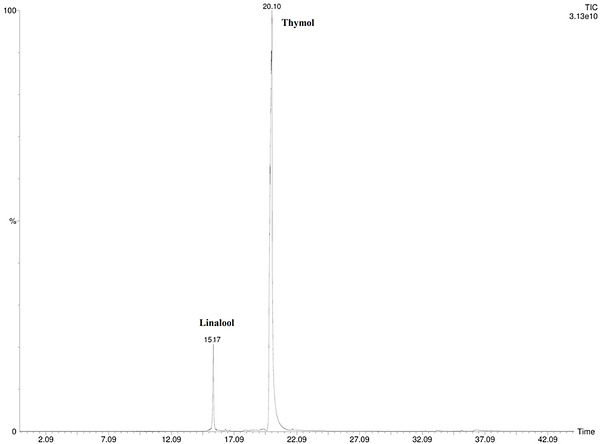
Antimicrobial Activity by Disc Diffusion Method
The antimicrobial activity of thymol hydrolate was evaluated using the disc diffusion method against 14 microbial strains, including Gram‐positive bacteria, Gram‐negative bacteria, yeasts, and filamentous fungi. The results, expressed as inhibition zone diameters (including the 6 mm disc), are presented in Table 2.
TABLE 2: Antimicrobial activity assessed by the disc diffusion method.
| Microorganisms | Inhibition zone of thymol hydrolate (mm) | Inhibition zone of ATB (mm) |
|---|---|---|
| Gram‐negative bacteria | ||
| Escherichia coli CCM 3953 | 10.67 ± 0.58 | 29.67 ± 0.58 |
| Salmonella enterica CCM 3807 | 9.67 ± 0.58 | 32.33 ± 0.58 |
| Yersinia enterocolitica CCM 7204T | 11.67 ± 0.58 | 30.33 ± 0.58 |
| Gram‐positive bacteria | ||
| Enterococcus faecalis CCM 4224 | 15.33 ± 0.58 | 31.33 ± 0.58 |
| Listeria monocytogenes CCM 4699 | 14.33 ± 0.58 | 31.67 ± 0.58 |
| Staphylococcus aureus CCM 4423 | 15.67 ± 0.58 | 31.67j ± 0.58 |
| Yeast | ||
| Candida albicans CCM 8136 | 7.33 ± 0.58 | 30.33 ± 0.58 |
| Candida glabrata CCM 8270 | 7.33 ± 0.58 | 30.67 ± 0.58 |
| Candida krusei CCM 8271 | 6.67 ± 0.58 | 29.33 ± 0.58 |
| Candida parapsilosis CCM 8260 | 8.33 ± 0.58 | 26.33 ± 0.58 |
| Candida tropicalis CCM 8264 | 7.33 ± 0.58 | 26.33 ± 0.58 |
| Fungi | ||
| Botrytis cinerea F‐314 | 5.67 ± 0.58 | 23.33 ± 0.58 |
| Fusarium solani CCM 8014 | 4.67 ± 0.58 | 24.33 ± 0.58 |
| Trichoderma harzianum CCM F‐470 | 6.67 ± 0.58 | 25.33 ± 0.58 |
Note: Data represents the mean (± standard deviation) of 3 samples.
Thymol hydrolate exhibited the strongest activity against Gram‐positive bacteria. The largest inhibition zones were observed for S. aureus (16.33 mm), followed by E. faecalis (15.33 mm) and L. monocytogenes (14.33 mm). Among Gram‐negative bacteria, moderate inhibition zones were recorded, with Y. enterocolitica showing the highest susceptibility (9.67 mm), followed by S. enterica (8.67 mm) and E. coli (8.33 mm).
Yeasts demonstrated relatively low susceptibility to thymol hydrolate. Inhibition zone diameters ranged from 5.33 mm (C. krusei and C. tropicalis) to 6.33 mm (C. parapsilosis). C. albicans and C. glabrata exhibited identical inhibition zones (5.67 mm). Filamentous fungi showed the weakest response to thymol hydrolate, with inhibition zones ranging from 4.67 mm (T. harzianum) to 5.67 mm (B. cinerea). F. solani exhibited an intermediate inhibition zone of 5.33 mm.
Positive controls amphotericin B for yeasts and filamentous fungi, gentamicin for Gram‐negative bacteria, and cefoxitin for Gram‐positive bacteria produced substantially larger inhibition zones (23.33–32.33 mm) than thymol hydrolate, confirming the expected antimicrobial activity of the reference agents.
Minimum Inhibitory Concentrations (MIC50 and MIC90)
The minimum inhibitory concentrations (MIC50 and MIC90) of thymol hydrolate were determined using the broth microdilution method. MIC50 values ranged from 5.765 mg/mL (S. aureus) to 46.013 mg/mL (B. cinerea), while MIC90 values ranged from 6.341 mg/mL (S. aureus) to 50.614 mg/mL (B. cinerea). The results are presented in Table 3.
TABLE 3: Minimal inhibitory concentration in mg/mL.
| Microorganisms | MIC50 | MIC90 |
|---|---|---|
| Gram‐negative bacteria | ||
| Escherichia coli CCM 3953 | 7.386 ± 0.612 | 8.347 ± 0.692 |
| Salmonella enterica CCM 3807 | 6.714 ± 0.558 | 7.587 ± 0.631 |
| Yersinia enterocolitica CCM 7204T | 12.662 ± 0.166 | 14.308 ± 0.187 |
| Gram‐positive bacteria | ||
| Enterococcus faecalis CCM 4224 | 6.280 ± 0.189 | 7.097 ± 0.213 |
| Listeria monocytogenes CCM 4699 | 10.133 ± 0.195 | 11.451 ± 0.221 |
| Staphylococcus aureus CCM 4423 | 5.442 ± 0.185 | 6.149 ± 0.209 |
| Yeast | ||
| Candida albicans CCM 8136 | 20.099 ± 0.028 | 22.713 ± 0.032 |
| Candida glabrata CCM 8270 | 22.228 ± 0.651 | 25.118 ± 0.736 |
| Candida krusei CCM 8271 | 18.459 ± 0.040 | 20.859 ± 0.045 |
| Candida parapsilosis CCM 8260 | 19.017 ± 0.819 | 21.489 ± 0.926 |
| Candida tropicalis CCM 8264 | 31.191 ± 0.114 | 35.246 ± 0.129 |
| Fungi | ||
| Botrytis cinerea F‐314 | 37.537 ± 0.494 | 42.416 ± 0.559 |
| Fusarium solani CCM 8014 | 34.744 ± 1.117 | 39.261 ± 1.262 |
| Trichoderma harzianum CCM F‐470 | 27.521 ± 0.578 | 31.099 ± 0.653 |
Note: Data represents the mean (± standard deviation) of 3 samples.
Among Gram‐positive bacteria, thymol hydrolate exhibited the highest activity against S. aureus (MIC50 = 5.765 mg/mL; MIC90 = 6.341 mg/mL), followed by L. monocytogenes (MIC50 = 6.714 mg/mL; MIC90 = 7.386 mg/mL) and E. faecalis (MIC50 = 7.638 mg/mL; MIC90 = 8.402 mg/mL).
Gram‐negative bacteria showed higher MIC values than Gram‐positive strains. The lowest MIC values among Gram‐negative bacteria were observed for Y. enterocolitica (MIC50 = 13.605 mg/mL; MIC90 = 14.966 mg/mL), followed by S. enterica (MIC50 = 13.727 mg/mL; MIC90 = 15.100 mg/mL). E. coli exhibited the highest MIC values among the tested bacterial strains (MIC50 = 15.946 mg/mL; MIC90 = 17.540 mg/mL).
Yeasts demonstrated substantially higher MIC values than bacteria, indicating lower susceptibility to thymol hydrolate. Among Candida species, C. albicans exhibited the lowest MIC values (MIC50 = 25.450 mg/mL; MIC90 = 27.996 mg/mL), whereas C. tropicalis showed the highest resistance (MIC50 = 41.422 mg/mL; MIC90 = 45.564 mg/mL). Intermediate MIC50 values were observed for C. glabrata (27.591 mg/mL), C. krusei (31.776 mg/mL), and C. parapsilosis (37.710 mg/mL).
Filamentous fungi exhibited the highest MIC values among all tested microorganisms. T. harzianum showed the lowest MIC values within this group (MIC50 = 35.477 mg/mL; MIC90 = 39.025 mg/mL), followed by F. solani (MIC50 = 43.106 mg/mL; MIC90 = 47.417 mg/mL). B. cinerea demonstrated the highest resistance to thymol hydrolate (MIC50 = 46.013 mg/mL; MIC90 = 50.614 mg/mL).
Overall, the antimicrobial efficacy of thymol hydrolate followed the pattern: Gram‐positive bacteria > Gram‐negative bacteria > yeasts > filamentous fungi.
Discussion
Chemical Composition and Chemotype Confirmation
GC–MS analysis of the thymol‐containing hydrolate revealed thymol (79.9%) as the predominant component, confirming that the Thymus vulgaris L. material used in this study belonged to the thymol chemotype. This observation is consistent with previous reports on thyme essential oils, in which thymol concentrations typically range from 30% to 70% [ref. 1, ref. 6]. The notably high thymol content (79.9%) detected in the present hydrolate indicates efficient transfer of phenolic monoterpenes into the aqueous phase during steam distillation. Linalool (17.4%) was identified as the second major component, a compositional feature characteristic of thymol chemotype thyme. The co‐occurrence of thymol and linalool has been widely reported in Thymus vulgaris essential oils and may enhance overall antimicrobial efficacy through additive or synergistic interactions [ref. 7]. Minor constituents such as α‐terpineol (1.0%), terpinen‐4‐ol (0.5%), and 1,8‐cineole (0.3%) are commonly detected in thyme‐derived products and are known to exhibit antimicrobial activity, although generally at lower potency than thymol [ref. 5].
The very low carvacrol content (0.7%) detected in the analyzed hydrolate further supports the classification of the source plant material as a thymol chemotype and clearly differentiates it from carvacrol‐dominant thyme products. This chemotype specificity is particularly important for standardization, reproducibility, and quality control in commercial applications, as different chemotypes are associated with distinct biological activities and safety profiles [ref. 11, ref. 12].
Antimicrobial Activity Against Gram‐Positive Bacteria
Thymol hydrolate exhibited pronounced antimicrobial activity against Gram‐positive bacteria, with S. aureus showing the highest susceptibility (MIC50 = 5.765 mg/mL; inhibition zone 16.33 mm). This finding is particularly relevant given that S. aureus is a major cause of foodborne illnesses and nosocomial infections, and that the increasing prevalence of methicillin‐resistant S. aureus (MRSA) strains poses significant challenges to conventional antimicrobial therapies [ref. 13, ref. 14]. Recent systematic reviews have confirmed MRSA contamination in retail meat and food products globally, with foodborne MRSA strains often harboring multiple virulence factors that facilitate horizontal dissemination of antimicrobial resistance genes [ref. 15].
The antimicrobial activity observed against S. aureus is comparable to that reported for previously studied plant‐derived hydrolates, such as concentrated clove hydrolate [ref. 16]. For example, concentrated clove hydrolate obtained by 50‐fold solid‐phase extraction has been reported to exhibit MIC values of 4–8 mg/mL against S. aureus, with inhibition zones ranging from 15.5 to 15.8 mm [ref. 16]. In contrast, the non‐concentrated thymol hydrolate evaluated in the present study achieved similar inhibitory effects (inhibition zone 16.33 mm; MIC50 = 5.765 mg/mL), indicating a relatively high antimicrobial potency despite the absence of any concentration step.
L. monocytogenes (MIC50 = 6.714 mg/mL) and E. faecalis (MIC50 = 7.638 mg/mL) also exhibited high susceptibility to thymol hydrolate. L. monocytogenes is of particular concern in ready‐to‐eat foods due to its psychrotrophic growth ability and high mortality rates among vulnerable populations [ref. 17, ref. 18]. The strong inhibitory effect observed against this pathogen highlights the potential applicability of thymol hydrolate in food preservation systems, especially for refrigerated products where conventional thermal treatments are unsuitable.
The antimicrobial mechanism of thymol against Gram‐positive bacteria involves multiple cellular targets. Due to its lipophilic nature, thymol can integrate into bacterial cell membranes, leading to disruption of membrane integrity, dissipation of the proton motive force (including membrane potential hyperpolarization and pH gradient collapse), and depletion of intracellular ATP reserves through blockade of ATP synthesis pathways [ref. 19, ref. 20]. In addition, thymol has been reported to inhibit essential bacterial enzymes and interfere with protein synthesis, contributing to its broad‐spectrum bactericidal activity [ref. 21].
The presence of linalool (17.5%) may further contribute to the antimicrobial efficacy of the hydrolate. Linalool possesses intrinsic antimicrobial activity through mechanisms including membrane depolarization, increased membrane permeability, disruption of ATP synthesis, and interference with respiratory metabolism [ref. 22, ref. 23]. Linalool may enhance thymol action by increasing bacterial membrane permeability, thereby facilitating thymol penetration into bacterial cells and exhibiting synergistic or additive antimicrobial effects [ref. 24]. Such multicomponent interactions are characteristic of plant‐derived antimicrobials and may offer advantages over single‐compound synthetic agents, including a reduced likelihood of resistance development.
Antimicrobial Activity Against Gram‐Negative Bacteria
Gram‐negative bacteria exhibited moderate susceptibility to thymol hydrolate, with MIC50 values approximately two‐ to three‐fold higher than those observed for Gram‐positive bacteria. Among the tested Gram‐negative strains, Y. enterocolitica showed the lowest MIC50 value (13.605 mg/mL), followed by S. enterica (13.727 mg/mL) and E. coli (15.946 mg/mL).
The reduced susceptibility of Gram‐negative bacteria compared to Gram‐positive strains is consistent with well‐established structural differences in bacterial cell envelopes. Gram‐negative bacteria possess an outer membrane rich in lipopolysaccharides (LPS), which functions as an effective permeability barrier limiting the penetration of hydrophobic antimicrobial compounds such as thymol [ref. 25, ref. 26]. The LPS molecules are located exclusively in the outer leaflet of the asymmetric outer membrane, creating a highly ordered structure that significantly reduces permeability to hydrophobic antibiotics and other lipophilic agents [ref. 27]. This additional barrier must be overcome before thymol can reach the cytoplasmic membrane and exert its antimicrobial effect.
Despite this intrinsic resistance mechanism, the MIC values obtained in the present study (13.6–15.9 mg/mL) remain within a potentially applicable range for food‐related applications. Previous studies on thyme essential oil have reported substantially lower MIC values (0.10–0.45 mg/mL) against Gram‐negative bacteria, including Salmonella spp. and E. coli [ref. 28, ref. 29], indicating approximately 30‐ to 150‐fold greater potency compared to thymol hydrolate. The substantial difference in antimicrobial activity between essential oil and hydrolate is expected, given the markedly lower concentration of volatile antimicrobial compounds in hydrolates (typically 0.02%–0.2%) compared to essential oils.
The observed activity against S. enterica is of particular relevance for food safety, as this pathogen is among the most frequent causes of foodborne gastroenteritis worldwide, with an estimated 93.8 million cases annually and 155,000 deaths globally [ref. 30, ref. 31]. Recent surveillance data indicate that Salmonella accounted for 19.6% of all foodborne outbreaks in the European Union in 2023, representing the largest proportion among bacterial foodborne pathogens [ref. 32]. These results suggest that thymol hydrolate could be considered for use in washing solutions for fresh produce or as a supplementary natural sanitizer in food processing environments to reduce Salmonella contamination.
Notably, disc diffusion assays revealed only minor differences in inhibition zone diameters among Gram‐negative bacteria (8.33–9.67 mm), whereas MIC determination demonstrated greater variability in susceptibility (13.6–15.9 mg/mL). This discrepancy underscores the importance of quantitative methods such as MIC determination in addition to qualitative disc diffusion screening, as the diffusion behavior of hydrolate constituents in agar media may not accurately reflect their true antimicrobial potency.
Antifungal Activity Against Yeasts
Yeast species exhibited markedly lower susceptibility to thymol hydrolate compared to bacteria, with MIC50 values ranging from 25.450 mg/mL (C. albicans) to 41.422 mg/mL (C. tropicalis). This reduced susceptibility is consistent with fundamental structural differences between prokaryotic bacteria and eukaryotic fungi. Fungal cells possess a rigid cell wall composed primarily of chitin and β‐glucans [ref. 33], as well as ergosterol‐containing plasma membranes [ref. 34], which collectively confer increased resistance to antimicrobial agents relative to bacterial cells [ref. 35].
Among the tested Candida species, C. albicans exhibited the lowest MIC50 value (25.450 mg/mL). This observation is of particular relevance given that C. albicans is the most common opportunistic fungal pathogen in humans, responsible for infections ranging from superficial mucosal candidiasis to invasive systemic disease in immunocompromised individuals [ref. 36, ref. 37]. The moderate antifungal activity observed suggests that thymol hydrolate may be suitable for use in topical formulations or as a natural preservative in cosmetic products to limit fungal contamination.
The susceptibility pattern observed among Candida species (C. albicans < C. glabrata < C. krusei < C. parapsilosis < C. tropicalis) indicates species‐specific differences in intrinsic resistance mechanisms. In particular, C. tropicalis, which exhibited the highest MIC50 value (41.422 mg/mL), is known for its strong biofilm‐forming capacity and production of multiple virulence factors [ref. 38], which may contribute to its reduced susceptibility to antimicrobial agents.
The antifungal activity of thymol is primarily attributed to its interaction with ergosterol, the major sterol component of fungal cell membranes, which disrupts membrane integrity, increases permeability, and results in leakage of intracellular components [ref. 34, ref. 39]. Thymol has also been reported to interfere with fungal cell wall synthesis and inhibit germ tube formation, an important virulence factor in Candida species [ref. 40].
MIC determination provides a more reliable quantitative measure of antifungal activity than disc diffusion assays, as differences in diffusion behavior of hydrolate constituents in agar media can significantly affect inhibition zone measurements.
Antifungal Activity Against Filamentous Fungi
Filamentous fungi exhibited the lowest susceptibility to thymol hydrolate among all tested microorganisms, with MIC50 values ranging from 35.477 mg/mL (T. harzianum) to 46.013 mg/mL (B. cinerea). This reduced susceptibility can be attributed to the complex multicellular organization of filamentous fungi, their thick cell walls composed of multiple polysaccharide layers [ref. 41], and their capacity to produce extracellular enzymes and secondary metabolites that may reduce the effectiveness of antimicrobial compounds [ref. 42].
B. cinerea, which exhibited the highest MIC50 value (46.013 mg/mL), is an economically important phytopathogen responsible for gray mold disease in a wide range of crops, including grapes, strawberries, and tomatoes [ref. 43]. The rapid development of resistance to synthetic fungicides by this pathogen has stimulated interest in natural antifungal alternatives [ref. 44]. Although the MIC values obtained in the present study are relatively high, published data indicate that thyme essential oils typically exhibit MIC values in the range of 0.085–0.3 mg/mL against B. cinerea [ref. 45], demonstrating substantially higher antifungal potency. This difference is expected, given the markedly lower concentration of bioactive volatile compounds in hydrolates compared to essential oils [ref. 46].
F. solani (MIC50 = 43.106 mg/mL) is another agriculturally relevant pathogen causing root rot and wilt diseases in numerous crops, as well as opportunistic infections in immunocompromised individuals [ref. 47]. Previous studies have reported MIC values of 0.085‐0.3 mg/mL for thyme, oregano, and marjoram essential oils against Fusarium species [ref. 45], further emphasizing the greater antifungal activity of essential oils relative to hydrolates.
In contrast, T. harzianum (MIC50 = 35.477 mg/mL), which is widely used as a biological control agent against plant pathogens [ref. 48], showed comparatively lower susceptibility. This observation suggests that, if thymol hydrolate were to be applied in agricultural environments, selective application strategies would be required to avoid potential interference with beneficial fungal species.
Disc diffusion assays revealed very small inhibition zones for filamentous fungi (4.67–5.67 mm), only marginally exceeding the disc diameter (6 mm). This limited inhibition may be attributed to several factors, including the restricted diffusion of hydrophobic thymol through aqueous agar media, rapid hyphal growth that may outpace antimicrobial diffusion [ref. 49], and possible interactions between thymol and agar components. These findings further support the use of MIC determination as a more reliable quantitative approach for assessing antifungal activity than disc diffusion assays [ref. 50].
Recent work by Menicucci et al. [ref. 4] demonstrated that thyme essential oil and hydrolate inhibited fungal growth on paper substrates, suggesting potential applications in the preservation of cellulose‐based materials. Although the present study focused on food‐related and clinically relevant fungi, these observations indicate that thymol hydrolate may also have broader applicability in material preservation and cultural heritage conservation.
Correlation Between Disc Diffusion and MIC Methods
An important observation of this study is the variable relationship between inhibition zone diameters obtained by the disc diffusion method and MIC values determined by broth microdilution across different microbial groups. For Gram‐positive bacteria, an inverse relationship was observed, whereby larger inhibition zones were generally associated with lower MIC values (e.g., S. aureus: 16.33 mm, MIC50 = 5.765 mg/mL; L. monocytogenes: 14.33 mm, MIC50 = 6.714 mg/mL). This pattern indicates a relatively good level of agreement between the two methods for Gram‐positive bacteria, consistent with established guidelines for conventional antimicrobial susceptibility testing [ref. 51].
In contrast, for Gram‐negative bacteria and fungi, the relationship between inhibition zone diameters and MIC values was weak or inconsistent. For example, E. coli, S. enterica, and Y. enterocolitica exhibited similar inhibition zones (8.33–9.67 mm) despite differences in MIC50 values (13.6–15.9 mg/mL). Likewise, Candida species displayed nearly identical, small inhibition zones (5.33–6.33 mm), while MIC50 values varied considerably (25.5–41.4 mg/mL). Similar discrepancies between disc diffusion and dilution methods have been reported for essential oils and plant extracts, particularly when testing complex natural mixtures [ref. 52, ref. 53].
The limited correspondence between disc diffusion and MIC results for Gram‐negative bacteria and fungi is likely related to differences in the diffusion behavior of hydrolate constituents in agar media. Hydrolates comprise complex mixtures of water‐soluble and partially water‐soluble compounds with diverse molecular sizes and polarities, which may diffuse at different rates through agar [ref. 54]. Furthermore, interactions between hydrolate components and agar polysaccharides may reduce the availability of active compounds at the agar surface, thereby affecting inhibition zone formation [ref. 55]. The hydrophobic nature of monoterpenes like thymol further complicates diffusion through aqueous agar matrices, resulting in concentration gradients that do not accurately reflect true antimicrobial potency [ref. 56].
These findings highlight an important methodological consideration: although the disc diffusion assay is useful for rapid, preliminary screening of antimicrobial activity, MIC determination by broth microdilution provides a more accurate and quantitative assessment of antimicrobial potency, particularly for complex natural mixtures such as plant hydrolates [ref. 57, ref. 58]. Accordingly, future studies aimed at standardization and quality control of hydrolates should prioritize MIC‐based methods over disc diffusion assays. Statistical analysis revealed significant differences in antimicrobial response among the tested microorganisms (Tukey’s HSD, p ≤ 0.05), suggesting differences in susceptibility as reflected in inhibition zone diameters and MIC values.
Comparison With Published Hydrolate Studies
Despite increasing interest in plant hydrolates, studies specifically addressing thymol‐rich thyme hydrolates remain limited, particularly in terms of comprehensive antimicrobial evaluation across different microbial groups. Direct comparison of the present results with previously published studies on plant hydrolates is limited by the relatively small number of comprehensive antimicrobial investigations in this area, particularly those focusing on thymol‐containing hydrolates. The majority of available studies primarily address essential oils rather than hydrolates, and when hydrolates are evaluated, they are frequently concentrated using solid‐phase extraction (SPE) or similar enrichment techniques prior to antimicrobial testing [ref. 16].
Available literature indicates that concentrated clove hydrolate (50‐fold SPE) exhibits MIC values of 0.4%–0.8% (equivalent to 4–8 mg/mL) against S. aureus and E. faecalis, with corresponding inhibition zones ranging from 15.5 to 18.8 mm [ref. 16]. In comparison, the non‐concentrated thymol hydrolate evaluated in the present study demonstrated MIC50 values of 5.765 mg/mL against S. aureus and 7.638 mg/mL against E. faecalis, with inhibition zones of 16.33 mm and 15.33 mm, respectively. These findings indicate that thymol hydrolate exhibits antimicrobial activity comparable to that reported for concentrated plant hydrolates, despite the absence of any concentration step.
The relatively high antimicrobial efficacy observed in this study can be attributed, at least in part, to the high thymol content (79.9%) of the hydrolate, which exceeds the thymol levels commonly reported for thyme essential oils (typically 30%–70%). The hydrodistillation process used for hydrolate production appears to have facilitated efficient transfer of thymol into the aqueous phase, resulting in a hydrolate with enhanced antimicrobial properties.
Only a limited number of studies have systematically evaluated the antimicrobial activity of hydrolates against both bacterial and fungal microorganisms [ref. 46]. In this context, the present work provides a broad assessment of antimicrobial efficacy by examining 14 microorganisms, including Gram‐positive bacteria, Gram‐negative bacteria, yeasts, and filamentous fungi. This comprehensive screening offers valuable comparative insight into the antimicrobial spectrum of thymol hydrolate and reveals a consistent susceptibility pattern (Gram‐positive bacteria > Gram‐negative bacteria > yeasts > filamentous fungi).
Hydrolates Versus Essential Oils: Practical Considerations
Although essential oils generally exhibit stronger antimicrobial activity than hydrolates, hydrolates offer several practical advantages that make them attractive for specific applications where moderate antimicrobial efficacy is sufficient. First, hydrolates contain substantially lower concentrations of volatile bioactive compounds than essential oils, resulting in a more favorable safety and tolerability profile. While essential oils may cause skin irritation, sensitization, or phototoxic reactions at higher concentrations, hydrolates are typically well tolerated and can often be applied directly to the skin without prior dilution [ref. 59]. This characteristic is particularly advantageous for cosmetic and personal care applications.
Second, hydrolates are inherently water‐based, which facilitates their incorporation into aqueous formulations such as toners, sprays, mists, and oral rinses. In contrast, essential oils require the use of emulsifiers or solubilizing agents for incorporation into water‐based systems, increasing formulation complexity and production costs [ref. 60]. Recent advances in nanoencapsulation technologies, including Pickering emulsions and nanoemulsions, have improved the stability and efficacy of essential oil‐based formulations [ref. 61, ref. 62].
Third, hydrolates generally exhibit milder and more subtle aromatic profiles than essential oils. Their less intense fragrance makes them suitable for products where strong odors are undesirable, such as facial cosmetics, dermatological formulations, and products intended for sensitive users [ref. 46].
From an economic perspective, hydrolates are by‐products of essential oil distillation and are therefore typically more cost‐effective than essential oils [ref. 63]. This advantage is particularly relevant for applications requiring large volumes of antimicrobial agents, including agricultural treatments, industrial sanitation, or surface disinfection. The valorization of hydrolates contributes to the sustainability of essential oil production by reducing waste and enhancing the economic viability of aromatic plant cultivation.
Finally, hydrolates are commonly regulated as cosmetic or food‐grade ingredients rather than as pharmaceutical agents in many jurisdictions, which may simplify regulatory approval processes depending on the intended use. However, regulatory classification may vary across regions and applications, and proper quality control measures, including microbiological testing and preservation strategies, remain essential for ensuring product safety [ref. 59].
Taken together, these considerations suggest that thymol hydrolate may be suitable for applications in which moderate antimicrobial activity is adequate and where safety, ease of formulation, sensory properties, and cost‐effectiveness are prioritized over maximal antimicrobial potency.
Potential Applications
Based on the antimicrobial activity demonstrated in this study, thymol hydrolate may have potential applications in several fields where moderate antimicrobial efficacy, combined with favorable safety and formulation properties, could be advantageous.
In the context of food preservation, the pronounced activity against Gram‐positive bacteria, particularly S. aureus and L. monocytogenes, suggests that thymol hydrolate may be considered as a natural preservative or surface treatment for ready‐to‐eat foods. Recent studies have demonstrated the efficacy of thyme essential oil in reducing foodborne pathogens in meat products, with applications including edible coatings, nanoemulsions, and active packaging systems [ref. 8, ref. 64, ref. 65]. The use of bacterial cellulose/thyme essential oil emulsion coatings has been shown to effectively inhibit spoilage of chilled chicken during refrigerated storage [ref. 60], while pickering emulsion formulations have improved the stability and antimicrobial efficacy of thyme essential oil against foodborne pathogens [ref. 61]. However, efficacy in complex food matrices would require validation under practical conditions.
In cosmetics and personal care products, the observed antifungal activity against Candida species suggests the potential use of thymol hydrolate as a functional ingredient contributing to microbial stability and product safety. Applications may include water‐based formulations such as toners, facial mists, deodorants, and oral care products. The safety profile of hydrolates for long‐term skin use has been documented for several Lamiaceae species at appropriate concentrations [ref. 59]. In addition to antimicrobial properties, the presence of linalool may enhance consumer acceptability and provide additional sensory benefits [ref. 46].
With respect to medical and pharmaceutical applications, the activity observed against clinically relevant microorganisms, including S. aureus, L. monocytogenes, and Candida species, suggests potential utility in topical formulations, including wound care products or oral rinses. The synergistic antibacterial effects of thyme and clove essential oils have been demonstrated against food isolates of E. coli and S. aureus [ref. 8], supporting potential applications in infection control. Nevertheless, translation of these findings into medical use would require comprehensive in vivo efficacy studies, toxicological evaluation, and clinical validation before any therapeutic application could be considered.
In agriculture and horticulture, although antifungal activity against filamentous fungi was moderate, thymol hydrolate may be further investigated as a component of integrated pest management strategies, particularly in organic farming systems where the use of synthetic fungicides is restricted. Plant essential oils, including those from thyme, have gained increasing attention as biopesticides due to their target specificity, biodegradability, and safety for nontarget organisms [ref. 66, ref. 67]. Recent advances in essential oil formulations, including nanoencapsulation and natural deep eutectic solvents (NaDES), have improved their stability and efficacy as biopesticides [ref. 66]. However, potential effects on beneficial microorganisms, such as Trichoderma species used in biological control, should be carefully evaluated.
Finally, recent studies reporting antifungal effects of thyme essential oils on paper substrates [ref. 4] suggest possible applications in the preservation of cellulose‐based materials. While the present study focused on food‐related and clinically relevant microorganisms, these findings point to broader potential uses of thymol hydrolate in the conservation of books, documents, and archival materials. However, further validation under real‐world conditions is required.
Limitations and Future Research Directions
Several limitations of the present study should be acknowledged. First, only a single reference strain of each bacterial and fungal species was evaluated. Future studies should include a broader range of strains, including clinical isolates and drug‐resistant variants, to better characterize the antimicrobial spectrum of thymol hydrolate and assess the potential for resistance development.
Second, the mechanisms underlying the antimicrobial activity of thymol hydrolate and possible interactions between thymol and other hydrolate constituents were not investigated. Further studies employing techniques such as transmission electron microscopy, membrane permeability assays, and transcriptomic or proteomic analyses could provide deeper insight into the modes of action involved.
Third, although MIC50 and MIC90 values were determined, minimum bactericidal and fungicidal concentrations (MBC/MFC) were not assessed, nor was activity against biofilm‐forming microorganisms evaluated. Since biofilms represent a major challenge in clinical, food‐processing, and industrial environments [ref. 68, ref. 69], future research should focus on the ability of thymol hydrolate to inhibit biofilm formation or disrupt established biofilms. Recent studies have demonstrated that thyme essential oil and its major component, thymol exhibit significant antibiofilm activity against foodborne pathogens, including Salmonella, E. coli, L. monocytogenes, and S. aureus [ref. 70], suggesting that thymol hydrolate may possess similar properties that warrant investigation.
Fourth, the antimicrobial activity was evaluated exclusively under in vitro conditions. The efficacy of thymol hydrolate in real‐world applications may be influenced by environmental factors such as pH, temperature, organic matter, and interactions with complex matrices (e.g., food, skin, or packaging materials). Therefore, in situ and application‐specific studies are required to validate its practical effectiveness. Finally, the stability of thymol hydrolate under different storage conditions and over extended periods was not examined. Long‐term stability studies are essential to ensure consistent antimicrobial performance and shelf‐life suitability for commercial applications.
Future research should therefore focus on (i) evaluating synergistic effects between thymol hydrolate and other natural antimicrobials or reduced doses of conventional antimicrobial agents [ref. 71]; (ii) assessing the effects of sub‐inhibitory concentrations on microbial virulence factors and biofilm development; (iii) determining cytotoxicity and safety profiles for topical and oral applications; (iv) developing and optimizing delivery systems such as nanoemulsions, liposomes, or hydrogels to enhance antimicrobial efficacy; (v) conducting scale‐up and standardization studies for industrial production; and (vi) performing targeted in vivo and clinical studies for selected food, cosmetic, or medical applications.
Significance and Innovation
This study provides a comprehensive evaluation of a thymol chemotype Thymus vulgaris hydrolate against a diverse panel of bacteria, yeasts, and filamentous fungi using standardized quantitative antimicrobial assays. The high thymol content (79.9%) identified in the hydrolate represents a distinguishing compositional feature and contributes to the pronounced antimicrobial activity observed, particularly against Gram‐positive bacteria.
The results demonstrate that even a non‐concentrated thymol hydrolate exhibits antimicrobial activity comparable to that reported for a 50‐fold SPE‐concentrated clove hydrolate [ref. 16]. This observation underscores its potential practical relevance. Overall, thymol chemotype thyme hydrolate appears to be an effective plant‐derived antimicrobial option, particularly when factors such as safety, formulation simplicity, and cost‐effectiveness are considered.
More broadly, this work contributes to the limited but growing body of research on plant hydrolates and supports their potential as sustainable and economically viable alternatives to synthetic antimicrobial agents. In the context of increasing antimicrobial resistance [ref. 72, ref. 73] and rising consumer demand for natural products [ref. 74, ref. 75]. Atanasov et al. [ref. 76] and Guedes et al. [ref. 75], the present findings provide a valuable foundation for further research and development of hydrolate‐based antimicrobial solutions for food, cosmetic, and related applications.
Conclusion
This study provides a comprehensive evaluation of the antimicrobial activity of a thymol chemotype Thymus vulgaris L. hydrolate against a diverse panel of clinically and economically relevant microorganisms. HS‐GC–MS analysis revealed a high thymol content (79.9%), with linalool (17.4%) as the second major constituent, confirming the thymol chemotype and providing a chemical basis for the observed antimicrobial effects. The antimicrobial activity of thymol hydrolate followed a consistent susceptibility pattern: Gram‐positive bacteria > Gram‐negative bacteria > yeasts > filamentous fungi. Pronounced activity was observed against Gram‐positive pathogens, particularly S. aureus, L. monocytogenes, and E. faecalis, while Gram‐negative bacteria exhibited moderate susceptibility. Yeasts and filamentous fungi showed lower sensitivity, although measurable antifungal activity was still detected across all tested fungal species. Comparison of disc diffusion and broth microdilution methods demonstrated good agreement for Gram‐positive bacteria but limited correspondence for Gram‐negative bacteria and fungi, highlighting the importance of MIC‐based approaches for quantitative assessment of hydrolate antimicrobial activity. This methodological finding is relevant for future standardization and quality control of plant hydrolates. From a practical perspective, thymol hydrolate offers several advantages over essential oils, including improved safety and tolerability, water solubility, milder sensory properties, and potential cost‐effectiveness. These characteristics, combined with its demonstrated antimicrobial activity, suggest further investigation of thymol hydrolate as a potential natural antimicrobial agent for applications in food preservation, cosmetics, and related fields. Overall, this work contributes to the limited scientific knowledge on plant hydrolates and provides a basis for future studies focusing on the mechanism of action, in vivo efficacy, stability, and formulation development. Further research into synergistic combinations and activity against resistant microorganisms may enhance the applicability of thymol hydrolate in addressing current challenges related to antimicrobial resistance. However, further studies are required to confirm its effectiveness under practical conditions.
Author Contributions
Miroslava Kačániová: conceptualization, data curation, writing – original draft, methodology, investigation, formal analysis, supervision, project administration, and funding acquisition. Joel Horacio Elizondo‐Luévano: review and editing, data curation, and formal analysis. Anis Ben Hsouna: data curation, writing – original draft, and formal analysis. Rania Ben Saad: data curation, writing – original draft, and formal analysis. Stefania Garzoli: conceptualization, formal analysis, methodology, data curation, review and editing, and supervision.
Conflicts of Interest
The authors declare no conflicts of interest.
References
- Thyme Essential Oil Potentials as a Bactericidal and Biofilm‐Preventive Agent Against Prevalent Bacterial Pathogens,”. Scientific Reports, 2025. [PubMed]
- Synergistic Activity of Thymol With Commercial Antibiotics Against Critical and High WHO Priority Pathogenic Bacteria,”. Plants, 2023. [PubMed]
- Hydrosols: Biological Activity and Potential as Antimicrobials for Food Applications,”. Food Control, 2018
- Exploring Wild Thymus sp. (L.) Chemotypes Across Pistoia Mountains Provides Thyme Essential Oil and Hydrolate Inhibiting Fungal Growth on Paper,”. Fitoterapia, 2025. [PubMed]
- Antimicrobial Activity of Nanoformulations of Carvacrol and Thymol: New Trend and Applications,”. OpenNano, 2023
- Isolation, Characterization and Antimicrobial Activity Study of Thymus vulgaris ,”. Scientific Reports, 2024. [PubMed]
- Determination of Cinnamaldehyde, Thymol and Eugenol in Essential Oils by LC–MS/MS and Antibacterial Activity of Them Against Bacteria,”. Scientific Reports, 2024. [PubMed]
- Antibacterial and Antibiofilm Efficacy of Thyme (Thymus vulgaris L.) Essential Oil against Foodborne Illness Pathogens, Salmonella Enterica subsp. Enterica Serovar Typhimurium and Bacillus Cereus,”. Antibiotics, 2023. [PubMed]
- Chemical Composition and Antibacterial Effect of Clove and Thyme Essential Oils on Growth Inhibition and Biofilm Formation of Arcobacter spp. And Other Bacteria,”. Antibiotics, 2024. [PubMed]
- Headspace/GC–MS Analysis and Investigation of Antibacterial, Antioxidant and Cytotoxic Activity of Essential Oils and Hydrolates From Rosmarinus officinalis L. and Lavandula Angustifolia Miller,”. Foods, 2021. [PubMed]
- Qualitative and Quantitative Variation in Monoterpene Co‐Occurrence and Composition in the Essential Oil of Thymus vulgaris Chemotypes,”. Journal of Chemical Ecology, 2003. [PubMed]
- Anti‐Inflammatory and Antimicrobial Properties of Thyme Oil and Its Main Constituents,”. IJMS, 2023. [PubMed]
- Methicillin‐Resistant Staphylococcus aureus (MRSA) in Different Food Groups and Drinking Water,”. Foods, 2024. [PubMed]
- Prevalence, Antimicrobial Resistance, and Distribution of Toxin Genes in Methicillin‐Resistant Staphylococcus aureus From Retail Meat and Fruit and Vegetable Cuts in the United Arab Emirates,”. Frontiers in Cellular and Infection Microbiology, 2025. [PubMed]
- Methicillin‐Resistant Staphylococcus aureus Contamination in Meat and Meat Products: A Systematic Review and Meta‐Analysis,”. Frontiers in Microbiology, 2025. [PubMed]
- Chemical Composition of Natural Hydrolates and Their Antimicrobial Activity on Arcobacter‐Like Cells in Comparison With Other Microorganisms,”. Molecules, 2020. [PubMed]
- Listeria in Food: Prevalence and Control,”. Foods, 2023. [PubMed]
- Listeria monocytogenes in Aquatic Food Products: Spotlight on Epidemiological Information, Bio‐based Mitigation Strategies and Predictive Approaches,”. Microbial Pathogenesis, 2024. [PubMed]
- Thymol as Biofilm and Efflux Pump Inhibitor: A Dual‐Action Approach to Combat Mycobacterium tuberculosis ,”. Cell Biochemistry & Function, 2024. [PubMed]
- Evaluation of the Membrane Damage Mechanism of Thymol Against Bacillus Cereus and Its Application in the Preservation of Skim Milk,”. Food Control, 2022
- The Action of Thymol on Oral Bacteria,”. Oral Microbiology and Immunology, 1995. [PubMed]
- Antimicrobial Activity and Proposed Action Mechanism of Linalool Against Pseudomonas Fluorescens ,”. Frontiers in Microbiology, 2021. [PubMed]
- Antibacterial Mechanism of Linalool Against L. monocytogenes, a Metabolomic Study,”. Food Control, 2022
- Combinatorial Antimicrobial Efficacy and Mechanism of Linalool Against Clinically Relevant Klebsiella pneumoniae ,”. Frontiers in Microbiology, 2021. [PubMed]
- Molecular Basis of Bacterial Outer Membrane Permeability Revisited,”. Microbiology and Molecular Biology Reviews, 2003. [PubMed]
- 26 P. Sperandeo , A. M. Martorana , and A. Polissi , Bacterial Cell Walls and Membranes, ed. A. Kuhn , (Springer International Publishing, 2019), 9–37.
- A New Antibiotic Traps Lipopolysaccharide in Its Intermembrane Transporter,”. Nature, 2024. [PubMed]
- In‐Depth Study of Thymus vulgaris Essential Oil: Towards Understanding the Antibacterial Target Mechanism and Toxicological and Pharmacological Aspects,”. BioMed Research International, 2022. [PubMed]
- Antibacterial Effects of Thyme Oil Loaded Solid Lipid and Chitosan Nano‐Carriers Against Salmonella Typhimurium and Escherichia coli as Food Preservatives,”. PLoS One, 2024. [PubMed]
- The Global Burden of Nontyphoidal Salmonella Gastroenteritis,”. Clinical Infectious Diseases, 2010. [PubMed]
- Human Salmonellosis: A Continuous Global Threat in the Farm‐to‐Fork Food Safety Continuum,”. Foods, 2023. [PubMed]
- The European Union One Health 2023 Zoonoses Report’,. EFS2, 2024. [DOI]
- Architecture of the Dynamic Fungal Cell Wall,”. Nature Reviews Microbiology, 2023. [PubMed]
- Fungicidal Activity of Thymol and Carvacrol by Disrupting Ergosterol Biosynthesis and Membrane Integrity Against Candida ,”. European Journal of Clinical Microbiology & Infectious Diseases, 2011. [PubMed]
- Elevated Chitin Content Reduces the Susceptibility of Candida Species to Caspofungin,”. Antimicrobial Agents and Chemotherapy, 2013. [PubMed]
- Hyphal Growth in Human Fungal Pathogens and Its Role in Virulence,”. International Journal of Microbiology, 2012
- Fungal Infections: Pathogenesis, Antifungals and Alternate Treatment Approaches,”. Current Research in Microbial Sciences, 2022. [PubMed]
- Molecular Mechanisms Governing Antifungal Drug Resistance,”. npj Antimicrob Resist, 2023. [PubMed]
- Mechanistic Insight into the Membrane Disrupting Properties of Thymol in Candida Species,”. The Microbe, 2024
- Inhibitory Activity of Thymol Against the Formation and Viability of Candida albicans Hyphae,”. Mycoses, 2007. [PubMed]
- The Fungal Cell Wall: Structure, Biosynthesis, and Function,”. Microbiology Spectrum, 2017
- Fungal Secondary Metabolism: Regulation, Function and Drug Discovery,”. Nature Reviews Microbiology, 2019. [PubMed]
- 43 S. Fillinger and Y. Elad , eds., Botrytis – the Fungus, the Pathogen and Its Management in Agricultural Systems (Springer International Publishing, 2016).
- The Rising Threat of Fungicide Resistance in Plant Pathogenic Fungi: Botrytis as a Case Study,”. J Chem Biol, 2014. [PubMed]
- The Effectiveness of Plant Essential Oils on the Growth of Botrytis cinerea, Fusarium sp. and Clavibacter Michiganensis subsp. Michiganensis ,”. Crop Protection, 2003
- Unlocking the Potential of Hydrosols: Transforming Essential Oil Byproducts into Valuable Resources,”. Molecules, 2024. [PubMed]
- Fusarium: Molecular Diversity and Intrinsic Drug Resistance,”. Plos Pathogens, 2016. [PubMed]
- Trichoderma‐based Products and Their Widespread Use in Agriculture,”. TOMYCJ, 2014
- In Vitro Drug Interaction Modeling of Combinations of Azoles With Terbinafine Against Clinical Scedosporium prolificans Isolates,”. Antimicrobial Agents and Chemotherapy, 2003. [PubMed]
- 50 N. P. Wiederhold , Antifungal Drug Resistance, ed. D.J. Krysan and W.S. Moye‐Rowley (Springer, 2023), 3–16.
- E. C. on A. S. EUCAST, Breakpoint Tables for Interpretation of MICs and Zone Diameters, version,. 2025
- Methods for In Vitro Evaluating Antimicrobial Activity: A Review,”. Journal of Pharmaceutical Analysis, 2016. [PubMed]
- Screening Methods to Determine Antibacterial Activity of Natural Products,”. Brazilian journal of microbiology, 2007
- Agar and Broth Dilution Methods to Determine the Minimal Inhibitory Concentration (MIC) of Antimicrobial Substances,”. Nature Protocols, 2008. [PubMed]
- Evaluation of Diffusion and Dilution Methods to Determine the Antibacterial Activity of Plant Extracts,”. Journal of Microbiological Methods, 2010. [PubMed]
- Effects of Melaleuca alternifolia (Tea Tree) Essential Oil and the Major Monoterpene Component Terpinen‐4‐ol on the Development of Single‐ and Multistep Antibiotic Resistance and Antimicrobial Susceptibility,”. Antimicrobial Agents and Chemotherapy, 2012. [PubMed]
- 57CLSI, M07 | Methods for Dilution Antimicrobial Susceptibility Tests for Bacteria That Grow Aerobically, can be found under https://clsi.org/shop/standards/m07/, 2024.
- Anti‐infective Potential of Natural Products: How to Develop a Stronger In Vitro Proof‐of‐concept,”. Journal of Ethnopharmacology, 2006. [PubMed]
- Multistep Approach Points to Compounds Responsible for the Biological Activity and Safety of Hydrolates From Nine Lamiaceae Medicinal Plants on Human Skin Fibroblasts,”. Antioxidants, 2023. [PubMed]
- Effects of Bacterial Cellulose/Thyme Essential Oil Emulsion Coating on the Shelf Life of Chilled Chicken Meat,”. Journal of the Science of Food and Agriculture, 2024. [PubMed]
- Pickering Emulsions as Vehicles for Bioactive Compounds From Essential Oils,”. Molecules, 2022. [PubMed]
- Comparison of Emulsion Stabilizers: Application for the Enhancement of the Bioactivity of Lemongrass Essential Oil,”. Polymers, 2024. [PubMed]
- Antioxidant Potential in Selected Species of Small Berry Fruits,”. Acta fytotechn zootechn, 2015
- Effect of Thymus vulgaris L. Essential Oil and Thymol on the Microbiological Properties of Meat and Meat Products: A Review,”. Heliyon, 2022. [PubMed]
- The Antioxidant and Antibacterial Potential of Thyme and Clove Essential Oils for Meat Preservation—An Overview,”. Applied Biosciences, 2024
- 66 I. Dridi , A. Landoulsi , N. Smirani , and Jonas , Biochemistry (IntechOpen, 2024).
- Plant Essential Oils as Biopesticides: Applications, Mechanisms, Innovations, and Constraints,”. Plants, 2023. [PubMed]
- Antibiofilm Properties of Essential Oils against Foodborne Bacteria: A Review of Mechanisms,”. Food Science and Biotechnology (, 2025. [DOI]
- Synergistic Anti‐Biofilm Strategy Based on Essential Oils and Its Application in the Food Industry,”. World Journal of Microbiology and Biotechnology, 2025. [PubMed]
- Essential Oils as a Novel Anti‐Biofilm Strategy against Salmonella Enteritidis Isolated from Chicken Meat,”. Microorganisms, 2025. [PubMed]
- Enhancing Antibiotic Efficacy and Combating Biofilm Formation: Evaluating the Synergistic Potential of Origanum vulgare Essential Oil Against Multidrug‐Resistant Gram‐Negative Bacteria,”. Microorganisms, 2024. [PubMed]
- Towards the Sustainable Discovery and Development of New Antibiotics,”. Nature Reviews Chemistry, 2021
- Antibiotic Resistance in Microbes: History, Mechanisms, Therapeutic Strategies and Future Prospects,”. Journal of Infection and Public Health, 2021. [PubMed]
- 74 C. C. Danta , S. S. Gurav , and R. V. Chikhale , Antidiabetic Drug Discovery From Natural Products (Elsevier, 2025), 39–50.
- Natural Antibiotics Against Antimicrobial Resistance: Sources and Bioinspired Delivery Systems,”. Brazilian journal of microbiology, 2024. [PubMed]
- Natural Products in Drug Discovery: Advances and Opportunities,”. Nature Reviews Drug Discovery, 2021. [PubMed]