
The Role of the Rhizosphere, Endophytes, and the Influence of Plant-Growth-Promoting Bacteria: Take the Cannabis Microbiome as an Example
Abstract
Cannabis sativa L. is a multipurpose crop of increasing agricultural and medical relevance, whose productivity and phytocannabinoid profile are influenced not only by genotype and environmental factors but also by the composition of its microbiota. This review synthesizes current knowledge (2020–2026) on the rhizosphere and endophytic microbiota of hemp, with particular emphasis on plant growth-promoting bacteria (PGPB) and their mechanisms of action. Molecular studies indicate that hemp-associated bacterial communities are dominated by Proteobacteria, Actinobacteriota, Firmicutes and Bacteroidota, with genotype-, tissue- and developmental-stage-dependent variation. PGPB influence plant performance through direct mechanisms, including biological nitrogen fixation, phosphate solubilization, siderophore production and phytohormone synthesis (indole-3-acetic acid (IAA), gibberellins, cytokinins, and 1-aminocyclopropane-1-carboxylate (ACC) deaminase), as well as indirect mechanisms such as antibiosis, enzyme-mediated pathogen inhibition and induction of systemic tolerance to abiotic stress. Experimental studies demonstrate that inoculation with selected strains or consortia can enhance biomass accumulation, improve germination and root architecture, increase resistance to Fusarium oxysporum and modulate cannabinoid and terpene profiles. Importantly, plant responses are cultivar-specific, highlighting the need for genotype-tailored microbial formulations.
Article type: Review Article
Keywords: rhizosphere microbiota, plant growth-promoting bacteria (PGPB), phytocannabinoids, plant–microbe interactions
Affiliations: Department of Plant Breeding and Bioresource Engineering, Faculty of Agriculture and Forestry, University of Warmia and Mazury in Olsztyn, Plac Łódzki 3, 10-724 Olsztyn, Poland; Chemprof Doradztwo Chemiczne s.c. Katarzyna Łuczyńska i Michał Łuczyński, Gutkowo 54B, 11-041 Olsztyn, Poland; Centre for Bioeconomy and Renewable Energies, University of Warmia and Mazury in Olsztyn, Plac Łódzki 3, 10-724 Olsztyn, Poland
License: © 2026 by the authors. CC BY 4.0 Licensee MDPI, Basel, Switzerland. This article is an open access article distributed under the terms and conditions of the Creative Commons Attribution (CC BY) license.
Article links: DOI: 10.3390/ijms27114802 | PMC: PMC13256532
Relevance: Relevant: mentioned in keywords or abstract
Full text: PDF (2.0 MB)
1. Introduction
1.1. Biology and Economic Importance of Cannabis Sativa
Cannabis sativa ssp. is an annual herbaceous flowering plant. It originated in Asia, but it is cultivated worldwide today. Hemp has been known since ancient times; there is evidence that the ancient Chinese used it as a food, a source of fiber and for ritual rites [ref. 1,ref. 2,ref. 3]. Hemp fiber was also used in medieval Europe as a fiber material and for rope production [ref. 4,ref. 5]. It was also used in traditional medicine [ref. 6]. The invention of synthetic fibers and the perception of hemp as a drug almost stopped the cultivation of this plant in Europe. The maximum permitted THC content in industrial hemp in the European Union was increased from 0.2% to 0.3% under the Common Agricultural Policy (CAP) reform adopted in 2021, with the new threshold applied from 1 January 2023 [ref. 7]. Hemp farmers must exclusively use certified seed from varieties listed in the EU Common Catalog of Varieties of Agricultural Plant Species. Nowadays, hemp is a multipurpose raw material for food, feed, cosmetics, dietary supplements, medicines, textiles, building materials, bioplastic production, and the production of energetic materials [ref. 8,ref. 9].
Cannabis is rich in phytochemical compounds, such as cannabinoids, flavonoids, and sesquiterpenes [ref. 10]. The most important group are cannabinoids. The group contains over 100 active chemical compounds but the primary ones are cannabidiol (CBD), cannabigerol (CBG) and tetrahydrocannabinol (THC) [ref. 11,ref. 12,ref. 13]. CBD is particularly important due to its low psychoactivity and beneficial therapeutic effects in the treatment of diseases and disorders such as neurodegenerative diseases, rheumatoid arthritis, neurological disorders, depression and epilepsy [ref. 6,ref. 13,ref. 14].
Hemp is adapted to grow in various climatic conditions in many regions of the world [ref. 15]. It is characterized by a short growing season, high biomass yield, and drought resistance and does not require the use of large amounts of insecticides [ref. 16]. Thanks to its rapid growth, hemp creates shade zones, limiting weed growth. These characteristics make hemp a valuable plant in intercropping strategies, reducing the risk of weed and crop pest spread and allowing for reduced pesticide and herbicide use. Cannabis sativa also bioaccumulates heavy metals and can be successfully used in soil phytoremediation [ref. 12,ref. 15].
1.2. Microbial Strategies for Sustainable Hemp Cultivation
Scientific progress is increasing awareness of the impact of agricultural practices, particularly fertilization, herbicides and pesticides, on the natural environment and consumer health. Plant protection products are particularly dangerous, negatively impacting fertility, carcinogenesis and the central nervous system [ref. 17]. Chemical residues also end up in groundwater, degrading its quality. Chemical fertilizers, along with surface runoff, reach water bodies, enriching the water with the nutrient’s phosphorus and nitrogen, which in turn leads to the rapid growth of aquatic algae [ref. 18,ref. 19,ref. 20]. Eutrophication of water possessions is a threat to human and animal life and also causes economic losses and leads to irreversible ecological changes.
The impacts of chemical intensification on human and animal health and ecosystems have been increasingly documented, leading to actions aimed at environmental protection [ref. 17,ref. 20,ref. 21,ref. 22]. The European Union’s Green Deal policy not only aims to reduce carbon dioxide emissions but also sets goals for agriculture, such as reducing the use of chemical pesticides by 50% and limiting the use of fertilizers. The Farm to Fork Strategy also emphasizes limiting the use of antimicrobials in animal husbandry and aquaculture and implementing organic production on 25% of the EU’s agricultural land. Climate change, scientific advances and growing consumer awareness are impacting agriculture and exerting pressure for change. Hemp is a plant with wide applications in many industries, characterized by rapid growth, resistance to drought, weeds and pests and a high capacity for carbon sequestration [ref. 23].
Soil conditions and fertility are closely linked to its microbial composition. The consortium of microorganisms is responsible for nutrient cycling and the synthesis and transformation of chemical compounds. The microbiology of the rhizosphere is particularly important because it determines the interactions between microorganisms and plants. Currently, isolates of beneficial microorganisms are used to create microbiological preparations that support plant growth and biosecurity. This is particularly important in terms of reducing the use of chemicals in agriculture, food safety and protecting biodiversity. The high potential of microorganisms to influence cannabis encourages further research; however, studies evaluating the effectiveness of microbiological preparations under field cultivation conditions are essential.
The aim of this work is to collect scientific reports on the microbiota of hemp (Cannabis sativa ssp.), its effect on growth, characteristics of secondary metabolite production and the use of growth-promoting bacteria.
2. Results and Discussion
2.1. The Mechanism of Action of Soil Bacteria on Plants
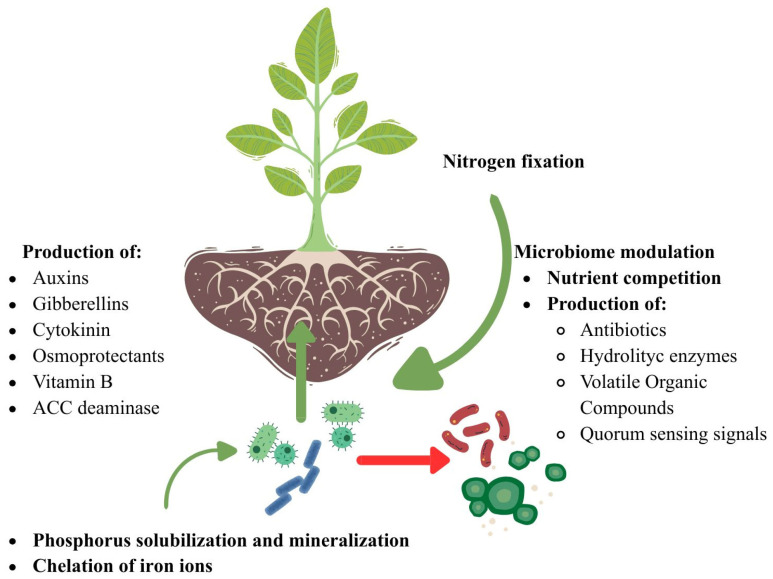
The impact of microorganisms on plants can be divided into direct and indirect actions. Indirect action involves regulating competition, producing antibiotics, hydrogen cyanide, or enzymes that degrade the cell walls of pathogenic fungi [ref. 22,ref. 24,ref. 25,ref. 26]. Direct action involves the production of siderophores, phytohormones such as indole-3-acetic acid, gibberellins and cytokinins, as well as nitrogen fixation and phosphorus solubilization [ref. 24,ref. 25,ref. 26,ref. 27]. Additionally, in response to environmental stress, microorganisms can produce compounds that prevent drought or frost. These actions are associated with both symbiotic plant bacteria and free-living soil bacteria associated with plant tissues (endophytes), as well as organisms living in the rhizosphere (Figure 1).
2.1.1. Atmospheric Nitrogen Fixation
Nitrogen, along with carbon and phosphorus, is the main nutrient. It is also the main component of the Earth’s atmosphere, accounting for 78%, but plants cannot bind it [ref. 26]. Some soil bacteria can process atmospheric nitrogen into forms available to plants [ref. 28,ref. 29,ref. 30]. These microorganisms occur as plant symbionts, e.g., Rhizobium spp. with legumes, or as free-living bacteria, e.g., Azotobacter spp., Azospirillum spp., Pseudomonas spp., and Bacillus spp. [ref. 30,ref. 31].
Nitrogen fixation is possible thanks to the action of the nitrogenase enzyme. This mechanism enables bacterial growth in nitrogen-poor environments. The nif genes encode the ability to produce the enzyme and its activity is conditioned by the presence of trace elements such as iron and molybdenum ions, anaerobic conditions, appropriate pH and energy [ref. 28,ref. 29]. The nitrogenase complex is highly sensitive to oxygen and nitrogen-fixing bacteria have defense strategies against excessive oxygen concentrations, such as the production of polymers or oxygen-scavenging proteins and the formation of biofilms [ref. 32]. The process itself is energy-intensive; the reduction of one nitrogen molecule requires the hydrolysis of 16 adenosine triphosphate (ATP) molecules [ref. 28,ref. 32].
Cannabis does not form a symbiotic relationship with nitrogen-fixing bacteria, but free-living microorganisms can have a positive impact on plant growth. A consortium of microorganisms has been shown to positively impact cannabis morphological characteristics as well as Soil-Plant Analysis Development (SPAD) values, which correlate with N content [ref. 33].
2.1.2. Phosphorus Solubilization
Phosphorus is an essential element, a component of basic chemical compounds such as deoxyribonucleic acid (DNA), ribonucleic acid (RNA), proteins and the energy carrier ATP. By regulating phosphorus metabolism, plants can respond to stress conditions. It occurs naturally in organic and mineral forms. Plants can take up soluble forms of phosphorus, such as orthophosphates. Organic forms, such as phytates, must first be mineralized, while mineral forms, such as apatite and calcium phosphate, must be solubilized. Soil pH is crucial; plant-available forms are present at pH 6.5–7.2. In alkaline soils, insoluble calcium and magnesium salts predominate, while, in acidic soils, iron and aluminum salts are inaccessible [ref. 34]. Fertilizers based on superphosphates and ammonium phosphates are used in agriculture. However, it is estimated that only 10–25% is absorbed by plants; the rest is washed away, causing soil contamination and water eutrophication [ref. 35].
The solubilization process is carried out by several soil microorganisms, including those from the following genera: Bacillus spp., Pseudomonas spp., Streptomyces spp., Aspergillus spp., Rhizobium spp., Fusarium spp., Trichoderma spp., Penicillium spp., Seratia spp., Acinetobacter spp., Agrobacterium spp. Arthrobacter spp., Burkholderia spp., and Rahnella spp. [ref. 34,ref. 36]. Several mechanisms are responsible for the ability of microorganisms to solubilize insoluble forms of phosphorus, the most important of which are the production of organic acids, the production of H2S, exopolysaccharides and siderophores [ref. 35]. The main mechanism is the production of organic acids such as gluconic acid, lactic acid, acetic acid, propionic acid, formic acid, malic acid and succinic acid [ref. 26,ref. 36,ref. 37,ref. 38]. These compounds chelate iron, calcium and aluminum ions in the soil, releasing phosphates into the soil [ref. 38]. Another mechanism involves the production of H2S by acidophilic sulfur-oxidizing bacteria, which can react with iron phosphate, producing iron sulfide and a phosphate group. Bacteria can also release protons into the environment, particularly when the nitrogen source is ammonium salts. During the conversion of NH4+ to NH3, H+ is released, leading to environmental acidification, which in turn affects the solubilization of insoluble phosphates. Another mechanism involves the production of exopolysaccharides, polymers composed of carbohydrate groups secreted outside the cell. These compounds participate in biofilm formation and can form complexes with soil metal ions, releasing their associated phosphorus reserves. Siderophores are low-molecular-weight compounds that strongly chelate iron, produced by both plants and bacteria. Binding iron ions allows plants to access phosphorus stored in the soil.
Phosphorus availability affects plant growth and development, including yield and chemical composition [ref. 39]. Studies by Contant et al. [ref. 40] demonstrated a positive effect of the Mammoth PTM bacterial consortium on bud yield and height of cannabis, while Vadhel et al. [ref. 41] demonstrated a positive effect of solubilizing bacteria on root and shoot length and cannabinoid content.
2.1.3. Production of Phytohormones
Soil bacteria can produce a range of phytohormones. Their importance is greatest in stressful situations such as drought, nutrient deprivation, salinity, or the presence of heavy metal ions. Microorganisms can synthesize auxins, cytokinins, gibberellins and 1-aminocyclopropane-1-carboxylate (ACC) deaminase [ref. 30,ref. 32,ref. 42].
The best-known phytohormone produced by soil microorganisms is indole-3-acetic acid. It promotes cell division and growth, as well as rooting and fruiting. It is estimated that 80% of microorganisms in the root zone can synthesize this compound. These include bacteria of the following genera: Acetobacter spp., Acinetobacter spp., Azospirillum spp., Arthrobacter spp., Azotobacter spp., Bacillus spp., Burkholderia spp., Peanibacillus spp., Pseudomonas spp., Rhizobium spp., Rhodococcus spp., Serratia spp., and Streptomyces spp. [ref. 43]. The hormone’s precursor is L-tryptophan [ref. 26,ref. 34,ref. 35,ref. 44,ref. 45].
Gibberellins, particularly gibberellic acid, are responsible for seed germination, shoot elongation, flowering and fruit set in plants [ref. 34]. These phytohormones include over 130 chemical compounds with diverse activities. There is evidence of gibberellin production by bacteria from the genera Achromobacter spp., Gluconobacter spp., Acinetobacter spp., Bacillus spp., Rhizobium spp., Azotobacter spp. and Azospirillum spp. [ref. 43].
Cytokinins are phytohormones whose precursor is adenine. They act in synergy with auxins, maintaining the balance between root and shoot growth, influencing cell division, organ formation and seed germination. They regulate nutrient transport and chlorophyll biosynthesis. Bacteria from the Agrobacterium spp., Bacillus spp., Methylobacterium spp., Bradhyrizobium spp. and Pseudomonas spp. groups can synthesize these phytohormones and are associated with the presence of the ipt gene, encoding the enzyme isopentenyltransferase (IPT) [ref. 43].
Ethylene is a gaseous plant hormone involved in regulating growth, development and plant stress responses. It plays an important role in fruit ripening, leaf shedding and response to drought or damage [ref. 26,ref. 43]. However, high ethylene concentrations can inhibit growth. The precursor of ethylene in plant cells is ACC—1-aminocyclopropane-1-carboxylic acid, which is converted to ethylene by ACC oxidase. Selected strains of soil bacteria possess the enzyme ACC deaminase, which degrades the precursor into alpha-ketobutyrate and ammonia, thereby reducing the potential for stress-causing ethylene formation while simultaneously providing the plant with nitrogen. This enzyme is present in selected strains of bacteria from the following genera: Pseudomonas spp., Serratia spp., Staphylococcus spp., Burkholderia spp., Bacillus spp. and Agrobacterium spp. [ref. 26,ref. 43].
2.1.4. Drought Prevention Measures
Prolonged drought causes a range of physiological, biochemical and molecular changes in plants. It inhibits plant growth and development, photosynthesis, phytohormone production and the transport of nutrients, micronutrients and macronutrients. Plants have their own mechanisms of response to drought: they close stomata, slow down photosynthesis, accumulate osmotic substances such as proline, glycine or betaine to retain water in the cell cytoplasm and secrete antioxidant substances to prevent the negative effects of free radicals [ref. 46].
Microorganisms possess several abilities that help mitigate the effects of drought. These mechanisms include the production of exopolysaccharides, which increase water retention and form a water-retaining coating around the root [ref. 46,ref. 47]. They also produce compounds with antioxidant properties, including enzymes peroxidase and catalase, which scavenge free radicals and prevent cell membrane degradation [ref. 30]. Their ability to produce phytohormones (indole-3-acetic acid), which helps plants develop strong root systems, is also important, as is ACC deaminase, which reduces the effects of ethylene [ref. 30,ref. 48]. Microorganisms can also produce osmoregulatory compounds, such as proline and trehalose, which help maintain water turgor and osmotic balance [ref. 46,ref. 49]. At the molecular level, bacteria activate plant genes responsible for drought response, such as dehydration-responsive element-binding (DREB), responsive to desiccation 29A (RD29A) and late embryogenesis abundant (LEA), which encode cell-stabilizing and osmoprotective proteins, as well as genes encoding antioxidant enzymes, including superoxide dismutase (SOD), catalase (CAT) and ascorbate peroxidase (APX) [ref. 46,ref. 50]. Microorganisms involved in the drought response include Bacillus spp., Pseudomonas spp., Rhizobium spp., Azospirillum spp. and Enterobacter spp.
2.1.5. Competition
Plants actively control the composition of the root zone microbiota through the substances they secrete, including attractants from selected groups. These microorganisms can inhibit microbial growth. Bacteria produce a range of chemical compounds, such as chitinases, cellulases, beta-1,3-glucanases, proteases and lipases, which can cause damage to cell walls and lead to cell lysis [ref. 50,ref. 51]. Bacteria of the Pseudomonas genus are capable of producing antibiotics, such as 2,4-diacetylphloroglucinol or phenazine-1-carboxylate, which inhibit fungal growth [ref. 44]. Selected strains of Bacillus spp. bacteria produce surfactants, such as surfactin or iturins, which affect the cell membranes of bacteria and fungi [ref. 37,ref. 45,ref. 52]. Bacteriocins, unlike antibiotics, which act on a narrower spectrum, are also important in competition for lower ecological status. Siderophores also play an indirect role, limiting the availability of iron to potentially pathogenic organisms [ref. 42,ref. 53,ref. 54]. For plant growth-promoting bacteria, antagonistic effects have been reported against fungi such as Botrytis spp., Fusarium spp., Sclerotium spp. and Phytophthora spp. [ref. 55].
2.2. The Effect of Bacteria on Cannabis Sativa
2.2.1. Culture-Based Studies on Bacterial Effects on Cannabis sativa spp.
Between 2020 and 2026, the impact of microorganisms and their consortia on Cannabis spp. was repeatedly analyzed. Studies considered plant growth parameters such as height, dry and fresh tissue weight, as well as the impact on germination and chemical parameters, including THC and cannabinoid content, polyphenol content and antioxidant properties. These studies used bacterial isolates with previously documented growth-promoting effects, isolates from hemp seeds or tissues, or commercial preparations (Table 1).
Table 1: The effect of microorganisms on Cannabis sativa spp. shown in publications from 2020 to 2026. ↑ indicates a significant increase in the parameter value, ↓ indicates a significant decrease in the parameter value.
| Country | Variety | Microorganism Tested | Place of Isolation | Effect on the Plant | Source |
|---|---|---|---|---|---|
| Canada(vase tests) | Fibrous variety:Anka | Pseudomonas fluorescens LBUM223; Pseudomonas protegens LBUM825; Bacillus velezensis LBUM279; Bacillus subtilis LBUM979; Bacillus siamensis LBUM1082 | Own collection | ↑ total plant dry matter | [ref. 56] |
| Greece(vase tests) | Fibrous variety:USO 31 | Rhizophagus irregularis | Commercial productMycoPlant® Polvo Grow | ↑ root length↑ dry shoot mass↑ total dry matter | [ref. 57] |
| Greece(vase tests) | Fibrous varieties:Felina; Fedora 17 | Trichoderma harzianum | Commercial product Trianum-P | ↑ root density↑ height and dry weight↑ number and fresh weight of buds | [ref. 58] |
| Italy(vase tests) | Oil variety:Finola | Azospirillum brasilense ATCC 29710; Gluconacetobacter diazotrophicus ATCC49037; Herbaspirillum seropedicae ATCC 35892; Burkholderia ambifaria PHP7 | Own collection | ↑ germination efficiency of plants infected with Fusarium oxysporum↑ shoot and root length | [ref. 59] |
| Italy(in vitro tests) | Fibrous variety:Futura 75 | Sphingomonas spp. | Endophytes of seeds and seedlings | ↑polyphenol content↑antioxidant activity | [ref. 60] |
| Thailand(vase tests) | Research variety:KKU05 | Rhizophagus prolifer PC2-2Rhizophagus aggregatus BM-3 g3 | Own collection | ↑ height of the above-ground part, leaf area, number of branches, number of inflorescences.↑ dry weight of leaf, stem and inflorescence.↑ root length, surface area and dry weight↑ CBD and THC content | [ref. 61] |
| Mexico(in vitro tests) | Medical variety:Mango Elite Plus | Bacillus spp. | Hemp root zone isolates | ↑ germination efficiency↑ sprout root length | [ref. 62] |
| Canada(vase tests) | Medical variety: CBD Kush | Bacillus spp.; Mucilaginibacter spp.; Pseudomonas spp. | Own collection | ↑ dry mass of inflorescences↑ THC and CBD content↑ total terpene content↑ stem dry weight | [ref. 63] |
| Morocco(vase tests) | Medical varieties:Therapy; Euphoria; Critical; CBD Sweet and Sour Widow; CBD US | Rhizophagus irregularisTrichoderma harzianum; Bacillus subtilis;Dictyosphaerium chlorelloides; Rhizopus irregularis DAOM 197198 | Commercial product Ferticann; own collection | ↑ inflorescence biomass↑ plant height↑ content of selected phytocannabinoids in selected hemp varieties | [ref. 64] |
| Austria(field tests) | Fibrous variety:Eletta Campana | Pseudomonas frigotolerans C1141; Serratia plymuthica RR2-5–10; Pseudomonas putida;Pseduomonas spp.; Bacillus spp. | Seed endophytes | ↑ germination efficiency↑ development of secondary roots↑ plant biomass, root length and seedling shoot length↑ stem height and thickness | [ref. 65] |
| Thailand(vase tests) | Medical variety:Foi Thong Suranaree 1 | Bacillus velezensis S141 | Soybean rhizosphere | ↑ dry mass of the plant, including stem, leaves, roots↑ chlorophyll content | [ref. 66] |
| Mexico(aquaponic tests) | Hybrid variety:Belmont | Pseduomonsa fluorescencs, Trichoderma harzianum, Trichoderma viride, Trichoderma reesei | Commercial product Micorrizas | ↑ length of the root and above-ground part↑ root and aboveground biomass↑ phenol and flavonoid content | [ref. 67] |
| Thailand(vase tests) | Medical variety: Foi Thong Suranaree 1 | Rhizobium dioscoreae; Pantoea dispersa; Paenibacillus azoreducens; Enterobacter cloacae; Acinetobacter johnsonii; Burkholderia cepacia;Pseudomonas spp. | Endophytes of Cannabis sativa spp. (root, leaf, stem) | ↑ root and shoot growth of the plant↑ dry mass of shoot and plant↑ height and dry weight of the plant. | [ref. 68] |
| Netherlands(aquaponic tests) | Medical varieties: Amnesia Haze; Gorilla glue | Bacillus spp.; Pseudomonas spp.;Flavobacterium spp.; Burkholderia spp. | Own collection | ↑ CBGA content↓ THC content | [ref. 69] |
An important mechanism that increases the effectiveness of inoculation is the interaction among various microorganisms. Comeau et al. [ref. 56] analyzed the effect of bacteria from the genera Bacillus (B. subtilis LBUM979, B. siamensis LBUM1082, and B. velezensis LBUM279) and Pseudomonas (P. fluorescens LBUM223 and P. protegens LBUM825) isolated from the root zone of Fragaria ananassa. A pot experiment conducted on the “Anka” cannabis cultivar showed that single strains did not significantly affect the dry weight of aboveground and underground plant parts, whereas bacterial combinations significantly increased biomass. In Promix medium, plant weight increased by approximately 30% for the LBUM223/979, LBUM223/1082 and LBUM825/979 pairs. A similar effect was observed in Canna Coco medium. Importantly, a double dose of a single Pseudomonas strain did not cause significant changes, whereas a high dose of Bacillus negatively affected plant vigor. These results indicate that microbial synergy, not just their concentration, is crucial. A similar approach was used in aquaponic systems. Marin-Campos et al. [ref. 67] studied a formulation containing Pseudomonas fluorescens, Trichoderma harzianum, T. viride and T. reesei. They demonstrated that the optimal inoculant dose (6.67 × 10⁴ CFU/L) increased plant height, stem and root diameter and leaf and stem biomass. This increase in biomass was also accompanied by an increase in flavonoid content. The authors attribute these effects to the production of growth regulators, siderophores and hydrolytic enzymes that increase the availability of mineral nutrients.
One of the most frequently described mechanisms of microbial action is improving nutrient availability through mineral solubilization, metal ion chelating and increasing the absorptive surface area of the root system. Research by Kakabouki et al. [ref. 57,ref. 58] showed that inoculation of hemp with preparations containing Rhizopus irregularis and Trichoderma harzianum led to increased root length, plant height and dry biomass. These effects were attributed to the microorganisms’ ability to solubilize elements such as Fe, Mn, Zn and P and to produce phytohormones, including indole-3-acetic acid and gibberellins. The extensive mycelial network also increased the absorptive surface area of the root system, improving plant water management. A similar phenomenon was observed with mycorrhizal fungi of the genus Rhizophagus. Seemakram et al. [ref. 61] demonstrated that inoculation with the Rhizophagus aggregatus BM-3 g3 strain significantly increased morphometric parameters of cannabis, including plant height, leaf area and dry weight of stems, leaves and inflorescences. Inoculation also influenced secondary metabolism, increasing CBD and THC content.
In addition to influencing plant growth, microorganisms can modulate the biosynthesis of secondary metabolites, including cannabinoids and terpenes. Ahmed et al. [ref. 64] demonstrated that the use of Ferticann, containing Rhizopus irregularis, Trichoderma harzianum and Bacillus subtilis, among others, resulted in changes in the cannabinoid composition of various medical cannabis varieties. Depending on the variety, changes in the content of cannabidivarin (CBDV), cannabigerol (CBG), cannabigerolic acid (CBGA) and tetrahydrocannabinolic acid (THCA) were observed. Similar observations were made by Lyu et al. [ref. 63], who studied the effects of bacteria from the genera Bacillus, Pseudomonas and Mucilaginibacter. Inoculation increased plant biomass and the number of flower buds and influenced the secondary metabolite profile. Mucilaginibacter increased cannabinoid and terpene content, while Pseudomonas primarily affected inflorescence yield. The influence of microorganisms on secondary metabolism has also been demonstrated in aquaponic systems. Tonolo et al. [ref. 69] found that inoculation with bacteria from the genera Bacillus spp., Pseudomonas spp., Flavobacterium spp. and Burkholderia spp. did not significantly affect plant morphology but increased CBGA content and reduced THCA.
Seed-associated endophytes are a significant source of microorganisms supporting hemp development. Gabriel et al. [ref. 60] isolated 36 bacteria from seeds and seedlings of the Futura 75 cultivar. One strain, belonging to the genus Sphingomonas, did not significantly affect seedling morphometric parameters but increased the content of polyphenols and compounds with antioxidant activity. Studies on seed microbiota also indicate the potential of bacteria from the genus Bacillus. Lobato et al. [ref. 65] demonstrated that the endophytic strain Bacillus frigoritolerans increased the yield of the fiber hemp cultivar Eletta Campana under field conditions by up to threefold compared to the control.
Rhizosphere microorganisms can also limit the development of plant pathogens by producing antifungal metabolites. Pellegrini et al. [ref. 59] demonstrated that a consortium of Azospirillum brasilense, Gluconacetobacter diazotrophicus, Herbaspirillum seropedicae and Burkholderia ambifaria inhibited the growth of Fusarium oxysporum by approximately 70% in in vitro assays. In pot experiments, the consortium increased the survival of infected plants by up to 85%, compared to 42% in the control group. This mechanism is associated with the production of antifungal metabolites such as pyrrolnitrin and burkholdins, as well as volatile sulfur compounds. Similar properties are observed in bacteria of the genus Bacillus, which produce a wide range of bioactive compounds, including siderophores, bacteriocins, lytic enzymes and volatile organic compounds. Corredor-Perilla et al. [ref. 62] demonstrated that Bacillus spp. isolates from the hemp rhizosphere could simultaneously stimulate seed germination and inhibit the development of Fusarium oxysporum. Some strains increased germination efficiency from 60% in the control group to 100%.
Bacteria of the genera Bacillus and Pseudomonas are characterized by their ability to colonize the root system rapidly and, in some cases, other plant tissues. Aunkam et al. [ref. 66] demonstrated that the Bacillus velezensis S141 strain colonized not only cannabis roots but also stems and leaves. Inoculation increased plant dry weight and chlorophyll content.
Research on the Cannabis rhizosphere microbiome also indicates the potential of other plant growth-promoting bacteria, such as Burkholderia cepacia or Rhizobium scorae, which increased plant biomass by up to 62–64% in pot experiments [ref. 68].
2.2.2. Microbiota Studies Using Molecular Methods
Due to the difficulties of isolating and culturing many microorganisms under laboratory conditions, molecular methods based on DNA amplification and sequencing are now widely used to characterize the plant microbiome. These techniques also enable the identification of microorganisms that do not grow on standard microbiological media, thus enabling a much more comprehensive understanding of the microbiological structure of the studied environment. Numerous studies describing the qualitative and quantitative composition of microorganisms associated with Cannabis sativa spp. have been published in recent years (Table 2).
Table 2: Research on the microbiota of Cannabis sativa spp. using molecular methods from 2020 to 2026. OTU—operational taxonomic unit; bASV—bacterial amplicon sequence variant; ASV—amplicon sequence variant.
| Country | Variety | Type of Analysis | Bacteria | Author |
|---|---|---|---|---|
| China | Industrial variety | Analysis of the microbiome composition at different stages of cannabis development | Alphaproteobacteria (20.64–35.44%); Acidobacteria_ Gp4 (6.81–8.57%); Actinobacteria (4.14–13.89%); Sphingobacteria (6.67–8.22%); Betaproteobacteria (5.62–6.32%); Gammaproteobacteria (4.80–6.37%); Cytophagia (3.18–4.38%); Gemmatimonadetes (3.07–3.61%) | [ref. 70] |
| Canada | Suver Hase diploid | Analysis of microbiome composition depending on ploidy | Bacillus; Streptomyces; Klebsiella; Pseudomonas; Enterobacter; Aeromonas; Mycoplasma; Micromonospora; Mucilaginibacter; Ruficoccus; Staphylococcus; Burkholderia; Mycolicibacterium; Erwinia; Bilophila; Streptococcus; Agrobacterium; Alteromonas; Sphingomonas; Corynebacterium; Actinomycetes; Pantoea; Leclercia | [ref. 71] |
| Suver Haze triploid | Bacillus; Enterobacter; Klebsiella; Agrobacterium | |||
| Austria | 52 varieties from around the world | Analysis of seed endophyte composition using breeding and molecular methods | Gammaproteobacteria; Alphaproteobacteria; Bacilli; Actinobacteria; Bacteroidia | [ref. 72] |
| USA | Anka | Molecular analysis of microorganisms from selected plant tissues (leaf, root, flower) and soil microbiome core designation | 8913 bacterial OTUs; Core: Comamonadaceae; Massilia; Aquabacterium; Rhizobium; Pseudomonas; Sphingomonas; Methylobacterium; Hymenobacter; Microbacteriaceae; Bacillus cereus; Ralstonia; Bacillus; Bradyrhizobium | [ref. 73] |
| China | GansuqingshuiYunnan No. 1Yunmaza No. 1Huoma No. 1 | Microbiome analysis, considering plant parts | Proteobacteria (67.26%); Cyanobacteria (14.40%); Firmicutes (8.07%); Actinobacteria (4.93%); Bacteroidetes (1.49%)Genus: Rhizobium (16.85%); Pseudomonas (3.14%), Planococcusb (1.99%), Bacillus (1.73%), Sphingomonas (1.34%) | [ref. 74] |
| Thailand | Foi Thong Suranaree 1 | Analysis of the endophyte microbiome from selected parts of hemp plants, considering growth conditions: field and pot tests | Proteobacteria 85.18%; Firmicutes (7.41%); Actinobacteriota (3.7%); Myxococcota (3.7%) | [ref. 68] |
| Canada | Anka | Analysis of the impact of selected PGPB, considering changes in biodiversity | Proteobacteria; Actinobacteriota; Bacteroidota; Planctomycetota; Verrucomicrobia; Acidobacteriota | [ref. 56] |
| Canada | CBD YummyCBD SharkHash | Analysis of the microbiome composition by cannabis chemotype and development stage | Proteobacteria; Actinobacteria; Bacteroidetes; Verrucomicrobia; Chloroflexi; Planctomycetes; Acidobacteria; Armatimonadetes; WPS-2; Patescibacteria; FCPU426; Fibrobacteres; Gemmatimonadetess; Firmicutes; Dependentiae; Spirochaetes; Hydrogenedentes | [ref. 75] |
| Austria | 40 varieties with varying degrees of domestication | Analysis of seed endophyte composition considering the degree of domestication | Core bacteria: Sphingomonas; Pelomonas; Ralstonia; Burkholderia; Bacillus; Staphylococcus; Pseudomonas; Enhydrobacter; Kosakonia | [ref. 65] |
| China | Industrial variety of Cannabis sativa | Analysis of soil microbial diversity in crops with different rotation systems over 3 years. Monoculture system and watermelon, potato and bean rotation | Proteobacteria 28.4–34.4%; Acidobacteria 19.4–23.2%; Bacteroidetes 10.3–12.9%Verrucomicrobia; Actinobacteria; Planctomycetes; Gemmatimonadetes; Chloroflexi; Candidatus Saccharibacteria; Firmicutes Nitrospirae; Cyanobacteria | [ref. 76] |
| USA | Tangerine | Analysis of soil and selected plant tissues to determine the microbiological composition | 2170 bASVs root zone soil342 bASVs leaves; 181 bASVs buds; 1141 bASVs root | [ref. 77] |
| Morocco | Medical Strains: Therapy; Euphoria, Critical; CBD Sweet and Sour Widow; CBD US | Analysis of the effect of microbial inoculation on the growth and production of secondary metabolites and the impact on the root zone microbiota. | 5931 bacterial ASVsCandidatus Kaiserbacteria; Caulobacterales; Chthoniobacterales; Gemmatales; Planctomycetales; Rhizobiales; Saccharimonadales; Sphingomondales; Streptomycetales; Tepidispharales | [ref. 78] |
One factor significantly shaping the structure of the cannabis microbiome is the plant’s developmental stage. Research by Guo et al. [ref. 70] demonstrated significant changes in the abundance and diversity of soil bacteria during plant ontogeny. The highest abundance of microorganisms was observed at the seedling stage, then declined during the intensive growth and flowering phases, and rebounded during plant maturation. Species diversity, as measured by the Shannon index, exhibited a different dynamic, with the highest values during the seedling and flowering phases and the lowest during maturation. The authors suggest that the dominance of rapidly growing bacteria in the initial and final stages of development may be related to their ability to utilize plant debris as a nutrient source effectively. Simultaneously, the reduction in microorganism abundance during intensive plant growth may be linked to the action of compounds secreted by roots that modulate the composition of the rhizosphere microbiota [ref. 70]. Similar observations regarding microbiome variability during plant development were presented by Comeau et al. [ref. 75], who demonstrated that the Shannon index increases until the prevegetative phase, then stabilizes in subsequent growth stages. As plants develop, the share of dominant taxa also changes, with the proportion of Proteobacteria gradually decreasing in favor of Actinobacteria. The authors also indicate that microbiome variability is more strongly associated with the plant development stage than with its genotype [ref. 75].
Another important factor determining the structure of the microbiome is the type of plant tissue. Metagenomic analyses show a clear gradation in microbial diversity between individual plant organs. In a study by Willman et al. [ref. 77], covering soil, roots, leaves and flower buds of the Tangerine cultivar, the highest number of bacterial amplicon variants (bASVs) was found in soil (2170 bASVs), followed by roots (1141 bASVs) and leaves (342 bASVs), and the lowest in flower buds (181 bASVs). In above-ground tissues, Gammaproteobacteria and Alphaproteobacteria dominated, while, in roots, in addition to Gammaproteobacteria, Bacteroidia and Actinobacteria were also abundant. In soil, the dominant groups were Alphaproteobacteria, Gammaproteobacteria and Deltaproteobacteria [ref. 77]. Similar relationships were noted in a study by Greetatorn et al. [ref. 68], which analyzed the microbiome of various plant parts of the medicinal cultivar Foi Thong Suranaree 1. The highest biodiversity was found in the soil of the plant root zone grown in the field, while the lowest was found in the aboveground tissues. In the buds of field-grown plants, Gammaproteobacteria (93.02%), Alphaproteobacteria (4.08%), and Bacilli (1.91%) dominated, whereas, in greenhouse conditions, Gammaproteobacteria accounted for almost all endophytes in leaves and buds. The greatest diversity in bacterial composition was observed in the roots of plants grown in the soil, where Gammaproteobacteria (83.56%) and Alphaproteobacteria (13.35%) dominated. The composition of the root microbiome differed significantly from that of pot-grown plants, where Actinobacteria (57.92%) and Gammaproteobacteria (40.17%) dominated [ref. 68]. A similar microbiome structure was described by Barnett et al. [ref. 73], who demonstrated the dominance of Actinobacteria, Gammaproteobacteria and Betaproteobacteria in the root tissues of the Anka cannabis cultivar. At the same time, Alphaproteobacteria dominated in the leaves and Firmicutes and Gammaproteobacteria in the flowers. The authors also indicate that some microorganisms abundant in plant tissues do not dominate in soil, suggesting that plants may selectively promote specific taxa [ref. 73].
Bacterial colonization also plays a significant role in shaping the plant microbiome. Analyses conducted by Wei et al. [ref. 74] showed that the highest microbial diversity was found in the root endosphere and rhizosphere soil, while the lowest was found in above-ground tissues such as flowers, stems and leaves. Bacteria from the phyla Proteobacteria, Actinobacteria and Bacteroidetes dominated in the soil and root endosphere, while Cyanobacteria and Firmicutes were more common in flowers. Analyses of colonization sources indicated that 53.32% of the bacteria present in the rhizosphere originated directly from the soil and nearly half of the root endophytes originated from the rhizosphere microbiota. Furthermore, as many as 86.04% of the bacteria present in flowers were taxa previously present in leaves, suggesting gradual migration of microorganisms within the plant [ref. 74].
Genetic factors, such as genotype, degree of domestication and ploidy also influence plant microbiome composition. Srivastava et al. [ref. 71] demonstrated significant differences in microbial biodiversity between diploid and triploid Suver Haze plants, with Shannon–Weiner indices of 2.65 and 0.53, respectively. Reductions in microbiome diversity with increasing ploidy are also observed in other plant species. Lobato et al. [ref. 65] demonstrated that cannabis genotype accounts for 53.6% of the variability in seed bacterial microbiome composition, while degree of domestication and chemotype explain 9.66% and 6.14% of this variability, respectively. The highest microbial biodiversity was found in the least domesticated cultivars and the lowest in inbred lines. In the case of the latter, a strong simplification of the microbiome structure was observed, with Pantoea agglomerans being the dominant species, constituting over 80% of the seed microbiota [ref. 72]. Analysis of the core microbiome revealed several bacteria in most of the studied samples, including Pelomonas, Ralstonia, Burkholderia spp., Pseudomonas spp., Enhydrobacter, and Rhodococcus erythropolis.
Seed microbiome studies also revealed significant differences between the cultivated and uncultivated fractions of microorganisms. The cultivated fraction accounted for only 6.3% of all detected amplicon variants but as much as 89.2% of the total microbial population. It was dominated by rapidly growing bacteria from the genera Pantoea, Bacillus and Pseudomonas. The uncultivated fraction, in turn, included numerous rare taxa, often phylogenetically distant from the cultivated bacteria, which likely function in complex networks of metabolic interdependencies, making their isolation in the laboratory difficult [ref. 72].
Environmental and agrotechnical factors, including substrate type and cultivation system also influence the structure of the cannabis microbiome. Research by Comeau et al. [ref. 56] showed that commercial Canna coco and Promix substrates are dominated by bacteria belonging to the phyla Proteobacteria, Actinobacteriota, Bacteroidota, Planctomycetota, Verrucomicrobiota and Acidobacteriota. Still, their quantitative share differs between the soil and the rhizosphere. The rhizosphere showed higher alpha diversity than the non-root-associated soil. The introduction of Bacillus spp. primarily influenced changes in the beta diversity of the microbiome, particularly in Promix [ref. 56]. Similarly, B. Ahmed et al. [ref. 64] showed that inoculation of plants with microbiological preparations leads to changes in the structure of the rhizosphere microbiome, increasing the share of bacteria with plant growth-promoting potential, such as Streptomyces spp., Rhizobium spp., Bradyrhizobium spp., and Mesorhizobium spp.
Cropping systems also significantly impact the structure of the soil microbiome. Tang et al. [ref. 76] demonstrated that monoculture systems exhibit significantly lower soil microbial biodiversity than rotational systems. Crop rotation favored the development of potentially beneficial bacteria, including Actinobacteria spp., Pseudomonas spp., Rhizobium spp., Flavobacterium spp. and Nitrospira spp., which may play an important role in soil ecosystem functioning and plant growth [ref. 56].
2.2.3. Negative Effects of Bacteria
Microorganisms isolated from the cannabis rhizosphere or other plant species, despite possessing plant growth-promoting traits, may not always exert beneficial effects and, in some cases, can negatively affect plant development. Examples include bacteria belonging to the genera Agrobacterium and Pseudomonas, which are capable of phytohormone production and phosphate solubilization, while simultaneously inducing pathological symptoms such as root gall formation and blight in hemp plants [ref. 79].
Several studies have also demonstrated that potentially beneficial bacteria can have adverse effects on seed germination and seedling development. Gabriele et al. [ref. 60] reported that inoculation with Sphingomonas spp. negatively affected seed germination and seedling morphometric traits, while simultaneously increasing polyphenol content and antioxidant activity. Similar observations were reported by Corredor et al. [ref. 62], where selected Bacillus spp. strains or bacterial consortia reduced germination rates by 30–90% and markedly inhibited seedling elongation.
The effects of bacterial inoculation are also strongly dose-dependent. Pagnani et al. [ref. 33] evaluated the influence of a bacterial consortium applied at concentrations of 106 CFU/mL and 107 CFU/mL. Plants inoculated with the lower dose exhibited greater stem length, dry biomass accumulation, and SPAD values than those treated with the higher concentration. Likewise, Aunkam et al. [ref. 66] demonstrated that the optimal concentration of Bacillus velezensis S141 was 106 CFU/mL, whereas inoculation with 104 CFU/mL did not significantly improve SPAD values or the dry biomass of roots, leaves, and stems. Marin-Campos et al. [ref. 67] similarly showed that inoculum concentration plays a critical role in determining plant responses. In their study, the commercial preparation “Micorrizas,” consisting of Pseudomonas fluorescens and Trichoderma spp., improved morphometric parameters at 104 CFU/mL, whereas a concentration of 105 CFU/mL negatively affected root length and antioxidant compound content.
Dose-dependent effects have also been observed in other plant species—for example, Tariq et al. [ref. 80] demonstrated that, among inoculation levels of 106, 107, and 108 CFU/mL of Bacillus spp., the concentration of 107 CFU/mL produced the greatest improvement in soybean seed germination. Importantly, only two of the three tested strains exerted significant positive effects, while one did not significantly influence germination.
2.2.4. Research Gaps and Limitations
Until recently, legislative restrictions associated with hemp cultivation, particularly strict limits on tetrahydrocannabinol (THC) content, substantially limited both agricultural and scientific interest in cannabis cultivation. Industrial hemp production was associated with economic and legal risks, as environmental stressors such as drought or intense solar radiation could increase THC concentrations above the permitted threshold. This uncertainty negatively affected the attractiveness of hemp cultivation and hindered the establishment of large-scale experimental studies.
A major turning point occurred in 2018 in the United States, when hemp containing less than 0.3% THC was removed from the Controlled Substances Act. Similar regulatory changes were implemented in the European Union, where the THC threshold for industrial hemp was increased from 0.2% to 0.3% in 2020 as part of the reform of the Common Agricultural Policy (CAP). Simultaneously, the rapid expansion of the cannabidiol (CBD) market increased the industrial and commercial relevance of Cannabis spp., stimulating interest among both growers and researchers. These regulatory changes also facilitated access to certified plant material and simplified the approval process for experimental cultivation.
Recent studies have demonstrated that numerous interacting factors shape the cannabis microbiome. The extensive diversity of cultivars, genotypes, and chemotypes and the cosmopolitan nature of Cannabis spp. creates substantial knowledge gaps regarding microbiome composition across different varieties and geographic regions. Consequently, several fundamental questions remain unresolved. For example, it is still unclear whether a conserved “core microbiome” exists across genetically and chemically distinct cannabis cultivars. In addition, the mechanisms responsible for microbiome assembly remain poorly understood. The contribution of vertically transmitted microorganisms and their role in shaping root-associated and rhizosphere microbial communities has not yet been fully elucidated.
Current research has focused predominantly on seed- and rhizosphere-associated microbiomes, whereas microbial communities inhabiting inflorescences and trichomes remain poorly characterized. Their potential role in regulating secondary metabolite biosynthesis is also largely unknown. Similarly, the effects of microorganisms on cannabinoid, terpene, and polyphenol production remain insufficiently understood. Available evidence suggests strong strain- and genotype-dependent interactions, which may result in either increases or decreases in THC and CBD concentrations. An important unresolved issue is the relative contribution of environmental stress and microbial activity to these metabolic shifts, as well as the extent to which these factors interact synergistically.
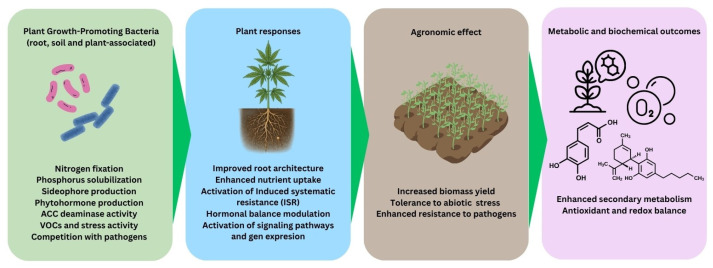
The mechanisms through which bacteria positively influence plant growth and development are relatively well characterized in cereals and other economically important crops. Processes such as phytohormone production, induced systemic resistance (ISR), and enhanced nutrient availability have been described not only at the phenotypic level but also in considerable molecular detail. Although several studies have reported beneficial effects of microorganisms on plant growth and secondary metabolite production in Cannabis sativa, many proposed mechanisms remain hypothetical. In particular, processes such as ISR induction or microbial modulation of pathways involved in THC and CBD biosynthesis still require validation at the molecular level. A proposed schematic model of microbial interactions affecting cannabis growth and metabolism is presented in Figure 2.
Current studies are focused primarily on metagenomic analyses, which enable taxonomic characterization of the cannabis-associated microbiome. However, understanding the mechanisms underlying plant–microorganism interactions requires integrating comprehensive multi-omics approaches. Metabolomic analyses are necessary to identify the chemical compounds involved in bidirectional plant–microbe interactions, whereas metatranscriptomic approaches may reveal mechanisms operating at the level of gene expression and provide insight into the activation of specific metabolic pathways. The integration of taxonomic, molecular, and chemical datasets with morphometric traits and secondary metabolite profiles could substantially improve our understanding of the relationships between the microbiome and Cannabis spp.
Another major research gap is the limited number of long-term field-scale studies. Current experiments are conducted under highly diverse cultivation systems, including pot, field, aquaponic, and hydroponic conditions. From both ecological and applied perspectives, field experiments most accurately reflect real agricultural environments. Such studies allow the investigation of interactions with native environmental microbiomes, including microbial competition, root-associated effects, and the influence of microorganisms on the chemical composition of Cannabis spp., including secondary metabolite production. However, field experiments are also associated with high levels of environmental variability. Factors such as temperature, humidity, solar radiation, and soil composition cannot be fully controlled and may substantially influence experimental outcomes. Consequently, obtaining reliable and reproducible results requires multi-location trials with sufficient biological replication. There is also a strong need for long-term, multi-season studies capable of minimizing the influence of seasonal variability. Such approaches require appropriate infrastructure and substantially increase the duration and cost of research.
An additional limitation arises from the lack of methodological standardization in studies investigating microorganisms associated with Cannabis sativa. Current research is based predominantly on sequencing of 16S rRNA gene regions and the fungal ITS region. However, studies differ considerably in methodologies related to sample collection, preparation procedures, seed or root surface sterilization, DNA extraction protocols, and bioinformatic pipelines. These methodological inconsistencies complicate direct comparisons among studies currently being conducted worldwide.
3. Search Strategy and Selection Criteria
This study included a review of papers on the Cannabis sativa spp. microbiome. The search was conducted using the following tools: Science Direct, Scopus, MDPI, Google Scholar, Research Gate and other sources. It focused on original papers, scientific articles, monographs, reports, conference proceedings and short communications. Search keywords included: hemp, plant growth-promoting bacteria, hemp microbiome, plant–microbiome interactions, cannabidiol, microbial diversity, industrial hemp, endophytes and cannabis microbiota. Two hundred and twelve scientific papers were identified, all in English. Seventy-five percent of these were published between 2020 and 2026. The publications were then assessed for their analyses of the impact of microorganisms on the plant and for studies using classical culture techniques and molecular techniques to determine the composition, quality and quantity of Cannabis spp. microbiota. The impact of microorganisms on Cannabis spp. was analyzed by assessing changes in morphometric parameters and secondary metabolite content.
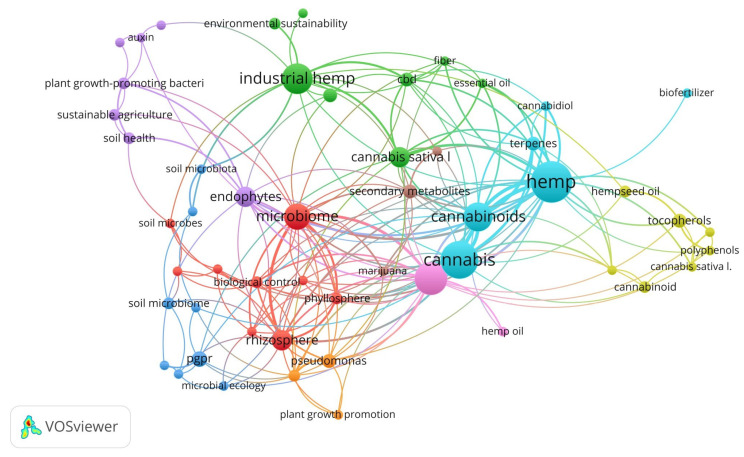
The publication set was analyzed using VOSviewer version 1.6.20, which grouped keywords by frequency. The minimum number of co-occurrences was set at 3. The size of the circles obtained from the analysis is proportional to the frequency of occurrence (Figure 3).
Based on the obtained map of keyword connections, a summary specifying the publication date was then created (Figure 4).
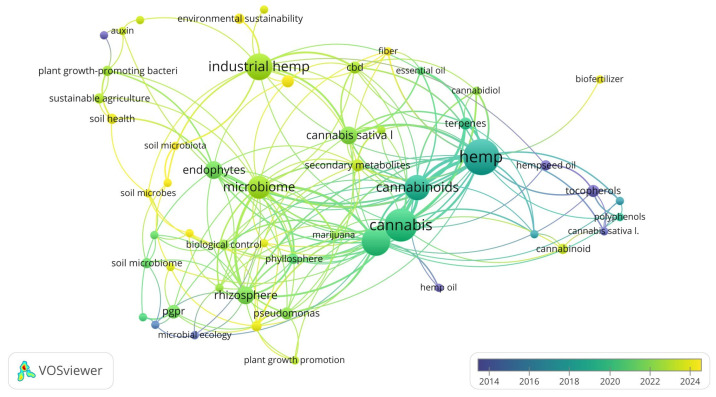
As a result of the analysis, 53 keywords were obtained, of which the most frequently occurring were hemp (25), Cannabis (22), Cannabis sativa (18), industrial hemp (16), cannabinoids (15), microbiome (13), rhizosphere (9), and endophytes (9).
4. Summary and Future Perspectives
Research conducted in recent years confirms that the composition of the cannabis microbiome is determined by both environmental factors and the plant’s genotype. The use of molecular methods significantly expands our knowledge of Cannabis sativa spp.-related microorganisms, indicating the presence of bacteria whose growth on media in laboratory conditions is impossible due to the network of interactions between microorganisms, specific culture conditions or slow growth.
Molecular analyses indicate the dominance of Proteobacteria, Actinobacteria, Firmicutes and Bacteroidota, while the share of individual microbial groups differs between industrial and medical varieties, and differences in composition also occur across tissues, indicating distinct colonization strategies and distinct roles.
Scientific reports also indicate plant–microorganism interactions, where cannabis of different genotypes can shape the microbial composition associated with the rhizosphere. Microorganisms, in turn, may influence the production of secondary metabolites in Cannabis sativa spp., but this effect is cultivar-specific and the mechanism remains to be further researched.
Bacillus, Pseudomonas, Rhizobium, Burkholderia, Mucilaginibacter and Serratia are also significant plant growth promoters in Cannabis. Their ability to increase biomass, improve germination, modulate the root system and exert antipathogenic effects has been noted. Multistrain inoculants, in many cases, demonstrated higher efficacy than single strains, confirming the complexity of interactions between microorganisms and the plant.
Future research should combine analysis of the cannabis genotype and chemotype with characterization of the microbiome and assessment of its biological functions. It is also important to determine the relationship between biodiversity levels and the functional stability of the agroecosystem. Furthermore, a combination of omics sciences should be employed to understand the impact of microorganisms on secondary metabolite biosynthesis pathways. Given the changes in agriculture, future research should also focus on developing effective growth-promoting formulations based on microorganisms as alternatives to chemical agents.
References
- H.-L. Li. An Archaeological and Historical Account of Cannabis in China. Econ. Bot., 1974. [DOI]
- J.M. McPartland. Cannabis Systematics at the Levels of Family, Genus, and Species. Cannabis Cannabinoid Res., 2018. [DOI | PubMed]
- M. Ren, Z. Tang, X. Wu, R. Spengler, H. Jiang, Y. Yang, N. Boivin. The Origins of Cannabis Smoking: Chemical Residue Evidence from the First Millennium BCE in the Pamirs. Sci. Adv., 2019. [DOI | PubMed]
- P. Kittel, B. Muzolf, M. Płóciennik, S. Elias, S.J. Brooks, M. Lutyńska, D. Pawłowski, R. Stachowicz-Rybka, A. Wacnik, D. Okupny. A Multi-Proxy Reconstruction from Lutomiersk-Koziówki, Central Poland, in the Context of Early Modern Hemp and Flax Processing. J. Archaeol. Sci., 2014. [DOI]
- G. Skoglund, M. Nockert, B. Holst. Viking and Early Middle Ages Northern Scandinavian Textiles Proven to Be Made with Hemp. Sci. Rep., 2013. [DOI | PubMed]
- F.T. Avoseh, F.M. Mtunzi, O.N. Avoseh, S. Takaidza. Cannabis sativa; Ethnobotanicals, Classifications, Pharmacology, and Phytochemistry. Nat. Prod. Commun., 2025. [DOI]
- Regulation (EU) 2021/2115 of the European Parliament and of the Council of 2 December 2021 Establishing Rules on Support for Strategic Plans to Be Drawn up by Member States under the Common Agricultural Policy (CAP Strategic Plans) and financed by the European Agricultural Guarantee Fund (EAGF) and by the European Agricultural Fund for Rural Development (EAFRD) and Repealing Regulations (EU) No 1305/2013 and (EU) No 1307/2013. Off. J. Eur. Union, 2021
- M. Zimniewska. Hemp Fibre Properties and Processing Target Textile: A Review. Materials, 2022. [DOI | PubMed]
- J.G. Cortés, B.R. Ryu, C. Pauli, L.R. Barroso, S.-H. Park. Industrial Applications of Hemp Fiber in Europe and Evolving Regulatory Landscape Industrial Applications of Hemp Fiber in Europe and Evolving Regulatory Landscape. J. Nat. Fibers, 2024. [DOI]
- C.M. Andre, J.F. Hausman, G. Guerriero. Cannabis sativa: The Plant of the Thousand and One Molecules. Front. Plant Sci., 2016. [DOI | PubMed]
- P. Cerino, C. Buonerba, G. Cannazza, J. D’Auria, E. Ottoni, A. Fulgione, A. Di Stasio, B. Pierri, A. Gallo. A Review of Hemp as Food and Nutritional Supplement. Cannabis Cannabinoid Res., 2021. [DOI | PubMed]
- A. Iftikhar, U. Zafar, W. Ahmed, M.A. Shabbir, A. Sameen, A. Sahar, Z.F. Bhat, P.Ł. Kowalczewski, M. Jarzębski, R.M. Aadil. Applications of Cannabis sativa L. In Food and Its Therapeutic Potential: From a Prohibited Drug to a Nutritional Supplement. Molecules, 2021. [DOI | PubMed]
- M. Krüger, T. van Eeden, D. Beswa. Cannabis sativa Cannabinoids as Functional Ingredients in Snack Foods—Historical and Developmental Aspects. Plants, 2022. [DOI | PubMed]
- T. Gülck, B.L. Møller. Phytocannabinoids: Origins and Biosynthesis. Trends Plant Sci., 2020. [DOI | PubMed]
- P. Dudziec, K. Warmiński, M.J. Stolarski. Industrial Hemp As a Multi-Purpose Crop: Last Achievements and Research in 2018–2023. J. Nat. Fibers, 2024. [DOI]
- C.B. John, A.R. Solamalai, R. Jambulingam. Estimation of Fuel Properties and Characterization of Hemp Biodiesel Using Spectrometric Techniques. Energy Sources Part A Recovery Util. Environ. Eff., 2020. [DOI]
- J.M. Muñoz-Bautista, A.T. Bernal-Mercado, O. Martínez-Cruz, J. Borboa-Flores, J.R. Ramos-Enríquez, C.L. Del-Toro-Sánchez. Environmental and Health Impacts of Pesticides and Nanotechnology as an Alternative in Agriculture. Agronomy, 2025. [DOI]
- S.O. Akinnawo. Eutrophication: Causes, Consequences, Physical, Chemical and Biological Techniques for Mitigation Strategies. Environ. Chall., 2023. [DOI]
- L. Liu, X. Zheng, X. Wei, Z. Kai, Y. Xu. Excessive Application of Chemical Fertilizer and Organophosphorus Pesticides Induced Total Phosphorus Loss from Planting Causing Surface Water Eutrophication. Sci. Rep., 2021. [DOI | PubMed]
- R.K. Mishra, A.K. Tripathi. The Effect of Eutrophication on Drinking Water. J. Earth Sci. Clim. Change, 2023. [DOI]
- I. Bano, S. Tanveer, B. Ali. Plant Growth Promoting Potential of Rhizobacteria Isolated from Cannabis sativa L. Pak-Euro J. Med. Life Sci., 2022. [DOI]
- S. Banerjee, M.G.A. van der Heijden. Soil Microbiomes and One Health. Nat. Rev. Microbiol., 2023. [DOI | PubMed]
- R.R. Ismagilov, I.A. Rusakov. Hemp (Cannabis sativa L.) Is an Effective Carbon-Depositing Crop. BIO Web of Conferences, 2024
- B.R. Glick. Plant Growth-Promoting Bacteria: Mechanisms and Applications. Scientifica, 2012. [DOI | PubMed]
- E. Clagnan, M. Costanzo, A. Visca, L. Di Gregorio, S. Tabacchioni, E. Colantoni, F. Sevi, F. Sbarra, A. Bindo, L. Nolfi. Culturomics- and Metagenomics-Based Insights into the Soil Microbiome Preservation and Application for Sustainable Agriculture. Front. Microbiol., 2024. [DOI | PubMed]
- B. Sachidanand, N.G. Mitra, V. Kumar, R. Roy, B.B. Mishra. Soil as a Huge Laboratory for Microorganisms. Agric. Res. Technol., 2019. [DOI]
- P. Chauhan, N. Sharma, A. Tapwal, A. Kumar, G.S. Verma, M. Meena, C.S. Seth, P. Swapnil. Soil Microbiome: Diversity, Benefits and Interactions with Plants. Sustainability, 2023. [DOI]
- S. Baker, J. Mathew. Importance and Application of Nitrogen Fixing Bacteria. 2025
- M. Schloter, P. Nannipieri, S.J. Sørensen, J.D. van Elsas. Microbial Indicators for Soil Quality. Biol. Fertil. Soils, 2018. [DOI]
- F. Pérez-Montaño, N. Aparicio, F. Arenas, J.M. Arjona, M. Camacho, N. Fernández-García, P. García-Fraile, N. Goicoechea, S. Macías-Naranjo, J. Matías. Emerging Crops and Plant Growth-Promoting Bacteria (PGPB): A Synergistic Approach to Climate-Resilient Agriculture. Microbiome, 2025. [DOI | PubMed]
- L.J. Gómez-Godínez, P. Cisneros-Saguilán, D.D. Toscano-Santiago, Y.E. Santiago-López, S.N. Fonseca-Pérez, M. Ruiz-Rivas, J.L. Aguirre-Noyola, G. García. Cultivable and Non-Cultivable Approach to Bacteria from Undisturbed Soil with Plant Growth-Promoting Capacity. Microorganisms, 2025. [DOI | PubMed]
- P. Renganathan, M. Astorga-Eló, L.A. Gaysina, E.O.R. Puente, J.C. Sainz-Hernández. Nitrogen Fixation by Diazotrophs: A Sustainable Alternative to Synthetic Fertilizers in Hydroponic Cultivation. Sustainability, 2025. [DOI]
- G. Pagnani, M. Pellegrini, A. Galieni, S. D’Egidio, F. Matteucci, A. Ricci, F. Stagnari, M. Sergi, C. Lo Sterzo, M. Pisante. Plant Growth-Promoting Rhizobacteria (PGPR) in Cannabis sativa ‘Finola’ Cultivation: An Alternative Fertilization Strategy to Improve Plant Growth and Quality Characteristics. Ind. Crops Prod., 2018. [DOI]
- P. Rawat, S. Das, D. Shankhdhar, S.C. Shankhdhar. Phosphate-Solubilizing Microorganisms: Mechanism and Their Role in Phosphate Solubilization and Uptake. J. Soil Sci. Plant Nutr., 2021. [DOI]
- L.I. da Silva, M.C. Pereira, A.M.X. de Carvalho, V.H. Buttrós, M. Pasqual, J. Dória. Phosphorus-Solubilizing Microorganisms: A Key to Sustainable Agriculture. Agriculture, 2023. [DOI]
- H. Rodríguez, R. Fraga. Phosphate Solubilizing Bacteria and Their Role in Plant Growth Promotion. Biotechnol. Adv., 1999. [DOI | PubMed]
- L. Söderström. Plant-Growth Promoting Rhizobacteria in Soilless Cannabis Cropping Systems: Implications for Growth Promotion and Disease Suppression. Bachelor’s Thesis, 2020
- L. Pan, B. Cai. Phosphate-Solubilizing Bacteria: Advances in Their Physiology, Molecular Mechanisms and Microbial Community Effects. Microorganisms, 2023. [DOI | PubMed]
- P. Cockson, M. Schroeder-Moreno, P. Veazie, G. Barajas, D. Logan, M. Davis, B.E. Whipker. Impact of Phosphorus on Cannabis sativa Reproduction, Cannabinoids, and Terpenes. Appl. Sci., 2020. [DOI]
- R.T. Conant, R.P. Walsh, M. Walsh, C.W. Bell, M.D. Wallenstein. Effects of a Microbial Biostimulant, Mammoth PTM, on Cannabis sativa Bud Yield. J. Hortic., 2017. [DOI]
- A. Vadhel, A. Kumar, S. Bashir, T. Malik, A. Mohan. Synergistic and Non-Synergistic Impact of HAP-Based Nano Fertilizer and PGPR for Improved Nutrient Utilization and Metabolite Variation in Hemp Crops. Environ. Sci. Nano, 2023. [DOI]
- K.L. Rana, D. Kour, T. Kaur, R. Negi, R. Devi, N. Yadav, P.K. Rai, S. Singh, A.K. Rai, A. Yadav. Endophytic Nitrogen-Fixing Bacteria: Untapped Treasurer for Agricultural Sustainability. J. Appl. Biol. Biotechnol., 2023. [DOI]
- A.M. Timofeeva, M.R. Galyamova, S.E. Sedykh. How Do Plant Growth-Promoting Bacteria Use Plant Hormones to Regulate Stress Reactions?. Plants, 2024. [DOI | PubMed]
- M. Taghinasab, S. Jabaji. Cannabis Microbiome and the Role of Endophytes in Modulating the Production of Secondary Metabolites: An Overview. Microorganisms, 2020. [DOI | PubMed]
- H. Tariq, S. Subramanian, A. Geitmann, D.L. Smith. Bacillus and Paenibacillus as Plant Growth-Promoting Bacteria in Soybean and Cannabis. Front. Plant Sci., 2025. [DOI | PubMed]
- H.B. Singh, C. Keswani, M.S. Reddy, E. Sansinenea, C. García-Estrada. Secondary Metabolites of Plant Growth Promoting Rhizomicroorganisms: Discovery and Applications, 2019
- A. Kumar, S. Singh, A.K. Gaurav, S. Srivastava, J.P. Verma. Plant Growth-Promoting Bacteria: Biological Tools for the Mitigation of Salinity Stress in Plants. Front. Microbiol., 2020. [DOI | PubMed]
- G. Santoyo, G. Moreno-Hagelsieb, M. del Carmen Orozco-Mosqueda, B.R. Glick. Plant Growth-Promoting Bacterial Endophytes. Microbiol. Res., 2016. [DOI | PubMed]
- N. Bouremani, H. Cherif-Silini, A. Silini, N.E.H. Rabhi, A.C. Bouket, L. Belbahri. Osmotolerant Plant Growth Promoting Bacteria Mitigate Adverse Effects of Drought Stress on Wheat Growth. AIMS Microbiol., 2024. [DOI | PubMed]
- K. Kesavardhini, I.M. Essa, A.K. Nayak, H.A.J. Gharban, K. Gayathri, P. Saranraj. Harnessing Plant Growth Promoting Rhizobacteria to Bolster Drought Tolerance in Plants. Discov. Appl. Sci., 2026. [DOI]
- C. Balthazar, A. Novinscak, G. Cantin, D.L. Joly, M. Filion. Biocontrol Activity of Bacillus spp. and Pseudomonas spp. Against Botrytis Cinerea and Other Cannabis Fungal Pathogens. Phytopathology, 2022. [DOI | PubMed]
- S. Andrić, A. Rigolet, A. Argüelles Arias, S. Steels, G. Hoff, G. Balleux, L. Ongena, M. Höfte, T. Meyer, M. Ongena. Plant-Associated Bacillus Mobilizes Its Secondary Metabolites upon Perception of the Siderophore Pyochelin Produced by a Pseudomonas Competitor. ISME J., 2023. [DOI | PubMed]
- M. Scott, M. Rani, J. Samsatly, J.B. Charron, S. Jabaji. Endophytes of Industrial Hemp (Cannabis sativa L.) Cultivars: Identification of Culturable Bacteria and Fungi in Leaves, Petioles, and Seeds. Can. J. Microbiol., 2018. [DOI | PubMed]
- W. Ma, S. Tang, Z. Dengzeng. Root Exudates Contribute to Belowground Ecosystem Hotspots: A Review. Front. Microbiol., 2022. [DOI | PubMed]
- S.M. Ahsan, M. Injamum-Ul-Hoque, A.K. Das, M. Imran, S. Tavakoli, D. Bin Kwon, S.M. Kang, I.J. Lee, H.W. Choi. Biological Guardians: Unveiling Microbial Solutions to Combat Cannabis sativa Fungal Pathogens. Stresses, 2025. [DOI]
- D. Comeau, C. Balthazar, A. Novinscak, N. Bouhamdani, D.L. Joly, M. Filion. Interactions Between Bacillus spp., Pseudomonas spp. and Cannabis sativa Promote Plant Growth. Front. Microbiol., 2021. [DOI | PubMed]
- I. Kakabouki, A. Mavroeidis, A. Tataridas, A. Kousta, A. Efthimiadou, S. Karydogianni, N. Katsenios, I. Roussis, P. Papastylianou. Effect of Rhizophagus Irregularis on Growth and Quality of Cannabis sativa Seedlings. Plants, 2021. [DOI | PubMed]
- I. Kakabouki, A. Tataridas, A. Mavroeidis, A. Kousta, S. Karydogianni, C. Zisi, V. Kouneli, A. Konstantinou, A. Folina, A. Konstantas. Effect of Colonization of Trichoderma Harzianum on Growth Development and Cbd Content of Hemp (Cannabis sativa L.). Microorganisms, 2021. [DOI | PubMed]
- M. Pellegrini, C. Ercole, C. Gianchino, M. Bernardi, L. Pace, M. Del Gallo. Fusarium oxysporum f. Sp. Cannabis Isolated from Cannabis sativa L.: In Vitro and in Planta Biocontrol by a Plant Growth Promoting-Bacteria Consortium. Plants, 2021. [DOI | PubMed]
- M. Gabriele, F. Vitali, E. Chelucci, C. Chiellini. Characterization of the Cultivable Endophytic Bacterial Community of Seeds and Sprouts of Cannabis sativa L. and Perspectives for the Application as Biostimulants. Microorganisms, 2022. [DOI | PubMed]
- W. Seemakram, J. Paluka, T. Suebrasri, C. Lapjit, S. Kanokmedhakul, T.W. Kuyper, J. Ekprasert, S. Boonlue. Enhancement of Growth and Cannabinoids Content of Hemp (Cannabis sativa) Using Arbuscular Mycorrhizal Fungi. Front. Plant Sci., 2022. [DOI | PubMed]
- I.C. Corredor-Perilla, J. Leonardo, C. Andrade, K.J. Olejar, S. Park. Rhizosphere Beneficial Properties of Soil Bacteria from Cannabis sativa L.: Seed Germination, Phosphorus Solubilization and Mycelial Growth Inhibition of Fusarium sp.. Rhizosphere, 2023. [DOI]
- D. Lyu, R. Backer, F. Berrué, C. Martinez-Farina, J.P.M. Hui, D.L. Smith. Plant Growth-Promoting Rhizobacteria (PGPR) with Microbial Growth Broth Improve Biomass and Secondary Metabolite Accumulation of Cannabis sativa L. J. Agric. Food Chem., 2023. [DOI | PubMed]
- B. Ahmed, F. Beneš, J. Hajšlová, L. Fišarová, M. Vosátka, M. Hijri. Enhanced Production of Select Phytocannabinoids in Medical Cannabis Cultivars Using Microbial Consortia. Front. Plant Sci., 2023. [DOI | PubMed]
- C. Lobato, J.M. de Freitas, D. Habich, I. Kögl, G. Berg, T. Cernava. Wild Again: Recovery of a Beneficial Cannabis Seed Endophyte from Low Domestication Genotypes. Microbiome, 2024. [DOI | PubMed]
- P. Aunkam, S. Sibponkrung, S. Limkul, T. Seabkongseng, K. Mahanil, K. Umnajkitikorn, N. Boonkerd, N. Teaumroong, S. Sato, P. Tittabutr. Mechanisms of Cannabis Growth Promotion by Bacillus Velezensis S141. Plants, 2024. [DOI | PubMed]
- V.M. Marín-Campos, J. Pineda-Pineda, L. Corlay-Chee, M. Vargas-Hernández, G. Almaguer-Vargas, R.M. López-Romero, V. Espinosa-Hernández, C. García-Osorio. Boosting Antioxidant Compounds in Cannabis sativa L. By Co-Inoculation to the Hydroponic System in Vegetative Stage. Arch. Agron. Soil Sci., 2025. [DOI]
- T. Greetatorn, J. Wongdee, P. Boonchuen, S. Sibponkrung. Harnessing Culturable Endophytic Bacteria to Enhance Cultivation and Δ 9 -Tetrahydrocannabinol (THC) Production in Drug-Type Cannabis sativa. Ind. Crops Prod., 2025. [DOI]
- F. Tonolo, B. Sewalt, K. Vrieling. Plant Growth-Promoting Rhizobacteria Colonize Δ 9—Tetrahydrocannabinolic Acid Drug-Type Cannabis sativa L. Roots and Modulate Cannabinoid Metabolism. Physiol. Plant., 2026. [DOI | PubMed]
- L. Guo, L. Ma, G. Wang, X. Chen, Z. Li, M. Wang, Y. Che, L. Zhang, S. Jie, Z. Jiang. Changes in Rhizosphere Soil Nutrients, Enzyme Activities, and Microbial Communities at Different Stages of Industrial Hemp Development. Agronomy, 2022. [DOI]
- A. Srivastava, T. Sharbel, V. Vujanovic. Exploring the Role of Endophytes in Cannabis sativa L. Polyploidy and Agricultural Trait Improvement. Int. J. Plant Biol., 2024. [DOI]
- C. Lobato, A. Abdelfattah, G. Berg, T. Cernava. Defining the Cultured and Uncultured Bacterial Fractions in Cannabis Seeds. Environ. Microbiome, 2025. [DOI | PubMed]
- S.E. Barnett, A.R. Cala, J.L. Hansen, J. Crawford, D.R. Viands, L.B. Smart, C.D. Smart, D.H. Buckley. Evaluating the Microbiome of Hemp. Phytobiomes J., 2020. [DOI]
- G. Wei, K. Ning, G. Zhang, H. Yu, S. Yang, F. Dai, L. Dong, S. Chen. Compartment Niche Shapes the Assembly and Network of Cannabis sativa-Associated Microbiome. Front. Microbiol., 2021. [DOI | PubMed]
- D. Comeau, A. Novinscak, D.L. Joly, M. Filion. Spatio-Temporal and Cultivar-Dependent Variations in the Cannabis Microbiome. Front. Microbiol., 2020. [DOI | PubMed]
- L. Tang, C. Fan, H. Yuan, G. Wu, J. Sun, S. Zhang. The Effect of Rotational Cropping of Industrial Hemp (Cannabis sativa L.) on Rhizosphere Soil Microbial Communities. Agronomy, 2022. [DOI]
- M. Willman, H.M. Keener, M.S. Benitez. Sequence Resource of Bacterial Communities Associated with Hemp in Ohio. Phytobiomes J., 2021. [DOI]
- W. Ahmad, L. Coffman, R.L. Ray, V. Balan, A. Weerasooriya, A.L. Khan. Microbiome Diversity and Variations in Industrial Hemp Genotypes. Sci. Rep., 2024. [DOI | PubMed]
- L. Buirs, Z.K. Punja. Endophytes in Cannabis sativa: Identifying and Characterizing Microbes with Beneficial and Detrimental Effects on Plant Health. Plants, 2025. [DOI | PubMed]
- H. Tariq, P. Dutilleul, J. Geddes-McAlister, A. Geitmann, D.L. Smith. Plant Growth-Promoting Bacillus Strains Modulate Early Soybean Development via Proteome Remodeling. BMC Plant Biol., 2025. [DOI | PubMed]