
HILPDA Is a Prognostic Biomarker and Correlates With Macrophage Infiltration in Pan-Cancer
Abstract
Background: The protein hypoxia-inducible lipid droplet-associated (HILPDA) is differentially expressed in various tumors. However, its role and correlation with immune cell infiltration in most tumors remain unclear.
Methods: HILPDA expression was analyzed in pan-cancer data from The Cancer Genome Atlas (TCGA) database. The influence of HILPDA in clinical prognosis was evaluated using clinical survival data from TCGA. Enrichment analysis of HILPDA was conducted using the R package “clusterProfiler.” We downloaded the immune cell infiltration score of TCGA samples from published articles and analyzed the correlation between the magnitude of immune cell infiltration and HILPDA expression.
Results: HILPDA was highly expressed and associated with worse overall survival, disease-specific survival, and progression-free interval in most tumor types. In addition, HILPDA expression was significantly associated with the glycolysis pathway and infiltration of immune cells. Tumor-associated macrophage (TAM) infiltration increased in tissues with high HILPDA expression in most tumor types. Immunosuppressive genes, such as PD-L1, PD-1, TGFB1, and TGFBR1 were positively correlated with HILPDA.
Conclusions: Our study suggests that HILPDA is a marker of poor prognosis. High HILPDA may contribute to TAM infiltration and be associated with tumor immunosuppression status.
Article type: Research Article
Keywords: HILPDA, pan-cancer, tumor associated macrophages, TCGA, immunossuppression
Affiliations: Department of Infectious Diseases, Nanfang Hospital, Southern Medical University, Guangzhou, China; Department of Radiation Oncology, Nanfang Hospital, Southern Medical University, Guangzhou, China
License: Copyright © 2021 Liu, Zhou, Zeng, Wu and Liu. CC BY 4.0 This is an open-access article distributed under the terms of the Creative Commons Attribution License (CC BY). The use, distribution or reproduction in other forums is permitted, provided the original author(s) and the copyright owner(s) are credited and that the original publication in this journal is cited, in accordance with accepted academic practice. No use, distribution or reproduction is permitted which does not comply with these terms.
Article links: DOI: 10.3389/fonc.2021.597860 | PubMed: 33816230 | PMC: PMC8015804
Relevance: Moderate: mentioned 3+ times in text
Full text: PDF (4.0 MB)
Introduction
Hypoxia-inducible lipid droplet associated protein (HILPDA) plays an oncogenic role in various tumor types. For example, HILPDA is overexpressed in colorectal cancer and promotes cancer progression via hypoxia-dependent and independent pathways (ref. 1). Interestingly, high HILPDA expression was reported to predict worse patient survival in renal cell carcinoma, in which it may become a potential target for molecular therapy (ref. 2). However, the roles of HILPDA in most tumor types remain unclear.
Complex tumor microenvironment (TME), especially tumor immune microenvironment (TIME), is the main factor for poor prognosis of tumor patients (ref. 3). Tumor associated macrophages (TAMs) constitute the plasticity and heterogeneity of TME, which can account for 50% of some solid tumors (ref. 4). TAMs, especially M2-like TAMs, play an important role in tumor progression. Many oncogenes can promote the infiltration of TAMs in TME to accelerate tumor progression. However, the association between HILPDA expression and the infiltration of TAMs has not been explored.
In this study, we evaluated HILPDA expression in different tumor types from The Cancer Genome Atlas (TCGA) database and its association with tumor stage and prognosis of patients. We found that HILPDA is overexpressed in 14 tumor types. Additionally, high HILPDA expression was associated with worse overall survival (OS), disease-specific survival (DSS), and progression-free intervals (PFI) in most tumor types. HILPDA was predicted to participate in pathways related to the cell cycle and tumor immunity. As of immune cell infiltration is an important prognostic factor in tumor progression (ref. 5, ref. 6), we examined the correlation between HILPDA expression and immune cell infiltration score and found that tumor associated macrophages (TAM) infiltration significantly increased in tissues with high HILPDA expression. Moreover, HILPDA was positively correlated with immunosuppressive gene, such as PD-L1, PD-1, TGFB1, and TGFBR1. Our results offer novel insights into the functional role of HILPDA and further highlight a potential mechanistic basis whereby HILPDA influences TAM infiltration and immunosuppressive gene expression in tumor microenvironment.
Materials and Methods
Data Collection and Analysis of HILPDA Expression
HILPDA expression profiles and clinical information of TCGA pan-cancer data were downloaded from the UCSC Xena (https://xenabrowser.net/datapages/) database. A total of 10496 patients with expression profiles and corresponding clinical data were included in our study. For HILPDA expression analysis in paired tumor and normal tissues, we selected a total of 1,362 patients with expression profiles of both tumor and adjacent normal tissues. For HILPDA expression analysis in different WHO stages, we selected a total of 7,105 patients with completed stage information. For survival analysis, 9,637, 9,165, and 9,479 patients with overall survival, disease-specific survival, and progression-free interval information were selected, respectively.
Correlation and Enrichment Analyses
The correlation analysis of HILPDA was performed using TCGA LIHC data. The Pearson correlation coefficient was calculated. The top 300 genes most positively correlated with HILPDA were selected for enrichment analysis to reflect the function of HILPDA. Gene Set Variation Analysis (GSVA) was conducted using the R package “GSVA” to calculate the pathway score of each sample based on the MSigDB database v7.1 (https://www.gsea-msigdb.org/gsea/msigdb/index.jsp). Gene set enrichment analyses (GSEA) were conducted using the R package “clusterProfiler,” with the following parameters: nPerm = 1,000, minGSSize = 10, maxGSSize = 1,000, and p-value-Cutoff = 0.05.
Immune Cell Infiltration
TCGA pan-cancer immune cell infiltration score was downloaded from the published study “The Immune Landscape of Cancer” (ref. 7), in which immune cell infiltration score was estimated using CIBERSORT. Samples of TCGA were divided into two groups (high HILPDA group and low HILPDA group) based on the median of HILPDA expression to compare the level of immune cell infiltration.
Tumor Mutation Burden Calculation
TCGA somatic mutation data was downloaded from the UCSC XENA database. Tumor mutation burden (TMB) was calculated as the number of mutated bases per million bases, based on somatic mutation data in each tumor. The TMB results are shown in Supplementary Table 1.
Statistical Analysis
Data are presented as the mean ± standard deviation (SD). Student’s t-test (two-tailed) was used to analyze differences between two groups using R software (version: 3.6.2). p < 0.05 was considered statistically significant: *p < 0.05; **p < 0.01; ***p < 0.001; and ****p < 0.0001.
Human Tissue Samples
The experiments involving human samples in our study were in accordance with the principles of the Declaration of Helsinki, and approved by the Institutional Review Board of Nanfang Hospital, Southern Medical University of Guangdong, China (NFEC-201208-K3). A total of 13 liver cancer and paired non-cancerous tissues were collected and used for qRT-PCR.
qRT-PCR
TRIzol® reagent (TaKaRa, Tokyo, Japan), PrimeScript™ 1st Strand cDNA Synthesis Kit (TaKaRa, Tokyo, Japan), and SYBR® Green PCR kit (TaKaRa, Tokyo, Japan) were used to perform the extraction of total RNA, synthesization of First-strand cDNA, and Real-time PCR, respectively. Primers as follows:
ACTB:
Forward Primer CATGTACGTTGCTATCCAGGC,
Reverse Primer CTCCTTAATGTCACGCACGAT
HILPDA:
Forward Primer AAGCATGTGTTGAACCTCTACC
Reverse Primer TGTGTTGGCTAGTTGGCTTCT
CD274:
Forward Primer TGGCATTTGCTGAACGCATTT
Reverse Primer TGCAGCCAGGTCTAATTGTTTT
TGFB1:
Reverse Primer TGCAGCCAGGTCTAATTGTTTT
Reverse Primer GTGGGTTTCCACCATTAGCAC.
Results
HILPDA Expression Is High in Several Tumor Types and Correlates With Clinical Stage
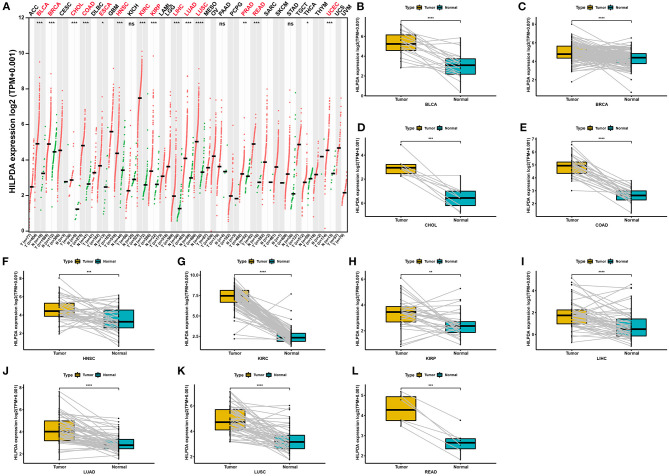
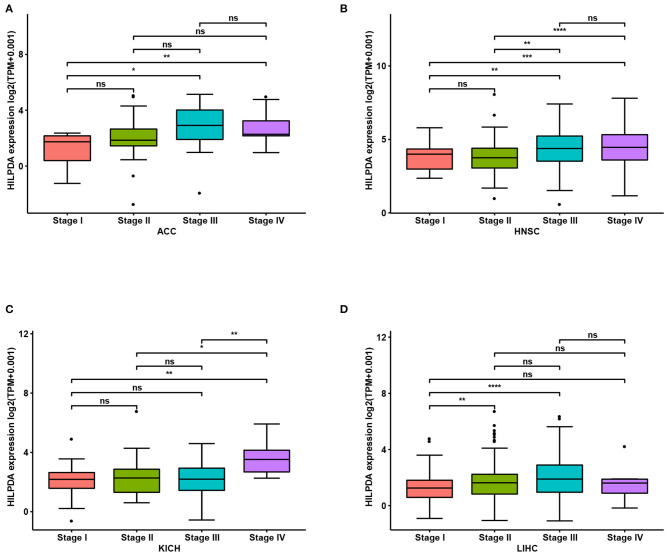
We first assessed HILPDA expression in pan-cancer data from TCGA. The analysis results revealed that HILPDA expression was higher in 14 tumors, including Bladder Urothelial Carcinoma (BLCA), Breast Invasive Carcinoma (BRCA), Cholangiocarcinoma (CHOL), Colon Adenocarcinoma (COAD), Esophageal Carcinoma (ESCA), Head and Neck Squamous Cell Carcinoma (HNSC), Kidney Renal Clear Cell Carcinoma (KIRC), Kidney Renal Clear Cell Carcinoma (KIRP), Liver Hepatocellular Carcinoma (LIHC), Lung Adenocarcinoma (LUAD), Lung Squamous Cell Carcinoma (LUSC), Prostate Adenocarcinoma (PRAD), Prostate Adenocarcinoma (READ), and Uterine Corpus Endometrial Carcinoma (UCEC), while lower expression was observed in Thyroid Carcinoma (THCA) (Figure 1A). For paired tumors and normal tissues, HILPDA was overexpressed in tumor tissues of BLCA, BRCA, CHOL, COAD, HNSC, KIRC, KIRP, LIHC, LUAD, LUSC, and READ (Figures 1B–L). In addition, the expression of HILPDA was closely related to the clinical stage, being higher in patients with relatively high stages of several tumor types, including Adrenocortical Carcinoma (ACC), HNSC, Kidney Chromophobe (KICH), and LIHC (Figures 2A–D).
HILPDA High Expression Correlates With Poor Cancer Prognosis
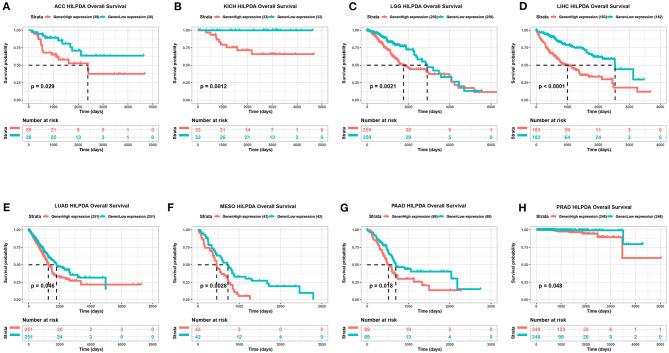
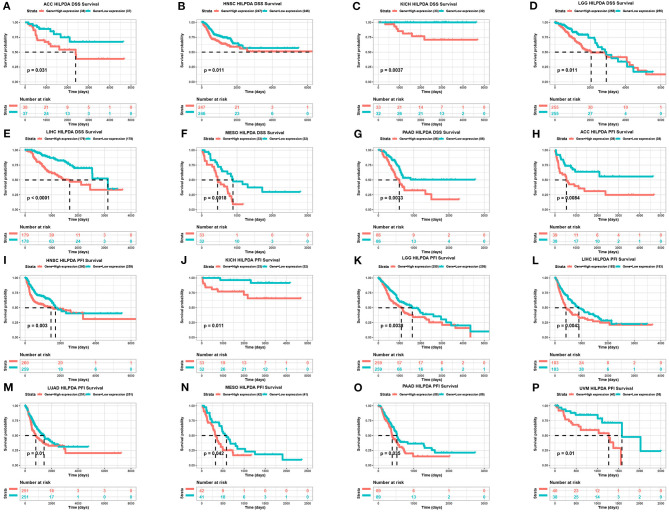
To evaluate the value of HILPDA in predicting the prognosis of cancer patients, the association between its expression and OS, DSS, and PFI was analyzed in TCGA cohort. Higher expression of HILPDA was significantly associated with worse OS in ACC (p = 0.029), KICH (p = 0.0012), LGG (p = 0.00097), LIHC (p < 0.0001), LUAD (p = 0.046), MESO (p = 0.0028), PAAD (p = 0.018), and PRAD (p < 0.048) (Figures 3A–H). Similarly, higher HILPDA expression was significantly associated with a reduction in DSS in ACC (p = 0.031), HNSC (p = 0.011), KICH (p = 0.0037), LGG (p = 0.011), LIHC (p < 0.0001), MESO (p < 0.0018), and PAAD (p = 0.0033) (Figures 4A–G). In addition, the PFI was reduced in the high HILPDA expression groups in ACC (p = 0.0084), HNSC (p = 0.003), KICH (p = 0.011), KIRC (p = 0.005), LGG (p = 0.0038), LIHC (p = 0.0043), LUAD (p = 0.01), MESO (p = 0.042), PAAD (p = 0.035), and UVM (p = 0.01) (Figures 4H–P).
HILPDA Is Involved in Pathways Related to Malignancy
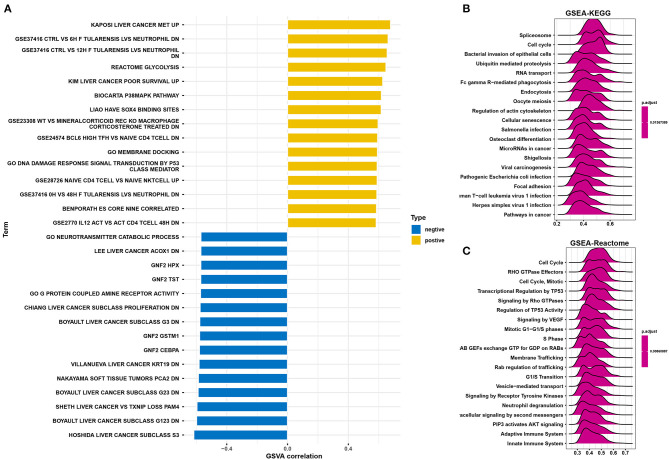
To predict the functions of HILPDA, we conducted a GSVA analysis based on gene sets from the MSigDB database v7.1. Results showed the scores of “Liver cancer MET up,” “Glycolysis,” and “Liver cancer poor survival up” pathways were positively correlated with HILPDA expression, indicating a role in these malignant processes (Figure 5A). We further conducted a GSEA analysis of HILPDA using TCGA LIHC data. The GSEA results showed that cell cycle-related pathways, including the cell cycle pathway in Kyoto Encyclopedia of Genes and Genomes (KEGG) and cell cycle, transcriptional regulation by P53, mitotic G-G1/S phases, and S phase in Reactome, were significantly enriched (Figures 5B,C). These results suggest that HILPDA is associated with many malignancy-related pathways, especially those related to the cell cycle and glycolysis.
High HILPDA Expression Correlates With High Immune Cell Infiltration and Immunosuppressive Genes in Most Tumors
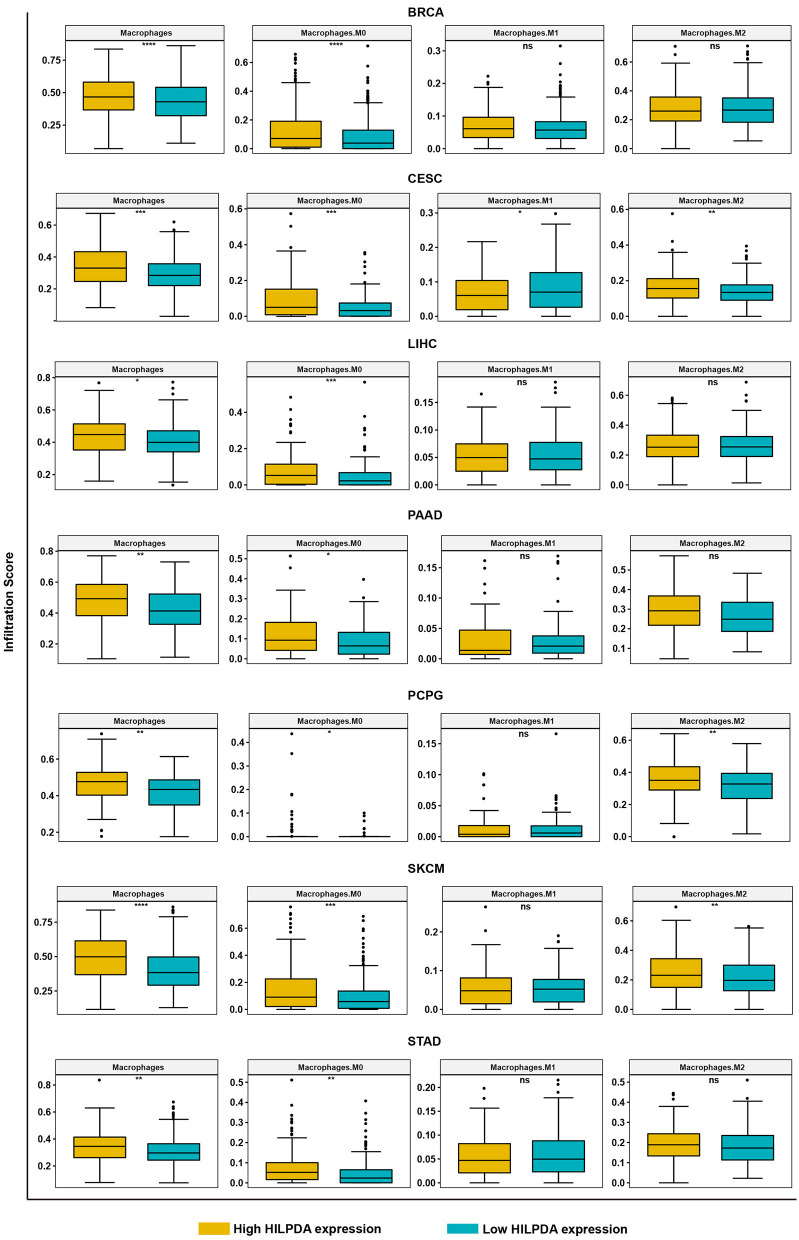
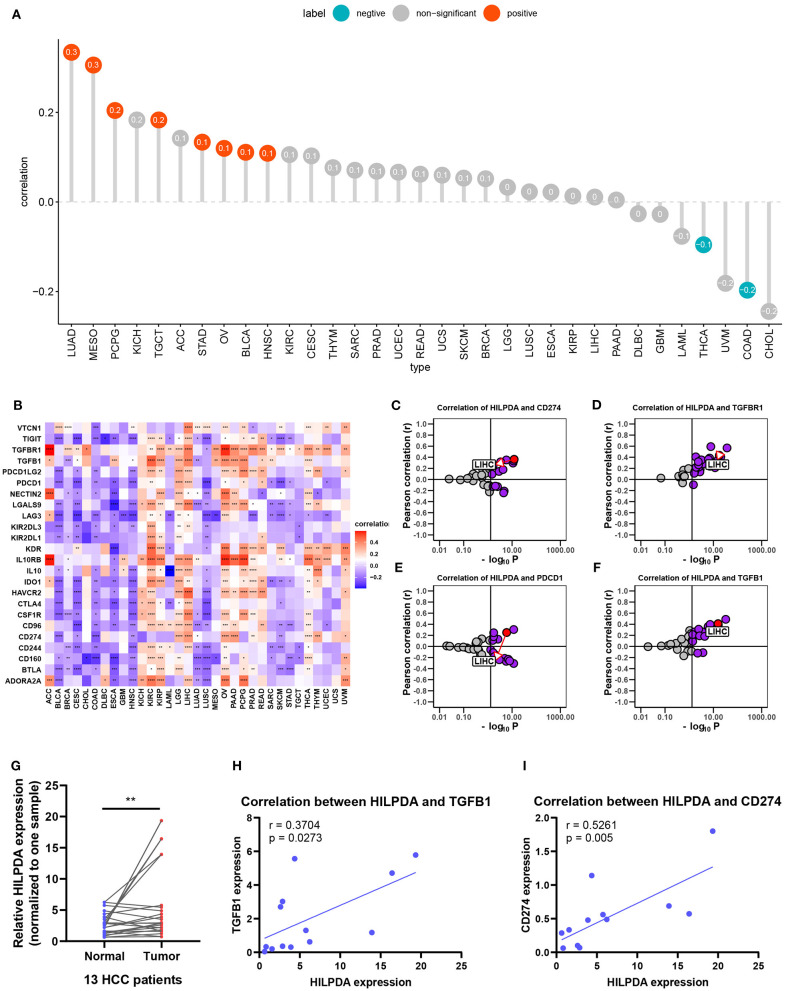
We further analyzed the effect of HILPDA on the tumor immune microenvironment. We noticed that macrophages, M0 macrophage or M2 macrophage infiltration levels were higher in the high HILPDA expression group in most tumor types, especially in BRCA, CESC, LIHC, PAAD, PCPG, SKCM, and STAD (Figure 6). Correlation analysis revealed that HILPDA expression was positively correlated with infiltration levels of macrophages in most tumor types, including BRCA, CESC, LIHC, PAAD, PCPG, SKCM, STAD, and UCS (Supplementary Figure 1). Tumor-associated macrophage (TAM) infiltration and TMB status are closely related to the immunosuppressive state of the tumor (ref. 8). We further analyzed the relationship of HILPDA with TMB and immunosuppressive genes using TCGA pan-cancer data. As shown in Figure 7A, HILPDA expression was positively correlated with TMB in LUAD, MESO, PCPG, TGCT, STAD, OV, BLCA, and HNSC, and negatively correlated with TMB in THCA and COAD. In addition, HILPDA expression was positively correlated with immunosuppressive genes, especially PD-L1 (CD274), PD-1 (PDCD1), TGFB1, and TGFBR1, in most tumors (Figures 7B–F). Moreover, we validated the expression of HILPDA and the correlation between the expression of HILPDA and TGFB1/CD274 using 13 paired samples from liver cancer patients. The results revealed that HILPDA was highly expressed in liver cancer tissues (Figure 7G). HILPDA expression was positively correlated with TGFB1 and CD274 expression in liver cancer tissues (Figures 7H,I). These results suggest that the high expression of HILPDA is closely related to the immunosuppressive status.
Discussion
HILPDA is involved in the progression of many diseases, including several tumor types (ref. 9, ref. 10). Previous studies have shown the oncogenic role of HILPDA in head and neck carcinoma (ref. 10), neuroblastoma (ref. 11), and mantle cell lymphoma (ref. 12) amongst others. However, HILPDA has not been extensively studied. Therefore, it is urgent to clarify the role of HILPDA in tumor progress and treatment.
In our study, we examined HILPDA expression levels and prognostic function in pan-cancer data using TCGA data from UCSC Xena. Based on our results, we found that HILPDA, compared to normal tissues, was overexpressed in BLCA, BRCA, CHOL, COAD, ESCA, HNSC, KIRC, KIRP, LIHC, LUAD, LUSC, PRAD, READ, and UCEC, while lower expression was observed in THCA in TCGA. The difference in HILPDA expression levels in different tumor types may reflect the distinct underlying functions and mechanisms. We further found that overexpression of HILPDA generally predicts poor prognosis in tumors with high HILPDA expression, such as ACC, KICH, LGG, LIHC, LUAD, MESO, PAAD, and PRAD. These results indicate that HILPDA is a prognostic biomarker for tumor patients.
The tumor microenvironment, especially the immune microenvironment, constitutes a vital element of tumor biology. Increasing evidence has revealed its clinicopathological significance in predicting outcomes and therapeutic efficacy (ref. 13, ref. 14). The infiltration of TAMs facilitates the progression of tumors (ref. 15, ref. 16). Our results proved that HILPDA has a close relationship with TAM infiltration as TAM infiltration levels were significantly higher in the high HILPDA expression group in BRCA, CESC, LIHC, PAAD, PCPG, SKCM, and STAD. Moreover, HILPDA expression was positively correlated with TAM infiltration level in most tumor types. As the high infiltration of TAMs in tumor often indicates the immunosuppressive microenvironment (ref. 17), we further investigated the relationship between HILPDA expression and tumor immunosuppressive microenvironment. We found the positive correlation between HILPDA expression and immunosuppressive genes, such as PD-L1, PD-1, TGFB1, and TGFBR1, indicates the key role of HILPDA in regulating tumor immunosuppressive microenvironment. The high expression of HILPDA indicates the immunosuppression of most tumors, providing a potential target for immunotherapy.
In summary, we demonstrate that TAM infiltration was significantly increased in tissues with high HILPDA expression and that HILPDA positively correlated with immunosuppressive genes. Our results offer novel insights into the functional role of HILPDA and further highlight a potential mechanistic basis whereby HILPDA influences TAM infiltration and immunosuppressive gene expression in the tumor microenvironment. Collectively, our findings show that HILPDA could be a valuable prognostic biomarker and a potential target for immunotherapy.
Data Availability Statement
The original contributions presented in the study are included in the article/Supplementary Material, further inquiries can be directed to the corresponding author/s.
Ethics Statement
The studies involving human participants were reviewed and approved by The Institutional Review Board of Nanfang Hospital, Southern Medical University of Guangdong, China. The patients/participants provided their written informed consent to participate in this study.
Author Contributions
LL, DW, CL, and XZ designed the study. CL and XZ performed the data analysis. CL and HZ wrote the manuscript and helped with the validation. All authors contributed to the article and approved the submitted version.
Conflict of Interest
The authors declare that the research was conducted in the absence of any commercial or financial relationships that could be construed as a potential conflict of interest.
References
- SH Kim, D Wang, YY Park, H Katoh, O Margalit, M Sheffer. HIG2 promotes colorectal cancer progression via hypoxia-dependent and independent pathways.. Cancer Lett. (, 2013. [DOI | PubMed]
- A Togashi, T Katagiri, S Ashida, T Fujioka, O Maruyama, Y Wakumoto. Hypoxia-inducible protein 2 (HIG2), a novel diagnostic marker for renal cell carcinoma and potential target for molecular therapy.. Cancer Res. (, 2005. [DOI | PubMed]
- RL Siegel, KD Miller, HE Fuchs, A Jemal. Cancer statistics, 2021.. CA Cancer J Clin. (, 2021. [DOI | PubMed]
- I Vitale, G Manic, LM Coussens, G Kroemer, L Galluzzi. Macrophages and metabolism in the tumor microenvironment.. Cell Metab. (, 2019. [DOI | PubMed]
- B Liang, Y Tao, T Wang. Profiles of immune cell infiltration in head and neck squamous carcinoma.. Biosci Rep. (, 2020. [DOI | PubMed]
- A Desrichard, F Kuo, D Chowell, KW Lee, N Riaz, RJ Wong. Tobacco smoking-associated alterations in the immune microenvironment of squamous cell carcinomas.. J Natl Cancer Inst. (, 2018. [DOI | PubMed]
- V Thorsson, DL Gibbs, SD Brown, D Wolf, DS Bortone, YT Ou. The immune landscape of cancer.. Immunity. (, 2018. [DOI | PubMed]
- C Ngambenjawong, HH Gustafson, SH Pun. Progress in tumor-associated macrophage (TAM)-targeted therapeutics.. Adv Drug Deliv Rev. (, 2017. [DOI | PubMed]
- MJ VandeKopple, J Wu, EN Auer, AJ Giaccia, NC Denko, I Papandreou. HILPDA regulates lipid metabolism, lipid droplet abundance, and response to microenvironmental stress in solid tumors.. Mol Cancer Res. (, 2019. [DOI | PubMed]
- JC van der Mijn, L Fu, F Khani, T Zhang, AM Molina, CE Barbieri. Combined metabolomics and genome-wide transcriptomics analyses show multiple HIF1α-induced changes in lipid metabolism in early stage clear cell renal cell carcinoma.. Transl Oncol. (, 2020. [DOI | PubMed]
- MA Applebaum, AR Jha, C Kao, KM Hernandez, G DeWane, HR Salwen. Integrative genomics reveals hypoxia inducible genes that are associated with a poor prognosis in neuroblastoma patients.. Oncotarget. (, 2016. [DOI | PubMed]
- V Kuci, L Nordström, P Conrotto, S Ek. SOX11 and HIG-2 are cross-regulated and affect growth in mantle cell lymphoma.. Leuk Lymphoma. (, 2016. [DOI | PubMed]
- X Bai, DH Wu, SC Ma, J Wang, XR Tang, S Kang. Development and validation of a genomic mutation signature to predict response to PD-1 inhibitors in non-squamous NSCLC: a multicohort study.. J Immunother Cancer. (, 2020. [DOI | PubMed]
- L Guo, X Li, R Liu, Y Chen, C Ren, S Du. TOX correlates with prognosis, immune infiltration, and T cells exhaustion in lung adenocarcinoma.. Cancer Med. (, 2020. [DOI | PubMed]
- DJ Shiau, WT Kuo, G Davuluri, CC Shieh, PJ Tsai, CC Chen. Hepatocellular carcinoma-derived high mobility group box 1 triggers M2 macrophage polarization via a TLR2/NOX2/autophagy axis.. Sci Rep. (, 2020. [DOI | PubMed]
- J Wu, W Gao, Q Tang, Y Yu, W You, Z Wu. M2 macrophage-derived exosomes facilitate hepatocarcinoma metastasis by transferring α(M) β(2) integrin to tumor cells.. Hepatology. (, 2020. [DOI | PubMed]
- X Chen, A Gao, F Zhang, Z Yang, S Wang, Y Fang. ILT4 inhibition prevents TAM- and dysfunctional T cell-mediated immunosuppression and enhances the efficacy of anti-PD-L1 therapy in NSCLC with EGFR activation.. Theranostics. (, 2021. [DOI | PubMed]