
Ruta Angustifolia Essential Oil: Behavioral and Insecticidal Effects Against Larvae and Adults of Tribolium castaneum
Abstract
The study aims to evaluate the behavioral and insecticidal effects of Ruta angustifolia EO (RAEO) against larvae and adults of a major pest insect, Tribolium castaneum. RAEO exhibited a strong repellency against both adults and larvae where percentages as high as 74 and 72 % of PR (Percentage of Repellency) were recorded respectively, at 0.47 μL/cm2 after 2 h. Regarding the antifeedant bioassay, no feeding deterrence was recorded in adults while an increase in appetite was registered in larvae exhibiting −80 % of FDI recorded at 0.2 μL/pellet. In terms of feeding preference, the response significantly depended on the developmental stage (F=97.19, P<0.05) and larvae were attracted to treated pellets recording percentages of 84 and 73 % of PI (Preference index) after 5 and 30 min at 0.05 μL/pellet; on the other hand, adults expressed a repulsive behavior at 0.2 μL/pellet with a PI of −81.1 (20 min), and −69.2 % (30 min). Regarding topical application toxicity, a significant difference was observed between larvae and adults (p<0.05 F=174.56). The study promotes the use of RAEO as a repellent and bioinsecticide for the control of larvae and adults of T. castaneum.
Article type: Research Article
Keywords: Feeding deterrent, Direct contact, Repellent, Feeding preference, Stored grain pest
Affiliations: Research team Agricultural and Aquaculture Engineering FPL Abdelmalek Essaadi University Tetouan Morocco; Research team Biotechnologies and Biomolecular Engineering Faculty of Science and Technology – Abdelmalek Essaadi University Tangier Morocco; Research Laboratory Biology, Environment and Sustainable Development ENS. Abdelmalek Essaadi University Tetouan Morocco; Regional Analysis and Research Laboratory National Office of Food Safety ONSSA Tangier Morocco; Messina Institute of Technology c/o Department of Chemical Biological, Pharmaceutical and Environmental Sciences, f ormer Veterinary School University of Messina, Viale G. Palatucci snc 98168 Messina Italy; Department of Food Sciences College of Agriculture University of Basrah Iraq
License: © 2024 The Author(s). Chemistry & Biodiversity published by Wiley-VHCA AG CC BY 4.0 This is an open access article under the terms of the http://creativecommons.org/licenses/by/4.0/ License, which permits use, distribution and reproduction in any medium, provided the original work is properly cited.
Article links: DOI: 10.1002/cbdv.202402043 | PubMed: 39435848 | PMC: PMC11908773
Relevance: Moderate: mentioned 3+ times in text
Full text: PDF (626 KB)
Introduction
Pest Insects are considered one of the most detrimental pests that can cause significant damage to stored products in milling, processing facilities, commercial warehouses, and retail stores.ref. cbdv202402043-bib-0001 These pests are considered a significant risk to food safety, especially with the alarm side effects of climate change and the increase of global warming which can create optimal conditions for their proliferation.ref. cbdv202402043-bib-0002 The red flour beetle Tribolium castaneum (T. castaneum), is considered one of the commonly found pest insects and is known for infesting a wide range of stored food commodities of economic importance.ref. cbdv202402043-bib-0003
To get rid of this species, management strategies often include the use of conventional chemical insecticides as the primary solution.[ref. cbdv202402043-bib-0004, ref. cbdv202402043-bib-0005, ref. cbdv202402043-bib-0006] However, The overuse of these chemicals has led to the continuous appearance of resistance cases in this pest’s populationsref. cbdv202402043-bib-0007 Moreover, these chemicals pose a threat to the environment as they persist in soil and infiltrate into groundwaters leading to detrimental consequences associated with soil and water contamination which impacts human health, soil biodiversity, and viability of non‐target organisms.[ref. cbdv202402043-bib-0008, ref. cbdv202402043-bib-0009] Consequently, it is crucial to develop new alternatives to replace or diminish the reliability of these chemicals.
In this regard, botanicals or natural products emerge as promising eco‐friendly alternatives for the control of this pest. Plants are considered sustainable production engines of natural molecules which attracted researchers all over the world to evaluate their activities against different pests including T. castaneum.[ref. cbdv202402043-bib-0010, ref. cbdv202402043-bib-0011] These plants, especially medicinal and aromatic plants (MAPs), are widely distributed across the world gathering large numbers of species containing a mine of molecules that could be the next potential insecticide.[ref. cbdv202402043-bib-0012, ref. cbdv202402043-bib-0013]
For instance, the Ruta genus, which belongs to the Rutaceae family, comprises over 40 species majorly found in the Mediterranean region.ref. cbdv202402043-bib-0014 The phytochemical studies conducted on these species highlight the presence of amino acids, saponins,ref. cbdv202402043-bib-0015 alkaloids, flavonoids, coumarins, tannins, volatile oil, glycosides, sterols and triterpenes.ref. cbdv202402043-bib-0016 They are used in the traditional medicine of many countries for the treatment of a variety of diseases. Exciting, diaphoretic, antiseptic, antispasmodic, anthelmintic emmenagogue, abortifacient and anti‐inflammatory properties are inferred to R. chalepensis var. bracteosa, R. graveolens and R. angustifolia. R. tuberculata treats bone and joint pain, dysmenorrhea, infertility in women, anemia and headache.ref. cbdv202402043-bib-0017
Moreover, essential oils (EOs) of the Ruta genus were reported in the literature to exhibit antimicrobial effects against different bacterial and fungal strains.ref. cbdv202402043-bib-0018 Besides, These oils also exhibited antiparasitic and insecticidal activities which promote the use of Ruta species as a potential alternative for commonly used synthetic chemicals.[ref. cbdv202402043-bib-0019, ref. cbdv202402043-bib-0020]
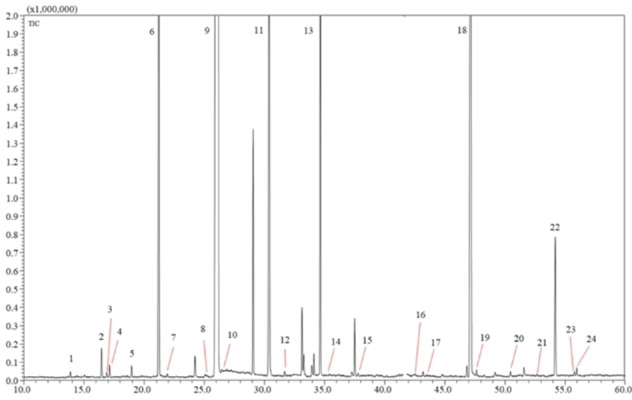
However, not all Ruta species were fairly evaluated. According to a recent review, Ruta chalepensis L., Ruta graveolens L., and Ruta montana L. were the three most extensively studied species.ref. cbdv202402043-bib-0021 On the other hand, Ruta angustifolia EOs have received limited research attention regarding their chemical composition and biological activity. In this regard, in our previous study,ref. cbdv202402043-bib-0022 we reported the chemical characterization of such a species along with antioxidant and antimicrobial activities, the latter demonstrated against numerous bacterial and fungal strains. The chemical composition of its EO was dominated by 2‐undecanone (nonyl methyl ketone) (Figure 1) with a percentage of 80.96 %, followed by Moskachane B (4.43 %), Undecyl methyl ketone (2.26 %) and Octyl methyl ketone (2.02 %). In total, ketones dominate the volatile content of R. angustifolia EO accounting for 87.4 of the entire volative content. Figure 2 reports the structure of 2‐undecanone.

Results are similar to a previous study reporting the chemical composition and antimicrobial activity of the essential oils from four Ruta species growing in Algeria.ref. cbdv202402043-bib-0023 In terms of the insecticidal, antifeedant, and repellent effect of this EO, to date, no reports have addressed this application either against pest insects in general, or T. castaneum in particular.
Hence, this study aims to evaluate the behavioral and insecticidal activities of Ruta angustifolia essential oil (RAEO) against larvae and adults of a major stored product pest, T. castaneum. The behavioral effects evaluated consisted of the repellent, antifeedant, and feeding preference effect of RAEO while the insecticidal effect was evaluated against larvae different exposure routes to the essential oil, starting from repellent effect to antifeedant and feeding preference bioassay, and finishing with topical application toxicity bioassay. These effects were assessed comparatively against both larvae and adults of this pest insect. This study will provide evidence of the insecticidal/behavioral effect of this Ruta species for the first time to promote its use in the management of stored product pests.
Results and Discussion
Topical Application Toxicity
As expressed in Table 1, RAEO exhibited a strong toxic effect against T. castaneum especially at the highest dose of 0.08 μL/insect. Mortality was significantly influenced by developmental stage (p<0.05 F=174.56). For instance, 5th instar larvae turned out to be the least sensitive (8 % of mortality was recorded at the highest dose after 24 h), compared to the adults one that were the most sensitive one. On the other hand, 1‐day‐old adults were the most sensitive while 7‐day‐old were less sensitive where 100 and 58 % of mortality were recorded respectively after 24 h.
Table 1: Topical application toxicity of Ruta angustifolia essential oil against Larvae (L5) and Adults (A1, A7, A14, A21) of Tribolium castaneum.
| Concentration (μL/insect) | |||||||||
|---|---|---|---|---|---|---|---|---|---|
| 0.02 | 0.04 | 0.08 | |||||||
| 24 h | 48 h | 72 h | 24 h | 48 h | 72 h | 24 h | 48 h | 72 h | |
| L5 | 4±2a | 8 ±2a | 14±2a | 6 ±2a | 8 ±2a | 12±2a | 8 ±2a | 30±3a | 58±2a |
| A1 | 10±0a | 12 ±2a | 16±2a | 38 ±4 | 40±4b | 40±4b | 100±0b | 100±0b | 100±0b |
| A7 | 2±2a | 4 ±2a | 4 ±2b | 10±3a | 10±3a | 10±3a | 58 ±2c | 64±2c | 64±2c |
| A14 | 6±2a | 10 ±3a | 12 ±2b | 42±4b | 44±2b | 48±4b | 70 ±3d | 70±3c | 72±2c |
| A21 | 8±2a | 8 ±2a | 8 ±2b | 40±3b | 48±2b | 48±2b | 68 ±4cd | 70±3c | 70±3c |
| F | 2.5 | 1.57 | 4.46 | 28.82 | 42.73 | 35.08 | 174.563 | 86.278 | 54.417 |
| P | 0.075 | 0.221 | 0.01 | <0.05 | <0.05 | <0.05 | <0.05 | <0.05 | <0.05 |
L5=5th instar Larvae, A1 =1 day old adults, A7=7 day old adults, A14=14 days old adults, A21=21 days old adults. Values expressed as the mean of mortality percentage ± Standard error for five replicates. Results are considered significant when the letters are different at a P <0.05 at different developmental stages using One‐way ANOVA and Tukey post hoc
This toxicity investigation for RAEO is hereby reported for the first time and can be attributed to its major compound, viz. 2‐undecanone. The latter was exclusively studied in house fly Musca domestica exhibiting significant topical application toxicity with an LD50 value of 58.1 μg/fly.ref. cbdv202402043-bib-0024 Additionally, 2‐undecanone induced 100 % mortality at 1 % against three stored product pests (Tenebrio molitor, Tribolium confusum, and Acanthoscelides obtectus) in filter paper contact bioassay.ref. cbdv202402043-bib-0025 When applied to grains, 2‐undecanone caused 98.9 % and 87.8 % of mortality in Tenebrio molitor adults and larvae respectively after 7 days at 1000 μL/kg wheat.ref. cbdv202402043-bib-0026 As for sealed petri dish assays, 2‐undecanone exhibited strong fumigant toxicity ranging between 94 and 97.9 % at 2.8 μg/cm3 against three species of flies, namely house fly, flesh fly: and blow fly, respectively, after 2 h.ref. cbdv202402043-bib-0023 On the other hand, it is important to mention that other 2‐undecanone‐rich EOs were reported in the literature for their insecticidal effect. For instance, Ruta chalepensis (64.35 % of 2‐undecanone) caused 100 % mortality in T. castaneum adults after 48 hours of exposure at 0.62 μL/mL.ref. cbdv202402043-bib-0027 Moreover, R. graveolens EO (16.22 % of 2‐undecanone) demonstrated strong toxicity against Ephestia kuehniella and Ectomyelois ceratoniae leading to an (LC50) values of 1.02 μL/L air and 1.97 μL/L air respectively.ref. cbdv202402043-bib-0028 The low sensitivity of larvae to RAEO observed in our study, complies with the studies reported in refs.[ref. cbdv202402043-bib-0029, ref. cbdv202402043-bib-0030] carried out on T. castaneum, demonstrating reduced sensitivity to essential oils through contact and fumigant toxicity. Additionally, similar results were reported in Trogoderma granarium and Cryptolestes ferrugineus larvae and adults. [26,31] However, exceptions exist, as demonstrated by Plata‐Rueda et al.ref. cbdv202402043-bib-0032 who reported increased sensitivity in Tenebrio molitor larvae compared to adults. These findings imply the existence of various factors influencing this activity. Factors such as the nature of the essential oil and the physiological differences between larvae and adults play pivotal roles. Consequently, it is crucial to carry out insecticidal bioassays on both developmental stages to determine their sensitivity and the efficiency of the EO.
Antifeedant Effect
T. castaneum adults and larvae did not express different antifeedant behavior towards pellets treated with RAEO (Table 2 ). In terms of adults, no disruption was observed in the four nutritional indexes while larvae’s appetite increased especially at 0.2 μL/pellet leading to −80 % of FDI. Despite the lack of an antifeedant effect on nutritional indexes was observed, statistical analysis revealed that there was a significant difference between larvae and adults in their response to RAEO in all four nutritional indexes (p<0.05 and F equals 4.9, 8.5, 5.9, and 4.5 respectively for RGR, RCR, ECI, and FDI).
Table 2: Antifeedant effect of Ruta angustifolia essential oils on Adults and Larvae of Tribolium castaneum.
| Concentration (μL/pellet) | RGR[] (mg/mg/day) | RCR[*] (%) | ECI[*] (%) | FDI[*](%) | |
|---|---|---|---|---|---|
| Adults | 0 | 0,023 ±0,002[a] | 0,204 ±0,014[a] | 11,2 ±1,1 [a] | 0,000 [a] |
| 0,05 | 0,027 ±0,010[a] | 0,196 ±0,007[a] | 13,9 ±5,3 [a] | 0,39 ±6,3[a] | |
| 0.1 | 0,025 ±0,004[a] | 0,235 ±0,010[a] | 10,6 ±1,8[a] | −19,7 ±6,4[a] | |
| 0.2 | 0,023 ±0,002[a] | 0,217 ±0,014[a] | 10,8 ±1,6[a] | −7,5 ±4,3 [a] | |
| Larvae | 0 | ‐0,010 ±0,005[a] | 0,079 ±0,017[a] | −34,6 ±27,2[a] | 0,000[a] |
| 0,05 | 0,006 ±0,010[a] | 0,114 ±0,012[a] | 1,64 ±11,7[a] | −13,0 ±13,5[a] | |
| 0.1 | 0,011 ±0,029[a] | 0,213 ±0,065[a] | −1,5±11,6[a] | −21,4 ±11,3[a] | |
| 0.2 | 0,007 ±0,017[a] | 0,208 ±0,039[a] | −9,1 ±17,9[a] | −80,9 ±27,7[a] |
[a] Values expressed as the mean of mortality percentage ± Standard error for five replicates. Results are considered significant when the letters are different at a P <0.05 at different concentrations using One‐way ANOVA and Tukey post‐hoc.*RGR : Relative Growth Rate *RCR : Relative Consumption Rate *ECI : Efficacy of Conversion of Ingested Food *FDI : Feeding Deterrence Index
Overall, this effect was evaluated for the first time using this EO In the literature, no antifeedant effect was reported using RAEO or any other Ruta species with the exception of one study where the antifeedant effect against Spodoptera frutiperda larvae was explored.[33].
Feeding Preference
The response of larvae and adults to different concentrations of RAEO depends on developmental stages (Figure 3, 4). For example, larvae were attracted to treated pellets where PI (preference index) of 84 and 73 % were recorded as the highest preference index (PI) after 5 and 30 mins respectively, at the lowest concentration (0.05 μL/pellet). The PI decreased significantly in a dose‐dependent manner reaching 55 and 7 % respectively for 0.1 and 0.2 μL/pellet after 5 minutes and decreasing to 25 and −24 % after 30 min. In contrast, adults expressed a repulsive behavior towards pellets treated with RAEO where the highest value of PI (−85 %) was recorded for 0.1 μL/pellet after 5 minutes. Overall, the highest concentration (0.2 μL/pellet) expressed the optimal response, with −80.9 %, −81.1 %, and −69.2 % recorded after 10, 20, and 30minrespectively. Statistical analysis indicates a highly significant difference between concentrations and also life stages throughout the 30‐minute experiment. For example, there is a highly significant difference between life stages (F=97.2 p<0.05) and concentrations (F=4.74, p<0.05) respectively after 10 minutes of exposure.
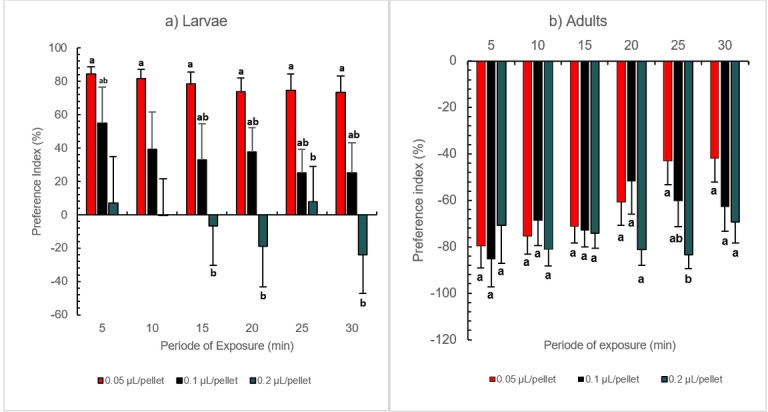
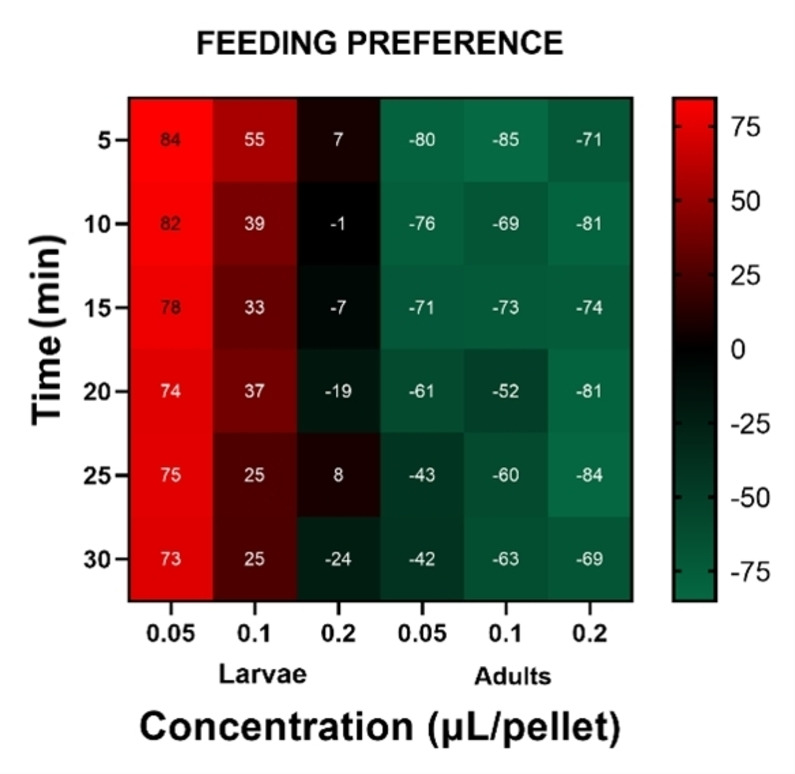
This effect is hereby reported for the first time; this adapted bioassay makes it a first of its kind in stored product insects especially since it focuses on feeding behavior, and not mortality or other commonly studied parameters. For instance, in the case of Trogoderma granarium, both adults and larvae avoided the food sources, with no significant difference noted. [26] Similarly, Lazarević et al. [34] found that both developmental stages of the Colorado potato beetle were repelled by the essential oil pure compounds camphor and thujone, challenging the trend observed in our study. Furthermore, they reported that the choice of treated leaf pellet did not depend on the life stage of the Colorado potato beetle Leptinotarsa decemlineata. The observed attractant effect of larvae in our study suggests a promising approach for eliminating larvae from stored products. This difference in responses may be attributed to factors related to the insect’s olfactory and gustatory systems, as well as the concentration of the treatment employed. Therefore, our findings open avenues for further exploration and underscore the need for a nuanced understanding of feeding behavior in stored product insects.
Repellency on Filter Paper
RAEO exhibited effective repellent activity against both larvae and adults of T. castaneum as illustrated in Figures 5, 6. For the larvae, the highest repellency rate was observed at the lowest concentration tested (0.047 μL/cm2), with a PR (percentage of repellency) of 74 after 2 and 4 h. At higher concentrations (Class IV), no significant difference was observed, where 70 and 64 % of PR were recorded at 0.094 and 0.189 μL/cm2, respectively, after 4 h. For the adults, the highest PR (76 %) was observed at the highest concentration after 4 h belonging to class IV. The lowest concentration, also, showed high PR of 72 % and 66 % after 2 and 4 h, respectively. Statistical analysis showed no significant difference between concentrations (F=3.130 and p=0.57) or between larvae and adults (F=2.593 and p=0.117).
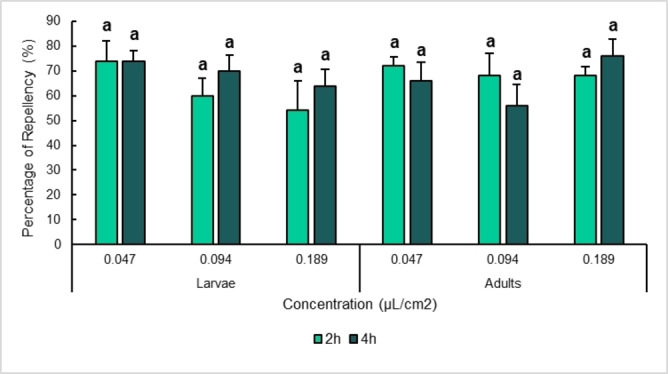
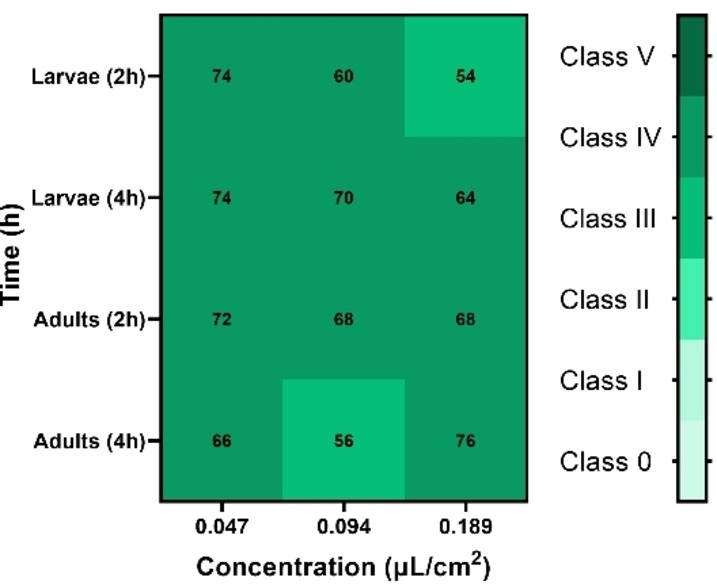
Nevertheless, no study has reported this effect using RAEO against T. castaneum, or any other insect species. This repellent effect is highly due to 2‐undecanone, which has been reported to display a significant repellent effect against some pest insects. For instance, 1 % of 2‐undecanone induced the highest levels of repellency against adults of three stored product pest insects (Tenebrio molitor, Tribolium confusum, and Acanthoscelides obtectus.ref. cbdv202402043-bib-0026. Fusková et al.ref. cbdv202402043-bib-0035 reported a significant repellent effect of this compound on adults of the western corn rootworm Diabrotica virgifera. Against flies, In a two‐choice behavioral assay, 194.6 μg/cm2 of 2‐undecanone gave 84.7 % and 80.7 % overall mean repellencies, respectively when exposed to blow flies and house flies.ref. cbdv202402043-bib-0023 Other plants containing this major compound also showed promising levels of repellency; for instance, 1.92×10⁷ ng/cm2 of Ruta chalepensis EO (40.1 % of 2‐undecanone) showed a potent repellent effect against both male and female of Aegorhinus superciliosus using four‐arm olfactometric bioassays.ref. cbdv202402043-bib-0036 Moreover, Ruta graveolens (44.7 % of 2‐undecanone) repelled Sitophilus zeamais adults especially when loaded in mineral matrices.ref. cbdv202402043-bib-0037 Additionally, Ruta chalepensis EO (64.35 % of 2‐undecanone) displayed 100 % PR against adults of T. castaneum at a dose of 0.038 μL/mL following the same protocol of repellency.ref. cbdv202402043-bib-0027 As for the absence of significance between larvae and adults, the same observation was reported in T. castaneum in ref.ref. cbdv202402043-bib-0038 The same observation was also reported in other stored product species such as Tenebrio molitor ref. cbdv202402043-bib-0032 and Tribolium confusum.ref. cbdv202402043-bib-0039
Conclusions
The present study highlights the effectiveness of RAEO in repelling both larvae and adults of T. castaneum which is crucial to protect stored products from their invasion. Our findings reveal a strong significant difference in the feeding behavior of larvae and adults either in the feeding deterrence or feeding preference bioassays. This study also provides compelling evidence of the strong and stage‐dependent insecticidal effect through direct contact. Overall, these results contribute significantly as novel evidence of the potent behavioral and insecticidal effects of this EO, suggesting the necessity of including both feeding stages in further studies, and possible inclusion in formulation or in combination with other insecticides to reduce the reliance on these products.
Experimental Section
Insect Culture
Larvae and adult individuals of the red flour beetle (Tribolium castaneum) used in this study were obtained from a laboratory culture at the Faculty of Science and Technology in Tangier, Morocco. The beetles were raised in a mixture of wheat flour and dried yeast in a 1 : 19 ratio (w/w), and were kept in bottles at a temperature of 30 °C and humidity of 60±5 % in the dark. Fifth instar larvae were used in all bioassays and experiments, while 7–14 days adults were used for antifeedant, feeding preference, and repellent bioassays. For toxicity by topical application, adults 1, 7, 14, and 21 days old were used and labeled as A1, A7, A14, and A21 respectively.
Plant Material and Essential oil Extraction
Ruta angustifolia plant materials, extraction procedure as well as chemical composition assessment were conducted as stated inref. cbdv202402043-bib-0022 In summary, wild Ruta angustifolia was harvested from Targuist, Morocco in June 2019. The identity of the plant was confirmed by Pr. Mohammed Bakkali, and a voucher of the specimen (Code MPU008384) was deposited in the Department of Botany and Plant Ecology of the Scientific Institute of Rabat (Morocco). After harvest, the aerial parts were dried in obscurity at room temperature for 10 days. One hundred grams of dried plant material was subjected to hydrodistillation using a Clevenger‐type apparatus for 3 h.
Chemical Characterization
The chemical composition, of the essential oil of Ruta angustifolia was analyzed using gas chromatography‐flame ionization detector/mass spectrometry (GC‐FID/MS) In summary, GC‐MS analyses were carried out on a GCMS‐QP2020 system (Shimadzu Europa GmbH, Duisburg, Germany) equipped with a split‐splitless injector and ‘AOC‐20i’ auto‐injector system. The column was an SLB‐5 ms fused‐silica capillary column (30 m×0.25 mm i.d.×0.25 um df film thickness), which was obtained from Merck Life Science (Merck KGaA, Darmstadt, Germany).
Topical Application Bioassay
Topical application bioassay, also known as contact toxicity, was carried out by applying different concentrations directly to the body of the insect. Three concentrations were prepared in acetone (2, 4, and 8 %) giving a final concentration of 0.02, 0.04, and 0.08 μL/insect. 1 μL of each concentration was applied to the body of the adult/larva using a precision micropipette (0.5–10 μL) while the control received 1 μl of acetone. Each concentration was performed in five replicates and The mortality rate was recorded after 24, 48, and 72 h. No correction was needed as no mortality was recorded in the control.
Antifeedant Bioassay
The antifeedant effect of essential oils was carried out using the method proposed by Huang et al.[40]. with some modifications. Flour pellets were prepared according to the method by Xie et al.[41]. where 10 g of the culture media (1 : 20 g/g) of Yeast and flour was added to 20 mL of distilled water and continuously stirred. Aliquots of 100 μL were then pipetted onto a plastic petri dish. The flour pellet was then left overnight to dry. The next day, dry flour pellets were equilibrated at 30 °C for 24 h, and only the ones weighed from 36 to 39 mg were used.
Each pellet was next treated with 10 μL of each EO concentration (0.5, 1, and 2 %) giving a final concentration of 0.05, 0.1, and 0.2 μL/pellet respectively. The treated flour pellets were then left at room temperature for 20 minutes to ensure the complete evaporation of acetone. The disk was next weighed and placed in a petri dish containing 5 adults/larvae previously weighted and starved for 24 h. Control pellets received acetone only and followed the same procedure. 3 days later, Insects and floor pellets‘ weight were weighed to calculate nutritional indexes following the following refs. [42, 43].⋅
Relative Growth Rate (RGR):
where: A: weight of live insect after the experiment (mg); B: weight of insect before the experiment (mg)
Relative Consumption Rate (RCR):
where: D: weight of food consumed by the insect (mg)
Efficacy of Conversion of Ingested Food (ECI)
Feeding Deterrence Index (FDI):
Where: C: Consumption of control diet and T: Consumption of treated diet.
The experiment was conducted in 5 replicates. For the four concentrations and the control.
Feeding Preference Bioassay
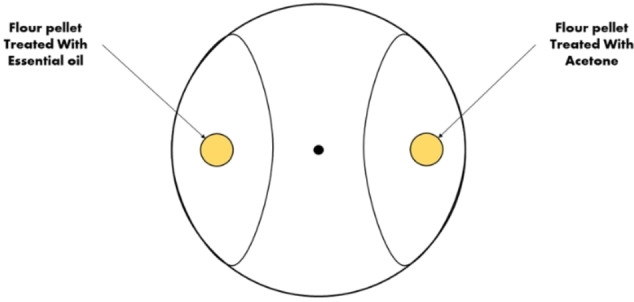
A preference test for food treated with essential oils for Larvae/adults of T. castaneum was conducted using flour pellets prepared followingref. cbdv202402043-bib-0041 and following the protocol by Rharrabe et al.[44]. with some modifications as illustrated in Figure 7. Two pellets were separately treated, one with 10 uL of the three concentrations used in the antifeedant test (0.5, 1, and 2 %) giving final concentrations of 0.05, 0.1, and 0.2 μL/pellet and the second with acetone. The two pellets were then left for 20 minutes at room temperature to allow the evaporation of the solvent and then deposited separately in the middle of the two zones. Test and control areas have been marked in each petri dish. The number of individuals in each area was counted every 5 minutes for 30 minutes. The preference index (IP) was calculated from the distribution of individuals in each area using the following formula previously described.
Nt =Number of larvae/adults observed in the control area,
Nc =Number of larvae/adults observed in the test area.

When the PI value is positive, individuals are attracted to the food treated. However, when it is negative, individuals are repelled or express a negative preference for the food treated with the essential oil.
Each treatment was reproduced 10 times using 10 larvae/adults per petri dish. Each individual has been tested only once.
Repellency Bioassay
The repellent effect was tested according to Jilani et a.ref. cbdv202402043-bib-0045 Filter paper circles (9 cm) were cut into two halves of which one received 300 μL of each concentration (0.5, 1, and 2 %) dissolved in acetone giving a final concentration of 0,047, 0.094, and 0.189 μL/cm2 respectively. While the other half was treated with 300 μL of acetone. Next, treated and control halves were left to dry for 3 minutes and then attached edge to edge with duct tape and placed into a petri dish (9 cm in diameter). Twenty individuals (unsexed adults or larvae) were released in the middle. The number of individuals that settled on each half of the filter paper was counted after 2, and 4 h. The average count was converted to a percentage of repellent (PR) using the following formula:ref. cbdv202402043-bib-0046
Nc Number of larvae/adults counted in the control half
Nt Number of larvae/adults counted in the treated half
Five replicates were reproduced of each treatment
PR value was used to classify repellency classes from 0 to V:
Class 0: The percentage of repulsion ≤0.1 %: not repellent;
Class I: 0.1 %≤PR ≤20 %: very poorly repulsive;
Class II: 20.1 %≤PR ≤40 %: moderate repellent;
Class III: 40.1 %≤PR ≤60 %: good repellent;
Class IV: 60.1 %≤PR ≤80 %: very repellent;
Class V: 80.1 %≤PR≤100 %: perfect repellent
Statistical Analysis
All statistical analyses were conducted using IBM’s software SPSS V25.0All data were analyzed using one‐way ANOVA followed by Tukey Test as post‐hoc at a significance level of p<0.05. Two‐way ANOVA was also assessed to determine the significance between developmental stages and concentrations. Tables of statistical analysis for all bioassays are provided in supplementary materials.
Author Contributions
Houssam Annaz: Methodology, Investigation, Visualization, Data curation, Writing ‐ Original draft ‐ Hamass Zerrad: Investigation, Writing ‐ Review & Editing‐ Mouna Moullamri: Investigation, Writing ‐ Review & Editing‐ Ayoub Ajaha: Writing ‐ Review & Editing,– Ayoub Kounnoun: Writing ‐ Review & Editing, ‐ Francesco Cacciola: Validation, Writing ‐ Review Editing ‐ Ammar B. Altemimi: Writing ‐ Review Editing ‐ Roberto Laganà Vinci : Writing ‐ Review Editing‐ Abdelhay Arakrak: Validation ‐ Writing ‐ Review Editing‐ Amin Laglaoui: Validation ‐ Writing ‐ Review Editing ‐ Noureddin Bouayad: Supervision ‐ Writing – Review Editing ‐ Kacem Rharrabe: Conceptualization – Project Administration ‐ Validation ‐ Supervision ‐ Writing ‐ Review Editing
Conflict of Interests
The authors declare no conflict of interest.
References
- 1 A. R. Gerken , J. F. Campbell , Ann. Entomol. Soc. Am. 2022, 115, 239–252.
- 2 C. Adler , C. Athanassiou , M. O. Carvalho , M. Emekci , S. Gvozdenac , D. Hamel , J. Riudavets , V. Stejskal , S. Trdan , P. Trematerra , J Stored Prod. Res. 2022, 97, 101977.
- 3 S. Zhang , S. Han , L. Xiong , Y. Hou , X. Gao , X. Tang , Nongye Gongcheng Xuebao/Transactions of the Chinese Society of Agricultural Engineering 2022, 38, 303–309.
- 4 R. Khatun , W. Islam , K. A. M. S. H. Mondal , J Biosci. (Rajshari) 2010, 18, 84–87.
- 5 F. H. Arthur , J Stored Prod. Res. 2018, 76, 151–160.
- 6N. Subekti, R. Saputri, AIP Conf. Proc. 2019, 2155.
- 7 S. G. Gautam , G. P. Opit , E. Hosoda , J Econ. Entomol. 2016, 109, 2525–2533.27744283
- 8 Y. Geng , J. Ma , R. Zhou , R. Jia , C. Li , X. Ma , Pest Manag. Sci. 2017, 73, 2063–2070.28296068
- 9 C. Zhang , X. Yi , C. Chen , D. Tian , H. Liu , L. Xie , X. Zhu , M. Huang , G. G. Ying , Environ. Int. 2020, 139, 105719.32283356
- 10 M. B. Isman , Annu. Rev. Entomol. 2020, 65, 233–249.31594414
- 11 D. F. Borges , E. A. Lopes , A. R. Fialho Moraes , M. S. Soares , L. E. Visôtto , C. R. Oliveira , V. M. Moreira Valente , Crop Protection 2018, 110, 135–140.
- 12 M. M. Cascaes , G. M. S. P. Guilhon , E. H. de Aguiar Andrade , Int. J Mol. Sci. 2015, 16, 23881–23904.26473832
- 13 M. Afrokh , S. Tahrouch , Chem. Data Collect. 2023, 43, 100984.
- 14 E. San Miguel , Econ. Bot. 2003, 57, 231–244.
- 15 O. Hnatyszyn , P. Arenas , A. R. Moreno , R. Rondina , J. D. Coussio , Rev. Soc. Parag. 1974, 14, 23–57.
- 16 C. C. Chen , Y. L. Huang , F. I. Huang , C. W. Wang , J. C. Ou , J. Nat. Prod. 2001, 64, 990–992.11473445
- 17 V. Hammiche , K. Maiza , J. Ethnopharmacol. 2006, 105, 358–367.16414225
- 18 A. Drioiche , S. Amine , J. Essential Oil-Bearing Plants 2020, 23, 902–917.
- 19 G. L. B. Castagnino , Pesqui. Agropecu. Bras. 2012, 47, 738–744.
- 20 S. Wang , S. C. Li , F. S. Cheng , T. Ren , D. H. Fan-Li , Chem. Biodivers. 2022, 19, e202200351.36053146
- 21 L. Nahar , H. R. El-Seedi , S. A. M. Khalifa , M. Mohammadhosseini , S. D. Sarker , Molecules 2021, 26, 4766.34443352
- 22 H. Zerrad , H. Bakrim , M. Moullamri , M. Bakkali , F. Alibrando , F. Cacciola , M. Mondello , P. Dugo , L. Mondello , A. Arakrak , A. Laglaoui , Oil Res. 2024, 36, 173–184.
- 23 F. Haddouchi , T. M. Chaouche , Y. Zaouali , R. Ksouri , A. Attou , A. Benmansour , Chem. 2013, 141, 253–258.
- 24 J. M. Deguenon , J. Zhu , S. Denning , M. H. Reiskind , D. W. Watson , R. Michael Roe , J Med. Entomol. 2019, 56, 1704–1714.31237324
- 25 Ľ. Cagáň , M. Apacsová Fusková , D. Hlávková , O. Skoková Habuštová , Plants 2022, 11, 3077.36432806
- 26 N. Ntalli , A. Skourti , E. P. Nika , M. C. Boukouvala , N. G. Kavallieratos , Environ. Sci. Poll. Res. 2021, 28, 42763–42775.
- 27M. Najem, M. Bammou, L. Bachiri, E. H. Bouiamrine, J. Ibijbijen, L. Nassiri, Evidence-based Complementary and Alternative Medicine 2020, 1, 5739786.
- 28 S. B. Chaaban , S. H. Hamdi , K. Mahjoubi , J. M. B. Jemâa , J. Plant Diseases Protec. 2019, 126, 237–246.
- 29 N. G. Kavallieratos , E. P. Nika , A. Skourti , N. Ntalli , M. C. Boukouvala , C. T. Ntalaka , F. Maggi , R. Rakotosaona , M. Cespi , D. R. Perinelli , A. Canale , G. Bonacucina , G. Benelli , Molecules 2021, 26, 1812.33806970
- 30Z. Hou, X. Wang, H. Wu, Y. An, J. Zhang, J. Wang, J. Liang, Journal of the Chin. Cereals Oils Assoc. 2022, 37, 7–12.
- 31 S. Ikawati , T. Himawan , A. L. Abadi , H. Tarno , Biodiversitas 2020, 21, 4301–4308.
- 32 A. Plata-Rueda , J. C. Zanuncio , J. E. Serrão , L. C. Martínez , Plants 2021, 10, 2513.34834876
- 33 B. A. Ayil-Gutiérrez , J. M. Villegas-Mendoza , Z. Santes-Hernández , A. D. Paz-González , M. Mireles-Martínez , N. M. Rosas-García , G. Rivera , Nat. Prod. Commun. 2015, 10, 1955–1958.26749835
- 34 J. Lazarević , I. Kostić , D. Šešlija Jovanović , D. Ćalić , S. Milanović , M. Kostić , Plants 2022, 11, 3587.36559699
- 35 M. Fusková , Ľ. Cagáň , J. Central Euro. Agri. 2021, 22, 443–449.
- 36 J. Tampe , L. Parra , K. Huaiquil , A. Quiroz , J Soil Sci Plant Nutr 2016, 16, 48–59.
- 37 A. G. W. U. Perera , M. M. S. C. Karunaratne , S. D. M. Chinthaka , Res 2022, 97, 101976.
- 38 S. Gao , M. Guo , Y. Yin , X. Zhang , Y. Zhang , K. Zhang , Science 2023, 58, 355–369.
- 39 A. La Pergola , C. Restuccia , E. Napoli , S. Bella , S. Brighina , A. Russo , P. Suma , J. Essential Oil Res. 2017, 29, 451–460.
- 40 Y. Huang , S. L. Lam , S. H. Ho , J Stored Prod Res 2000, 36, 107–117.
- 41Y. S. Xie, R. P. Bodnaryk, P. G. Fields, Canadian Entomologist 1996, 128, 865–875.
- 42 R. R. Farrar , J. D. Barbour , G. G. Kennedy , Ann. Entomol. Soc. Am 1989, 82, 593–598.
- 43 S. Manuwoto , J. Mark Scriber , J Econ Entomol 1982, 75, 163–167.
- 44 K. Rharrabe , E. Jacquin-Joly , F. Marion-Poll , Ecol Evol 2014, 2, 5.
- 45 G. Jilani , R. C. Saxena , J Econ Entomol. 1990, 83, 629–634.
- 46L. L. McDonald, R. H. Guy, R. D. Speirs,‘,Preliminary Evaluation of New Candidate Materials as Toxicants, Repellents, and Attractants against Stored-Product Insects, US Agricultural Research Service, 1970. (No. 882).